As we all know, music video of the day has always been and always will be Val’s baby. Starting with If You Don’t Know Me By Nowin June of 2016, Val has shared and analyzed over 300 music videos! It’s become one of my favorite of our regular features here on the Shattered Lens.
As most of you know, for health reasons, Val is taking a temporary break from this feature. Until Val comes back, I figured that I might occasionally share a video or two. Admittedly, I do not have Val’s encyclopedic knowledge of music (and I should admit that my musical taste pretty much begins and ends with EDM) but what Val and I do share is a deep appreciation for a little Canadian show called Degrassi.
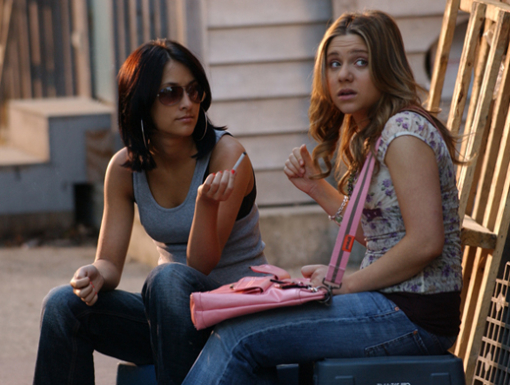
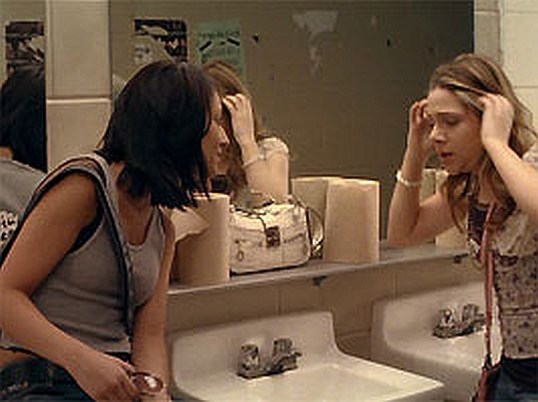
See, it was that love of Degrassi that led me to the video below. Earlier tonight, I was rewatching Death of a Disco Dancer, the third episode of Degrassi’s fifth season. In this episode, Paige is upset that her friend, co-worker, and classmate, Alex, doesn’t seem to care about going to college. When Degrassi hosts a college fair, Paige attempts to entice Alex to attend by offering her a joint.
“Will you go if you’re high?” Paige asks.
“I’ll go if you’re high,” Alex answers.
The two of them duck into an alley and light up the joint. What follows is perhaps the best three minute montage in the history of Degrassi as a very stoned Paige and Alex walk through the fair, giggling at all the Canadian college recruiters. It’s all good fun until Paige discovers that a friend of her mother’s is at the fair. Uh-oh!
Anyway, I’ve always loved the song that plays during the montage. It’s called Upfront With You and it’s performed by a Canadian band called Universal Honey. After watching the episode tonight, I looked the song up on YouTube and that’s when I came across the video that was made for it in 1996.
Now, despite doing a handful of Google searches, I can’t tell you who directed or worked on this video. I can tell you that Universal Honey has been around since 1992 and the band is made up of Leslie Stanwyck and Johnny Sinclair. (Before Universal Honey, they were both in a band called The Pursuit of Happiness.) Up Front With You is off of their first album, Magic Basement.
Not surprisingly, this is a Canadian band. One of the great things about Degrassi is that it exposed me to a lot of Canadian bands that I, as an American, might otherwise have never heard of.
After I watched Deadly Sorority, I watched the second Lifetime premiere of the night, Running Away!
Why Was I Watching It?
I nearly missed Running Away, which would have been a shame. After being disappointed with Deadly Sorority, I was seriously tempted to go down to my neighbor’s 3-day Cinco de Mayo party. But, somehow, my cinematic instincts knew that I should take the time to watch Running Away. I’m glad that I did because Running Away is one of the best Lifetime films of the years so far.
What Was it About?
Peg (Paula Tricky) is a single mother, struggling to raise two rebellious daughters even as the bank attempts to take her home away from her. However, salvation comes in the form of Richard (William McNamara). Richard is never quite clear about what he does for a living but he’s rich. He has a great (and big) house. He drives a red sports car and has no problem about honking the horn at people crossing the street and shouting, “Yeah, you better be watching!” He’s more than a little creepy but he appears to worship the ground that Peg walks on. Add to that, when he asks her to marry him, he gives her a really nice ring.
After the wedding, Peg’s two daughters have differing reactions to Richard. The youngest, Lizzie (Madison Lee Brown), loves their new home and decides that Richard isn’t as bad or as creepy as he originally seemed. Maggie (Holly Deveaux) knows that Richard is a creepy perv, the type who walks in on her when she’s in the shower and who, when he discovers that she’s been drinking beer, uses the knowledge for sexual blackmail. Being molested and abused by her stepfather, Maggie resorts first to self-harm and then to running away.
Maggie finds herself living with a drug dealer and his traumatized girlfriend. Both Richard and Peg are searching for her but both have different plans for what to do when they find her.
What Worked?
I know that the plot probably sounds extremely melodramatic and, in a way, I guess it was. But, that’s okay. This is a film that used melodrama to make a very real and important point about the consequences of abuse. This a very well-done and very heartfelt film.
It took me a while to recognize William McNamara, who gives an all-too realistic performance as the monstrous Richard. When we first meet Richard, the film wisely plays up his dorkiness. We know he’s a bad guy but we’re still shocked by just how bad and dangerous he ultimately turns out to be. Paula Trickey also does a good as Peg, portraying her with a combination of regret, disillusionment, and, as the same time, a cautious hope for the future. However, the film really belongs to Holly Deveaux, who gives an empathetic and compelling performance of Maggie, one that reveals both her pain and her inner strength.
What Did Not Work?
I have to admit that, towards the end of the film, I kind of rolled my eyes when one final secret about Richard was revealed. At that point, he was already such a bad guy that revealing the reason why he was so rich felt like overkill. Other than that, though, I would say that the entire films worked.
“Oh my God! Just like me!” Moments
As someone who was an angry, rebellious, and often self-destructive teenager, I related to Maggie. Holly Deveaux’s performance captured all of the emotions. Though the whole movie, I was cringing as I had flashbacks to all the times that I was tempted to get on a bus and go wherever it took me.
(Seriously, for about a year and a half, I had this ludicrously romanticized fantasy about getting on a bus, traveling to random towns, and spending a year filling up my notebooks with my thoughts on America. After I talked about it one too many times, my sister Megan drove me down to the Greyhound station in downtown Dallas and we spent an hour watching people get on and off buses. The sights and the smells — well, mostly the smells — of actual bus living pretty much ended that fantasy.)
Lessons Learned
You can’t run away from your problems but you can beat them over the head with a baseball bat.
Last night, I watched the latest Lifetime original film, Deadly Sorority!
Why Was I Watching It?
You have to give the people at Lifetime some credit. I often give them a hard time for the way that they retitle movies to give them more of a “Lifetime-y” feel but Deadly Sorority is a perfect title. According to the imdb, this movie was originally called Undergrad Nightmare. Deadly Sorority is such an improvement that I don’t even know where to begin. It was enough to convince me to watch.
(Of course, I would have watched anyway because the movie was on Lifetime but, for the purpose of this review format, let’s pretend like the title was the sole reason.)
What Was It About?
Sam (Greer Grammer) and Kris (Emilija Branac) have been BFFs since high school but, once they arrive at Barclay University, things start to change. Kris gets accepted into an exclusive sorority and soon, her new “sisters” are telling Sam to stay away. When Kris is murdered, Sam suddenly finds herself as the number one suspect. Everyone says that Sam was obsessed with Kris and jealous over her new friends.
In order to prove her innocence, Sam is going to have to catch the real murderer. Was it Kris’s frat boy boyfriend? Was it the lecherous professor or his wife? Was it the creepy guy who lives upstairs from her? Was it one of Kris’s sorority sisters? Was it … well, actually, that’s all the suspects. It’s a small school.
What Worked?
I absolutely loved Barclay University, which was located up in the mountains, had nice, big dorm rooms (during my first year of college, I lived in a dorm that didn’t even have air conditioning), and — as far as I could tell — only three or four professors. There weren’t many students either. Sam and Kris’s history class only had about 12 students in it. As someone who hated the anonymous feeling of being one of many students in a gigantic lecture hall, I appreciated that.
The sorority was effectively creepy. However…
What Did Not Work?
…the sorority itself really didn’t figure much into the plot. There were a few effective scenes of all of the sisters staring at Sam dismissively but otherwise, the sorority was just a big, pink-clad red herring. Deadly Sorority is a great title but Undergrad Nightmare was actually a more accurate title. Usually, I don’t mind a misleading title but, when you promise a deadly sorority, you need to deliver.
The identity of the murderer also felt a bit random to me.
“Oh my God! Just like me!” Moments
I related to Sam, who had a wonderfully snarky attitude and said whatever was on her mind. Unlike Sam, I was actually invited to join a sorority but I turned them down because I was busy being a nonconformist. I kind of regret that choice because, according to what I’ve seen on Lifetime, joining a sorority would have led to several years of adventure and melodrama. At the very least, I would have had a few hundred more closets to borrow from.
80 years ago, on May 6th, 1937, the Hindenburg, a German airship, exploded in the air over New Jersey. The disaster was not only covered live by radio reporter Herbert Morrison (whose cry of “Oh the humanity!” continues to be parodied to this day) but it was also one of the first disasters to be recorded on film. Looking at the footage of the Hindenburg exploding into flame and sinking to the ground, a mere skeleton of what it once was, it’s hard to believe that only 36 people died in the disaster. The majority of those who died were crew members, most of whom lost their lives while helping passengers off of the airship. (Fortunately, the Hindenburg was close enough to the ground that many of the passengers were able to escape by simply jumping.)
Not surprisingly, there was a lot of speculation about what led to the Hindenburg (which has successfully completed 63 flights before the disaster) exploding. The most commonly accepted explanation was that it was simply an act of God, the result of either lightning or improperly stored helium. Apparently, there was no official evidence found to suggest that sabotage was involved but, even back in 1937, people loved conspiracy theories.
And really, it’s not totally implausible to think that the Hindenburg was sabotaged. The Hindenburg was making its first trans-Atlantic flight and it was viewed as being a symbol of Nazi Germany. One of the ship’s passengers, Captain Ernest Lehman, was coming to the U.S. in order to lobby Congress to give Germany helium for their airships. With Hitler regularly bragging about the superiority of German industry, the theory was that an anti-Nazi crewman or passengers planted a bomb on the Hindenburg. Since no individual or group ever stepped forward to claim responsibility, the theory continues that the saboteur must have perished in the disaster.
At the very least, that’s the theory put forward by a film that I watched earlier today, the 1975 disaster movie, The Hindenburg.
A mix of historical speculation and disaster film melodrama, The Hindenburg stars George C. Scott as Col. Franz Ritter, a veteran of the German air force who is assigned to travel on the Hindenburg and protect it from saboteurs. Ritter is a Nazi but, the film argues, he’s a reluctant and disillusioned Nazi. Just a few weeks before the launch of the airship, his teenage son was killed while vandalizing a synagogue. Ritter is a patriot who no longer recognizes his country and George C. Scott actually does a pretty good job portraying him. (You do have to wonder why a seasoned veteran of the German air force would have a gruff, slightly mid-Atlantic accent but oh well. It’s a 70s disaster film. These things happen.)
Ritter is assigned to work with Martin Vogel (Roy Thinnes), a member of the Gestapo who is working undercover as the Hindenburg’s photographer. Tt soon becomes obvious that he is as much a fanatic as Ritter is reluctant. Vogel is a sadist, convinced that every Jewish passenger is secretly a saboteur. Thinnes is chilling in the role. What makes him especially frightening is not just his prejudice but his casual assumption that everyone feels the same way that he does.
And yet, as good as Scott and Thinnes are, the rest of the cast is rather disappointing. The Hindenburg features a large ensemble of actors, all playing characters who are dealing with their own privates dramas while hoping not to burn to death during the final 15 minutes of the film. Unfortunately, even by the standards of a typical 70s disaster film, the passengers are thinly drawn. I liked Burgess Meredith and Rene Auberjonois as two con artists but that was mostly because Meredith and Auberjonois are so charming that they’re fun to watch even if they don’t have anything to do. Anne Bancroft has one or two good scenes as a German baroness and Robert Clary does well as a vaudeville performer who comes under suspicion because of his anti-Nazi leanings. Otherwise, the passengers are forgettable. Whether they die in the inferno and manage to make it to the ground, your main reaction will probably be to look at them and say, “Who was that again?”
Anyway, despite all of Ritter and Vogel’s sleuthing, it’s not much of mystery because it’s pretty easy to figure out that the saboteur is a crewman named Boerth (William Atherton). Having seen Real Genius, Die Hard and the original Ghostbusters, I found it odd to see William Atherton playing a sympathetic character. Atherton did okay in the role but his attempt at a German accent mostly served to remind me that absolutely no one else in the film was trying to sound German.
Anyway, the main problem with The Hindenburg is that it takes forever for the airship to actually explode. The film tries to create some suspense over whether Ritter will keep the bomb from exploding but we already know that he’s not going to. (Let’s be honest. If you didn’t already know about the Hindenburg disaster, you probably wouldn’t be watching the movie in the first place.) The film probably would have worked better if it had started with the Hindenburg exploding and then had an investigator working backwards, trying to figure out who the saboteur was.
However, the scenes of the explosion almost make up for everything that came before. When that bomb goes off, the entire film suddenly switches to black-and-white. That may sound like a cheap or even sensationalistic trick but it actually works quite well. It also allows the scenes of passengers and crewmen trying to escape to be seamlessly integrated with actual footage of the Hindenburg bursting into flame and crashing to the ground. The real-life footage is still shocking, especially if you’re scared of fire. Watching the real-life inferno, I was again shocked to realize that only 36 people died in the disaster.
In the end, The Hindenburg is flawed but watchable. George C. Scott was always at his most watchable when playing a character disappointed with humanity and the real-life footage of the Hindenburg disaster is morbidly fascinating.
(I know this is a boring poster but it’s literally one of the few Giallo in Venice graphics that I can post without running the risk of getting the site in trouble.)
So, I finally saw the infamous (and, in many countries, banned) 1979 film, Giallo in Venice.
Back when I first decided to learn about the history of Italian horror, Giallo in Venice was a title that I frequently came across in the course of my research. Everyone — and I do mean everyone — seemed to agree on three points: 1) it was one of the most graphic and mean-spirited Italian thrillers of all time, 2) it had never been released on DVD or Blu-ray in the United States and, as such, it was not the easiest film to see, and 3) the film was really, really bad.
Now, I have to admit that I probably wouldn’t have had any desire to see Giallo in Venice if not for the fact that I repeatedly read that it would be next to impossible for me to do so. I hate being told what I can and cannot do. Don’t get me wrong. Everything that I read about Giallo in Venice was overwhelmingly negative. Critics, some of whom I actually respected, were nearly unanimous in their dismissal of the film. Unlike my hope that I’ll someday see fully restored versions of Greed and London After Midnight, seeing Giallo in Venice was never a number one priority for me. Instead, it was just something that I kept in the back of my mind. If I ever had a chance to watch Giallo in Venice, I told myself, I would just so I could say that I had seen it.
Last week,I got that chance. I discovered that Giallo in Venice had not only been uploaded on YouTube but it was also the uncut version. (I’m not going to include a link because of the film’s graphic content. I don’t want to get either this site or the people who uploaded the video in trouble. If you go to YouTube and search for “Giallo in Venice,” it should be one of the first videos to come up.) The only problem was that, along with being copied from a faded VHS tape, it was the Russian language version. Basically, whenever any of the film’s characters spoke, you would first hear the line in the original Italian and then a rather angry man would shout the same the line in Russian. Unfortunately, I know very little Italian and absolutely no Russian.
Needless to say, this led to a rather odd viewing experience. If Giallo in Venice had been directed by a visual stylist like Lucio Fulci, Dario Argento, Mario Bava, or even Ruggero Deodato, it might not have been a problem. Those four directors are all rightly renowned for their ability to create mood and atmosphere. (And, for that matter, the best giallo films are often more concerned with visuals than dialogue.) Unfortunately, Giallo in Venice was directed by Mario Landi, an veteran television director whose style can best be described as “turn on the camera at the start of the scene, turn it off at the end.”
(Landi also directed Patrick Still Lives, which is a smidgen more interesting than Giallo in Venice.)
As for the film’s plot — well, it’s hard for me to say for sure. Not to overemphasize this point but, quite literally, I COULD NOT UNDERSTAND A WORD THAT ANYONE WAS SAYING.
The film opens in Venice, with a man being stabbed to death while a woman drowns in a canal. Inspector De Paul (Jeff Blynn) is assigned to solve the murders. He has poofy hair that wouldn’t be out of place in a stage production of Boogie Nights and, for some reason, Inspector De Paul is constantly eating hard-boiled eggs. In just about every scene in which he appears, he is eating an egg. Though it was hard to judge his overall performance (though the Russian seemed to enjoy repeating De Paul’s dialogue), Jeff Blynn really got into eating those eggs. It got rather sickening to watch after a while. As far as I could tell, De Paul’s investigation amounted to talking to one witness and then talking to the dead woman’s roommate.
The roommate, incidentally, is played by Mariangela Giordano, who also appeared in Patrick Still Lives, Burial Ground, and Michele Soavi’s The Sect. Any fan of Italian horror will not only recognize Giordano but will also immediately know that her Giallo in Venice character is destined meet an unlucky end. Patrick Still Lives, Burial Ground, and Giallo in Venice were all produced by Giordano’s then-boyfriend and, in all three films, she played a character who was graphically and gruesomely killed onscreen. In Patrick Still Lives, she was skewered by a fireplace poker. In Burial Ground, she made the mistake of trying to breastfeed her zombiefied son. And in Giallo in Venice, one of her legs is slowly sawed off. Seriously, if my boyfriend insisted that I suffer a terrible death in every film that he produced, it would probably be an issue. Just saying.
Anyway, while Inspector De Paul is investigating the murder, this young couple keeps popping up. They’re young, rich, and fifty shades of fucked up. Fabio (Gianni Dei) has apparently been rendered impotent by all the cocaine that he’s been snorting and the only way he can get off is by forcing Flavia (Leonara Favi) to play out all of his kinky fantasies. I found myself wondering why the film kept switching back and forth, between the not-quite-loving couple and the murder investigation. Was Fabio the murderer? Then, suddenly, I realized that Fabio and Flavia were the same couple who were murdered at the start of the film. The Fabio and Flavia scenes were flashbacks. I’m assuming that my confusion was due to the Russian dialogue but it says something about Landi’s visual style that it was impossible to tell, just from watching, that the Flavia/Fabio scenes were meant to be flashbacks.
(As far as I can — and again, dialogue problems — the flashbacks weren’t triggered by anyone saying, “I remember one time…” or anything like that. Add to that, most of the flashbacks only featured Fabio and Flavia so, logically, there’s no way anyone could have been telling Inspector De Paul what happened. Instead, the flashbacks just felt like random scenes that were sprinkled in between the violence and the eating.)
Giallo in Venice is a mix of egg eating, sex, and sadism. The graphic murders are probably what Giallo in Venice is best known for, though I have to admit that I found the constant egg eating to be almost as disgusting. As for the film’s gore, it was just as graphic and extreme as I had previously read. But, with the exception of what happens to poor Mariangela Giordano, the violence has no impact on the viewer. Since Landi directs with no discernible style, there’s nothing behind the murders beyond the fact that, when you title a movie Giallo in Venice, you’re obligated to include a few deaths. It’s violence for the sake of violence and therefore, rather boring. Admittedly, I’m sure it was rather shocking in 1979 but, today, audiences are more used to that sort of thing. After all, everyone’s seen that tutorial on how to be a zombie for Halloween.
While watching Giallo in Venice, it was hard not to compare it to Lucio Fulci’s The New York Ripper. Both films are deeply unpleasant but, due to Fulci’s energetic and, at times, subversive direction, there’s at least always something going on underneath the blood-drenched surface of The New York Ripper. You can debate whether or not he succeeded but it can’t be denied that Fulci was going for something more than just sadism when he made The New York Ripper. (If you doubt me, read Stephen Thrower’s analysis in Beyond Terror: The Films of Lucio Fulci.) Landi’s style, in Giallo in Venice, is so flat that there’s not only nothing going on underneath but the surface itself seems to be pretty barren too.
To give credit where credit is due, I did appreciate just how ugly Landi managed to make Venice look. I’ve been to Venice and I absolutely love it. I would never believe that a director could make Venice look like a dump but Mario Landi managed to do it. I don’t know if that was intentional on his part but it actually worked for the film. Since all of the characters actually lived in Venice, it made sense that they wouldn’t be standing around and admiring the city’s natural beauty. Instead, they all live and operate in the parts of Venice that tourists don’t see.
Finally, Landi did manage to get one interesting shot, when the reflection of one of the victims is seen in the killer’s sunglasses. Unfortunately, Landi was so impressed by that shot that he kept using it over and over again until, eventually, it became far less interesting.
One final note: Giallo in Venice had a very odd score. It sounded like it was being played by a cocktail lounge jazz quartet. The music, itself, was actually rather boring but it was so totally out-of-place that it became oddly charming. I found myself craving a drink with a little umbrella in it.
Anyway, that’s Giallo in Venice. It’s not good, it’s not memorable, but at least I can now say that I’ve seen it.
— Phillip Jeffries (David Bowie) in Twin Peaks: Fire Walk With Me (1992)
Even among fans of the show, Twin Peaks: Fire Walk With Me is controversial.
If you read Reflections: An Oral History of Twin Peaks, you’ll discover that many members of the television show’s cast either didn’t want to be involved in the film or didn’t care much for it when it came out. Fearful of being typecast, Kyle MacLachlan only agreed to play Dale Cooper on the condition that his role be greatly reduced. (Was it that fear of being typecast as clean-cut Dale Cooper that led to MacLachlan later appearing in films like Showgirls?) Neither Lara Flynn Boyle nor Sherilyn Fenn could work the film into their schedules.
When Twin Peaks: Fire Walk With Me premiered at Cannes, it was reportedly booed by the same critics who previously applauded Lynch’s Wild at Heart and who, years later, would again applaud Mulholland Drive. When it was released in the United States, the film was savaged by critics and a notorious box office flop. Quentin Tarantino, previously a fan of Lynch’s, has been very outspoken about his hatred of Twin Peaks: Fire Walk With Me. When I first told people that we would be looking back at Twin Peaks for this site, quite a few replied with, “Even the movie?”
And yet, there are many people, like me, who consider Twin Peaks: Fire Walk With Me to be one of David Lynch’s most haunting films.
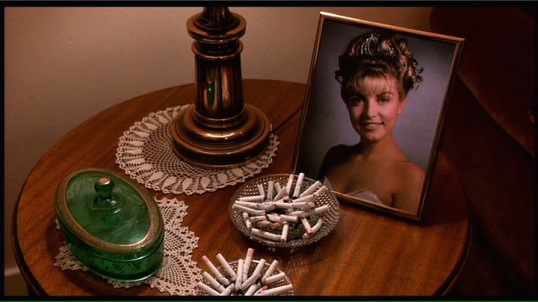
It’s also one of his most straight forward. Twin Peaks: Fire Walk With Me is a prequel, dealing with the events leading up to the death of Laura Palmer. Going into the film, the viewer already knows that Laura Palmer (Sheryl Lee) is full of secrets. They know that she is using drugs. They know that she is dating Bobby (Dana Ashbrook), while secretly seeing James (James Marshall). They know about her diary and her relationship with the reclusive Harold (Lenny Von Dohlen). They know that she is a friend to innocent Donna Hayward (Moria Kelly, somewhat awkwardly taking the place of Lara Flynn Boyle). Even more importantly, they know that she has spent the last six years of her life being abused by BOB (Frank Silva) and that BOB is her father, Leland Palmer (Ray Wise). The viewer starts the story knowing how it is going to end.
Things do get off to a somewhat shaky start with a nearly 20-minute prologue that basically plays like a prequel to the prequel. Theresa Banks, who was mentioned in the show’s pilot, has been murdered and FBI director Gordon Cole (David Lynch) assigns agents Chester Desmond (Chris Isaak) and Sam Stanley (Kiefer Sutherland) to investigate. Chester and Sam’s investigation basically amounts to a quick reenactment of the first season of Twin Peaks, with the agents discovering that Theresa was involved in drugs and prostitution. When Chester vanishes, Dale Cooper is sent to investigate. Harry Dean Stanton shows up as the manager of a trailer park and David Bowie has an odd cameo as a Southern-accented FBI agent who has just returned from the Black Lodge but otherwise, the start of the film almost feels like a satire of Lynch’s style.
But then, finally, we hear the familiar theme music and the “Welcome to Twin Peaks” sign appears.
“And the angel’s wouldn’t help you. Because they’ve all gone away.”
— Laura Palmer (Sheryl Lee), Twin Peaks: Fire Walk With Me (1992)
A year has passed since Theresa Banks was murdered. The rest of the film deals with the final few days of the life of doomed homecoming queen Laura Palmer. Laura smiles in public but cries in private. She is full of secrets that she feels that she has to hide from a town that has literally idolized her. She has visions of terrifying men creeping through her life and each day, she doesn’t know whether it will be BOB or her father waiting for her at home. She knows that the world considers her to be beautiful but she also know that, within human nature, there is a desire to both conquer and destroy beauty. When she sleeps, she has disturbing dreams that she cannot understand but that she knows are important. At a time when everyone says she should be happy to alive, all she can think about is death. Everywhere she goes, the male gaze follows and everything that should be liberating just feels her leaving more trapped. For all the complaints that Twin Peaks: Fire Walk With Me is somehow too strange to be understood, it’s not a strange film at all. This is David Lynch at his most straight forward. Anyone who thinks that Laura’s story is incomprehensible has never been a 17 year-old girl.
This is the bleakest of all of David Lynch’s films. There is none of broad humor or intentional camp that distinguished the TV show. After the show’s occasionally cartoonish second season, the film served as a trip into the heart of the darkness that was always beating right underneath the surface of Twin Peaks. It’s interesting how few of the show’s regulars actually show up in Twin Peaks: Fire Walk With Me. None of the characters who represented goodness are present. There’s no Doc Hayward. No Sheriff Truman. No Deputies Andy or Hawk. No Pete Martell. No Bookhouse Boys. Scenes were filmed for some of them but they didn’t make it into the final cut because their tone did not fit with the story that Lynch was seeking to tell. The Hornes, Dr. Jacoby, Josie, none of them are present either.
Instead, there’s just Larua and her father. As much as they try to deny it, Laura knows that she is going to die and Leland knows that he is going to kill her. Killer BOB and the denziens of the Black Lodge may be scary but what’s truly terrifying is the sight of a girl living in fear of her own father. Is Leland possessed by BOB or is BOB simply his way of excusing his own actions? If not for Leland’s sickness, would BOB even exist? When Laura shouts, “Who are you!?” at the spirit of BOB, she speaks for every victim of abuse who is still struggling to understand why it happened. For all the talk of the Black Lodge and all the surreal moments, the horror of this film is very much the horror of reality. Leland’s abuse of Laura is not terrifying because Leland is possessed by BOB. It’s terrifying because Leland is her father
David Lynch directs the film as if it where a living nightmare. This is especially evident in scenes like the one where, at the dinner table, Leland switches from being kindly to abusive while Laura recoils in fear and her mother (Grace Zabriskie) begs Leland to stop. It’s a hard scene to watch and yet, it’s a scene that is so brilliantly acted and directed that you can’t look away. As brilliant as Ray Wise and Grace Zabriskie are, it’s Sheryl Lee who (rightly) dominates the scene and the rest of the film, giving a bravely vulnerable and emotionally raw performance. In Reflections, Sheryl Lee speaks candidly about the difficulty of letting go of Laura after filming had been completed. She became Laura and gave a performance that anchors this absolutely terrifying film.
“Mr. Lynch’s taste for brain-dead grotesque has lost its novelty.”
— Janet Maslin
“It’s not the worst movie ever made; it just seems to be”
— Vincent Canby
If you need proof that critics routinely don’t know what they’re talking about, just go read some of the original reviews of Twin Peaks: Fire Walk With Me.
And yet, having just rewatched the show and now the movie, I can understand why critics and audiences were baffled by this film. This is not Twin Peaks the TV show. There is no light to be found here. There is no comic relief. (Even Bobby Briggs, who had become something of a goofy anti-hero by the time the series ended, is seen here shooting a man in the head.) There is no exit and there is no hope. In the end, the film’s only comfort comes from knowing that Laura was able to save one person before dying. It’s not easy to watch but, at the same time, it’s almost impossible to look away. The film ends on Laura’s spirit smiling and, for the first time, the smile feels real. Even if she’s now trapped in the Black Lodge, she’s still free from her father.
Since this was a prequel, it didn’t offer up any answers to the questions that were left up in the air by the show’s 2nd season finale. Fortunately, those questions will be answered (or, then again, they may not be) when the third season premieres on Showtime on May 21st.
Last night, I finally saw the latest Werner Herzog film to be released in the United States, Queen of the Desert.
Queen of the Desert has actually been around … well, I was going to say forever but actually, I first started to hear about it in 2014. It premiered (to less-than-enthusiastic reviews) at the Berlin International Film Festival in February of 2015 and was released in Germany later that same year. Originally, it was going to get a wide release in America but then IFC acquired the distribution rights and ended up sitting on it for two years. (During that time, Herzog went on to direct another film, Salt and Fire.) Only last month did Queen of the Desert finally get a very limited theatrical and VOD release here in the United States.
Despite all of the bad things that I had heard, I was still looking forward to seeing Queen of the Desert. Why not? Werner Herzog is one of my favorite directors. The star of Queen of the Desert, Nicole Kidman, is one of my favorite actresses. Of course, there was also the Franco factor. I knew that Queen of the Desert featured James Franco in a small role and, if you’ve been reading this site for a while, y’all know how I feel about James Franco.
Having now watched it, I can say that Queen of the Desert is not the disaster that so many have been insisting. That doesn’t mean that it’s a great film or even a good film. It’s a very middle-of-the-road film, one that is too well-made to really be a disaster but, at the same time, is never as memorable as it should be.
Queen of the Desert tells the story of Gertrude Bell (Nicole Kidman), who abandoned a safely comfortable but restrictive life in turn-of-the-century Britain so that she could explore the world. In the film, Gertrude falls in love twice and, following the unhappy (and tragic) conclusions of those affairs, she always returns to the Middle East, where surviving the harshness of the desert and exploring the ruins of past civilizations brings her peace and gives her life a greater meaning.
That’s a theme that should be familiar to anyone who has watched any of Herzog’s documentaries or feature films. The problem is that, as told in this film, there’s no real spark to the story or to Gertrude as a character. Herzog’s best work has often dealt with people driven to the point of madness by their obsessions. Think about Nicolas Cage in Bad Lieutenant: Port of Call New Orleans. Think about Timothy Treadwell, obsessively living with the grizzlies until one them ate him in Grizzly Man. Consider the introverted eccentrics who explored The Cave of Forgotten Dreams or even Christian Bale’s refusal to allow himself to be broken in the POW film, Rescue Dawn. Think about Klaus Kinski in just about every film he ever made with Herzog. For that matter, just think about Werner Herzog himself is Les Blank’s documentary, The Burden of Dreams. Nicole Kidman would seem like an ideal choice for Gertrude and she does a good job with the role but, as written, Gertrude never has that touch of madness. Unlike Aguirre, she’s not looking to conquer nature. Unlike Fitzcarraldo, she’s not trying to bring “civilization” to the isolated spot in the world. Unlike Timothy Treadwell, she’s not even trying to literally become one with nature. Instead, she’s just someone who deals with heartache by going on a trip. I do that every time I spend the weekend up at Lake Texoma.
(The real-life Gertrude Bell died, under somewhat mysterious circumstances, of an overdose of sleeping pills. Whether it was suicide or an accidental overdose is not known. In the film, the circumstances of her death — which seem very Herzogian, to be honest — are glossed over by an end title card that simply informs us that she died in 1926.)
As I said earlier, Queen of the Desert is disappointing but it’s not terrible. Visually, it’s quite stunning and the scenes of the sand blowing in the desert are often a hundred times more interesting than the film’s storyline. Whenever Herzog is letting his camera focus on the desert or glide over the ruins of an ancient palace, you can understand why Herzog wanted to make this film. But, unfortunately, the film keeps returning to a story that’s about as middling as an old soap opera.
Nicole Kidman does a good job as Gertrude but she runs into the same problem that she ran into with Grace of Monaco. She’s stuck with a script that repeatedly tells us that the lead character is fascinating without ever really giving her a chance to prove it. (Before I get any angry comments, I know that Grace Kelly was fascinating and I’m sure that Gertrude Bell was too. I’m merely talking about the way that they were portrayed in their biopics.) As the men in her life, James Franco and Robert Pattinson are both ideal but Damian Lewis is a bit on the dull side.
All in all, this is not one of Werner Herzog’s best but, with all that said, I’ll still follow him anywhere that he chooses to go.
— Dale Cooper (Kyle MacLachlan) in Twin Peaks 2.22 “Beyond Life and Death”
“The Log Lady stole my truck!”
— Pete Martell (Jack Nance), same episode
“Some of your friends are here.”
— The Man From Another Place (Michael Anderson), same episode
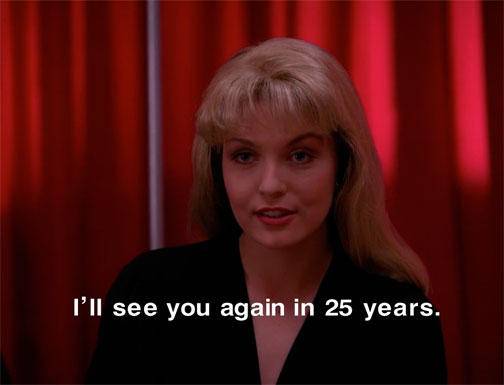
“I’ll see you again in 25 years.”
— Laura Palmer (Sheryl Lee), same episode
Here we are.
Starting exactly one month ago, we started our Twin Peaks recaps. I handled some, Leonard handled some, and Jeff handled some. Gary added a post on David Lynch’s first three short films. Val shared music videos that were either inspired by Lynch or directed by Lynch himself. Jeff devoted his Movie a Day posts to reviewing films that all had a Twin Peaks connection. As Leonard put it on twitter, projects are fun and I know we certainly had a lot of fun putting all of this together.
But, all good things must come to an end and, at least until the third season premieres on Showtime later this month, we have reached the end of Twin Peaks. Episode 30 brought the story to a temporary end. (The movie, Twin Peaks: Fire Walk With Me, was a prequel about the last days of Laura Palmer. It’s a haunting film and one that we’ll look at tomorrow but, at the same time, it doesn’t offer up any answers to any of the questions that the finale left hanging.)
A little history: Twin Peaks was a huge success during its first season but, during the second season, ratings plunged. According to the book, Reflections: An Oral History of Twin Peaks by Brad Dukes, neither David Lynch nor Mark Frost were as involved during the second season as they had been during the first. As compared to the genuinely unsettling first season, the second season struggled to find its voice. Was it a mystery? Was it a broad comedy? Was it a show about the paranormal or was it a soap opera? It was all of that and, for many people, that was too much. Today, of course, audiences are used to quirkiness. They’re used to shows that straddle several different genres. It’s no longer a revolutionary idea to be openly meta.
But in 1991, Twin Peaks was the show that ABC both didn’t know what to do with and, by the end, didn’t really want. It was regularly moved around the schedule and, often, weeks would pass without a new episode. Consider this: nearly two months passed between the airing of The Path to the Black Lodge and the final two episodes of the show. (Miss Twin Peaksand Beyond Life and Death were both aired on June 10th, 1991.)
For the final episode, David Lynch returned to direct and, though hardly anyone saw it when it originally aired, it’s an episode that left such an impression that — 25 years later — Showtime agree to bring the series back. The third season of Twin Peaks will premiere later this month but until then, let’s go ahead and recap Beyond Life and Death.
One last time, we open with Angelo Badalamenti’s beautiful theme music and those haunting shots of Twin Peaks.
We start at the sheriff’s station, with Lucy (Kimmy Robertson) and Andy (Harry Goaz) having a moment. Lucy talks about how scared she was when the lights went out and then says she found herself wondering what would happen if they were stuck in an elevator in the hospital and she went into labor. Andy replies that, if that happened, he would deliver the baby “in front of God and everyone.” Awwwww!
In Harry’s office, Cooper (Kyle MacLachlan) and Hawk (Michael Horse) stare at the cave drawing while Harry (Michael Ontkean) says that he has deputies in three counties looking for Windom Earle. Windom appears to have vanished. Cooper replies that the only hope they have of finding Windom and Annie is in the map.
“Fire walk with me,” Cooper says, softly, “Fire walk with me.”
Pete (Jack Nance) steps into the office and announces that the Log Lady stole his truck. I love the way that Jack Nance delivers the line, “The Log Lady stole my truck!” (Sadly, Nance was murdered just a few years after the end of Twin Peaks.) Pete says that, when last seen, the Log Lady was driving into Ghostwood Forest.
“Pete,” Cooper announces, “the Log Lady did not steal your truck. The Log Lady will be here in one minute.”
“12 rainbow trouts in the bed,” Pete says.
This triggers Harry’s memory. He announces that there is a circle of 12 sycamores in Ghostwood Forest. It’s called Glastonbury Grove. Hawk says that Glastonbury Grove is where he found the pages from Laura’s diary. Cooper suddenly says, “That’s the legendary burial place of King Arthur! Glastonbury!”
“King Arthur is buried in England,” Pete says, dismissively, “Last I heard anyway.”
Right on time, The Log Lady (Catherine E. Coulson) shows up at the office.
“Where’s my truck?” Pete demands.
“Pete, Windom Earle stole your truck,” Cooper says.
Pete looks very confused. Jack Nance really acted the Hell out of this scene. (Interestingly enough, Catherine Coulson was, in real life, Nance’s ex-wife.)
The Log Lady ignores Pete. She has a jar of oil that she hands to Cooper. The Log Lady says that her husband claimed that the oil was the opening to a gateway. Everyone agrees that it smells like scorched engine oil. Cooper has Hawk bring in Ronette Pulaski (Phoebe Augustine), who says that she smelled the oil the night that she was attacked and Laura Palmer was killed.
Out in the woods, a pickup truck comes to a stop in front of Glastonbury Grove. Inside the truck, Windom Earle (Kenneth Welsh) forces Annie (Heather Graham) to look at the 12 rainbow trout in back. Annie tells Windom that, if he’s going to kill her, to go ahead and get it over with. Windom says that there is plenty of time for that but, right now, he is enjoying the fear that he is feeling.
(After being portrayed in far too cartoonish a manner over the past few episodes, Windom is finally menacing again. For that matter, this is the first — and, as fate would have it, the only — episode where Heather Graham seems to be truly committed to her role as Annie. This episode directly challenges anyone who thinks that David Lynch is merely a visual artist who can’t direct actors.)
As Annie recites Psalm 141, Windom drags her through the woods. Windom shoves her into the the middle of the grove.
“I tell you, they have not died,” Windom recites, “Their hands clasp, yours and mine.”
Suddenly, in the middle of the woods, the red curtains appears. Windom leads the now zombified Annie through them.
At the Hurley House, Doc Hayward (Warren Frost) is looking over the heavily bandaged Mike (Gary Hershberger) and Nadine (Wendy Robie). Meanwhile, Ed (Everett McGill) is cheerfully talking to Norma (Peggy Lipton) by the fire place. (I like the fact that, with everything that’s going on, Ed and Norma are just happy to be together.) Just as Ed and Norma start to dance, Nadine suddenly gets her memory back and starts to shout about silent drape runners. Nadine demands that Ed make everyone go away.
At the Hayward house, Eileen (Mary Jo Deschanel) sits in her wheelchair and stares at Ben Horne (Richard Beymer). Donna (Lara Flynn Boyle) comes walking down the stairs, carrying a suitcase. Eileen begs Donna not to leave but Donna starts screaming about not knowing who her parents are. Ben steps forward and apologizes. He says he only wanted to do good. He wanted to be good. He says that it felt good to finally tell the truth.
Doc Hayward arrives home and is not happy to see Ben. Ben is begging for forgiveness when, suddenly, his own wife (Jan D’Arcy) comes walking through the front door. She demands to know what Ben is trying to do to their family.
Donna looks at Doc Hayward and starts to chant, “You’re my Daddy! You’re my Daddy!” Eileen looks away, which is a polite way of saying, “No, Ben’s your Daddy and you’ve got a half-sister that everyone likes more than you.”
Ben tries to apologize again and, after 29 episodes of never losing his temper, Doc Hayward finally snaps and punches Ben. Ben falls back and hits the back of his head on the fireplace! Oh my God! Is Ben dead!? Is Doc Hayward now evil!?
(I know the answer but I’m not going to tell you until the end of this review.)
At the Martell House, Andrew (Dan O’Herlihy) is all excited because he’s figured out that the key is the key to a safety deposit box. He steals the key from the pie plate and replaces it with a duplicate. However, Pete steps into the room just in time to see Andrew doing it.
In the woods, Cooper and Harry come across the abandoned truck. They walk into the forest but Cooper suddenly announces that he must go alone. Cooper takes Harry’s flashlight and walks through the forest. Eventually, he hears the hooting of an owl and comes across Glastonbury Grove. Cooper steps into the circle and the red curtains appear. As Harry watches from a distance, Cooper steps though the curtains.
(Though it may just be coincidence, the red curtains always make me think about the opening of Dario Argento’s Deep Red.)
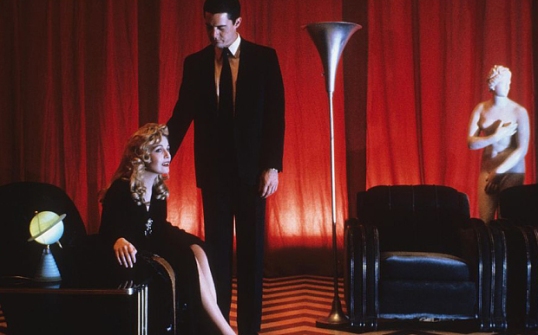
Cooper finds himself in the red curtained hallways. He walks until he reaches the room from his dreams. As the lights stobe, the Man From Another Place (Michael Anderson) dances while a lounge singer (Jimmy Scott) sings about Sycamore Trees. The Man From Another Place eventually hopes into a velvet chair. It’s deeply unsettling to watch because we know that, behind one of those curtains, BOB is lurking.
In the forest, Andy finds Harry. They sit outside of Glastonbury Grove and wait for Cooper to return.
Morning comes. We get a few final shots of the countryside around Twin Peaks. The mountains. The bridge where, 29 episodes ago, Ronette Pulaski was discovered battered and nearly catatonic. The forest. The countryside was beautiful when we first saw it but, after spending 31 hours in the world of Twin Peaks, it is now impossible to look at that wilderness without wondering what secrets are being concealed beneath the tranquil surface.
Harry and Andy are still sitting outside of Glastonbury and there is something truly touching about the sight of these two friends loyally waiting for their third friend to return. Andy volunteers to go to diner to get them breakfast. Harry says, “Yes.” Andy lists off all of the usual Twin Peaks food. Coffee. Pancakes. Desert. “Yeah,” Harry replies. When Andy finally asks if Harry wants pie, Harry falls silent. How can anyone eat pie with Cooper missing?
Meanwhile, at the bank — OH MY GOD! YOU MEAN WE’RE NOT GOING TO THE BLACK LODGE TO FIND OUT WHAT’S GOING ON WITH COOPER YET!? — an old lady sleeps at the new accounts desk. (It’s a very Lynchian image, to be honest.)
Audrey Horne (Sherilyn Fenn) comes in and says hello the elderly bank president, Mr. Mibbler (Ed Wright). Mibbler is really happy to see Audrey, even after she explains that she is going to be chaining herself to the vault as a part of her environmental protest. For whatever reason, almost all of David Lynch’s film features at least one elderly character who moves slowly and is utterly clueless about the world around them. Mr. Mibbler is certainly a part of that tradition.
(Speaking for myself, I like the way that the scene in the bank is shot and acted but it still frustrates me that, during the 2nd season, Twin Peaks could never quite figure out what to do with Audrey. When Kyle MacLachlan vetoed any romance between Cooper and Audrey, it pretty much destroyed Audrey’s storyline. To make us believe that Cooper and Audrey could actually fall in love with other people, the writers kept Cooper and Audrey from interacting and, as a result, it often seemed that Audrey was trapped in another, rather less interesting show. While Cooper investigated the Black Lodge and Windom Earle, Audrey was stuck playing Civil War with her father and improbably falling in love with John Justice Wheeler. Even in the finale, Audrey mostly serves as a distraction from the show’s main storyline. The character deserved better.)
Andrew and Pete show up at the bank. Mibbler is shocked to see that Andrew is still alive but Andrew is more concerned with opening up that deposit box. It takes Mibbler a while to find the box but when he does, he promptly opens it. What’s inside the box? Well, there’s a note from Thomas that read, “Finally got you, Andrew. Love, Thomas.” And there’s a bomb, which promptly explodes.
Oh my God, is Audrey dead!? Well, the episode never reveals who died or survived in the bank. However, having looked through the recently published The Secret History of Twin Peaks, I know the answer and I will reveal it at the end of this review.
At the Double R, Major Briggs (Don S. Davis) and Betty (Charlotte Stewart) are sharing a booth and, as opposed to the way they were portrayed all through the first season, they appear to be very much (and very playfully) in love.
At the counter, Bobby (Dana Ashbrook) watches his parents making out and then turns to Shelly (Madchen Amick.) He asks her to marry him. Shelly mentions that she’s still married to Leo and then she and Bobby start going, “Arf! Arf! Arf!,” which is a strangely cheerful callback to the way that Bobby and Mike taunted James Hurley at the end of the pilot. Bobby says that Leo is up in the woods, having the time of his life. A jump cut quickly reminds us that Leo is actually up in the woods trying to keep a bunch of tarantulas from falling down on his head.
Suddenly, Dr. Jacoby (Russ Tamblyn) and Sarah Palmer (Grace Zabriskie) step into the diner. They walk right over to Maj. Briggs. Dr. Jacoby says that Sarah has a message for him, one that she felt was very important. Speaking in the distorted voice of Windom Earle, Sarah says, “I am in the Black Lodge with Dale Cooper. I’m waiting for you.”
And here is where the finale basically goes insane. Seen today, the final 20 minutes of this episode remain genuinely unsettling and often rather frightening. I can only imagine how audiences reacted in 1991. I did a little research (which is a fancy way of saying that I looked on Wikipedia) and, believe it or not, the top-rated television show in 1991 was 60 Minutes. Needless to say, the finale of Twin Peaks was about as far from 60 Minutes as you could get.
In the Black Lodge, Cooper still sits in the room with red curtains. The Man From Another Place tells him, “When you see me again, it won’t be me.” The Man From Another Place explains that the room with red curtain is a waiting room. (Purgatory, perhaps?)
“Some of your friends are here,” The Man From Another Place continues.
Laura Palmer (Sheryl Lee), dressed in black, walks in and sits down beside The Man From Another Place. “Hello Agent Cooper,” she says, speaking backwards. “I’ll see you again in 25 years. Meanwhile.” Laura vanishes.
(The 25 years explains why, way back in the third episode, Cooper appeared to be a much older man in his dream. It’s also interesting to note that, later this month, the 3rd season of Twin Peaks will air roughly 25 years after the 2nd season ended.)
Suddenly, the room service waiter (Hank Worden) appears with a cup of coffee. “Hallelujah,” he says. “Hallelujah,” the Man from Another Place agrees.
The waiter places on a table next to Cooper. Suddenly, the waiter is gone and the Giant (Carel Struycken) stands in his place. The Giant sits down next to The Man From Another Place.
“One and the same,” he says.
(Even though I know what’s going to happen, watching this scene still makes me nervous. The Giant, the Waiter, and The Man From Another Place are the only friends that Cooper has in the Black Lodge. Once the Giant leaves, who will be the next to come out?)
The Giant vanishes. The Man From Another Place rubs his hands together and gets a sinister little smile on his face. As he has done so many times since the series began, Cooper attempts to drink his coffee but discovers that it is now frozen solid. Suddenly, it’s not frozen and it pours out of the cup. Then, just as suddenly, it’s thick and only slowly dribbles out when Cooper tips the cup.
“Wow, BOB, wow,” the Man From Another Place says. He looks directly at the camera and says, his voice now much more rougher, “Fire walk with me.”
It’s an incredibly unsettling moment in an already unsettling episode. By this point, we all know what “Fire walk with me” means.
There’s an explosion. A woman (Laura or Annie?) screams. The lights start to strobe. Cooper walks out of the room and finds himself, once again, in the hallway. Having heard the scream and knowing what BOB did to Ronette, Laura, Maddy, and countless others, it is a coincidence that the only decoration in the hallway is a reproduction of the Venus de Milo, a beautiful woman who does not have the arms necessary to protect herself? As well, it is surely not a coincidence that the Black Lodge could just as easily pass for an “exclusive” section of One-Eyed Jack’s.
Cooper steps through another set of curtains and finds himself in a second room, one that looks just like the first room except that it’s deserted.
Cooper returns to the first room where The Man From Another Place snaps, “Wrong way!”
Cooper goes back to the second room. At first, it appears to be deserted but suddenly The Man From Another Place appears, laughing maniacally. “Another friend!” he says and suddenly, Maddy Ferguson (Sheryl Lee), dressed in black much like Laura, steps into the room. “Watch out for my cousin,” she says and then vanishes.
Cooper returns to the first room, which is now deserted.
Suddenly, the Man From Another Place appears beside him.
“Doppleganger,” the Man says.
Laura, her eyes white, suddenly stands in front of Cooper. “Meanwhile,” she says.
Suddenly, Laura screams and the lights start to strobe again. Still screaming, Laura charges at Cooper. Cooper runs from the room and suddenly, finds himself in the Black Lodge’s foyer. He realizes that, like all of Windom Earle’s victims, he has been stabbed in the stomach. Cooper staggers back into the hallway and, following a trail of bloody footprints, he returns to the second room.
In the room, he sees himself lying on the floor next to Caroline Earle (Brenda E. Mathers). Like Cooper, Caroline has been stabbed. Suddenly, Caroline sits up and … IT’S ANNIE! Cooper calls out her name but suddenly, the bodies disappear and the strobe lights start again.
Calling Annie’s name, Cooper returns to the first room. Annie is waiting for him. “Dale,” she says, “I saw the face of the man who killed me. It was my husband.”
“Annie,” Dale says.
“Who is Annie?”
Suddenly, Annie is a white-eyed Caroline and then she transforms into the still shrieking Laura. Laura turns into Windom Earle. As Cooper and Windom stare at each other, Annie materializes and then vanishes again. Windom says that he will set Annie free but only if Cooper gives up his soul.
“I will,” Cooper says and, for the first time, Cooper’s voice is now as distorted as all the other inhabitants of the Black Lodge.
Windom stabs Cooper in the stomach and suddenly, there’s another explosion. The strobe lights start again and Windom is screaming for help. Cooper, no longer wounded, sees that BOB (Frank Silva) has grabbed Windom. Windom screams and BOB snaps, “BE QUIET!”
(As scary as BOB is, it’s undeniably satisfying to see Windom Earle finally not in control.)
BOB tells Cooper to go. Windom, BOB explains, is wrong. “He can’t ask for your soul. I will take his!”
Windom screams as BOB literally rips his soul out of his head. Finally, Windom falls silent. As BOB continues to laugh, Cooper runs from the room. Suddenly, someone else comes running through the room and — OH NO! IT’S A DOPPELGANGER COOPER AND WOW, IS HE ACTING WEIRD!
Cooper walks through the hallway when suddenly, Leland Palmer (Ray Wise) steps out from behind a curtain. His hair is brown again but his eyes are now white. Leland smiles and says, “I did not kill anybody.”
Doppelganger Cooper appears and chases after the real Cooper. They run through the Black Lodge until Doppelganger Cooper manages to grab the real Cooper.
BOB appears and stares straight at the camera. AGCK!
Suddenly, at Glastonbury Grove, the curtains appear. Night has fallen again but Harry is still loyally sitting in the forest, waiting for Cooper’s return. When he sees the curtains, Harry runs into the circle of trees and finds the bodies of both Cooper and Annie.
Cut to the Great Northern. Cooper wakes up in bed, with Doc Hayward and Harry sitting beside him. Speaking in an oddly mechanical tone of voice, Cooper first says that he wasn’t sleeping and then asks, “How’s Annie?” Harry says that Annie is at the hospital and she’ll be okay.
“I need to brush my teeth,” Cooper says.
In the bathroom, Cooper squeezes an entire tube of toothpaste into the sink. He then rams his head into the mirror and, as the reflection of BOB stares back at him, he starts to laugh. “How’s Annie?” he mocking repeats. “How’s Annie?”
AGCK!
And, with that deeply unsettling turn of events, Twin Peaks came to a temporary end. This brilliantly directed episode ended with three cliffhangers. What happened to Ben? Who died at the bank? What happened to Dale Cooper?
I promised you answers to some of those question so, according to The Secret History of Twin Peaks, here they are:
Ben survived his injury.
At the bank, the bomb killed Mr. Dibbler, Andrew, and Pete. (Perhaps not coincidentally, both Dan O’Herlihy and Jack Nance died long before Showtime announced that it was reviving the show.) Audrey survived, largely because Pete shielded her with his body. Shaken by the violent death of both her brother and her husband, Catherine returned to Ben everything that he had signed over to her. Catherine became a recluse.
As for what happened to Dale — well, that’s question that we will hopefully get an answer to when Twin Peaks returns to Showtime on May 21st!
Well, that concludes our Twin Peaks recaps! Thank you everyone for reading and thank you, Jeff and Leonard, for going on this adventure with me!
Now, how about we all get some coffee and slice of cherry pie?
Well, it’s May 1st! Not only is it International Worker’s Day but, here in the United States, it is also Loyalty Day!
What are you supposed to do on Loyalty Day? To be honest, I’m not really sure. I actually didn’t even know there was such a thing as Loyalty Day until about two years ago. I guess I’ll spend this Loyalty Day as I spent previous Loyalty Days, ironically commenting on the fact that it’s Loyalty Day.
So, with all that in mind, here’s a rather odd blast from the past (1948, to be exact) called Make Mine Freedom. It’s a cartoon about why America rules and the rest of the world sucks. Woo hoo! Praise the Lord and pass the ammunition! USA! USA! USA!
As for the cartoon itself, it’s charmingly odd and will be best enjoyed by people who have a sense of humor about their ideology. (Good luck finding anyone like that in 2017. Those of us who think that both the left and the right are worthy of ridicule are becoming an endangered species.) This cartoon was produced by Arkansas’s Harding College and, online, there seems to be some debate over who actually directed it. Some sources claim that this was one of the first projects on which Joseph Barbera and William Hanna ever worked. Others insist that this film should be properly credited to either Fritz Freling or Fred Moore.
Well, whoever directed it, did a good job of exposing that mean old Dr. Utopia…
Last night, as thunder rumbled outside and the skies were lit up by lighting, I curled up on the couch and I watched the latest Lifetime original film, Manny Dearest!
Why Was I Watching It?
A Canadian film called Manny Dearest? As soon as I saw the title, I assumed that it had to be a sequel to Degrassi: The Next Generation, one that would follow Manny Santos as she searched for love and success in Hollywood.
(Before you say that was a silly assumption on my part, just consider the number of Degrassi actors who regularly appear on the Lifetime network.)
Anyway, it turned out that I was wrong but I was already live-tweeting the movie so I kept watching.
What Was It About?
Karen (Ashely Scott) needs someone to help watch her two sons. Alex (Mitch Ryan) is a male nanny, otherwise known as a manny. Now, if this was a Hallmark film, Karen and Alex would fall in love and Alex would end up dumping her fiancée, a recovering alcoholic named Greg (Woody Jeffreys). But, since this is a Lifetime film, Alex turns out to be just a little crazy. Not only does he become obsessed with Karen and plot to get Greg out of the picture but he also teaches Karen’s sons some questionable lessons about how to deal with bullies.
What Worked?
This was actually one of the better Lifetime films that I’ve seen this year. Yes, it was obvious that Alex was going to turn out to be crazy but that’s Lifetime. When you sit down to watch a Lifetime movie, you know that the nanny is always going to turn out to be crazy. It would have been a betrayal of the audience to not have Alex turn out to be just a little insane.
Mitch Ryan did an excellent job playing Alex. Even though he was crazy and a murderer and he regularly drugged other people, Alex was still strangely likable. Last night, the majority of twitter was Team Alex. We especially enjoyed it when he scared the Hell out of a bully who was giving Karen’s son a hard time. Take that, bully! Add to that, Alex cooked, he did the dishes, he cleaned the house, and, whenever he showed up at the house at 3 in the morning, he was very careful about not waking anyone up.
My favorite character was Cori (Jordan Largy), a single mother who took one look at Alex and decided that she liked what she saw. The thing I liked about Cori is that she always said exactly what was on her mind and she didn’t let anything hold her back. Cori was the type of person who, when she brought her daughters over to play with Karen’s sons, greeted Alex by saying, “We thought we’d come by for a quickie.”
At this point, it’s a bit of a cliché for me to praise a Lifetime film for taking place in a nice house but, seriously, Karen had a really nice house.
What Did Not Work?
I guess some people would say that it was a problem that the villain was a hundred times more likable than the people he was menacing but not me. This is was a fun and entertaining Lifetime movie. As far as I’m concerned, it all worked.
“Oh my God! Just like me!” Moments
At one point, when Alex tells Cori that he’s not interested, Cori responds with, “Your loss.” I once said the same thing while breaking up with someone and I felt good about myself for a whole month afterward.
Lessons Learned
I like to think that, between watching Degrassi and Lifetime films like this one, I’ve learned a good deal about Canada. For me, the most Canadian moment of Manny Dearest came when the police approached Alex and, despite having guns, did not open fire on him. Restraint, it’s very Canadian.