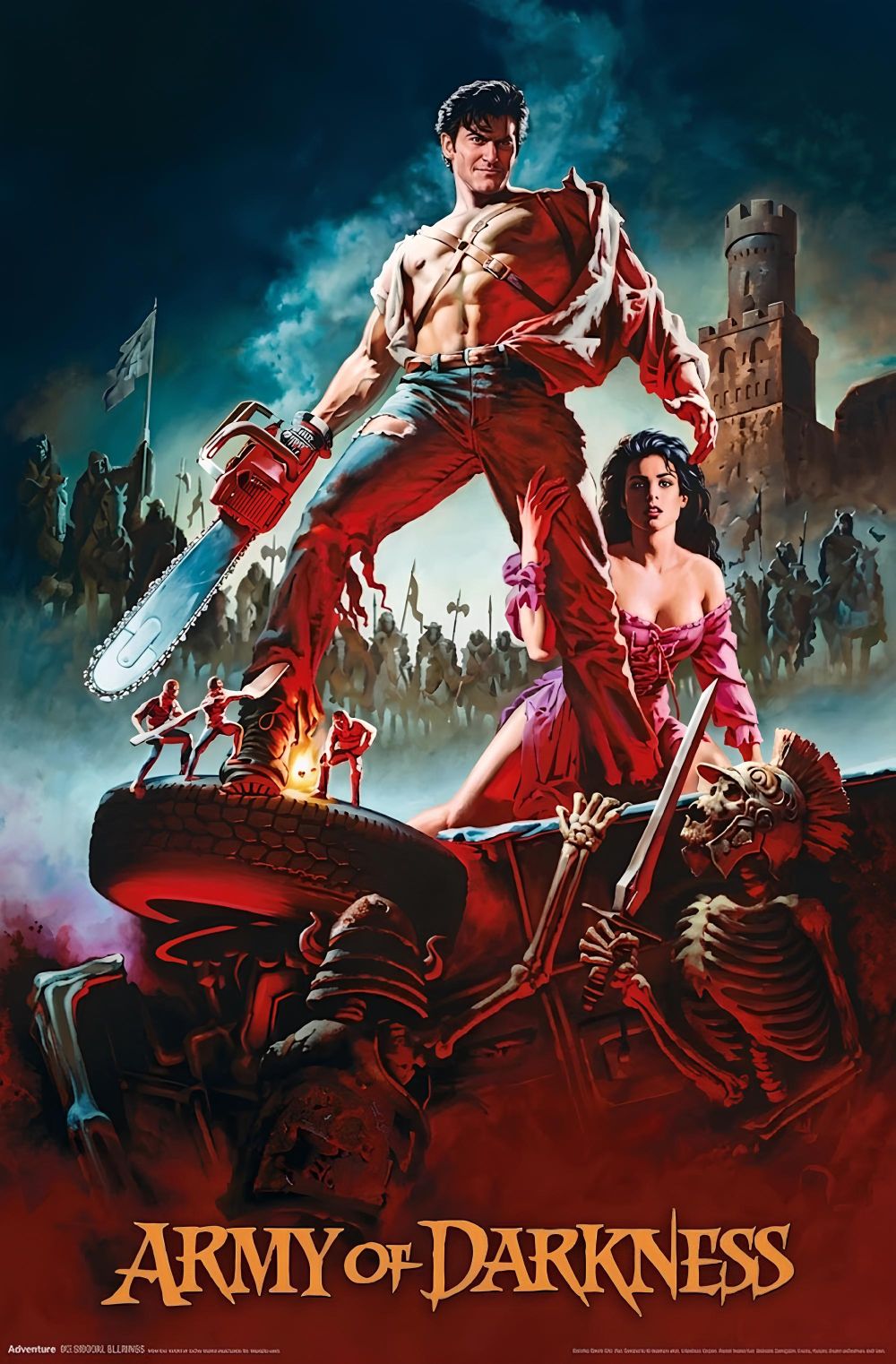
Horror Film Review: Army of Darkness (dir. by Sam Raimi)


“Well hello, Mister Fancypants. Well, I’ve got news for you, pal: you ain’t leadin’ but two things right now: Jack and shit… and Jack just left town.” — Ash Williams

Few cult movies embrace their own insanity as joyfully as Sam Raimi’s Army of Darkness. Directed by Raimi and released in 1992, the third chapter in the Evil Dead series takes Ash Williams out of the isolated-cabin horror setting of The Evil Dead and Evil Dead II and drops him into a sword-and-sorcery adventure full of skeleton armies, haunted forests, miniature doppelgängers, exploding Deadites, and more quotable one-liners than most action comedies manage in an entire franchise. It is still technically a horror movie, but calling it just a horror movie misses the point. This is a slapstick fantasy-action comedy with monsters, and its ridiculousness is exactly why it has endured as a cult favorite.

The story picks up almost immediately after the end of Evil Dead II, with Ash getting sucked through a portal and landing in medieval England. Rather than being welcomed as some prophesied savior, he is immediately treated like a suspicious outsider and thrown into a pit with a Deadite. That opening alone tells you what kind of movie this will be. Ash is no longer simply a terrified everyman trying to survive an impossible nightmare. He is now a chainsaw-handed loudmouth who shoots first, insults everyone around him, and somehow carries himself like the greatest warrior in history despite constantly making situations worse through his own arrogance.

Bruce Campbell is the entire engine of Army of Darkness. Ash has become a full-blown cartoon hero by this point, halfway between a B-movie John Wayne, a professional wrestler cutting a promo, and a smug department-store employee who has somehow convinced himself he is a legendary warrior. Campbell plays the role with total commitment, which is the key to why the comedy works. He never acts embarrassed by the dialogue or tries to make Ash seem cooler than he is. The character is funny because he is deeply incompetent beneath all the bravado. Ash talks like a conquering hero, but his victories usually involve panic, luck, explosives, and a lot of property damage.

The familiar “Groovy” attitude from Evil Dead II gets pushed even further here. Ash is not meant to be a noble fantasy protagonist. He is selfish, crude, lazy, and usually more interested in returning to modern life than helping the people trapped in a medieval war. That makes him a funny fit for the genre. In a normal fantasy film, the chosen hero would humbly accept his destiny, train with a sword, and unite the kingdoms. Ash complains about the inconvenience, makes demands, insults the locals, and uses his knowledge of basic mechanics to become a magical figure in their eyes. His improvised metal hand, shotgun, chainsaw, and homemade weapons make him look like a mad scientist dropped into an old Ray Harryhausen movie.

Raimi’s direction is as energetic as ever, even if Army of Darkness is noticeably cleaner and more studio-sized than the first two films. The early Evil Dead movies had a grimy, do-it-yourself quality that made their horror feel unusually mean and immediate. This one has a broader, more polished adventure-movie look. There are castles, battlefields, elaborate costumes, large-scale miniature work, and a full army of stop-motion skeletons. It is still cheap-looking in places, but that is part of its charm. The effects do not need to be seamless because the movie’s entire personality is built around heightened artifice. When skeletons leap around in exaggerated stop-motion or a tiny Ash attacks the full-sized Ash in a windmill, the film feels like a live-action cartoon with blood, dirt, and medieval armor.

The windmill sequence is probably the purest expression of what makes the movie special. Ash enters a windmill to escape danger and ends up trapped with miniature versions of himself, eventually swallowing one by accident. It has almost nothing to do with the larger plot in any serious sense, yet it is hilarious because Raimi keeps escalating the gag. Instead of treating the tiny Ash as a brief visual joke, the movie turns him into a recurring problem that literally grows into Evil Ash, Ash’s undead double and the leader of the titular army. That progression makes perfect cartoon logic: a small annoyance becomes a full-scale apocalypse because Ash was too careless to deal with it properly.

The horror elements are lighter than they were in the first two films, and that will probably be the biggest dividing line for viewers. Anyone expecting the nasty isolation, body horror, and relentless dread of The Evil Dead may be surprised by how openly silly this installment is. The Deadites are still grotesque enough to keep the supernatural threat alive, especially in the opening pit fight and the later siege, but they are no longer as frightening as they are funny. Raimi is much more interested in visual gags, wild camera movement, and action-movie momentum than scares.

That tonal change does not make Army of Darkness a lesser movie; it just makes it a very different one. In fact, it may be the most accessible entry in the original trilogy for people who do not normally enjoy horror. You can watch it without being especially invested in the mythology, because the plot is basically a delivery system for set pieces. Ash needs the Necronomicon to get home. He says the magic words wrong. Evil Ash rises. A skeleton army attacks. Ash helps defend the castle. The movie keeps moving, rarely pauses to explain itself, and never tries to make its fantasy world feel more serious than necessary.

The final battle is a great example of Raimi getting the maximum entertainment out of a relatively limited toolbox. Ash turns medieval villagers into a makeshift modern army, complete with explosives, contraptions, and a vehicle that feels hilariously out of place in the period setting. The action is messy, noisy, and deliberately overblown, with exploding skeletons and clashing armies staged more like a rowdy theme-park spectacle than a conventional epic. Raimi understands that the point is not realism. The point is seeing Ash yell at an undead army while wielding a chainsaw and acting like he personally invented warfare.

The movie’s dialogue is another major reason it remains so beloved. “This is my boomstick” has become the obvious classic, but Army of Darkness is packed with lines that sound like they were designed to be repeated by friends after midnight screenings. Campbell’s delivery turns even the dumbest insult into something memorable. The movie knows Ash is absurd, but it also understands that he needs to be just cool enough for the audience to enjoy watching him survive. He is a lovable jerk because he is never actually in control for long. The universe keeps humiliating him, and Campbell makes every humiliation feel like another opportunity for a louder comeback.

Army of Darkness is not the scariest Evil Dead movie, the most atmospheric, or even necessarily the best constructed. It is uneven, shamelessly goofy, and occasionally held together by pure momentum. But it has a distinct personality that most franchise sequels would kill for. Raimi and Campbell take a low-budget horror premise and stretch it into a medieval monster comedy without losing the series’ manic spirit. It feels handmade even when it is big, silly even when it is violent, and weirdly triumphant despite Ash being one of the least heroic heroes in fantasy cinema. For fans of practical effects, stop-motion creatures, quotable cult movies, and Sam Raimi operating with absolutely no interest in restraint, Army of Darkness remains a blast.
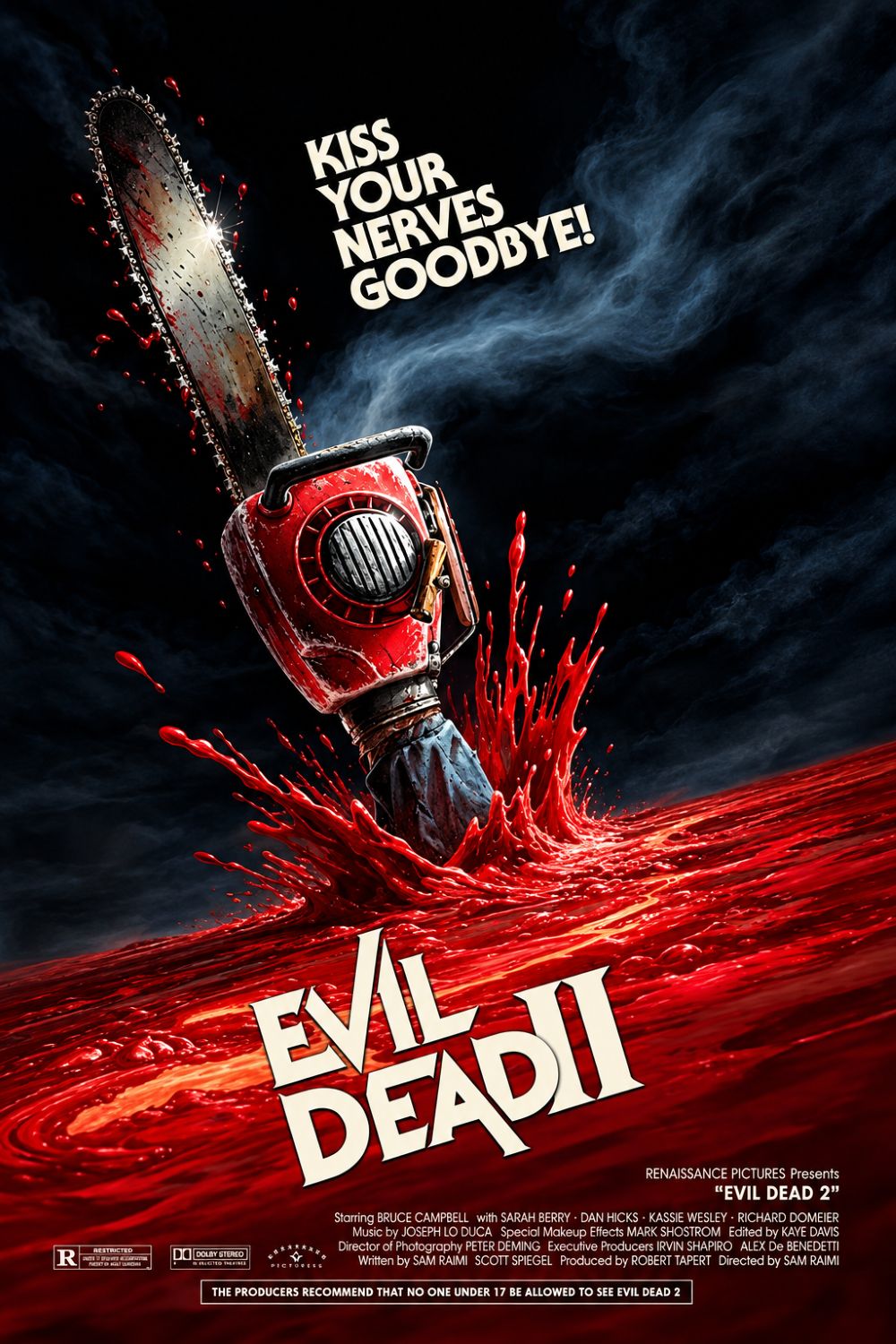
Horror Film Review: Evil Dead II (dir. by Sam Raimi)


“Swallow this.” — Ash Williams

With Evil Dead II, Sam Raimi took the basic cabin-in-the-woods nightmare of The Evil Dead and turned it into a frantic horror-comedy fever dream. Released in 1987, the film occupies a strange and wonderful place between a genuine continuation of The Evil Dead and a wildly exaggerated reimagining of it. It is nastier, funnier, more technically ambitious, and considerably more confident than its predecessor, yet it retains the homemade, anything-can-happen energy that made the original such a cult landmark. If The Evil Dead was a lean, rough-edged cabin-in-the-woods nightmare made by young filmmakers determined to prove themselves, Evil Dead II is Raimi and star Bruce Campbell returning with more resources, sharper instincts, and a total willingness to push every idea until it becomes cartoonishly grotesque.

The film begins with Ash Williams and his girlfriend Linda arriving at the infamous isolated cabin in the woods. It does not take long for them to stumble across the Necronomicon, the ancient book responsible for awakening flesh-hungry Deadites. What follows is an escalating barrage of possession, bodily mutilation, flying blood, demonic laughter, severed limbs, possessed household objects, and increasingly deranged attempts by Ash to survive the night. On a basic story level, it is familiar material. A group of people trapped in a remote location awaken evil forces and become possessed one by one. Raimi’s great achievement is that he never treats the formula as a limitation. Instead, he turns it into a delivery system for visual invention, slapstick timing, and creative violence.

The question of whether Evil Dead II is a sequel, a remake, or both has followed the movie for decades, and the honest answer is that it is effectively a sequel with a condensed remake-style opening. Raimi could not simply reuse footage from The Evil Dead, so the beginning retells the essential premise of the first film with Ash and Linda as the only characters at the cabin. That recap changes details, leaves out the original group of friends, and presents a shortened version of Ash’s first encounter with the Deadites. Once Ash survives the opening stretch and the evil returns, the movie continues beyond the events of The Evil Dead, making it a genuine sequel. Still, because the first act recreates so much of the original’s setup in a more polished and heightened form, it understandably feels like a remake before it becomes a continuation.

Bruce Campbell is the center of everything, and his performance is a huge part of why the film remains so beloved. Ash begins as an ordinary, frightened guy in over his head, but Campbell slowly transforms him into the character audiences recognize today: bruised, filthy, angry, absurdly resilient, and just arrogant enough to make his suffering hilarious. One of the movie’s most impressive qualities is how long Campbell can hold the screen almost entirely by himself. For substantial stretches, Ash has no real human companion to play off. He is acting opposite fake hands, props, stop-motion creatures, splattering fluids, camera movements, and the hostile architecture of the cabin. Campbell has to sell physical terror while also land jokes with the precision of a silent-film comedian.

The famous scene in which Ash’s possessed hand attacks him is probably the clearest example of what makes Evil Dead II special. In another horror movie, a man losing control of his hand might be played as disturbing body horror. Raimi turns it into a manic live-action cartoon. Ash battles his own hand with plates, books, a mousetrap, and anything else within reach, while Campbell throws himself around the room with astonishing commitment. The scene is funny because it is so excessive, but it never entirely stops being gruesome. Ash is still bleeding, suffering, and increasingly losing his mind. That balance is essential to the movie. Raimi does not abandon horror for comedy; he makes the comedy emerge from the intensity of the horror.

The cabin itself becomes one of the film’s great characters. In The Evil Dead, the location feels claustrophobic and decayed, a believable place that happens to become a site of supernatural violence. In Evil Dead II, it becomes something closer to a haunted funhouse. The walls seem alive, furniture appears to mock Ash, mounted animal heads laugh at him, and the entire building seems to participate in his breakdown. The sequence where Ash starts laughing alongside the room’s objects is especially memorable because it captures the film’s unstable tone. It is visually ridiculous, but there is genuine unease underneath it. Ash may be seeing a supernatural manifestation, losing his sanity, or both. Raimi keeps the audience off-balance by making laughter and fear feel almost inseparable.

Raimi’s direction is ferocious. The camera is constantly moving, rushing through forests, crashing into rooms, swooping toward characters, and creating the impression that the evil itself is an invisible force with a point of view. The “demon-cam” technique, in which the camera races through the woods toward its victims, returns from the first film but feels even more aggressive here. It gives the Deadites a strange presence despite the fact that they are often unseen. You do not merely hear something approaching; you feel the camera barreling toward Ash as if the movie has become possessed.

The practical effects remain a major reason to watch the film. They are intentionally messy, tactile, and sometimes obviously artificial, but that artificiality is part of the charm. The Deadites look like diseased puppets dragged out of a nightmare, their faces stretching into exaggerated masks of rot and rage. Blood does not behave like blood; it sprays in impossible volumes and bizarre colors. Bodies deform, heads spin, limbs detach, and tiny monsters swarm the frame. Rather than striving for realism, the effects aim for maximum impact. They create a world where physical rules have broken down, which suits a story about ancient evil invading the ordinary world.

The film’s humor also deserves credit for never making Ash too cool too early. Later installments, especially Army of Darkness, would lean more heavily into the swaggering, wisecracking version of the character. In Evil Dead II, he earns every bit of confidence through suffering. He is not a superhero with a chainsaw hand; he is a man forced to improvise a grotesque solution because he has no better option. When he straps the chainsaw onto his stump and prepares for battle, it is triumphant, but it is also the result of one of the most painful and grotesque scenes in the movie. The iconic image works because Raimi lets the audience experience the desperation behind it.

The supporting cast arrives later than expected, including Annie Knowby, daughter of the archaeologist connected to the Necronomicon, along with several others whose involvement predictably goes terribly wrong. They are not developed with the same attention as Ash, but that is not really the point. Their function is to give the Deadites fresh bodies to possess, create new complications, and help move the story toward its gleefully chaotic finale. Sarah Berry gives Annie an appealing mix of intelligence and panic, while Ted Raimi’s Henrietta becomes one of the movie’s most monstrous creations. The cellar scenes involving Henrietta are nasty, darkly funny, and among the strongest reminders that Raimi still knows how to make the audience uncomfortable even amid all the comedy.

By the time the film reaches its ending, Evil Dead II has become larger than its cabin setting. Its final twist sends Ash somewhere no viewer could reasonably have expected, turning what began as a contained survival-horror story into the launching point for the more openly fantasy-driven Army of Darkness. Yet the ending works precisely because the entire film has trained us to expect escalation. Every scene somehow finds a way to become more exaggerated than the last. A possessed girlfriend becomes a dancing corpse. A severed hand becomes a homicidal creature. A cabin becomes a carnival of insanity. A man with a chainsaw becomes an accidental hero.

More than three decades later, Evil Dead II still feels alive because it has a personality that no polished studio production could replicate. Its effects are physical, its performances are fearless, and its direction is so energetic that the movie seems ready to burst through the screen. It is gross, loud, silly, inventive, and sincerely scary in flashes. Raimi understands that horror can be horrifying and hilarious without weakening either quality. Evil Dead II is not merely a cult classic because people quote Ash or remember the chainsaw. It is a cult classic because it transforms limitations, madness, and handmade craftsmanship into a one-of-a-kind cinematic experience.

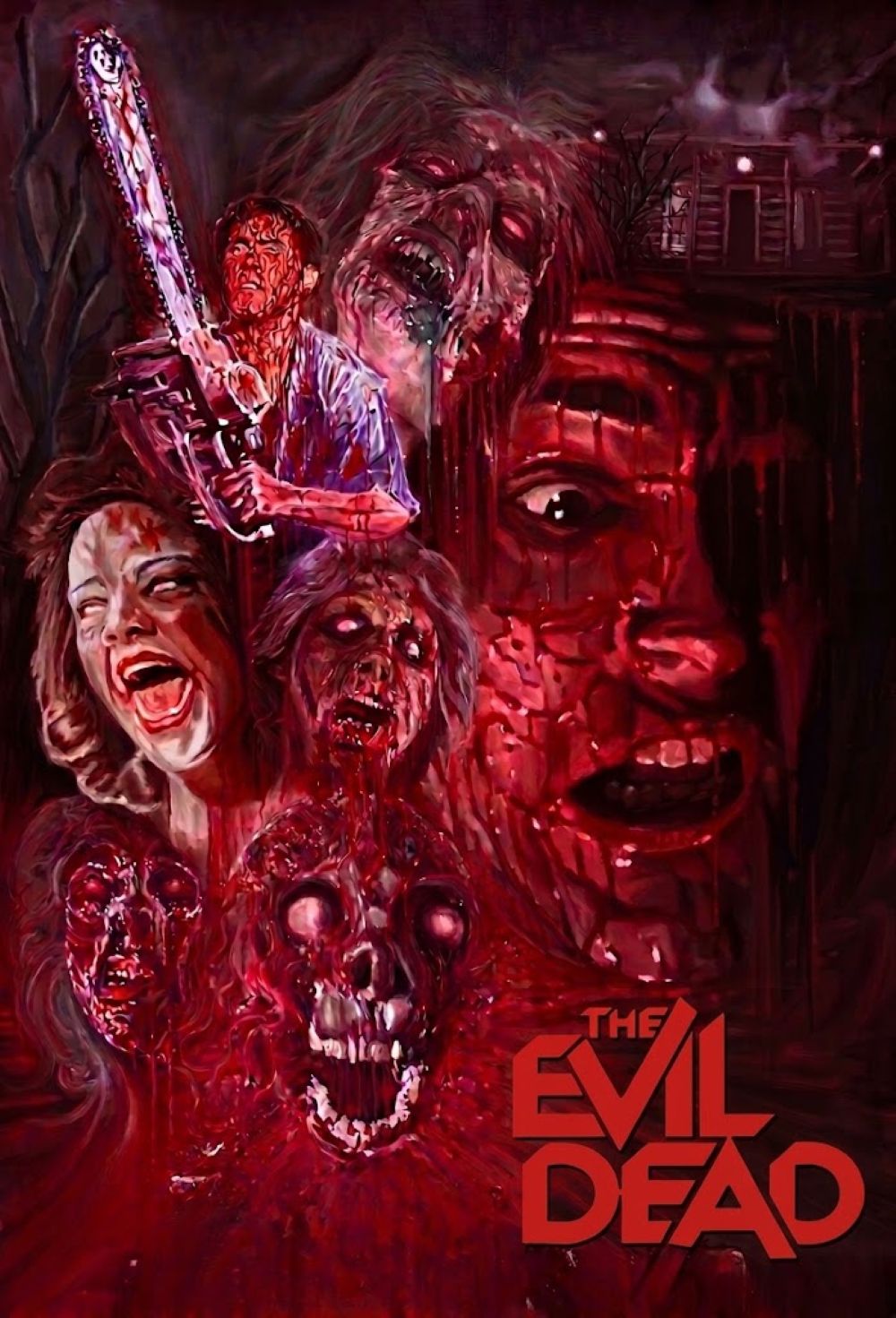
Horror Film Review: The Evil Dead (dir. by Sam Raimi)


“I fear that the only way to stop those possessed by the spirits of the book is through the act of… bodily dismemberment.” — Professor Knowby

The Evil Dead is the kind of movie that feels like it should not have become a classic, at least not by conventional standards. It was made cheaply, filmed under brutal conditions, packed with unknown actors, and built around an extremely simple premise: five college friends head to an isolated cabin in the woods, unwittingly awaken an ancient evil, and spend the rest of the night being torn apart by demonic forces. Yet more than four decades later, Sam Raimi’s 1981 horror debut remains one of the most energetic, inventive, and genuinely nasty independent films ever made. It is rough around the edges in ways that are impossible to ignore, but those rough edges are a major part of its appeal. The Evil Dead feels handmade, hungry, and a little bit unhinged.

The story starts with Ash Williams, his girlfriend Linda, Ash’s sister Cheryl, and their friends Scotty and Shelly arriving at a remote Tennessee cabin for what is supposed to be a relaxing getaway. It is one of the most familiar setups in horror history now, but Raimi and his collaborators made it feel threatening before the real violence even begins. The cabin is decrepit, damp, and isolated to an almost absurd degree. There is no real sense of civilization nearby. The forest itself seems hostile, with tangled trees, strange sounds, and an atmosphere that makes the woods feel less like a location and more like a living organism surrounding the characters.

The group soon discovers a cellar beneath the cabin, where they find an ancient book bound in flesh, a dagger, and a tape recording left by an archaeologist. The recording describes the Necronomicon, a book of demonic incantations, and naturally the characters make the worst possible decision by playing the tape aloud. That act releases the evil presence that has been lurking in the forest, and the movie moves quickly from creepy cabin story to all-out supernatural nightmare. The concept is simple, but it gives Raimi room to focus on mood, visual invention, and escalation rather than complicated mythology.

What makes The Evil Dead special is how aggressively Raimi directs it. Even in his first feature, he had a style that was impossible to mistake for anyone else’s. The camera is constantly moving, lunging through the woods, creeping around corners, tilting at unnatural angles, and racing toward people as if the audience has become the demon’s point of view. The famous “demon-cam” shots are still startling because of how physical they feel. The camera does not glide elegantly. It charges. It crashes through the environment. It feels like something has broken loose and is hunting the characters.

That restless filmmaking gives the movie a personality far larger than its budget. Raimi turns limitations into an advantage. The cabin becomes a maze of shadows, floorboards, trap doors, windows, and hidden spaces. A cheap-looking hallway can suddenly become terrifying because the editing, sound design, and camera movement make it feel unstable. Raimi understands that horror does not always come from seeing a monster clearly. Sometimes it comes from the sense that the camera itself has stopped behaving normally, that the space around the characters is warping, and that even the trees outside are watching them.

The special effects are another major reason the film still has such a devoted following. They are obviously practical, often messy, and occasionally so exaggerated that they cross into dark comedy, but they have a tactile quality that modern digital effects often lack. The possessed characters look genuinely diseased and wrong: pale skin, dead eyes, rotting makeup, distorted faces, and unnatural movements. When the deadites attack, they do not simply become generic zombies. They taunt their friends, laugh at them, imitate their voices, and enjoy causing emotional pain. That cruel playfulness makes them more disturbing than ordinary monsters.

The makeup work on the possessed Cheryl, Shelly, and Linda remains especially effective because it turns familiar faces into grotesque masks. Ellen Sandweiss, Betsy Baker, and Theresa Tilly bring an unsettling intensity to those transformations, switching from frightened victims to shrieking, mocking demons. The performances are broad and theatrical, but that is exactly what the material needs. Nothing in The Evil Dead is subtle for very long. The film keeps pushing the characters past the point of normal human behavior until they are laughing, screaming, convulsing, and bleeding all over the cabin.

Bruce Campbell’s Ash is interesting because he is not yet the wisecracking, chainsaw-handed cult hero he would become in the sequels. In The Evil Dead, Ash is mostly an ordinary young man who slowly realizes he is trapped in a situation beyond comprehension. Campbell is still charismatic, and there are flashes of the physical comedy and wild-eyed determination that would define the character later, but this version of Ash is more vulnerable. He panics, hesitates, and suffers. By the end, he looks exhausted in a way that feels earned, covered in sweat, dirt, blood, and trauma.

That difference gives the original movie its own identity within the larger Evil Dead series. Evil Dead II would remake and expand many of the first film’s ideas with more money, more comedy, and a much more overtly cartoonish sensibility. Army of Darkness would take Ash into full fantasy-adventure mode. Those later films are arguably more polished and more immediately entertaining, especially for viewers who love Campbell’s comedic performance. But The Evil Dead has a rawness that the sequels never tried to reproduce. It is a horror movie first, even when its excesses become funny.

The film’s tonal shifts are one of its most fascinating qualities. Raimi clearly understands that grotesque violence can become absurd if it is pushed far enough, and the movie occasionally seems aware of its own madness. A possessed hand reaches through a window. A character gets stabbed with a pencil in one of the film’s most infamous scenes. Bodies erupt in streams of colored goo rather than realistic blood. The final destruction of the deadites is so elaborate that it feels like Raimi and his effects team were determined to empty every container of slime they had available. It is disgusting, but it is also gleefully imaginative.

At the same time, The Evil Dead can be more unpleasant than people remember. Its treatment of Cheryl in the woods is difficult to watch and remains one of the film’s most controversial moments. The scene is meant to establish the cruelty and violation associated with the demonic force, but it is not necessary to enjoy the movie, and it has aged badly compared with the more comic-book brutality of later entries. Raimi himself would move away from that kind of material in the sequels. It is worth acknowledging because the scene changes the tone of the film and may be a deal-breaker for some viewers.

The sound design helps make the movie feel more oppressive than its modest production would suggest. The woods groan, doors bang, voices echo from impossible places, and the demonic chants on the tape recording create a sense that something ancient has been invited into the cabin. Joseph LoDuca’s score adds another layer of unease, using shrill strings and harsh musical stabs to make even quiet scenes feel unstable. The soundtrack is not trying to be elegant. It is trying to make the viewer tense up, and it succeeds.

There is also something inspiring about the movie’s independent spirit. Raimi, Campbell, producer Robert Tapert, and their crew famously made the film through determination, ingenuity, and a willingness to endure conditions that sound miserable in retrospect. You can feel that effort on screen. Every strange camera angle, handmade prop, and splattering effect carries the energy of filmmakers trying to prove they can do something bigger than their resources should allow. The Evil Dead does not hide its budget. It turns that budget into part of its legend.

For horror fans, the movie is essential not because it is flawless, but because it is so alive. It captures the feeling of discovering a forbidden VHS tape or stumbling into a midnight screening where the audience is laughing, cringing, and yelling at the screen. It is scary in places, silly in others, and relentlessly committed to its own bizarre nightmare logic. Raimi would go on to make superhero movies, westerns, thrillers, and studio blockbusters, but the wild visual imagination that defined his career is already fully visible here.

The Evil Dead is a scrappy, blood-soaked supernatural horror movie that earns its reputation through pure filmmaking nerve. Its story may be basic, its acting may be uneven, and some of its material has not aged gracefully, but the movie’s pace, practical effects, demonic imagery, and manic camerawork remain unforgettable. It feels less like a carefully manufactured horror product than a curse someone managed to put on film. That is why it still works: Raimi and his team did not just make a movie about evil invading a cabin. They made the entire movie feel possessed.