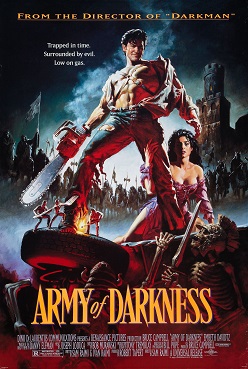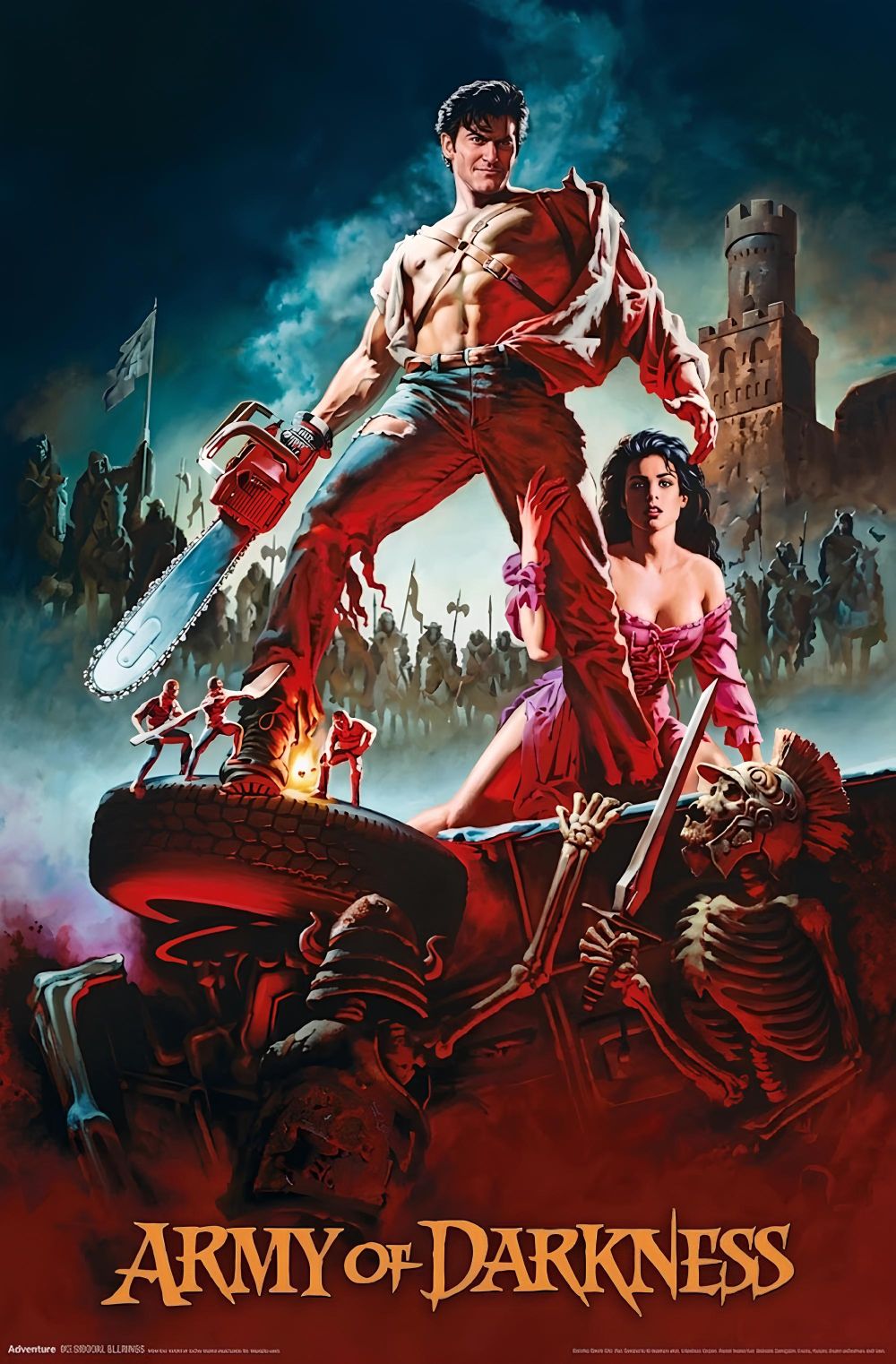
Horror Film Review: Army of Darkness (dir. by Sam Raimi)


“Well hello, Mister Fancypants. Well, I’ve got news for you, pal: you ain’t leadin’ but two things right now: Jack and shit… and Jack just left town.” — Ash Williams

Few cult movies embrace their own insanity as joyfully as Sam Raimi’s Army of Darkness. Directed by Raimi and released in 1992, the third chapter in the Evil Dead series takes Ash Williams out of the isolated-cabin horror setting of The Evil Dead and Evil Dead II and drops him into a sword-and-sorcery adventure full of skeleton armies, haunted forests, miniature doppelgängers, exploding Deadites, and more quotable one-liners than most action comedies manage in an entire franchise. It is still technically a horror movie, but calling it just a horror movie misses the point. This is a slapstick fantasy-action comedy with monsters, and its ridiculousness is exactly why it has endured as a cult favorite.

The story picks up almost immediately after the end of Evil Dead II, with Ash getting sucked through a portal and landing in medieval England. Rather than being welcomed as some prophesied savior, he is immediately treated like a suspicious outsider and thrown into a pit with a Deadite. That opening alone tells you what kind of movie this will be. Ash is no longer simply a terrified everyman trying to survive an impossible nightmare. He is now a chainsaw-handed loudmouth who shoots first, insults everyone around him, and somehow carries himself like the greatest warrior in history despite constantly making situations worse through his own arrogance.

Bruce Campbell is the entire engine of Army of Darkness. Ash has become a full-blown cartoon hero by this point, halfway between a B-movie John Wayne, a professional wrestler cutting a promo, and a smug department-store employee who has somehow convinced himself he is a legendary warrior. Campbell plays the role with total commitment, which is the key to why the comedy works. He never acts embarrassed by the dialogue or tries to make Ash seem cooler than he is. The character is funny because he is deeply incompetent beneath all the bravado. Ash talks like a conquering hero, but his victories usually involve panic, luck, explosives, and a lot of property damage.

The familiar “Groovy” attitude from Evil Dead II gets pushed even further here. Ash is not meant to be a noble fantasy protagonist. He is selfish, crude, lazy, and usually more interested in returning to modern life than helping the people trapped in a medieval war. That makes him a funny fit for the genre. In a normal fantasy film, the chosen hero would humbly accept his destiny, train with a sword, and unite the kingdoms. Ash complains about the inconvenience, makes demands, insults the locals, and uses his knowledge of basic mechanics to become a magical figure in their eyes. His improvised metal hand, shotgun, chainsaw, and homemade weapons make him look like a mad scientist dropped into an old Ray Harryhausen movie.

Raimi’s direction is as energetic as ever, even if Army of Darkness is noticeably cleaner and more studio-sized than the first two films. The early Evil Dead movies had a grimy, do-it-yourself quality that made their horror feel unusually mean and immediate. This one has a broader, more polished adventure-movie look. There are castles, battlefields, elaborate costumes, large-scale miniature work, and a full army of stop-motion skeletons. It is still cheap-looking in places, but that is part of its charm. The effects do not need to be seamless because the movie’s entire personality is built around heightened artifice. When skeletons leap around in exaggerated stop-motion or a tiny Ash attacks the full-sized Ash in a windmill, the film feels like a live-action cartoon with blood, dirt, and medieval armor.

The windmill sequence is probably the purest expression of what makes the movie special. Ash enters a windmill to escape danger and ends up trapped with miniature versions of himself, eventually swallowing one by accident. It has almost nothing to do with the larger plot in any serious sense, yet it is hilarious because Raimi keeps escalating the gag. Instead of treating the tiny Ash as a brief visual joke, the movie turns him into a recurring problem that literally grows into Evil Ash, Ash’s undead double and the leader of the titular army. That progression makes perfect cartoon logic: a small annoyance becomes a full-scale apocalypse because Ash was too careless to deal with it properly.

The horror elements are lighter than they were in the first two films, and that will probably be the biggest dividing line for viewers. Anyone expecting the nasty isolation, body horror, and relentless dread of The Evil Dead may be surprised by how openly silly this installment is. The Deadites are still grotesque enough to keep the supernatural threat alive, especially in the opening pit fight and the later siege, but they are no longer as frightening as they are funny. Raimi is much more interested in visual gags, wild camera movement, and action-movie momentum than scares.

That tonal change does not make Army of Darkness a lesser movie; it just makes it a very different one. In fact, it may be the most accessible entry in the original trilogy for people who do not normally enjoy horror. You can watch it without being especially invested in the mythology, because the plot is basically a delivery system for set pieces. Ash needs the Necronomicon to get home. He says the magic words wrong. Evil Ash rises. A skeleton army attacks. Ash helps defend the castle. The movie keeps moving, rarely pauses to explain itself, and never tries to make its fantasy world feel more serious than necessary.

The final battle is a great example of Raimi getting the maximum entertainment out of a relatively limited toolbox. Ash turns medieval villagers into a makeshift modern army, complete with explosives, contraptions, and a vehicle that feels hilariously out of place in the period setting. The action is messy, noisy, and deliberately overblown, with exploding skeletons and clashing armies staged more like a rowdy theme-park spectacle than a conventional epic. Raimi understands that the point is not realism. The point is seeing Ash yell at an undead army while wielding a chainsaw and acting like he personally invented warfare.

The movie’s dialogue is another major reason it remains so beloved. “This is my boomstick” has become the obvious classic, but Army of Darkness is packed with lines that sound like they were designed to be repeated by friends after midnight screenings. Campbell’s delivery turns even the dumbest insult into something memorable. The movie knows Ash is absurd, but it also understands that he needs to be just cool enough for the audience to enjoy watching him survive. He is a lovable jerk because he is never actually in control for long. The universe keeps humiliating him, and Campbell makes every humiliation feel like another opportunity for a louder comeback.

Army of Darkness is not the scariest Evil Dead movie, the most atmospheric, or even necessarily the best constructed. It is uneven, shamelessly goofy, and occasionally held together by pure momentum. But it has a distinct personality that most franchise sequels would kill for. Raimi and Campbell take a low-budget horror premise and stretch it into a medieval monster comedy without losing the series’ manic spirit. It feels handmade even when it is big, silly even when it is violent, and weirdly triumphant despite Ash being one of the least heroic heroes in fantasy cinema. For fans of practical effects, stop-motion creatures, quotable cult movies, and Sam Raimi operating with absolutely no interest in restraint, Army of Darkness remains a blast.
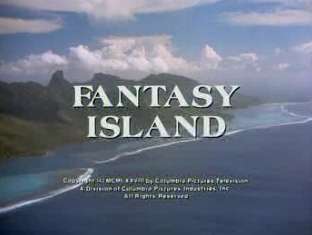
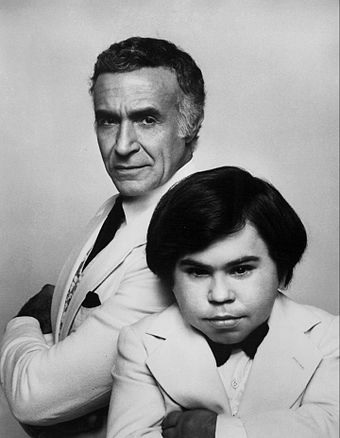
Retro Television Review: Fantasy Island 7.5 “Roarke’s Sacrifice/The Butler’s Affair”


Welcome to Retro Television Reviews, a feature where we review some of our favorite and least favorite shows of the past!  On Tuesdays, I will be reviewing the original Fantasy Island, which ran on ABC from 1977 to 1984.  Unfortunately, the show has been removed from most streaming sites.  Fortunately, I’ve got nearly every episode on my DVR.

This week, Roarke is haunted by a past love.

Episode 7.5 “Roarke’s Sacrifice/The Butler’s Affair”

(Dir by Cliff Bole, originally aired on November 12th, 1983)

This is an odd episode.  Both of the stories deal with love.  In one of them, Lee Meriwether plays a woman who is in love with her butler, Efrem Zimbalist, Jr.  She comes to Fantasy Island with a group of friends, all of whom are very judgmental about the idea of Meriwether dating a member of the help.  Mr. Roarke deals with the situation by threatening to reveal all of their secrets.  He explains that he does a thorough background check on everyone who comes to Fantasy Island.  I’m not sure if I buy that because some really bad folks have come to the Island.  Anyway, this story ends with Zimbalist starting to loosen up and Meriwether saying that she was going to continue to train him to be her boyfriend once they returned to the mainland.  I’m not sure if this is so much a love story as much as it’s a “I want to have sex with someone who I pay so they can’t ever say no” story.

The other story is a bit more interesting.  Julie Mars (Cyd Charisse, who I adore) is a dancer who walks with a cane.  It turns out that she and Roarke have been in love for years and the implication is that Roarke spent time with her off of the Island.  This is really a big deal.  It goes against everything that has always been implied about Roarke in the past.  Roarke never leaves the Island, that’s what we believed.  It turns out we were wrong.  He’s not only left the Island before but he’s fallen in love.  Julie’s fantasy is to be able to dance again.  Roarke grants her fantasy and Edmond Rome (Cesar Romero) wants to puts her in a show.  Roarke knows that the only way Julie can continue to dance is if she forgets the love that she has for Roarke.  That doesn’t quite make sense but Roarke just goes with it.  She leaves the Island, acting as if Roarke is just a friendly acquaintance as opposed to being the love of her life.

That was sad!  What made it especially sad is that Roarke doesn’t really have anyone to talk about all of this.  Tattoo was close enough to being an equal that Roarke could open up to him.  Lawrence is just a butler.  Some people confide in their butler.  Some people — as seen in this very episode — fall in love with their butler.  Roarke, however, is lost without Tattoo.

Poor Roarke!

Retro Television Review: Fantasy Island 5.15 “The Case Against Mr. Roarke/Save Sherlock Holmes”


Welcome to Retro Television Reviews, a feature where we review some of our favorite and least favorite shows of the past!  On Tuesdays, I will be reviewing the original Fantasy Island, which ran on ABC from 1977 to 1984.  Unfortunately, the show has been removed from most streaming sites.  Fortunately, I’ve got nearly every episode on my DVR.

This week, Mr. Roarke might be a father!

Episode 5.15 “The Case Against Mr. Roarke/Save Sherlock Holmes”

(Dir by Don Weis, originally aired on February 6th, 1982)

After last week’s episode with Julie, Tattoo returns this week and Julie is nowhere to be seen.  When Mr. Roarke asks where Julie is, Tattoo mentions that Julie is helping with the Custer’s Last Stand fantasy.  At this point, I can only assume that a life insurance policy has been taking out on Julie and Roarke or Tattoo, or maybe both are trying to get her killed so they can collect.

Julie not being present means that she misses out on one of the biggest scandals in Fantasy Island history.  A former guest, Fran Warner (Laraine Stephens), returns to the Island after seven years.  Accompanying her is her six year-old daughter, Nancy (Nicole Eggert).  Fran loudly declares that Mr. Roarke is Nancy’s father and that he now has an obligation to take care of her.  Fran even has a birth certificate where, under the father’s name, someone has written — and I kid you not — “Mr. Roarke.”

Is Mr. Roarke the kid’s father?  As is his habit, he refuses to answer the question directly when Tattoo asks it.  But it soon turns out that no, Mr. Roarke is not Nancy’s father.  Instead, Fran is sick and may be dying and she wants to make sure that Nancy is cared for.  When Nancy learns the truth, she runs away and Tattoo leads a search party across the Island.  Fear not, of course.  Nancy is found and a very forgiving Mr. Roarke allows Nancy and Fran to stay on the Island.  And Fran’s terminal disease suddenly becomes less terminal!

While this is going on, security guard Kevin Lansing (Ron Ely) gets to live his fantasy of helping a great detective.  Kevin doesn’t care which detective he gets to help so Roarke sends him back to Victorian-era London so that Kevin can work with Dr. Watson (a charming Donald O’Connor) to save Sherlock Holmes (Peter Lawford, not looking well in one of his final performances) from the clutches of Moriarty (Mel Ferrer, being as sinister here as he was in countless giallo films).  Kevin also falls for Nurse Heavenly (RIta Jenrette, the wife of a corrupt Democrat member of Congress) and is pleased to discover that she’s not really Moriarty’s assistant.  Instead, she was just another guest on the Island having a fantasy.

The Sherlock Holmes story was silly but fun, in the way that Fantasy Island often is.  It’s always interesting when this show goes into the past and we get to see how the show’s crew dressed up the show’s sets to try to make them look historically accurate.  The same street appears in every episode but sometimes, that street is in 1890s London and sometimes, it’s in 1690s Salem and sometimes, it’s just in modern day Fantasy Island!  As for the Mr. Roarke’s a father storyline, it was predictable but still, it was a good showcase for Ricardo Montalban’s enigmatic interpretation of Mr. Roarke.

This was a pleasant trip to the Island!

Horror Film Review: Army of Darkness (dir by Sam Raimi)


This is not going to be a traditional film review because let’s just state the obvious.  Army of Darkness is great.  Everyone knows that Army of Darkness is great.  Everyone loves Army of Darkness.  It’s not like you’re reading this review because you need to know whether or not Army of Darkness is a good film.

Now, interestingly enough, not everyone recognized just how good Army of Darkness was when it was first released.  A lot of reviewers were confused by director Sam Raimi’s mix of of horror (because the Deadites are scary under any circumstances) and slapstick comedy.  Today, we’re used to films and television shows that attempt to mix comedy and horror.  Ryan Murphy’s built an entire career out of mixing gore with camp and, as a result, he’s the favorite horror filmmaker of people who think they’re too good for horror.  In 1992, when Army of Darkness was first released, mixing horror and comedy caught critics and audiences off-guard.  What’s interesting is that 31 years later, Army of Darkness still feels fresh while many of the comedy horror films that followed feel tired.

I think one reason why the film continues to work is because it’s obvious that both Sam Raimi and Bruce Campbell were truly committed to bringing their demented vision to screen.  The film features Campbell as Ash Williams, the S-Mart clerk who, after a night of fighting the Deadites and losing his hand, has found himself in the Middle Ages, captured by Lord Arthur (Marcus Gilbert) and expected to live the life of a medieval slave.

Ash is often described as being one of the dumbest movie heroes of all time but, as this film shows, Ash’s stupidity is also his secret weapon.  While others heroes would probably get caught up trying to rationalize or understand the situation in which they’ve found themselves, Ash just accepts it.  While others heroes would strategize or try to figure out a clever way to get out of their situation, Ash simply fights back and runs straight into trouble.  “This is my boomstick!” Ash yells at one point and, while it establishes himself as being a great warrior, it’s also a case of Ash bragging on himself.  Ash is a big fan of bragging and it must be said that it usually works out for him..  When Ash is attacked by evil Ash and several miniature Ashes, the mindless delight that all of these different Ashes take in trying to destroy each other is infectious.

Of course, Ash’s stupidity can also be his biggest downfall.  For me, the best part of this film is when Ash tries to recover the Necronomicon from the haunted forest.  He is given three simple words that he needs to repeat before taking the book.  Before entering the forest, he practices by repeating the words twice but refuses to repeat them a third time because “I’ve got them!”  Of course, Ash doesn’t have them so he does what any of us would do.  He attempts to mumble the third world.  This, of course, raises an army of the dead.

(My second favorite part of the film is that the army of the dead is surprisingly talkative as they rise from their graves.  My third favorite part of the movie is Ted Raimi continually popping up as different supporting characters, occasionally even arguing with himself.  My fourth favorite part of the movie — well, I’ve got a lot of favorite parts of this movie.  Army of Darkness is one of those endlessly quotable movies about which you can spend hours saying, “Remember when….”)

“Shop smart, shop S-mart,” Ash says at one point and it’s tempting to laugh because Ash isn’t smart but he’s determined and his oddly confident and he manages to find a strange sort of joy in every situation that he finds himself.  He’s the ultimate blue collar hero and Army of Darkness is the ultimate celebration of Ash Williams, Bruce Campbell, and Sam Raimi.

Horror On TV: Tales From the Crypt 2.2 “The Switch”


Tonight’s excursion in televised horror comes the second season of HBO’s Tale From The Crypt.  Originally broadcast on April 21st, 1990, The Switch tells the story of an elderly millionaire (William Hickey) who is desperately in love with a younger woman (Kelly Preston).  When she tells him that she’s looking for a younger man, he goes to extreme lengths to become that younger man.

The episode was directed by Arnold Schwarzenegger and features good work from both William Hickey and Kelly Preston.  And, of course, the whole story ends with a sardonic twist that, once again, reminds the viewers that the universe is just as random and meaningless as Werner Herzog says it is.

Enjoy!

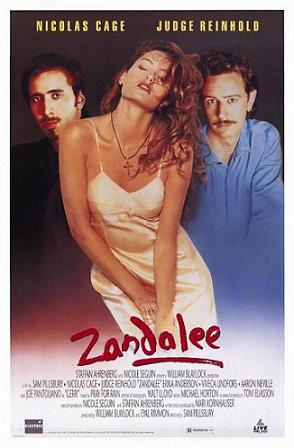
Embracing the Melodrama Part II #86: Zandalee (dir by Sam Pillsbury)


Zandalee

“I want to shake you naked and eat you alive…”

— Johnny (Nicolas Cage) in Zandalee (1991)

As you can probably guess from the quote above, Zandalee is a crazy little movie.

Zandalee takes place in New Orleans, which means that there’s a lot of rain, a lot of jazz, a lot of flamboyant accents, and a lot of sweat.  Zandalee (Erika Anderson) owns a boutique and spends most of her time jogging across the city.  (Zandalee has reddish hair, comes from a Catholic background, and runs a lot so naturally, I related to her.)

During one of her runs, Zandalee happens to pass a thief who is being chased by the police.  The thief flirts with her even while he’s being arrested.  The thief, interestingly enough, is played by a surprisingly hot Steve Buscemi.  Even more interesting is that, though his character makes a dramatic entrance and gets a lot of good lines, Buscemi doesn’t appear again until near the very end of the movie.  There’s really no point to Buscemi being in the film but somehow, it just seems right for him to suddenly be there.

And really, that’s the type of film that Zandalee is.  Odd characters pop up and then disappear.  Plot points are raised and then abandoned.  Events play out almost at random, as if Zandalee’s morning runs are taking her further and further into a dream world.

(It’s all a bit like Lost River, except for the fact that Zandalee is actually memorable in its weirdness, as opposed to just being annoying.)

Zandalee is married to Thierry (Judge Reinhold), a former poet who has abandoned his literary ambitions and taken over the family business.  Now, he’s mostly a figurehead who spends all of his time hanging out with drunk and uninteresting Philistines.  Thierry is so guilt-ridden over giving up poetry that he’s been rendered impotent.  Try as he might, he cannot make love.  As he puts it, while standing naked and staring out into the dark night, he is “a paraplegic of the soul.”

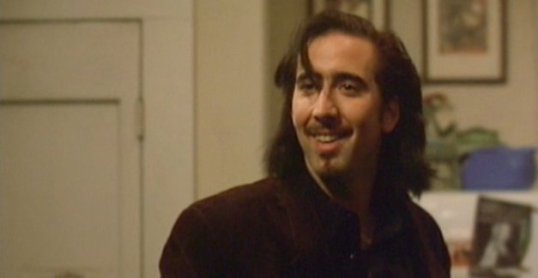
And then Johnny (Nicolas Cage) shows up.  Johnny was Thierry’s childhood friend.  Johnny is a painter and, from the minute he arrives, he’s giving Thierry a hard time for selling out.  Johnny also has long, stringy hair and a mustache and goatee.  He speaks in Nicolas Cage’s trademark muffled monotone, muttering lines of philosophical pretension.  When we first meet Johnny, he’s with Remy (Marisa Tomei, who much like Steve Buscemi, pops up and then vanishes and yet somehow it still seems totally appropriate that she’s in the film) but soon, Johnny has decided that he wants Zandalee.

Or, as he tells her when he approaches her during one of her runs, “I like it when you don’t wear anything underneath….”

Soon, Johnny and Zandalee are having a passionate affair.  Much as Zandalee once inspired Thierry’s poetry, she now inspires Johnny’s art.  Of course, Johnny is also inspired by cocaine.  Along with selling it and snorting it, Johnny also mixes it with olive oil and dips his fingers in it before fingering Zandalee.  And, as effective as some of these Johnny/Zandalee scenes are, it’s still impossible to watch all of this without thinking, “What the Hell, Nicolas Cage!?”

(Even by the standards of Nicolas Cage, Zandalee is a strange film.)

Anyway, eventually, Zandalee breaks it off with Johnny and Johnny’s paintings starts to suffer.  Thierry realizes what has been going on and it all leads to the scene below.

And, believe it or not, that all happens during the first hour!  Even after that epic dance off, there’s still another half hour of melodrama to go!  Zandalee is a seriously odd movie.

Zandalee can be viewed, in its uncensored entirety, on YouTube.  Usually, I’d embed the film at the bottom of this review but Zandalee is so extremely NSFW that it’s probably safer if you just go to YouTube and search for it yourself.

niccagezandaleeSeriously, Nic Cage wants you to do it.