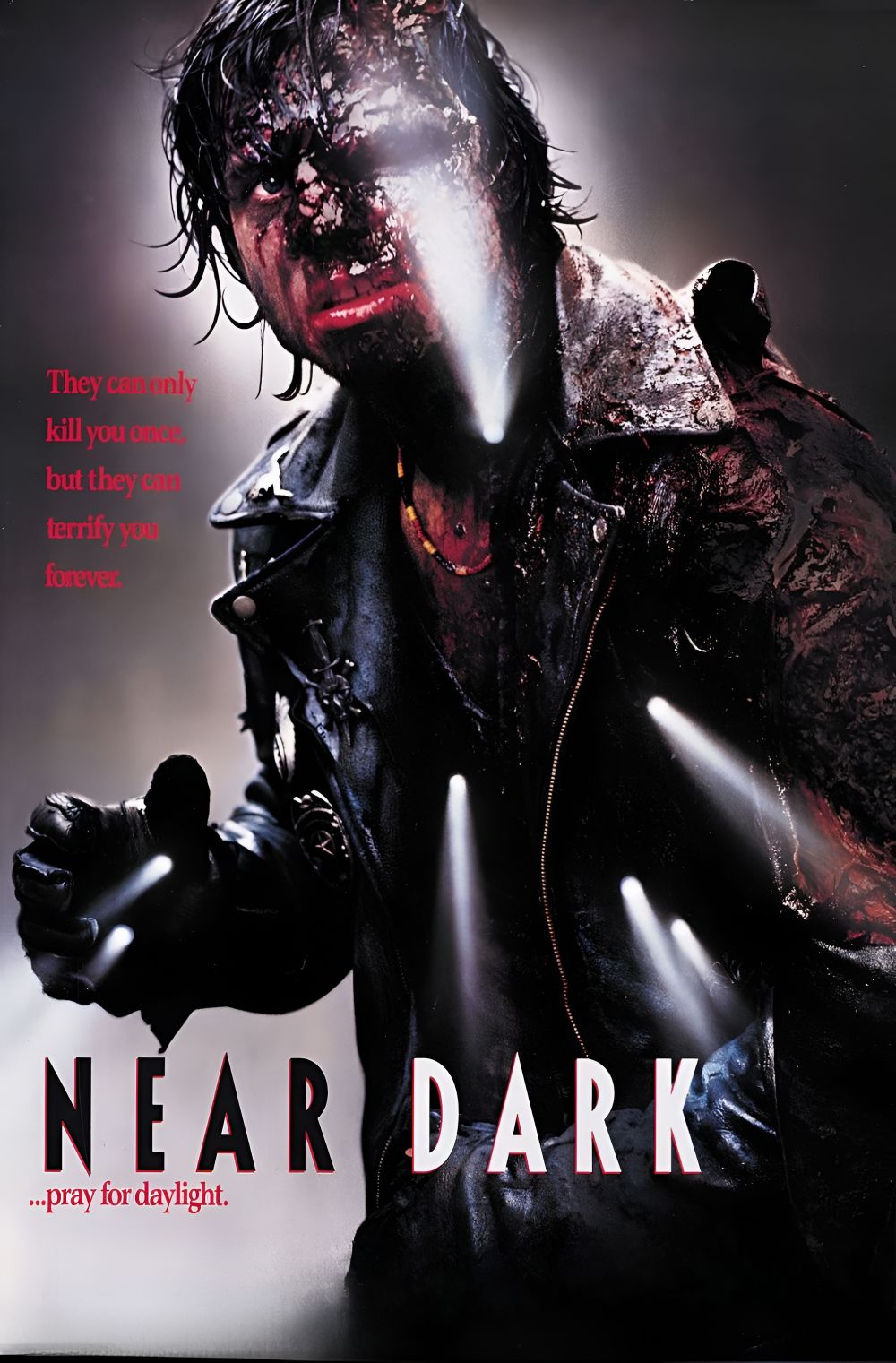
Horror Film Review: Near Dark (dir. by Kathryn Bigelow)


“Let’s put it this way: I fought for the South.” — Jesse

Most vampire movies make you wonder what it would feel like to live forever. Near Dark makes you wonder who you’d be stuck living forever with. In Kathryn Bigelow’s 1987 western-horror film, becoming a creature of the night means joining a small, volatile group whose affection comes with conditions and whose idea of a good evening could leave a roomful of people dead. There’s romance in this world, but very little comfort. Bigelow builds the movie around the uncomfortable possibility that finding people who understand you might be almost as dangerous as having nowhere to belong. It’s a scruffy, seductive horror film that knows how exciting bad company can seem before the bill arrives.

Caleb, played by Adrian Pasdar, doesn’t go looking for immortality. He’s a country boy looking for a little excitement when he meets Mae, played by Jenny Wright. Their early flirtation has the familiar awkwardness of two strangers trying to figure each other out, except one of them has a much better reason to worry about sunrise. A bite changes Caleb’s circumstances before he understands what he has gotten into. Soon he’s traveling with Mae’s vampire companions, who regard him less as a welcome addition than a problem she has brought home. He needs their help, but needing these particular people is its own kind of nightmare.

That dependence gives the story more tension than a simple battle between humans and monsters would offer. Caleb can’t just walk away and resume his old life, yet accepting the group means accepting what they do. The vampires aren’t interested in allowing him a long adjustment period. They expect him to feed, contribute, and stop making his confusion everyone else’s problem. There’s a darkly funny clash of perspectives here: Caleb is enduring an existential crisis, while his new companions are dealing with an irritating passenger. Bigelow makes their impatience recognizable without suggesting that their demands are reasonable.

The western elements give that conflict a natural shape. These vampires behave like an outlaw gang, traveling through an American landscape where staying mobile offers both freedom and protection. Their loyalty matters, but it exists within a closed circle. Anyone outside it is a potential resource, obstacle, or victim. That makes the genre combination feel purposeful rather than decorative. Westerns often find excitement in people who live beyond ordinary rules, and vampire stories have their own attraction to seductive outsiders. Near Dark brings those traditions together, then asks what their freedom looks like from the perspective of someone they decide to hurt.

Bigelow also understands how to make open space feel threatening. Roads and empty horizons usually suggest escape, but they provide little shelter when daylight arrives. The farther these characters get from civilization, the fewer places they have to hide. A miserable room can become more valuable than miles of beautiful countryside. That reversal gives the landscape an active role in the suspense. The vampires may dominate an encounter after dark, but their power comes with a deadline. No amount of swagger can change the time of sunrise, and the movie gets considerable mileage out of watching dangerous people suddenly become desperate.

The physical texture makes that desperation convincing. Clothes look worn, temporary accommodations feel uncomfortable, and traveling together seems like something everyone has done for too long. Immortality hasn’t brought these people luxury or even much convenience. They still have to find transport, secure shelter, and manage one another’s moods. Bigelow doesn’t stop the story to explain their routines, but the strain is visible. This is a particularly effective way of grounding the supernatural: the characters may have extraordinary abilities, yet their existence remains full of practical annoyances. Escaping ordinary human life has left them with a different set of exhausting obligations.

At the same time, the film never becomes so grimy that you lose sight of its appeal. Bigelow finds beauty in nighttime spaces, especially when Caleb and Mae are briefly alone. Darkness offers them privacy and the possibility of closeness, even as it connects them to everything threatening around them. Tangerine Dream’s electronic score helps sustain that contradiction. Its drifting, dreamlike sound creates an emotional distance from the rough surroundings without making them disappear. The music can make a moment feel tender and suspended, then leave the violence to shatter it. That push between attraction and alarm gives the film much of its distinctive atmosphere.

Bill Paxton embodies the alarming side as Severen, a vampire who seems thrilled that survival provides so many opportunities for bad behavior. He plays the role with outrageous confidence, making Severen funny without making him safe. The danger lies in how much pleasure he takes in every confrontation. He isn’t merely prepared to hurt someone if necessary; he appears disappointed when an evening doesn’t require it. Paxton makes that appetite entertaining enough to put the viewer in an awkward position. You look forward to seeing what Severen will do next while understanding that anyone actually standing beside him should be looking for an exit.

Lance Henriksen’s Jesse works through restraint rather than constant provocation. As the group’s leader, he has an authority that doesn’t need much advertising. Henriksen suggests long experience in the way Jesse watches people and decides how much patience they deserve. His steadiness makes the gang feel sustainable, at least on its own ugly terms. These aren’t simply predators who happen to be in the same vehicle. They have a structure, and Jesse helps hold it together. That structure gives Caleb’s possible acceptance real weight. He’s being offered a place in something established, not just permission to tag along until the next disaster.

The film’s strongest idea is that belonging can involve affection and coercion at the same time. The vampires’ attachments don’t have to be fake for their influence to be destructive. They can care about their own people while expecting those people to commit terrible acts. For Caleb, that makes the choice harder than rejecting an obviously empty promise. The group understands what he is becoming in a way his former world cannot. Their companionship answers a real need, but it also demands that he abandon the hesitation keeping him connected to his humanity. Acceptance is available, provided he becomes someone capable of earning it.

Mae gives that conflict its emotional center. Wright makes her vulnerable without turning her into a blameless observer of the gang’s behavior. She belongs to this life, and her attraction to Caleb doesn’t magically separate her from it. Their romance works best when it acknowledges that difficulty. She can offer tenderness without offering safety, and he can care about her without being able to live as she does. Pasdar is less immediately magnetic than the actors playing his traveling companions, but his relative ordinariness serves a purpose. Caleb still has recognizable limits, which gives the audience a way to measure how far the others expect him to go.

The roadhouse sequence makes those expectations impossible to avoid. As the gang terrorizes a bar, the movie strips away any comfortable distinction between their charisma and their cruelty. Bigelow allows the scene to be outrageous and darkly funny, particularly through Paxton, while keeping the vulnerability of the other people in view. It’s exciting filmmaking, but the excitement catches in your throat. For Caleb, the encounter is more than another demonstration of how dangerous his companions are. It’s a test of whether he can participate. He can’t remain indefinitely on the edge of their world, enjoying its romance while refusing its central activity.

That willingness to make the monsters compelling without excusing them is one of the film’s best qualities. Their humor, loyalty, and individuality matter, but none of those things makes their victims disposable. The movie holds both sides of that equation together better than it handles its eventual resolution. Without spelling out the mechanics, the route toward normality feels too convenient after Caleb’s predicament has become so physically and morally tangled. The emotional desire behind the ending is understandable; the storytelling shortcuts are less satisfying. A film so good at establishing the cost of this existence could have used a more difficult reckoning with escape.

Even so, Near Dark earns its place in the memory through the uneasy life it creates between attacks. The worn-out spaces, shifting loyalties, fleeting tenderness, and approaching daylight make the gang feel like more than a collection of horror characters. You can imagine them continuing down another road, having the same arguments and finding new strangers to consume. That’s what makes Caleb’s dilemma linger. The real threat isn’t simply that these people might kill him. It’s that he might become comfortable with them. Bigelow’s film is at its sharpest when the night looks beautiful, the company almost feels welcoming, and you remember exactly what staying would require.
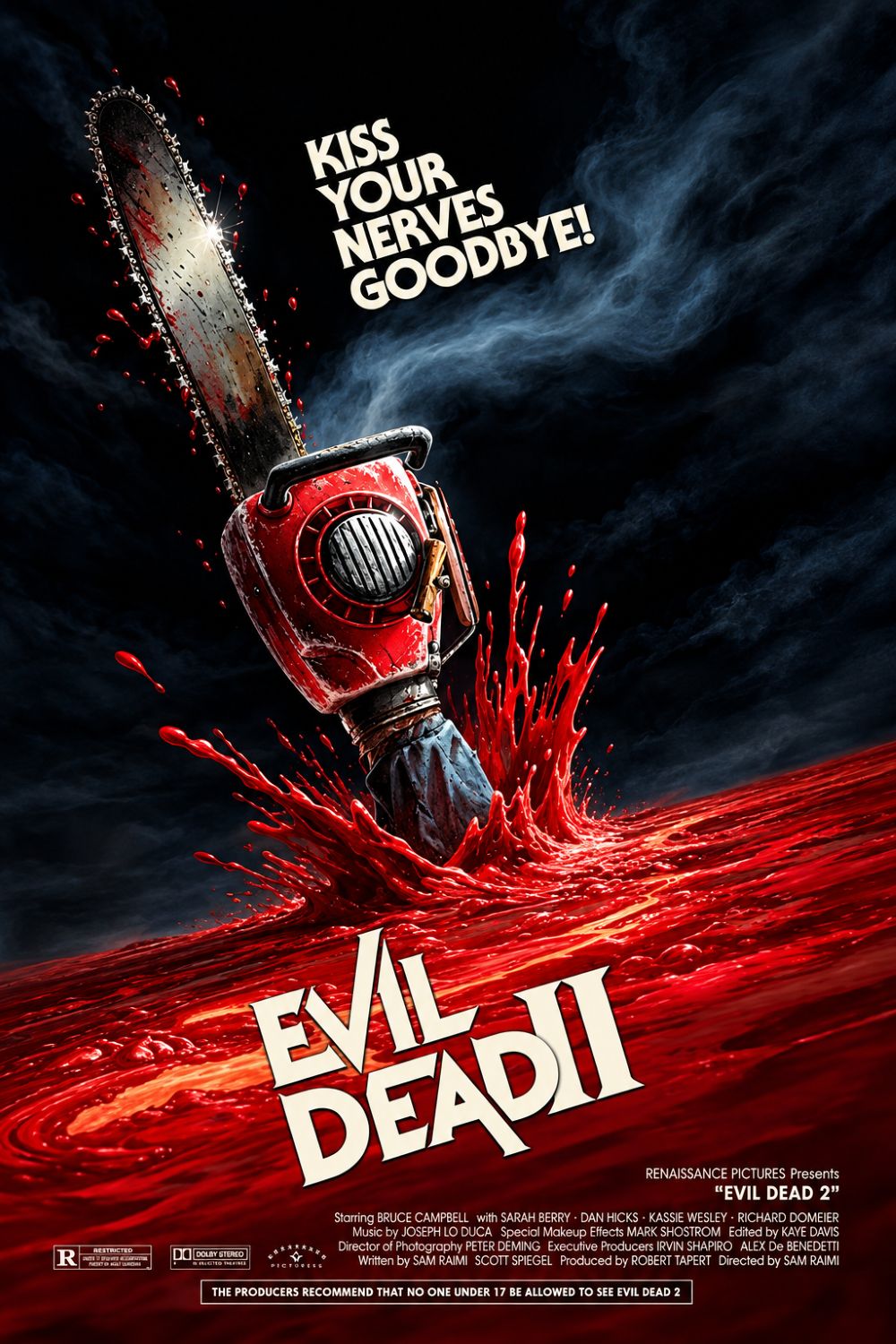
Horror Film Review: Evil Dead II (dir. by Sam Raimi)


“Swallow this.” — Ash Williams

With Evil Dead II, Sam Raimi took the basic cabin-in-the-woods nightmare of The Evil Dead and turned it into a frantic horror-comedy fever dream. Released in 1987, the film occupies a strange and wonderful place between a genuine continuation of The Evil Dead and a wildly exaggerated reimagining of it. It is nastier, funnier, more technically ambitious, and considerably more confident than its predecessor, yet it retains the homemade, anything-can-happen energy that made the original such a cult landmark. If The Evil Dead was a lean, rough-edged cabin-in-the-woods nightmare made by young filmmakers determined to prove themselves, Evil Dead II is Raimi and star Bruce Campbell returning with more resources, sharper instincts, and a total willingness to push every idea until it becomes cartoonishly grotesque.

The film begins with Ash Williams and his girlfriend Linda arriving at the infamous isolated cabin in the woods. It does not take long for them to stumble across the Necronomicon, the ancient book responsible for awakening flesh-hungry Deadites. What follows is an escalating barrage of possession, bodily mutilation, flying blood, demonic laughter, severed limbs, possessed household objects, and increasingly deranged attempts by Ash to survive the night. On a basic story level, it is familiar material. A group of people trapped in a remote location awaken evil forces and become possessed one by one. Raimi’s great achievement is that he never treats the formula as a limitation. Instead, he turns it into a delivery system for visual invention, slapstick timing, and creative violence.

The question of whether Evil Dead II is a sequel, a remake, or both has followed the movie for decades, and the honest answer is that it is effectively a sequel with a condensed remake-style opening. Raimi could not simply reuse footage from The Evil Dead, so the beginning retells the essential premise of the first film with Ash and Linda as the only characters at the cabin. That recap changes details, leaves out the original group of friends, and presents a shortened version of Ash’s first encounter with the Deadites. Once Ash survives the opening stretch and the evil returns, the movie continues beyond the events of The Evil Dead, making it a genuine sequel. Still, because the first act recreates so much of the original’s setup in a more polished and heightened form, it understandably feels like a remake before it becomes a continuation.

Bruce Campbell is the center of everything, and his performance is a huge part of why the film remains so beloved. Ash begins as an ordinary, frightened guy in over his head, but Campbell slowly transforms him into the character audiences recognize today: bruised, filthy, angry, absurdly resilient, and just arrogant enough to make his suffering hilarious. One of the movie’s most impressive qualities is how long Campbell can hold the screen almost entirely by himself. For substantial stretches, Ash has no real human companion to play off. He is acting opposite fake hands, props, stop-motion creatures, splattering fluids, camera movements, and the hostile architecture of the cabin. Campbell has to sell physical terror while also land jokes with the precision of a silent-film comedian.

The famous scene in which Ash’s possessed hand attacks him is probably the clearest example of what makes Evil Dead II special. In another horror movie, a man losing control of his hand might be played as disturbing body horror. Raimi turns it into a manic live-action cartoon. Ash battles his own hand with plates, books, a mousetrap, and anything else within reach, while Campbell throws himself around the room with astonishing commitment. The scene is funny because it is so excessive, but it never entirely stops being gruesome. Ash is still bleeding, suffering, and increasingly losing his mind. That balance is essential to the movie. Raimi does not abandon horror for comedy; he makes the comedy emerge from the intensity of the horror.

The cabin itself becomes one of the film’s great characters. In The Evil Dead, the location feels claustrophobic and decayed, a believable place that happens to become a site of supernatural violence. In Evil Dead II, it becomes something closer to a haunted funhouse. The walls seem alive, furniture appears to mock Ash, mounted animal heads laugh at him, and the entire building seems to participate in his breakdown. The sequence where Ash starts laughing alongside the room’s objects is especially memorable because it captures the film’s unstable tone. It is visually ridiculous, but there is genuine unease underneath it. Ash may be seeing a supernatural manifestation, losing his sanity, or both. Raimi keeps the audience off-balance by making laughter and fear feel almost inseparable.

Raimi’s direction is ferocious. The camera is constantly moving, rushing through forests, crashing into rooms, swooping toward characters, and creating the impression that the evil itself is an invisible force with a point of view. The “demon-cam” technique, in which the camera races through the woods toward its victims, returns from the first film but feels even more aggressive here. It gives the Deadites a strange presence despite the fact that they are often unseen. You do not merely hear something approaching; you feel the camera barreling toward Ash as if the movie has become possessed.

The practical effects remain a major reason to watch the film. They are intentionally messy, tactile, and sometimes obviously artificial, but that artificiality is part of the charm. The Deadites look like diseased puppets dragged out of a nightmare, their faces stretching into exaggerated masks of rot and rage. Blood does not behave like blood; it sprays in impossible volumes and bizarre colors. Bodies deform, heads spin, limbs detach, and tiny monsters swarm the frame. Rather than striving for realism, the effects aim for maximum impact. They create a world where physical rules have broken down, which suits a story about ancient evil invading the ordinary world.

The film’s humor also deserves credit for never making Ash too cool too early. Later installments, especially Army of Darkness, would lean more heavily into the swaggering, wisecracking version of the character. In Evil Dead II, he earns every bit of confidence through suffering. He is not a superhero with a chainsaw hand; he is a man forced to improvise a grotesque solution because he has no better option. When he straps the chainsaw onto his stump and prepares for battle, it is triumphant, but it is also the result of one of the most painful and grotesque scenes in the movie. The iconic image works because Raimi lets the audience experience the desperation behind it.

The supporting cast arrives later than expected, including Annie Knowby, daughter of the archaeologist connected to the Necronomicon, along with several others whose involvement predictably goes terribly wrong. They are not developed with the same attention as Ash, but that is not really the point. Their function is to give the Deadites fresh bodies to possess, create new complications, and help move the story toward its gleefully chaotic finale. Sarah Berry gives Annie an appealing mix of intelligence and panic, while Ted Raimi’s Henrietta becomes one of the movie’s most monstrous creations. The cellar scenes involving Henrietta are nasty, darkly funny, and among the strongest reminders that Raimi still knows how to make the audience uncomfortable even amid all the comedy.

By the time the film reaches its ending, Evil Dead II has become larger than its cabin setting. Its final twist sends Ash somewhere no viewer could reasonably have expected, turning what began as a contained survival-horror story into the launching point for the more openly fantasy-driven Army of Darkness. Yet the ending works precisely because the entire film has trained us to expect escalation. Every scene somehow finds a way to become more exaggerated than the last. A possessed girlfriend becomes a dancing corpse. A severed hand becomes a homicidal creature. A cabin becomes a carnival of insanity. A man with a chainsaw becomes an accidental hero.

More than three decades later, Evil Dead II still feels alive because it has a personality that no polished studio production could replicate. Its effects are physical, its performances are fearless, and its direction is so energetic that the movie seems ready to burst through the screen. It is gross, loud, silly, inventive, and sincerely scary in flashes. Raimi understands that horror can be horrifying and hilarious without weakening either quality. Evil Dead II is not merely a cult classic because people quote Ash or remember the chainsaw. It is a cult classic because it transforms limitations, madness, and handmade craftsmanship into a one-of-a-kind cinematic experience.

Film Review: Transformers: The Movie (dir. by Nelson Shin)


1986 was such a fantastic year.

With movies like Top Gun, Labyrinth and Ferris Bueller’s Day Off already out, the summer would give us Big Trouble in Little China, Aliens, & The Fly (Which at one point you could catch as a double feature with Aliens). The two best announcements at home were that a new baby was on the way and Transformers: The Movie was coming out. By August, we knew the baby would be a boy and a name was already set aside for him. We were naming him after a fallen Officer who was a friend of my father’s on the Force.

Impending older brotherhood was nice, but for 11 year old me, it all took a backseat to the Death of Optimus Prime. Up until then, the most shocking fictional event we had in school was either Return of the Jedi closing the book on Star Wars some years prior, K.I.T.T. getting destroyed (and rebuilt with Super Turbo Boost) in Knight Rider, or Rico losing Angelina in a car bomb during the Season Finale of Miami Vice just a few months back.

I didn’t get a chance to see Transformers: The Movie during the film’s initial run, simply because there wasn’t anyone at home who wanted to sit through it with me. My older brother, through other means, managed to score a VHS copy of the film within the first week or so of its theatrical release. I watched and re-watched that video so many times, and would even pause it to try to draw some of the characters. Eventually, I was able to catch a re-release for the film’s 30th Anniversary.

After two full seasons of the show, Transformers: The Movie was basically Hasbro’s way of cleaning house from the 1984 Generation 1 toy line to introduce a new set. The show sold figures, and the hopes were that the film would do the same. Granted, there were already a large number of Transformers to work with by the time the movie came out. With nearly 50 Autobots and about 35 Decepticons to choose from, the film focused on a few, such as the Insecticons, Dinobots and some of the G1 favorites like Soundwave, Starscream, Jazz & Bumblebee. The Constructicons (and Devestator)were the only group set to be featured in the movie. The Stunticons & Aerialbots would sit this one out. Hasbro really didn’t care too much about the impact of any of these changes on the movie’s plot. While most of the trailers asked “Does Optimus Die?”, their toy commercial line already introduced Rodimus Prime.

Produced by De Laurentiis Entertainment Group (Near Dark, Blue Velvet), Transformers: The Movie takes us to the future of 2005. The Autobots and Decepticons are still fighting it out, with a few changes in the war. The Decepticons own the Transformers home planet of Cybertron, but the Autobots have control of two of Cybertron’s Moons and a city on Earth. Lead by Optimus Prime (Peter Cullen, Eeyore on The Adventures of Winnie the Pooh), the plan is get back to Earth and then handle the Decepticons from there. Of course, the Decepticons and their leader, Megatron (Frank Welker, The Golden Child) find out about this and intercept an Autobot shuttle, outright killing classic show staples Prowl, Brawn, Rachet and Ironhide. I can’t imagine what it was like to be a kid, bring your favorite toy to the movies, only to see the character it’s based on killed on screen. To make things worse, a planet eating transformer named Unicron threatens both parties, including Cybertron. Can Unicron be stopped?


It wasn’t a total loss. We were introduced to new Autobots in the rookie Hot Rod (Judd Nelson, The Breakfast Club), the war hero Kup (Lionel Stander, TV’s Hart to Hart), the fast talking Blurr (John Moschitta, Jr., Dick Tracy), would be leader Ultra Magnus (Robert Stack, Airplane), an Autobot First Lady in Arcee (Susan Blu), and Triple Changer Springer (Neil Ross). The two most famous vocal additions were Leonard Nimoy (Invasion of the Body Snatchers) the new Deception leader Galvatron and Orson Welles (The Third Man) as Unicron. As a kid, it was pretty awesome to know that both Spock and the “No Wine Before It’s Time” guy were joining in all of this. It made Transformers seem a bit larger. My parents would point out that Orson Welles was “the” Orson Welles, but as Citizen Kane wasn’t on my radar (despite my Dad owning and watching it), I associated him with Wine commercials. To both their credit, Nimoy and Welles did just fine with their vocal talents.

While the animation for Transformers was never fantastic, the movie was a bit of an improvement. It never quite reached the levels of anime films like Fist of the North Star & Golgo 13: The Professional. The Soundtrack was ultimately where the film shined, with a mix of rock music from bands like Lion and Stan Bush and a score by Vince DiCola. Coming off of Staying Alive and Rocky IV, DiCola’s work on Transformers: The Movie was great, and remains a go to album for me when music is needed for a situation.

The Death of Optimus Prime was a bit of a shock to the audiences that saw (and cared about) it. Hasbro would eventually bring Prime back temporarily as a Zombie in an episode of the show’s 3rd Season, and then again to lead in the season’s 2 part finale, “The Return of Optimus Prime”.

After seeing the film, I asked me parents for some of the movie based Transformers. Christmas was put on hold by my Mom as she went into labor around Christmas Eve. I was able to open just one gift before Christmas. This happened to be a Hot Rod figure that I found in a toy store back in November, which was quickly snatched and wrapped for the Christmas Pile before I could get to open it. She had my little brother on Christmas Morning, and we eventually celebrated the holiday half a week later. Bless her heart, she gave me almost the entire Movie line – Galvatron, Rodimus Prime, Springer, Cyclonus, and the Predacons (who weren’t in the movie). Playing with them took a backseat to diaper detail, but hey, that Christmas was one of the best.

Overall, Transformers: The Movie is one of those films I happily return to from time to time. It’s not incredible in any major way, but it takes me back to one element of a magical year.