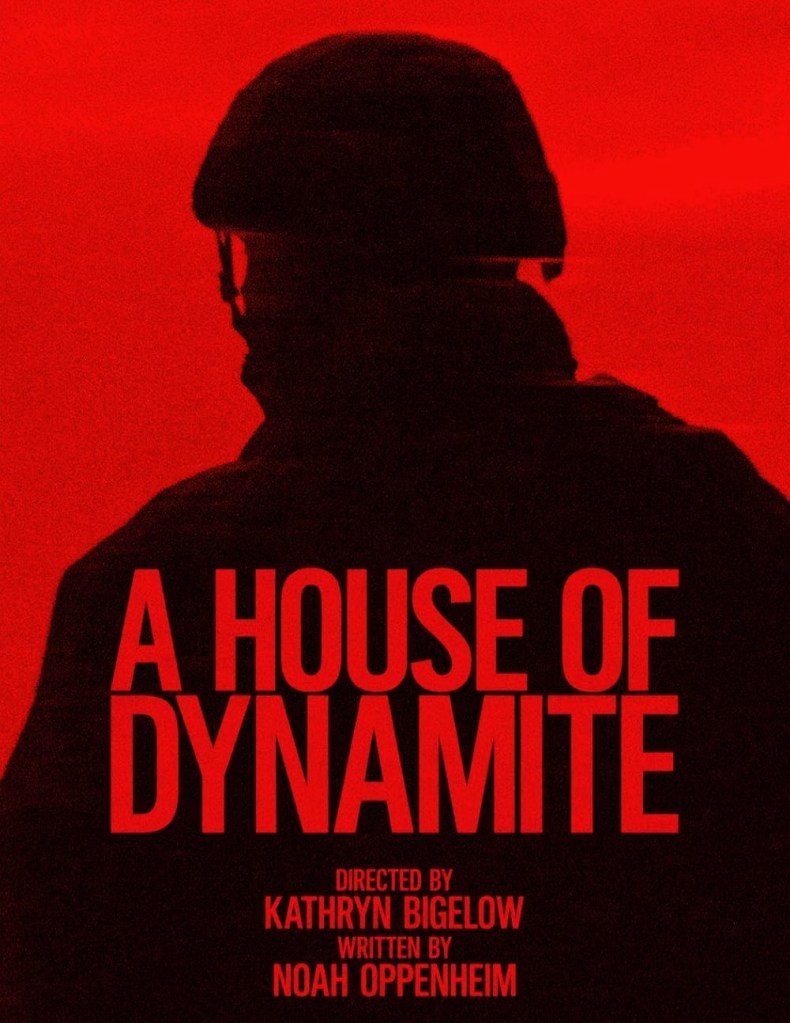
Horror Review: A House of Dynamite (dir. by Kathryn Bigelow)


“So it’s a fucking coin toss? That’s what 50 billion dollars buys us?” — Secretary of Defense Reid Baker

The end of the Cold War was supposed to close a chapter of fear. With the superpowers stepping back from the brink, the world briefly believed it had entered an era of stability. Yet that promise never held. The weapons remained, the rivalries adapted, and the global machinery of deterrence continued to hum beneath the surface. Kathryn Bigelow’s A House of Dynamite faces this reality head-on, transforming the mechanics of modern nuclear defense into something unnervingly human. On the surface, it plays as a high-tension political technothriller, but beneath that precision lies a deeply existential horror film—one built not on shadows or monsters, but on daylight, competence, and the narrow margins of human fallibility.

The premise is piercingly simple. An unidentified missile is detected over the Pacific. Analysts assume it’s a test or a glitch—another false alarm in a world overflowing with them. But within minutes, as conflicting data streams converge, what seemed routine begins to look real. The film unfolds in real time over twenty excruciating minutes, charting the reactions of those charged with interpreting and responding to the potential catastrophe. Bigelow divides the film into three interwoven perspectives: the White House Situation Room, the missile intercept base at Fort Greely, and the President’s mobile command aboard Marine One. The structure allows tension to grow from every direction at once, each perspective magnifying the other until the screen feels ready to collapse under its own pressure.

Capt. Olivia Walker (Rebecca Ferguson), commanding officer of the Situation Room, anchors the story with calm professionalism that gradually frays into disbelief. Ferguson’s performance is clear-eyed and tightly modulated—precise, disciplined, and quietly devastating. She stands as the rational center inside chaos, her composure the last gesture of control in a world that no longer follows reason.

Over her is Adm. Mark Miller (Jason Clarke), Director of the Situation Room, who represents the institutional embodiment of confidence. Clarke plays him with methodical restraint, a man who trusts procedure long after it stops earning trust. Miller’s authority is both comforting and horrifying: a portrait of leadership built on ritual rather than certainty.

At Fort Greely, Anthony Ramos brings an intimate immediacy as the officer charged with the missile intercept. His scenes hum with kinetic dread—the physical execution of decisions made thousands of miles away. Through him, the film captures the most primal kind of fear: acting when hesitation could mean extinction, knowing that success and failure are separated only by chance.

The President, portrayed by Idris Elba, spends much of the crisis in motion—first within the cocoon of the presidential limousine, and later, aboard Marine One as it carves through blinding daylight. Elba gives a performance of subtle, steady erosion. At first, he embodies unshakeable calm, a figure of poise and authority; but as the situation deepens, his steadiness wanes. Words become shorter, pauses longer. Every decision carries consequences too vast for resolution. It is a measured, understated portrait of power giving way to human uncertainty.

Bigelow’s direction is stripped of ornament and focused on precision. Barry Ackroyd’s cinematography heightens the claustrophobia of command centers—the sterile light, the reflective glass, the sense that every surface observes its occupants—while his exterior scenes pierce with harsh brightness, suggesting that no sanctuary exists under full exposure. Kirk Baxter’s editing maintains an unrelenting pulse, cutting with mathematical precision while preserving the eerie stillness of the moments where no one dares to speak.

​A House of Dynamite also shows how even with the most competent experts—military, intelligence, and political—working to manage an escalating crisis, there is no path to victory. The professionals at every level stop seeking to prevent the worst and instead focus on saving what they can when the worst becomes inevitable. The film’s scariest revelation is not the potential for destruction, but the paralysis that intelligence creates. If the brightest, most disciplined people in the world cannot find an answer, what happens when power falls into the hands of those less prepared or less rational? In its quiet way, the film poses that question that we see more and more each day on the news and on social media and we are left with silence and realization of the horror of it all.

Despite its precision, the film isn’t without flaws. Bigelow’s triptych structure—cutting between the three perspectives—works brilliantly to escalate tension, yet the repetition of similar beats slightly blunts the impact. Each segment revisits the same crisis rhythms—a data discrepancy, an argument over authority, another uncertain update—sometimes slowing the natural momentum. While the repetition underlines the futility of bureaucratic systems in chaos, the transitions don’t flow as fluidly as the rest of the film’s airtight craftsmanship. The result is a film that is gripping overall, occasionally uneven in rhythm, but never less than absorbing.

When the final minutes arrive, Bigelow declines to deliver resolution. No mushroom clouds, no catharsis. The President sits in Marine One, head down with the weight of the world on his shoulders as he contemplates his options in the Black Book (options in how to retaliate) and knowing that he has no good choices in front of him. The world remains suspended between survival and oblivion, and the silence that follows feels heavier than sound. The ending resists closure because endings, in the nuclear age, are an illusion—the fear continues no matter what happens next.

In a year crowded with strong horror releases—SinnersWeapons, The Long Walk and Frankenstein among them—A House of Dynamite stands apart. Dressed in the crisp realism of a technothriller, it’s a horror film defined by procedure, light, and silence. Bigelow builds terror from competence, from the steady voices and confident gestures of people trying to manage the unmanageable. This is not the chaos of fiction but the dread of reality, a reminder that the systems meant to preserve and protect might one day fail to deliver on its promise. For all its precision and restraint, A House of Dynamite shakes in the memory long after it ends—the year’s most quietly terrifying film.

Nuclear Close Calls: The situation and question brought up in the film has basis in history as there has been many instances of close calls and false alarms. The film itself doesn’t confirm that the missile detonated, but the implications in past confirmed events just shows how close the world has been to a completed catastrophe.

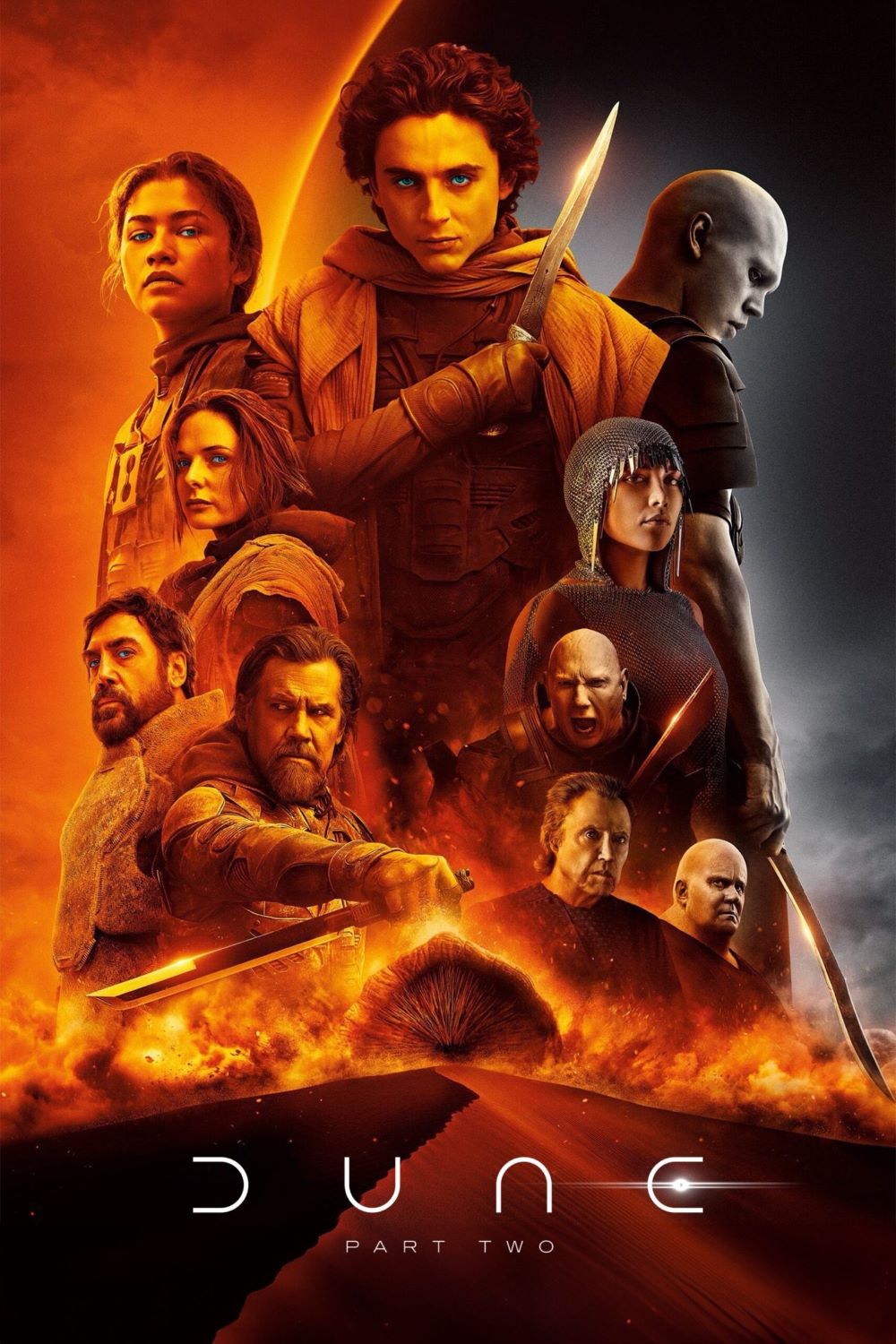
Bless the Maker – The Dune Part Two trailer has arrived!


The trailer for Denis Villeneuve’s Dune Part Two was just released. We’re seeing some new faces in Florence Pugh as Princess Irulan, Austin Butler as Feyd, Lea Seydoux as Lady Margot and Christopher Walken as the Padishah Emperor Shaddam IV. I like Javier Bardem’s Stilgar telling Paul to “Keep things simple.” here. So far, it’s looking good!

Dune Part Two will be released on November 3rd.

Ethan Hunt returns in the Mission: Impossible – Dead Reckoning Part One Teaser!


Holy Cow! On Twitter, Christopher McQuarrie dropped the teaser trailer for Mission: Impossible – Dead Reckoning – Part One and there’s just so much to unpack here. Lorne Balfe reunites with McQuarrie on the score and I’m loving the piece that plays in this trailer. It looks like almost everyone from Mission: Impossible Fallout are back, and some new faces are present with Haley Atwell joining the fray. It’s also interesting to see Henry Czerny back in the mix. If the Fast and Furious movies have taught us anything, it’s that you can always find a use for a character you thought you shelved. Wow, it’s just a teaser, and it’s only Part One! I’m pretty excited for this.

The Sleeper Awakens with the new Dune Trailer


Just about everyone’s waiting for Denis Villeneuve’s remake of Frank Herbert’s Dune. Having grown up on the David Lynch version (and making my way through the novel), it has some big shoes to fill. Thankfully, what we’ve seen of it so far seems interesting. Villeneuve should have an easy time with the source material, though the movie has had its share of reshoots and dealing with the pandemic. We’ll see how it goes.

We finally have a trailer and some Wormsign!!. I’m liking the look of it. Chalamet’s Paul Atreides has some attitude to him, and I’m curious to see what Stellan Skarsgard does with the Baron Harkonnen.

Enjoy.

<- Artwork of the Day: A Bloody Business Artist Profile: Stewart Rouse ->

The Utah Film Critics Association honors Parasite and 1917!


On Sunday, the Utah Film Critics Association announced their picks for the best of 2019 and it was another good showing for Parasite!  The film picked up awards for best picture, best screenplay, and best non-English language film.  Meanwhile, 1917 took awards for direction and cinematography while Adam Driver and Scarlett Johansson took home the acting awards for Rise of Skywalker and Avengers: Endgame …. just kidding!  They both won for Marriage Story.

Here are the winners!

Best Picture: Parasite. Runner-up: Once Upon a Time … in Hollywood.

Best Achievement in Directing: Sam Mendes, 1917. Runner-up: Quentin Tarantino, Once Upon a Time … in Hollywood.

Best Lead Performance, Male: Adam Driver, Marriage Story. Runner-up: Joaquin Phoenix, Joker.

Best Lead Performance, Female: Scarlett Johansson, Marriage Story. Runner-up: Lupita Nyong’o, Us.

Best Supporting Performance, Female: Florence Pugh, Little Women. Runner-up: Rebecca Ferguson, Doctor Sleep.

Best Supporting Performance, Male: Joe Pesci, The Irishman. Runner-up: Willem Dafoe, The Lighthouse.

Vice/Martin Award for Performance in a Science-Fiction, Fantasy or Horror Film: Robert Downey, Jr., Avengers: Endgame. Runner-up: Lupita Nyong’o, Us.

Best Original Screenplay: Bong Joon-ho and Jin Won Han, Parasite. Runner-up: Rian Johnson, Knives Out.

Best Adapted Screenplay: Greta Gerwig, Little Women. Runner-up: Taika Waititi, Jojo Rabbit.

Best Cinematography: Roger Deakins, 1917. Runner-up: Jarin Blaschke, The Lighthouse.

Best Original Score: Matt Morton, Apollo 11. Runner-up: Dan Levy, I Lost My Body.

Best Film Editing: Todd Douglas Miller, Apollo 11. Runner-up: Andrew Buckland, Michael McCusker and Dirk Westervelt, Ford v Ferrari.

Best Documentary Feature: Apollo 11. Runner-up: Hail Satan?

Best Animated Feature: I Lost My Body. Runners-up: How to Train Your Dragon: The Hidden World and Toy Story 4.

Best Non-English Language Feature: Parasite. Runner-up: Portrait of a Lady on Fire.


Film Review: Doctor Sleep (Dir. by Mike Flanagan)


If I asked you about Stephen King’s The Shining, would the book or the film come to mind?

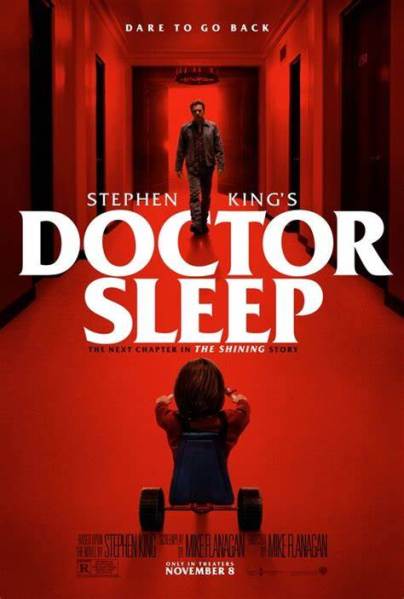
DoctorSleepPosterWhen it comes to adapting Stephen King’s stories to film, it’s not an easy feat. King himself had a problem turning his own short story “Trucks” into something good when he directed Maximum Overdrive. For every great film like Stanley Kubrick’s The Shining, or It-Chapter One, we occasionally get a misstep like The Dark Tower or It-Chapter Two.  As King can sometimes get wordy in his books, I’ve felt the best adaptations were the ones where the director’s own vision came into play. Kubrick made a number or changes to King’s story, including the Grady twins and the hedge maze, which were never in the novel. The film is so widely recognized that most people recall events in the movie, rather than the book. That’s the effect Kubrick had. 

With Doctor Sleep, Mike Flanagan once again proves he’s a fantastic fit for King. The film moves at a great pace, with great performances by Rebecca Ferguson and newcomer Kyliegh Curran. In an age where audiences are typically quiet, the applause that occurred in scenes during last night’s preview screening were great to hear. The film manages to pay homage to Kubrick’s The Shining and King’s Novel of Doctor Sleep while still completely showcasing Flanagan’s vision. Of course, we already knew this from Flanagan taking on King’s own Gerald’s Game and Netflix’s The Haunting of Hill House.  One might even argue that for this film, we may in time recall Flanagan’s tale more clearly than King’s.

Doctor Sleep takes place after the events of The Shining, with Dan Torrance (Ewan McGregor) suffering from the same demons that plagued his father, Jack. Although the keeps to himself, he drinks too much, gets into brawls, and is unable to hold down decent work. Dan is also haunted by the Overlook Hotel, and the power that drew the souls to him known as The Shining. The Shining (or just the Shine) is a coveted power in King’s lore. When a group of nomads that feed on the Shine (in a way that’s reminiscent of Mick Garris’ Sleepwalkers) discover a girl with the same ability, Dan is brought out of hiding. 

Fans of the original Kubrick film will see there’s a lot of love here. You’ll be able to count some of the references to The Shining, from objects in a room to different locales. For casting, Flanagan uses a mixture of old favorites and new faces. You’ll recognize some of them right from the start, such as Bruce Greenwood and Violet McGraw. Others, like Jacob Tremblay (The Predator) are welcome additions. Rather than relying on footage from the original Shining, Flanagan recreates certain elements with new cast members, which I felt worked extremely well here. I’m not sure how others will take it.

Ewan McGregor is good in the role of Dan Torrance, which feels more like his Mark Renton character from Trainspotting than anything else to me.  This isn’t a bad thing, but it works. The film truly belongs to both Rebecca Ferguson (Mission Impossible: Fallout) and Kyliegh Curran. Ferguson’s Rose the Hat is a wicked villain, and she carries the role with a sinister, yet stylish flair. Ferguson has some of the best scenes in the film, particularly when paired with Zahn McClarnon (Midnight, Texas and Westworld), who plays Crow Daddy. Kyliegh Curran chews up the scenes she’s in, easily handling screen time with McGregor and Ferguson like a pro. Rounding out the cast are Cliff Curtis (Sunshine), Carl Lumbly (Mantis) and Emily Alyn Lind (The Babysitter). 

Doctor-Sleep-1

Dan Torrance (Ewan McGregor) can’t run from his past in Mike Flanagan’s Doctor Sleep.

As for the fear factor, there is some terror in the hunt for Abra and the way that the group interact. Doctor Sleep doesn’t have much in the way of jump scares, but makes up for it with some tense moments. I didn’t feel as scared as I did with It-Chapter One, but I cared enough about the characters to worry about how the story was going to turn out. That might be a turn off for those expecting to watch the movie from between their fingers or run out of the theatre screaming. If you enjoyed Flanagan’s other works, such as Hush or Oculus, you’ll be fine.

Speaking of Hush, Doctor Sleep lacks a Kate Siegel cameo. Flanagan is Siegel’s partner in crime (and husband). Together, they’ve been in almost every film they’d done. I’ve gotten used to going “Oh, there’s Kate!”, while watching his films. It’s not an issue at all, but it would’ve been cool to see her.

The camera work for Doctor Sleep is very even, though there are a few special effects scenes that really stand out and picked up some applause (or gasps) once they were over. The one main drawback I had with the film was that it was a little difficult to keep up with all of the locations and time periods early on. Even though everything’s clearly labeled, it took me a moment to recognize just where and when things were occurring. Not a terrible thing, though.

Overall, Doctor Sleep is an easy film to recommend. It has some great performances, and manages to be a great follow up to The Shining, while showing a lot of love for the source material.

Doctor Sleep hits cinemas on Friday, November 8th, and I’ll make a return visit.


Trailer: Men In Black International


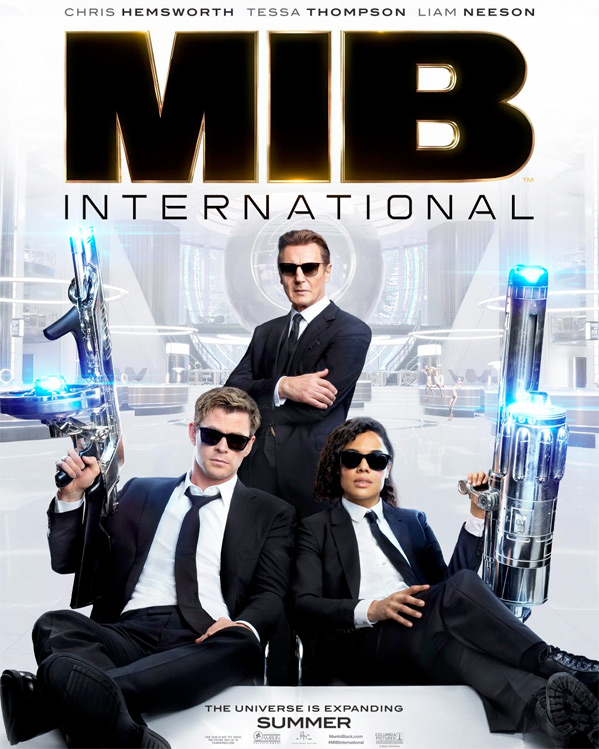
MIB International

It looks like we have a set of new agents donning the black suits this time around.

Seems Thor and Valkyrie are doing a side gig for the Men In Black. There’s no Agent K or Agent J to save the world from otherworldly dangers. We now have Agent H and Agent M to take up the mantle of protecting the world. The trailer also shows us that the MIB is a global organization and no more New York as the stomping ground, but we also have London and it’s branch of the MIB.

Men In Black International was a sequel that didn’t garner too much excitement when first announced, but as the cast was finalized and announced the excitement began to rise. And it is quite a cast when one really looks at it: Chris Hemsworth, Tessa Thompson, Liam Neeson, Emma Thompson, Kumail Nanjiani, Rafe Spall and Rebecca Ferguson.

Men In Black International will be out June 14, 2019. A release date with enough time between it and the juggernaut that will be Avengers: Endgame.

Film Review: The Snowman (dir by Tomas Alfredson)


So, I finally watched the 2018 thriller, The Snowman, and my main reaction to the film is that it featured a lot of snow.

That’s understandable, of course.  The film takes place in Norway and it’s called The Snowman so, naturally, I wasn’t expecting a lot of sunshine.  Still, after a while, the constant shots of the snow-covered landscape start to feel like almost some sort of an inside joke.  It’s almost as if the film is daring you to try to find one blade of grass in Norway.  Of course, the snow is important because the film’s about a serial killer who builds snowmen at the sites of his crimes.  They’re usually pretty big snowmen as well.  It’s hard not to be a little impressed by the fact that he could apparently make such impressive snowmen without anyone noticing.

Along with the snow, the other thing that I noticed about this movie is that apparently no one knows how to flip a light switch in Norway.  This is one of those films where every scene seems to take place in a dark room.  I found myself worrying about everyone’s eyesight and I was surprised the everyone in the film wasn’t wearing glasses.  I can only imagine how much strain that puts on the eyes when you’re constantly trying to read and look for clues in the dark.

Michael Fassbender plays Harry Hole, a Norwegian police inspector who may be troubled but still gets results!  He’s upset because his ex-girlfriend (Charlotte Gainsbourg) has a new boyfriend (Jonas Karlsson).  He’s also upset because his son (Michael Yates) doesn’t know that Harry is actually his father.  Or, at least, I think that Harry’s upset.  It’s hard to tell because Fassbender gives a performance that’s almost as cold as the snow covering the Norwegian ground.  Of course, he’s always watchable because he’s Fassbender.  But, overall, he doesn’t seem to be particularly invested in either the role or the film.

Harry and his new partner (Rebecca Ferguson) are investigating a missing person’s case, which quickly turns into a multiple murder mystery.  It turns out that the crimes are linked to a bunch of old murders, all of which were investigated by a detective named Gert Rafto (Val Kilmer).  Gert was troubled but he still got results!  Or, at least, Harry thinks that he may have gotten results.  Nine years ago, Rafto died under mysterious circumstances…

Now, I have to admit that when, 30 minutes into the film, the words “9 years earlier” flashed on the screen, I groaned a bit.  I mean, it seemed to me that the movie was already slow enough without tossing in a bunch of flashbacks.  However, I quickly came to look forward to those brief flashbacks, mostly because they featured Val Kilmer in total IDGAF mode.  Kilmer stumbles through the flashbacks, complete with messy hair and a look of genuine snarky bemusement on his face.  Kilmer gives such a weird and self-amused performance that his brief scenes are the highlight of the film.

Before it was released, The Snowman was hyped as a potential Oscar contender.  After the movie came out and got roasted by the critics, director Tomas Alfredson replied that the studio forced him to rush through the production and that 10 to 15% of the script went unfilmed.  Considering Alfredson’s superior work on Let The Right One In and Tinker, Tailor, Soldier, Spy, I’m inclined to give him the benefit of the doubt.  The film’s disjointed style would certainly seem to back up Alfredson’s claim that there was originally meant to be more to the film than actually ended up on the screen.

The Snowman is one of those films that doesn’t seem to be sure what it wants to be.  At times, it aspires to David Lynch-style surrealism while, at other times, it seems to be borrowing from the morally ambiguous crime films of Taylor Sheridan.  Ultimately, it’s a confused film that doesn’t seem to have much reason for existing.  At the same time, I’ve also been told that the Jo Nesbø novel upon which the movie is based is excellent.  The same author also wrote the novel that served as the basis for 2011’s Headhunters, which was pretty damn good.  So, read the book and ignore the film.

Playing Catch-Up With The Films of 2017: Life (dir by Daniel Espinosa)


I don’t care what Neil deGrasse Tyson says.  Space is dangerous.

Just judging by what I’ve seen in the movies, it might be a good idea for humanity to stay earthbound.  Seriously, it seems like every time a group of astronauts and scientists spend an extended period of time off of our planet, bad shit happens.  They either end up leaving behind someone on Mars or sometimes they crash land on a planet inhabited by vampires.  Occasionally, they end up with evil creatures bursting out of their chest and, if they’re not careful, they might even end up accidentally traveling all the way to Hell and back.

For that matter, it might be a good idea to also stop listening to Bill Nye.  I’ve seen enough movies to know better than to trust science.  Did you know that every time a revived corpse has gone on a killing spree, a scientist has been to blame?  In the movies, science always says it’s going to make the world a better place but ultimately, it just seems to make things worse.

Consider Life, for instance.

This science fiction film, which came out earlier this year and didn’t stick around in theaters for very long, opens with the crew of the International Space Station taking questions from a group of school children on Earth.  Everyone is really excited because a probe has been picked up evidence that there was once extraterrestrial life on Mars.  Starting from one cell, the scientists have managed to clone an alien organism.  (Or something like that.  Wisely, the movie doesn’t waste too much time on how all of this actually works.)  The school kids name the organism Calvin.

Isn’t that cute?

But here’s the thing.  Life is a science fiction/horror movie hybrid and, as a result, we already know that it was a mistake to bring that alien to life.  We know that almost everyone in that space station is going to die a terrible death.  It doesn’t matter that the scientists are played by people like Jake Gyllenhaal, Ryan Reynolds, and Rebecca Ferguson  We know what is going to happen because we’ve all seen at least one movie in the Alien franchise.  We know what’s going to happen and, when things start to fall apart, the entire audience nods and says, “I told you so.”

That’s not to say that Life doesn’t work.   Life may be predictable but that’s actually a part of the film’s charm.  This is the type of film that you need to watch with a group of your loudest and snarkiest friends.  (I watched it with my sisters during the 4th of July weekend.  We all love Jake.  We all love Ryan.  Things got a bit out of hand.)  You don’t watch Life because you’re looking for an upbeat portrait of space exploration.  You watch Life so that you can yell, “No, don’t bring Calvin to life!  No, you idiot!  Don’t go into space!  Don’t lock yourself in the lab!  HAVEN’T ANY OF YOU SCIENTISTS EVER SEEN A HORROR MOVIE BEFORE!?”

(Indeed, one of the unexpected pleasures of Life was seeing that even brilliant people will do stupid things when confronted by the unknown.)

That said, Life occasionally caught me off guard.  It’s not that I was shocked to see the members of the cast being picked off one by one by Calvin.  Instead, I was shocked by the film’s relentlessly dark and bleak vision.  For a film called Life, it’s ultimately all about death.  Just because a character is being played by a big star, that doesn’t mean they won’t end up with Calvin entering their body and graphically devouring them from the inside out.  Calvin was a truly frightening creation and director Daniel Espinosa does a good job of capturing the claustrophobia and clutter of the space station.  Even if they didn’t exactly break any new ground, Espinosa and screenwriters Rhett Reese and Paul Wernick deserve a lot of credit for pursuing the film to its dark conclusion.  In space, they seem to suggest, there is no hope.

In conclusion, the main lesson of Life seems to be this: outer space is a terrible place and the worst thing that humanity can do is leave the planet.  Science is going to be the death of us.  Neil deGrasse Tyson has a lot to answer for.

Film Review: The Girl On The Train (dir by Tate Taylor)


the-girl-on-the-train

Before I get around to talking about The Girl On The Train, I’m going to tell you a little story about myself.

A few years ago, I used to make a point of riding the DART train.  (DART stands for Dallas Area Rapid Transit.  Large sections of Upstream Color were filmed on a DART train.)  Every weekend, instead of driving out to the Dallas Angelika or the Dallas Museum of Art and contributing to climate change or whatever it was that I was supposedly doing whenever I drove my car, I would hop on the train.  It was a little inconvenient but I was saving the world.  Or something.

It was about a 30 minute ride from my local DART Station to downtown Dallas and I have to admit that I actually used to enjoy it.  I would always look out the window and watch as Dallas passed by.  I got to know all of the buildings and houses on the route pretty well.  Thanks to riding the DART train, I discovered that there’s a house on Forrest Lane that’s been boarded up for five years and counting.  Near Spring Creek, there’s a two-story house that I wouldn’t mind owning.  It’s a two-story glass house and it has a really nice deck that looks out over the creek.  I would always look at those houses and, in my mind, I would make up lurid stories about the people who lived there.  For a while, it was great fun.

(Unfortunately, it eventually stopped being fun but that’s a story that will have to wait for whenever I finally get around to reviewing Ms. 45…)

As I watched The Girl On The Train, I started to think about those times on the DART train.  And the more I thought about it, the more I realized that every story that I came up with while sitting on my DART train was a hundred times more interesting than anything that happened in The Girl On The Train.

Emily Blunt stars as Rachel Watson.  Rachel is an alcoholic.  She got divorced from Tom (Justin Theroux) after she discovered that Tom was having an affair with their real estate agent, Anna Boyd (Rebecca Ferguson).  Tom and Anna are now married and have a baby.  Rachel, meanwhile, is a blackout drunk who has been unemployed for a year.  She spends her time on a train, drinking and ride back and forth between Connecticut and New York.

Every night, the train stops near Rachel’s old house.  Rachel looks out the window and she stares at her former home.  Occasionally, she sees Tom and Anna celebrating their new life.  Rachel also finds herself obsessing on the house next door.  Megan Hipwell (Haley Bennett) lives at the house and works as Tom and Anna’s nanny.  As Rachel discovers from looking out the train’s window, Megan is cheating on her husband with a mysterious, bearded man (Edgar Ramirez).

(Rachel has a really good view from her window seat.  Admittedly, I’m notoriously near-sighted so I might not be the best judge, but I could never actually see what was happening inside any of the houses that I stared at.  Rachel, however, must have super vision.  Maybe she was Supergirl before she turned into an alcoholic.  Who knows?)

One day, a drunk-off-her-ass Rachel forces her way off of the train and stumbles towards her former home.  She thinks that she sees Anna jogging and chases after her.  “Whore!” Rachel yells before passing out.  When Rachel regains consciousness, she can’t remember anything that happened.  But she has vague memories of being involved in some sort of struggle…

Eventually, Rachel learns that Megan is missing and presumed murdered.  Even worse, Rachel is the number one suspect.  The main detective (who is somewhat inevitably played by Allison Janney) suspects that Rachel mistook Megan for Anna.  It turns out that Rachel has a history of erratic behavior.  She even tried to kidnap Tom and Anna’s baby!  Seriously, lock Rachel up!

Trying to figure out what happened and clear her name, Rachel approaches Megan’s husband, Scott (Luke Evans) and pretends to be a friend of Megan’s.  It turns out that Scott was an abusive husband.  Soon, he’s both confiding in Rachel and encouraging her to start drinking again.  Rachel starts spending more and more time with Scott and it becomes obvious that she’s trying to live the life that she once imagined that Megan and Scott had.  There’s an interesting subtext to both Rachel’s obsession with Megan and her attempt to start a new relationship with Scott but it’s never really explored.  Instead, it’s brought up and then abandoned a few scenes later.

In fact, as a film, The Girl On The Train never really explores anything.  (It only grudgingly hints at the complexity of the book on which it was based.)  As opposed to similar films like Gone Girl or Denis Villeneuve’s Prisoners, there’s not much depth or insight to The Girl On The Train.  I’ve read some reviews that have complained that The Girl On The Train is “melodramatic” or “trashy,” but, if that were the case, it would at least be a fun movie to watch.  This is one of those films that thinks it’s a lot deeper than it actually is.

The Girl On The Train was probably doomed as soon as Tate Taylor was hired to direct it.  Taylor previously directed both The Help and a musical biopic called Get On Up.  Tate Taylor is one of those directors who goes out of his way not to challenge his audience (The Help is one of the most positive films about systemic racism that I’ve ever seen) but The Girl On The Train needed a director with more of a subversive edge.  The Girl On The Train needed a director who would embrace the film’s pulpy sensibility as opposed to one who would go out of his way to sand away the story’s rough edges and create an inoffensive and bland product that would be perfect for mass consumption.

And then you’ve got the film’s cast, which is full of talented performers who all seem to be uniquely uninspired by the material that they have to work with.  Emily Blunt did such good work in Looper and Sicario so why is she so boring here?  Why does Justin Theroux seem to be eagerly awaiting the end of the movie?  Why are both Haley Bennett and Rebecca Ferguson reduced to playing characters who feel as if they’ve sprung out of a misogynist’s daydream?  What is Edgar Ramirez even doing in the movie?  Or Lisa Kudrow?  Or Laura Prepon?  Why is it that every world-weary female authority figure has to be played by Allison Janney?  Why?  Why?  Why!?

So, I have to admit that I was a bit disappointed with The Girl On The Train.  I think I would have been more entertained if I had just hopped on the DART train and let my imagination do the rest of the work.