Warhammer 40,000: Inside the Grimdark Galaxy


“In the grim darkness of the far future, there is only war.”

Warhammer 40,000—usually shortened to Warhammer 40K, 40K, or simply Warhammer—is a science-fiction miniature wargame and one of modern pop culture’s largest shared fictional universes. Built around the famously bleak promise that “In the grim darkness of the far future, there is only war,” it imagines humanity in the 41st millennium: still alive, but reduced to a decaying, fanatical, militarized empire fighting an endless conflict against aliens, demonic powers, and its own self-destructive instincts.

What began in 1987 as a strange, punk-inflected tabletop release has become a global entertainment property spanning miniatures, novels, comics, animation, video games, audiobooks, collectible figures, apparel, and planned screen projects. Its strength is that it works on several levels at once: it is a tactical game, an art-and-modeling hobby, an enormous science-fiction mythology, a cosmic-horror setting, a military epic, and a satire of authoritarianism pushed so far that it becomes monstrous.

From Rogue Trader to a Global Hobby

Warhammer 40K emerged from Games Workshop’s earlier success with Warhammer Fantasy Battle. Founded in the United Kingdom during the 1970s, Games Workshop began as a hobby company concerned with mail-order games, tabletop role-playing games, and miniatures. After the release of Warhammer Fantasy Battle in 1983, the company developed a science-fiction counterpart: Warhammer 40,000: Rogue Trader, released in 1987. Games Workshop identifies that launch as a major turning point and says the game rapidly became the world’s most popular wargame.

The original Rogue Trader was far stranger and less regimented than modern 40K. It was part skirmish game, part tabletop role-playing game, and part open-ended science-fiction sandbox. Players might command a small expedition of explorers, mercenaries, aliens, mutants, pirates, or Imperial agents rather than the large armies associated with the game today. The rules encouraged improvisation, scenario-building, character creation, and the invention of bizarre corners of a hostile galaxy.

Its titular Rogue Traders were Imperial explorers and licensed opportunists: merchants, colonizers, diplomats, archaeologists, and private adventurers granted authority to travel beyond the Imperium’s established borders. That concept captures early 40K’s loose, exploratory spirit. The setting was a collage of pulp adventure, cosmic horror, war fiction, medieval religious imagery, dystopian bureaucracy, science-fiction clichés, and black comedy.

As later editions arrived, Warhammer 40K increasingly became an army-scale miniature wargame. Players began building forces around recognizable factions, leaders, squads, vehicles, and monsters. They buy unpainted plastic or resin kits, assemble them from separate parts, customize their weaponry and colors, paint them, and deploy them on terrain-filled tables.

A game may involve infantry formations, tanks, artillery, giant psychic creatures, alien swarms, aircraft, war machines, and genetically engineered super-soldiers. Dice resolve shooting, melee attacks, armor saves, morale, special abilities, and unpredictable battlefield events. Rulebooks and faction codexes provide the mechanical framework, but the miniatures remain the true center of the hobby. They are game pieces, collectible objects, art projects, and physical embodiments of the fiction.

A Universe Built From Influences

Part of Warhammer 40K’s longevity comes from its deliberately hybrid nature. It was never built from one source, genre, or artistic philosophy. It is a science-fantasy setting assembled from decades of literature, comics, horror, military fiction, mythology, history, tabletop gaming, heavy-metal album art, and British satire. Its most distinctive achievement is not inventing every ingredient from scratch; it is fusing familiar influences into a universe with an immediately recognizable voice and aesthetic.

Frank Herbert’s Dune is among the clearest and most consequential influences. Dune supplied a model for science fiction that felt ancient, religious, feudal, ecological, political, and mythic all at once. The 40K Emperor shares obvious conceptual territory with Leto Atreides II, the transformed ruler at the center of Herbert’s God Emperor of Dune. Rick Priestley has explicitly compared the Emperor to Leto, noting the shared notion of a ruler defined by long-term sacrifice and an individual transformed into a reluctant or burdensome deity.

The influence appears throughout 40K’s structure. The title “God-Emperor,” the use of “lasgun,” the importance of interstellar navigation, the dangers of psychic power, and the notion of a galaxy shaped by feudal houses, religious institutions, and decaying imperial authority all evoke the imaginative territory Herbert helped popularize. The Imperium is not a direct copy of Herbert’s Imperium, but it channels the same sense of vast history and civilizational exhaustion: humanity has conquered the stars, yet has become trapped by the systems it created.
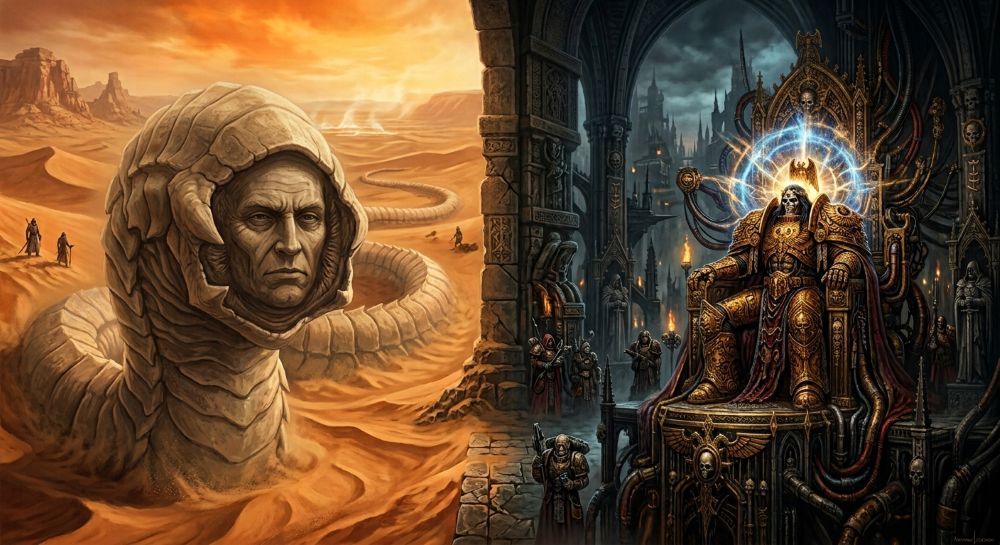
Dune also helps explain why 40K feels less like sleek technological futurism and more like a medieval empire projected into space. The Imperium has spaceships, energy weapons, genetic engineering, and interstellar travel, but it is socially structured around dynasties, priesthoods, hereditary institutions, sacred relics, and ritualized warfare. A starship captain can wield authority like a feudal noble; a machine-priest can treat a computer system as a holy object; an entire planet can be governed according to rules that resemble an exaggerated mixture of medieval monarchy, colonial empire, and religious absolutism.

Robert A. Heinlein’s Starship Troopers also looms behind the setting, especially in its militarized future, armored infantry, planetary invasions, and questions about citizenship, duty, service, and the relationship between soldiers and the state. The Space Marine may not be a direct lift from Heinlein’s mobile infantry, but 40K shares the image of heavily armored future soldiers descending into hostile worlds as humanity’s elite warriors. The major difference is tonal. Heinlein’s novel is explicitly invested in debating civic responsibility and military service; 40K turns militarized citizenship and state power into a far more excessive, terrifying, and baroque nightmare.

The roots of Chaos reach deeply into the work of Michael Moorcock, especially the Elric stories, the broader Eternal Champion cycle, and Moorcock’s recurring tension between cosmic order and cosmic chaos. Priestley has said that Realm of Chaos, a foundational early Warhammer supplement, drew inspiration from Moorcock’s fiction. Moorcock’s influence can be felt in Warhammer’s willingness to treat Chaos as more than generic evil. It is a metaphysical force of mutation, temptation, instability, transformation, corruption, and destructive freedom.

The Chaos Gods of 40K are not simply demons waiting outside reality. They are entities shaped by mortal emotion and civilization’s psychic debris. Rage creates Khorne, ambition feeds Tzeentch, despair strengthens Nurgle, and obsession empowers Slaanesh. That fusion of cosmic mythology and inner human failing is distinctly Moorcockian in spirit, even as 40K develops it into a universe of its own.

Walter M. Miller Jr.’s A Canticle for Leibowitz is another key lens through which to understand the Imperium. Miller’s post-apocalyptic novel imagines a future in which religious custodians preserve fragments of lost knowledge after civilization collapses, often without fully understanding what they have saved. The Adeptus Mechanicus—the techno-priests of Mars—operates on a grandiose science-fiction version of that principle. It preserves ancient technologies, treats machines as sacred, seeks lost artifacts, and often turns scientific understanding into religious ritual.

The Imperium’s relationship with technology is therefore central to its tragedy. Humanity possesses equipment advanced beyond anything available in the present day, yet much of that knowledge has been forgotten, distorted, or rendered taboo. A machine can be repaired through liturgical procedure. A blueprint can be treated like scripture. Innovation can be regarded with suspicion because it threatens inherited dogma. A Canticle for Leibowitz offers one important ancestor for that image of civilization after knowledge has become relic, ritual, and superstition.
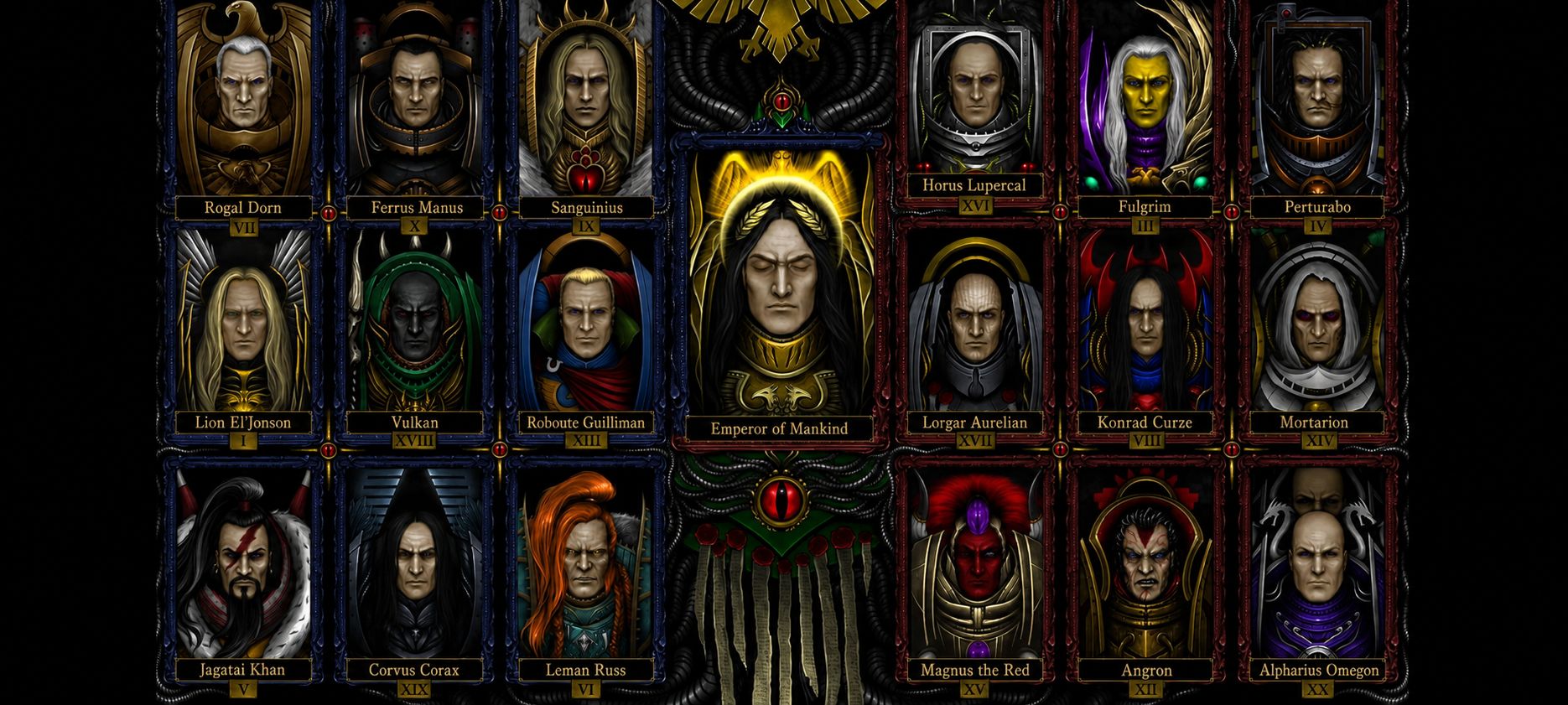
John Milton’s Paradise Lost also echoes through 40K, most strongly in the story of the Emperor, his Primarch sons, and the Horus Heresy. The broad outline has unmistakable Biblical and Miltonic flavor: a father figure of immense authority creates near-divine sons; his favored son falls into rebellion; a vast heavenly order is split by betrayal; the resulting war reshapes creation; and the remnants of the fallen become demons or devils waging eternal war against their former kin.

Horus Lupercal is not simply Satan, and the Emperor is emphatically not a straightforward God figure. 40K is too morally compromised for that kind of clean analogy. The Emperor can be visionary, tyrant, savior, manipulator, father, failed reformer, and imprisoned god all at once. Yet the emotional architecture is Biblical: the fall of beloved sons, the tragedy of betrayal, the creation of a false church around a broken father, and the transformation of rebellion into eternal damnation.

British comics are just as important as canonical science-fiction novels. The influence of 2000 AD—especially its anarchic, darkly comic, satirical approach to dystopia—helps explain 40K’s original voice. Judge Dredd offered a future city-state defined by absurdly authoritarian law enforcement, brutal social control, violence, and exaggerated fascistic spectacle. The comic’s writers and artists mixed dystopian science fiction with satire and a distinctive, sometimes savage sense of humor.

That sensibility can be found in 40K’s hive cities, the planet-sized urban slums and industrial nightmares where billions live under crushing conditions. It can be found in the Adeptus Arbites, the Imperium’s heavily armed enforcers; in the Inquisition’s secret-police authority; and in the setting’s fascination with rules so vast and convoluted that they become a form of madness. If Dune helped give 40K its mythic science-fantasy scale, 2000 AD helped give it its dystopian absurdity and its willingness to make political cruelty both horrifying and grotesquely ridiculous.

The Grim Darkness of Humanity

The universe of Warhammer 40K is set roughly 38,000 years in the future, during the 41st millennium. Humanity once spread across the stars during a technological golden age, but that civilization collapsed under the weight of war, artificial intelligence, psychic catastrophe, isolation, and rebellion. By the present-day setting, human worlds have been reassembled into the Imperium of Man, an unimaginably vast empire that is too decentralized, bureaucratic, and dangerous to be fully governed.

The Imperium is humanity’s main shield against extinction, but it is also one of genre fiction’s most oppressive regimes. It is a theocracy governed through censorship, terror, war, forced labor, religious obedience, and endless sacrifice. Its authorities routinely destroy entire populations to stop the spread of Chaos, mutation, rebellion, or alien influence. Its citizens are taught to fear difference and accept death in the Emperor’s service as the highest possible duty.

At the center is the Emperor of Mankind. Long ago, the Emperor was an active psychic ruler who attempted to unite humanity under a secular, rational Imperium. Following the catastrophic civil war known as the Horus Heresy, he was mortally wounded and placed upon the Golden Throne, a colossal life-support device on Terra—the future Earth. Ten thousand years later, he is physically inert, sustained by immense sacrifice, but is worshipped as a literal god by trillions of Imperial citizens.

The irony is crucial: the Emperor’s earlier project was hostile to religion, yet the civilization founded in his name has turned him into the center of a fanatical state faith. His dead or dying body has become a symbol that justifies absolute obedience, endless crusades, censorship, and the persecution of anyone defined as impure or disloyal.
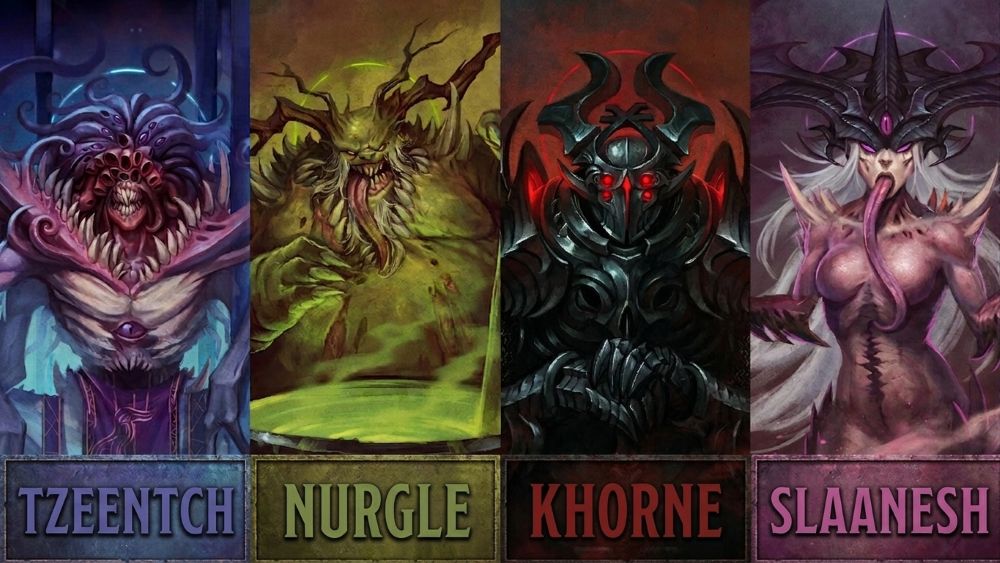
The galaxy is connected by the Warp, a parallel psychic dimension used for interstellar travel and communication. But the Warp is unstable, dangerous, and shaped by mortal thought and emotion. It is home to Chaos, a supernatural force embodied by four great gods:

  • Khorne, the god of rage, war, slaughter, blood, and martial violence.
  • Tzeentch, the god of change, sorcery, mutation, ambition, manipulation, and conspiracy.
  • Nurgle, the god of plague, decay, despair, entropy, and grim endurance.
  • Slaanesh, the god of obsession, pleasure, excess, perfection, sensation, and self-destruction.

Chaos is both an external threat and an internal consequence. It feeds on the fear, pain, rage, greed, and desperation of sentient life. The more brutal and hopeless the galaxy becomes, the stronger Chaos becomes. This makes the universe a self-perpetuating tragedy: the Imperium commits atrocities to preserve itself, but its cruelty produces exactly the despair and violence upon which its greatest enemy thrives.

Fascism, Satire, and the Imperium

Any serious account of Warhammer 40K has to address the politics embedded in the Imperium of Man. Its authoritarian, fascistic, xenophobic, ultra-nationalist, and theocratic character is foundational to the setting. It is not a decorative aesthetic applied to otherwise uncomplicated heroes. The Imperium is a nightmare-state built from state violence, militant conformity, religious terror, permanent war, enforced ignorance, and the idea that collective survival excuses every atrocity.

The Imperium’s language is full of concepts familiar to real-world authoritarian movements: purity, loyalty, unity, sacrifice, tradition, enemies within, enemies without, obedience to sacred authority, and extermination of the “other.” Aliens are not merely rivals but existential contaminants. Mutants are treated as proof of corruption. Heresy is not a disagreement but a disease. Citizens are expendable resources in a war machine. The state is sacred; doubt is treason.

But that is not an invitation to admire the Imperium. Its grotesque political logic is part of the property’s original satirical foundation. The early Rogue Trader era was shaped by the same punk, anti-establishment, dystopian, and satirical energy that ran through much British genre culture during the 1980s. Its creators were working against the backdrop of Thatcher-era Britain, a period of profound political conflict over nationalism, policing, class, militarism, organized labor, public institutions, and the treatment of dissent.

The broader Warhammer line occasionally made that influence explicit. The 1986 campaign The Enemy Within, written for Warhammer Fantasy Roleplay, included Empress Magritta/Magraritha as a pointed satire of Margaret Thatcher, while its title echoed Thatcher’s notorious rhetoric about “the enemy within.” It would be simplistic to reduce the whole of 40K to a single anti-Thatcher allegory, especially after decades of expansion under many writers. Yet the setting’s foundational instinct was to take authoritarian rhetoric and imperial fantasy to ridiculous, horrifying extremes.

The Imperium is the ultimate in-joke about the bankruptcy of those ideas. It asks what would happen if every authoritarian fantasy—racialized or species-based purity, sacred hierarchy, militarized masculinity, obedience, nationalism, fear of outsiders, religious certainty, and expansion through force—were granted total control over a galaxy for ten thousand years. The answer is not a stable civilization. It is stagnation, paranoia, ignorance, endless violence, and a government that can preserve life only by making life unbearable.

This is why far-right and fascistic bad-faith actors who try to claim the Imperium as an ideal are missing the point, whether unintentionally or deliberately. They see its armored soldiers, skull-covered banners, huge weapons, slogans about purity, and worship of the God-Emperor as an image of restored order. Yet 40K frames the actual consequences of this “order” as horrific: worlds burned clean, populations sacrificed, dissidents tortured, knowledge lost, and humanity spiritually hollowed out.
Games Workshop has directly addressed real-world prejudice and fascist appropriation in its community. It stated that it would “never accept nor condone any form of prejudice, hatred, or abuse,” described the Imperium as driven by hatred and extreme xenophobia, and declared: “The Imperium is driven by hate. Warhammer is not.” The company also stated that people displaying real-world hate symbols or behaving in discriminatory ways are not welcome in official stores, events, or the Warhammer community.

The satire can become complicated because Warhammer 40K is made to be visually spectacular. It sells massive armored warriors, cathedral-sized starships, gigantic tanks, heroic last stands, and grandiose military imagery. A Guardsman defending civilians or a Space Marine holding a city against monsters can still be brave. Individual courage is real within the fiction. But the heroic action of a character should not be confused with moral endorsement of the system that character serves.

A good way to understand the setting is to distinguish people from institutions. A soldier can be selfless; the empire can remain monstrous. A Space Marine can save a planet from Tyranids; the Imperium can still be a fascistic theocracy. The tragedy is that many of the setting’s protagonists have been born into conditions where brutality is taught as necessity and alternatives appear impossible.

Factions, Heroes, and Horrors

The most famous force in Warhammer 40K is the Adeptus Astartes, better known as the Space Marines. They are genetically engineered, heavily indoctrinated super-soldiers created from the genetic legacy of ancient demigod generals. Organized into independent Chapters rather than massive unified legions, Space Marines are the Imperium’s elite shock troops—the “Angels of Death.”
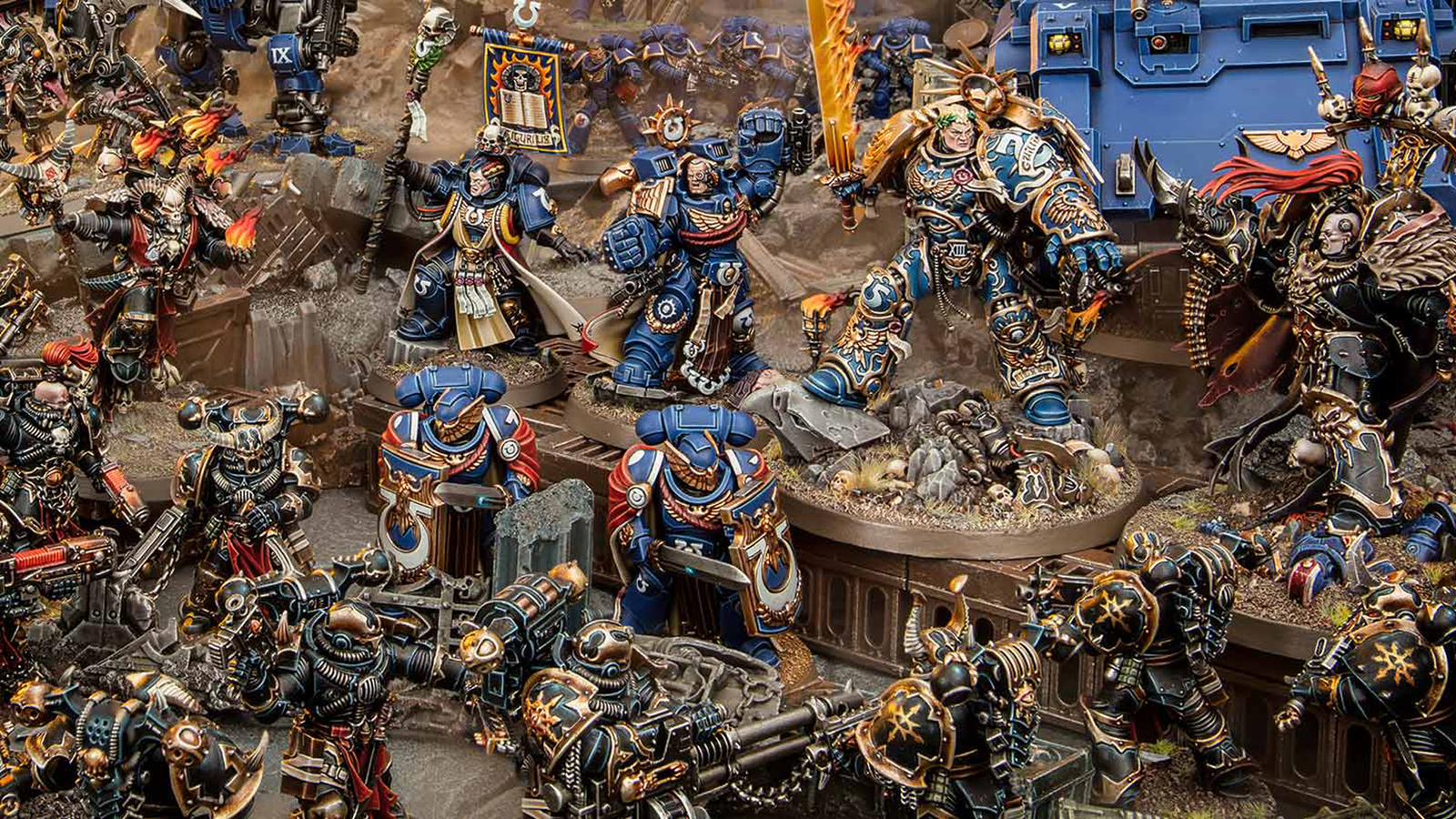
The Ultramarines are disciplined and highly organized warriors with Roman-style military and civic imagery. The Blood Angels are noble heroes afflicted by a hereditary thirst for bloodshed. The Dark Angels are secretive knightly warriors haunted by ancient betrayal. The Space Wolves use Viking and Norse mythic imagery, while the Black Templars are crusading religious zealots who embrace the Imperium’s faith with particular intensity.

The Imperium is much more than Space Marines. The Astra Militarum, also called the Imperial Guard, consists of ordinary human soldiers confronting impossible threats with rifles, tanks, artillery, discipline, and numbers. The Adeptus Mechanicus are the cybernetic techno-priests of Mars who preserve and worship ancient machines. The Adepta Sororitas, or Sisters of Battle, are armed warrior-nuns who serve the Imperial faith. The Inquisition hunts heresy, alien infiltration, rogue psykers, and Chaos cults with nearly unlimited authority. The Adeptus Custodes are the Emperor’s golden-armored bodyguards, while the secretive Grey Knights specialize in combating daemons.

The main human enemy is Chaos, and its most iconic servants are the Chaos Space Marines—the descendants of legions that rebelled against the Emperor during the Horus Heresy. The disease-ravaged Death Guard serve Nurgle. The occult Thousand Sons serve Tzeentch. The berserk World Eaters serve Khorne. These factions illustrate one of the franchise’s recurring themes: virtues such as courage, ambition, loyalty, knowledge, and strength can be warped into fanaticism, cruelty, obsession, and self-destruction.

The xenos factions are equally essential. The Orks are massive green war-addicts who find genuine joy in combat, making them one of the setting’s strangest blends of comedy and menace. The Aeldari, formerly called Eldar, are an ancient psychic species divided among multiple societies, including the nomadic Craftworld Aeldari and the sadistic Drukhari raiders. The Necrons are ancient machine dynasties awakening from tomb worlds to reclaim a galaxy they believe belongs to them. The T’au Empire is technologically advanced and organized around the “Greater Good,” but its rhetoric of unity also hides coercion, surveillance, and imperial expansion.
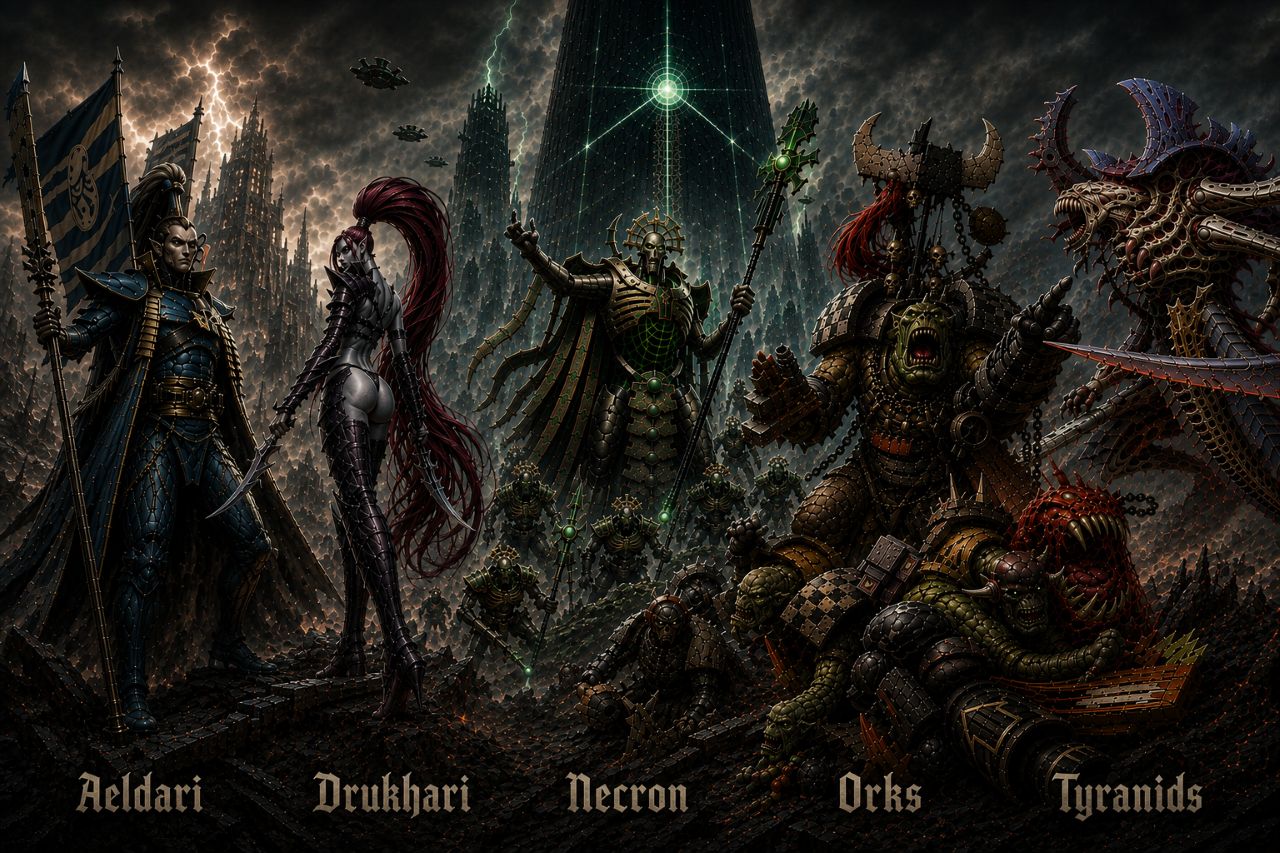
The Tyranids provide the setting’s purest form of cosmic horror. They are an extragalactic hive species controlled by the immense Hive Mind. They do not want land, gold, ideological victory, revenge, or diplomacy. They consume worlds for biomass. A Tyranid invasion strips a planet of plants, animals, people, oceans, and every possible usable resource. Their advance is often prepared by Genestealer Cults, which infiltrate human societies, breed hybrid populations, incite rebellion, and prepare entire worlds to be devoured.

The Horus Heresy and Mainstream Rise

The foundational historical event in Warhammer 40K is the Horus Heresy, a galaxy-wide civil war that occurred ten thousand years before the main setting. In humanity’s earlier period of expansion, the Emperor launched the Great Crusade, a campaign to reunite scattered human worlds beneath a secular Imperium. To command his armies, he created twenty Primarchs, superhuman sons and generals whose genetic material was used to create the original Space Marine Legions.

The Emperor’s favored son was Horus Lupercal, whom he named Warmaster. Horus was manipulated and corrupted by Chaos, then led roughly half of the Space Marine Legions in rebellion against the Emperor. The father-and-son imagery echoes Paradise Lost and Biblical tales of rebellion, but 40K gives it a brutally ambiguous twist: the Emperor is not a blameless divine father, and his rebellious sons are not united by a coherent moral cause. The war is a catastrophe born from pride, secrecy, ambition, manipulation, and the failure of a ruler who tried to shape humanity’s future through absolute control.

The Heresy ended during the Siege of Terra. The Emperor confronted Horus aboard the traitor’s flagship and destroyed him, but received mortal wounds in the process. The Emperor’s survival on the Golden Throne saved humanity from immediate collapse, yet it also ensured that the Imperium would spend the next ten thousand years worshipping a broken relic instead of realizing the future he claimed to seek.

The Horus Heresy became one of the franchise’s largest literary projects through the expansive The Horus Heresy novel series, and its ancient battles now form the basis of the dedicated tabletop game Warhammer: The Horus Heresy. Its impact explains nearly every major feature of modern 40K: the division of Space Marines into Chapters, the hatred between loyalists and traitors, the divinity of the Emperor, and the Imperium’s permanent paranoia about betrayal.

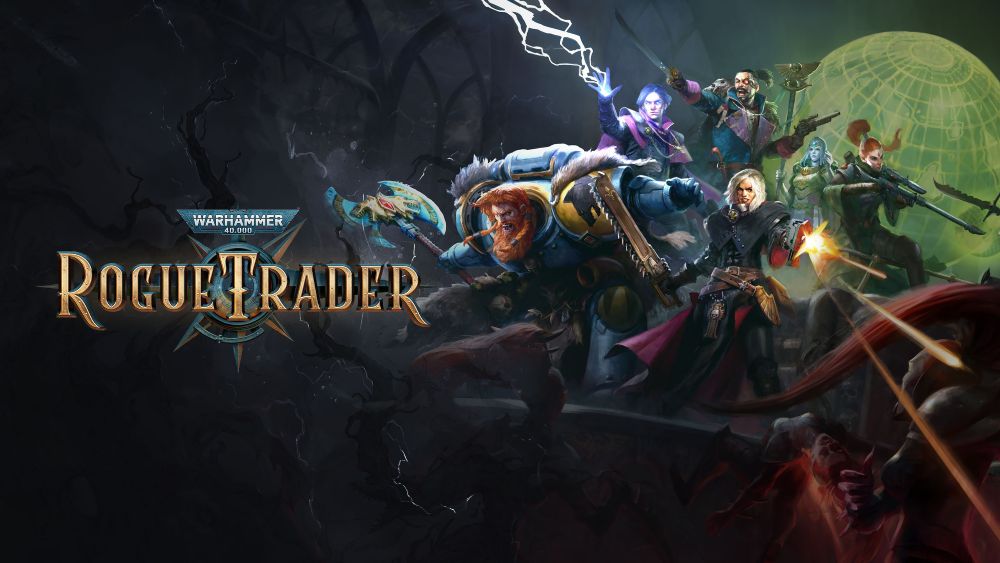
For decades, Warhammer 40K was huge within hobby culture but comparatively specialized in wider popular culture. Its mainstream growth accelerated through video games, online miniature-painting communities, audiobooks, social media, and increasingly polished adaptations. Relic Entertainment’s Warhammer 40,000: Dawn of War helped establish the setting as a major PC strategy property after its 2004 release. Later games such as Warhammer 40,000: Space Marine, Warhammer 40,000: Darktide, Warhammer 40,000: Rogue Trader, and Warhammer 40,000: Space Marine 2 made the franchise accessible to people who may never have collected miniatures.
Black Library, Games Workshop’s fiction label, also made the setting more accessible by turning its lore into character-driven stories. Eisenhorn works as a detective thriller and political mystery centered on the Inquisition. Gaunt’s Ghosts follows ordinary soldiers through the machinery of Imperial war. Ciaphas Cain brings a more comic, self-aware perspective to the setting. The Horus Heresy transforms the franchise’s oldest backstory into a vast tragic saga.

The move toward television and animation marks the clearest mainstream expansion yet. Secret Level featured a Warhammer 40,000 animated episode in 2024, while Amazon MGM Studios, Blur Studios, and Games Workshop are developing a larger animated project connected to the Deathwatch. Henry Cavill is attached as an executive producer and is also associated with Amazon’s developing live-action Warhammer 40,000 project.

Ultimately, Warhammer 40K has endured because it is not merely a franchise about powerful soldiers and giant battles. It is a gigantic, flexible setting that can support military tragedy, gothic horror, cosmic horror, detective stories, religious dystopia, dark comedy, political intrigue, space opera, and apocalyptic adventure. Its most enduring insight is that a civilization cannot build genuine security through hatred, obedience, and endless war. In Warhammer 40K, those ideas do not create order. They create the grim darkness from which no one can escape.
Review: Frank Herbert’s Children of Dune


“To know the future is to be trapped by it.” — Leto II Atreides

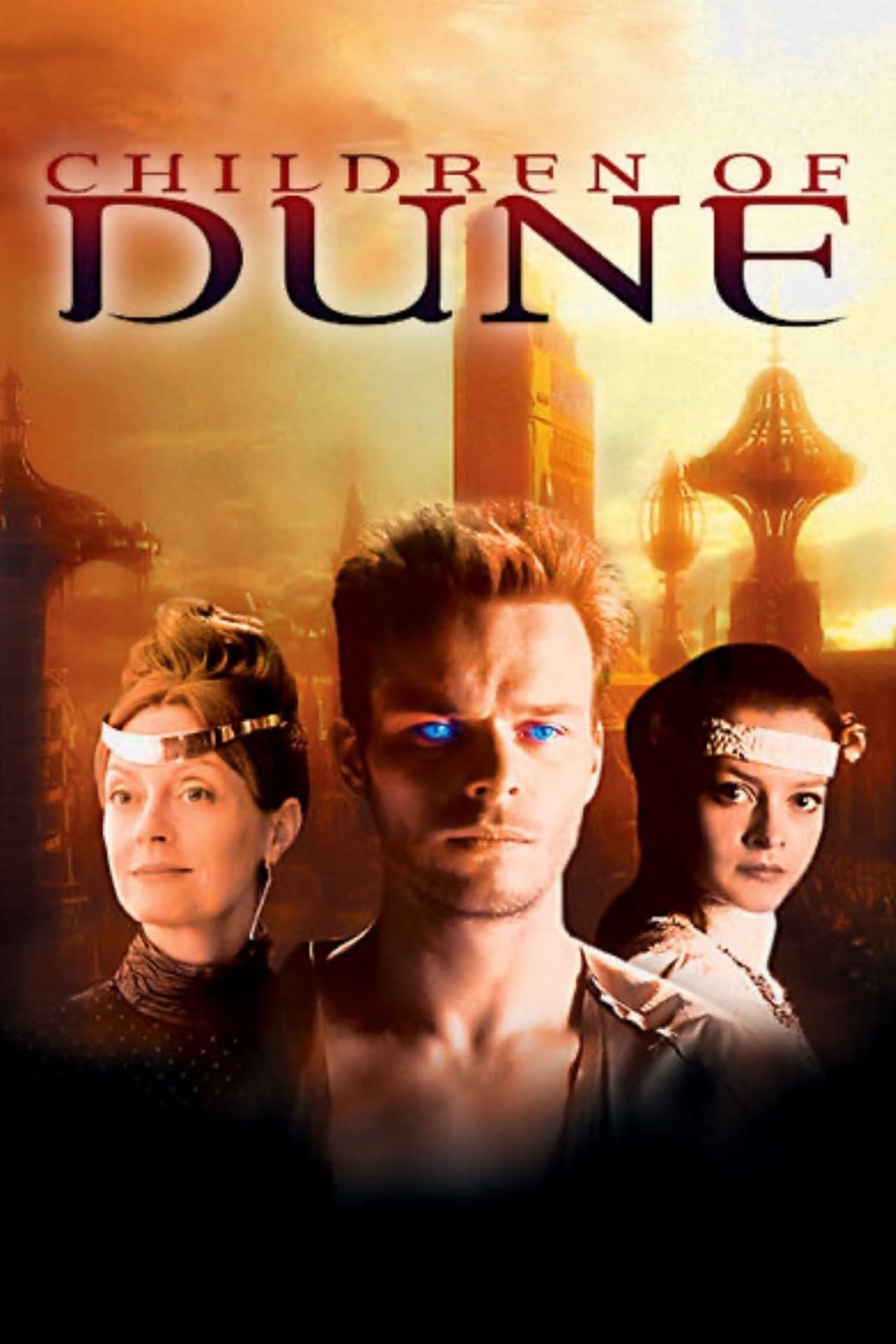
Children of Dune is one of those sci-fi miniseries that feels a little rough around the edges, but still manages to hit with real ambition, atmosphere, and a lot more emotional weight than its modest TV budget might suggest. It is based on Frank Herbert’s Dune Messiah and Children of Dune, aired on the Sci Fi Channel in 2003 as a three-part miniseries, and it serves as a continuation of the 2000 Frank Herbert’s Dune adaptation.

What makes this version stand out is that it doesn’t just try to retell a story about desert politics and giant worms. It digs into legacy, prophecy, religious fanaticism, and the terrifying cost of being treated like a messiah. That sounds heavy, and it is, but the miniseries keeps moving with enough drama, betrayals, and strange mythic energy that it rarely feels static.

The opening section works especially well because it immediately reminds you that Paul Atreides’ victory was never a clean one. By the time the story gets going, his empire is already rotting from the inside, and the series makes a strong case that power on Arrakis is always poisoned by something, whether it is politics, faith, or the sand itself. The shift from Paul’s once-legendary rise to the unraveling of the world around his children gives the story a tragic tone that fits Herbert’s universe perfectly.

A big reason the miniseries works is that it understands Dune is not really about flashy action, even though it has some. It is about ideas, and this adaptation is willing to spend time on them. The show’s best material comes from the way it frames religion as both weapon and trap, especially once the myth of Muad’Dib starts consuming the people who worshiped him. That theme gives the whole thing a haunted feeling, like everyone is living inside a prophecy they do not fully understand.

The cast does a lot of heavy lifting, too. Alec Newman brings a wounded, exhausted quality to Paul that fits the role well, and his scenes carry real sadness because he feels like a man who has seen too far and cannot unsee it. Jessica Brooks, James McAvoy, and Julie Cox all help ground the family drama, while Susan Sarandon brings a cold intensity that gives the political side of the story some bite. Even when the dialogue gets stiff, the actors usually sell the material better than the script itself does.

One of the most interesting choices in Children of Dune is how it treats the twins, Leto II and Ghanima, as more than just plot devices. Their importance is obvious from the beginning, but the series gradually builds them into the real center of gravity. That works because the story is partly about inheritance, and these kids are inheriting not just a throne, but a nightmare of destiny, expectation, and manipulation. The series knows that the most dangerous thing in this universe is not a blade or a bomb, but a future someone insists is already written.

The production design is another area where the miniseries earns a lot of goodwill. It has that early-2000s TV look, sure, and some effects are clearly limited by the era, but the sets, costumes, and overall visual imagination give it a strong sense of place. Arrakis feels harsh and ceremonial at the same time, which is exactly what it should feel like. The costumes also help sell the political divide between factions, making the whole thing look more like a living empire than a generic sci-fi stage.

There are moments where the miniseries feels very theatrical, almost to a fault. Characters occasionally deliver lines with so much seriousness that the show risks sounding like it is declaring its themes instead of dramatizing them. That said, this is also part of the charm. Children of Dune is not embarrassed by its own scale or its own weirdness, and that confidence helps it pull off material that could easily have collapsed under a more self-conscious approach.

The pacing is mostly solid across the three parts, though it does have the usual miniseries issue of compressing a very large story into a limited runtime. Because it covers most of Dune Messiah in the first installment and then adapts Children of Dune in the later parts, some transitions feel abrupt and some developments move faster than they probably should. Still, the adaptation largely keeps its focus, and it is impressive how much story it packs in without turning into total chaos.

If there is a weakness here, it is that the miniseries can sometimes feel like it is working harder to explain the mythology than to make you feel it. Herbert’s world is notoriously dense, and this version does not always smooth that out for viewers who are not already familiar with the books. A newcomer could easily feel like they have been dropped into the middle of a dynastic collapse with very little hand-holding. But for a follow-up to Frank Herbert’s Dune, that density is more of a feature than a bug.

The best compliment I can give Children of Dune is that it respects the seriousness of its material without becoming completely lifeless. It has the courage to be grand, strange, and a little mournful all at once. Even when the execution is uneven, the miniseries understands that the heart of this saga is not a simple battle for power. It is the burden of seeing the future and realizing it may be worse than the present.

As a sequel, it improves on the sense of scale and emotional consequence from the earlier adaptation. It feels less like an introduction to a universe and more like the tragic fallout of one. That makes it a more satisfying watch for viewers who want Dune to feel like an epic family tragedy instead of just a sand-covered political thriller. The fact that it does this on TV, with all the limitations that implies, makes the achievement even more impressive.

In the end, Children of Dune is a flawed but memorable miniseries that succeeds because it commits to its own strange seriousness. It may not be sleek, and it may not always be easy to follow, but it has ideas, mood, and a genuine sense of doom that suits Herbert’s universe. For fans of the books, it is one of the more interesting screen adaptations because it is willing to lean into the philosophical and tragic side of the saga rather than sanding it down into something safer. For everyone else, it is still a fascinating piece of early-2000s sci-fi television that swings bigger than most shows of its era.

Review: Dune (dir. by David Lynch)


“The sleeper has awakened.” — Paul “Muad’Dib” Atreides

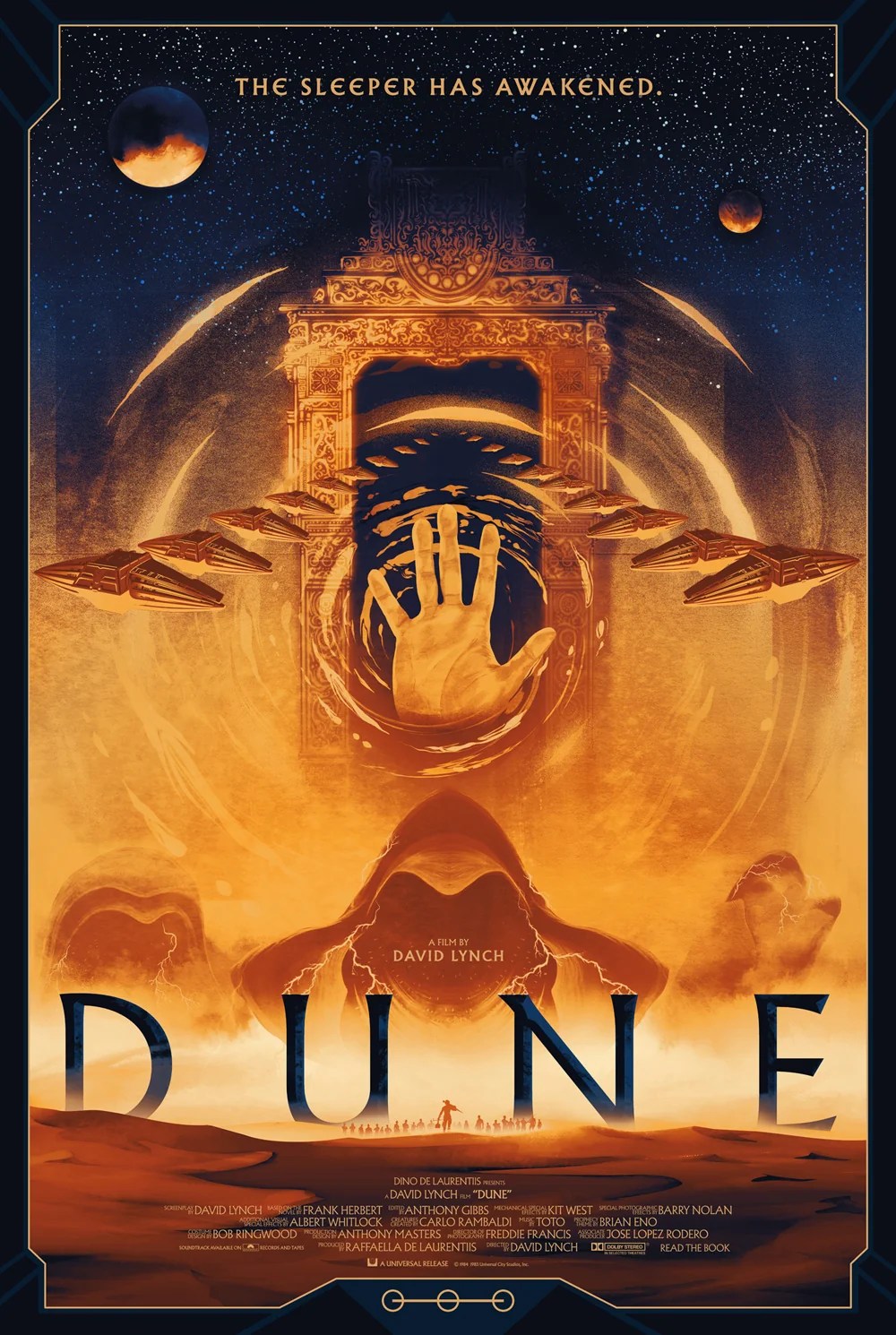
David Lynch’s Dune is one of those movies that somehow manages to be both a spectacular failure and a strangely hypnotic piece of cinema at the same time. It feels like a film willed into existence through pure creative tension: on one side, Frank Herbert’s dense, political, and spiritual sci‑fi novel; on the other, David Lynch’s surreal, psychological, dream‑logic sensibility. The result is a singular oddity—visually bold, dramatically uneven, and endlessly fascinating if you’re in the mood for something that feels more like a hallucination than a conventional space opera.

To call the adaptation ambitious is underselling it. After the collapse of Alejandro Jodorowsky’s infamous attempt to adapt Dune, the project eventually landed at Universal with producer Dino De Laurentiis, and Lynch—fresh off The Elephant Man—was brought in to turn Herbert’s galaxy‑spanning book into a two‑hour‑ish feature. On paper, it seems like inspired casting: Lynch had the visual imagination and emotional intensity to do something memorable with the material. But he was never a natural fit for streamlined blockbuster storytelling. His instincts live in mood, subconscious imagery, and uneasy psychological textures rather than clean plot mechanics. You can feel that clash all over the final film, and it’s part of what makes it so weirdly compelling.

Right from the opening, Dune doesn’t hold your hand. Princess Irulan’s floating head lays out a massive info‑dump about spice, the Imperium, and Arrakis that plays like someone reading you the glossary at the back of a sci‑fi novel. It’s dense, awkward, and kind of charming in its sincerity. The movie takes Herbert’s universe extremely seriously—no wink, no irony, no attempt to sand off the stranger edges. The Bene Gesserit, mentats, feudal houses, and prophecies are all presented straight, as if the audience will either keep up or be left behind. There’s something almost punk about that level of commitment.

Kyle MacLachlan, in his debut as Paul Atreides, is perfectly cast for Lynch’s take on the character. He’s got this earnest, slightly naive presence that gradually hardens as the story pushes him toward messiah status. Instead of leaning into a swashbuckling hero archetype, Lynch frames Paul’s evolution as something interior and dreamlike, almost like a spiritual awakening happening inside a hostile universe. Paul’s visions aren’t giant, crystal‑clear CGI prophecy sequences; they’re fragmented, flickering images, whispers, and flashes of desert and blood. You can feel Lynch trying to drag the sci‑fi epic into his own subconscious, even if the narrative doesn’t always keep up.

The supporting cast is packed with strong, sometimes delightfully bizarre performances. Francesca Annis gives Lady Jessica a sensual, haunted calm that fits the Bene Gesserit’s mix of discipline and manipulation. Jurgen Prochnow’s Duke Leto radiates dignified doom; he feels like a man who knows he’s walking into a trap but can’t step off the path. Then you get to the Harkonnens, where Lynch just lets his freak flag fly. Kenneth McMillan’s Baron is a grotesque comic‑book monster, oozing, cackling, floating on anti‑grav tech, and reveling in cruelty. It’s not subtle, but it is unforgettable. And of course Sting as Feyd‑Rautha, stalking around in barely‑there outfits and sneering like a rock star beamed in from another film entirely, just adds to the movie’s fever‑dream energy.

Visually, Dune is a feast and sometimes a bit of a choke. The production design leans into a kind of retro‑futurist baroque: cavernous sets, ornate technology, and spaces that feel less like functional environments and more like places out of a dark fantasy. Lynch and cinematographer Freddie Francis infuse everything with shadow, smoke, and texture, so even the quiet scenes feel heavy and loaded. The sandworms are huge, tactile, and worshipful in scale; the way they burst from the desert feels more like a religious manifestation than a monster attack. Even if you’re lost in the plot, the images stick with you—daggers, stillsuits, weirding whispers, blood on sand.

The sound and music do a ton of work in giving the film its identity. The score, primarily by Toto with contributions from Brian Eno, is this fusion of 80s rock sensibility and orchestral grandeur. It shouldn’t work, but it does; the main theme swells with tragic heroism, while other cues veer into eerie, synthy territory that matches Lynch’s off‑kilter tone. The sound design around the “weirding” abilities, the internal monologues, and the roar of the sandworms all help sell the world even when the script is sprinting past exposition. It’s one of those films where you might not fully grasp every detail, but the combined force of image and sound makes you feel like you’ve visited a real, deeply strange place.

The big structural problem, and the thing that most clearly separates Lynch’s adaptation from Denis Villeneuve’s two‑part version, is time and emphasis. Lynch is trying to cram the entire arc of Dune into a single film, and that means the plotting goes from methodical to breakneck halfway through. The first half lingers on the setup—Caladan, the move to Arrakis, the betrayal—while the second half rockets through Paul’s Fremen transformation, the guerrilla war, the sandworm riding, and the final confrontation. Subplots are hinted at and dropped, character arcs feel truncated, and the voiceover is forever trying to patch gaps the edits created. Themes like ecological transformation, the manipulation behind religious prophecy, and the long‑term horror of Paul’s rise are mostly reduced to gestures.

The best way to see Dune in Lynch’s version is actually through the extended cut, which adds a bit more context to certain scenes and lets the film breathe slightly more than the theatrical release. The theatrical cut is so aggressively compressed that pieces of motivation and setup just vanish, leaving the story feeling even more disjointed. The extended version restores some of the connective tissue—especially around Paul’s early time with the Fremen, the political maneuvering in the lead‑up to the final act, and the way certain characters orient themselves in the larger conflict. It doesn’t magically fix the studio‑driven structure or the inherent weirdness of Lynch’s choices, but it does make the film feel a little more complete, a little closer to the director’s original vision. It’s still messy, but less like a rushed homework assignment and more like a genuinely eccentric, if compromised, longform take on Herbert’s world.

Tonally, Lynch and Villeneuve are almost mirror images. Lynch’s film is cramped, loud in its weirdness, and often grotesque, playing like a baroque horror‑opera about destiny. Villeneuve’s is stately, slow‑burn, and solemn, more interested in the weight of empire, colonialism, and religious manipulation. Even their takes on Paul are distinct. In Lynch’s film, Paul ultimately plays more like a triumphant chosen one; whatever ambiguity is there gets overshadowed by the climactic victory and the literal act of making it rain as a grand, almost celebratory miracle. Villeneuve leans harder into the darker implications: Paul is framed as a potentially dangerous figure whose rise may unleash something terrible, and his two‑part arc emphasizes the holy war and fanaticism coalescing around him instead of treating his ascension as a clean win. Where Lynch’s ending lands somewhere between pulp myth and studio‑mandated uplift, Villeneuve’s execution feels closer to a tragedy about messianic power.

Knowing all that, Lynch’s Dune ends up feeling like a relic from an era when studios occasionally handed gigantic, unwieldy properties to filmmakers with intensely personal styles and just hoped for the best. It doesn’t “work” in a conventional plot sense, and if you’re coming to it after the sleek coherence of Villeneuve’s films, it can feel like a chaotic, cluttered alternate‑universe version of the same story. But that alternate universe has its own power. There’s a raw, handmade intensity to Lynch’s take—a sense that he’s trying to turn Dune into a waking dream about destiny, decay, and the seduction of power, even as the studio scissors are hacking away at his vision.

In the end, David Lynch’s Dune is a beautifully broken thing: a movie that fails as a straightforward adaptation but succeeds as a cinematic experience you can’t quite shake. Villeneuve gives you a clearer, more faithful, and philosophically aligned Dune, the one that explains itself and lets you sit with its implications. Lynch gives you the nightmare version, messy and compromised, but pulsing with strange life. If Villeneuve’s two‑part saga is the definitive modern telling, Lynch’s film—especially the extended cut—remains the haunting alternate path, a vision of Arrakis filtered through a very particular mind, sandblasted, grotesque, and unforgettable.

Dune: Part Two (dir. by Denis Villeneuve) Review


“The Mahdi is too humble to say he is the Mahdi. Even more reason to know he is!” — Stilgar

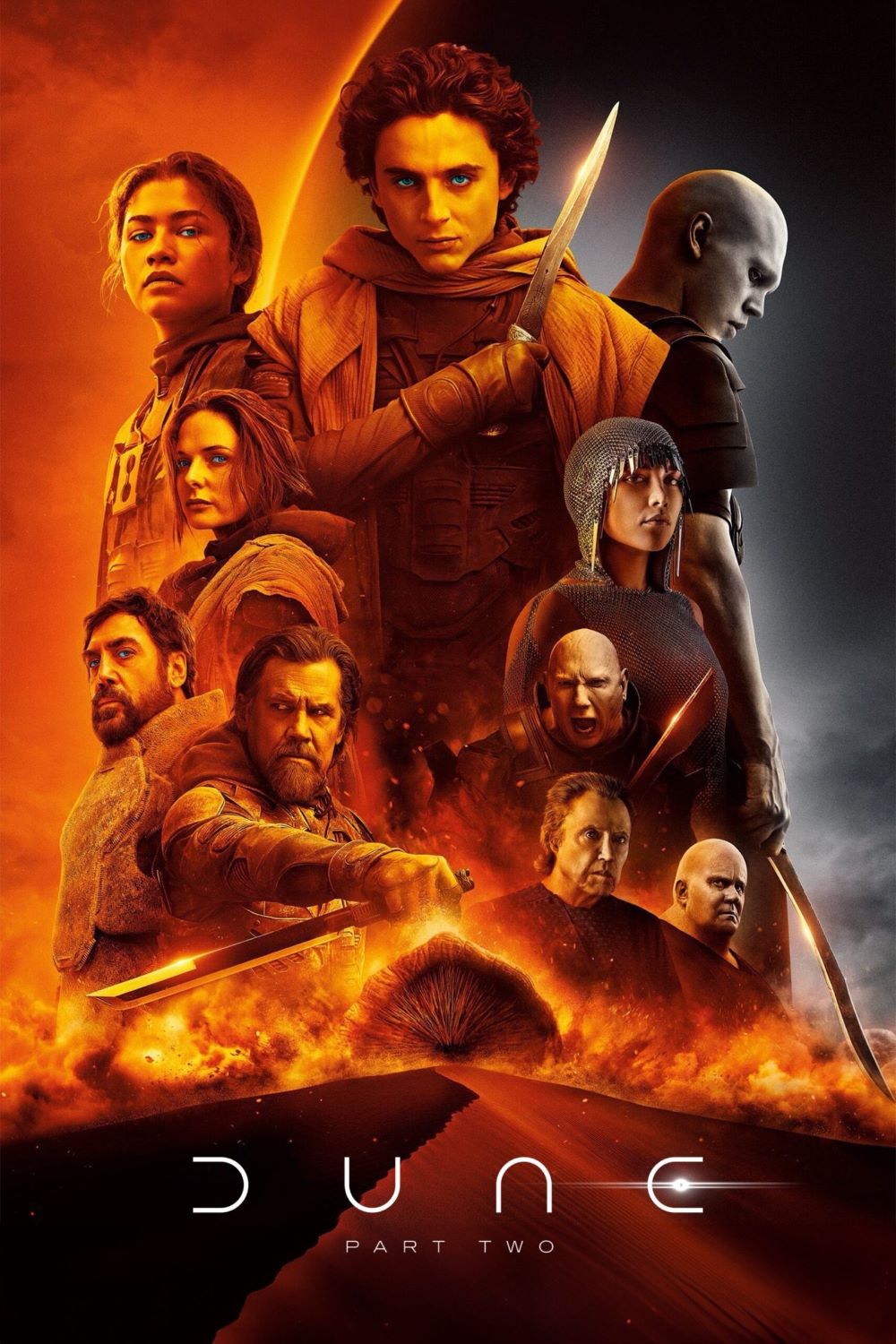
Dune: Part Two picks up right where the first film left off, diving headfirst into Paul Atreides’ quest for revenge on the desert world of Arrakis, and it absolutely delivers on the epic, operatic scale the setup promised. The first movie was all mood and table-setting; this one cashes in that patience with a story that’s bigger, louder, and way more emotionally volatile, without totally ditching the cerebral, slow-burn vibe that makes Dune feel different from other sci-fi tentpoles. Denis Villeneuve isn’t just continuing a story; he’s doubling down on the idea that this whole saga is less about a hero’s rise and more about the terrifying consequences of people begging for a savior and then getting exactly what they asked for.

Narratively, the film tracks Paul and his mother Jessica as they embed deeper into Fremen culture while House Harkonnen tightens its stranglehold on Arrakis. Paul trains, raids spice convoys, and slowly evolves from accepted outsider to full-on messianic figure, even as he keeps insisting he doesn’t want that role. The emotional throughline is his relationship with Chani, who acts as both partner and conscience, pushing back against the religious fervor gathering around him. At the same time, you’ve got Baron Harkonnen scheming from his grotesque oil-bath throne and Feyd-Rautha unleashed as the house’s rabid attack dog, chewing through enemies in gladiatorial arenas and on the battlefield. The stakes are clear and simple—control of Arrakis and its spice—but the film keeps twisting that into something more existential: control of the future itself and who gets to write it.

Visually, Dune: Part Two is just ridiculous in the best way. Arrakis still feels harsh and elemental, like the planet itself is a character that occasionally decides to eat people via sandworm. The desert exteriors are shot with that hazy, golden brutality where every wide shot makes the Fremen look tiny against an uncaring landscape. When Paul finally rides a sandworm, it’s not played as some clean, heroic moment but as a thrashing, chaotic stunt that looks legitimately dangerous—he’s clinging to this titanic creature, sand exploding in sheets around him, the camera swinging wide so you feel both the scale and the sheer lunacy of what he’s doing. The Harkonnen world, by contrast, is stark and stylized, all cold geometry and void-like skies, leaning into monochrome to make it feel like you’ve stepped into some industrial underworld. Villeneuve’s obsession with scale and texture pays off; every frame feels like it was composed to be stared at.

The action this time is more frequent and more brutal. Where Dune: Part One held back, this one goes for full war-movie energy. You get Fremen ambushes out of sand, night raids lit by explosions, and a final battle that’s basically holy war meets desert cavalry charge. Sandworms surf through shield walls, ornithopters slam into the ground, and a sea of troops gets swallowed by sand and fire. The choreography stays clean enough that you can track who’s doing what, but it never loses that messy, grounded feel—knife fights still feel close and ugly, even when they’re surrounded by massive spectacle. The duel between Paul and Feyd is the peak of that: sweaty, vicious, and personal, more about willpower and ideology than just skill.

Performance-wise, the film runs on the tension between Timothée Chalamet’s Paul and Zendaya’s Chani. Chalamet gets to shift from haunted survivor to someone who realizes he can pull the strings of history—and chooses to do it anyway. He plays Paul as a guy who genuinely hates what he sees in his visions but can’t stomach losing, which gives the final act a bitter edge. Zendaya finally gets the screen time the first film teased, and she makes the most of it. Chani isn’t just “the love interest”; she’s the one person in the story who consistently calls bullshit on prophecy, seeing how Fremen belief is being turned into a weapon. That skepticism, that refusal to be swept up, becomes the emotional counterweight to everything Jessica and the Bene Gesserit are engineering.

Rebecca Ferguson’s Jessica goes full political operator here, and it’s honestly one of the most interesting arcs in the film. Once she takes on the role of Reverend Mother, she leans into manipulating Fremen faith, playing up visions, symbols, and omens to lock in Paul’s status. She’s terrifyingly pragmatic about it, and the movie doesn’t let that slide as a “necessary evil”—it’s part of how this whole situation curdles into fanaticism. Austin Butler’s Feyd-Rautha is pure menace: feral, theatrical, and oddly charismatic, like a rock star who decided to become a warlord. He feels like the dark mirror of Paul, another bred product of a toxic system, but one who embraces cruelty instead of burden.

Then you’ve got Florence Pugh’s Princess Irulan and Christopher Walken’s Emperor Shaddam IV, introduced with real weight as the heir to the throne and the man who greenlit House Atreides’ betrayal—but then largely sidelined as bit characters rather than the shadowy power brokers they should be. On paper, they’re the architects of galactic order, pulling levers from opulent palaces while Paul scrambles in the sand. The film gives them poised entrances and sharp dialogue, but parks them as observers to Paul’s whirlwind, more like well-dressed cameos than forces reshaping the board. Walken nails the Emperor’s weary calculation, and Pugh hints at Irulan’s future scheming, but without deeper scenes of imperial intrigue, they orbit Paul’s story instead of challenging it head-on, underscoring how his rise eclipses even the old guard.

Hans Zimmer’s score keeps pushing that strange, alien soundscape he built in the first film and then amps it up. The music leans hard on percussion, guttural vocals, and warped instruments that feel half-organic, half-industrial, like you’re listening to the desert itself breathing. The score doesn’t really do the classic “themes you hum on the way out of the theater” thing; instead, it sits in your bones. During the big set pieces, it’s almost overwhelming—drones, chants, and pounding rhythms layering on top of each other until your seat feels like it’s vibrating. In quieter scenes, Zimmer pulls back just enough to let a harsh little motif peek through, usually when Paul is weighing his choices or when Chani realizes how far things are slipping away from what she hoped for.

Thematically, Dune: Part Two sinks its teeth deepest into the dangers of blind faith and the double-edged sword of prophecy—how it can shatter chains of oppression only to forge far heavier ones in their place. Frank Herbert’s original warning pulses through every frame: belief isn’t just a comfort or a spark for revolution; it’s a weapon that smart people wield to hijack desperate hearts. The Fremen, crushed under imperial boot and environmental hell, latch onto their Lisan al-Gaib legend like a lifeline, and figures like Jessica and the Bene Gesserit are all too happy to fan those flames. Lines like Stilgar’s “The Mahdi is too humble to say he is the Mahdi. Even more reason to know he is!” twist logic into a pretzel, showing how faith devours reason—Paul’s every hesitation or miracle just “proves” his divinity more. Chani’s gut-punch retort, “This prophecy is how they enslave us!” lays it bare: what starts as liberation from Harkonnen greed morphs into submission to a new myth, one engineered off-world to keep Arrakis in check.

Paul embodies this tragedy most painfully. His spice-fueled visions reveal futures of jihad consuming the stars, yet the “narrow path” he chooses—embracing the prophecy—breaks the Fremen’s subjugation to outsiders while binding them to him as unquestioning soldiers. It’s not accidental heroism; it’s a calculated gamble where prophecy empowers the oppressed to topple one empire, only for Paul to birth a deadlier one, fueled by the very zeal that freed them. Princess Irulan’s cool observation, “You underestimate the power of faith,” chills because it’s the Emperor admitting belief outstrips blades or thrones—faith doesn’t just win wars; it rewrites reality, turning Fremen riders into galaxy-scouring fanatics. Even the Reverend Mother Mohiam’s “We don’t hope. We plan” unmasks prophecy as cold manipulation, a multi-generational con that breakers colonial chains today while guaranteeing control tomorrow.

Villeneuve doesn’t glorify this cycle; he revels in its horror. The final rally, with Fremen chanting “Lisan al-Gaib!” as Paul seizes the throne, thrills like a rock concert and curdles like a cult initiation. Chani riding off alone isn’t defeat—it’s the last gasp of clear-eyed doubt in a tide of delusion. Faith topples the Baron and humbles Shaddam, sure, but it installs Paul as its high priest-emperor, proving Herbert right: saviors don’t save; they scale up the suffering. The film tweaks the book to amplify this, giving Chani more agency to voice the peril, making the “victory” feel like a velvet trap. It’s prophecy as breaker of chains—smashing Harkonnen spice rigs and imperial ornithopters—then creator of new ones, with Paul’s jihad looming not as triumph, but inevitable apocalypse.

If the film has a real sticking point, it’s that tension between being a massive, audience-pleasing sci-fi epic and being a deeply cynical story about the cost of belief. On a surface level, it totally works as a grand payoff: you get your worm rides, your duels, your big speeches, your villains being humbled. But underneath, Villeneuve keeps threading in this idea that what we’re watching isn’t a happy ending; it’s the start of something worse. The sidelining of Irulan and Shaddam reinforces how Paul’s myth-centered rise devours old powers, prophecy steamrolling politics.

As a complete experience, Dune: Part Two feels like the rare blockbuster that respects its audience’s patience and intelligence. It assumes you remember part one, assumes you’re willing to sit with long, quiet moments and sudden bursts of violence, and assumes you’ll notice that the “hero’s journey” here is more of a slow moral collapse dressed up as triumph. It’s messy in spots—some pacing jolts, some underused heavy hitters in the cast—but it swings so hard and with such confidence that the rough edges end up feeling like part of its personality. The result is a movie that works both as an immediate, visceral ride and as something you keep chewing on afterward, wondering if you were supposed to be as excited as you were by the sight of a new god-king being crowned in the desert.

Dune: Part One (dir. by Denis Villeneuve) Review


“I said I would not harm them and I shall not. But Arrakis is Arrakis and the desert takes the weak. This is my desert. My Arrakis. My Dune.” — Baron Vladimir Harkonnen

Denis Villeneuve’s Dune: Part One is one of those big, monolithic blockbusters that feels less like a movie night and more like being slowly lowered into someone else’s dream. It’s massive, deliberately paced, and sometimes emotionally chilly, but when it hits, it really hits, and you can feel a director absolutely obsessed with getting this universe right. The film adapts roughly the first half of Frank Herbert’s novel, following Paul Atreides, heir to House Atreides, as his family accepts control of the desert planet Arrakis, the only source of the spice melange that powers space travel and heightens human abilities. The setup is pure operatic space-feudalism: the Emperor orders House Atreides to take over Arrakis from their bitter rivals, House Harkonnen, in what is basically a beautifully staged death trap. Villeneuve leans into the political trap aspect; even if you’ve never read Dune, you can tell from minute one that this is not an opportunity, it’s a setup, and that sense of doom hangs over everything.

What Villeneuve really nails is the “ancient future” texture that people always talk about with Dune but rarely pull off on screen. The technology looks advanced but worn, ritualized, and heavy, from the gargantuan starships to the dragonfly-like ornithopters that rattle and pitch like actual aircraft instead of sleek sci-fi toys. The production design and Greig Fraser’s cinematography go all-in on scale: Caladan’s stormy oceans, Arrakis’s endless dunes, cavernous fortresses that make the human figures look insignificant. It’s not just pretty—it’s doing character work for the universe, selling you on the idea that people here live under forces (political, religious, environmental) that absolutely dwarf them. In theme terms, this is Villeneuve visually translating Herbert’s obsession with ecology and power structures, but he externalizes it more than the book: instead of living inside characters’ heads, you’re constantly being reminded how small they are against their environment.

All of that is backed by Hans Zimmer’s aggressive, sometimes overwhelming score, which sounds like someone trying to invent religious music for a civilization that doesn’t exist yet. It’s not subtle; there are bagpipes blaring on Caladan, guttural chants over Sardaukar warriors being ritually baptized in mud, and wailing voices that basically scream “destiny” every time Paul has a vision. But it syncs with Villeneuve’s approach: this is myth-making by way of blunt force, and the sound design and music are part of the same strategy of immersion and awe. Compared to the novel’s intricate, almost clinical tone, the film leans much harder into a mythic, quasi-religious mood. That means some of Herbert’s more sardonic or critical edges get smoothed out, but it also lets Villeneuve foreground the feeling of a civilization that already half-believes its own prophecies.

Narratively, Dune: Part One walks a weird tightrope. On one hand, this is a story about prophecies, chosen ones, and a messiah in the making, but on the other, the film quietly undercuts that fantasy. Villeneuve and his co-writers emphasize the Bene Gesserit’s centuries-long manipulation of bloodlines and myths, including seeding prophecies among the Fremen, so Paul’s “chosen one” status comes prepackaged with a lot of moral unease. That’s one of the places where Villeneuve stays very faithful to Herbert: the idea that religious belief can be engineered and weaponized. At the same time, by stripping out so much of the book’s interior commentary, the movie makes that critique more atmospheric than explicit. You feel that something is off about Paul’s destiny—the visions of holy war help with that—but you don’t hear the narrative voice outright interrogating the myth the way the novel does. It’s like Villeneuve wants the audience to experience the seduction of the messiah narrative first, and only slowly realize how poisonous it is.

Timothée Chalamet’s performance takes advantage of that approach by playing Paul as a kid who has been trained his whole life for greatness but absolutely does not want the role he’s being handed. Early on, he’s soft-spoken, almost recessive, but you see flashes of arrogance and temper, especially in the Gom Jabbar test and the later tent breakdown after his visions of a holy war in his name. Villeneuve doesn’t try to turn him into an instant charismatic leader; instead, he feels like a thoughtful, scared teenager caught in a machine that’s been running for centuries. That divergence from the source material is subtle but important: book-Paul, with all his internal analysis and mentat-like processing, comes off almost superhumanly composed. Film-Paul is less in control, more overwhelmed, which shifts the theme from “a superior mind learning to navigate fate” toward “a boy being crushed into a role he might never have truly chosen.”

The supporting cast is absurdly stacked, and the film uses them more as archetypes orbiting Paul than as fully fleshed-out characters, which is both a feature and a bug. Oscar Isaac’s Duke Leto radiates tired nobility, a man who knows he is walking into a trap but refuses to show fear because he needs his people to believe. Rebecca Ferguson’s Lady Jessica might be the most compelling presence in the movie: a Bene Gesserit trained in manipulation and control, visibly torn between her loyalty to the order and her love for her son. Ferguson gives Jessica a constant undercurrent of panic; even when she’s composed and commanding the Voice, you can feel the guilt and fear simmering underneath. In Herbert’s text, Jessica carries a heavy burden of calculation and self-critique through internal monologue; Villeneuve replaces that with rawer, more visible emotion. That choice makes Jessica more immediately relatable on screen but also shifts the theme slightly—from a cold, almost chess-like examination of breeding programs and long-term plans to a more intimate conflict between institutional programming and maternal love.

On the more purely fun side, Jason Momoa’s Duncan Idaho brings some sorely needed looseness and warmth. He’s one of the only characters who feels like he exists outside the grim political machinery, which makes his relationship with Paul read as genuinely affectionate instead of court-mandated mentorship. His big stand against the Sardaukar is shot like a mythic warrior’s last stand, and it sells Duncan as the kind of legend people would sing about after the fact. The tradeoff is that Duncan’s characterization leans into straightforward heroism; some of the book’s emphasis on the complexities and limits of loyalty gets compressed into a single grand gesture. Josh Brolin’s Gurney Halleck mostly glowers and shouts in this installment, but there’s enough there—especially in the training scene—that you get a sense of this gruff soldier-poet without the film ever stopping to spell it out. What’s missing, though, is the more overt sense of Atreides culture and camaraderie that the novel lingers on; Villeneuve sketches it, then moves on.

If the heroes lean archetypal, the villains almost go minimalistic to a fault. Stellan Skarsgård’s Baron Harkonnen is an imposing, bloated specter, more a presence than a personality; he spends a lot of time floating, brooding, and letting the makeup and lighting do the talking. In the book, the Baron is a much more talkative schemer, constantly plotting and vocalizing his nastiness, which underlines Herbert’s theme of decadence rotting the powerful from within. Here he’s closer to a horror-movie monster, which works visually but makes the political conflict feel a bit less textured. It’s a conscious trade: Villeneuve sacrifices some of Herbert’s satirical bite for a cleaner, more archetypal good-house-versus-evil-house dynamic. The Mentats, like Thufir Hawat and Piter de Vries, also get sidelined, and with them goes a lot of the book’s focus on human computation and the consequences of tech bans; the movie nods to that world-building but clearly doesn’t prioritize those themes.

Where Dune: Part One really shines is in its set-pieces that double as worldbuilding lessons. The spice harvester rescue sequence isn’t just about a sandworm attack; it’s a crash course in how dangerous Arrakis is, how unwieldy the spice operation can be, and how Paul reacts when the spice hits his system and his visions start intensifying. The hunter-seeker assassination attempt in his room does something similar for palace intrigue and surveillance, even if the staging (Paul standing unnervingly still as the device inches toward him) has rubbed some viewers the wrong way. These scenes make Arrakis feel like a living trap: environmental, political, and spiritual all at once. Compared to the novel’s detailed ecological and economic exposition, Villeneuve’s version is more experiential—you feel sandstorms and worm sign before you fully understand the larger ecological philosophy that Herbert spells out. That keeps the film more cinematic, but it also means the deeper environmental thesis is only hinted at rather than explored.

The downside of Villeneuve’s devotion to mood and worldbuilding is pacing. This is a two-and-a-half-hour movie that very much feels like “Part One,” and you can sense the absence of a conventional third-act climax. The story peaks emotionally with the fall of House Atreides—Leto’s death, Duncan’s sacrifice, Kynes’s end—but then keeps going, drifting into the deep desert with Paul and Jessica. The final duel with Jamis is thematically important—Paul’s first deliberate kill, a step toward becoming the kind of leader his visions imply—but as a closer for a blockbuster, it’s quiet and off-kilter. What’s interesting is how that duel distills one of Herbert’s key themes—the cost of survival and leadership—down to a single, intimate moment. The book wraps that in a ton of cultural detail and internal reflection; the film pares it down to body language, breath, and a few lines of dialogue. Villeneuve keeps the moral weight of the act but narrows the lens, trusting the audience to sit with what it means for Paul to cross that line without spelling it out.

If you come in as a Dune novice, the film is surprisingly navigable but not always emotionally generous. Villeneuve strips away the novel’s dense internal monologues and replaces them with visual suggestion and sparse dialogue, which keeps the movie from turning into a two-hour voiceover but also makes some motivations feel opaque. Characters like Dr. Yueh suffer the most from this approach; his betrayal happens so quickly and with so little setup that it plays more as a plot requirement than a tragic inevitability. That’s a clear case where the film discards a major thematic thread: Herbert uses Yueh to dig into ideas of conditioning, trauma, and the limits of “programmed” loyalty, but Villeneuve mostly uses him to push the plot into the Harkonnen attack. The tradeoff is understandable in a two-part film structure, but it’s a noticeable hollow spot for viewers who care about the story’s psychological underpinnings.

Still, as an opening movement, Dune: Part One feels like a deliberate choice to build the cathedral before lighting the candles. It’s more concerned with making Arrakis, its politics, and its religious machinery feel tangible than with delivering a neatly wrapped narrative. That can make it frustrating if you want a self-contained story, but it pays off in atmosphere: by the time Paul and Jessica join Stilgar’s Fremen and we get that final image of a sandworm being ridden across the dunes, you believe this is a place where myths can walk around as real people. Villeneuve stays true to Herbert’s broad thematic architecture—power, religion as control, ecology as destiny—but he discards a lot of the author’s density and interior commentary in favor of a more streamlined, sensory-driven experience. As a result, the film feels less like reading a dense political text and more like standing inside the legend that text would later be written about.

As a complete film, it’s imperfect—sometimes emotionally distant, sometimes so in love with its own scale that character beats get swallowed—but it’s also one of the rare modern blockbusters that feels handcrafted rather than committee-engineered. As an adaptation, it respects the spirit of Dune while making sharp, cinematic choices about what to emphasize and what to streamline, even if that means some beloved book moments get reduced or reconfigured. And as a foundation for a larger saga, it does exactly what “Part One” says on the label: it sets the board, crowns no clear winners, and leaves you with the distinct feeling that the real story—the dangerous one—is only just beginning.

The Sleeper Awakens with the new Dune Trailer


Just about everyone’s waiting for Denis Villeneuve’s remake of Frank Herbert’s Dune. Having grown up on the David Lynch version (and making my way through the novel), it has some big shoes to fill. Thankfully, what we’ve seen of it so far seems interesting. Villeneuve should have an easy time with the source material, though the movie has had its share of reshoots and dealing with the pandemic. We’ll see how it goes.

We finally have a trailer and some Wormsign!!. I’m liking the look of it. Chalamet’s Paul Atreides has some attitude to him, and I’m curious to see what Stellan Skarsgard does with the Baron Harkonnen.

Enjoy.

<- Artwork of the Day: A Bloody Business Artist Profile: Stewart Rouse ->