4 Shots From 4 Films is just what it says it is, 4 shots from 4 of our favorite films. As opposed to the reviews and recaps that we usually post, 4 Shots From 4 Films lets the visuals do the talking.
Are we alone in the universe? To help us consider that question, here are….
4 Shots From 4 Films
The War of the Worlds (1953, dir by Byron Haskins)
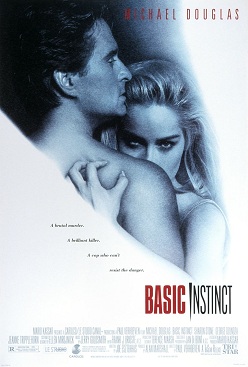
Nick Curran (Michael Douglas) is a San Francisco police detective who, along with his jolly partner Gus (George Dzundza), finds himself investigating the ice pick-stabbing of a rock star. The main suspect is glamorous writer Catherine Trammel (Sharon Stone), who is obviously guilty but manages to outsmart all of the men investigating her by not wearing panties during her interrogation. Nick finds himself drawn to Catherine, despite his own relationship with with psychologist Elizabeth Garner (Jeanne Tripplehorn). The more Nick digs into Catherine’s past, the more he becomes obsessed with her but also the more he suspects that she may be a serial killer. This is mostly because Catherine obviously is a serial killer and anyone should have been able to figure that out. Instead, Nick, an experienced homicide detective, just gets turned on.
It’s strange to remember how seriously people took BasicInstinct when it was released in 1992. People debated whether it was a throwback to Hitchcock or just a dirty movie. Feminists debated whether it was empowering or exploitive. For several years afterwards, every show from TheSimpsons to Seinfeld parodied the interrogation scene. (In Seinfeld’s case, it helped that Wayne Knight appeared in the film as the district attorney who kept shifting in his seat to get a better view.) Sharon Stone was described as being the new Grace Kelly and, for a period of years, was the subject of fawning profiles in which she was asked about the future of sex in movies. For a while, she was inescapable.
Sharon Stone, to be fair, did make the role of Catherine her own. It’s impossible to imagine some of the other actresses considered — Michelle Pfeiffer, Geena Davis, Mariel Hemingway, or Meg Ryan — in the role. After a decade of not getting anywhere with her film career, Stone was hungry to be a star and was also willing to do things on camera that other name actresses would have refused. Sharon Stone was not the next Grace Kelly and Catherine Trammel was ultimately more of a sexual fantasy than an actual character but Stone still deserves a lot of credit for her uninhibited performance in the role. Though Stone later said that she didn’t realize what was actually being filmed during the interrogation scene, it’s her confidence and her unapologetic sensuality that makes the scene compelling. Her performance has the energy that the sleepwalking Michael Douglas lacks.
Today, BasicInstinct is best-viewed as a satire. Director Paul Verhoeven sends up both the cop film and the erotic thriller with a movie that turned everything to eleven. The film’s sensibility is established by the fact that Michael Douglas’s “hero” is nicknamed Shooter because he killed two innocent people while high on cocaine. The film’s main joke is an obvious one. Everyone is too busy staring at Sharon Stone to notice that she’s about to stab them in the back with an icepick. Joe Eszterhas’s script was vulgar to the point of parody and, fortunately, director Paul Verhoeven understood that even more than Eszterhas did.
BasicInstinct has been imitated countless times but it’s never been equaled. To that, the credit is owed to Sharon Stone and Paul Verhoeven.
4 Shots From 4 Films is just what it says it is, 4 shots from 4 of our favorite films. As opposed to the reviews and recaps that we usually post, 4 Shots From 4 Films lets the visuals do the talking.
It’s Paul Verhoeven’s birthday and that means that it is time for….
4 Shots From 4 Paul Verhoeven Films
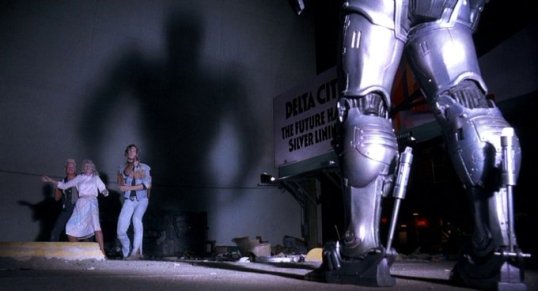
Robocop (1987, dir by Paul Verhoeven, DP: Jost Vacano)
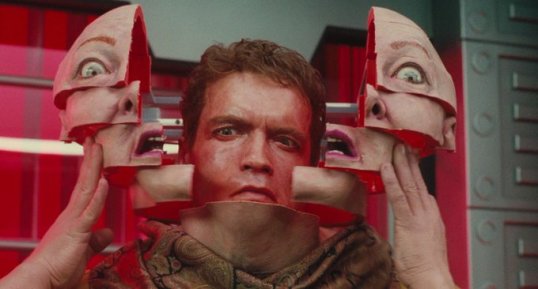
Total Recall (1990, dir by Paul Verhoeven, DP: Jost Vacano)
Showgirls (1995, dir by Paul Verhoeven, DP: Jost Vacano)
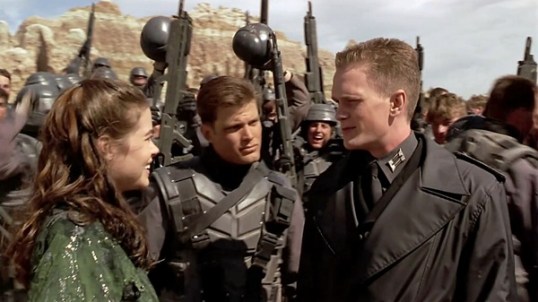
Starship Troopers (1997, dir by Paul Verhoeven, DP: Jost Vacano)
Today, the Shattered Lens wishes a happy birthday to director Paul Verhoeven. This scene that I love is from Verhoeven’s 1997 sci-fi epic, StarshipTroopers. Over-the-top, satirical, and violent, this scene epitomizes the aesthetic of Verhoeven’s American films.
2022 was a big year for my wife Sierra and I when it comes to “movie tourism.” I’ve already discussed our trips to Pennsylvania and Colorado to celebrate my healthy obsession with the late, great action movie icon Charles Bronson. In that same year, we spent some time in the beautiful city of Casper, Wyoming. About 40 miles from Casper is a place called “Hell’s Half Acre.” Sierra lived in Casper for 18 years, and she told me that the movie STARSHIP TROOPERS was filmed there. I had no idea. I had watched the movie way back in late 90’s because it was directed by Paul Verhoeven, the Dutch director who had made a star out of Rutger Hauer before coming to America and directing films like ROBOCOP, TOTAL RECALL, and BASIC INSTINCT. I remember it being graphically violent, but I honestly didn’t remember much about it. The fact that it was filmed out in the middle of nowhere outside of Casper piqued my interest, and I was determined to know more.
In a nutshell, STARSHIP TROOPERS stars Casper Van Dien as Johnny Rico, a young man who joins the military after graduation to become a citizen, and because of his love for his high school sweetheart Carmen (Denise Richards). As part of his service, he finds himself in a war against the bug aliens of Klendathu. Every day is a battle for survival as the soldiers try to save the human race. Aside from Van Dien and Richards, director Verhoeven has assembled an excellent supporting cast that includes veterans like Michael Ironside, Clancy Brown, and even Rue McClanahan. Maybe it’s because I visited the location, but I enjoyed the movie much more now, than I remember enjoying it back in the 90’s.
Hell’s Half Acre stood in for the alien planet of Klendathu in STARSHIP TROOPERS. It’s an interesting looking area that reminds me of the look of the Grand Canyon when viewed from afar. It turned out to be the perfect place for an alien planet, even if there was always a chance that the cast and crew might run into a rattlesnake or two. Here’s a picture I took of the sign on the premises that tells you a little more about Hell’s Half Acre.
The picture at the top of the article shows how Hell’s Half Acre is used in the movie to represent the alien planet of Klendathu. Here’s an image of the movie’s star, Casper Van Dien, on location. I met several people in Casper who remember when the actors and the crew were staying in Casper during filming, and they all spoke very positively of Van Dien. I also find it interesting that Casper Van Dien is filming this movie just outside of Casper, Wyoming. What are the chances?
Here are few of the pictures we took on our visit. I sent the picture below to my son while we were out of town and asked him if he knew where we were. His guess was The Grand Canyon!
Making movies is one hell of a business, and visiting Hell’s Half Acre was a great reminder of the imagination it takes to create movie magic. It was also a fun way to spend part of day, especially for a movie lover like me!
Last week, I watched the original Robocop (along with Robocop 2 and Robocop 3) and I have to say that the first film holds up far better than I was expecting. Made and released way back in 1987, Robocop may be one of the most prophetic films ever made.
Consider the plot:
America is torn apart by crime and a growing gap between the rich and the poor. That was probably true in 1987 and it’s certainly true in 2021.
Throughout the film, we see news reports about what’s happening in the world. The news is always grim but the reporters are always cheerful and the main message is that, no matter what’s happening, the government is not to blame and anyone who questions the wisdom of the establishment is a fool. If that’s not a perfect description of cable news and our current state-run media, I don’t know what is.
The populace is often too busy watching stupid game shows to really pay attention to what’s happening all around them. I’m writing these words on a Wednesday, which means that Game of Talents will be on Fox tonight, immediately after The Masked Singer.
Detroit, a once proud center of industry, has now turned into a dystopian Hellhole where no one feels that they’re safe. Now, I don’t live in Detroit so I don’t know how true that is but I do know that most of the recent news that I’ve heard about the city has not exactly been positive. Also, this seems like a good time to point out that, even though the film is set in Detroit, it was shot in Dallas. Though the Dallas skyline has undoubtedly changed a bit since 1987, I still recognized several buildings while watching Robocop. Seeing Reunion Tower in the background of a movie that’s supposed to be set in Detroit was interesting, though perhaps not as interesting as seeing our City Hall transformed into the headquarters of Detroit’s beleaguered police force.
OCP, a multi-national conglomerate that’s run by the amoral but occasionally charming Old Man (played by the brilliant Dan O’Herlihy), has a contract with city of Detroit to run their police department. This certainly doesn’t seem far-fetched in 2021. Considering that we now have prisons that are run by private companies and that the government has shown a willingness to work with private mercenaries overseas, it’s not a stretch to imagine a city — especially one on the verge of bankruptcy — handing over the police department to a private company.
Two OCP executives — Dick Jones (Ronny Cox) and Bob Morton (Miguel Ferrer) — are competing to see who can be the first to create and develop a peace-keeping robot, a machine that will replace the need to employ (and pay) human police officers. Dick Jones goes with an actual robot, which malfunctions during a boardroom demonstration and guns down another executive. (The scene where the poor exec is targeted is both terrifying and darkly humorous at the same time. Particularly disturbing is how everyone in the boardroom keeps shoving him back towards the robot in order to ensure that they won’t accidentally be in the line of fire.) Bob Morton, however, takes a mortally wounded cop named Murphy (Peter Weller) and turns him into Robocop!
Robocop turns out to be a huge success and is very popular with the media. (Anyone who doubts this would really happen has obviously never watched news coverage of a drone attack.) As you can guess, Dick is not particularly happy about getting shown up by Morton and his robocop. Dick also happens to be secretly in league with Clarence Boddicker (Kurtwood Smith), the crimelord who blew Murphy apart in the first place.
(A gangster and a businessman working together!? I doubt that was shocking even in 1987.)
Robocop claims that he’s just a machine, without a past or emotions, but he’s still haunted by random flashes of his life as Murphy. Working with Lewis (Nancy Allen), Murphy’s former partner, Robocop tracks down Boddicker and his gang. A lot of people die in outrageously violent ways. (The scene where Boddicker and his gang use a shotgun to torture Murphy is still shocking, even after all these years.) The violence is so over-the-top that it soon becomes obvious that director Paul Verhoeven is deliberately trying to get those of us watching to ask ourselves why we find films like this to be so entertaining. On the one hand, Robocop is an exciting action film with a sense of humor. On the other hand, it’s the type of subversive satire of pop and trash culture to which Verhoeven would return with Basic Instinct, Starship Troopers, and Showgirls. This is the type of film that asks the audience, “What are you doing here?”
34 years after it was first made, Robocop remains a triumph. Peter Weller’s performance holds up well, as he does a great job of capturing Robocop’s anguish while, at the same time, never forgetting that the character is ultimately a machine, one that’s trapped in a sort of permanent limbo. I also really liked the performance of Miguel Ferrer, who takes a character who should be unlikable and instead makes him into a surprisingly sympathetic figure.
Of course, a film like this lives and dies on the strength of its villains and both Ronny Cox and Kurtwood Smith are ideally cast as Dick Jones and Clarence Boddicker. Kurtwood Smith especially took me by surprise by how believably evil and frightening he was. As a I watched the film, I realized that it was his glasses that made him so intimidating. Wearing his glasses, he looked like some sort of rogue poet, a sociopathic intellectual who had chosen to use his talents to specifically make the world into a terrible place. Boddicker’s crew was full of familiar actors like Paul McCrane, Ray Wise, and, as the always laughing Joe Cox, Jesse Goins. Interestingly enough, all of the bad guys seemed to genuinely be friends. Even though they were all willing to betray each other (“Can you fly Bobby?”), they also seemed to really enjoy each other’s company. That somehow made them even more disturbing than a group of bad guys who were only in it for the money. The villains in Robocop really do seem to savor the chance to show off just how evil they can be.
(Incidentally, for all of the Twin Peaks fans out there, this film features three members of the show’s ensemble: Miguel Ferrer, Ray Wise, and Dan O’Herlihy.)
Robocop holds up well as entertainment, prophecy, and satire. Though not much was expected from it when it was first released, it became a surprise hit at the box office. Needless to say, this led to a sequel. I’ll deal with that film in about an hour.
The Alliance of Women Film Journalists (of which I am not a member and what’s up with that!?) announced their picks for the best of 2016 earlier this week.
And here they are:
AWFJ BEST OF AWARDS
These awards are presented to women and/or men without gender consideration. Best Film
Arrival Hell or High Water La La Land
Manchester by the Sea Moonlight
Best Screenplay, Adapted
Arrival – Eric Heisserer
Lion – Luke Davies
Love & Friendship – Whit Stillman Moonlight – Barry Jenkins
Nocturnal Animals –Tom Ford
Best Documentary 13th – Ava DuVernay
Gleason – Clay Tweel
I Am Not Your Negro – Raoul Peck
OJ Made in America – Ezra Edelman Weiner – Elyse Steinberg and Josh Kriegma
Best Actress
Amy Adams – Arrival
Isabelle Huppert – Elle Ruth Negga – Loving
Natalie Portman – Jackie Emma Stone – La La Land
Best Actress in a Supporting Role Viola Davis – Fences
Greta Gerwig – 20th Century Women
Naomie Harris – Moonlight
Octavia Spencer – Hidden Figures
Michelle Williams – Manchester by the Sea
Best Non-English-Language Film
Elle – Paul Verhoeven, France
Fire At Sea – Gianfranco Rossi, Italy The Handmaiden – Chan-Wook Park, South Korea
Julieta – Pedro Almodovar. Spain
Toni Erdmann – Maren Ede, Germany
EDA FEMALE FOCUS AWARDS
These awards honor WOMEN only
Best Woman Director Andrea Arnold – American Honey Ava DuVernay -13TH
Rebecca Miller – Maggie’s Plan
Mira Nair – Queen of Katwe
Kelly Reichardt – Certain Women
Best Woman Screenwriter Andrea Arnold – American Honey
Rebecca Miller – Maggie’s Plan Kelly Reichardt – Certain Women
Lorene Scafaria – The Meddler
Laura Terruso – Hello, My Name is Doris
Best Breakthrough Performance Sasha Lane – American Honey
Janelle Monáe – Moonlight and Hidden Figures
Madina Nalwanga – Queen of Katwe Ruth Negga – Loving
Outstanding Achievement by A Woman in The Film Industry Ava DuVernay – For 13TH and raising awareness about the need for diversity and gender equality in Hollywood
Anne Hubbell and Amy Hobby for establishing Tangerine Entertainment’s Juice Fund to support female filmmakers
Mynette Louie, President of Gamechanger Films, which finances narrative films directed by women
April Reign for creating and mobilizing the #OscarsSoWhite campaign
EDA SPECIAL MENTION AWARDS
Actress Defying Age and Ageism Annette Bening – 20th Century Women
Viola Davis – Fences
Sally Field – Hello, My Name is Doris Isabelle Huppert – Elle and Things to Come
Helen Mirren – Eye in the Sky
Actress Most in Need Of A New Agent Jennifer Aniston – Mother’s Day and Office Christmas Party
Melissa McCarthy – The Boss and Ghostbusters
Margot Robbie – Suicide Squad and Tarzan
Julia Roberts – Mother’s Day
Shailene Woodley – Divergent Series
AWFJ Hall of Shame Award Sharon Maguire and Renee Zellweger for Bridget Jones’s Baby
Nicholas Winding Refn and Elle Fanning for The Neon Demon
David Ayer and Margot Robbie for Suicide Squad
David E. Talbert and Mo’Nique for Almost Christmas
Here are the 2016 Seattle Film Award Nominees! I don’t know what the cat’s yawning about; these nominations are actually an interesting mix of the usual suspects (Moonlight, Manchester, La La Land) and a few unexpected but intriguing picks (like 13th and The Witch).
Showgirls in the 1995 film that, 20 years after it was first released, is still held up as the standard by which all subsequent bad films are judged. The story behind the production is legendary. Screenwriter Joe Ezsterhas was paid a then-record sum to write a script that ripped off All About Eve and featured lines like, “Come back when you’ve fucked some of that baby fat off,” and “You’re the only who can get my tits poppin’ right!” (And let’s not forget the heroine’s oft-repeated catch phrase, “It doesn’t suck.”) A major studio specifically hired Paul Verhoeven with the understanding that he was going to give them an NC-17 rated film. And finally, the lead role was given to Elizabeth Berkley, an actress whose previous experience amounted to co-starring on Saved By The Bell.
(And, let’s be honest, the only reason Jessie Spano was a tolerable character was because she wasn’t Screech.)
Berkley plays Nomi Malone, a sociopath who wants to be a star. She hitchhikes her way to Las Vegas where, as is destined to happen to anyone who shows up in Vegas or New York with a clunky suitcase, she is promptly robbed of all of her possessions. “Fuck! Fuck! Fuck! Fuck!” she yells, showing off the very expensive dialogue that was written for her by Joe Ezsterhas. Eventually, Nomi starts to take her frustration out on a random car. The car, it turns out, belongs to sweet-natured Molly (Gina Revara), who is a seamstress for a tacky Vegas show called Goddess.
(Seriously, Goddess makes Satan’s Alley from Staying Alive look like a work of quiet genius.)
Soon, Nomi is living in Molly’s trailer and working as a stripper at the Cheetah Club. The Cheetah Club is owned by Al, who is amazingly sleazy but who is also played by Robert Davi. Robert Davi is one of those actors who knows how to make terrible dialogue interesting and it’s instructive to watch him perform opposite Elizabeth Berkley and the rest of the cast. Whereas the majority of the cast always seems to be desperately trying to convince themselves that their dialogue is somehow better than it actually is, Davi knows exactly what he’s saying. Watching his performance, it’s obvious that Davi understood that he was appearing in a bad film so he figured that he might as well enjoy himself.
The same can be said of Gina Gershon, who plays Cristal Connors, the star of Goddess. Sexually voracious Cristal is basically a male fantasy of what it means to be bisexual. Cristal hires Nomi to give a lapdance to her sleazy boyfriend, Zack (Kyle MacLachlan, giving a good performance despite having to spend the entire film with hair in his eyes) and then arranges for her to be cast in the chorus of Goddess. There’s absolutely nothing subtle about Gershon’s performance and that’s why it’s perfect for Showgirls. It’s been argued that Showgirls is essentially meant to be a huge in-joke and, out of the huge cast, only Gershon, Davi, and occasionally MacLachlan seem to be in on it.
Certainly, it’s apparent that nobody bothered to tell Elizabeth Berkley. Berkley gives a performance of such nonstop (and misdirected) intensity that you end up feeling sorry for her. She’s just trying so hard and she really does seem to think that she can somehow make Nomi into a believable character. And it’s actually a bit unfair that Elizabeth is always going to be associated with this film because I doubt any actress could have given a good performance in a role as inconsistently written as Nomi. One second, Nomi is a wide-eyed innocent who is excited about living in Las Vegas. The next second, she’s screaming, “FUCK OFF!” and threatening strangers with a switch blade. She may be a survivor (and I imagine that’s why we’re supposed to root for her) but she’s also humorless, angry, and apparently clinically insane.
Hilariously, we’re also continually told, by literally everyone else in the movie, that she’s a great dancer, despite the fact that we see absolutely no evidence of this fact. Check out this scene below, where Nomi dances with a lot of enthusiasm and little else.
Once Nomi is cast in Goddess, she promptly sets out to steal both the starring role and Zack from Cristal. Nomi’s cunning plan, incidentally, amounts to fucking Zack in his pool and shoving Cristal down a flight of stairs. Nomi’s finally a star but when a Satanic rock star named Andrew Carver (William Shockley) comes to town, Nomi is confronted with the sordid truth about Las Vegas and, because this long film has to end at some point, Nomi must decide whether to take a stand or…
Well, you can guess the rest.
(Incidentally, I like to assume that Andrew Carver was meant to be a distant cousin of the great short story writer Raymond Carver.)
There seems to be two schools of thought when it comes to Showgirls.
Some critics claim to Showgirls is just crap. They say that it’s a terrible film with bad dialogue, bad acting, and terrible direction. These critics view Joe Eszterhas as being the villain of this tale, a misogynist who conned the studios into paying two million dollars for a terrible script.
And then other critics claim that Showgirls is crappy on purpose. They claim that Verhoeven meant for the film to be a satire of both American culture and Hollywood showbiz dramas. For these critics, Verhoeven used Eszterhas’s terrible script and Elizabeth Berkley’s inexperience to craft a subversive masterpiece.
Myself, I fall somewhere in between. Based on Verhoeven’s other films — Starship Troopers comes immediately to mind — I think his intent with Showgirls probably was meant to be satirical and subversive. But, at the same time, I would argue that Verhoeven’s intent doesn’t change the fact that Showgirls is a surprisingly boring film. For all the sex and the nudity and the opulent costumes and sets and all of the over-the-top dialogue, Showgirls is never really that interesting of a film. It barely even manages to reach the level of being so-bad-that-it’s-good. Instead, it’s slow, it’s draggy, and — satiric or not — the bad performance, the bad dialogue, and the nonstop misogyny get a bit grating after a few minutes.
Of course, that’s why you should never watch Showgirls alone. Showgirls is a film that you have to watch as a part of a group of friends so that you can all laugh together and shout out snarky comments. The first time I ever saw Showgirls was at a party and it was a lot of fun. But, for this review, I rewatched the film on Netflix and I was surprised by how much of a chore it was to sit through the entire running time. This is one of those films — like Birdemic and The Room — that you have to watch with a group. You watch for the experience, not the film.
In 2009 Liam Neeson began a new phase of his career as an actor. Before 2009 he was always put into roles as the father figure and mentor to a younger protagonist. He did quite well in handling these roles. Most of the time he was the only good thing about the films he was in and it was due to how he handled the supporting role given to him. But 2009 changed everything as Liam Neeson arrived on the film scene as a bonafide action hero in his role as a former CIA Special Activities Division operative in the action-thriller, Taken. That film surprised many and Neeson’s badass portrayal of a father out to save his daughter opened the eyes of many filmgoers who always saw him as the calm, wise elder. He has taken on the mantle of older, action-hero characters from Harrison Ford who lived off and became rich doing roles such as the one in Taken.
Two years later we have another film where we get to see Liam Neeson in another role which cements his place in the action-hero pantheon. Also like Pierre Morel’s film, this one takes place in Europe and directed by another European filmmaker trying to make a name for himself in Hollywood, Jaume Collet-Serra. It would be disingenious to say that Collet-Serra had it in him to direct a film as tight and fast-moving as Unknown. His two Hollywood productions were the remake of the classic horror film, House of Wax, and the underappreciated horror film from 2009, Orphan. With this new action-thriller, Unknown, Collet-Serra and Neeson create a film which owes much of its film dna to Hitchcock and his mistaken-man classic, North by Northwest. I would also say that this film also owes much of its action and characters to one of the early 1990’s best sci-fi action films, Paul Verhoeven’s Total Recall.
The film begins with Neeson’s character, Dr. Martin Harris, and his wife Liz (played by Mad Men‘s January Jones) arriving in Berlin to attend a biomedical conference. Right from the start Neeson makes us believe in Harris being an everyman. The good professor doesn’t seem the alpha male-type. But after certain seemingly random circumstances and events puts Harris in a coma for four days we begin to see signs and glimpses that Neeson’s character may have more to him than meets the eye.
It’s when Harris’ awakens from his coma that the meat of the film’s story begins. We know going in that Neeson’s character knows he’s not crazy and that someone out there has made things appear as if he is becoming insane. Maybe the accident in the beginning of the film have given us a false perspective on the film. What we might be seeing could be a manifestation of Harris’ mental breakdown from the accident and subsequent coma. But little clues in the film’s dialogue keeps things vague, but not so much that our initial stance that Harris’ is being manipulated won’t be the final endgame.
It is the endgame in the film which may make or break the whole production for some people. The screenplay by Oliver Butcher and Stephen Cromwell is not the strongest out there and it tries to be too complex with its red herrings when trying to keep it simple would’ve sufficed. One could almost sense that the two writers were trying to be too Hitchcock that they lost sight of how Hitchcock’s films were simple affairs which only appeared to be complex. Yet, despite some necessary leaps of logic that audiences needed to make to continue believing in the film, Unknown manages to keep the core story moving forward to it’s inevitable conclusion.
The performances by everyone involved is what keeps this film from spiralling out of Collet-Serra’s capable hands. One would almost certainly point out the strong work by Neeson as the Harris. January Jones’ Liz Harris, at first, seemed like an extension of her Betty Draper character from Mad Men, but as the story moves forward we get to see more layers of personalities in her character to make her interesting beyond the dutiful and supportive wife. But the standout performance outside of Neeson has to go to Diane Kruger as Gina, the taxi driver who was involved in Neeson’s character getting in his accident in the beginning of the film.
Kruger arguably is one of Hollywood’s classic beauty, but she has an ability to actually keep that beauty in check with her acting that we believe her to be the “everywoman” in some of the roles she plays. Beauty doesn’t come into the Gina character’s personality. Kruger does a great job of playing the pawn in a much larger game being played on Neeson’s character. Her reluctance to help him gradually crumbles as she soon realizes that her own safety and survival is now inextricably linked to unraveling the mystery of who Martin Harris really is.
Unknown is one of those films that actually has an advantage being released in the so-called dead season which runs from January and into March. It’s a film season when studios put out films they have no faith in being a major blockbuster which means summer and Holiday season release are out. It’s not prestigious enough to be put out in the Fall and early Winter. But as a piece os well-done escapist fare it’s perfect for this so-called dead season. Jaume Collet-Serra has shown that even when working from an average screenplay he knows how to get the best out of his cast to sell the film to the audience. He also has a firm grasped on pacing and how to handle action sequences.
In the end, the film still loves or dies by how the audience reacts to Liam Neeson’s character. While his Martin Harris is not the Bryan Mills from Taken, by the time the final scene fades to black we begin to see how similar the two characters really are and how much they share. Until the big name films start dropping in beginning in March (blockbuster season seem to come earlier and earlier with each passing year), Unknown is one of those films that should help make this early months of the film season more entertaining than it usually is in year’s past.
As an aside, for those who know their films would understand why I say that, in addition to this film having aspirations of being Hitchcockian, Unknown definitely borrows or has been influenced by some of the story and character developments of Verhoeven’s Total Recall. I almost half-expected for a half-mutant seer named Kuato to make an appearance to explain it all to Neeson’s ccharacter.















 Through the Shattered Lens