I was kind of skeptical about Mulan but this actually looks pretty exciting. Mulan will be in theaters on March 27th.
I was kind of skeptical about Mulan but this actually looks pretty exciting. Mulan will be in theaters on March 27th.
Here it is! The Top Gun: Maverick Super Bowl spot!
This spot admittedly doesn’t really tell you a lot about the film. Tom Cruise is back, but we already knew that. Val Kilmer shows up for a second or two. Lots of airplanes, of course. And really, that’s probably all that this preview needed to be effective.
Me: “Am I the only person in the world who doesn’t like SpongeBob?”
World: “Yes!”
Me: “Oh. Okay.”
Well, regardless of how I might feel about SpongeBob, the rest of the world seems to be excited about his upcoming movie. Here’s the Super Bowl spot!
I guess the point of this trailer is that Sonic The Hedgehog is really, really fast.
At least he doesn’t look no longer looks like he’s going to kill someone, so that’s an improvement. Seriously, film twitter takes a lot of criticism but this is one of those rare cases where the folks at Paramount should be thanking everyone who complained online.
Well, it’s Super Bowl Sunday and you know what that means! It’s time for everyone to watch the commercials. As we do every year, we’re going to post every single teaser and trailer that drops during the big game. Actually, it may be a little bit easier than usual this year because, apparently, there aren’t going to be as many trailers as there have been in the past. It’s not cheap to advertise during the Super Bowl and a lot of studios apparently decided that money could be put to better use elsewhere. It makes sense, really. Why spend millions to run one commercial during the Super Bowl when you can just drop the ad on YouTube and then have your star tweet out the link?
That said, we should still have a few trailers to look forward. For instance, here’s the Super Bowl teaser for A Quiet Place 2!
Since Jon Krasinski’s character died at the end of the first film, I’m going to assume that this sequel is going to be, at least partially, a prequel. So, we’ll get to see how the Earth got invaded and all that good stuff. I thought the first A Quiet Place was absolutely brilliant so I’m definitely looking forward to seeing if the sequel can live up to it!

Well, another Sundance Film Festival has come to a close! Here’s what won at this year’s festival. If this year is like other years, a few of the films mentioned below will also be players once Oscar season begins later this year. For instance, just from what I’ve read, I wouldn’t be surprised to see Minari‘s name come up quite a bit between now and next January.

The Art Directors Guild have announced their picks for the best of 2019!
And here they are:
NOMINEES FOR EXCELLENCE IN PRODUCTION DESIGN FOR FILM
PERIOD FILM
Ford v Ferrari, Production Designer: François Audouy
The Irishman, Production Designer: Bob Shaw
Jojo Rabbit, Production Designer: Ra Vincent
Joker, Production Designer: Mark Friedberg
1917, Production Designer: Dennis Gassner
WINNER – Once Upon a Time… in Hollywood, Production Designer: Barbara Ling
FANTASY FILM
Ad Astra, Production Designer: Kevin Thompson
Aladdin, Production Designer: Gemma Jackson
WINNER – Avengers: Endgame, Production Designer: Charles Wood
Dumbo, Production Designer: Rick Heinrichs
Maleficent: Mistress of Evil, Production Designer: Patrick Tatopoulos
Star Wars: The Rise of Skywalker, Production Designers: Rick Carter, Kevin Jenkins
CONTEMPORARY FILM
A Beautiful Day in the Neighborhood, Production Designer: Jade Healy
John Wick: Chapter 3 – Parabellum, Production Designer: Kevin Kavanaugh
Knives Out, Production Designer: David Crank
WINNER – Parasite, Production Designer: Lee Ha-Jun
Us, Production Designer: Ruth De Jong
ANIMATED FILM
Abominable, Production Designer: Max Boas
Frozen II, Production Designer: Michael Giaimo
How To Train Your Dragon: The Hidden World, Production Designer: Pierre-Olivier Vincent
The Lion King, Production Designer: James Chinlund
WINNER – Toy Story 4, Production Designer: Bob Pauley
NOMINEES FOR EXCELLENCE IN PRODUCTION DESIGN FOR TELEVISION
ONE-HOUR PERIOD OR FANTASY SINGLE-CAMERA SERIES
A Series of Unfortunate Events: “Penultimate Peril: Part 1,” Production Designer: Bo Welch
The Crown: “Aberfan,” Production Designer: Martin Childs
Game of Thrones: “The Bells,” Production Designer: Deborah Riley
The Mandalorian: “Chapter One,” Production Designer: Andrew L. Jones
WINNER – The Marvelous Mrs. Maisel: “Ep. 305, Ep. 308,” Production Designer: Bill Groom
ONE-HOUR CONTEMPORARY SINGLE-CAMERA SERIES
Big Little Lies: “What Have They Done?” “The Bad Mother,” “I Want to Know,” Production Designer: John Paino
The Boys: “The Female of the Species,” Production Designer: Dave Blass
Euphoria: “The Trials and Tribulations of Trying to Pee While Depressed,” “And Salt the Earth Behind You,” Production Designer: Kay Lee
The Handmaid’s Tale: “Mayday,” Production Designer: Elizabeth Williams
WINNER – The Umbrella Academy: “We Only See Each Other at Weddings and Funerals,” Production Designer: Mark Worthington
TELEVISION MOVIE OR LIMITED SERIES
Black Mirror: “Striking Vipers,” Production Designer: Anne Beauchamp
Catch-22, Production Designer: David Gropman
WINNER – Chernobyl, Production Designer: Luke Hull
Deadwood: The Movie, Production Designer: Maria Caso
Fosse/Verdon, Production Designer: Alex DiGerlando
HALF HOUR SINGLE-CAMERA SERIES
Barry: “ronny/lily,” Production Designer: Tyler B. Robinson
Fleabag: “Ep. 5,” Production Designer: Jonathan Paul Green
GLOW: “Up, Up, Up,” Production Designer: Todd Fjelsted
The Good Place: “Employee of the Bearimy,” “Help Is Other People,” Production Designer: Ian Phillips
WINNER – Russian Doll: “Nothing in This World is Easy,” Production Designer: Michael Bricker
MULTI-CAMERA SERIES
WINNER – The Big Bang Theory: “The Stockholm Syndrome,” “The Conference
Valuation,” “The Propagation Proposition,” Production Designer: John Shaffner
The Cool Kids: “Vegas, Baby!,” Production Designer: Stephan Olson
Family Reunion: “Remember Black Elvis?,” Production Designer: Aiyanna Trotter
No Good Nick: “The Italian Job,” Production Designer: Kristan Andrews
Will & Grace: “Family, Trip,” “The Things We Do for Love,” “Conscious
Coupling,” Production Designer: Glenda Rovello
SHORT FORMAT: WEB SERIES, MUSIC VIDEO OR COMMERCIAL
Apple: “It’s Tough Out There,” Production Designer: Quito Cooksey
Ariana Grande, Miley Cyrus, Lana Del Rey: “Don’t Call Me Angel,” Production Designer: Emma Fairley
WINNER – MedMen: “The New Normal,” Production Designer: James Chinlund
Portal for Facebook: “A Very Muppet Portal Launch,” Production Designer: Alex DiGerlando
Taylor Swift: “Lover,” Production Designer: Kurt Gefke
VARIETY, REALITY OR EVENT SPECIAL
WINNER – Drunk History: “Are You Afraid of the Drunk?,” Production Designer: Monica Sotto
91st Oscars, Production Designer: David Korins
Rent: Live, Production Designer: Jason Sherwood
Saturday Night Live: “1764 Emma Stone,” “1762 Sandra Oh,” “1760 John Mulaney,” Production Designers: Keith Raywood, Akira Yoshimura, Joe DeTullio, Eugene Lee
Taylor Swift Reputation Stadium Tour, Production Designers: Tamlyn Wright, Baz Halpin

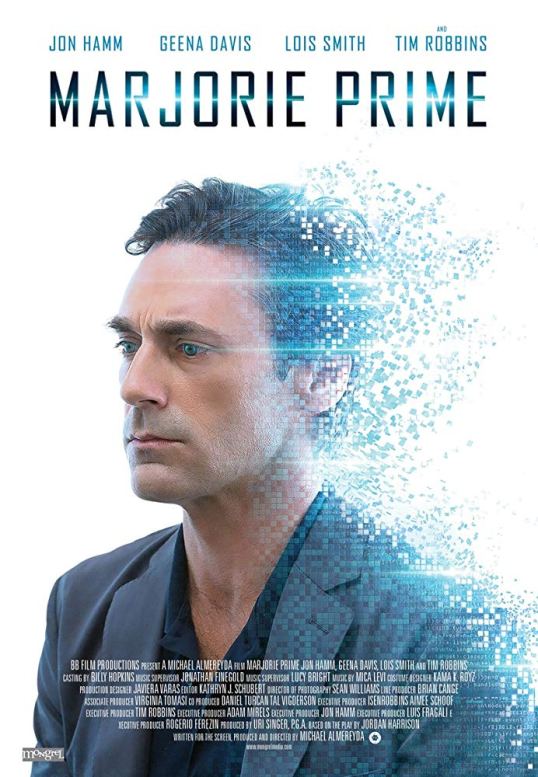
In the year 2050, a woman (Lois Smith) sits in the living room of her beautiful house. Through the windows, we can see that she has a view of an even more beautiful beach. In fact, the beach is nearly too pristine. So is the house. Somehow, everything about the location feels both inviting and fake at the same time. We find ourselves wondering what could possibly be lurking underneath the surface.
The woman is 85 years old. Her name is Marjorie. She’s talking to a very handsome and charming man named Walter (Jon Hamm). As they talk, it becomes obvious that Walter and Marjorie are married. Walter mentions that he proposed to her after they saw the movie My Best Friend’s Wedding. Marjorie doesn’t remember ever seeing a movie by that name and when Walter explains the plot to her, Marjorie simply smiles and nods along. Afterwards, she says that she wishes they had gotten married after seeing Casablanca. She wants a better memory than the one they have.
We can’t help but notice that Walter appears to be quite a bit younger than Marjorie, despite Marjorie saying that Walter was considerably older than her when they first got married. This is because the Walter to whom she is speaking is not the real Walter. The real Walter died years ago. Walter Prime is a hologram, a computer program designed to give Marjorie someone to speak to. Marjorie is in the early stages of Alzheimer’s. When she first got Walter Prime, she specifically decided that she wanted to spend her days with the young Walter, as opposed to the old man that he became. Sometimes, she knows that Walter is just a program and other times, she thinks that he’s real.
Living with Marjorie is her daughter, Tess (Geena Davis) and Tess’s husband, Jon (Tim Robbins). Tess finds the hologram of her father to be somewhat creepy and she wonders why her mother treats the hologram better than she treats her own daughter. Jon, on the other hand, feels that the hologram is just what Marjorie needs.
Time passes. Marjorie grows closer to the hologram while Tess grows angrier and angrier over her mother’s condition. When Tess discovers that Marjorie has been reading a bible, she has a meltdown because her mother has apparently forgotten that she was always a militant atheist. Jon tries to keep everyone calm. Is Jon trying to the inevitable better for everyone or is he just trying to distract himself from the pain that’s all around him?
The hologram and Jon have a meeting. The hologram says that, even though Jon and Tess have programmed him to act, think, and talk just like the original Walter, there are still things that he hasn’t been properly programmed for. While filling Walter Prime in on some more of Marjorie and Walter’s past, Jon reveals the family tragedy that has haunted the family for years….
Marjorie Prime is not a particularly happy movie. It takes place over the course of several decades and we follow Marjorie, Jon, Tess, and Walter through a great deal of changes. The only thing the remains consistent is that everyone is eventually left with only half-remembered fragments of their past. Some of those fragments are happy and others are full of regret. Everyone ages except for the holograms but, as becomes apparent in one particularly heart-breaking scene, a hologram is only as good as the person programming it. A hologram can be programmed to superficially act like someone but it can never actually be that person. As much as Jon, Tess, and Marjorie attempt to recreate the past, it can’t be done because the past can never truly be relived.
Marjorie Prime is science fiction without CGI. It’s a film that’s designed to make you think and it succeeds. It would also probably be unbearably depressing if not for the skills of the cast. Lois Smith is heart-breaking and sympathetic as Marjorie while Jon Hamm does a good job of showing why Walter Prime would be so attractive in theory and so frustrating in reality. (Walter Prime can be programmed to act like he cares but he can’t truly do it.) Geena Davis gives an intelligent and thoughtful performance as Tess, capturing both her anger and regret and the film even makes good use of Tim Robbins’s tendency towards to smarminess.
Marjorie Prime, which was acclaimed when it premiered at Sundance in 2017, is currently streaming on Amazon Prime.

Last night, the Writers Guild of America honored their picks for the best screenplays of 2019. It was a very good night for Parasite.
Here are the winners:
SCREENPLAY NOMINEES
ORIGINAL SCREENPLAY
1917, Written by Sam Mendes & Krysty Wilson-Cairns; Universal Pictures
Booksmart, Written by Emily Halpern & Sarah Haskins and Susanna Fogel and Katie Silberman; United Artists Releasing
Knives Out, Written by Rian Johnson; Lionsgate
Marriage Story, Written by Noah Baumbach; Netflix
WINNER – Parasite, Screenplay by Bong Joon Ho and Han Jin Won, Story by Bong Joon Ho; Neon
ADAPTED SCREENPLAY
A Beautiful Day in the Neighborhood, Written by Micah Fitzerman-Blue & Noah Harpster, Inspired by the Article “Can You Say…Hero?” by Tom Junod; TriStar Pictures
The Irishman, Screenplay by Steven Zaillian, Based upon the Book I Heard You Paint Houses by Charles Brandt; Netflix
WINNER – Jojo Rabbit, Screenplay by Taika Waititi, Based on the book Caging Skies by Christine Leunens; Fox Searchlight
Joker, Written by Todd Phillips & Scott Silver, Based on Characters from DC Comics; Warner Bros. Pictures
Little Women, Screenplay by Greta Gerwig, Based on the Novel by Louisa May Alcott; Sony Pictures
DOCUMENTARY SCREENPLAY
Citizen K, Written by Alex Gibney; Greenwich Entertainment
Foster, Written by Mark Jonathan Harris; HBO Documentary Films
WINNER – The Inventor: Out for Blood in Silicon Valley, Written by Alex Gibney; HBO Documentary Films
Joseph Pulitzer: Voice of the People, Written by Robert Seidman & Oren Rudavsky; First Run Features
The Kingmaker, Written by Lauren Greenfield; Showtime Documentary Films
TELEVISION, NEW MEDIA, AND NEWS NOMINEES
DRAMA SERIES
The Crown, Written by James Graham, David Hancock, Peter Morgan; Netflix
The Handmaid’s Tale, Written by Marissa Jo Cerar, Yahlin Chang, Nina Fiore, Dorothy Fortenberry, Jacey Heldrich, John Herrera, Lynn Renee Maxcy, Bruce Miller, Kira Snyder, Eric Tuchman; Hulu
Mindhunter, Written by Pamela Cederquist, Joshua Donen, Marcus Gardley, Shaun Grant, Liz Hannah, Phillip Howze, Jason Johnson, Doug Jung, Colin J. Louro, Alex Metcalf, Courtenay Miles, Dominic Orlando, Joe Penhall, Ruby Rae Spiegel; Netflix
WINNER – Succession, Written by Jesse Armstrong, Alice Birch, Jon Brown, Jonathan Glatzer, Cord Jefferson, Mary Laws, Lucy Prebble, Georgia Pritchett, Tony Roche, Gary Shteyngart, Susan Soon He Stanton, Will Tracy; HBO
Watchmen, Written by Lila Byock, Nick Cuse, Christal Henry, Branden Jacobs-Jenkins, Cord Jefferson, Jeff Jensen, Claire Kiechel, Damon Lindelof, Janine Nabers, Stacy Osei-Kuffour, Tom Spezialy, Carly Wray; HBO
COMEDY SERIES
WINNER – Barry, Written by Alec Berg, Duffy Boudreau, Bill Hader, Emily Heller, Jason Kim, Taofik Kolade, Elizabeth Sarnoff; HBO
The Marvelous Mrs. Maisel, Written by Kate Fodor, Noah Gardenswartz, Daniel Goldfarb, Alison Leiby, Daniel Palladino, Sono Patel, Amy Sherman-Palladino, Jordan Temple; Prime Video
PEN15, Written by Jeff Chan, Maya Erskine, Anna Konkle, Gabe Liedman, Stacy Osei-Kuffour, Andrew Rhymer, Jessica Watson, Sam Zvibleman; Hulu
Russian Doll, Written by Jocelyn Bioh, Flora Birnbaum, Cirocco Dunlap, Leslye Headland, Natasha Lyonne, Amy Poehler, Tami Sagher, Allison Silverman; Netflix
Veep, Written by Gabrielle Allan-Greenberg, Rachel Axler, Emilia Barrosse, Ted Cohen, Jennifer Crittenden, Alex Gregory, Steve Hely, Peter Huyck, Erik Kenward, Billy Kimball, David Mandel, Ian Maxtone-Graham, Dan Mintz, Lew Morton, Dan O’Keefe, Georgia Pritchett, Leila Strachan; HBO
NEW SERIES
Dead To Me, Written by Rebecca Addelman, Njeri Brown, Liz Feldman, Kelly Hutchinson, Anthony King, Emma Rathbone, Kate Robin, Abe Sylvia; Netflix
PEN15, Written by Jeff Chan, Maya Erskine, Anna Konkle, Gabe Liedman, Stacy Osei-Kuffour, Andrew Rhymer, Jessica Watson, Sam Zvibleman; Hulu
Russian Doll, Written by Jocelyn Bioh, Flora Birnbaum, Cirocco Dunlap, Leslye Headland, Natasha Lyonne, Amy Poehler, Tami Sagher, Allison Silverman; Netflix
WINNER – Watchmen, Written by Lila Byock, Nick Cuse, Christal Henry, Branden Jacobs-Jenkins, Cord Jefferson, Jeff Jensen, Claire Kiechel, Damon Lindelof, Janine Nabers, Stacy Osei-Kuffour, Tom Spezialy, Carly Wray; HBO
What We Do in the Shadows, Written by Jesse Armstrong, Sam Bain, Jemaine Clement, Josh Lieb, Iain Morris, Stefani Robinson, Duncan Sarkies, Marika Sawyer, Tom Scharpling, Paul Simms,Taika Waititi; FX Networks
ORIGINAL LONG FORM
WINNER – Chernobyl, Written by Craig Mazin; HBO
The Terror: Infamy, Written by Max Borenstein, Alessandra DiMona, Shannon Goss, Steven Hanna, Naomi Iizuka, Benjamin Klein, Danielle Roderick, Tony Tost, Alexander Woo; AMC
Togo, Written by Tom Flynn; Disney+
True Detective, Written by Alessandra DiMona, Graham Gordy, Gabriel Hobson, David Milch, Nic Pizzolatto; HBO
ADAPTED LONG FORM
El Camino: A Breaking Bad Movie, Written by Vince Gilligan; Netflix
WINNER – Fosse/Verdon, Written by Debora Cahn, Joel Fields, Ike Holter, Thomas Kail, Steven Levenson, Charlotte Stoudt, Tracey Scott Wilson, Based on the book Fosse by Sam Wasson; FX Networks
The Loudest Voice, Written by John Harrington Bland, Laura Eason, Tom McCarthy, Alex Metcalf, Gabriel Sherman, Jennifer Stahl, Based on the Book The Loudest Voice in the Room and the New York Magazine Articles by Gabriel Sherman; Showtime
Unbelievable, Written by Michael Chabon, Susannah Grant, Becky Mode, Jennifer Schuur, Ayelet Waldman, Based on the Pro Publica & The Marshall Project article “An Unbelievable Story of Rape” and This American Life radio episode “Anatomy of Doubt;” Netflix
ORIGINAL SHORT FORM NEW MEDIA
After Forever, Written by Michael Slade & Kevin Spirtas; Prime Video
WINNER – Special, Written by Ryan O’Connell; Netflix
ANIMATION
“Bed, Bob & Beyond” (Bob’s Burgers), Written by Kelvin Yu; Fox
“The Gene Mile” (Bob’s Burgers), Written by Steven Davis; Fox
“Go Big or Go Homer” (The Simpsons), Written by John Frink; Fox
“A Horse Walks Into A Rehab” (BoJack Horseman), Written by Elijah Aron; Netflix
“Livin’ La Pura Vida” (The Simpsons), Written by Brian Kelley; Fox
WINNER – “Thanksgiving of Horror” (The Simpsons), Written by Dan Vebber; Fox
EPISODIC DRAMA
“407 Proxy Authentication Required” (Mr. Robot), Written by Sam Esmail; USA Network
“A Good Man is Hard to Find” (Ray Donovan), Written by Joshua Marston; Showtime
“Mirror Mirror” (The OA), Written by Dominic Orlando & Claire Kiechel; Netflix
“Moondust” (The Crown), Written by Peter Morgan; Netflix
“Our Little Island Girl” (This Is Us), Written by Eboni Freeman; NBC
WINNER – “Tern Haven” (Succession), Written by Will Tracy; HBO
EPISODIC COMEDY
“Here’s Where We Get Off” (Orange Is the New Black), Written by Jenji Kohan; Netflix
“It’s Comedy or Cabbage” (The Marvelous Mrs. Maisel), Written by Amy Sherman-Palladino; Prime Video
“Nice Knowing You” (Living With Yourself), Written by Timothy Greenberg; Netflix
WINNER – “Pilot” (Dead to Me), Written by Liz Feldman; Netflix
“The Stinker Thinker” (On Becoming a God in Central Florida), Written by Robert F. Funke & Matt Lutsky; Showtime
“Veep” (Veep), Written by David Mandel; HBO
COMEDY/VARIETY TALK SERIES
Conan, Head Writer: Matt O’Brien Writers: Jose Arroyo, Glenn Boozan, Daniel Cronin, Andres du Bouchet, Jessie Gaskell, Brian Kiley, Laurie Kilmartin, Todd Levin, Levi MacDougall, Conan O’Brien, Andy Richter, Frank Smiley, Mike Sweeney; TBS
Full Frontal with Samantha Bee, Head Writer: Melinda Taub Writing Supervised by: Joe Grossman, Nicole Silverberg Writers: Samantha Bee, Kristen Bartlett, Pat Cassels, Sean Crespo, Mike Drucker, Mathan Erhardt, Miles Kahn, Sahar Rizvi, Special Material by: Allison Silverman; TBS
WINNER – Last Week Tonight with John Oliver, Senior Writers: Dan Gurewitch, Jeff Maurer, Jill Twiss, Juli Weiner Writers: Tim Carvell, Daniel O’Brien, John Oliver, Owen Parsons, Charlie Redd, Joanna Rothkopf, Ben Silva, Seena Vali; HBO
Late Night with Seth Meyers, Head writer: Alex Baze Supervising Writers: Sal Gentile, Seth Reiss, Writers: Jermaine Affonso, Karen Chee, Bryan Donaldson, Matt Goldich, Dina Gusovsky, Jenny Hagel, Allison Hord, Mike Karnell, John Lutz, Seth Meyers, Ian Morgan, Amber Ruffin, Mike Scollins, Mike Shoemaker, Ben Warheit; NBC Universal
The Late Late Show with James Corden, Head Writers: Lauren Greenberg, Ian Karmel Writers: Demi Adejuyigbe, James Corden, Rob Crabbe, Lawrence Dai, Nate Fernald, Caroline Goldfarb, Olivia Harewood, David Javerbaum, John Kennedy, Kayleigh Lamb, James Longman, Jared Moskowitz, CeCe Pleasants, Tim Siedell, Benjamin Stout, Tom Thriveni, Louis Waymouth, Ben Winston; CBS
The Late Show with Stephen Colbert, Head Writers: Jay Katsir, Opus Moreschi Writers: Michael Brumm, River Clegg, Aaron Cohen, Stephen Colbert, Paul Dinello, Ariel Dumas, Glenn Eichler, Django Gold, Gabe Gronli, Greg Iwinski, Barry Julien, Daniel Kibblesmith, Eliana Kwartler, Matt Lappin, Asher Perlman, Tom Purcell, Kate Sidley, Jen Spyra, Brian Stack, John Thibodeaux; CBS
COMEDY/VARIETY SPECIALS
Desi Lydic: Abroad, Written by Devin Delliquanti, Lauren Sarver Means; Comedy Central
WINNER – Full Frontal with Samantha Bee Presents: Not the White House Correspondents’ Dinner Part 2, Head Writer Melinda Taub, Writing Supervised by Joe Grossman, Nicole Silverberg, Writers Samantha Bee, Kristen Bartlett, Pat Cassels, Sean Crespo, Mike Drucker, Mathan Erhardt, Lewis Friedman, Miles Kahn, Sahar Rizvi, Special Material by Allison Silverman; TBS
The Late Late Show Carpool Karaoke Primetime Special 2019, Head Writers Lauren Greenberg, Ian Karmel, Writers Demi Adejuyigbe, James Corden, Rob Crabbe, Lawrence Dai, Nate Fernald, Caroline Goldfarb, John Kennedy, James Longman, Jared Moskowitz, CeCe Pleasants, Tim Siedell, Benjamin D. Stout, Tom Thriveni, Louis Waymouth, Ben Winston; CBS
Ramy Youssef: Feelings, Written by Ramy Youssef; HBO
COMEDY/VARIETY SKETCH SERIES
At Home with Amy Sedaris, Writers: Cole Escola, Amy Sedaris, Allison Silverman; truTV
WINNER – I Think You Should Leave with Tim Robinson, Writers: Jeremy Beiler, Zach Kanin, Tim Robinson, John Solomon; Netflix
Saturday Night Live, Head Writers: Michael Che, Colin Jost, Kent Sublette Supervising Writers: Anna Drezen, Fran Gillespie, Sudi Green, Streeter Seidell Senior Writer: Bryan Tucker Weekend Update Head Writer: Pete Schultz Writers: James Anderson, Neal Brennan, Andrew Briedis, Dan Bulla, Megan Callahan, Steven Castillo, Emma Clark, Andrew Dismukes, Alison Gates, Tim Herlihy, Steve Higgins, Sam Jay, Erik Kenward, Steve Koren, Rob Klein, Michael Koman, Dan Licata, Alan Linic, Eli Coyote Mandel, Dave McCary, Dennis McNicholas, Lorne Michaels, John Mulaney, Josh Patten, Jasmine Pierce, Katie Rich, Simon Rich, Gary Richardson, Marika Sawyer, Robert Smigel, Mark Steinbach, Will Stephen, Julio Torres, Bowen Yang; NBC Universal
QUIZ AND AUDIENCE PARTICIPATION
Are You Smarter Than A 5th Grader?, Head Writer Bret Calvert, Writers Seth Harrington, Rosemarie DiSalvo; Nickelodeon
Hollywood Game Night, Head Writers Ann Slichter, Grant Taylor, Writers Michael Agbabian, Marshall Davis, Allie Kokesh, Dwight D. Smith; NBC
Jeopardy!, Writers Matthew Caruso, John Duarte, Harry Friedman, Mark Gaberman, Debbie Griffin, Michele Loud, Robert McClenaghan, Jim Rhine, Steve D. Tamerius, Billy Wisse; ABC
Who Wants To Be A Millionaire, Head Writer Stephen Melcher, Writers Kyle Beakley, Patricia A. Cotter, Ryan Hopak, Gary Lucy, James Rowley, Ann Slichter; Disney/ABC Syndication
DAYTIME DRAMA
Days of Our Lives, Writers: Lorraine Broderick, Ron Carlivati, Joanna Cohen, Carolyn Culliton, Richard Culliton, Rick Draughon, Dave Kreizman, Rebecca McCarty, Ryan Quan, Dave Ryan, Katie Schock, Betsy Snyder; NBC Universal
General Hospital, Head Writers: Shelly Altman, Christopher Van Etten, Dan O’Connor Associate Head Writer: Anna T. Cascio Writers: Barbara Bloom, Suzanne Flynn, Charlotte Gibson, Lucky Gold, Kate Hall, Elizabeth Korte, Donny Sheldon, Scott Sickles; ABC
WINNER – The Young and the Restless, Writers: Amanda L. Beall, Jeff Beldner, Sara Bibel, Matt Clifford, Annie Compton, Christopher Dunn, Sara Endsley, Janice Ferri Esser, Mellinda Hensley, Lynn Martin, Anne Schoettle, Natalie Minardi Slater, Teresa Zimmerman; CBS
CHILDREN’S EPISODIC, LONG FORM AND SPECIALS
“It’s Just… Weird” (Alexa & Katie), Written by Romi Barta; Netflix
WINNER – “Remember Black Elvis?” (Family Reunion), Written by Howard Jordan, Jr.; Netflix
“Remember How This All Started?” (Family Reunion), Written by Meg DeLoatch; Netflix
“Stupid Binder” (Alexa & Katie), Written by Nancy Cohen; Netflix
“Time to Make… My Move” (Jim Henson’s The Dark Crystal: Age of Resistance), Written by Javier Grillo-Marxuach; Netflix
DOCUMENTARY SCRIPT – CURRENT EVENTS
“Coal’s Deadly Dust” (Frontline), Written by Elaine McMillion Sheldon; PBS
“The Mueller Investigation” (Frontline), Written by Michael Kirk & Mike Wiser; PBS
WINNER – “Trump’s Trade War” (Frontline), Written by Rick Young; PBS
DOCUMENTARY SCRIPT – OTHER THAN CURRENT EVENTS
“Chasing The Moon Part One: A Place Beyond The Sky” (American Experience), Written by Robert Stone; PBS
WINNER – “Right To Fail” (Frontline), Written by Tom Jennings; PBS
“Supreme Revenge” (Frontline), Written by Michael Kirk & Mike Wiser; PBS
NEWS SCRIPT – REGULARLY SCHEDULED, BULLETIN, OR BREAKING REPORT
WINNER – “Terror in America: The Massacres in El Paso and Dayton” (Special Edition of the CBS Evening News with Norah O’Donnell), Written by Jerry Cipriano, Joe Clines, Bob Meyer; CBS News
NEWS SCRIPT – ANALYSIS, FEATURE, OR COMMENTARY
“Atlanta, EP. 3” (A King’s Place), Written by Jessica Moulite, Ashley Velez; TheRoot.com
WINNER – “Fly Like An Eagle” (60 Minutes), Written by Katie Kerbstat Jacobson, Scott Pelley, Nicole Young; CBS News
“’Tis the Season: Here’s How Jesus Became So Widely Accepted as White,” Written by Joon Chung, Felice León, Ashley Velez; TheRoot.com
“Toxic Water Crisis Still This Haunts New York Town”, Written by Lena Jackson; HuffPost.com
DIGITAL NEWS
“A Gridiron of Their Own,” Written by Kelsey McKinney; Deadspin.com
WINNER – “Stories About My Brother,” Written by Prachi Gupta, Jezebel.com
RADIO/AUDIO NOMINEES
RADIO/AUDIO NEWS SCRIPT – REGULARLY SCHEDULED, BULLETIN, OR BREAKING REPORT
“CBS News on the Hour with Norah O’Donnell – El Paso, Texas and Dayton, Ohio – Communities in Mourning,” Written by James Hutton; CBS News Radio
WINNER – “Hail and Farewell: Remembering Some Headline Makers,” Written by Gail Lee; CBS News Radio
“World News This Week, August 9, 2019,” Written by Stephanie Pawlowski and Jim Ryan; ABC News Radio
“World News This Week, September 13, 2019,” Written by Joan B. Harris; ABC News Radio
RADIO/AUDIO NEWS SCRIPT – ANALYSIS, FEATURE, OR COMMENTARY
WINNER – “The Enduring Legacy of Jackie Kennedy Onassis,” Written by Dianne E. James, Gail Lee; CBS News Radio
“Woodstock: Back to the Garden,” Written by Gail Lee, CBS News Radio
PROMOTIONAL WRITING NOMINEES
“CBS Promos”, Written by Molly Neylan; CBS
“Star. Kill. Evil. FBI.,” Written by Ralph Buado; CBS
WINNER – “Star Trek: Picard” and “All Rise Promos,” Written by Jessica Katzenstein; CBS
“My Christian name was Philip Pirrip, which I pronounced Pip….”
SHUT UP, PIP!
Seriously, there’s a lot of good things that can be said about Charles Dickens’s Great Expectations but most readers simply can’t get past the fact that the narrator insists on being called Pip. I don’t necessarily blame them, as Pip might be a good nickname for a child but, by the time you’re 16, you should be demanding that everyone call you Phil. That said, I’ve always liked Great Expectations. Despite the fact that Charles Dickens could be a terribly pedantic writer, the plot of Great Expectations is genuinely interesting and the book is full of interesting characters, the majority of whom don’t demand to be known by their childhood nicknames. Plus, I’ve always related to Estella.
The 1946 film adaptation of Great Expectations was at least the third movie to be made from the novel and it would be followed by many more. (In 1998, there was a modernized version where Pip was wisely renamed Finn.) Still, the 1946 adaptation is the best. As directed by David Lean (and based on a stage version that was put together by none other than Alec Guinness), Great Expectations remains true to the source material while, at the same time, cutting away a lot of extraneous material. As a result, Lean’s film version of the story maintains a clear narrative momentum, which is something that eluded Dickens in his sprawling original.
John Mills plays Pip, an orphan who is being raised by his wicked aunt and her husband, the simple but kind-hearted blacksmith, Joe Gargery (Bernard Miles). One night, Pip helps out an escaped convict named Magwitch (Finlay Currie) and, though Magwitch is eventually recaptured, that one act of kindness will determine the rest of Pip’s life.
Pip is invited to visit the mansion of a recluse named Miss Havisham (Martita Hunt) and it’s there that he first meets and falls in love with the beautiful but rather cold-hearted Estella (Jean Simmons and then, after Estella grows up, Valerie Hobson). Of course, what Pip doesn’t realize is that Miss Havisham has specifically raised Estella to destroy the hopes and dreams of every man that she meets.
Eventually, Pip grows up and discovers that he has a mysterious benefactor who feels that Pip should be transformed into a gentlemen so that he might be able to meet the “great expectations” that the benefactor has for him. Pip, of course, assumes that it’s Miss Havisham but even those who haven’t read the book will probably suspect that there’s more to it than just that. Pip moves to London, where he stays with Herbert Pocket (Alec Guinness), a pale young man (for that’s how Dickens described him) who teaches Pip that a gentleman does not use his knife as a fork. Herbert was always my favorite character in the book and he’s my favorite character in the film, largely because he’s played by the totally charming Alec Guinness.
Anyway, Pip becomes a bit of a snob but eventually, he discovers the truth about his benefactor and the last few years of his life. It causes him to not only rip down a lot of curtains but also to reconsider what it truly means to be a a gentleman.
It’s all very well-done, largely because David Lean doesn’t allow the fact that he’s making a film out of a great novel get in the way of telling a good story. The film is well-acted by a wonderful cast of British thespians, all of whom manage to make even the most artificial of scenes and lines seem naturalistic and believable. Even though Pip is a bit of a jerk, John Mills manage to turn him into a sympathetic character. (Mills plays Pip as if he himself cannot stand the fact that he’s turned into such a snob.) Both Jean Simmons and Valerie Hobson do a wonderful job of bringing the potentially problematic character of Estella to life and Bernard Miles is wonderfully empathetic in the role of the Joe Gargery. The scene where a nervous Gargery first meets Pip after Pip has become a gentleman is a true example of great acting.
Not surprisingly, Lean also does a great job of bringing 19th century England to life. Watching this film is a bit like stepping into a time machine and going back to the Dickensian era. As filmed by Lean, London is as bright and vibrant as Pip’s childhood home is dark and constraining. When Pip finds Magwitch on the beach, Lean directs the scene as if it were from a film noir. When Pip enters the darkened home of Miss Havisham and meets the beautiful but destructive Estella, the film flirts with becoming a Rebecca-style gothic romance. And when it’s just Pip and Herbert Pocket talking, it becomes a comedy of manners. Not surprisingly, Great Expectations won Oscars for both its art design and its gorgeous black-and-white cinematography.
Great Expectations was also nominated for Best Picture. However, it lost to Gentleman’s Agreement.


