First released in 1973, The Werewolf of Washington is one of those obscure films that always seems to pop up in Mill Creek box sets. That’s largely because Werewolf of Washington has slipped into the public domain and anyone can release and sell a copy of it. (It’s also been uploaded to YouTube by a few hundred different users.) It’s a film that I’ve actually watched quite a few times, largely because it is so easily available.
Which doesn’t necessarily mean that it’s any good. I have to admit that, in between viewings, I always seem to convince myself that The Werewolf of Washington is a better film than it actually is. The idea behind the film sounds clever. The President’s press secretary (played by Dean Stockwell) is a werewolf. When the full moon shines, he transforms and wrecks havoc on the streets on D.C. Stockwell still wears his suit, even when he’s a wolfman. The President (played by Biff McGuire) is a total idiot who spends a lot of time bowling. The Attorney General (Clifton James) is a paranoid fascist who is quick to blame the werewolf’s murders on outside agitators. For no particular reason, a dwarf mad scientist (Michael Dunn) shows up.
Yes, the idea is clever but the execution … actually, the execution is not terrible. Dean Stockwell gives a good performance and there’s a funny scene where he starts to turn into a werewolf while bowling with the President. Stockwell’s fingers swell up and get stuck in the bowling ball and Stockwell totally freaks out. And then there’s a scene where the werewolf attacks a woman in a phone booth and it’s actually rather suspenseful and almost scary. Plus, Biff McGuire is great and all too plausible as the vapid President.
And yet, overall, the film itself is never as good as you want it to be. I think a large part of the problem is that the film opens with a long voice over from Dean Stockwell, which explains why his character ended up in Budapest (that would be where he gets bitten by the werewolf) and why the President subsequently named him press secretary. It’s so much backstory that you get the feeling that the opening narration must have been added in post production in order to cover up scenes that either did not work or that the film’s director never got a chance to shoot.
And really, the entire film is like that. The film is a collection of scenes that never really flow together or establish any sort of steady pace. And, when it comes to both horror and comedy, pace is key.
The Werewolf of Washington is a clever idea. I just wish the execution had been just as clever.
And I’ll probably continue to wish that the next time that I rewatch it.
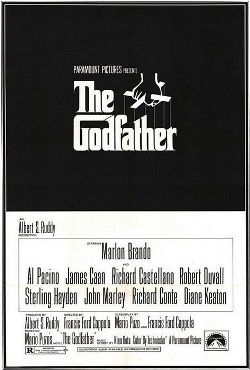
“I got something for your mother and Sonny and a tie for Freddy and Tom Hagen got the Reynolds Pen…” — Kay Adams (Diane Keaton) in The Godfather (1972)
It probably seems strange that when talking about The Godfather, a film that it is generally acknowledged as being one of the best and most influential of all time, I would start with an innocuous quote about getting Tom Hagen a pen.
(And it better have been a hell of a pen because, judging from the scene where Sollozzo stops him in the street, it looked like Tom was going all out as far as gifts were concerned…)
After all, The Godfather is a film that is full of memorable quotes. “Leave the gun. Take the cannoli.” “I’m going to make him an offer he can’t refuse.” “It’s strictly business.” “I believe in America….” “That’s my family, Kay. That’s not me.”
But I went with the quote about the Reynolds pen because, quite frankly, I find an excuse to repeat it every Christmas. Every holiday season, whenever I hear friends or family talking about presents, I remind them that Tom Hagen is getting the Reynolds pen. Doubt me? Check out these tweets from the past!
But all that love also makes The Godfather a difficult film to review. What do you say about a film that everyone already knows is great?
Do you praise it by saying that Al Pacino, Robert Duvall, James Caan, Diane Keaton, Marlon Brando, John Cazale, Richard Castellano, Abe Vigoda, Alex Rocco, and Talia Shire all gave excellent performances? You can do that but everyone already knows that.
Do you talk about how well director Francis Ford Coppola told this operatic, sprawling story of crime, family, and politics? You can do that but everyone already knows that.
Maybe you can talk about how beautiful Gordon Willis’s dark and shadowy cinematography looks, regardless of whether you’re seeing it in a theater or on TV. Because it certainly does but everyone knows that.
Maybe you can mention the haunting beauty of Nina Rota’s score but again…
Well, you get the idea.
Now, if you somehow have never seen the film before, allow me to try to tell you what happens in The Godfather. I say try because The Godfather is a true epic. Because it’s also an intimate family drama and features such a dominating lead performance from Al Pacino, it’s sometimes to easy to forget just how much is actually going on in The Godfather.
The Godfather tells the story of the Corleone Family. Patriarch Vito Corleone (Marlon Brando) has done very well for himself in America, making himself into a rich and influential man. Of course, Vito is also known as both Don Corleone and the Godfather and he’s made his fortune through less-than-legal means. He may be rich and he may be influential but when his daughter gets married, the FBI shows up outside the reception and takes pictures of all the cars in the parking lot. Vito Corleone knows judges and congressmen but none of them are willing to be seen in public with him. Vito is the establishment that nobody wants to acknowledge and sometimes, this very powerful man wonders if there will ever be a “Governor Corleone” or a “Senator Corleone.”
Vito is the proud father of three children and the adopted father of one more. His oldest son, and probable successor, is Sonny (James Caan). Sonny, however, has a temper and absolutely no impulse control. While his wife is bragging about him to the other women at the wedding, Sonny is upstairs screwing a bridesmaid. When the enemies of the Corleone Family declare war, Sonny declares war back and forgets the first rule of organized crime: “It’s not personal. It’s strictly business.”
After Sonny, there’s Fredo (John Cazale). Poor, pathetic Fredo. In many ways, it’s impossible not to feel sorry for Fredo. He’s the one who ends up getting exiled to Vegas, where he lives under the protection of the crude Moe Greene (Alex Rocco). One of the film’s best moments is when a bejeweled Fredo shows up at a Vegas hotel with an entourage of prostitutes and other hangers-on. In these scenes, Fred is trying so hard but when you take one look at his shifty eyes, it’s obvious that he’s still the same guy who we first saw stumbling around drunk at his sister’s wedding.
(And, of course, it’s impossible to watch Fredo in this film without thinking about both what will happen to the character in the Godfather, Part II and how John Cazale, who brought the character to such vibrant life, would die just 6 years later.)
As a female, daughter Connie (Talia Shire) is — for the first film, at least — excluded from the family business. Instead, she marries Sonny’s friend Carlo Rizzi (Gianni Russo). And, to put it gently, it’s not a match made in heaven.
And finally, there’s Michael (Al Pacino). Michael is the son who, at the start of the film, declares that he wants nothing to do with the family business. He’s the one who wants to break with family tradition by marrying Kay Adams (Diane Keaton), who is most definitely not Italian. He’s the one who was decorated in World War II and who comes to his sister’s wedding still dressed in his uniform. (In the second Godfather film, we learn that Vito thought Michael was foolish to join the army, which makes it all the more clear that, by wearing the uniform to the wedding, Michael is attempting to declare his own identity outside of the family.) To paraphrase the third Godfather film, Michael is the one who says he wants to get out but who keeps getting dragged back in.
And finally, the adopted son is Tom Hagen (Robert Duvall). Tom is the Don’s lawyer and one reason why Tom is one of my favorite characters is because, behind his usual stone-faced facade, Tom is actually very snarky. He just hides it well.
Early on, we get a hint that Tom is more amused than he lets on when he has dinner with the crude Jack Woltz (John Marley), a film producer who doesn’t want to use Johnny Fontane (Al Martino) in a movie When Woltz shouts insults at him, Tom calmly finishes his dinner and thanks him for a lovely evening. And he does it with just the hint of a little smirk and you can practically see him thinking, “Somebody’s going to wake up with a horse tomorrow….”
However, my favorite Tom Hagen moment comes when Kay, who is searching for Michael, drops by the family compound. Tom greets her at the gate. When Kay spots a car that’s riddled with bullet holes, she asks what happened. Tom smiles and says, “Oh, that was an accident. But luckily no one was hurt!” Duvall delivers the line with just the right attitude of “That’s my story and I’m sticking to it!” How can you not kind of love Tom after that?
And, of course, the film is full of other memorable characters, all of whom are scheming and plotting. There’s Clemenza (Richard S. Catellano) and Tessio (Abe Vigoda), the two Corleone lieutenants who may or may not be plotting to betray the Don. There’s fearsome Luca Brasi (Lenny Montana), who spends an eternity practicing what he wants to say at Connie’s wedding and yet still manages to screw it up. And, of course, there’s Sollozzo (Al Lettieri, playing a role originally offered to Franco Nero), the drug dealer who reacts angrily to Vito’s refusal to help him out. Meanwhile, Capt. McCluskey (Sterling Hayden) is busy beating up young punks and Al Neri (Richard Bright) is gunning people down in front of the courthouse. And, of course, there’s poor, innocent, ill-fated Appollonia (Simonetta Stefanelli)…
The Godfather is a great Italian-American epic, one that works as both a gangster film and a family drama. Perhaps the genius of the Godfather trilogy is that the Corleone family serves as an ink blot in a cinematic rorschach test. Audiences can look at them and see whatever they want. If you want them and their crimes to serve as a metaphor for capitalism, you need only listen to Tom and Michael repeatedly state that it’s only business. If you want to see them as heroic businessmen, just consider that their enemies essentially want to regulate the Corleones out of existence. If you want the Corleones to serve as symbols of the patriarchy, you need only watch as the door to Michael’s office is shut in Kay’s face. If you want to see the Corleones as heroes, you need only consider that they — and they alone — seem to operate with any sort of honorable criminal code. (This, of course, would change over the course of the two sequels.)
And, if you’re trying to fit a review of The Godfather into a series about political films, you only have to consider that Vito is regularly spoken of as being a man who carries politicians around in his pocket. We may not see any elected officials in the first Godfather film but their presence is felt. Above all else, it’s Vito’s political influence that sets in motion all of the events that unfold over the course of the film.
The Godfather, of course, won the Oscar for best picture of 1972. And while it’s rare that I openly agree with the Academy, I’m proud to say that this one time is a definite exception.
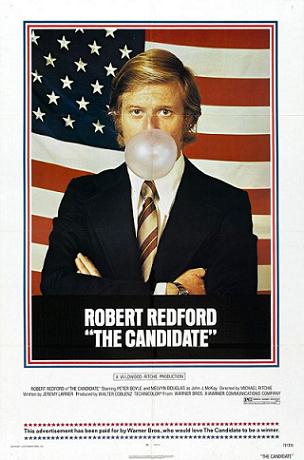
“What do we do now?” — Democratic senate candidate Bill McKay (Robert Redford) in The Candidate (1972)
When I reviewed Advise & Consent, I mentioned that if anyone could prevent billionaire Tom Steyer from winning the Democratic nomination to run in the 2016 California U.S. Senate election, it would be Betty White. Well, earlier today, Tom Steyer announced that he would NOT be a candidate. You can guess what that means. Betty White has obviously already started to set up her campaign organization in California and, realizing that there was no way that he could possibly beat her, Tom Steyer obviously decided to step aside.
So, congratulations to Betty White! (I would probably never vote for her but I don’t live in California so it doesn’t matter.) As future U.S. Senator Betty White prepares for the next phase of her career, it would probably be a good idea for her to watch a few movies about what it takes to win political office in the United States.
For example: 1972’s The Candidate.
The Candidate would especially be a good pick for the nascent Betty White senate campaign because the film is actually about a senate election in California! California’s U.S. Sen. Crocker Jarmon (Don Porter) is a Republican who everyone assumes cannot be defeated for reelection. Democratic strategist Marvin Lucas (a heavily bearded Peter Boyle) is tasked with finding a sacrificial candidate.
The one that Marvin comes up with is Bill McKay (Robert Redford, before his face got all leathery), a 34 year-old lawyer who also happens to be the estranged son of former Governor John J. McKay (Melvyn Douglas, whose wife Helen ran for one of California’s senate seats in 1950). As opposed to his pragmatic and ruthless father, Bill is idealistic and the only reason that he agrees to run for the Senate is because Marvin promises him that he’ll be able to say whatever he wants. Marvin assures Bill that Jarmon cannot be beaten but if Bill runs a credible campaign, he’ll be able to run for another office in the future.
However, Jarmon turns out to be a weaker candidate than everyone assumed. As the charismatic Bill starts to close the gap between himself and Jarmon, he also starts to lose control of his campaign. He soon finds himself moderating his positions and worrying more about alienating potential voters than stating his true opinions. (In one of the film’s best scenes, Bill scornfully mutters his standard and generic campaign speech to himself, obviously disgusted with the vapid words that he has to utter in order to be elected.) The film ends on a properly downbeat note, one that reminds you that the film was made in the 70s but also remains just as relevant and thought-provoking in 2015.
Written by a former political speech writer and directed, in a semi-documentary style, by Michael Ritchie, The Candidate is an excellent film that answer the question as to why all political campaigns and politicians seem to be the same. The Candidate is full of small details that give the film an air of authenticity even when a familiar face like Robert Redford is on screen.
Whenever I watch The Candidate, I find myself wondering what happened to Bill McKay after the film’s iconic final scene. Did he ever regain his idealism or did he continue on the path to just becoming another politician. As much as we’d all like to think that the former is true, it’s actually probably the latter.
That just seems to be the way that things go.
Hopefully, Betty White will learn from Bill McKay’s example.
“Go ahead and hate your neighbor; go ahead and cheat a friend. Do it in the name of heaven; you can justify it in the end. There won’t be any trumpets blowin’ come the judgment day On the bloody morning after, one tin soldier rides away”
— From One Tin Soldier, the theme song of Billy Jack (1971)
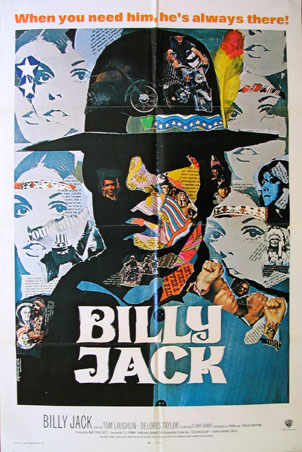
Yesterday, we took a look at The Born Losers, the first film to ever feature the character of future U.S. Senator Billy Jack. The Born Losers ended with former Green Beret-turned-gun-toting-pacifist Billy Jack (played, of course, by Tom Laughlin) saving the girl, killing the bad guy, and getting shot in the back by the police. As Born Losers ended, we were left to wonder whether Billy would survive his wounds or would he just be another victim of the establishment.
Well, audiences had to wait five years to find out.
When Laughlin returned to the role in 1971’s Billy Jack, it was revealed that not only had Billy Jack lived but he was now residing in a cave with his wise Native American grandfather. Billy still had little use for civilization but he would occasionally emerge from his cave. Sometimes, it was to protect wild mustangs from being hunted the evil Old Man Posner (Bert Freed) and his sociopathic son Bernard (David Roya). Other times, it was to protect the Freedom School and, even more importantly, the Freedom School’s founder, Jean (played by Laughlin’s wife, Delores Taylor).
The local townspeople viewed the Freedom School with suspicion and whenever the students went into town, they would be harassed by Bernard and his friends. Fortunately, the students could always count on Billy to show up, say a few angry words, and then lose control. Billy may have been a liberal but he was no pacifist. Jean, however, fully embraced nonviolence and she always made it clear that she wasn’t comfortable with Billy providing her kids with a violent example.
Finally, both Jean and Billy’s convictions were put to the test. First off, the bigoted townspeople tried to close the school. Then, Jean was raped by Bernard. And finally, Billy found himself barricaded in an old mission, surrounded by police and national guardsmen. Even as Jean pleaded with Billy to lay down his weapons and to peacefully surrender, Billy made it clear that he was willing to die for his beliefs.
And, as the film ended, you would never guess that Billy Jack would eventually become a member of the U.S. Senate. But, in just a few years, that’s exactly what would happen in Billy Jack Goes To Washington!
Now, of course, Billy Jack is ultimately a product of its time and that’s both a blessing and a curse. To be honest, if anything could transform me from being the socially liberal, economically conservative girl that you all know and love into a card-carrying right-wing extremist, it would be having to spend any time with the students at the Freedom School. They are all so smugly convinced of their own moral superiority that the townspeople almost start to look good by default. Whether they’re attending improv class or disrupting a meeting at town hall, the majority of the students come across like a bunch of rich kids from the suburbs, playing hippy and slumming by hanging out with poor minorities. As you watch them, it’s difficult not to suspect that most of them are going to get bored with rebelling after a year or two and eventually end up growing up to be just like their parents.
Fortunately, the film is saved by the pure sincerity of Laughlin and Taylor. For all the attention that the film gets for the scenes of Billy Jack beating people up, the most compelling scenes are the ones where Jean and Billy Jack debate nonviolence. There’s an honesty and a passion to these scenes, one that proves that Laughlin and Taylor, as opposed to so many other self-styled counterculture filmmakers, were actually serious about their beliefs. Billy Jack is an essential film, not only as a time capsule of the era in which it was made but also as one of the few films to actually make a legitimate attempt to explore what it truly means to embrace nonviolence.
Billy Jack is also a historically important film. When American Independent Pictures withdrew from the production, Laughlin took Billy Jack to 20th Century Fox. When 20th Century Fox looked at the completed film and did not know how to market it, Laughlin distributed the film himself, without the support of a major studio. And, despite what all of the naysayers may have predicted, Billy Jack was a huge hit.
And every indie filmmaker since owes a huge debt of gratitude to Tom Laughlin.
If you ever find yourself on the campus of the University of North Texas and you need to kill some time, stop by the UNT Library, go up to the second floor, find the biographies, and track down a copy of Peter Manso’s Mailer: His Life and Times.
Back in December of 2007, at a time when I really should have been studying for my finals, I spent an entire afternoon in the library reading Manso’s book. I didn’t know much about Norman Mailer, the Pulitzer prize-winning writer and occasional political candidate, beyond the fact that he died that previous November and that a lot of older people who I respected apparently thought highly of his work. Though Manso’s book had been written 20 years earlier, it still provided an interesting portrait of the controversial author. It was largely an oral history, full of interviews with people who had known Mailer over the years. As I skimmed the book, it quickly became apparent that, among other things, Mailer was a larger-than-life figure.
For me, the book was at its most interesting when it dealt with Mailer’s attempts to be a filmmaker. In the 1960s, Mailer directed three movies. All three of them also starred Norman Mailer and featured his friends in supporting roles. All three of them were largely improvised. And, when released into theaters, all three of them were greeted with derision.
Maidstone, Mailer’s 3rd film, was filmed in 1970. In the film, Mailer played Norman Kingsley, an avante garde film director who is running for President. Over the course of one weekend, while also working on a movie about a brothel, Norman meets with potential supporters and debates the issues. And, of course, shadowy figures plot to assassinate Norman, not so much because they don’t want him to be President as much as they want him to be a martyr for their vaguely defined cause.
Just based on what I read in Manso’s book, it’s hard not to feel that the making of Maidstone could itself be the basis of a good movie. Mailer essentially invited all of his friends to his estate and they spent 5 days filming, with no script. It was five days of drinking, drugs, and bad feelings.
At one point, actor and painter Herve Villechaize (who would later play Knick Knack in The Man With The Golden Gun) got so drunk and obnoxious that he was picked up by actor Rip Torn and literally tossed over a fence. The unconscious Villechaize ended up floating face down in a neighbor’s pool. After fishing Villechaize out of the pool, the neighbor tossed him back over the fence and shouted, “Norman, come get your dwarf!”
Eventually, after five days, filming fell apart. Some members of the cast were okay with that. And one most definitely was not..
Fortunately, Maidstone is currently available on YouTube so I watched it last night. Unfortunately, the film itself is never as interesting as the stories about what went on behind the cameras. Maidstone is essentially scene after scene of people talking and the effectiveness of each scene depends on who is in it. For instance, Norman’s half-brother is played by Rip Torn, a professional actor with a big personality. The scenes with Torn are interesting to watch because Rip Torn is always interesting to watch. However, other scenes feature people who were clearly cast because they happened to be visiting the set on that particular day. And these scenes are boring because, quite frankly, most people are boring.
And then you’ve got Norman Mailer himself. For an acclaimed writer who was apparently quite a celebrity back in the day, it’s amazing just how little screen presence Norman Mailer had as an actor. Preening for the camera, standing around shirtless and showing off his hairy back along with his middle-aged man boobs, Mailer comes across as being more than a little pathetic. He’s at his worst whenever he tries to talk to a woman, giving off a vibe that’s somewhere between creepy uncle and super veiny soccer dad having a midlife crisis.
It’s an uneven film but, for the first half or so, it’s at least interesting as a time capsule. For those of us who want to know what rich intellectuals were like in the late 60s, Maidstone provides a service. However, during the second half of the film, it becomes obvious that Mailer got bored. Suddenly, all pretense towards telling an actual story are abandoned and the film becomes about Mailer asking his cast for their opinion about what they’ve filmed so far.
And then, during the final 15 minutes of the film, Norman Mailer decides to have the cameramen film him as he plays with his wife and children. This is apparently too much for Rip Torn who, after spending an eternity glaring at Mailer and undoubtedly thinking about everything he could have been doing during those five day if he hadn’t been filming Maidstone, walks up to Mailer, says, “You must die, Kingsley,” and then hits Mailer on the head with a hammer.
This, of course, leads to a long wrestling match between Mailer and Torn and, as the cameras roll, blood is spilled and insults are exchanged. There’s a lot of differing opinions about whether this final fight was spontaneous or staged. Having seen the footage, I get the impression that Mailer was caught off guard but that Torn probably let the cameraman know what he was going to do ahead of time.
Regardless, it’s hard to deny that the pride of Temple, Texas, Elmore “Rip” Torn, appears to be the one who came out on top. After the fight, Mailer and Torn have a lengthy argument that amounts to Rip saying that he had to do it because it was the only way that the film would make sense while Mailer replies with some of the least imaginative insults ever lobbed by a Pulitzer winner.
(So basically, Rip Torn won both the physical and the verbal rounds of the fight.)
Anyway, you can watch the entire Rip Torn/Norman Mailer confrontation below.
Now, while the fight is really the only must-see part of Maidstone, it still has considerable value as a time capsule of the time when it was made. You can watch it below!
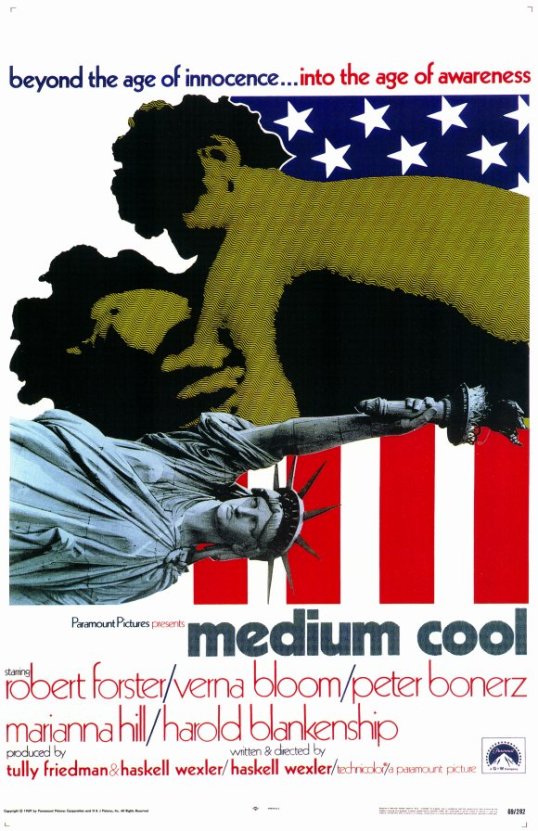
For the past few days, I’ve been chronologically reviewing 94 films about politicians and, to a lesser extent, politics. Four days ago, I started in on the 60s by taking a look at Sunrise at Campobello, one of the most traditional-minded and pro-American movies ever made. And now, I’m closing out the decade by taking a look at 1969’s Medium Cool, a film that is — in style, ideology, and content — the exact opposite of Sunrise at Campobello.
I should admit that I’m cheating a bit by including Medium Cool in this series of reviews. When I first started Shattered Politics, I said that I would be reviewing films about politicians. While Medium Cool is a fiercely political film, there are few elected officials to be seen on screen. That said, it was shot during the infamous 1968 Democratic National Convention and, as such, the politicians are present regardless of whether or not they’re seen.
Plotwise, the film follows a news cameraman, John (Robert Forster), and his sound guy (Peter Bonerz) as they go around Chicago, searching for stories. Along the way, they interview the disturbingly cheerful owner of a gun club (played, in his film debut, by Peter Boyle), several people who volunteered on Robert Kennedy’s presidential campaign, and, in one of the film’s best and most awkward scenes, a group of Black Panthers.
Throughout the first half of the film, John remains detached from the stories that he covers. He’s more concerned with getting the footage and getting a good soundbite than in really listening to what anyone is saying. (In many ways, he’s like a less sociopathic version of the character played by Jake Gyllenhaal in Nightcrawler.) It’s not until John discovers that his station is sharing his footage with the FBI that John finally starts to show some political awareness. Unfortunately, he also shows some anger and ends up losing his job as a result.
Now unemployed, John meets Eileen (Verna Bloom), a single mother who has recently moved to Chicago from West Virginia. Now that he’s free from the detachment of his job, John actually starts to develop feelings for both Eileen and her son, Harold (Harold Blankenship). When Harold runs away, Eileen and John search Chicago for him. Unfortunately, their search happens at the same time as the 1968 Democratic Convention. While John and Eileen search, the Chicago police are busy beating protestors in the street.
(The video below is long, but worth watching, as is the entire film.)
Now, I know that, in the past, I’ve been critical of many of the counter culture films of the late 60s and early 70s, describing their politics as being shallow, trendy, and faux Leftist. (And if you doubt me, read my reviews of Getting Straight, Zabriskie Point, and R.P.M.) However, Medium Cool is an exception to those films, in that it actually works. Medium Cool was directed by famed cinematographer, Haskell Wexler. Wexler began his career shooting documentaries and, in many ways, that’s exactly what Medium Cool is. Though Robert Forster may be an actor, many of the people that he interviewed in the film were not. When he talks to the former Kennedy campaign workers, he’s talking to actual volunteers and getting their true feelings, as opposed to something written for them by an out-of-touch screenwriter. When we see John and Eileen trying to survive the violence outside the Democratic Convention, we’re also seeing Robert Forster and Verna Bloom attempting to do the same thing. The protestors being attacked were real. The cops doing the attacking were real. The violence was real.
And, considering that Medium Cool was released 46 years ago, the issues raised by the film are still real. When the Black Panthers suspiciously view John and his sound guy, we’re reminded of the protestors in Ferguson demanding that the national media get out of their way. When we see the protests outside the 1968 Democratic Convention, how can we not compare them to the protests that we still see every day? When the cops line up in military precision and we hear that orders must be followed, are we watching Medium Cool or are we watching CNN?
During one of Medium Cool‘s better known moments, an off-screen voice is heard to shout, “Look out, Haskell! It’s real!,” warning director Haskell Wexler that the violence he’s filming is actually happening. And that’s a warning that’s still appropriate and relevant today. We may be watching from the safety of our homes but it’s still real.
(Of course, it should be mentioned that, according to Wexler himself, “Look out, Haskell! It’s real!” was actually added to the scene in post production.)
It’s perhaps indicative of how much American culture changed in the 60s that a decade that started with Ralph Bellamy playing Franklin D. Roosevelt would end with Medium Cool. Fortunately, Medium Cool gives us plenty of evidence about how that change happened.
Seriously, the great thing about being in your 20s is that everything is set up to specifically appeal to you. Everyone wants your attention, your money, your tweets, your ideas, you love, and everything else. And, yes, I understand that most people neither like nor respect my generation but oh well and whatever. Trust me, the generation coming up behind mine is a hundred times worse.
2008 was a great time to be a politically knowledgeable millennial. Everyone running for President was desperate to get our vote and they were willing to promise us anything. And, since my age group voted overwhelmingly for Obama, all of the old elitists in the national media briefly fell in love with us. (The genius of Obama’s 2008 campaign was to tell us that we were the people that we were waiting for. Technically, it’s a bit nonsensical but never doubt what you can accomplish by appealing to the ego of the electorate.)
Of course, over the past few years, my generation has essentially been fucked over by both political parties and, since we dared to complain about it, nobody likes us anymore. But, oh well and whatever. American culture is basically built around our whims so we really don’t need anyone else’s love.
And, if all this sounds a little bitter or angry, I would point that young people and old people have been at war since time began. Generational conflict is nothing new. And if you need proof of that, I suggest watching a film from 1968 called Wild In The Streets.
Wild in the Streets tells the story of Max Frost (Christopher Jones), a rock star who lives in a gigantic mansion with his band and his groupies. When Max is asked to perform at a campaign appearance for senate candidate Johnny Fergus (Hal Holbrook), he agrees to do so because Fergus supports lowering the voting age. (When Wild In The Streets was made, you had to be 21 to vote. So, if your birthday fell on election day, you could cast your first vote and then go have your first legal drink.) However, at the rally, Max announces that he wants 14 year-olds to have the vote and then performs a song called “14 or fight!”
Max’s song is such a sensation and leads to so many protests that, in a compromise, the voting age is lowered to 15. Johnny Fergus is elected to the Senate and, before you can say “Blue dog,” promptly starts to ignore the will of the people who supported him. So, Max arranges for his girlfriend Sally (Diane Varsi) to be elected to the U.S. House. After spiking the water supply of Washington D.C. with LSD, Sally gets a bill passed and the age requirement for holding political office is lowered to 14!
Of course, in the next election, 24 year-old Max Frost is elected President of the United States. Soon, anyone over the age of 35 is being sent to re-education camps where they are force-fed LSD. Max is so ruthless that he even sends his own mother (Shelley Winters) off to re-education.
And, with all the old people gone, everything is perfect for Max. Except for that fact that 10 year-olds are now demanding the vote…
In many ways, Wild in the Streets feels like a film that could have only been made in 1968. From the psychedelic direction to the costumes to the hair to music, everything about this movie screams late 60s. But, at the same time, it’s still a genuinely amusing satire, largely because generational conflict is timeless. We all think that those older than us are clueless and that those younger are spoiled. There’s a lot of things in your life that can control. Sadly enough, getting older is not one of them.
Wild in the Streets is a fun and amusing time capsule. See it now before the younger generation comes of age and totally fucks up the world.
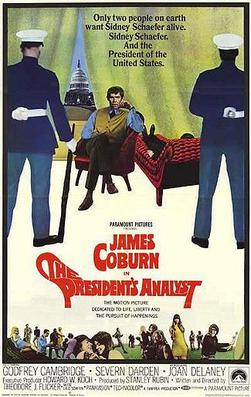
“If I was a psychiatrist, which I am, I would say that I was turning into some sort of paranoid personality, which I am!” — Dr. Sidney Schaefer (James Coburn) in The President’s Analyst (1967)
Let’s just be absolutely honest about something. Judging from what they regularly get caught saying and from some of the policies that they support, a good deal of politicians could probably use some sort of professional help. That’s probably especially true of the men who sit in the Oval Office. It can’t be easy to have to hide so many secrets, tell so many lies, and be constantly aware of how close the government is to actually collapsing. We’ve had 44 Presidents and I imagine all of them probably could have used someone to talk to.
But here’s the thing. We spend so much time worrying about the well-being of the President that we often don’t stop to think about the people who have to listen to them speak on a daily basis. I imagine that being the President’s therapist must be a thankless job. Not only do you have to spend hours listening to someone who you may not have voted for but, at the same time, you can’t share any of the information that you’ve learned.
That would certainly seem to be what’s happening with Dr. Sidney Schaefer (James Coburn), the title character of the wonderfully psychedelic 1967 satire, The President’s Analyst. At the start of the film, Sidney is a supremely confident psychiatrist. He can calmly and rationally deal with all of his patients problems and, in order to keep from getting overwhelmed, he has his own analyst (Will Geer).
One of his patients is Don Masters (Godfrey Cambridge), an agent for the Central Enquiries Agency (CEA) who is first seen casually murdering a man on the streets of New York. (When Sidney discovers that Don is an assassin, he’s thrilled and impressed to discover that Don has managed to channel all of his hostility into his job.) What Sidney doesn’t realize is that Don is testing him to see if he’s up to the job of serving as the President’s analyst.
At first, Sidney is thrilled with his new position but he soon discovers that being the closest confidante of the leader of the free world has its downside. For one thing, Sidney is viewed by suspicion by Henry Lux (Walter Burke), the head of the Federal Bureau of Regulation (which, in this film, is exclusively staffed by people who are less than 5 feet tall). Even beyond being targeted by the FBR, Sidney struggles with not being able to see his own therapist and discuss what he’s been told by the President. Soon, Sidney is becoming paranoid and is even convinced that his girlfriend is a spy.
(And, of course, she is.)
So, Walter does what any sensible and paranoid person would do. He makes a run for it. Pursued by the FBR, the CEA, and a Russian assassin (a funny performance from Severn Darden, who also played Kolp, the sadistic torturer in Conquest of the Planet of the Apes), Sidney hides out with everyone from a group of hippies to a family of heavily armed, karate-trained, middle class “militant liberals.”
(The father of the militant liberal family is played by William Daniels, who decades later would play Mr. Feeney in Boy Meets World.)
Of course, there’s an even bigger conspiracy at work than even Sidney realizes. The real threat is the TPC and I’m not going to tell you what that stands for. You need to see the movie.
And really, The President’s Analyst is a film that you really should see. What makes this film truly special — beyond the clever dialogue and the excellent performances and the great direction — is that it’s both a product of when it was made and a timeless portrait of power and paranoia. It’s a time capsule that still feels incredibly relevant.
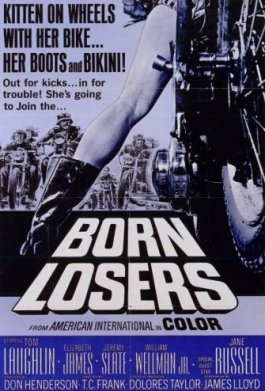
For the past few days, I’ve been in the process of reviewing 94 films about politics and politicians. With that in mind, you may be wondering why, after reviewing films like The Last Hurrah, Sunrise at Campobello, and Advise & Consent, I am now reviewing a 1967 biker film called The Born Losers.
It all comes down to Billy Jack. In the 70s, Tom Laughlin would write, direct, and star in two hit films — Billy Jack and The Trial of Billy Jack. In these films, Laughlin played the title character. Billy Jack was everything that you could hope for in a counter-culture hero. First off, as an American Indian, he was an authentic American as opposed to just another European intruder. He was a war hero, who had served as a Green Beret in Vietnam. He often carried a gun with him, which meant that he understood and supported the 2nd Amendment and good for him! Billy Jack was also a master of hapkido, which meant that he could kick ass in the most visually appealing way possible.
Even more importantly, Billy Jack called the Man out on his racism and his intolerance. Billy Jack was an environmental activist before anyone else. Billy Jack went on vision quests. Billy Jack was anti-war. Billy Jack was a pacifist. And, of course, Billy Jack ended up killing a lot of people but they were all bad guys.
By making and distributing Billy Jack himself, Laughlin became an independent film pioneer and made history. He also became a counter-culture hero and Billy Jack remains a cult figure even today. But what a lot of people don’t realize is that Billy Jack first appeared in Born Losers and that, in the little seen Billy Jack Goes To Washington, he eventually ended up serving in the U.S. Senate.
When you consider that Billy Jack would eventually be Sen. Jack, that means the Born Losers isn’t just a low-budget, violent biker film. Instead, it’s the exploitation version of Young Mr. Lincoln. It’s a chance to see what Billy Jack was doing before he became a statesman.
(And rest assured, the other three Billy Jack films will be reviewed before Shattered Politics ends.)
As we discover at the start of Born Losers, pre-politics Billy Jack was just an enigmatic veteran who lived in the mountains of California. When we first see Billy, he’s walking along a grassy hill. A deer safely runs by the camera. A rabbit pops its head out of a hole in the ground and looks relieved to see Billy. If I’m being a little bit snarky, it’s because I’ve seen all of the Billy Jack films and I know how often this exact scene is played out over the course of the franchise. But, in all fairness, it’s actually a fairly well-done and visually appealing scene and, as an actor, Laughlin had the presence to pull it off.
A far less pretty scene is occurring in the town of Big Rock, where teenagers are showing up to hang out on the beach and are being harassed by a group of bikers, the Born Losers of the title. The Born Losers are an odd collection of bikers, with half of them looking like extras from Sons of Anarchy and the other half looking like the type of hipsters that I always see whenever I go to a movie at the Alamo Drafthouse. Their leader (Jeremy Slate) is named Danny but the rest of the gang are known by their nicknames.
(For instance, there’s Crabs. Why is he called Crabs? “Because he’s got them!” Danny helpfully explains.)
After the Born Losers rape four girls, they launch a campaign of violence and intimidation to keep the girls from testifying in court. Billy comes to the aid of one of the girls, Vicky (Elizabeth James, who also wrote the script). I related to Vicky, largely because she does things like ride a motorcycle while wearing a white bikini, which is exactly the sort of thing that I would do if I lived in California.
Now, there’s a lot of negative things that I could say about Born Losers. It’s talky. With the exception of Laughlin and Slate, it’s obvious that the majority of the cast was made up of amateurs. The final half of the film drags as you wait for an ending that you have probably already predicted.
But you know what?
I actually like The Born Losers. Hidden underneath all of the exploitation trappings and heavy-handed moralizing, this is a very sincere film. Whatever they may have lacked in budget or subtlety, Laughlin’s films made up for in sincerity. And, as strange as it may be to say about a film that features four rapes and is padded out with a thoroughly gratuitous striptease, The Born Losers is not a misogynistic film. Both Laughlin the director and Billy Jack the character are on the side of the victims of the Born Losers and when the film calls out society for blaming the victims instead of the rapists, it does so with a fury that elevates the entire film above your typical 1967 biker film.
And, while I don’t know if I’d ever vote for Billy Jack, there’s nobody I’d rather have on my side.
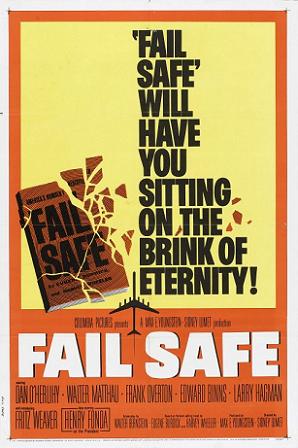
After watching Dr. Strangelove, you may find yourself asking what that film would have been like if it had treated its doomsday scenario seriously. Well, you can find out by watching yet another film from 1964, Sidney Lumet’s Fail-Safe.
What’s Fail-Safe about? Well, basically, it tells the exact same story as Dr. Strangelove, except without the humor. Once again, an American bomber is accidentally ordered to launch a nuclear attack against Russia. Again, the President (played, somewhat inevitably, by Henry Fonda) has to have an awkward conversation with the leader of Russia. Again, a sinister defense advisor (this time played by Walter Matthau) argues that the world can survive a nuclear war.
Admittedly, there is no equivalent to George C. Scott’s Buck Turgidson in Fail-Safe. However, there is a General Black (Dan O’Herilihy) who has a recurring nightmare about watching a bullfight while the sky around him glows with radiation.
Fail-Safe has the same plot as Dr. Strangelove but none of the humor. In fact, Fail-Safe has absolutely no humor at all. It’s one of the most somber films that I’ve ever seen. It has a good opening with General Black’s nightmare and an effective ending that makes excellent use of freeze frames but the middle of the film is basically just a collection of endless debates.
And I’m sure that approach made sense at the time because, after all, Fail-Safe was dealing with a serious theme, it was directed by a serious filmmaker, and it featured a bunch of serious actors. And maybe if I had never seen Dr. Strangelove, Fail-Safe would not seem like such a slow and boring movie. But I have seen Dr. Strangelove and, as a result, it’s impossible to watch Fail-Safe without wanting to hear Henry Fonda say, “You can’t fight here! This is the war room!”