Brad takes on THE WHITE BUFFALO (1977), starring Charles Bronson and Will Sampson!


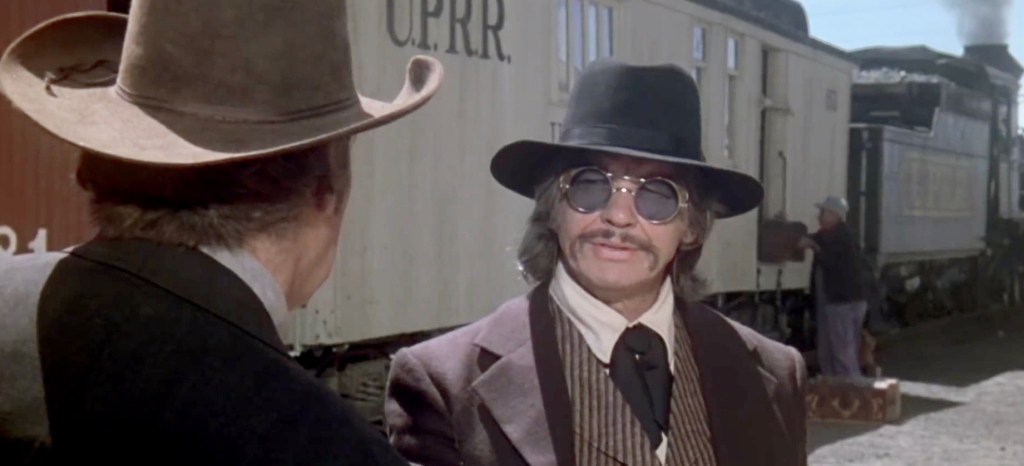
Charles Bronson as Wild Bill Hickok

Back in 2023, my family visited the Black Hills of South Dakota. The first thing we did was visit Mount Rushmore. The second thing we did was visit the Mount Moriah Cemetery and the final resting place of Wild Bill Hickok. Situated on the top of a hill overlooking the city of Deadwood, it’s a beautiful place that also includes the graves of Calamity Jane and Sheriff Seth Bullock. I insisted that we see the location for possibly the most superficial reason possible… because Charles Bronson played Hickok in THE WHITE BUFFALO.

Based on a novel by Richard Sale, the story opens with Hickok having a recurring nightmare of a snowy showdown with a giant white “spike.” And if he has pistols handy, he wakes up firing them uncontrollably and you’d better not be nearby. Determined to face his fear, he heads out into the hills with his friend Charlie Zane (Jack Warden), hoping to find the albino buffalo, so he can put him down and end the nightmares. Around the same time, the great beast has stampeded the camp of Crazy Horse (Will Sampson) killing his child in the process. Convinced that the child cannot have peace in the afterlife, Crazy Horse sets out to kill the buffalo so he can wrap his child in its white “robe” and free her spirit. With Hickok a prolific killer of Indians, and Crazy Horse a brave Lakota Oglala warrior, the two men seem to be on a deadly collision course in those snowy hills.

Charles Bronson’s final western, THE WHITE BUFFALO has a lot of the scenes you’d expect. With Bronson playing a famous gunman, we get to see several gunfights as he makes his way through various Wyoming towns, featuring well-known actors like Clint Walker and Ed Lauter. We also get to see him visit various saloons, as well as the widow Schermerhorn, played by Kim Novak. When he really “knew” her, she was a prostitute named Poker Jenny. Along with those I’ve already mentioned, it’s an all-star affair as we see such familiar faces as Stuart Whitman, John Carradine, Slim Pickens, and even a young Martin Kove sprinkled throughout the film. And of course, we get to see Bronson take on the gigantic white buffalo of the title, first in his dreams, and then later in reality! Directed by veteran filmmaker J. Lee Thompson, these scenes are staged and executed well, with Hickok’s nightmares given an especially eerie quality.
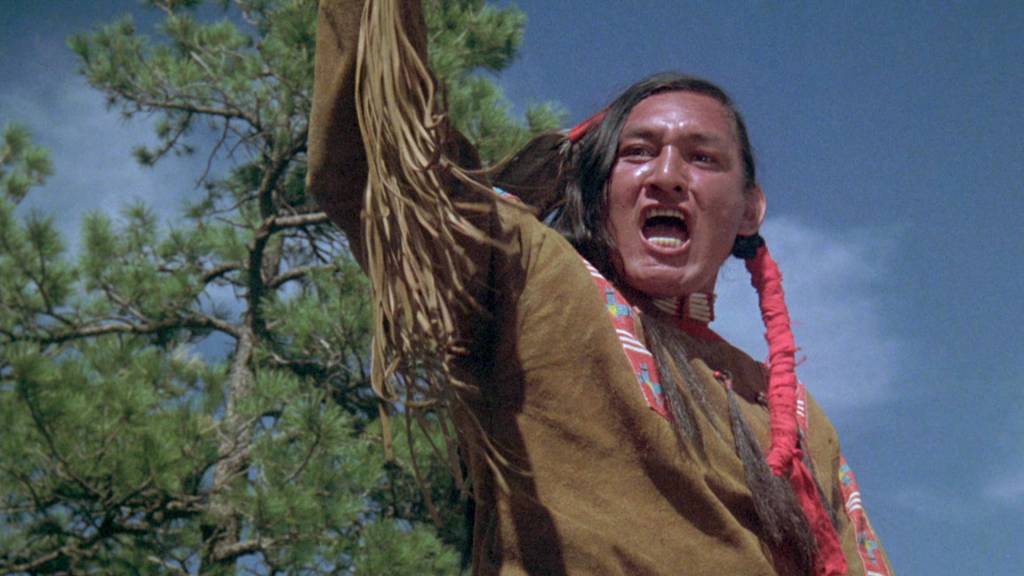
Will Sampson as Crazy Horse

While the movie has the expected scenes, it’s the unexpected character moments that sets THE WHITE BUFFALO apart as a uniquely strong entry in Bronson’s filmography. Hickok may be a man haunted by dreams of a monstrous white buffalo, but Bronson plays him in such a way that we can feel his exhaustion and literal sickness from too many years of a dangerous and difficult life. The buffalo is more than just an animal… it’s a symbol of guilt, fear and the coming of death itself. Bronson could always underplay a role better than just about anyone else, but here he’s reflective and haunted in way that I’ve not seen before, and he’s really good.

I also think the movie gets better every time Bronson shares a scene with Will Sampson. Sampson brings dignity and intelligence to Crazy Horse. His mission is more noble than Hickok’s, and an unexpected friendship develops between the two men, despite their vast differences. Ultimately, it’s this relationship that provides the film an emotional weight that sneaks up on you by the end, even if it’s not meant to last.

THE WHITE BUFFALO is not a perfect film. The animatronic buffalo may look a little hokey, and the film may seem a little slow at times for those expecting an action-packed western or monster movie. However, Bronson and Sampson are so good in their myth-making performances that the film eventually becomes something more. It’s the idea of watching two aging warriors, bound together through the bravery of confronting death, that I found to be more interesting and compelling than anything else on display.

THE WHITE BUFFALO is currently streaming on Amazon Prime, Tubi, PlutoTV, and The Roku Channel.
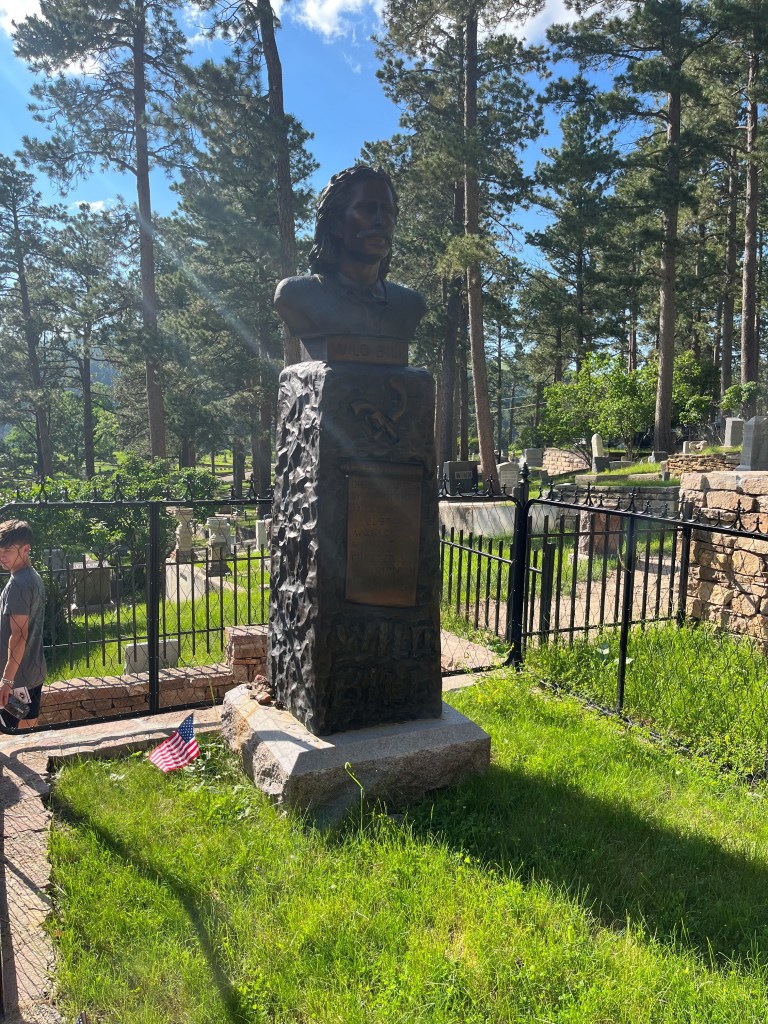
Wild Bill Hickok’s gravesite in Mount Moriah Cemetery in Deadwood, South Dakota

Late Night Retro Television Review: CHiPs 2.7 “High Flyer”


Welcome to Late Night Retro Television Reviews, a feature where we review some of our favorite and least favorite shows of the past!  On Mondays, I will be reviewing CHiPs, which ran on NBC from 1977 to 1983.  The entire show is currently streaming on Freevee!

This week, it’s helicopter time!

Episode 2.7 “High Flyer”

(Dir by Gordon Hessler, originally aired on November 4th, 1978)

Ponch in the air?

Not if Ponch has anything to say about it!  All of the members of the Highway Patrol are apparently required to spend one day on helicopter patrol but Ponch is scared of heights.  First, he pretends to have a cold.  Then, he pretends to have an earache, just to discover that the helicopter has been grounded due to bad weather.  Finally, the day comes when Ponch has no more excuses and the weather is clear.  Ponch goes up in the air but, fortunately, being in the helicopter allows Ponch to spot the van that’s being driven by a bunch of car thieves that he and Baker have spent the entire episode chasing.  To give credit where credit is due, the scene where the helicopter chases a thief in a stolen car is genuinely well-shot and exciting to watch.  Fortunately, the thief managed to drive some place where no one else was around so the helicopter could then fly way too close to the ground and do a whole bunch of ludicrously dangerous stunts.  I’m kind of surprised no one died to be honest.

While Ponch dealt with his fear of flying, Baker dealt with Kim (Cynthia Bain), the teenage daughter of his neighbor, Carol (Mary Louise Weller).  After having a fight with her mother, Kim decided to just move into Baker’s apartment.  Realizing that Kim had a bit of a crush, Ponch and Baker recruited Sindy Cahill — the only female member of the Highway Patrol who has spent the entire season demanding to be taken seriously — to pretend to be Baker’s girlfriend.  Heart-broken, Kim returned home.  That was a really terrible ending for what, until that point, had actually been a well-acted look at teen angst and first crushes.  Weller, Bain, and Larry Wilcox were all giving sensitive performances so it’s a bit unfortunate that it was all just a set-up for another “Let’s-Demean-Cahill” moment.

So, this episode was not so great when it came to the human drama but it was redeemed by the helicopter action.  When in doubt, toss in a helicopter.

Shattered Politics #29: Billy Jack (dir by Tom Laughlin)


Billy_Jack_poster

“Go ahead and hate your neighbor; go ahead and cheat a friend.
Do it in the name of heaven; you can justify it in the end.
There won’t be any trumpets blowin’ come the judgment day
On the bloody morning after, one tin soldier rides away”

— From One Tin Soldier, the theme song of Billy Jack (1971)

Yesterday, we took a look at The Born Losers, the first film to ever feature the character of future U.S. Senator Billy Jack.  The Born Losers ended with former Green Beret-turned-gun-toting-pacifist Billy Jack (played, of course, by Tom Laughlin) saving the girl, killing the bad guy, and getting shot in the back by the police.  As Born Losers ended, we were left to wonder whether Billy would survive his wounds or would he just be another victim of the establishment.

Well, audiences had to wait five years to find out.

When Laughlin returned to the role in 1971’s Billy Jack, it was revealed that not only had Billy Jack lived but he was now residing in a cave with his wise Native American grandfather.  Billy still had little use for civilization but he would occasionally emerge from his cave.  Sometimes, it was to protect wild mustangs from being hunted the evil Old Man Posner (Bert Freed) and his sociopathic son Bernard (David Roya).  Other times, it was to protect the Freedom School and, even more importantly, the Freedom School’s founder, Jean (played by Laughlin’s wife, Delores Taylor).

The local townspeople viewed the Freedom School with suspicion and whenever the students went into town, they would be harassed by Bernard and his friends.  Fortunately, the students could always count on Billy to show up, say a few angry words, and then lose control. Billy may have been a liberal but he was no pacifist.  Jean, however, fully embraced nonviolence and she always made it clear that she wasn’t comfortable with Billy providing her kids with a violent example.

Finally, both Jean and Billy’s convictions were put to the test.  First off, the bigoted townspeople tried to close the school.  Then, Jean was raped by Bernard.  And finally, Billy found himself barricaded in an old mission, surrounded by police and national guardsmen.  Even as Jean pleaded with Billy to lay down his weapons and to peacefully surrender, Billy made it clear that he was willing to die for his beliefs.

And, as the film ended, you would never guess that Billy Jack would eventually become a member of the U.S. Senate.  But, in just a few years, that’s exactly what would happen in Billy Jack Goes To Washington!

Now, of course, Billy Jack is ultimately a product of its time and that’s both a blessing and a curse.  To be honest, if anything could transform me from being the socially liberal, economically conservative girl that you all know and love into a card-carrying right-wing extremist, it would be having to spend any time with the students at the Freedom School.  They are all so smugly convinced of their own moral superiority that the townspeople almost start to look good by default.  Whether they’re attending improv class or disrupting a meeting at town hall, the majority of the students come across like a bunch of rich kids from the suburbs, playing hippy and slumming by hanging out with poor minorities.  As you watch them, it’s difficult not to suspect that most of them are going to get bored with rebelling after a year or two and eventually end up growing up to be just like their parents.

Fortunately, the film is saved by the pure sincerity of Laughlin and Taylor.  For all the attention that the film gets for the scenes of Billy Jack beating people up, the most compelling scenes are the ones where Jean and Billy Jack debate nonviolence.  There’s an honesty and a passion to these scenes, one that proves that Laughlin and Taylor, as opposed to so many other self-styled counterculture filmmakers, were actually serious about their beliefs.  Billy Jack is an essential film, not only as a time capsule of the era in which it was made but also as one of the few films to actually make a legitimate attempt to explore what it truly means to embrace nonviolence.

Billy Jack is also a historically important film.  When American Independent Pictures withdrew from the production, Laughlin took Billy Jack to 20th Century Fox.  When 20th Century Fox looked at the completed film and did not know how to market it, Laughlin distributed the film himself, without the support of a major studio.  And, despite what all of the naysayers may have predicted, Billy Jack was a huge hit.

And every indie filmmaker since owes a huge debt of gratitude to Tom Laughlin.