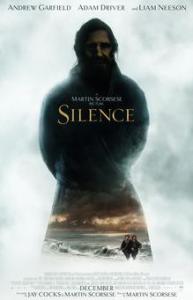
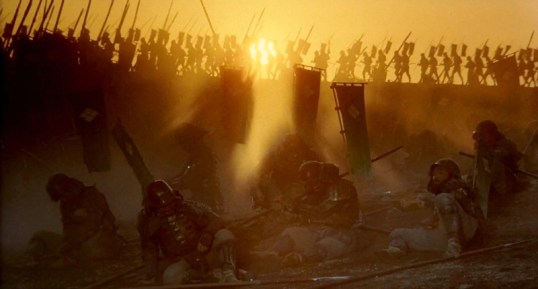
OH MY GOD!!!! Here’s The Trailer for Silence!


It’s here!  The trailer for Silence here!

Silence is one of the most anticipated films of 2016.  Directed by Martin Scorsese, it tells the epic story of three Jesuits in Japan.  Reportedly, Scorsese has been trying to get this film made since at least 1996.

For a while, of course, there was some doubt as to whether or not Silence would even be done in time for 2016.  In fact, it looked like the film might get pushed back to 2017 and, as a result, would fall out of Oscar contention.

If this story sounds familiar, it’s because the same thing nearly happened to Scorsese’s last film, The Wolf of Wall Street.

Will Silence have the same Oscar success as Wolf of Wall Street?  It’s hard to say.  The subject matter could be a hard sell.  I’m excited about it but then again, I love Scorsese and I come from a culturally Catholic background.  Will non-Catholics who love Michael Bay be as excited about Silence as I am?

Who knows?  To be honest, the trailer is full of striking images but I find myself wondering if this is going to be one of those visually impressive but emotionally detached films, the type that you respect more than you enjoy.

Watch the trailer below and decide for yourself!

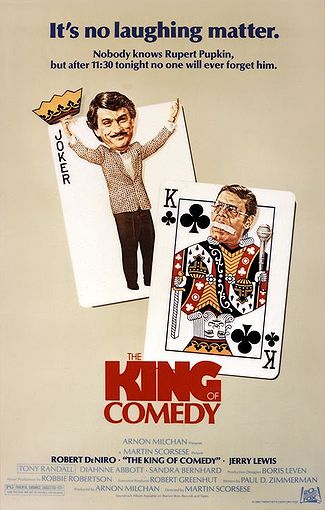
Film Review: The King of Comedy (dir by Martin Scorsese)


Kingofcomedy

Oh my God, do y’all want to see a really great film?

Then you need to do what I did earlier tonight.  You need to sit down and watch Martin Scorsese’s 1983 media satire, The King of Comedy.

Want to know more about The King of Comedy?  Then read on!  But be aware that there are spoilers in the review below!

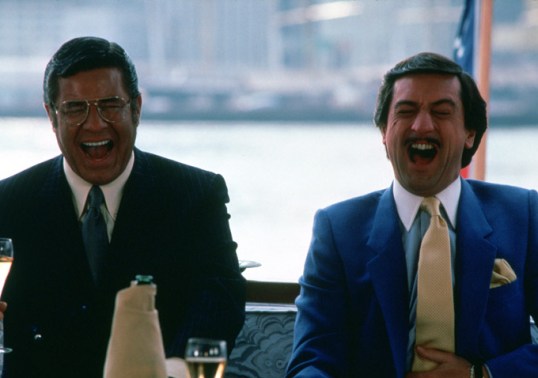
The King of Comedy tells the story of … well, it actually tells the story of several people.  On the one hand, it’s the story of Jerry Langford (played by Jerry Lewis, who gives a performance that is so good that you might even forget that he directed The Day The Clown Cried), a comedian who has his own late night talk show.  Jerry is a celebrity, the type who is mostly famous for being himself.  He makes his living by interviewing people at night but, in his daily life, he struggles to interact with the world at large.  Whenever Jerry steps outside, people start yelling at him.  When he walks away from one elderly fan, she responds by screaming insults at him.  If Jerry seems to be paranoid, it’s because he has good reason to be.

For instance, Masha (a chillingly unhinged performance from Sandra Bernhard) is obsessed with him.  When we first see Masha, she is jumping inside of Jerry’s limousine and refusing to leave.  When she finally gets a chance to be alone with her idol, her manner alternates between desire and hostility.  She may love Jerry but she could just as easily kill him.

And then there’s Rupert Pupkin (Robert De Niro).  Rupert is the character who brings Jerry and Masha together.  He’s a stand-up comedian, the self-described “king of comedy.”  He’s convinced that he can be a star if he can just get on Jerry’s show.  Rupert spends his time imagining the great friendship that he and Jerry could have, if only Jerry would let him on TV.  In his mind, he plays out the scene in which Jerry begs Rupert to take over the show.  Of course, in reality, Rupert lives in his mother’s basement and is surrounded by card-board cutouts of celebs that he will never meet.  When we first see Rupert, his only real skill seems to be the ability to get on everyone’s last nerve.

It’s a little hard to believe now but, when De Niro started his career, he almost exclusively played fuck-ups.  True, he may have won an Oscar for playing Vito Corleone in The Godfather, Part II.  But even while he was playing Vito, he was also playing the erratic and perpetually in debt Johnny Boy in Mean Streets.  In Taxi Driver, he was the delusional Travis Bickle and, in Raging Bull, he was a boxer who managed to alienate just about everyone in the world before finally ending up as an obese self-parody.  But, out of all the fuck-ups that the young(ish) Robert De Niro played, perhaps none was a bigger fuck-up than Rupert Pupkin.

Rupert Pupkin is a character whose sole purpose in life seems to be to make other people cringe with embarrassment.  He is the type of guy who will always come on too strong and say the wrong thing.  Even when Rupert manages to meet Jerry, he is so annoying that Jerry can barely wait to get away from him.  He is the type who asks if you want to see a picture of his “pride and joy” and then shows you a picture of two bottles of dishwashing liquid.  It undoubtedly took some courage to so fully commit to such an off-putting character but that’s exactly what De Niro did.  Rupert is perhaps one of the most annoying characters in cinematic history and yet, perhaps because he’s played by Robert De Niro, you can’t help but feel sorry for him.  You never exactly like him.  But you can’t help but feel a little bit sorry for him.  He is just so clueless!

Of course, what Rupert lacks in common sense, he makes up for in ambition.  He truly believes that he’s destined to be the king of comedy and if he and Masha have to kidnap Jerry Langford for that to happen, so be it.  It is perhaps not surprising that Rupert and Masha would kidnap Jerry and threaten to kill him unless Rupert is invited to appear on the show.  What is surprising is the fact, once we finally see Rupert’s act, we discover that it’s not as bad as we were expecting:

Apparently, when the film was first released, there was some controversy over whether or not Rupert actually appeared on TV and became a star or if it was just another of his delusions.  What’s funny is that there wouldn’t be any controversy today.  In 1983, the idea of someone going to such extremes to be famous may have seemed over-the-top.  In 2016, however, we all know Rupert would eventually end up with his own reality show.  In its way, The King of Comedy is one of the most prophetic films ever made.

The King of Comedy is a great film that, even after all these years, still deserves to be seen.  In fact, it’s probably even more relevant today than when it was first released.

the-king-of-comedy-deniro


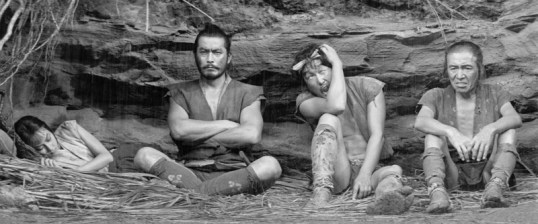
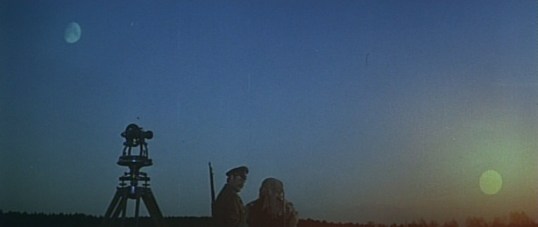
4 Shots From 4 Films: Akira Kurosawa


4 Shots From 4 Films is just what it says it is, 4 shots from 4 of our favorite films. As opposed to the reviews and recaps that we usually post, 4 Shots From 4 Films is all about letting the visuals do the talking.

With the latest entry to the Star Wars franchise set to be released in just a few days I thought it was appropriate to share four particular scenes from one filmmaker who has been a huge influence on George Lucas’ vision for Star Wars. This filmmaker also became a huge influence on other master filmmakers such as John Ford, Steven Spielberg, Martin Scorsese, Francis Ford Coppola and Sidney Lumet just to name a few.

Many consider this filmmaker to be one of the greatest filmmakers who ever lived and in this humble individual’s opinion he was the greatest filmmaker who stood above all and whose storytelling and visual techniques would become part of the modern filmmaker’s toll bag.

The man I speak of is Akira Kurosawa.

4 SHOTS FROM 4 FILMS

The Hidden Fortress (dir. by Akira Kurosawa)

The Hidden Fortress (dir. by Akira Kurosawa)

Dersu Uzala (dir. by Akira Kurosawa)

Dersu Uzala (dir. by Akira Kurosawa)

Yojimbo (dir. by Akira Kurosawa)

Yojimbo (dir. by Akira Kurosawa)

Kagemusha (dir. by Akira Kurosawa)

Kagemusha (dir. by Akira Kurosawa)

Embracing the Melodrama Part II #119: Shutter Island (dir by Martin Scorsese)


Shutter IslandThe 2010 film Shutter Island finds the great director Martin Scorsese at his most playful.

Taking place in 1954, Shutter Island tells the story of two detectives, Teddy Daniels (Leonardo DiCaprio, giving an excellent performance that, in many ways, feels like a test run for his role in Inception) and Chuck Aule (Mark Ruffalo, also excellent), who take a boat out to the Ashecliffe Hospital for The Criminal Insane, which is located on Shutter Island in Boston Harbor.  They are investigating the disappearance of inmate Rachel Solando, who has been incarcerated for drowning her three children.

Ashecliffe is one of those permanently gray locations, the type of place where the lights always seem to be burned out and the inmates move about like ghostly visions of sins brought to life.  It’s the type of place that, had this movie been made in the 50s or 60s, would have been run by either Vincent Price or Peter Cushing.  In this case, the Cushing role of the cold and imperious lead psychiatrist is taken by Ben Kingsley.  Max Von Sydow, meanwhile, plays a more flamboyantly sinister doctor, the role that would have been played by Vincent Price.

When a storm strands Teddy and Chuck on the island, they quickly discover that neither the staff nor the patients are willing to be of any help when it comes to tracking down Rachel.  As Teddy continues to investigate, he finds himself stricken by migraines and haunted by disturbing images.  He continually sees a mysterious little girl.  He has visions of his dead wife (Michelle Williams).  A horribly scarred patient in solitary confinement (Jackie Earle Haley) tells him that patients are regularly taken to a lighthouse where they are lobotomized.  When Teddy explores more of the island, he comes across a mysterious woman living in a cave and she tells him of even more sinister activity at Ashecliffe.  Meanwhile, Chuck alternates between pragmatic skepticism and flights of paranoia.

And I’m not going to share anymore of the plot because it would be a crime to spoil Shutter Island.  This is a film that you must see and experience for yourself.

This is one of Martin Scorsese’s most entertaining films, an unapologetic celebration of B-movie history. He knows that he’s telling a faintly ludicrous story here and, wisely, he embraces the melodrama.  Too many directors would try to bring some sort of credibility to Shutter Island by downplaying the film’s more melodramatic moments.  Scorsese, however, shows no fear of going over the top.  He understands that this is not the time to be subtle.  This is the time to go a little crazy and that’s what he does.

Good for him.

Shattered Politics #74: The Aviator (dir by Martin Scorsese)


The_Aviator_Poster

“The way of the future.” — Howard Hughes (Leonardo DiCaprio) in The Aviator (2004)

As I recently rewatched the 2004 best picture nominee, The Aviator, I realized that, in the film’s scheme of things, Ava Gardner was far more important than Katharine Hepburn.  (Or, perhaps it would be more appropriate to say that Kate Beckinsale’s Ava Gardner was far more important than Cate Blanchett’s Katharine Hepburn.)

Over the course of the film, both Hepburn and Gardner are involved with billionaire-turned aviator-turned film director Howard Hughes (Leonardo DiCaprio).  Throughout the film, Katherine is portrayed as being flighty, pretentious, and overdramatic.  There’s a lot of dark humor to the scene where Katherine breaks up with Howard, largely because Katharine is incapable of not acting as if she’s making a film.  Her every word is so carefully rehearsed that you have to agree when Howard says that she’s incapable of not giving a performance.  Ava, on the other hand, is always direct.  She has a sense of humor.  She has no trouble telling Howard off.  Whereas Katharine put on airs of being an incurable romantic, Ava tells Howard flat out that she doesn’t love him and is only using him to forward her career.

But, while Katharine Hepburn gets more screen time, it’s Ava Gardner who actually saves Howard’s business.  Towards the end of the film, after Howard has had a nervous breakdown and has locked himself in a hotel room, it’s Ava who suddenly shows up, cleans him, and dresses him.  She’s the one who gives Howard the strength to leave his room and to face down the corrupt senator (Alan Alda) who is investigating his business.

Of course, Howard Hughes is best known for once being the world’s richest recluse.  In the 1960s, Howard locked himself away in a hotel room in Las Vegas and spent the next decade laying naked in bed and watching television.  The Aviator doesn’t deal with this period of Howard’s life but it’s full of scenes where we catch glimpses of Howard’s future.  Throughout the film, we watch as Howard obsessively washes his hands.  We watch as he gives precise instructions on how even the simplest of tasks are to be accomplished.  We watch as he grows increasingly paranoid about the germ-filled outside world.  The film suggests that Howard’s obsessive compulsive disorder both served to make him a great engineer and a great filmmaker while, at the same time, ultimately destroying him.

The Aviator was the second film that DiCaprio made with Scorsese.  And, as bad as DiCaprio may have been in Gangs of New York, he’s absolutely brilliant in The Aviator.  As a character, Howard Hughes has so many quirks and tics that it would have been easy for DiCaprio to go overboard.  Instead, he gives a surprisingly subtle performance.  And, even more importantly as far as I’m concerned, he actually sounds authentically Texan when he speaks.

In many ways, much of The Aviator reminds me of Gangs of New York.  Both films are gorgeously produced period epics that try to cover a lot of material.  Both films are absolute cat nip for history nerds like me.  But, whereas Gangs of New York leaves one feeling vaguely dissatisfied, The Aviator actually improves with subsequent viewings.  Whereas the action in Gangs had no center, The Aviator revolves around Howard and the actor playing him.

While the Aviator starts off with Howard making movies and romancing Katharine Hepburn, it’s at its best when Howard appears before a committee chaired by Sen. Owen Brewster (Alan Alda) and passionately defends both himself as an engineer and a businessman and the right of innovators everywhere to freely pursue their passion.  The film suggests that Brewster was bribed by Howard’s main business rival, Juan Trippe (Alec Baldwin, in unapologetic villain mode), and it’s hard not to applaud when Howard stands up for himself.

Speaking of which, it’s odd, so soon after reviewing Alan Alda in The Seduction of Joe Tynan, to see Alda playing a far less ethical politician in The Aviator.  That said, Alda’s corrupt performance in The Aviator is a hundred times better than his cutesy work in Joe Tynan.  If anything, Alda gives a performance here that will remind everyone of why they don’t care much for their congressman.

The Aviator was nominated for best picture but it lost to the far more low-key Million Dollar Baby.  Scorsese would have to wait until the release of The Departed for one of his films to finally win best picture.

Shattered Politics #71: Gangs of New York (dir by Martin Scorsese)


Gangs_of_New_York_Poster

Despite the fact that it was nominated for best picture and marked the start of his fantastically successful collaboration with actor Leonardo DiCaprio, Martin Scorsese’s 2002 film Gangs of New York does not have the best reputation.  It always seems to be regarded as one of Scorsese’s lesser films and, often times, both The Aviator and The Departed are described as representing a comeback of sorts from Gangs.

To a certain extent, I have to agree.  Gangs of New York is a lesser Scorsese movie but then again, a lesser Scorsese film is still a hundred times better than the greatest films from Brett Ratner or Michael Bay.

The flaws of Gangs of New York are many.  The film, which tells the epic story of how an Irish gang led by Leonard DiCaprio battled a nativist gang led by Daniel Day-Lewis in Civil War-era New York City, runs for nearly 3 hours and yet it somehow still feels rushed and incomplete.  Cameron Diaz is far too contemporary of an actress to be truly believable as a 19th century pickpocket.  For that matter, Leonardo DiCaprio gives one of the worst performances of his career, coming across as being one-note and shrill.  If you only knew DiCaprio from his work in Gangs of New York, you would have a hard time believing that he was capable of doing the type of work that he did in Inception or The Wolf of Wall Street.

And yet, Gangs of New York is one of those flawed films that I can’t help but enjoy.

First off, on a purely personal level, how can I not love a film about how terribly the Irish were treated in the 19th Century?  Seriously, the Irish were regarded as if they were somehow subhuman.  They were attacked for being Catholic.  They were viewed as being criminals.  An entire freaking political party — the American party — was formed specifically to keep the Irish out.  But you know what?  We Irish kept coming, we kept fighting for our rights, and now everyone wishes they could be one of us!

Secondly, and this should not a shock when you consider that the film was directed by Martin Scorsese, the film looks absolutely gorgeous!  Despite the fact that it’s takes place in a 19th century slum and most of the characters are poor, Gangs of New York is a visual feast.  I loved the ornate sets and all the colorful clothes.  I loved the attention to detail that was put into everything.

(My favorite visual from the film: Daniel Day-Lewis and his entourage walking down a street while fireworks explode directly over Day-Lewis’s shoulder.)

Third, there’s Daniel Day-Lewis’s performance as Bill “The Butcher” Cutting.  One reason why DiCaprio’s performance is so noticeably bad is because he’s acting opposite Day-Lewis.  Sporting a handle-bar mustache and speaking in an almost satirically exaggerated New York accent, Day-Lewis turns Bill into one cinema’s greatest villains.

Add to that, the great Italian actor Giovanni Lombardo Radice show up for a few minutes, playing Simon Legree in a theatrical production of Uncle Tom’s Cabin!  Scorsese should make more films with Radice.

But, perhaps the main reason why I enjoy Gangs of New York is because, as I’ve mentioned so many times in the past, I really am a big history nerd.  And Gangs of New York deals with a period in American history that really doesn’t get as much attention as it deserves.  While we all know that the Civil War started when the South seceded from the union, what is often forgotten is that the North was not united in their support of Abraham Lincoln and the Union.  In fact, the Mayor of New York, Fernando Wood, was such a strong supporter of the Confederacy that he, at one point, suggested that New York City should secede from the union as well.  And when Lincoln instituted the draft, NYC — and several other cities in the north — exploded into riots.

Of course, Gangs of New York is not a 100% historically accurate.  For one thing, it compresses the time frame of the draft riots and — as films often do — it downplays the culture of Northern racism and instead portrays racists like Bill Cutting as being the exception to the rule.  But, even with that in mind, Gangs of New York still serves as a good starting point for those who want to learn more about American history than what they’ve been told in school.

My favorite parts of Gangs of New York dealt not with how the gangs fought each other but instead how the gangs were used as political foot soldiers.  One of the major supporting characters in Gangs of New York is William “Boss” Tweed (Jim Broadbent), a real-life politician who was at the center of one of America’s first major political scandals.  When we first meet Tweed, he is using Bill Cutting’s gang to fix elections.  However, as the film progresses, Tweed comes to realize that the political future of New York rests with the Irish.  So, Tweed starts using the Irish gang to fix elections.  For those of us who are into political history, the Boss Tweed scenes are a lot of fun.

Gangs of New York has its flaws.  It’s the type of project that, if it were made today, it would probably be a series on HBO and it would win all sorts of awards.  (Actually, it did kinda.  It was called Boardwalk Empire.)  It’s not perfect, but I like it.

Shattered Politics #39: Taxi Driver (dir by Martin Scorsese)


Taxi_Driver_poster

We’ve never had a President named Charles.  We’ve had several Presidents named John and a quite a few named James.  We’ve even had three named George.  But we’ve never had a Charles.  We’ve come close.  Charles Evans Hughes nearly beat evil old Woodrow Wilson in 1916.  Charles Cotesworth Pinckney was nominated two times in a row by the Federalists but lost to Thomas Jefferson and James Madison respectively.  We’ve had three Vice Presidents names Charles — Fairbanks, Dawes, and Curtis — but never a President.

And, if we ever do elect a President named Charles, he’s probably go by either Charlie or Chuck.  The United States has always liked to think of itself as being a country that has no official royal family and, as a name, Charles probably sounds far to aristocratic for most voters.

That’s why I’m sure that, once U.S. Sen. Charles Palatine won the Democratic presidential nomination back in 1976, he probably insisted that people start calling him Chuck.  Of course, Sen. Palatine probably had no idea how lucky he was to win that nomination.  If not for a few secret service agents, Sen. Palatine could very well have fallen victim to a psychotic taxi driver named Travis Bickle.

Sen. Palatine’s presidential campaign is a major subplot of Martin Scorsese’s 1976 masterpiece of paranoia, Taxi Driver.  As played by an actor named Leonard Harris, Sen. Palatine appears to be the epitome of a politician.  He may smile at the right moment but his eyes are always shifty.  Even his campaign slogan (“We Are The people!”) is vapid in an all too plausible way.  (How different is “We Are the People” from “We Are The People We’ve Been Waiting For?”)  For the most part, Palatine remains a remote figure, giving speeches and appearing in television commercials.  The only time that we get to know Palatine as a person is when he gets in a taxi being driven by Travis Bickle (Robert De Niro).

Travis recognizes him immediately and tells him that he tells everyone who gets in the cab that “they gotta vote for you.”  Palatine smirks a little as he asks Travis what he thinks the most important issue of the election is.  Travis goes on a bit about how someone needs to destroy all of the scum and filthy lowlifes who seem to populate Travis’s section of New York.  As Travis rambles, Palatine’s smile disappears and it becomes obvious that he’s realized that he is essentially being driven by a psycho.  Oh shit, Palatine is probably thinking, this guy is telling people that they gotta vote for me?  However, Palatine quickly regains his composure and assures Travis that the wisest people that he’s ever met have been taxi drivers.

Of course, what Palatine doesn’t realize is that Travis only knows about the campaign because he happens to be obsessed with a Palatine campaign worker named Betsy (Cybill Shepherd).  And Betsy even goes out with Travis a few times.  But then Travis, who spends the majority of the film showing how little skill he has when it comes to understanding and relating to other people, takes Betsy to an adult film.

With Betsy refusing to take his calls, Travis’s attention shifts to Iris (Jodie Foster), a teenage prostitute.  Obviously seeing himself as being a knight in shining armor, Travis tells Iris that she has to go back home to her parents.  As Travis talks, it becomes apparent that he’s simply repeating talking points that he’s heard on TV.  (If Taxi Driver was made today, Travis would be one of those people constantly sharing “inspirational” Facebook posts.)  Iris laughs at Travis and goes back to her pimp, Sport (Harvey Keitel).

And, of course, Travis goes even crazier than before.

38 years after it was first released, Taxi Driver remains a disturbing and powerful film.  However, what makes it effective is that, in many ways, it’s perhaps the darkest comedy ever made.  Throughout the entire film, Travis essentially tells everyone that he meets that he’s disturbed and potentially dangerous and, throughout the entire film, everyone seems to be determined to ignore all of the signs.

Critics always talks about the scene where Travis points a gun at his mirror and asks, “You talkin’ to me?”  And that’s a great scene.  It deserves to be famous, just as De Niro deserves all of the praise that he’s gotten for his iconic performance in Taxi Driver.

However, for me, there are two other scenes that are just as brilliant.  The first is where Travis attempts to get some advice from an older cabbie named Wizard (Peter Boyle).  Travis says he’s been having a lot bad thoughts.  Wizard shrugs and says that everyone has those.  What makes this scene particularly memorable are the lengths that Wizard goes to in order to avoid acknowledging that Travis is obviously disturbed.

And then, there’s the scene where Travis buys a gun from Easy Andy (Steven Prince).  Andy is such a salesman and is so nonchalant about all of his weaponry that, for a few brief minutes, Steven Prince actually manages to steal the spotlight from Robert De Niro.

Whenever one thinks about Taxi Driver, one automatically pictures Robert De Niro.  That’s why it’s all the more interesting that De Niro was not the first choice for Travis.  When Taxi Driver was in pre-production and a pre-Jaws Steven Spielberg (of all people) was thinking about directing it, Jeff Bridges as briefly attached to the role.  And while it’s always tempting to think about what a Spielberg/Bridges version of Taxi Driver would look like, I think we’re all right to be happy that the actual film was directed by Scorsese and starred De Niro.  They truly made Taxi Driver into one of the most memorable films ever made.

taxi-driver-mohawk

Let’s Say Goodbye to 2014 with Leonardo DiCaprio in The Aviator


Well, 2014 is nearly over.

Soon, it will be 2015.

Soon, the present will become the future.

2014 will not go down in history as one of humanity’s finest moments.  Considering all that’s happened over the past year, it’s hard for me to be surprised by the fact that several of my favorite films of the year were films that I would normally describe as being entertaining escapism.

In 2014, we needed to be entertained.  We needed to escape.

Will 2015 be any better?  What will be the way of the future?  It’s a question that Leonardo DiCaprio asked at the end of Martin Scorsese’s 2004 film The Aviator and it’s a question that we’re still asking today.

Documentary Review: Seduced and Abandoned (dir by James Toback)


I recently watched James Toback’s 2013 Seduced and Abandoned on HBO.  This documentary failed to seduce me but it certainly left me feeling abandoned.

Seduced and Abandoned follows James Toback and Alec Baldwin as they wander around the Cannes Film Festival, interviewing filmmakers and attempting to raise money for Toback’s latest film.  That film, incidentally, is a remake of  Last Tango In Paris.  Though neither Toback nor Baldwin goes into too much detail about the film (and I’m not exactly convinced that they’re all that serious about it to begin with), we do learn that this remake would be set in Iraq.  Alec Baldwin would play a right-wing CIA agent while Neve Campbell  would play a leftist journalist.  We watch as Baldwin and Toback pitch this film to a countless number of potential producers and ask for twenty million dollars.  Without fail, every producer replies that he loves Alec Baldwin but he’s not willing to spend that type of money on him because Baldwin is not a bankable star.  As Baldwin and Toback frequently lament, nobody seems to care what the film is about.  Instead, they’re only interested in making money.

And this brings us to this documentary’s main problem.  It would be easier to agree with them about businessmen sacrificing art for greed if not for the fact that the movie that Toback and Baldwin are talking about making sounds like perhaps the worst fucking film ever pitched.  A remake of Last Tango in Paris starring Alec Baldwin, directed by James Toback, and taking place in Iraq?  Are you freaking kidding me?  I would never pay money to see a movie that sounded that pretentious.  I would never ask anyone else to buy me a ticket for this movie.  If I saw this movie on HBO, I would cancel my cable subscription.  Seriously, no way.

And yes, I do understand Baldwin and Toback’s point.  They’re arguing that a politically-themed, Iraq-set remake of Last Tango In Paris could not be made today because the system has been set up to silence the voice of artists. The industry is more concerned with making money than making an artistic statement.  I happen to agree 100% but that still doesn’t change the fact that Toback and Baldwin’s film sounds terrible.

Toback and Baldwin interview everyone from Ryan Gosling to Jessica Chastain to Martin Scorsese to Francis Ford Coppola and the one thing that every interview has in common is the sound of Toback’s braying laughter.  It’s a very forced and calculating laugh, one that seems almost as fake as Toback’s pseudo-intellectual persona.  And that’s the other big problem with Seduced and Abandoned.  Toback and Baldwin never really come across as being the rebels that they obviously believe themselves to be.  Even when Toback is talking to the financiers that he and Baldwin appear to blame for ruining the movies, it’s obvious that Toback wants us to impressed by the fact that he knows so many fabulously wealthy people.  In the end, the film feels self-congratulatory in the most undeserving of ways.

And yet, there are occasional moments where the film, almost despite itself, manages to escape from the suffocating egos of James Toback and Alec Baldwin.  The section of the film that deals with the history of Cannes Film Festival is fascinating and Martin Scorsese is such a lively and sincere artist that it’s impossible not to enjoy his interview.  (In many ways, Scorsese seems to be the anti-Toback.)  For a few seconds, Alec Baldwin stops being insufferable long enough to do a reasonably humorous impersonation of Woody Allen.  If you’re a student of Italian cinema, you’ll be happy to see a brief appearance from Mark Damon, a former actor turned producer who appears in several Italian spaghetti westerns in the late 60s.  Damon is the first producer to have to sit through Toback’s pitch and its fascinating to watch just how indifferent he is to idea of remaking Last Tango In Paris with Alec Baldwin and James Toback.

Mark Damon aside, Seduced and Abandoned is a documentary that fails to do the former and will probably inspire many viewers to do the latter.

44 Days of Paranoia #28: The Departed (dir by Martin Scorsese)


For our latest entry in the 44 Days of Paranoia, we take look at the film that the Academy named the best picture of 2006, Martin Scorsese’s The Departed.

The Departed takes the plot of the 2002 Hong Kong film Infernal Affairs and transports it to Boston.  For years, crime lord Frank Costello (Jack Nicholson) has ruled South Boston with an iron fist.  However, police Captain Queenan (Martin Sheen) and his assistant, Sgt. Dignan (Mark Wahlberg) think that they have finally found a way to take Costello down.  They recruit police academy trainee Billy Costigan (Leonardo DiCaprio) to go undercover and infiltrate Costello’s organization.  To help establish his cover, Costigan drops out of the academy and does time in prison on a fake assault charge.

Meanwhile, Costello has an agent of his own.  Years earlier, Colin Sullivan (Matt Damon) was specifically recruited and trained by Costello to become a mole inside the Massachusetts State Police.  Sullivan soon finds himself also working under Queenan.

While the amoral Sullivan finds it easy to deal with his dual role of being both a cop and a criminal, the far more emotionally unstable Costigan has a much more difficult time of it.  Not helping is the fact that Costello turns out to be a legitimate madman who spends half of his time dismembering people and the other half serving as a secret informant to the FBI.  While Sullivan smoothly works his way up the ranks, Costigan pops pills and becomes more and more paranoid.

Eventually, both Costigan and Sullivan are ordered to uncover the double agents in their respective organizations.  What they don’t realize is that, even as they both attempt to learn the other’s identity, they are both seeing the same woman, psychiatrist Madolyn (Vera Farmiga.)

In the scene below, which happens to be my favorite from the entire film, Costigan and Madolyn make love after Madolyn assures Costigan that she doesn’t have a cat.  That makes sense when you consider that Costigan is essentially a rat.

I have to admit that, as much as I did appreciate certain parts of the film, I was still disappointed the first time I saw The Departed.  It wasn’t so much that the movie itself was bad as much as it was the fact that it didn’t live up to the standard set by previous Scorsese films.  The film seemed to somehow be both conventional and overly busy at the same time, with the constantly moving camera and the propulsive soundtrack feeling more like they were more the result of a director trying to be like Scorsese than Scorsese himself.  While I appreciated the comedic relief of Alec Baldwin’s performance as Queenan’s rival on the force and I thought that Matt Damon made a compelling villain, both Leonardo DiCaprio and Martin Sheen seemed to have been bitten by the overacting bug.  It was hard not to feel somewhat disappointed that, after waiting for over three decades to be honored by the Academy, Scorsese finally won his Oscar for The Departed.

However, with subsequent viewings, The Departed has grown on me.  Once I was freed up from the expectations that come from watching a Scorsese film for the first time, I was able to enjoy The Departed for what it actually was, a very well-made and entertaining crime drama that occasionally flirted with being something more.

Watching The Departed for a second time, I was better able to appreciate the sly humor of Jack Nicholson’s performance.  As played by Nicholson, Frank Costello becomes both the devil incarnate and a somewhat pathetic relic who is incapable of understanding that his time has passed.  Watching Nicholson for a second time also led to me better appreciating Martin Sheen’s performance.  Since Nicholson and Sheen are meant to the equivalent of the angel and the devil sitting on Damon and DiCaprio’s shoulders, it was necessary for Sheen to be as virtuous as Nicholson was demonic.

By the time that I watched The Departed for the third time, it was a lot more obvious to me that the entire film was, more or less, meant to be a satire.  What Nicholson’s criminal empire and Sheen’s police force have in common is that neither one of them works the way that they’re supposed to.  If there’s anything to be learned from the film, it’s that nothing means much of anything.  (The Coen Brothers would be proud.)

Finally, after multiple viewings, it becomes obvious that The Departed is very much a Scorsese film.  Even if his direction isn’t quite as showy as viewers have come to expect, there’s still enough little touches and details that remind us that this film was made by a master.  To cite the obvious example that everyone cites, just watch for the X’s that always somehow manage to appear on the wall or the carpet before anyone in the film dies.  With multiple viewings, It also became obvious to me that even if this film was set in Boston and not New York and even if the characters were Irish and not Italian, this film was still thematically pure Scorsese, dealing with themes of guilt, identity, punishment, and martyrdom.

Like all worthwhile films, The Departed is one that grows better with subsequent viewings.

Other Entries In The 44 Days of Paranoia 

  1. Clonus
  2. Executive Action
  3. Winter Kills
  4. Interview With The Assassin
  5. The Trial of Lee Harvey Oswald
  6. JFK
  7. Beyond The Doors
  8. Three Days of the Condor
  9. They Saved Hitler’s Brain
  10. The Intruder
  11. Police, Adjective
  12. Burn After Reading
  13. Quiz Show
  14. Flying Blind
  15. God Told Me To
  16. Wag the Dog
  17. Cheaters
  18. Scream and Scream Again
  19. Capricorn One
  20. Seven Days In May
  21. Broken City
  22. Suddenly
  23. Pickup on South Street
  24. The Informer
  25. Chinatown
  26. Compliance
  27. The Lives of Others