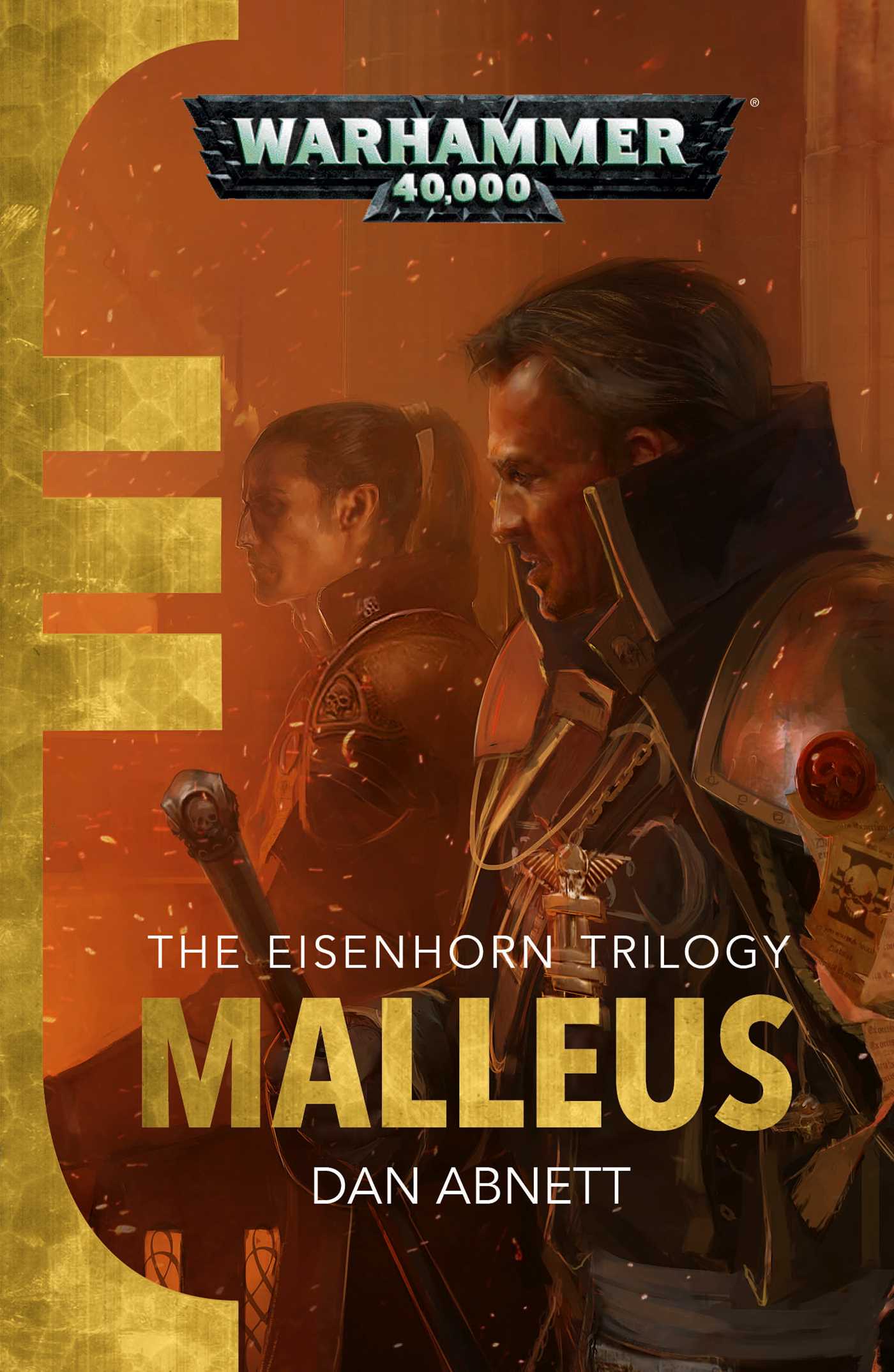
Malleus: Eisenhorn (by Dan Abnett) Review


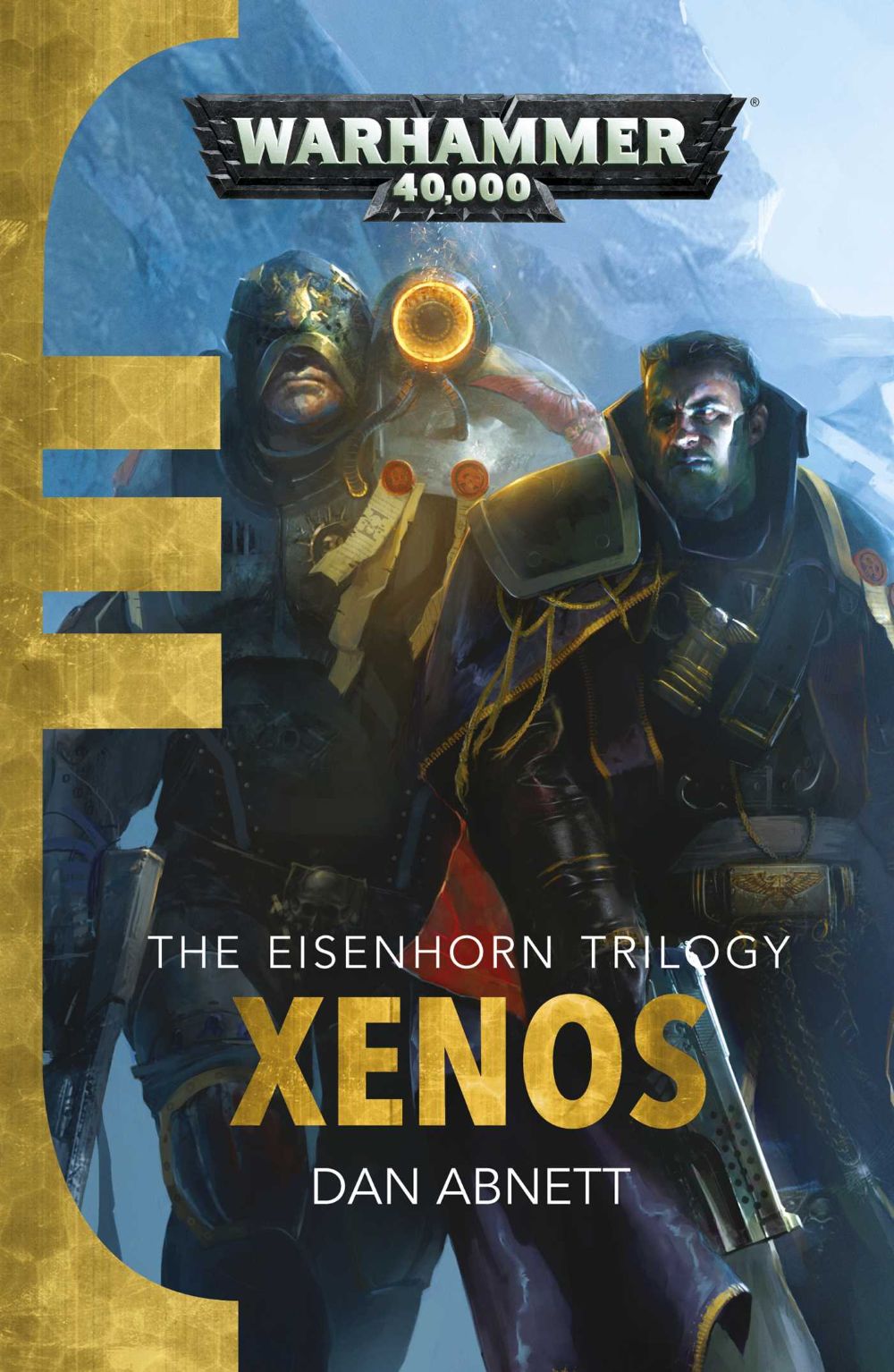
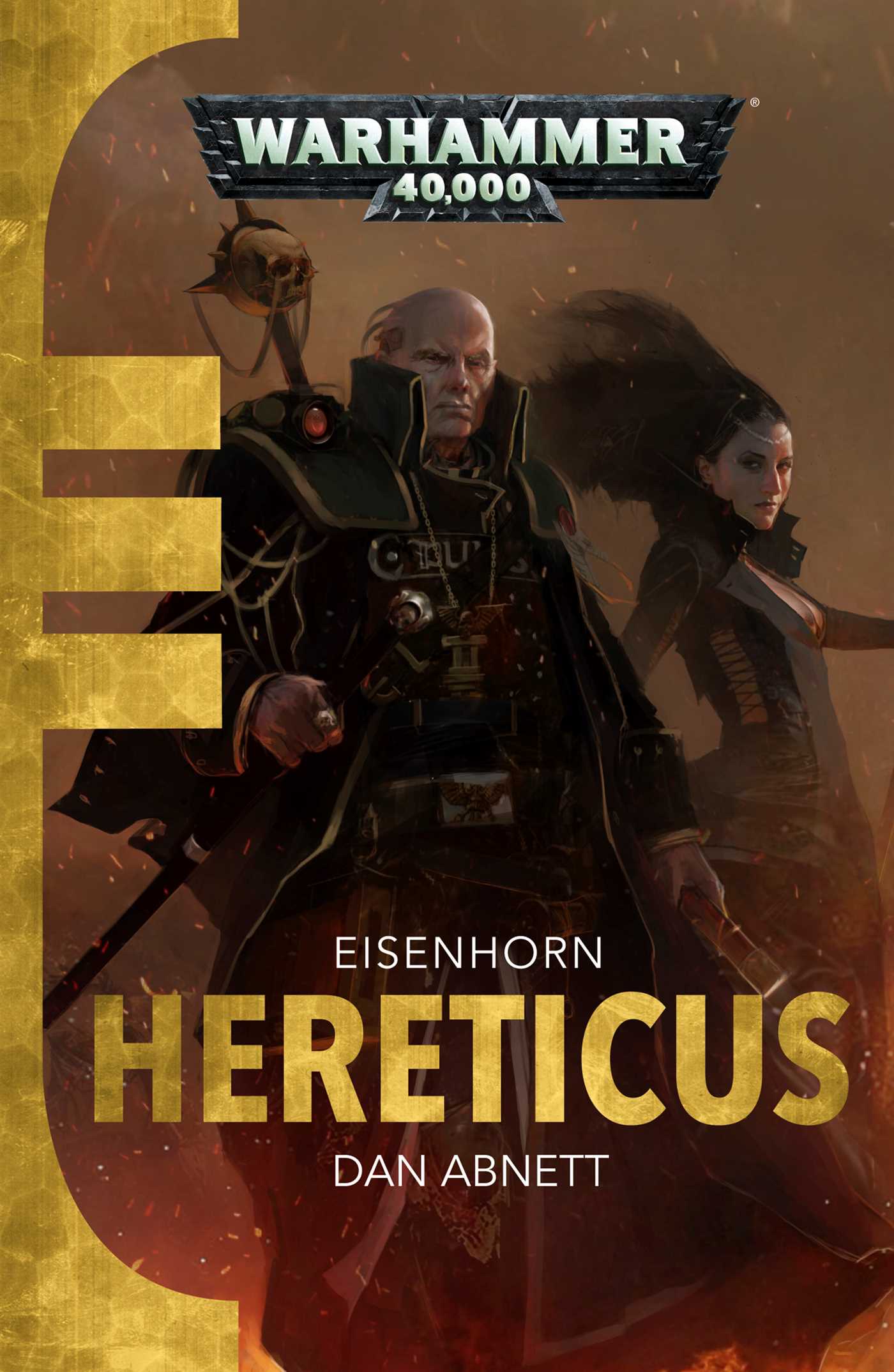
Malleus is where Dan Abnett makes it clear that the Eisenhorn saga is not simply a highly entertaining Warhammer 40,000 detective series. It is the installment where the story grows darker, more unsettling, and considerably more interested in the price of fighting evil within a civilization that has already sacrificed much of its own humanity. Following the groundwork laid by XenosMalleus expands the scope of Inquisitor Gregor Eisenhorn’s world while also making its central figure far more morally complicated. The mystery is larger, the action is more openly supernatural, and the danger of Chaos feels much closer than before. More importantly, the novel begins forcing Eisenhorn to question whether the principles that have guided him are enough to survive the threats he faces.

As discussed in my review of Xenos, that earlier novel was such an effective introduction to the colossal setting of Warhammer 40,000 because it treated the universe as a place to be explored rather than a wall of lore to be memorized. It gave readers the perspective of an investigator moving through the Imperium’s strange social structures, criminal underworlds, religious institutions, and alien dangers. Malleus works especially well as the next step because it retains that accessibility while taking readers deeper into the setting’s darkest spiritual and ideological corners. Readers should still begin with Xenos, but the Eisenhorn trilogy as a whole remains one of the best ways to begin one’s journey into the massive fictional universe that is Warhammer 40,000. It proves that the franchise can support horror, crime fiction, political paranoia, occult mystery, and character tragedy just as effectively as battlefield spectacle.

Set years after the events of XenosMalleus finds Eisenhorn carrying the emotional and professional consequences of everything that came before. He is no longer simply the sharp, controlled, and confident Imperial investigator introduced in the first book. Time, loss, and years spent confronting horrors hidden beneath the Imperium’s rigid public order have taken their toll. Eisenhorn still believes in his duty and still possesses a strong sense of justice, but there is a growing exhaustion beneath his certainty. He has learned that the Imperium is too vast, corrupt, and fragile for justice to function in any clean or uncomplicated way. He has also learned that many enemies cannot be defeated by conventional means.

The plot begins with the kind of investigative intrigue that made Xenos so compelling, but Abnett quickly pushes the story into more dangerous territory. Eisenhorn is drawn into a conspiracy involving forbidden knowledge, hidden cult activity, old enemies, and threats that reach beyond the physical world. The story increasingly brushes against the realm of Chaos, a force that is far more insidious than a conventional military enemy. Chaos does not merely conquer territory or kill its opponents. It spreads through ambition, fear, resentment, desperation, and the belief that ordinary moral limits are unacceptable luxuries in a desperate situation. In Malleus, the greatest danger is not always a monster in a dark room or a cultist behind a mask. It is the argument that monstrous methods may be justified if they produce a necessary result.

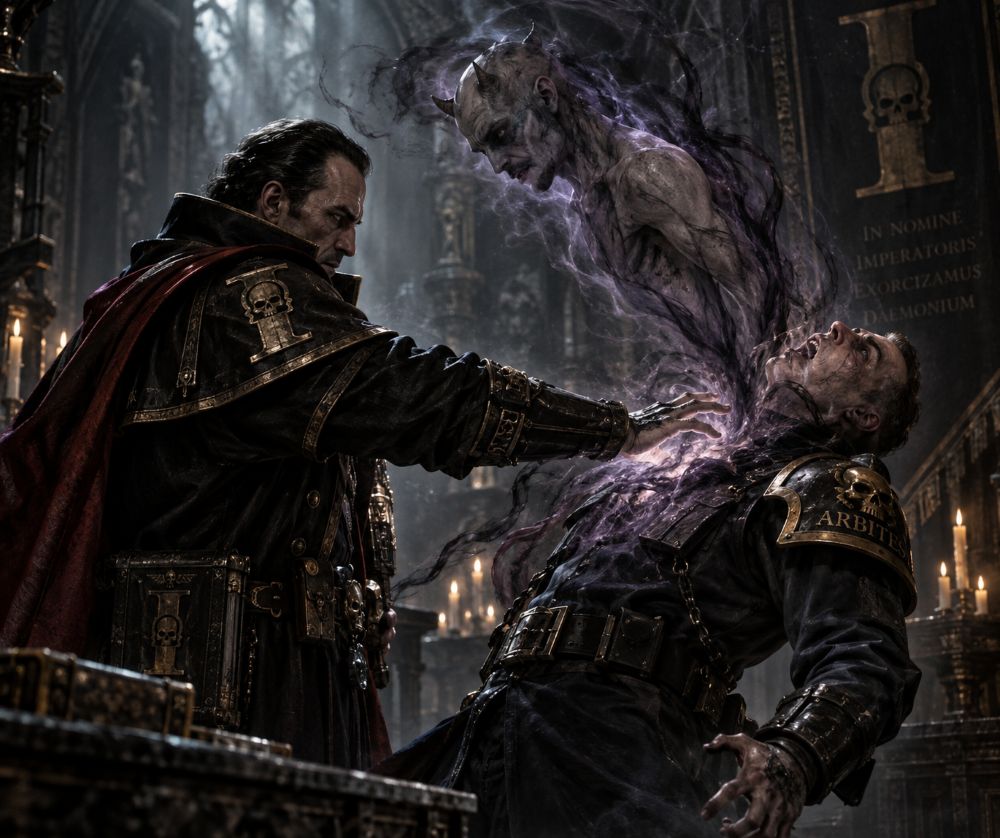
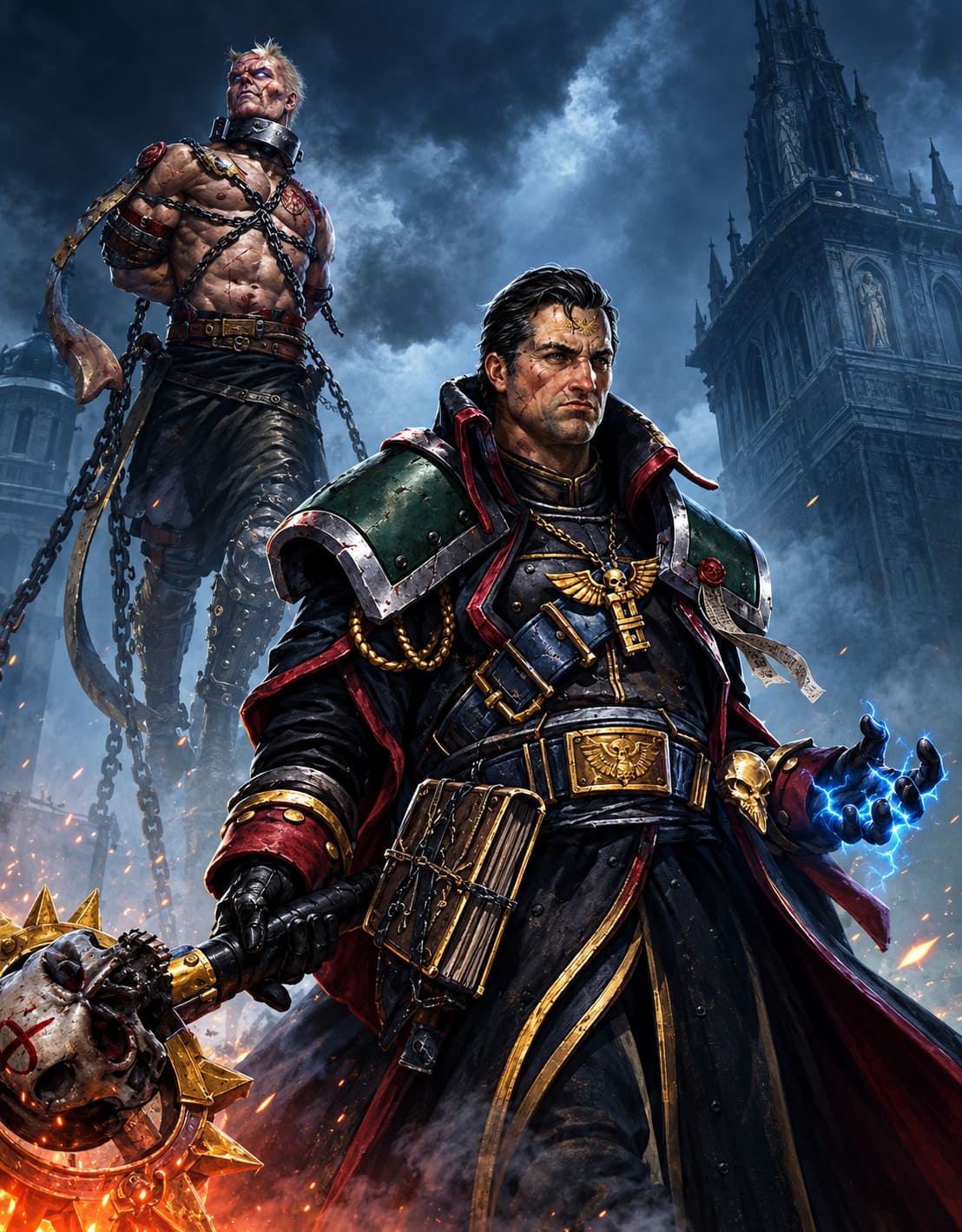
That theme becomes even more powerful with the arrival of Cherubael, the daemonhost who becomes one of the defining and most disturbing presences in the Eisenhorn saga. Cherubael is not just an evil creature for Eisenhorn to defeat. He is a living contradiction: a being of Chaos bound into human form, capable of providing knowledge and power that could prove decisive against far greater threats. His existence immediately creates the kind of moral problem that no Inquisitor can dismiss lightly. Cherubael is useful, but he is also inherently corrupting. He is a weapon that cannot be separated from the horror of what it is.

Abnett makes Cherubael memorable because he is not written as a mindless, roaring monster. He is intelligent, articulate, mocking, and disarmingly calm. He understands human weakness and knows how to make temptation sound like logic. That quality gives him a more unnerving presence than a simple daemonic antagonist. Cherubael does not need to persuade Eisenhorn to worship Chaos. He only needs to make him consider whether he can control a dangerous resource, whether he can use forbidden power for a righteous purpose, and whether the alternative might cost even more innocent lives. In a universe where Chaos often appears through mutation, madness, ritual sacrifice, and overt possession, Cherubael represents a subtler kind of corruption: the conviction that evil can remain safely contained in the hands of a sufficiently strong and intelligent person.

Eisenhorn’s relationship with Cherubael is therefore one of the novel’s most important developments. Eisenhorn is not a reckless thrill-seeker, and he does not turn toward Radical methods because he wants power for its own sake. He understands the danger more clearly than most people could. Yet his years of experience have taught him that strict adherence to approved Imperial methods can fail when confronted with enemies who respect no rules, no laws, and no limits. The daemonhost becomes a test of whether Eisenhorn’s conviction remains rooted in principle or begins to bend around necessity. Every time he sees value in Cherubael’s power, he edges closer to a line that he once would have regarded as absolute.

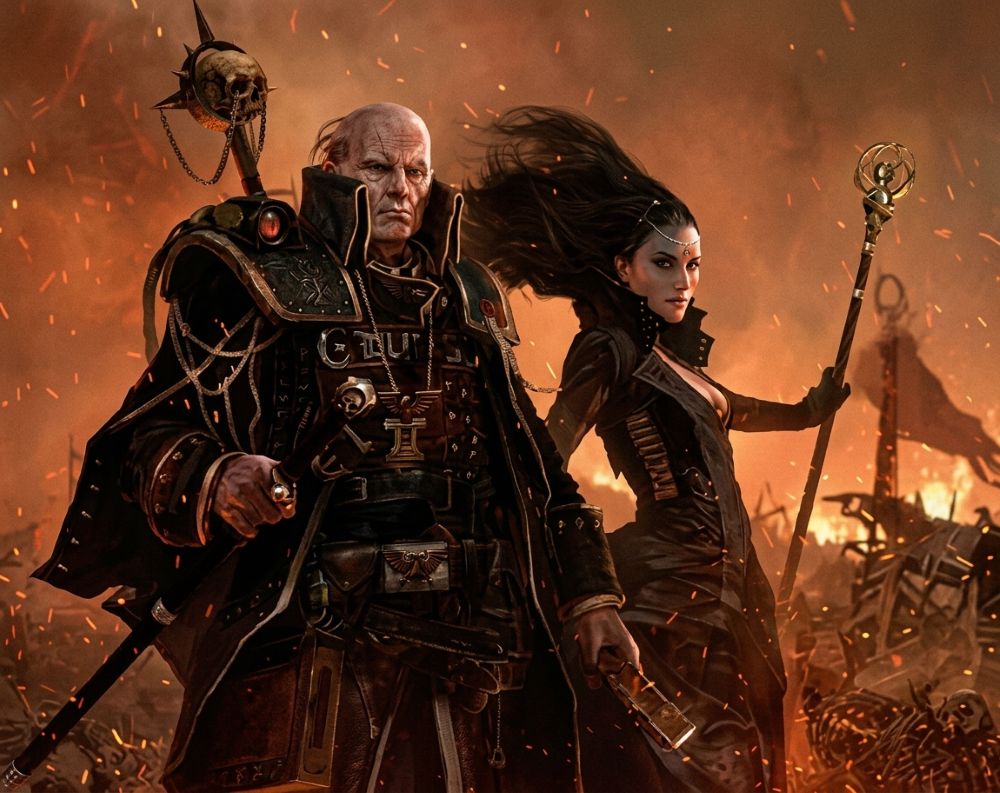
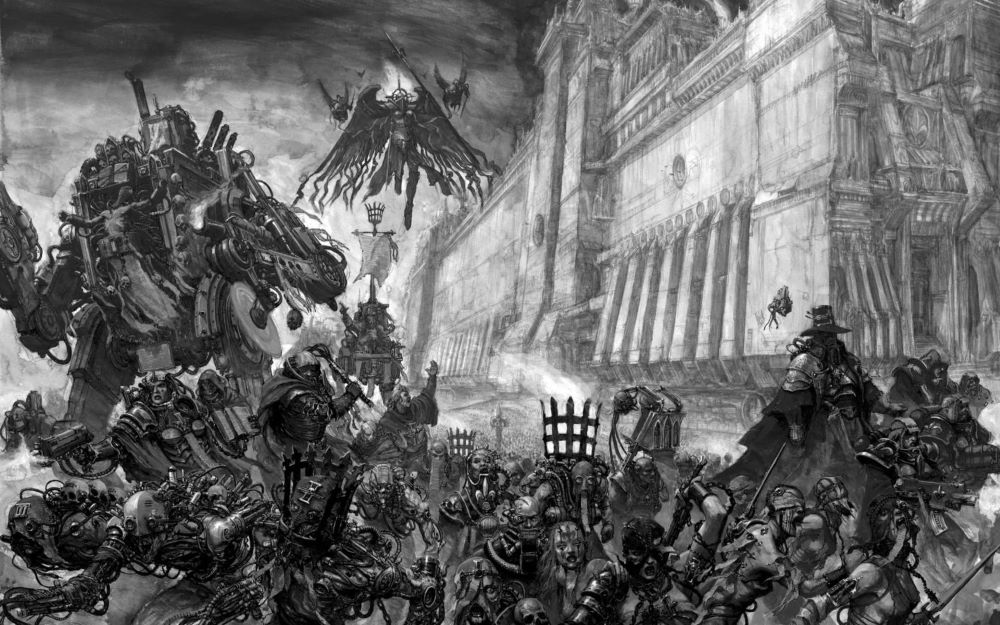
That growing tension ties directly into the ideological divisions within the Inquisition. One of Malleus’ strongest qualities is that it refuses to depict the Inquisition as a single, unified force. From a distance, the Inquisition appears almost limitless in its authority. Its agents can command armies, seize resources, investigate powerful institutions, prosecute heretics, and condemn worlds in the name of humanity’s survival. But Abnett makes clear that the organization is full of competing doctrines, personal rivalries, jurisdictional disputes, and mutual suspicion. Inquisitors may share a broad mission, yet they can disagree completely on how that mission should be carried out.

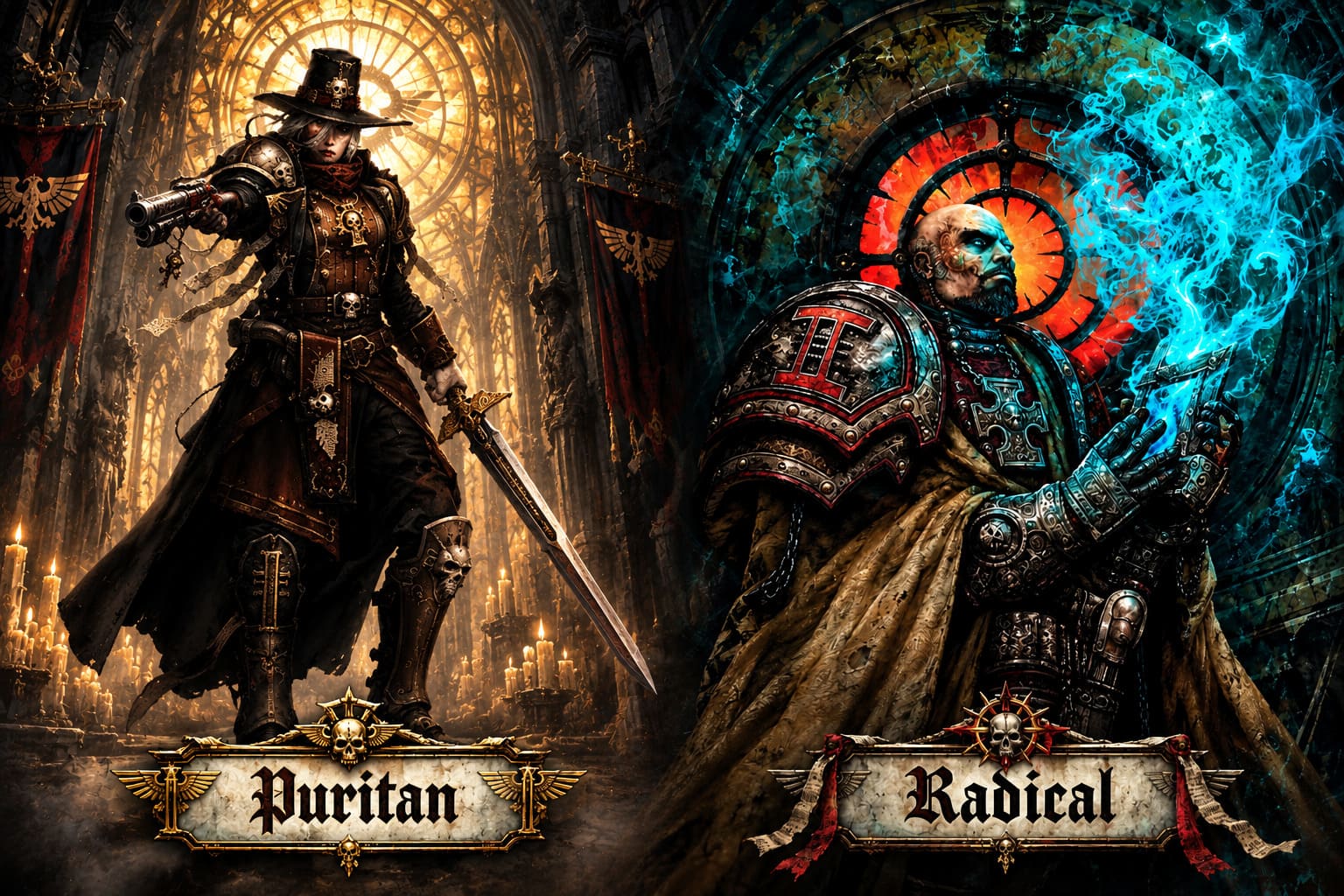
The Puritan and Radical divide is especially important. Puritans believe that the Imperium must fight heresy, alien threats, and Chaos without using the weapons, knowledge, or powers of those enemies. Their position can be severe, even inflexible, but it comes from a real understanding of how corruption works in the Warhammer 40,000 universe. Chaos does not need a person to consciously embrace it in order to gain influence. A single compromise, a forbidden artifact, a dangerous ritual, or an attempt to master what should never be mastered can open the door to disaster. To a Puritan, a daemonhost such as Cherubael is not an asset. It is proof that someone has already crossed a line from which there may be no return.

Radicals take a more pragmatic and far more dangerous view. They believe that the Inquisition cannot adequately fight the galaxy’s darkest forces without studying, exploiting, or weaponizing the tools those forces use. In the abstract, there is a grim logic to that approach. If Chaos is a threat unlike any ordinary military opponent, then understanding its workings may be essential to resisting it. The trouble is that the line between studying Chaos and serving it can disappear with frightening speed. A Radical may begin by using a forbidden artifact to stop a greater evil, then justify a more serious compromise during the next emergency, and eventually become unable to see the difference between tactical necessity and personal obsession.

Eisenhorn sits uncomfortably between these positions in Malleus. He remains deeply suspicious of Chaos and possesses many instincts that could be described as Puritan. He does not romanticize the enemy or dismiss the danger of corruption. At the same time, the circumstances he faces begin pressing him toward Radical choices. Cherubael is the clearest symbol of that shift. The daemonhost embodies the seductive claim that terrible power can be harnessed responsibly if the person using it has the right intentions. Eisenhorn’s willingness to consider that possibility does not make him a straightforward villain, which is exactly why the situation works so well. His choices have reasons behind them. His decisions are understandable. They may even save lives. But the novel never lets the reader forget that understandable choices can still have horrifying consequences.

The schism between Puritans and Radicals also shows how the Inquisition’s internal divisions can hinder the work of the Ordos as much as the threats they are supposed to combat. The Inquisition exists to confront dangers that ordinary Imperial institutions cannot handle, but its members can become trapped in battles over authority, doctrine, and ideological purity. Inquisitors may distrust one another, conceal evidence, challenge a colleague’s methods, or focus so intensely on proving another agent compromised that they lose sight of the immediate threat. That infighting is especially dangerous in a universe where enemies such as Chaos actively benefit from paranoia, secrecy, pride, and division.

A Puritan can be so certain that Radical methods lead only to damnation that they fail to recognize an urgent threat until it is too late. A Radical can become so convinced that they alone are capable of responsibly wielding forbidden tools that they stop seeing their own corruption. Both sides believe they are defending humanity. Both can be right about the dangers posed by the other. And both can make the Imperium more vulnerable in the process. Abnett uses this conflict to give the setting real political and philosophical texture. The Inquisition is not merely an all-powerful secret police force with dramatic titles and unlimited permission to destroy things. It is an unstable, deeply human institution whose members are themselves vulnerable to dogma, ego, grief, obsession, and fear.

The supporting cast helps keep Malleus from becoming too relentlessly bleak. Aemos remains a valuable presence because his learning, loyalty, and history with Eisenhorn give the novel an emotional foundation. Alizabeth Bequin continues to be one of the more interesting figures in the series, not simply because of her unusual nature but because she complicates Eisenhorn’s tendency to view people through the practical lens of an investigation. Eisenhorn’s associates are not faceless retainers or disposable mission assets. They are people who have endured extraordinary dangers together, and their bonds create moments of warmth and loyalty amid the book’s Gothic horror.

Abnett also continues to excel at making the Imperium feel inhabited. The setting is famous for colossal wars, massive armies, and apocalyptic imagery, but the Eisenhorn books often work best when they explore the spaces beneath that scale. Malleus moves through worlds and institutions shaped by wealth, bureaucracy, religious repression, criminality, and desperation. It shows how ordinary citizens can live their entire lives under the shadow of enormous Imperial power without fully understanding the supernatural horrors being fought on their behalf. That ground-level perspective makes the setting’s oppressive atmosphere more convincing. The galaxy is not merely dangerous because wars are constantly happening somewhere. It is dangerous because its social systems create secrecy, inequality, fear, and countless opportunities for hidden corruption to grow.

The novel is somewhat more sprawling than Xenos. It includes a larger web of characters, conspiracies, locations, and occult ideas, which can make it feel less neatly constructed than the first book’s detective narrative. However, that expanding complexity suits the story. Eisenhorn is no longer dealing with a case that can be solved by following clues toward a single clear answer. He is moving through an environment where the truth is fragmented, alliances are unstable, and each revelation raises more questions. The disorder is part of the point. Chaos should not feel comfortably organized, and Eisenhorn’s own moral certainty becomes increasingly disordered as the novel progresses.

Abnett’s prose remains one of the great strengths of the book. He can write action with clarity and force, whether the scene involves gunfights, physical confrontations, psychic peril, or full-blown daemonic horror. Just as importantly, he knows how to make a quiet conversation threatening. Some of Malleus’ best material comes from interrogations, tense exchanges between allies, confrontations with ideological opponents, and moments where a character realizes that the person they trusted may not be what they seemed. The novel’s greatest weapon is not sheer violence, but suspense. Readers can often feel that something is wrong long before Eisenhorn fully understands what it is.

Ultimately, Malleus is an excellent middle chapter because it transforms Eisenhorn’s story from a clever Inquisitorial investigation into a more troubling moral tragedy. It raises the stakes without abandoning the human perspective that made Xenos work so well. Cherubael’s arrival gives the novel a powerful symbol of temptation and compromise, while the Puritan-Radical divide reveals that the Inquisition’s most dangerous enemies are not always found outside its walls. Eisenhorn still wants to protect humanity, and he remains brave, resourceful, and fundamentally committed to his cause. But Malleus makes an increasingly uncomfortable point: a person can begin with noble intentions and still become dangerous by deciding that only they are qualified to choose which rules no longer apply.

That is what gives the novel its lingering power. Malleus is entertaining as a mystery, action story, horror novel, and tour through the stranger side of Warhammer 40,000. But it is most compelling as a story about the cost of necessity. Eisenhorn’s enemies are terrifying, yet Abnett understands that the more frightening question is what Eisenhorn will become in order to defeat them.

Eisenhorn Saga
Xenos: Eisenhorn (by Dan Abnett) Review


“I’m excusing a lot because I recognize the trauma and the loss you have suffered. But my patience isn’t limitless… unlike my authority.” — Inquisitor Gregor Eisenhorn

Xenos by Dan Abnett is one of the best places to begin a journey into the immense, intimidating fictional universe of Warhammer 40,000. The setting has decades of lore, countless factions, and a reputation for throwing newcomers into a blizzard of Gothic names, alien species, religious doctrine, and galaxy-wide war. Abnett gets around that problem by starting on a smaller, more personal scale. Rather than opening with armies of Space Marines firing bolters into a battlefield, Xenos follows an investigation. It is a mystery novel first, but one wrapped in political intrigue, supernatural horror, science-fiction adventure, and the oppressive atmosphere that makes Warhammer 40,000 unique.

The novel follows Gregor Eisenhorn, an Imperial Inquisitor investigating the suspicious death of another Inquisitor and the possible return of an infamous forbidden text. What initially appears to be a contained case grows steadily more complicated, carrying Eisenhorn from the polished halls of the powerful to the dangerous, hidden corners of the Imperium. Along the way, he encounters criminal networks, secretive cults, alien interests, old enemies, and clues suggesting that the threat he is following is far larger than it first appears. That is about as much as the plot should be revealed going in. One of Xenos’ greatest pleasures is seeing an investigation expand in unexpected directions as Eisenhorn realizes that every answer seems to reveal another, more disturbing question.

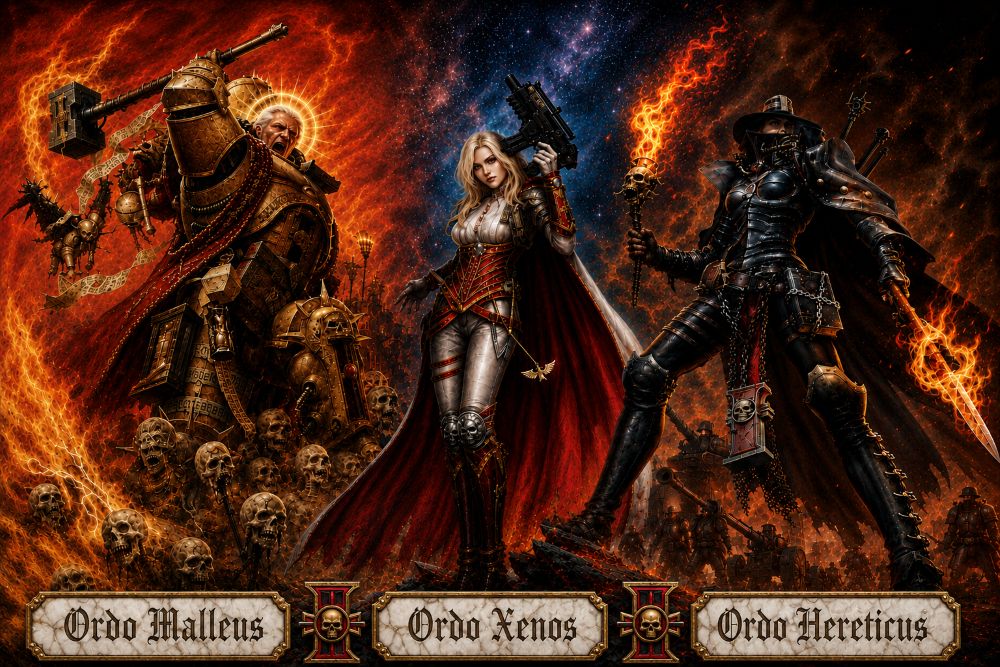
For newcomers, Eisenhorn is a perfect guide through the setting because his job gives him access to virtually every level of Imperial society. The Inquisition is the Imperium’s feared internal-security and investigative force, responsible for hunting down threats such as heresy, Chaos corruption, rogue psykers, dangerous mutants, and alien infiltration. Its three major branches are the Ordo Xenos, which deals with alien threats; the Ordo Malleus, which combats daemonic and major Chaos threats; and the Ordo Hereticus, which investigates internal heresy and corruption within humanity. Eisenhorn belongs to the Ordo Xenos, although Xenos quickly makes it clear that the lines between those responsibilities can become blurry when an investigation leads into forbidden knowledge and the influence of Chaos.

Inquisitors operate with enormous authority inside the sprawling hierarchy of the Imperium’s bureaucracy. They can demand cooperation from military officers, nobles, bureaucrats, religious leaders, and law-enforcement agencies alike, often placing them effectively above the normal chain of command. That vast authority makes them necessary in an empire as corrupt, unwieldy, and permanently threatened as the Imperium, but it also makes them frightening. Eisenhorn can investigate almost anyone, order arrests and executions, seize resources, and disregard ordinary procedure if he believes the situation demands it. The novel’s central moral tension comes from that power: what happens when someone entrusted with protecting humanity has the freedom to do almost anything in its name?

That question gives Xenos considerably more weight than a straightforward sci-fi detective story. Eisenhorn is not a traditional hero, though he is clearly written as the protagonist and often comes across as intelligent, disciplined, and committed to his work. He believes in the Imperium, believes in his duty, and believes that evil has to be confronted before it spreads. At the same time, he works inside a system where fear and brutality are normal tools of governance. An Inquisitor cannot afford to be naïve, especially when dealing with Chaos, cults, and conspiracies built around forbidden knowledge. But Abnett constantly pushes Eisenhorn toward uncomfortable choices, forcing him to decide how much compromise is acceptable when the enemy is capable of manipulating minds, corrupting souls, and destroying worlds.

That is one of the major reasons the book works so well. Warhammer 40,000 can sometimes feel like a setting built from giant concepts: eternal war, fanatical religion, ancient aliens, grim military hardware, and cosmic evil. Xenos does not ignore any of those things, but it makes them matter on a human level. The Imperium is not merely described as a brutal galaxy-spanning empire; Abnett shows how it functions through its people and institutions. There are noble houses, archives, cults, scholars, law officers, ship crews, bureaucrats, mercenaries, and citizens who have learned to survive under a regime where suspicion can be fatal. The book makes the Imperium feel less like a background painting and more like a living, oppressive civilization.

Abnett’s greatest strength is his ability to reveal the setting without drowning the reader in exposition. There are plenty of unfamiliar terms in Xenos, especially for readers coming in cold, but the novel rarely stops to hand over a rulebook-style explanation. You learn about the Warp because it is dangerous and uncanny whenever it enters the story. You understand Chaos because its influence produces paranoia, violence, and spiritual corruption. The Eldar are introduced not as a long historical lecture but as secretive, ancient, unsettlingly intelligent outsiders with motives that human characters cannot fully grasp. That approach preserves the sense that this universe is far bigger than Eisenhorn’s current case, while still making the plot easy to follow.

The pacing is helped by the fact that Abnett never lets the story remain in one mode for too long. Xenos begins with the mood of an investigative thriller, but it gradually expands into something stranger and more dangerous. The novel moves through crime scenes, aristocratic gatherings, interrogation rooms, alien ruins, dangerous underworld spaces, and moments of full-scale action. That variety keeps the book from becoming too bleak or static. The setting is absolutely grim, and the violence can be nasty, but there is also a strong sense of momentum and adventure. Abnett knows that the horror of the 41st Millennium is more effective when the reader is also excited to see what strange corner of it comes next.

His prose is another major advantage. Abnett writes in a style that is clean and readable without losing the ornate, Gothic flavor of the setting. He can handle action well, especially when Eisenhorn and his team are forced into sudden violence, but he is arguably even better with atmosphere. Some of the novel’s most memorable scenes involve conversations where nobody says exactly what they mean, tense interrogations, the discovery of forbidden evidence, or the lingering sense that an apparently routine lead has opened a door that should have remained closed. He gives Xenos the feel of a noir investigation filtered through a nightmare version of space opera.

Eisenhorn’s supporting cast helps keep the novel grounded. Aemos, his loyal savant, brings experience and knowledge to the team, while the warrior Midas Betancore adds a practical edge to their fieldwork. Alizabeth Bequin, whose unusual nature is tied to some of the setting’s stranger ideas, becomes one of the more intriguing figures around Eisenhorn. Each character has a defined role, but they are not simply pieces of equipment for the Inquisitor to deploy. Their reactions to danger, secrecy, and Eisenhorn himself make it clear that he may possess enormous legal authority, but he still depends on people he cannot completely control.

The relationship between Eisenhorn and Bequin is especially effective because Abnett does not force it into an overly simple romance. In a lighter setting, their dynamic might become predictable, but Warhammer 40,000 is not a world where emotional connection comes without consequences. Their growing trust is complicated by secrets, duty, personal history, and the fact that Eisenhorn’s work places everyone around him in danger. The novel is stronger for that restraint. It understands that Eisenhorn’s position makes ordinary human relationships difficult, and that the pressure of the Inquisition can turn even loyalty into something painful.

If there is a weakness in Xenos, it is that the middle section can occasionally feel rushed. Abnett covers a lot of territory, introduces several important concepts, and puts Eisenhorn in contact with a broad cast of characters. Some supporting figures and locations are memorable but could have used a little more time to develop. The book also has the feeling of a first installment in a larger story, particularly as Eisenhorn’s moral compromises begin to take shape. Still, that is not a serious flaw. The novel provides a satisfying central investigation while clearly establishing bigger questions that continue through Malleus and Hereticus.

What ultimately makes Xenos such a successful novel is that it understands the appeal of Warhammer 40,000 without relying entirely on surface-level spectacle. The setting has no shortage of memorable imagery: skull-covered cathedrals, psychic powers, ancient alien technology, daemon-haunted worlds, and armies fighting endless wars across the stars. But Abnett gives all of that a purpose by focusing on a man trying to hold onto his principles in a universe that rewards ruthlessness. Eisenhorn is not merely fighting cultists, aliens, and supernatural conspiracies. He is fighting the possibility that protecting humanity may require him to become something he once would have condemned.

For longtime fans, Xenos offers a welcome change from stories focused solely on battlefield carnage. It shows the day-to-day machinery of the Imperium, the political paranoia beneath its religious language, and the hidden wars being fought far away from the front lines. For newcomers, it is an especially good entry point because it does not require prior knowledge of the tabletop game, its codices, or its enormous chronology. It introduces the setting’s major ideas through a compelling story rather than a lecture.

Xenos is suspenseful, violent, atmospheric, and smarter than many people may expect from a novel tied to a miniature wargame. Dan Abnett turns the colossal scale of Warhammer 40,000 into a strength, giving readers glimpses of a universe full of horrors while keeping the narrative centered on one investigation and one increasingly compromised man. It is a highly entertaining science-fiction thriller in its own right, but it is also one of the clearest demonstrations of why Warhammer 40,000 has endured for so long. If someone wants to take their first step into this massive fictional universe, Xenos is a smart place to start.

Warhammer 40,000: Inside the Grimdark Galaxy


“In the grim darkness of the far future, there is only war.”

Warhammer 40,000—usually shortened to Warhammer 40K, 40K, or simply Warhammer—is a science-fiction miniature wargame and one of modern pop culture’s largest shared fictional universes. Built around the famously bleak promise that “In the grim darkness of the far future, there is only war,” it imagines humanity in the 41st millennium: still alive, but reduced to a decaying, fanatical, militarized empire fighting an endless conflict against aliens, demonic powers, and its own self-destructive instincts.

What began in 1987 as a strange, punk-inflected tabletop release has become a global entertainment property spanning miniatures, novels, comics, animation, video games, audiobooks, collectible figures, apparel, and planned screen projects. Its strength is that it works on several levels at once: it is a tactical game, an art-and-modeling hobby, an enormous science-fiction mythology, a cosmic-horror setting, a military epic, and a satire of authoritarianism pushed so far that it becomes monstrous.

From Rogue Trader to a Global Hobby

Warhammer 40K emerged from Games Workshop’s earlier success with Warhammer Fantasy Battle. Founded in the United Kingdom during the 1970s, Games Workshop began as a hobby company concerned with mail-order games, tabletop role-playing games, and miniatures. After the release of Warhammer Fantasy Battle in 1983, the company developed a science-fiction counterpart: Warhammer 40,000: Rogue Trader, released in 1987. Games Workshop identifies that launch as a major turning point and says the game rapidly became the world’s most popular wargame.

The original Rogue Trader was far stranger and less regimented than modern 40K. It was part skirmish game, part tabletop role-playing game, and part open-ended science-fiction sandbox. Players might command a small expedition of explorers, mercenaries, aliens, mutants, pirates, or Imperial agents rather than the large armies associated with the game today. The rules encouraged improvisation, scenario-building, character creation, and the invention of bizarre corners of a hostile galaxy.

Its titular Rogue Traders were Imperial explorers and licensed opportunists: merchants, colonizers, diplomats, archaeologists, and private adventurers granted authority to travel beyond the Imperium’s established borders. That concept captures early 40K’s loose, exploratory spirit. The setting was a collage of pulp adventure, cosmic horror, war fiction, medieval religious imagery, dystopian bureaucracy, science-fiction clichés, and black comedy.

As later editions arrived, Warhammer 40K increasingly became an army-scale miniature wargame. Players began building forces around recognizable factions, leaders, squads, vehicles, and monsters. They buy unpainted plastic or resin kits, assemble them from separate parts, customize their weaponry and colors, paint them, and deploy them on terrain-filled tables.

A game may involve infantry formations, tanks, artillery, giant psychic creatures, alien swarms, aircraft, war machines, and genetically engineered super-soldiers. Dice resolve shooting, melee attacks, armor saves, morale, special abilities, and unpredictable battlefield events. Rulebooks and faction codexes provide the mechanical framework, but the miniatures remain the true center of the hobby. They are game pieces, collectible objects, art projects, and physical embodiments of the fiction.

A Universe Built From Influences

Part of Warhammer 40K’s longevity comes from its deliberately hybrid nature. It was never built from one source, genre, or artistic philosophy. It is a science-fantasy setting assembled from decades of literature, comics, horror, military fiction, mythology, history, tabletop gaming, heavy-metal album art, and British satire. Its most distinctive achievement is not inventing every ingredient from scratch; it is fusing familiar influences into a universe with an immediately recognizable voice and aesthetic.

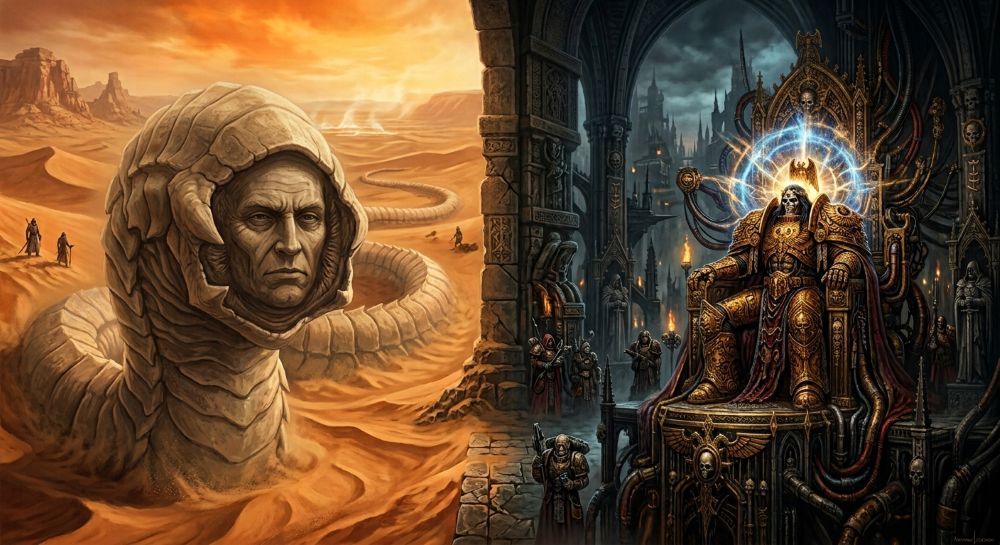
Frank Herbert’s Dune is among the clearest and most consequential influences. Dune supplied a model for science fiction that felt ancient, religious, feudal, ecological, political, and mythic all at once. The 40K Emperor shares obvious conceptual territory with Leto Atreides II, the transformed ruler at the center of Herbert’s God Emperor of Dune. Rick Priestley has explicitly compared the Emperor to Leto, noting the shared notion of a ruler defined by long-term sacrifice and an individual transformed into a reluctant or burdensome deity.

The influence appears throughout 40K’s structure. The title “God-Emperor,” the use of “lasgun,” the importance of interstellar navigation, the dangers of psychic power, and the notion of a galaxy shaped by feudal houses, religious institutions, and decaying imperial authority all evoke the imaginative territory Herbert helped popularize. The Imperium is not a direct copy of Herbert’s Imperium, but it channels the same sense of vast history and civilizational exhaustion: humanity has conquered the stars, yet has become trapped by the systems it created.

Dune also helps explain why 40K feels less like sleek technological futurism and more like a medieval empire projected into space. The Imperium has spaceships, energy weapons, genetic engineering, and interstellar travel, but it is socially structured around dynasties, priesthoods, hereditary institutions, sacred relics, and ritualized warfare. A starship captain can wield authority like a feudal noble; a machine-priest can treat a computer system as a holy object; an entire planet can be governed according to rules that resemble an exaggerated mixture of medieval monarchy, colonial empire, and religious absolutism.

Robert A. Heinlein’s Starship Troopers also looms behind the setting, especially in its militarized future, armored infantry, planetary invasions, and questions about citizenship, duty, service, and the relationship between soldiers and the state. The Space Marine may not be a direct lift from Heinlein’s mobile infantry, but 40K shares the image of heavily armored future soldiers descending into hostile worlds as humanity’s elite warriors. The major difference is tonal. Heinlein’s novel is explicitly invested in debating civic responsibility and military service; 40K turns militarized citizenship and state power into a far more excessive, terrifying, and baroque nightmare.

The roots of Chaos reach deeply into the work of Michael Moorcock, especially the Elric stories, the broader Eternal Champion cycle, and Moorcock’s recurring tension between cosmic order and cosmic chaos. Priestley has said that Realm of Chaos, a foundational early Warhammer supplement, drew inspiration from Moorcock’s fiction. Moorcock’s influence can be felt in Warhammer’s willingness to treat Chaos as more than generic evil. It is a metaphysical force of mutation, temptation, instability, transformation, corruption, and destructive freedom.

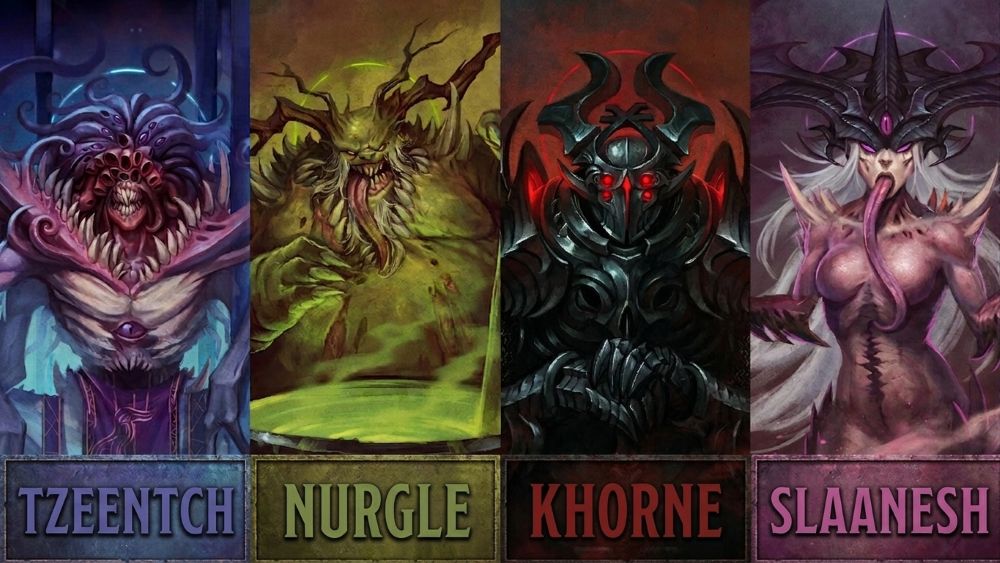
The Chaos Gods of 40K are not simply demons waiting outside reality. They are entities shaped by mortal emotion and civilization’s psychic debris. Rage creates Khorne, ambition feeds Tzeentch, despair strengthens Nurgle, and obsession empowers Slaanesh. That fusion of cosmic mythology and inner human failing is distinctly Moorcockian in spirit, even as 40K develops it into a universe of its own.

Walter M. Miller Jr.’s A Canticle for Leibowitz is another key lens through which to understand the Imperium. Miller’s post-apocalyptic novel imagines a future in which religious custodians preserve fragments of lost knowledge after civilization collapses, often without fully understanding what they have saved. The Adeptus Mechanicus—the techno-priests of Mars—operates on a grandiose science-fiction version of that principle. It preserves ancient technologies, treats machines as sacred, seeks lost artifacts, and often turns scientific understanding into religious ritual.

The Imperium’s relationship with technology is therefore central to its tragedy. Humanity possesses equipment advanced beyond anything available in the present day, yet much of that knowledge has been forgotten, distorted, or rendered taboo. A machine can be repaired through liturgical procedure. A blueprint can be treated like scripture. Innovation can be regarded with suspicion because it threatens inherited dogma. A Canticle for Leibowitz offers one important ancestor for that image of civilization after knowledge has become relic, ritual, and superstition.

John Milton’s Paradise Lost also echoes through 40K, most strongly in the story of the Emperor, his Primarch sons, and the Horus Heresy. The broad outline has unmistakable Biblical and Miltonic flavor: a father figure of immense authority creates near-divine sons; his favored son falls into rebellion; a vast heavenly order is split by betrayal; the resulting war reshapes creation; and the remnants of the fallen become demons or devils waging eternal war against their former kin.

Horus Lupercal is not simply Satan, and the Emperor is emphatically not a straightforward God figure. 40K is too morally compromised for that kind of clean analogy. The Emperor can be visionary, tyrant, savior, manipulator, father, failed reformer, and imprisoned god all at once. Yet the emotional architecture is Biblical: the fall of beloved sons, the tragedy of betrayal, the creation of a false church around a broken father, and the transformation of rebellion into eternal damnation.

British comics are just as important as canonical science-fiction novels. The influence of 2000 AD—especially its anarchic, darkly comic, satirical approach to dystopia—helps explain 40K’s original voice. Judge Dredd offered a future city-state defined by absurdly authoritarian law enforcement, brutal social control, violence, and exaggerated fascistic spectacle. The comic’s writers and artists mixed dystopian science fiction with satire and a distinctive, sometimes savage sense of humor.

That sensibility can be found in 40K’s hive cities, the planet-sized urban slums and industrial nightmares where billions live under crushing conditions. It can be found in the Adeptus Arbites, the Imperium’s heavily armed enforcers; in the Inquisition’s secret-police authority; and in the setting’s fascination with rules so vast and convoluted that they become a form of madness. If Dune helped give 40K its mythic science-fantasy scale, 2000 AD helped give it its dystopian absurdity and its willingness to make political cruelty both horrifying and grotesquely ridiculous.

The Grim Darkness of Humanity

The universe of Warhammer 40K is set roughly 38,000 years in the future, during the 41st millennium. Humanity once spread across the stars during a technological golden age, but that civilization collapsed under the weight of war, artificial intelligence, psychic catastrophe, isolation, and rebellion. By the present-day setting, human worlds have been reassembled into the Imperium of Man, an unimaginably vast empire that is too decentralized, bureaucratic, and dangerous to be fully governed.

The Imperium is humanity’s main shield against extinction, but it is also one of genre fiction’s most oppressive regimes. It is a theocracy governed through censorship, terror, war, forced labor, religious obedience, and endless sacrifice. Its authorities routinely destroy entire populations to stop the spread of Chaos, mutation, rebellion, or alien influence. Its citizens are taught to fear difference and accept death in the Emperor’s service as the highest possible duty.

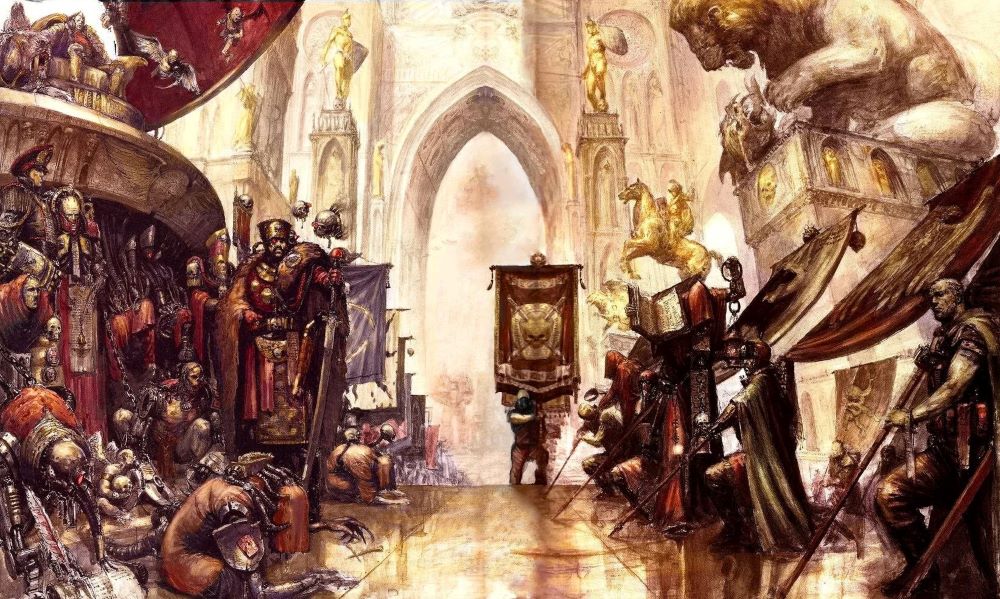
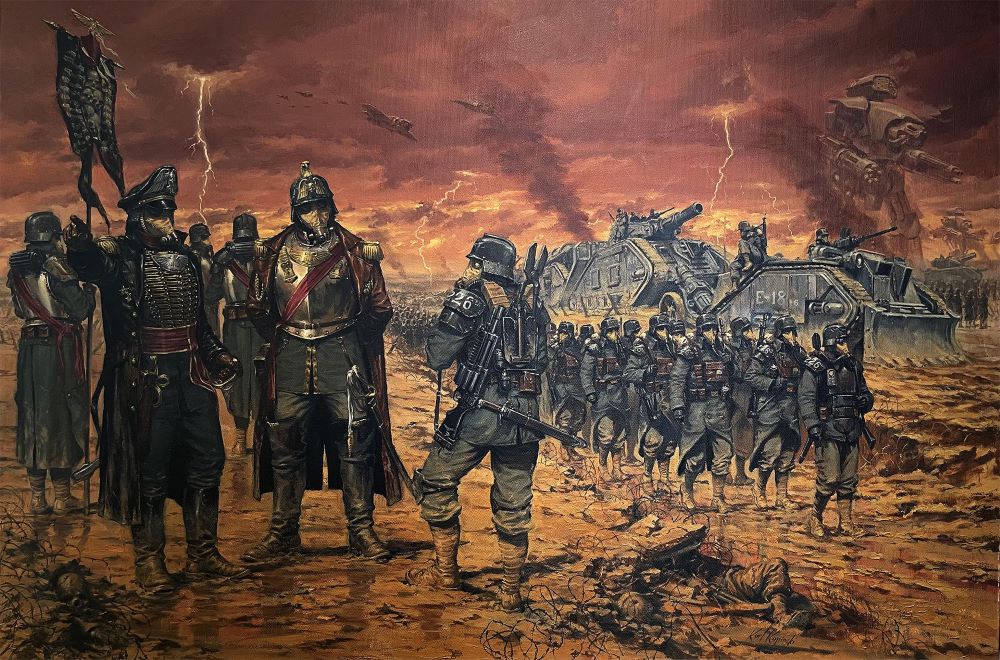
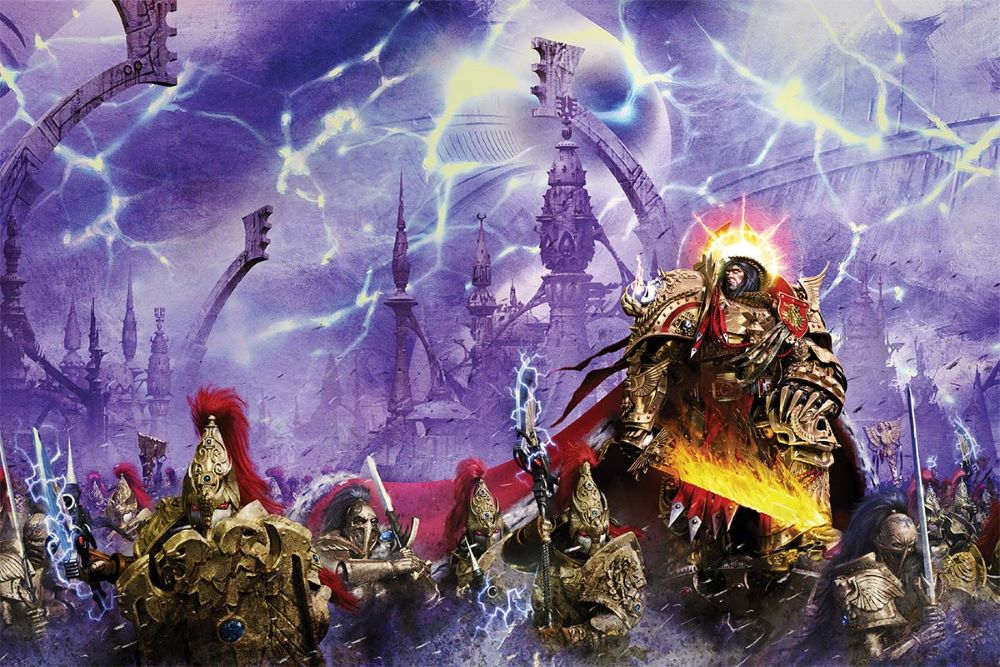
At the center is the Emperor of Mankind. Long ago, the Emperor was an active psychic ruler who attempted to unite humanity under a secular, rational Imperium. Following the catastrophic civil war known as the Horus Heresy, he was mortally wounded and placed upon the Golden Throne, a colossal life-support device on Terra—the future Earth. Ten thousand years later, he is physically inert, sustained by immense sacrifice, but is worshipped as a literal god by trillions of Imperial citizens.

The irony is crucial: the Emperor’s earlier project was hostile to religion, yet the civilization founded in his name has turned him into the center of a fanatical state faith. His dead or dying body has become a symbol that justifies absolute obedience, endless crusades, censorship, and the persecution of anyone defined as impure or disloyal.

The galaxy is connected by the Warp, a parallel psychic dimension used for interstellar travel and communication. But the Warp is unstable, dangerous, and shaped by mortal thought and emotion. It is home to Chaos, a supernatural force embodied by four great gods:

  • Khorne, the god of rage, war, slaughter, blood, and martial violence.
  • Tzeentch, the god of change, sorcery, mutation, ambition, manipulation, and conspiracy.
  • Nurgle, the god of plague, decay, despair, entropy, and grim endurance.
  • Slaanesh, the god of obsession, pleasure, excess, perfection, sensation, and self-destruction.

Chaos is both an external threat and an internal consequence. It feeds on the fear, pain, rage, greed, and desperation of sentient life. The more brutal and hopeless the galaxy becomes, the stronger Chaos becomes. This makes the universe a self-perpetuating tragedy: the Imperium commits atrocities to preserve itself, but its cruelty produces exactly the despair and violence upon which its greatest enemy thrives.

Fascism, Satire, and the Imperium

Any serious account of Warhammer 40K has to address the politics embedded in the Imperium of Man. Its authoritarian, fascistic, xenophobic, ultra-nationalist, and theocratic character is foundational to the setting. It is not a decorative aesthetic applied to otherwise uncomplicated heroes. The Imperium is a nightmare-state built from state violence, militant conformity, religious terror, permanent war, enforced ignorance, and the idea that collective survival excuses every atrocity.

The Imperium’s language is full of concepts familiar to real-world authoritarian movements: purity, loyalty, unity, sacrifice, tradition, enemies within, enemies without, obedience to sacred authority, and extermination of the “other.” Aliens are not merely rivals but existential contaminants. Mutants are treated as proof of corruption. Heresy is not a disagreement but a disease. Citizens are expendable resources in a war machine. The state is sacred; doubt is treason.

But that is not an invitation to admire the Imperium. Its grotesque political logic is part of the property’s original satirical foundation. The early Rogue Trader era was shaped by the same punk, anti-establishment, dystopian, and satirical energy that ran through much British genre culture during the 1980s. Its creators were working against the backdrop of Thatcher-era Britain, a period of profound political conflict over nationalism, policing, class, militarism, organized labor, public institutions, and the treatment of dissent.

The broader Warhammer line occasionally made that influence explicit. The 1986 campaign The Enemy Within, written for Warhammer Fantasy Roleplay, included Empress Magritta/Magraritha as a pointed satire of Margaret Thatcher, while its title echoed Thatcher’s notorious rhetoric about “the enemy within.” It would be simplistic to reduce the whole of 40K to a single anti-Thatcher allegory, especially after decades of expansion under many writers. Yet the setting’s foundational instinct was to take authoritarian rhetoric and imperial fantasy to ridiculous, horrifying extremes.

The Imperium is the ultimate in-joke about the bankruptcy of those ideas. It asks what would happen if every authoritarian fantasy—racialized or species-based purity, sacred hierarchy, militarized masculinity, obedience, nationalism, fear of outsiders, religious certainty, and expansion through force—were granted total control over a galaxy for ten thousand years. The answer is not a stable civilization. It is stagnation, paranoia, ignorance, endless violence, and a government that can preserve life only by making life unbearable.

This is why far-right and fascistic bad-faith actors who try to claim the Imperium as an ideal are missing the point, whether unintentionally or deliberately. They see its armored soldiers, skull-covered banners, huge weapons, slogans about purity, and worship of the God-Emperor as an image of restored order. Yet 40K frames the actual consequences of this “order” as horrific: worlds burned clean, populations sacrificed, dissidents tortured, knowledge lost, and humanity spiritually hollowed out.

Games Workshop has directly addressed real-world prejudice and fascist appropriation in its community. It stated that it would “never accept nor condone any form of prejudice, hatred, or abuse,” described the Imperium as driven by hatred and extreme xenophobia, and declared: “The Imperium is driven by hate. Warhammer is not.” The company also stated that people displaying real-world hate symbols or behaving in discriminatory ways are not welcome in official stores, events, or the Warhammer community.

The satire can become complicated because Warhammer 40K is made to be visually spectacular. It sells massive armored warriors, cathedral-sized starships, gigantic tanks, heroic last stands, and grandiose military imagery. A Guardsman defending civilians or a Space Marine holding a city against monsters can still be brave. Individual courage is real within the fiction. But the heroic action of a character should not be confused with moral endorsement of the system that character serves.

A good way to understand the setting is to distinguish people from institutions. A soldier can be selfless; the empire can remain monstrous. A Space Marine can save a planet from Tyranids; the Imperium can still be a fascistic theocracy. The tragedy is that many of the setting’s protagonists have been born into conditions where brutality is taught as necessity and alternatives appear impossible.

Factions, Heroes, and Horrors

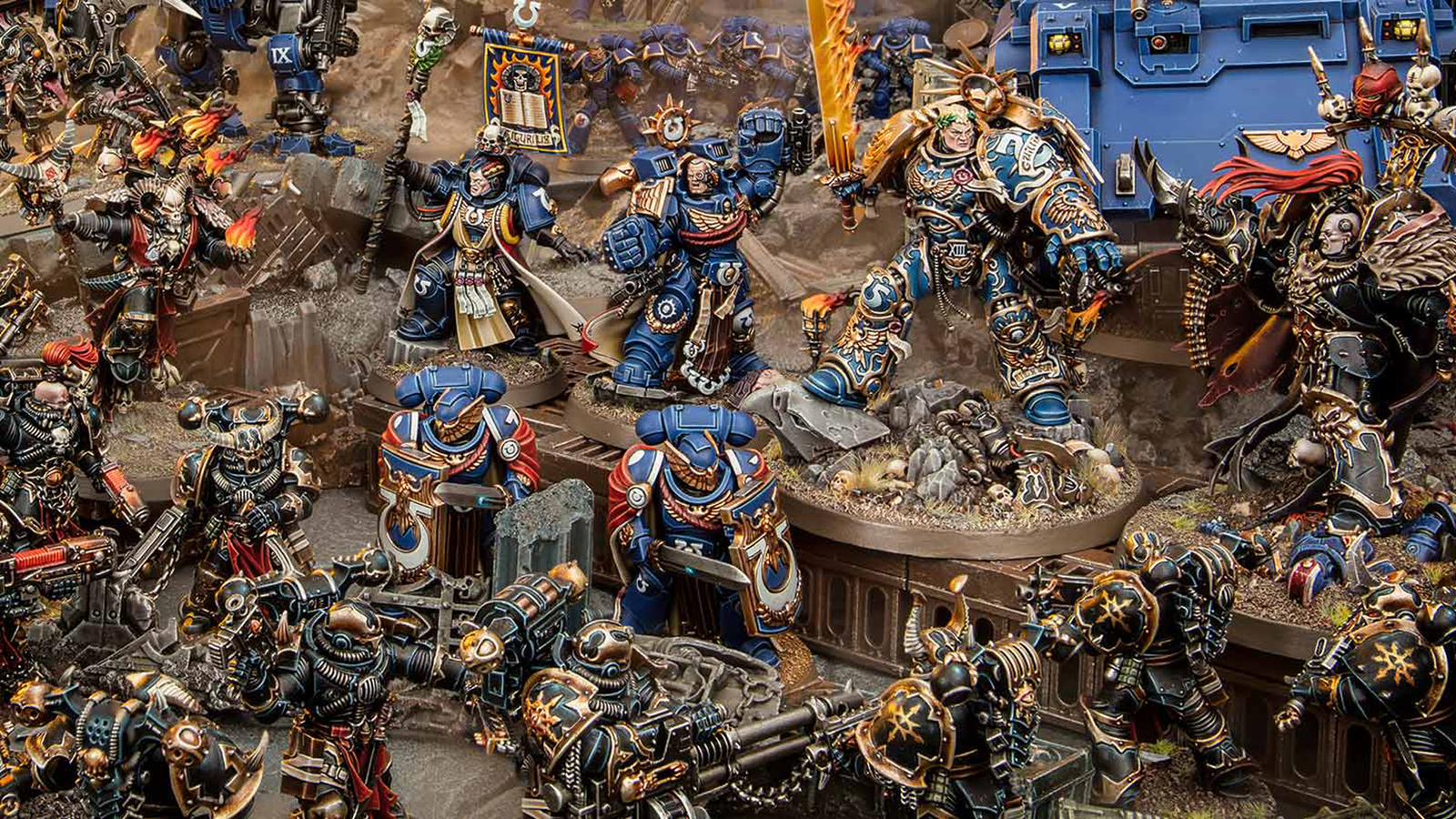
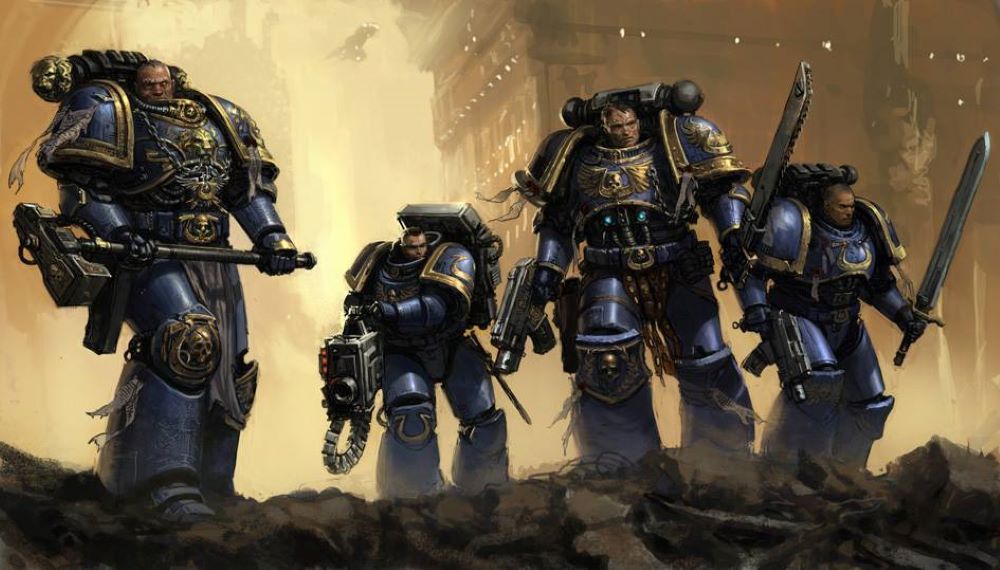
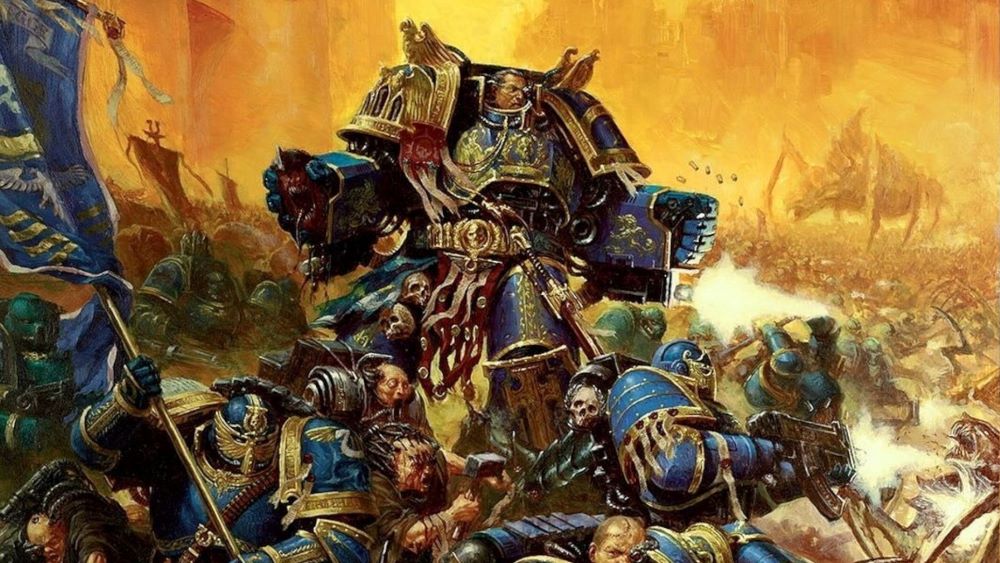
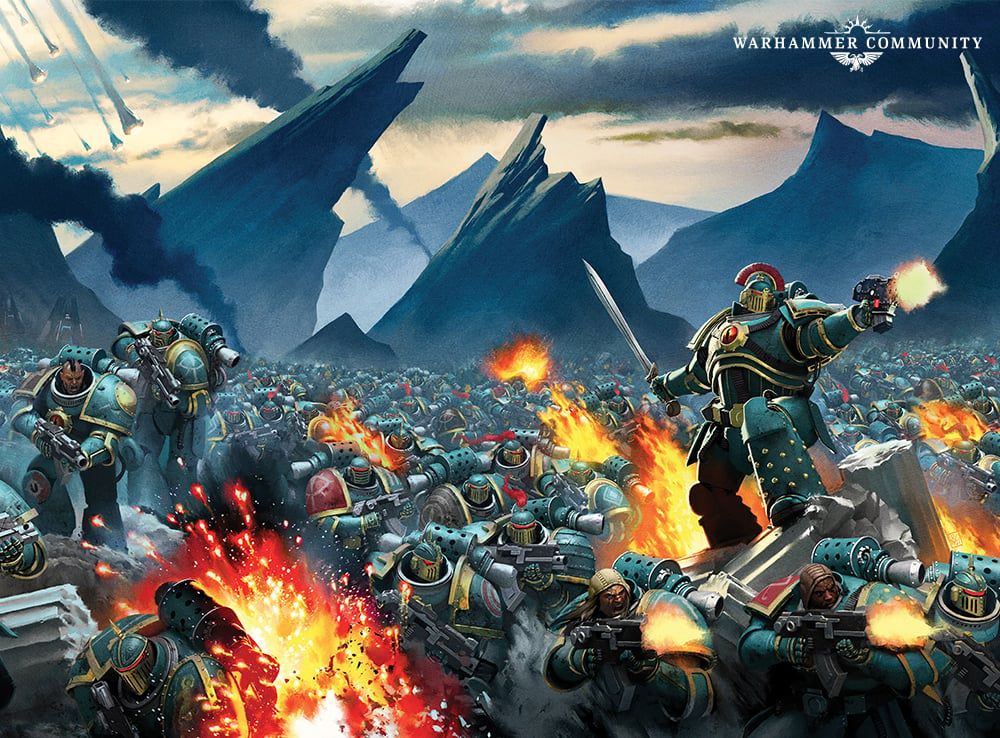
The most famous force in Warhammer 40K is the Adeptus Astartes, better known as the Space Marines. They are genetically engineered, heavily indoctrinated super-soldiers created from the genetic legacy of ancient demigod generals. Organized into independent Chapters rather than massive unified legions, Space Marines are the Imperium’s elite shock troops—the “Angels of Death.”

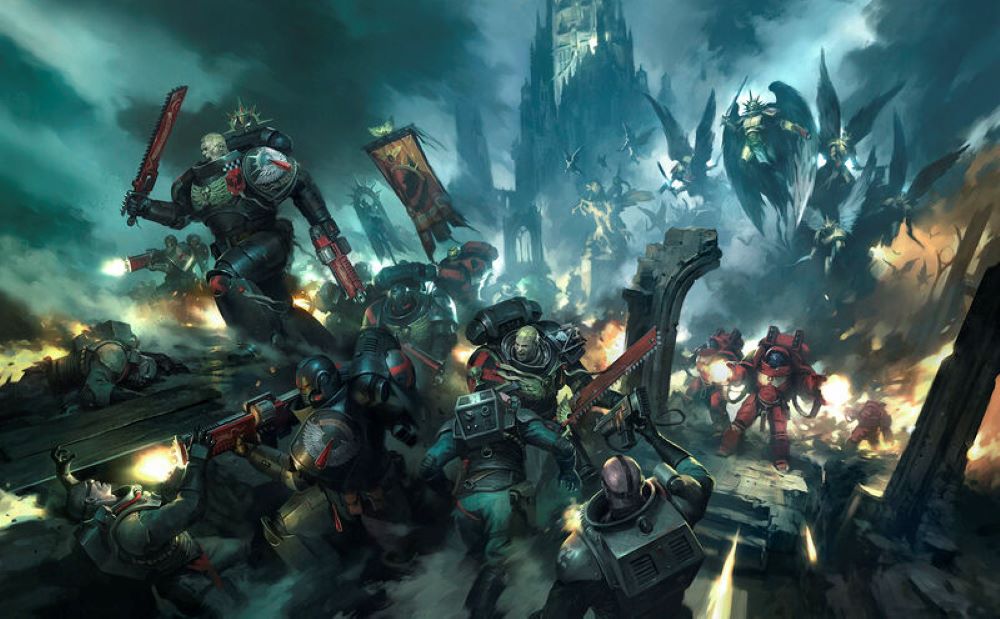
The Ultramarines are disciplined and highly organized warriors with Roman-style military and civic imagery. The Blood Angels are noble heroes afflicted by a hereditary thirst for bloodshed. The Dark Angels are secretive knightly warriors haunted by ancient betrayal. The Space Wolves use Viking and Norse mythic imagery, while the Black Templars are crusading religious zealots who embrace the Imperium’s faith with particular intensity.

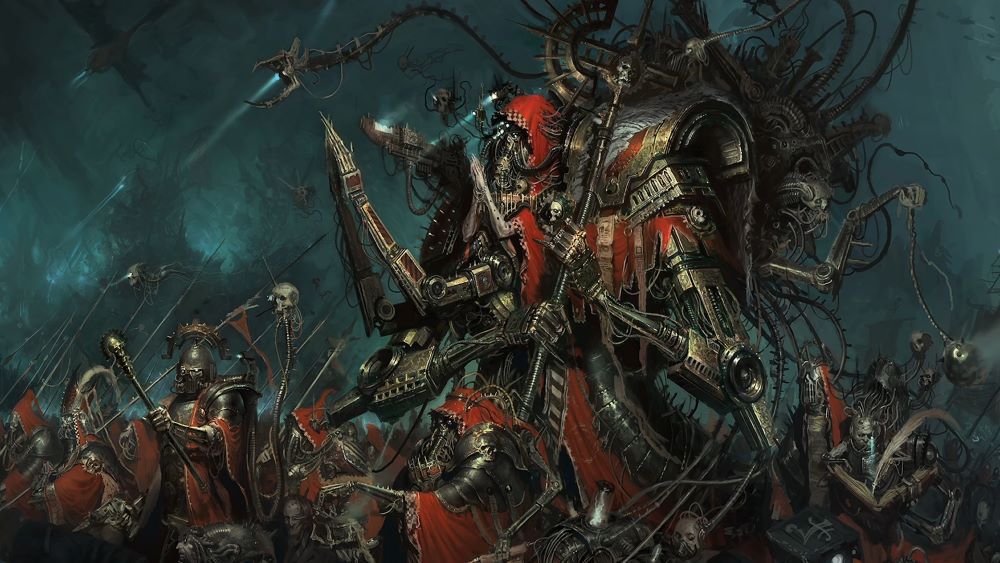
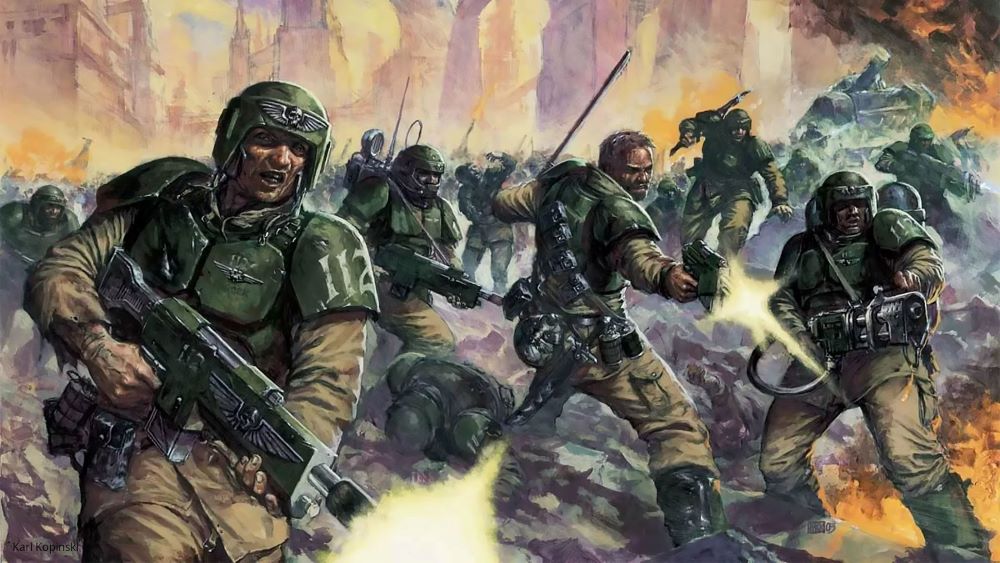
The Imperium is much more than Space Marines. The Astra Militarum, also called the Imperial Guard, consists of ordinary human soldiers confronting impossible threats with rifles, tanks, artillery, discipline, and numbers. The Adeptus Mechanicus are the cybernetic techno-priests of Mars who preserve and worship ancient machines. The Adepta Sororitas, or Sisters of Battle, are armed warrior-nuns who serve the Imperial faith. The Inquisition hunts heresy, alien infiltration, rogue psykers, and Chaos cults with nearly unlimited authority. The Adeptus Custodes are the Emperor’s golden-armored bodyguards, while the secretive Grey Knights specialize in combating daemons.

The main human enemy is Chaos, and its most iconic servants are the Chaos Space Marines—the descendants of legions that rebelled against the Emperor during the Horus Heresy. The disease-ravaged Death Guard serve Nurgle. The occult Thousand Sons serve Tzeentch. The berserk World Eaters serve Khorne. These factions illustrate one of the franchise’s recurring themes: virtues such as courage, ambition, loyalty, knowledge, and strength can be warped into fanaticism, cruelty, obsession, and self-destruction.

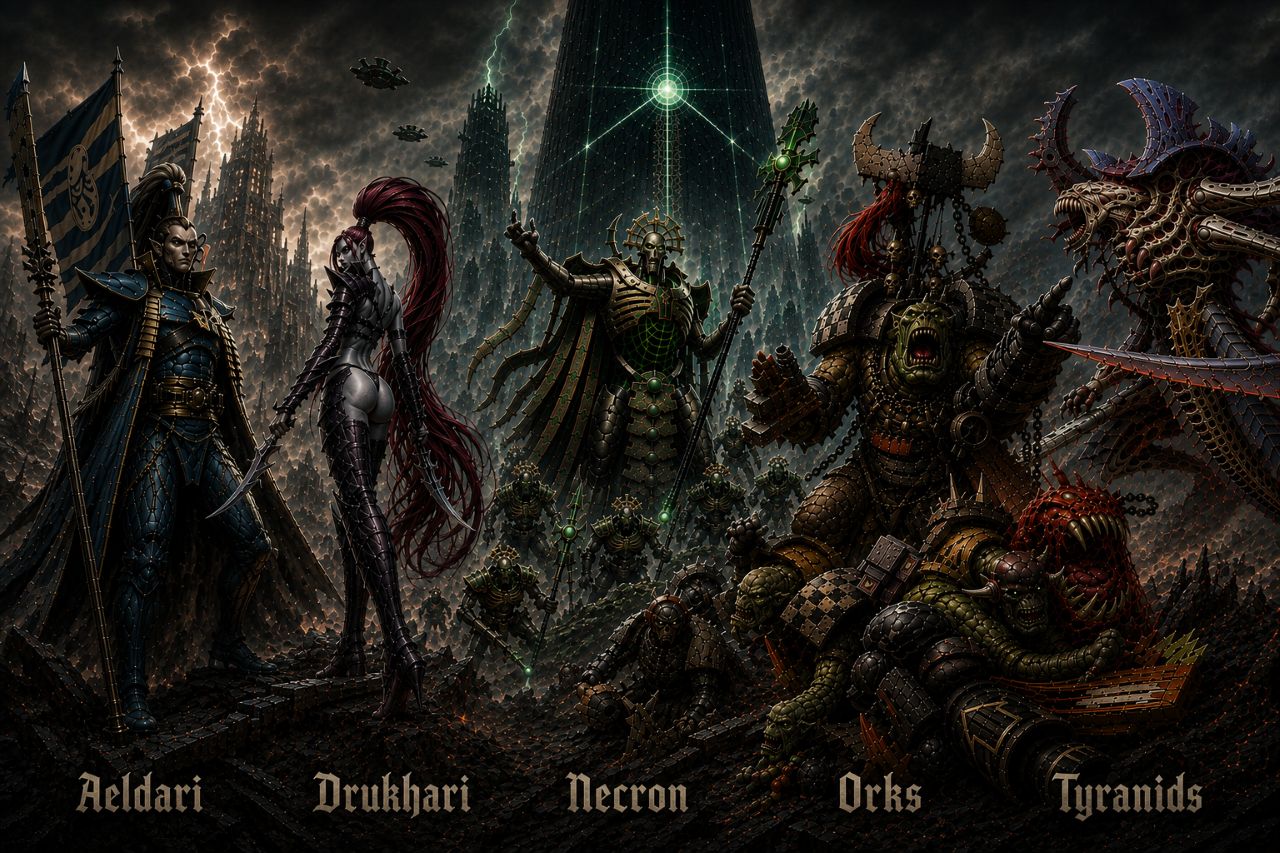
The xenos factions are equally essential. The Orks are massive green war-addicts who find genuine joy in combat, making them one of the setting’s strangest blends of comedy and menace. The Aeldari, formerly called Eldar, are an ancient psychic species divided among multiple societies, including the nomadic Craftworld Aeldari and the sadistic Drukhari raiders. The Necrons are ancient machine dynasties awakening from tomb worlds to reclaim a galaxy they believe belongs to them. The T’au Empire is technologically advanced and organized around the “Greater Good,” but its rhetoric of unity also hides coercion, surveillance, and imperial expansion.

The Tyranids provide the setting’s purest form of cosmic horror. They are an extragalactic hive species controlled by the immense Hive Mind. They do not want land, gold, ideological victory, revenge, or diplomacy. They consume worlds for biomass. A Tyranid invasion strips a planet of plants, animals, people, oceans, and every possible usable resource. Their advance is often prepared by Genestealer Cults, which infiltrate human societies, breed hybrid populations, incite rebellion, and prepare entire worlds to be devoured.

The Horus Heresy and Mainstream Rise

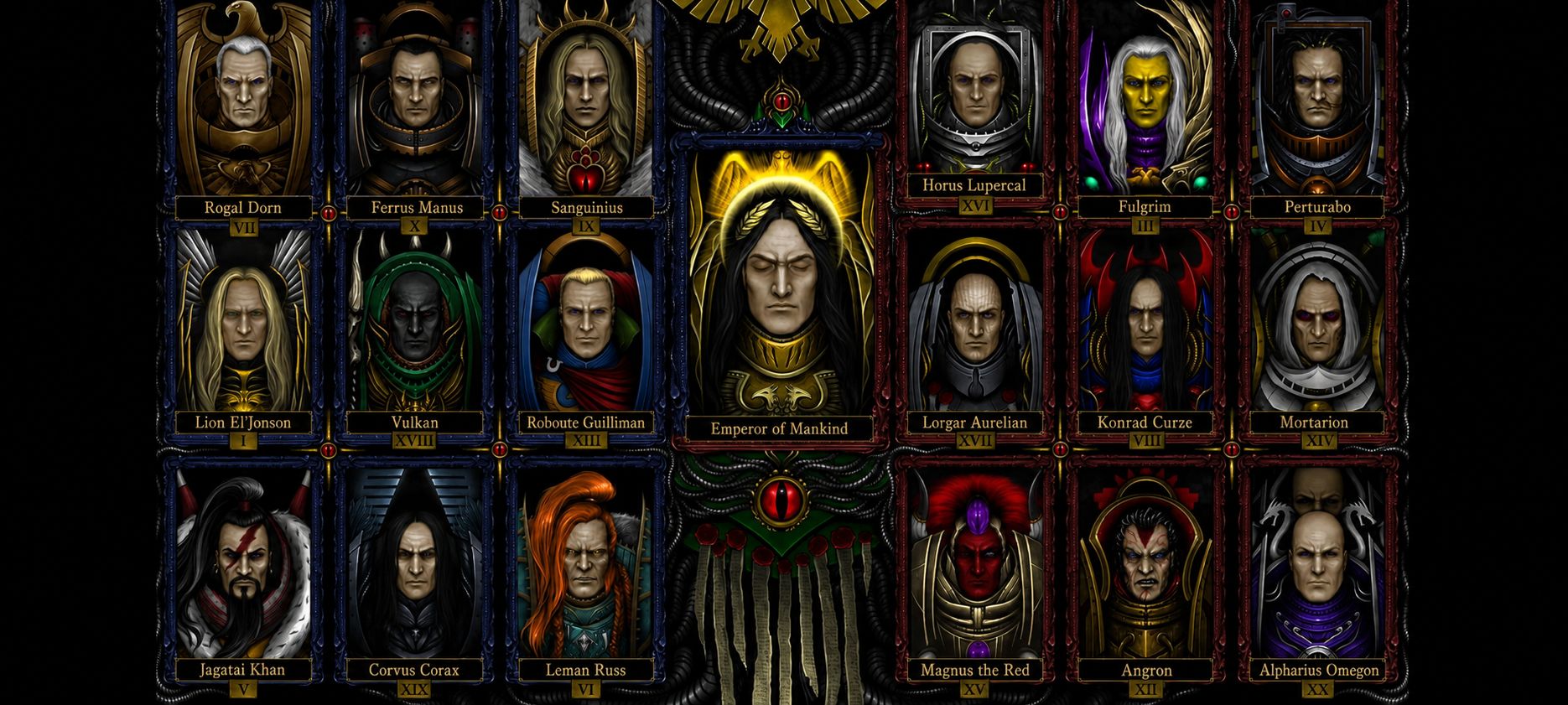
The foundational historical event in Warhammer 40K is the Horus Heresy, a galaxy-wide civil war that occurred ten thousand years before the main setting. In humanity’s earlier period of expansion, the Emperor launched the Great Crusade, a campaign to reunite scattered human worlds beneath a secular Imperium. To command his armies, he created twenty Primarchs, superhuman sons and generals whose genetic material was used to create the original Space Marine Legions.

The Emperor’s favored son was Horus Lupercal, whom he named Warmaster. Horus was manipulated and corrupted by Chaos, then led roughly half of the Space Marine Legions in rebellion against the Emperor. The father-and-son imagery echoes Paradise Lost and Biblical tales of rebellion, but 40K gives it a brutally ambiguous twist: the Emperor is not a blameless divine father, and his rebellious sons are not united by a coherent moral cause. The war is a catastrophe born from pride, secrecy, ambition, manipulation, and the failure of a ruler who tried to shape humanity’s future through absolute control.

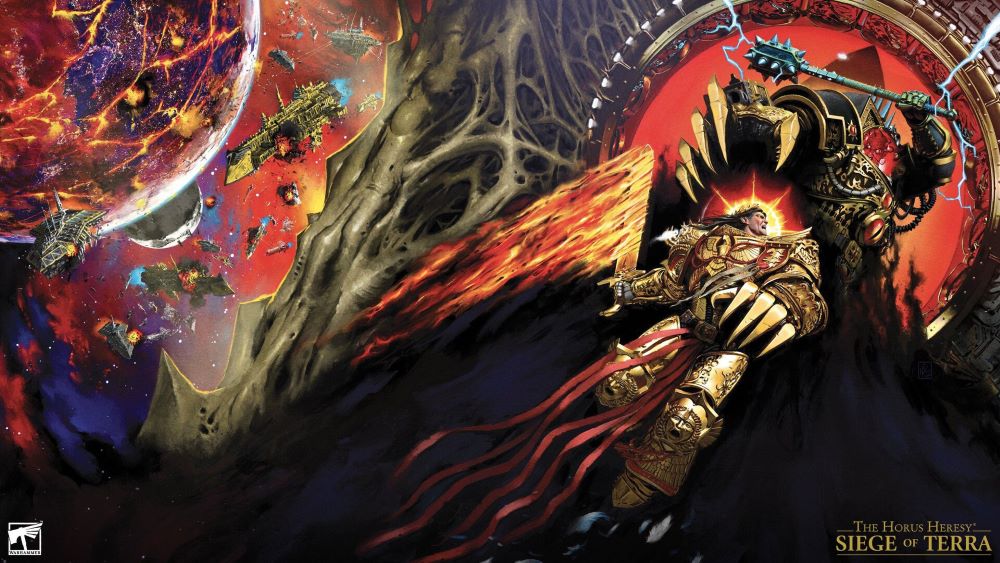
The Heresy ended during the Siege of Terra. The Emperor confronted Horus aboard the traitor’s flagship and destroyed him, but received mortal wounds in the process. The Emperor’s survival on the Golden Throne saved humanity from immediate collapse, yet it also ensured that the Imperium would spend the next ten thousand years worshipping a broken relic instead of realizing the future he claimed to seek.

The Horus Heresy became one of the franchise’s largest literary projects through the expansive The Horus Heresy novel series, and its ancient battles now form the basis of the dedicated tabletop game Warhammer: The Horus Heresy. Its impact explains nearly every major feature of modern 40K: the division of Space Marines into Chapters, the hatred between loyalists and traitors, the divinity of the Emperor, and the Imperium’s permanent paranoia about betrayal.

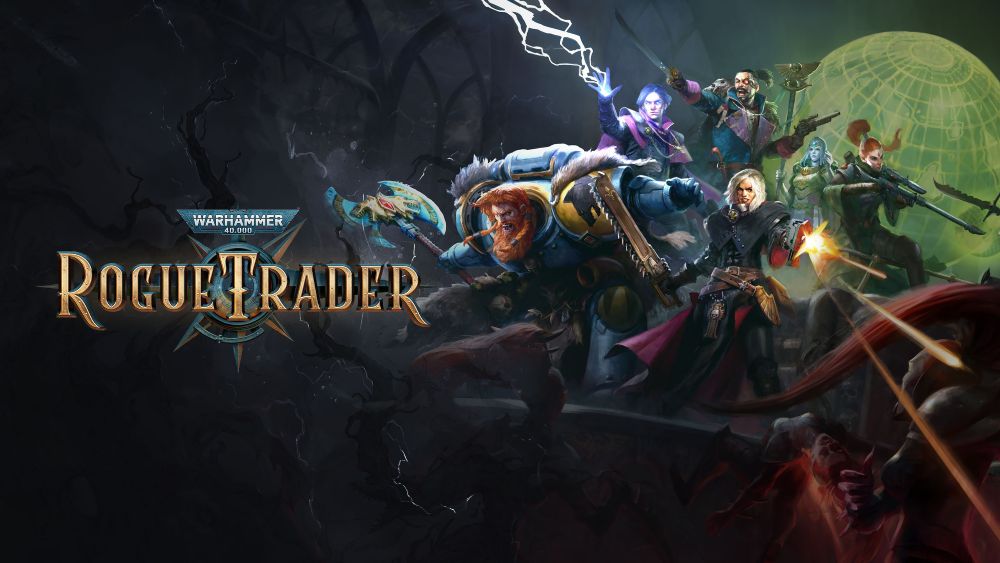
For decades, Warhammer 40K was huge within hobby culture but comparatively specialized in wider popular culture. Its mainstream growth accelerated through video games, online miniature-painting communities, audiobooks, social media, and increasingly polished adaptations. Relic Entertainment’s Warhammer 40,000: Dawn of War helped establish the setting as a major PC strategy property after its 2004 release. Later games such as Warhammer 40,000: Space Marine, Warhammer 40,000: Darktide, Warhammer 40,000: Rogue Trader, and Warhammer 40,000: Space Marine 2 made the franchise accessible to people who may never have collected miniatures.

Black Library, Games Workshop’s fiction label, also made the setting more accessible by turning its lore into character-driven stories. Eisenhorn works as a detective thriller and political mystery centered on the Inquisition. Gaunt’s Ghosts follows ordinary soldiers through the machinery of Imperial war. Ciaphas Cain brings a more comic, self-aware perspective to the setting. The Horus Heresy transforms the franchise’s oldest backstory into a vast tragic saga.

The move toward television and animation marks the clearest mainstream expansion yet. Secret Level featured a Warhammer 40,000 animated episode in 2024, while Amazon MGM Studios, Blur Studios, and Games Workshop are developing a larger animated project connected to the Deathwatch. Henry Cavill is attached as an executive producer and is also associated with Amazon’s developing live-action Warhammer 40,000 project.

Ultimately, Warhammer 40K has endured because it is not merely a franchise about powerful soldiers and giant battles. It is a gigantic, flexible setting that can support military tragedy, gothic horror, cosmic horror, detective stories, religious dystopia, dark comedy, political intrigue, space opera, and apocalyptic adventure. Its most enduring insight is that a civilization cannot build genuine security through hatred, obedience, and endless war. In Warhammer 40K, those ideas do not create order. They create the grim darkness from which no one can escape.

Artist Profile: Karl Kopinsky


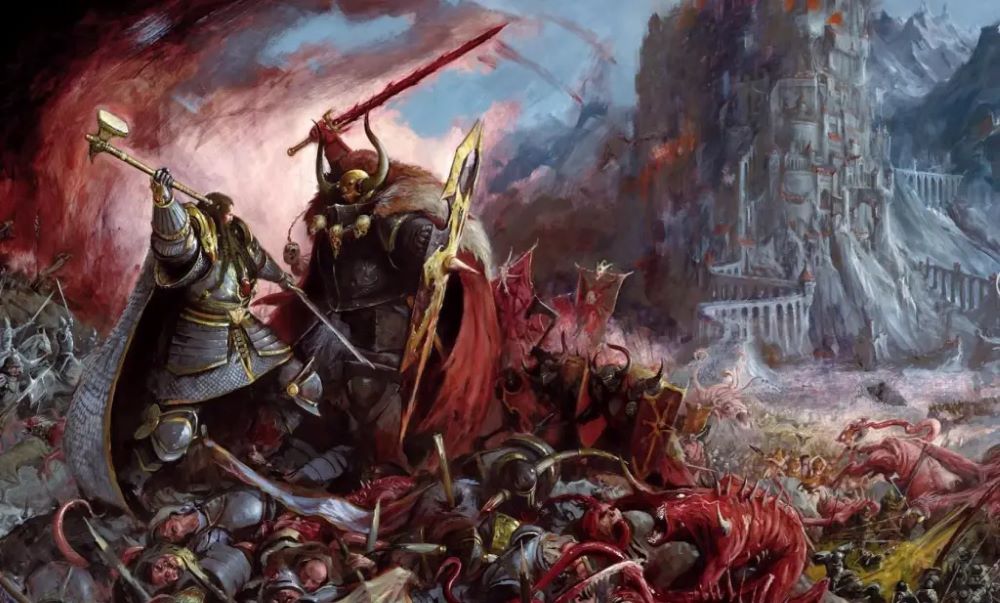
Karl Kopinski is well-known for his powerful and vivid artwork within the Warhammer 40,000 and Warhammer Fantasy universes. His illustrations bring to life the dark and intense atmosphere of these worlds, combining detailed pencil sketches with digital painting techniques. Kopinski’s art captures the ruggedness and drama of the characters and environments, giving fans a strong visual connection to the stories and miniature figures. His early work with Games Workshop helped establish the distinctive look and feel that many associate with the Warhammer brand.

In his Warhammer 40K pieces, Kopinski focuses on dynamic characters and battle scenes that feel full of energy and history. From armored soldiers to monstrous creatures, his work emphasizes strong contrasts and vivid expression, creating images that suggest an ongoing saga of conflict and heroism. Similarly, his fantasy art conveys mythical themes with a fresh, raw energy, balancing realism with imaginative design. His style invites both players and artists to immerse themselves in the rich narratives of these fantasy worlds while inspiring miniature hobbyists who recreate his detailed designs.

Beyond his contributions to Warhammer, Kopinski continues to explore fantasy art through various projects, blending realistic anatomy and dramatic light with creative storytelling. His illustrations stand out for their ability to mix traditional drawing techniques with modern digital tools, offering a unique and compelling look that appeals to a broad audience.

Artist Profile: Neil Roberts


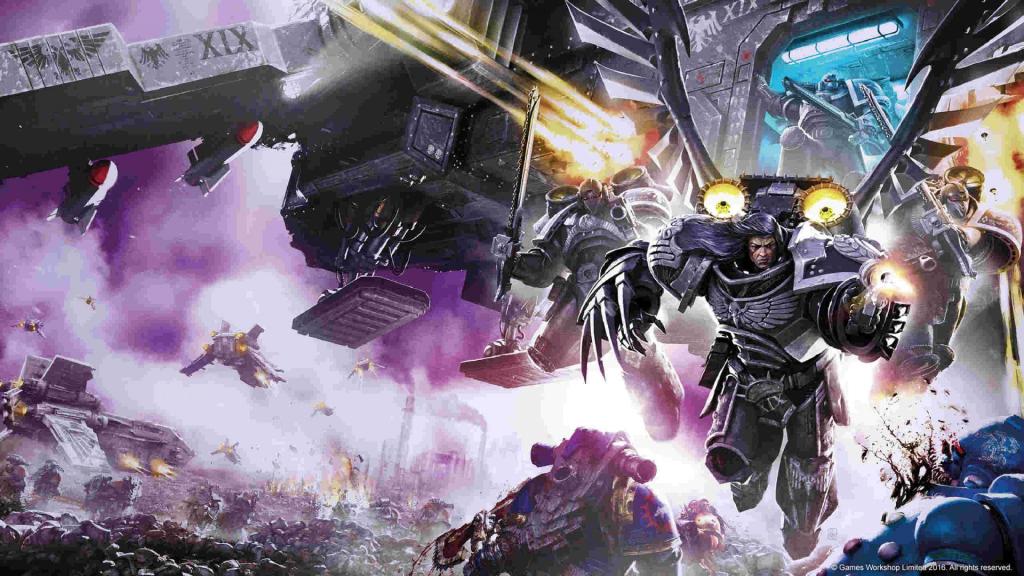
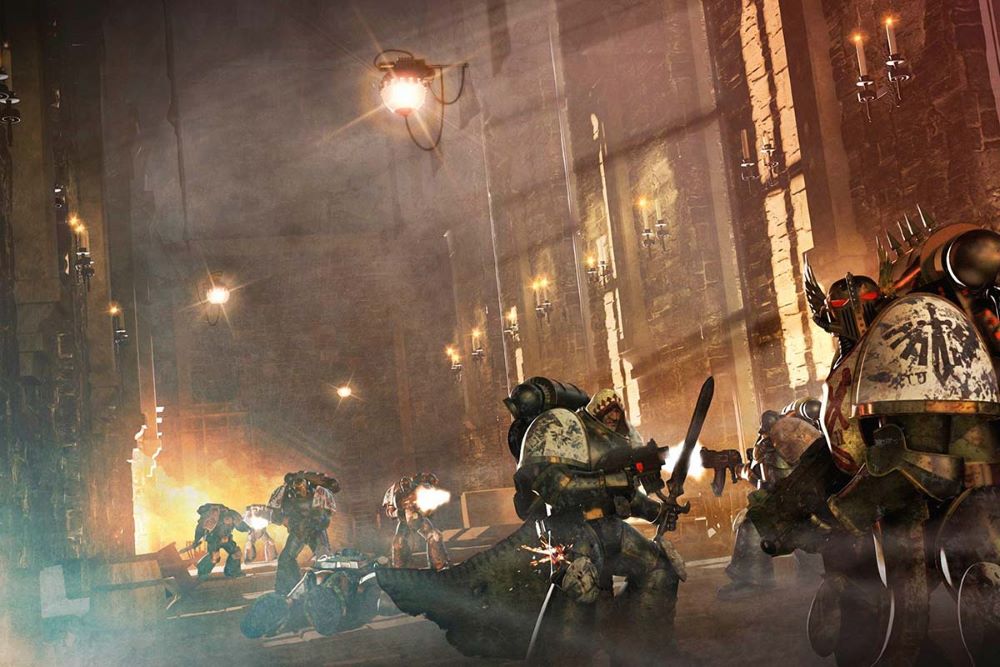
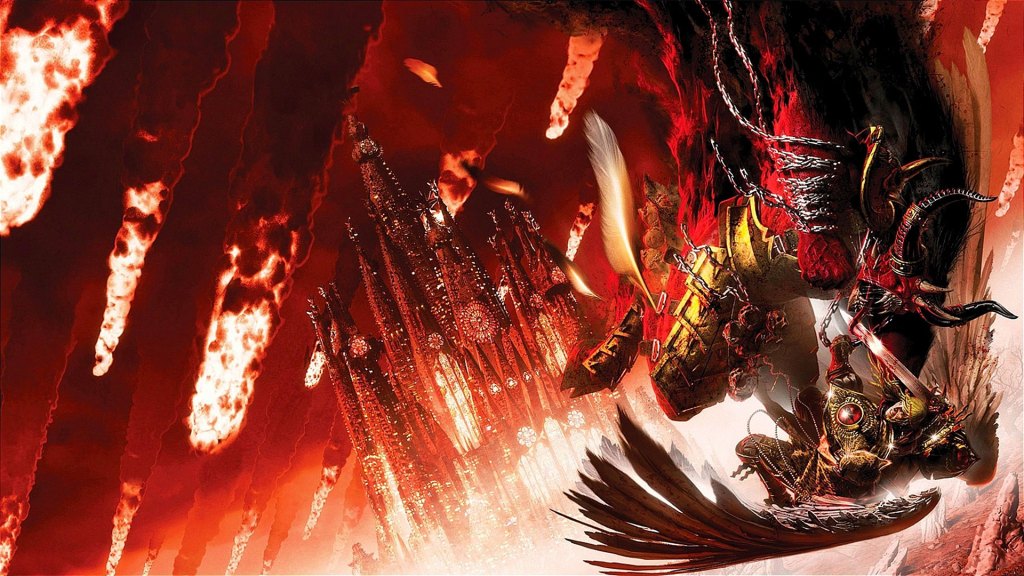
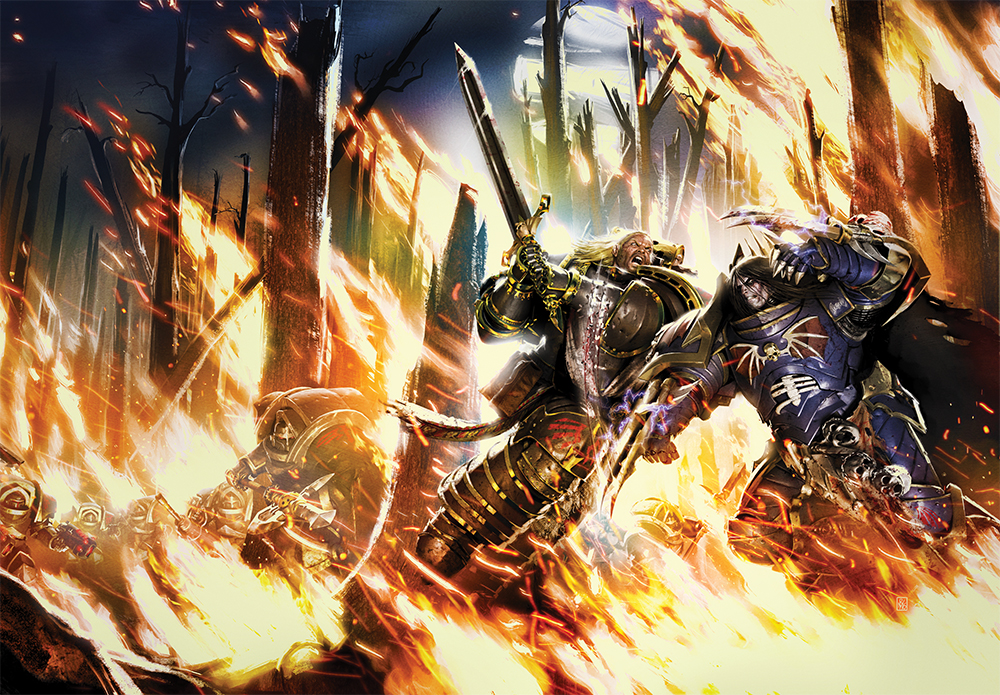
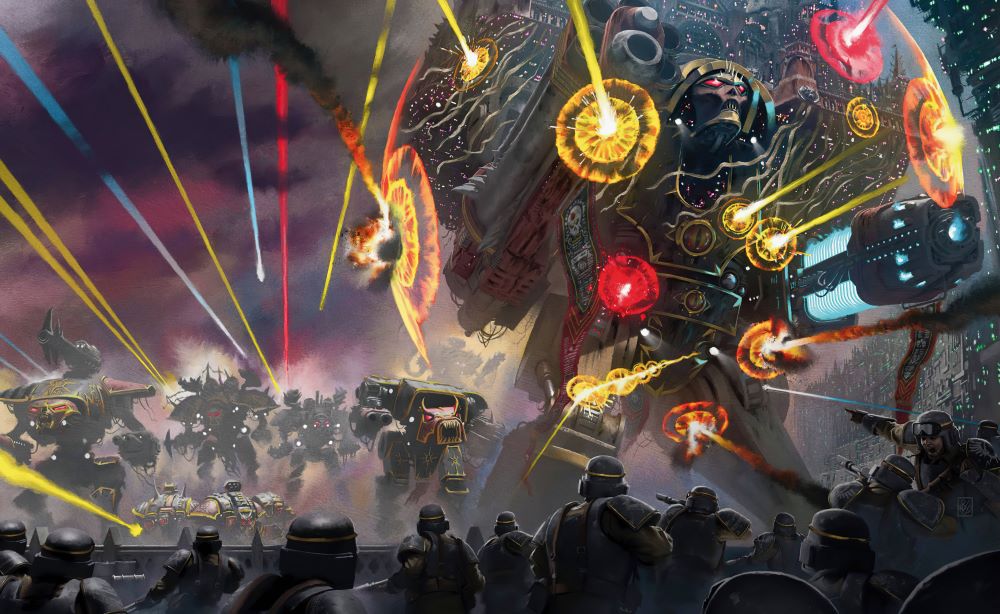
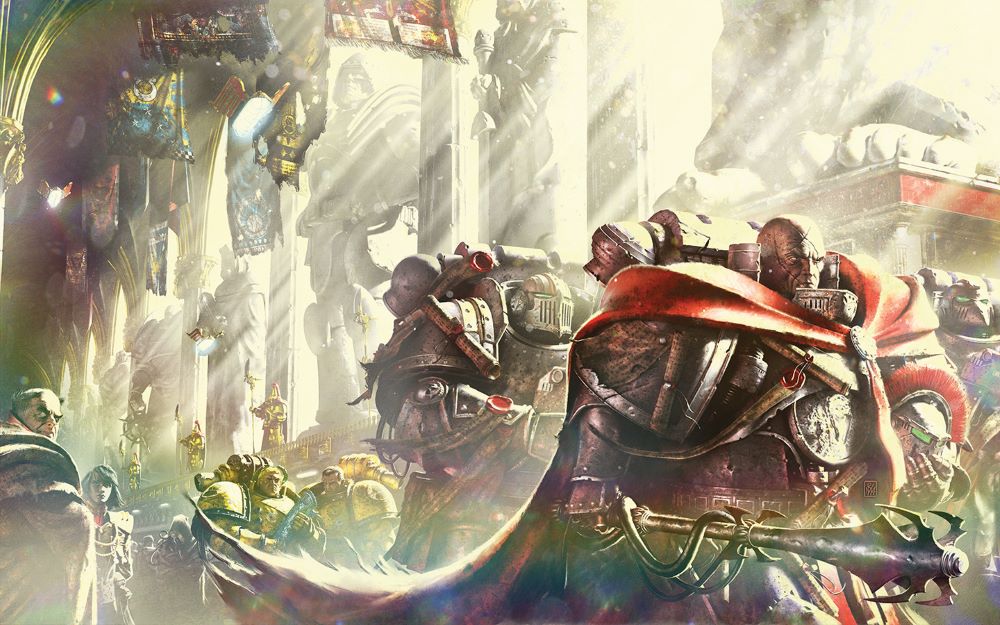
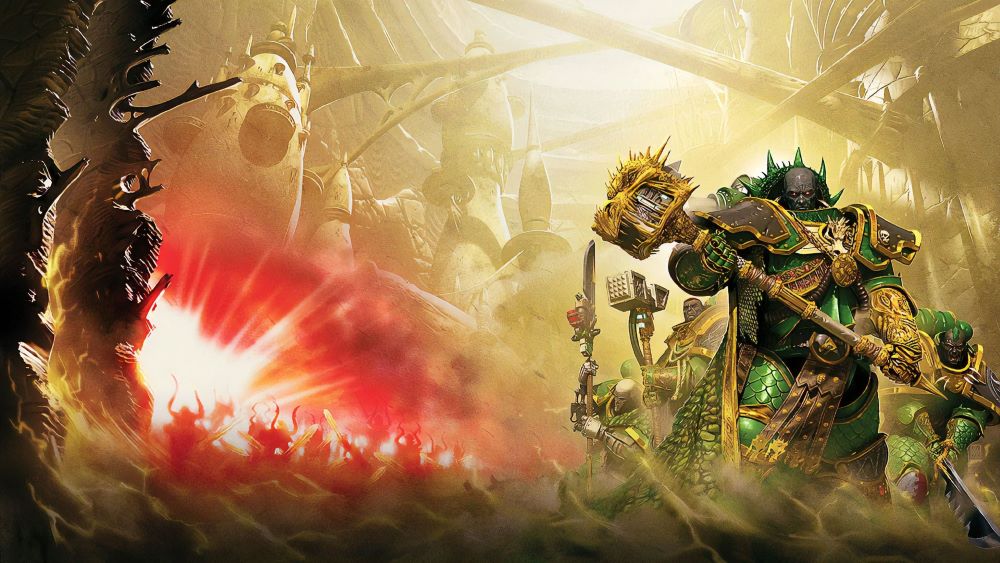
Neil Roberts has a knack for bringing the dark, brutal world of Warhammer 40K’s Horus Heresy to life with his cover art. His paintings do an amazing job of showing the grim and epic atmosphere that defines the setting — filled with shadows, war-torn armor, and a sense of endless struggle. The moody lighting and intense detail in his work really pull you into a universe that feels both vast and oppressive, perfectly matching the tone of the stories inside.

What makes his art stand out is how he captures that feeling of dread mixed with heroism. His Space Marines and iconic characters aren’t just soldiers; they’re larger-than-life figures bathed in harsh light and surrounded by chaos, which really nails the “grim darkness” aspect Warhammer fans expect. Every cover looks like a scene from a massive battle where hope is scarce, but courage burns bright—which is exactly how the Horus Heresy saga plays out.

Roberts’ style balances digital polish with a painterly touch, giving his art depth and life without losing the hand-crafted vibe. This approach makes the scenes feel immersive, like a visual gateway to the brutal and tragic history of the Imperium. For fans, his covers aren’t just illustrations; they’re essential to experiencing the full weight of the Warhammer 40K universe’s darkest moments.

Horror Review: Event Horizon (dir. by Paul W. S. Anderson)


“You know nothing. Hell is only a word. The reality is much, much worse.” — Dr. Weir

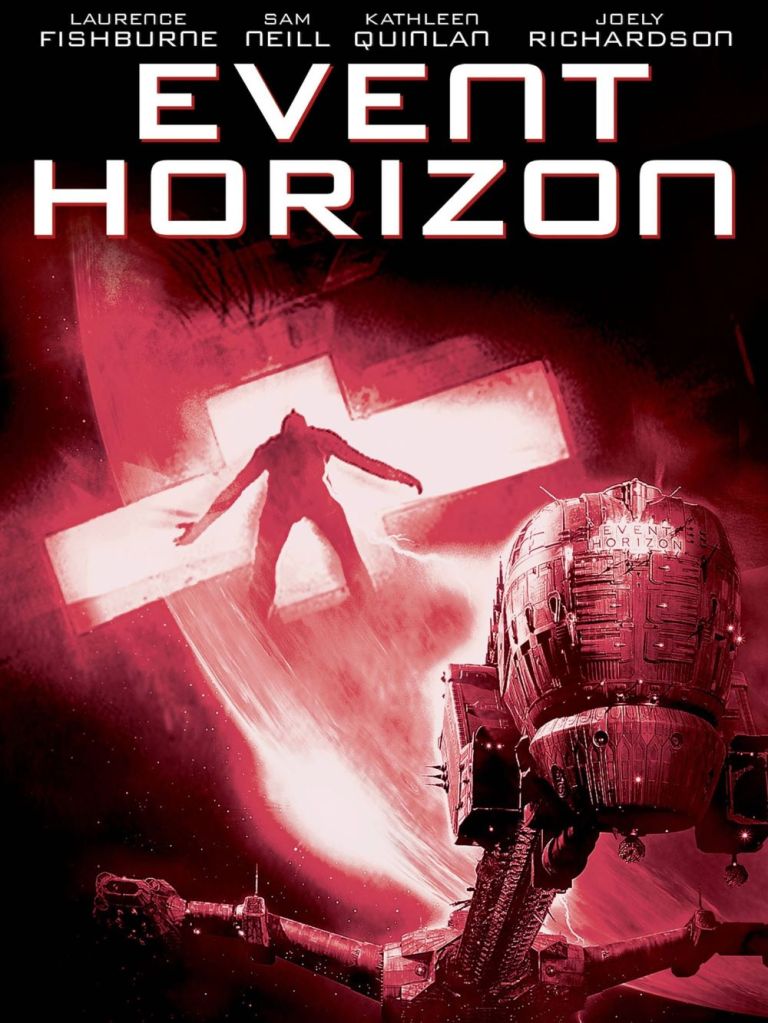
Paul W.S. Anderson’s 1997 film Event Horizon stands out as a memorable mix of science fiction and horror, remembered for its gripping atmosphere and disturbing visuals. The story is set in 2047: a rescue crew aboard the Lewis and Clark is sent out to recover the long-missing spaceship Event Horizon, a vessel built to test a new kind of faster-than-light travel. Onboard with them is Dr. William Weir, the Event Horizon’s creator, who explains that the ship vanished after first activating its “gravity drive,” which can fold space to allow for instant travel across vast cosmic distances.

Soon after reaching the drifting Event Horizon, the crew discovers signs of mass violence and horror. They recover a disturbing audio message and realize something traumatic happened to the original crew. As they search for survivors, they experience intense and personal hallucinations—memories and fears brought to life by the ship. It becomes clear that the Event Horizon didn’t just jump through space; it traveled to a place outside reality, a nightmarish interdimensional realm resembling hell.

What makes Event Horizon particularly unique is its concept of hell as an alternate dimension that can infect and corrupt whatever or whoever crosses into it. The ship’s gravity drive doesn’t simply facilitate faster travel—it accidentally opens a gateway to this chaotic, malevolent place. This portrayal of hell as a dangerous interdimensional reality that preys on minds and bodies echoes the idea found in the massive gaming property Warhammer 40K, where hell is depicted as the Warp, a dimension of chaos that corrupts and drives people insane. Like the Warp, the film’s hell is an unpredictable, hostile realm where sanity and physical form break down, infecting and warping everything that comes into contact.

Visually, the film relies on claustrophobic corridors, flickering lights, and unsettling sounds to keep the audience off-balance. The design of the ship itself—part gothic cathedral, part industrial nightmare—adds to the sense of unease and dread throughout. The use of practical effects and detailed sets grounds the sci-fi terror in something tangible, making it all feel more immediate and believable.

Event Horizon also hints at bigger philosophical questions: how far should science go, and what happens when the drive for knowledge is unchecked by ethics or humility? The gravity drive is a technological wonder, but it’s treated with little caution by its inventor, and the catastrophic results suggest that some discoveries may be better left unexplored. The ship becomes both a literal and figurative vehicle for exploring the limits of human ambition and the dangers of pushing beyond them.

As the movie builds toward its climax, the rescue crew faces increasingly desperate odds. The possessed Dr. Weir, now an outright villain, sees the hellish dimension the gravity drive visited as the next step for humanity—a place of chaos and suffering. Multiple characters die in gruesome ways, and the survivors have to fight their own fears and the haunted ship itself. The ending is chilling and ambiguous, leaving open the possibility that the ship’s evil has not been fully contained.

At release, Event Horizon divided critics and audiences. Some found the violence and nightmare imagery too intense or the story too messy to follow. Others praised its ambition and the way it blends psychological horror with cosmic sci-fi. Over the years, the film has developed a cult reputation, frequently cited as one of the more effective and original space horror movies. Its legacy can be seen in later media, especially in video games that tackle similar haunted spaceship scenarios.

However, the film is not without flaws. Many viewers and critics point out uneven pacing, especially in the second half where tension sometimes drains away. The characters often act inconsistently or make choices that feel unrealistic for trained astronauts, which undermines the suspense. The script’s tonal shifts—from serious psychological drama to moments that unintentionally verge on camp—can jolt the viewer out of the experience. The use of jump scares is sometimes predictable, and the film’s heavy reliance on loud, chaotic sequences instead of quiet suspense can feel overwhelming. Some CGI effects haven’t aged well, contrasting with the otherwise impressive practical effects and set design. Acting performances are mixed too; while Sam Neill and Laurence Fishburne are strong, some supporting cast members lack conviction, making emotional engagement uneven.

Importantly, Event Horizon represents Paul W.S. Anderson at his most subtle and effective in directing. Compared to many of his later films, where his style often becomes frenetic and unchecked—possibly due to a lack of producer control—Event Horizon is more controlled, atmospheric, and haunting. This balance between style and substance makes it one of Anderson’s better directorial works, if not his best to date. The film showcases his interest in spatial geography, the use of negative space, and claustrophobic production design, all elements he would expand on in his later work but never as effectively deployed as here. The haunting visual touches, combined with his ability to direct actors and maintain tension, set Event Horizon apart from his more bombastic, less focused later entries.

Despite its flaws, Event Horizon remains gripping and memorable. Its strengths lie in combining deeply personal psychological horror with the vast, terrifying unknown of space and alternate realities. The film explores not just external threats, but also how guilt, fear, and trauma can be weaponized by forces beyond human understanding. For viewers seeking more than a standard haunted spaceship story, Event Horizon offers a disturbing, thought-provoking glimpse into the dark frontier of science, faith, and madness. It stands as a cult classic of sci-fi horror that continues to inspire discussion about the dangers of pushing too far into the unknown.

Space Hulk


space-hulk-03

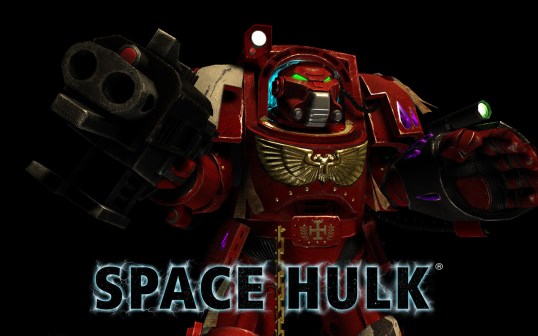
A long time ago, Games Workshop released a board game for their popular “Warhammer 40,000” game franchise. It featured a web of interlocking pieces that could be fashioned together to create the claustrophobic interior of a derelict spacecraft, adrift an unknowable period of time in the great beyond. Obstacles such as doors (both functional and not) populated the game board, and then one player took control of an incursion team of elite Space Marine Terminators as they attempt to secure the derelict. In the lore of the universe, this is done because such derelicts, or “Space Hulks”, have the awesome potential to harbor lost technologies from the distant past. Also, such ships could be full of random marauding Orks, or much worse… the Tyranid Genestealers controlled by Space Hulk’s second player.

You don’t need to know what all of that stuff is to understand that the game was fun. The Space Marine player deploys their squad of Terminators and attempts to achieve their objective, while the Genestealers spawn into the map after play begins as ‘radar blips’. Until visual contact is made, the Terminators can’t know how many Genestealers each blip represents… and even a single one of them is a mortally dangerous adversary at close quarters. Of course, the Terminators prefer to do most of their fighting at range, and have stormbolters (think assault rifles), assault cannons (think miniguns) and heavy flamers (think heavy flamers!) they can deploy to wipe out the Genestealers before they can close to close-combat range. Combat within the game is capriciously lethal, and the whole experience was half an hour or so of good, clean fun.

Fast forward to 2013. Space Hulk (even its re-issue!) has been out of print for a long time. It is now very expensive to acquire, and must be procured second-hand (‘new’ copies exist, but you’ll more than likely have to resort to various hobbying or miniatures sites on the Internet to find them). Enter Full Control Studios, a UK-based developer with several other turn-based strategy credits to their name, who on 15 August of this year dropped “Space Hulk”, a fully realized 3-D recreation of the board game experience that some of us will remember. You know, from a long time ago. Their stated goal was to faithfully recreate the board game experience. The tension of that game primarily came from the uncertainty facing both the Genestealer and Terminator players. The Terminators knew their objective and had prior knowledge of the spawn points for the Genestealers, but had no way of knowing which spawn location they might choose to use, and as I mentioned before… the Genestealers always ride single file, to hide their numbers. The Genestealers need these advantages to make up for their deficiencies in long-range firepower, which the Space Marines have brought in spades.

At the time of the game’s launch, it was met with very mixed reviews. I’ll get to some of the game’s high points in a moment, but it was rightly criticized at launch for an obscene number of bugs. I’m happy to report (in fact, it’s the reason that I’m doing this review now) that with the advent of the 1.3 version patch and the release of the new DLCs, that the game has been running smooth and bug free for me ever since I revisited it. I have not even noticed any jarring graphical anomalies, though they seem like an inevitability in modern game experiences. With the game now smoothly playable, I feel like I can much more authentically recommend it to the interested player. If you are interested… read on, I guess!

Couched in these terms, the video game experience is a very pleasing one. The 3-D graphics are pretty (maybe nothing awe-inspiring, but this is 2013, you’d have to work very hard to impress me with game graphics), and more importantly, the environments have been well constructed to recreate the claustrophobia of the original game. Because, my friends, the corridors aboard the space hulk are only one square wide. You can’t just have your marines spread out in a fire line and advance under a withering hail of machine gun bullets. Instead, the winning tactic tends to be advancing slowly using the ‘Overwatch’ command to fire at moving Genestealers off-turn, or to deploy the heavy flamer or the powerful psionics of the Terminator Librarians to deny certain passageways to the Genestealers completely. Otherwise, what tends to happen, is that a whole bunch of Genestealers charge your position, and your guys die one after another. Oh, and that’s one thing to keep in mind if you do try out Space Hulk: Some of your guys will die. Trying to prevent all friendly casualties? That way lies madness.

If some of this stuff sounds at least a little reminiscent of another recent release (specifically, 2012’s XCOM: Enemy Unknown) that’s because the interfaces share some similarities. Veterans of the new XCOM game will probably find that they have an upper hand in some respects, as you’ll understand what kind of tactics work against enemies that you don’t always know the position of, and who are hilariously deadly if approached in a cavalier fashion. Each of your Terminators, by default, has four ‘Action Points’ available in a turn. One AP allows your space marine to take a step, change his facing 90 degrees, or discharge his firearm (the Heavy Flamer requires 2 action points). You can also use 2 AP to enter Overwatch or Guard (Guard gives you a marginally better chance of success in melee, can be effective on units who already have a leg-up in melee combat)… AP is also used for things like opening doors, acquiring mission critical objects, and so on.

The Genestealer player’s traditional disadvantage, on the other hand, is that she does not know how many command points the Terminator squad has on a given turn, which (in the original version) allowed them to do certain things ‘out of turn’. In the 2013 video game release, command points are rolled at the start of turn (1-6, and you can re-roll them if your squad’s ‘Sergeant’ is still alive), and can be used (at a 1:1 exchange rate) to supplement a Terminator’s normal limit of 4 AP in a turn. In addition, when autofiring while on Overwatch, any roll of ‘doubles’ (1s, 2s, 3s, 4s, whatever) will jam the overwatching weapon…but your Terminator can automatically unjam at the cost of a leftover Command Point.

The game is entirely tactical, without any sort of overarching strategic framework. You enter each scenario (or multiplayer match) with the Terminator’s forces and objectives pre-determined. Only the tactical combat on the map is in play. For that, I find it to be both engaging and fun… in small doses. The game play deepens when you add in all of the game’s potential features, like the Genestealers being able to loose Broodlords into the hulk, and the full Terminator arsenal, including heavy melee weapons, assault cannons, heavy flamers, and psionic Librarians, rather than just the vanilla stormbolter guys…but still doesn’t really match the tactical depth of a game like XCOM, which has many varied enemy types, special unit skills, and a wider arsenal of weapons. An average scenario can clock in at 40 minutes or so, which is not at all disagreeable for me, and, unlike XCOM, Space Hulk is quite amenable to the idea of saving, taking a break, and coming back to your game later.

Oh, one more thing: Space Hulk normally retails at $29.99 from Steam, but is featured in the 2013 year-end sale at 50% off!

Trailer: Warhammer 40K: Space Marine (I Am War)


Been an uneventful day for me today which usually means a slow posting day. One thing that I did come across which came out today was a new trailer for one of my more highly-anticipated games this year. The latest trailer for THQ and Relic Entertainment’s Warhammer 40,000: Space Marine has been released and shows more gameplay footage and hints at the single-player campaign’s storyline.

I was once asked if I ever was given a chance to be a fictional character who would I choose to be. Well, as this trailer clearly shows I definitely want to be a Space Marine (or the more accurate term used in this fictional world: Adeptus Astartes). I mean look at the size of these guys and they even get to wear very ornate and baroque looking armor. Though I’m sure Lisa Marie would want that I paint the armor in more pastel colors.

Warhammer 40,000: Space Marine still set for a September 6, 2011 for the Xbox 360, PS3 and Windows PC.

Warhammer 40K: Dark Millenium Trailer


E3 2010 has made some announcements in regards to several MMORPGs set for release in the near future. One game is Square-Enix’s Final Fantasy XIV which is the sequel to their previous MMORPG in Final Fantasy XI. The second is BioWare’s much-anticipated MMORPG based on George Lucas’ iconic space opera franchise, Star Wars: The Old Republic. Both titles have their fanbase looking forward to play them if just to take a break from the 800 lb. gorilla of the MMO-world: World of Warcraft.

Flying under the radar, but no less anticipated by their own legions of fans is Vigil Studios and THQ’s foray into the MMORPG genre. I am talking about their MMORPG title based on the very popular Games Workshop IP, Warhammer 40,000. Building upon the success and popularity of THQ’s own Dawn of War franchise (also based on the 40k universe), this MMORPG is to be called Warhammer 40K: Dark Millenium Online.

I’m not a huge fan of MMORPG titles since despite how well they play and how much they really look they’re major timesinks that require almost complete dedication from the player to really get into the game. This means almost leaving other games by the wayside and as a gamer that’s a big decision. Either play one game all the time and ignore other great games or only play casually the MMO title and not really get into it.

With this title I may have to rethink about how I feel about MMORPGs since this is one IP that even I am excited over. I have been a huge Warhammer 40K fan since 1990 when I was a senior in high school and my interest has never waned one bit. Now that the franchise has successfully made it’s transition over to video gaming I’m excited for the prospect of enjoying the franchise even more than just reading the lore and playing the tabletop.

The game looks to be like your typical persistent-world MMORPG with two opposing factions having their own unique classes. What I like from looking at the trailer is how heavily it’s based on combat and from the looks of things it might be similar to another scifi-based MMO of the past and that’s Sony’s very own Planetside. I like that vehicles are something that a player can use to fight NPCs and other players of the opposing faction. The only question I and other fans probably have is whether Vigil and THQ will avoid the mistakes Mythic made with Warhammer Online by actually creating a game with an endgame for people to use as their goal.

I’m sure more details will follow as the months pass by. Here’s to hoping that a release date or, at the very least, a beta date for people to participate in, gets announced in the near future. I already know what I shall play and that’s as a Space Marine and hopefully of the Dark Angels Chapter.