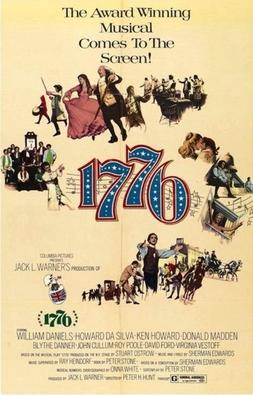
Icarus File No. 29: 1776 (dir by Peter R. Hunt)


The year is 1776.  The British have landed in Canada and are now marching towards New York with the intention of putting down a revolultion that has sprung up over issues like unfair taxation.  In Philadelphia, John Adams (William Daniels) is frustrated by the refusal the second Continental Congress to take up debate on whether or not the 13 North American colonies should announce their official independence from Britian.  Every day, Adams steps into the chamber and demands that the Congress take some action.  And, every day, his fellow deletates sing, “Sit down, John!”

Yes, you read that correctly.  They sing it.

Based on a 1969 Broadway musical, 1776 features a lot of singing, a lot talking, and not much else.  This is a film about the debate surrounding the writing of the Declaraiton of Independence that sometimes feels as if it’s telling its story in real time.  It’s no shock when Benjaming Franklin (Howard Da Silva) continually falls asleep at his desk or when Thomas Jefferson (Ken Howard) sings that he’d rather be home.  This is a nearly 3-hour film that feels like 3 months.  Some films about the Revolutionary War emphasize the brilliance of the Founding Fathers.  Some films emphazie the struggle to be free.  Other films emphasize the daily violence of serving in the army.  1776 captures the monotony of being trapped in a room full of cranky middle-aged men who will not stop talking.  The film dutifully captures every debate and controversy.  When John Adams shouts at everyone to get on with it, it’s hard not to sympathize until you realize that Adams himself is a huge reason why nothing ever seems to get done.  There’s only so many hours in the day that can be devoted to singing songs.

Perhaps the most shocking thing about 1776 is that it was realsed in 1972.  Nothing about 1776 suggests that it’s a product of the same era in which Bob Fosse was redefining the musical with Caberet and Francis Ford Coppola was refefining the historial epic with The Godfather and John Boorman was risking the lives of Burt Reynolds and Jon Voight to capture a weekend rafting trip.  There’s nothing about Peter R. Hunt’s direction to suggest that this film was made in the same era that saw Robert Altman playfully reinventing genres ranging from the service comedy to the detective film to the ensemble musical.  At a time when American directors were rebelling against convention and experimenting with new ways to tell stories, 1776 is a lengthy, dramatically inert and stagebound Broadway adaptation.  In style and look, it feels like a cinematic product of the 1950s or the early 60s, a film that was made when Hollywood’s only competition was from television.  Even Thomas Jefferson’s longing for his wife (Blythe Danner) is played discreetly.  When she finally does show up in Philadelphia, Jefferson closes the shudders.  When John Adams and Benjamin Franklin notice that the shudders are still closed hours later, it’s treated as a moment for everyone in the audience to turn red as they try not to giggle.  They’re having sex, the audience is meant to think, Good thing they’re married!  It’s a moment that feels as natural and human as Sandra Dee looking over her shoulder and winking as she goes off with Troy Donahue.

The key to understanding 1776 is to be found in the opening credits.  “Produced by Jack Warner.”  By the time 1776 went into production, Warner had been a Hollywood mogul for 54 years.  He started his career in the silent era and he built Warner Brothers into one of Hollywood’s most successful studios.  When he was younger, he was the one breaking the rules, making gangster movies and turning actor like James Cagney, Humphrey Bogart, and Edward G. Robinson into stars.  However, by the time he made 1776, Warner was the last of a dying breed.  Despite having greenlit Bonnie and Clyde, one of the seminal “Now Hollywood” productions, the older Jack Warner had little use for the Hollywood counterculture.  1776 was reportedly a pet project for Jack Warner, a film that he took a strong hand in producting and which he expected would sweep the box office and the Oscars.  Warner recruited the majority of the show’s Broadway cast to appear in the film.  Warner personally ordered the remove of a musical number that seemed to discreetly critcize the Vietnam War.  Warner even went on TV to promote the film.  During an interview on the Merv Griffin Show, Warner launched into a triade about “pinko commies.”  I imagine Warner had a point about the communists but it still was probably not the right way to promote the film in the 1970s.  While other films invited the counterculture into Hollywood, 1776 was essentially Jack Warner shouting, “Stay off my lawn!” with the voice of William Daniels.

1776 was a last attempt to hold onto the old way of making movies.  It was a film about a revolution that was desgined to thwart another revolution.  The Continental Congress was menaced by the British.  Jack Warner was menaced by the shadows of Coppola, Scorsese, and Friedkin.  It would be Jack Warner’s final film as a producer.  He died in 1974, still one of the towering figures in the history of Hollywood.  Of the old time moguls, only Adolph Zuker and Darryl F. Zanuck outlasted Jack Warner.

When Hamilon first came out in 2025, it was often described as being the antidote to 1776Hamilton was entertaining where 1776 was stodgy.  Well, maybe.  1776 may lack great songs but it doesn’t really have any truly bad ones either.  Instead, it’s just a very middle-of-the-road show, inoffensive and designed to keep the tourits happy.  Hamilton was viewed as being revolutionary when it was released but now it feels a bit gimmicky, with both the show and the almost religious initial enthusiasm for it feeling like somewhat embarassing artifacts from a different era.  (From the coverage during the Hamilton’s heyday, you would think no one but Lin-Manuel Miranda had ever written about Alexander Hamilton or Aaron Burr before.)  There is a great film to be made about the Continental Congress but it probably doesn’t invovle any singing.

As for 1776, William Daniels is amusing when he gets frusrated and Blythe Danner is far prettier than the real Martha Jefferson and the film itself is a forgettable tribute to the great men who foudned a great country.
Previous Icarus Files:

  1. Cloud Atlas
  2. Maximum Overdrive
  3. Glass
  4. Captive State
  5. Mother!
  6. The Man Who Killed Don Quixote
  7. Last Days
  8. Plan 9 From Outer Space
  9. The Last Movie
  10. 88
  11. The Bonfire of the Vanities
  12. Birdemic
  13. Birdemic 2: The Resurrection 
  14. Last Exit To Brooklyn
  15. Glen or Glenda
  16. The Assassination of Trotsky
  17. Che!
  18. Brewster McCloud
  19. American Traitor: The Trial of Axis Sally
  20. Tough Guys Don’t Dance
  21. Reach Me
  22. Revolution
  23. The Last Tycoon
  24. Express to Terror 
  25. 1941
  26. The Teheran Incident
  27. Con Man
  28. Looker

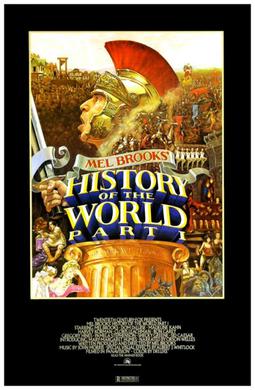
The History of the World, Part I (1981, directed by Mel Brooks)


Overlong, wildly uneven, gimmicky too a fault, and often laugh out loud funny with a mix of jokes that range from the crude to the sublimely clever to the surprisingly sentimental, The History of the World, Part I is the ultimate Mel Brooks films.

Narrated by Orson Welles and featuring five historical stories and a collection of coming attractions, The History of the World Part I follows man from his caveman origins to the French Revolution and the thread that ties it all together is that humanity always screws up but still finds a way to survive.  Moses (Mel Brooks) might drop and break one of the three tablets listing the 15 Commandments but he’s still able to present the other ten.  Stand-up philosopher Comicus (Mel Brooks) might make the mistake of poking fun at the weight of Emperor Nero (Dom DeLuise) but he still makes his escape with Josephus (Gregory Hines), Swiftus (Ron Carey), and Miriam the Vestal Virgin (Mary-Margaret Humes) and ends up serving as the waiter at the Last Supper.  (“Jesus!”)  The Spanish Inquisition may have been a catastrophe but it also gave Torquemada (Mel Brooks) a chance to show off his performance skills.  The French Revolution may have been a bloodbath but the future still held promise.  Ask for a miracle and he’ll show up as a white horse named Miracle, no matter what era of history you’re living in.

The humor is very Mel Brooks.  During the Roman Empire sequence, Madeline Kahn plays Empress Nympho.  Jackie Mason, Harvey Korman, Cloris Leachman, Spike Milligan, Jan Murray, Sammy Shores, Shecky Greene, Sid Caesar, Henny Youngman, and Hugh Hefner all make cameo appearances.  Carl Reiner is the voice of God.  John Hurt plays Jesus.  The film ends with the promise of a sequel that will feature “Jews in Space.”  Not every joke lands.  The entire caveman sequence feels forced.  But when the film works — like during The Inquisition production number — it’s hard not get caught up in its anything-goes style.  The entire Roman Empire sequence is probably more historically accurate than the typical Hollywood Roman epic.  That’s especially true of Dom DeLuise’s naughty performance as Emperor Nero.

Mel Brooks is 99 years old today and he says that he has at least one more film to give us, a sequel to Spaceballs.  I’m looking forward to it!  I’m also looking forward to rewatching and enjoying all of the films that he’s already given us.  The History of the World, Part I may not have initially enjoyed the critical acclaim of his earlier films but, in all of its anarchistic glory, it’s still pure Mel Brooks.

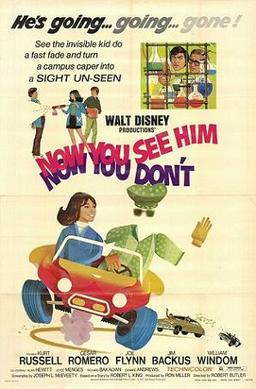
I Watched Now You See Him, Now You Don’t (1972, Dir. by Robert Butler)


Dexter Riley (Kurt Russell) is back and just in time because Medfield College is on the verge of getting closed down again.

In The Computer Wore Tennis Shoes, buying a computer was supposed to be the solution to all of Medfield’s financial problems.  I guess it didn’t work because Medfield is broke again and corrupt businessman A.J. Arnoe (Cesar Romero) is planning on canceling the school’s mortgage so that he can turn it into a casino.

There is some hope.  Dexter has accidentally created an invisibility spray.  Not only does it tun anything that it touches invisible but it also washes away with water so there’s no risk of disappearing forever.  Dexter and his friend Schuyler (Michael McGreevey) know that they can win the science fair with their invention but the science fair doesn’t want to allow small schools like Medfield to compete unless they really have something big to offer.  Dexter tells the Dean (Joe Flynn) that he has a sure winner but Dexter also refuses to reveal what it is because he doesn’t want word to leak before for the science fair.  The Dean decides to raise the money to pay off the mortgage by becoming a golfer, as one does.  Schulyer works as the Dean’s caddy while Dexter uses the invisibility spray to help the Dean cheat.  That’s a good message for a young audience, Disney!  But when Arno finds out about the spray, he wants to steal it so he can rob a bank.

This was even dumber than The Computer Wore Tennis Shoes but it was also hard to dislike it.  The comedy was too gentle, Kurt Russell and the rest of the cast were too likable, and the special effects were too amusingly cheap in that retro Disney way for it to matter that the movie didn’t make any sense.  When a bunch of college kids learn the secret of invisibility and use it to cheat at golf, you know you’re watching a Disney film.

Retro Television Review: Fantasy Island 5.22 “The Ghost’s Story/The Spoilers”


Welcome to Retro Television Reviews, a feature where we review some of our favorite and least favorite shows of the past!  On Tuesdays, I will be reviewing the original Fantasy Island, which ran on ABC from 1977 to 1984.  Unfortunately, the show has been removed from most streaming sites.  Fortunately, I’ve got nearly every episode on my DVR.

This week, season 5 comes to an end.

Episode 5.22 “The Ghost’s Story/The Spoilers”

(Dir by Don Chaffey, originally aired on May 8th, 1982)

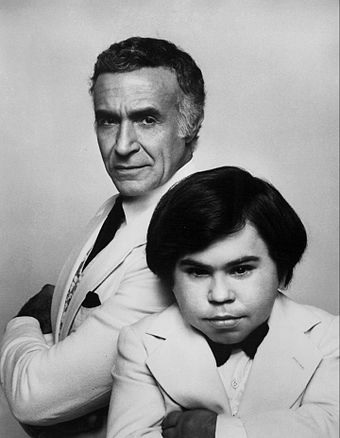
The latest batch of guests are arriving and Julie is nowhere to be seen!  Perhaps that’s because, as Mr. Roarke explains to Tattoo, Julie is helping out a guest who has an invisibility fantasy.  Tattoo and Roarke watch as the guest walks by.  His body may be invisible but his pants are not.

This is the final episode of the fifth season and it’s also the final episode in which Wendy Schaal will be credited as a part of the cast.  I wasn’t a huge fan of the Julie character but it still seems like a bit of a shame that she didn’t get to do anything in the finale.  Then again, this episode doesn’t really feel like a finale.  I don’t know what was going on behind the scenes during the fifth season but it’s hard not to feel, with the way that Julie and Tattoo have randomly shown up in different stories, that the season’s episodes were not shown in the order in which they were filmed.  Maybe all the Julie episodes were filmed at one time, while Herve Villechazie was off doing something else.  Who knows?  It’s just been a strange season.

That’s all wonderful and interesting, Lisa …. But what about this week’s fantasies!? you may be asking.

They both feel a bit familiar.  That’s not always a bad thing, of course.  Fantasy Island is a comfort show and a part of the comfort is knowing that things are always going to play out in a certain way.  But, with this episode, both fantasies felt as if they had been done better in the past.

Harry (Bo Hopkins) is a bounty hunter who comes to the Island to track down fugitive Nick Tanner (Robert Fuller).  Nick has been accused of robbing a bank and is hiding out on a nearby island.  Harry goes to the island but he soon discovers that Nick is innocent and that the real bank robbers have also come to the island in search of Nick.  Luckily, there’s a widow named Juliet (Jo Ann Pflug) who is also living on the island.  Harry and Nick hide out at her place before they all team up to defeat the real bank robbers.  Nick and Juliet fall in love and Mr. Roarke performs one of his trademark wedding ceremonies.  Nick and Juliet then board the plane back to America and …. wait a minute, what about Harry?  It was his fantasy!  We don’t ever see Harry leave Fantasy Island.  Maybe he’s still living there.

(Personally, I think he married Julie and that’s why she was no longer working there once season six began.  I like that.  Consider it to be canon.)

The other fantasy is a haunted house story.  Amanda Parsons (Tanya Roberts) comes all the way from Baltimore to spend 24 hours in one of Fantasy Island’s many haunted houses.  Two other paranormal investigators attempt to do it before Amanda but they end up fleeing after two minutes.  I’m not sure why.  The manor looks creepy but it turns out that the ghost is a rather wimpy and not at all frightening guy named Timothy Black (Dack Rambo).  Cursed by his own father after Timothy refused to fight a duel with Captain Fitzhugh Ross (John McCook), Timothy has spent two hundred years haunting the old manor.  Amanda takes sympathy on him.  It turns out that Ross’s descendant is also on the Island.  Timothy challenges him to a duel, causing the latest Ross to run in fear.  Timothy and his ghost dad (John Myhers) realize it’s okay to be scared of getting shot.  Ghost Dad asks Roarke to bring Timothy back to life so that he can pursue his romance with Amanda.  Roarke does just that, despite the fact that, in many previous episodes, Roarke has specifically said that he cannot bring the dead back to life.

Usually, I enjoy Fantasy Island‘s haunted house fantasies but this one didn’t do much for me.  I think it’s because the ghost was just too wimpy.  There’s nothing more annoying than a whiny a dead guy,

And so ends this very odd season.  Next week, we being season 6!

Retro Television Review: Fantasy Island 5.12 “The Magic Camera/Mata Hari/Valerie”


Welcome to Retro Television Reviews, a feature where we review some of our favorite and least favorite shows of the past!  On Tuesdays, I will be reviewing the original Fantasy Island, which ran on ABC from 1977 to 1984.  Unfortunately, the show has been removed from most streaming sites.  Fortunately, I’ve got nearly every episode on my DVR.

This week’s episode presents your erstwhile reviewer with a bit of an ethical quandary.

Episode 5.12 “The Magic Camera/Mata Hari/Valerie”

(Dir by Don Chaffey and Don Weis, originally aired on January 16th, 1982)

I don’t feel completely comfortable about reviewing this episode of Fantasy Island and I’ll tell you why.

Occasionally, Fantasy Island would broadcast an extra-long episode.  These episodes would typically feature three fantasies as opposed to the usual two.  Unfortunately, when these long episodes were syndicated, one of the fantasies would be edited out so the episode would fit into an hour-long slot.  Usually, the editing was not particularly smooth, either.  The end result would usually be an episode that seemed oddly paced and the performances of Ricardo Montalban and Herve Villechaize would often seem uneven as well.  As such, it’s neither easy nor particularly fair to review those edited episodes.  When it comes to reviewing, I always want to see the complete episode.

And yet, now that the original Fantasy Island is no longer streaming anywhere (seriously, what the Hell, Tubi?), I’m stuck using the episodes that I have on my DVR.  And that means reviewing the edited, syndicated versions of these episodes.

As you can probably guess, this is one of those edited episodes.  The Valerie fantasy was removed for syndication.  That’s a shame because Valerie featured the final televised performance of actor Christopher George, a charismatic B-movie veteran who is pretty popular around the Shattered Lens offices.  It also featured Michelle Phillips, though apparently she did not return as the mermaid who she played earlier on the show.  I’d love to review Valerie but I can’t.  And that sucks,

As for the other two fantasies, one is basically a remake of the Lillian Russell fantasy, except this time Martha Harris (Phyllis Davis) goes into the past and finds herself transformed into her great-grandmother, Mata Hari.  She gets to dance.  She gets to spy.  She gets thrown in prison and sentenced to death but, fortunately, her life is spared when the firing squad’s rifles are filled with blanks and she’s given a drug by one of the men who is in love with that makes her appear to be dead.  This was a enjoyable fantasy, mostly because of the costumes and the melodrama.

The other fantasy features Bob Denver, coming to the Island for the second week in a row.  This time, he’s a photographer who wants to take the type of pictures that the world’s greatest photographers couldn’t.  Because of the awkward way the fantasy was stated, the photographer ends up with a camera that takes pictures of the future.  At first, the photographer is really happy and uses his camera to commit a little insider trading.  But then he takes a picture of a newspaper and sees a headline announcing his death in a fiery auto accident.  Uh-oh!

Again, neither of the two fantasies is bad (though the second one does require a certain tolerance for Bob Denver that some people may not have) but it was hard for me to enjoy them knowing that I was missing out on a third fantasy.  For that reason, I assigning this episode a grade of incomplete.  If I ever get a chance to watch the complete episode, uncut, I’ll revisit this review but until then, I really can’t give an overall grade to this episode.

Finally, for those keeping track, both Julie and Tattoo join Roarke when it’s time to greet the guests.  That’s only second time that’s happened this season.

Retro Television Reviews: Fantasy Island 4.11 “The Artist and the Lady/Elizabeth’s Baby”


Welcome to Retro Television Reviews, a feature where we review some of our favorite and least favorite shows of the past!  On Tuesdays, I will be reviewing the original Fantasy Island, which ran on ABC from 1977 to 1986.  Almost the entire show is currently streaming is on Youtube, Daily Motion, and a few other sites.

Sorry for the late review!  I’m currently on Vicodin (nothing to worry about) and it set me far behind today.

Episode 4.11 “The Artist And The Lady/Elizabeth’s Baby”

(Dir by Michael Vejar, originally aired on January 17th, 1981)

This week, we have two new fantasies.  One is surprisingly sweet.  The other is about as dumb as can be.

Poor Tattoo!  Because Mr. Roarke is busy with the good fantasy this week, it largely falls on Tattoo to play host for the bad fantasy.  Kermit Dobbs (Don Most) is a nerdy art teacher who wants to be a real artist.  Before leaving to oversee the good fantasy, Roarke gives Dobbs a potion that, when Dobbs drinks it, gives him the talent of Patrick O’Herlihy (Peter Brown), a mad Irish artist who, for some reason, lives in the wilds of Fantasy Island.  What Dobbs doesn’t know that is that the potion not only gives him Patrick’s talent but it also apparently gives him the knowledge of every woman that Patrick has slept with on the island.  When Kermit paints a picture of a Deborah Dare (Michelle Pfeiffer — wait, what!?) and knows just where to place her birthmark, it leads to the men on the Island chasing Kermit into the wilderness.

It’s in the wilds that Kermit meets Patrick and they spend some time drinking and talking about art.  Eventually, Kermit gives up his claim to Patrick’s talent and he leaves the island with Deborah.  Meanwhile, all the men on the Island now want to kill Patrick so I’m not really sure that this qualifies as a good ending.

That was all really stupid, with every actor in the fantasy going overboard with their characters.  Don Most apparently went a week without shaving before appearing on this episode, in an attempt to come across as someone with an artistic soul.  It didn’t work.

The far better fantasy featured Eve Plumb as Elizabeth Blake, a woman who is pregnant and who know that she will probably die in childbirth.  Her fantasy is to have a chance to see what her daughter’s future life will be like.  Though reluctant, Mr. Roarke travels with her to three separate years in the future.  (Interestingly enough, even though they eventually end up traveling 20 years into the future, the world still looks like the 70s.)  At first, Elizabeth is happy to see that her daughter will have an apparently happy childhood but things get progressively darker until finally, Lisa Blake (Alison Arngrim) has run away from home and is working as a prostitute.  Mr. Roarke allows Elizabeth to talk to Lisa (hey!) on the condition that Elizabeth not reveal her identity.  Elizabeth is able to convince Lisa to go back home.

It’s a sweet but rather sad story.  Even as Elizabeth leaves Fantasy Island with the knowledge that she was able to help her daughter, she still leaves with the knowledge that she’s going to die in childbirth.  In the lead role, Eve Plumb is as good as Don Most was bad.

That one good fantasy is so good that it saves the episode.  That bad fantasy is so bad that it keeps this episode from being the classic that it should have been.  Such is life on Fantasy Island.


Retro Television Reviews: Fantasy Island 3.5 “The Chain Gang/The Boss”


Welcome to Retro Television Reviews, a feature where we review some of our favorite and least favorite shows of the past!  On Tuesdays, I will be reviewing the original Fantasy Island, which ran on ABC from 1977 to 1986.  Almost entire show is currently streaming is on Youtube!

What I’ve long-feared has happened.

Tubi has removed the original Fantasy Island from its site.  The recently-canceled Fox version can be viewed but not the original.  Don’t get me wrong.  I liked the new Fox version.  But these are Retro Television Reviews and a show that premiered in 2021 is not yet retro.

Fortunately, quite a few episodes are on YouTube and it’s probable that the original complete series will again end up streaming somewhere.  So, I’m going to try to continue to review this show.  I can’t guarantee that I won’t run out of episodes at some point.  For instance, it doesn’t appear that much of seasons 6 or 7 can be found, even on YouTube.  (Unfortunately, it appears that only the first three seasons of Fantasy Island have been released on DVD.)  But I’m going to do my best!

Episode 3.5 “The Chain Gang/The Boss”

(Dir by Michael Vejar, originally aired on October 19th, 1979)

Tattoo has decided that he wants to be an artist!  Mr. Roarke demands to know why because God forbid Tattoo have a life outside of spotting the plane.  Tattoo admits that he wants to get the island women to pose for him.  Mr. Roarke orders Tattoo to abandon his art career and head down to the docks to meet the plane.

The plane is carrying two guests who hope, much like Tattoo, to change their lives.

Cindy Carter (Donna Mills) is a switchboard operator who has a crush on her boss, Brent Bailey (Brett Halsey).  Her fantasy is to be the boss of her own company.  Mr. Roarke grants her wish and soon, Cindy is in charge of her own multi-national corporation.  In fact, her corporation owns Brent Bailey’s business!  Cindy also gets a executive assistant named Gary Pointer (Roddy McDowall).  Unfortunately, it turns out that Brent isn’t a very nice person and he’s been siphoning money out of the pension fund.  He threatens to frame Cindy to keep her from approving an audit of the fund.  However, with Gary’s support and eventual love, Cindy stands up to Brent and reveals his wrong-doing.  Mr. Atwell (Stacy Keach, Sr.), the presumed-dead head of the company, suddenly shows up at the stockholder’s meeting and announces that he faked his own death to discover who was embezzling from the pension fund.  The stockholders applaud as Brent Bailey is taken away from the police.  It’s all rather silly and melodramatic but the likable presence of Roddy McDowall kept the story entertaining.

Meanwhile, Mike Jenner (Dennis Cole) came to the Island to confront Eddie Collins (Cameron Mitchell), the criminal that Mike believes murdered his father and framed him for a theft.  (There’s a lot of theft in this episode.)  Mr. Roarke reveals that Eddie lives in a nearby fishing village.  Mike goes to the village, spots Eddie, and punches him.  Eddie hits back….

….and both of them are sentenced to spend a year on a chain gang!

Fantasy Island has a chain gang!?  And the chain gang is overseen by a redneck named Captain Hawks (R.G. Armstong)!?  Why has this never been mentioned before?  I mean, is it normal to sentence paying guests to spend a year on the chain gang?

Anyway, Eddie and Mike set aside their difference and break out out the prison camp.  (Fantasy Island has prison camps!?)  During their escape, Eddie gets trapped in quicksand.  Mike does eventually rescue him but only after Eddie confesses to having framed Mike’s father.  As soon as Eddie confesses, Mr. Roarke shows up in his jeep.  Apparently, Mike is now free to leave the Island with his fiancee (Pat Klous) while Eddie is sent to the Fantasy Island prison for the rest of his life.  Much as the other fantasy was saved by the reliable likability of Roddy McDowall, this episode was saved by Cameron Mitchell’s grouchy presence.  One could always trust Mitchell to give it his all while playing a bad guy.

With the fantasies taken care of, Tattoo returns to his art.  When he asks his model to pose naked, she destroys all of his paintings while Mr. Roarke laughs and laughs.  Mr. Roarke really does hate his assistant.

Horror on TV: Kolchak: The Night Stalker 1.7 “The Devil’s Platform” (dir by Alan Baron)


Tonight’s episode of Kolchak: The Night Stalker is a fun one!

In this episode, Kolchak investigates a series of mysterious deaths that seem to involve one very ambitious politician (played by Tom Skerritt).  Kolchak’s investigation leads him to believe that not only has the politician made a deal with the devil but that the politician also has the ability to transform himself into a killer dog!

Agck!

That’s Chicago-style politics for you,  I guess.

This episode originally aired on November 15th, 1974.

Enjoy!