I decided that, in 2017, I would review a movie a day and I nearly succeeded. I didn’t review a movie on the day Chris Cornell died. I missed a few days in March due to a sinus infection. Including the review that I’m posting below, I reviewed 356 movies in 2017. According to the year-end stats, my most popular reviews were for Heavy Metal Parking Lot, Slaughter, Body Chemistry 3, Body Chemistry 4, and Beatlemania.
Since tomorrow will be the start of a new year, this is going to be the end of my A Movie A Day experiment. In 2018, I’ll still be watching movies and posting reviews on this site but this is my final daily review. For my final Movie A Day, I picked the greatest movie of all time, The Delta Force!
Produced by Cannon Films, The Delta Force starts in 1980, with a helicopter exploding in the desert. America’s elite special missions force has been sent to Iran to rescue the men and women being held hostage in the embassy. The mission is a disaster with the members of Delta Force barely escaping with their lives. Captain Chuck Norris tells his commanding officer, Col. Lee Marvin, that he’s finished with letting cowardly politicians control their missions. Chuck heads to Montana while Lee spends the next few years hitting on the bartender at his local watering hole.
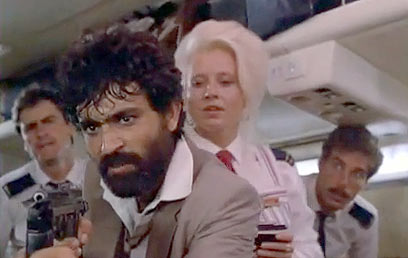
In 1985, terrorists led by Robert Forster hijack an airplane and divert it to Beirut. Among those being held hostage: Martin Balsam, Shelley Winters, Lainie Kazan, Susan Strasberg, Kim Delaney, and Bo Svenson. The great George Kennedy plays a priest named O’Malley who, when the Jewish passengers are moved to a separate location, declares himself to be Jewish and demands to be taken too. Jerry Lazarus is a hostage who spends the movie holding a Cabbage Patch doll that his daughter gave him for luck. Former rat packer Joey Bishop plays a passenger who says, “Beirut was beautiful then. Beautiful.” Fassbinder favorite Hanna Schygulla is the stewardess who refuses to help the terrorists because, “I am German!”
In America, General Robert Vaughn activates The Delta Force to rescue the hostages and take out the terrorists. As Lee Marvin prepares everyone (including Cannon favorite, Steve James and, in a nonspeaking role, Liam Neeson) to leave, the big question is whether Chuck Norris will come out of retirement for the mission. Of course, he does. Even better, he brings his motorcycle with him.
Anyone who has ever seen The Delta Force remembers Chuck’s motorcycle. Not only did it look incredibly cool but it was also mounted with machine guns and it could fire missiles at cowardly terrorists. It didn’t matter whether you agreed with the film’s politics were or whether you even liked the movie, everyone who watched The Delta Force wanted Chuck’s motorcycle. As the old saying goes, “You may be cool but you’ll never be Chuck Norris firing a missile from a motorcycle cool.”
The Delta Force is really three different films. One film, shot in the style of a disaster film, is about the hostages on the plane and their evil captors. The second film is Lee Marvin (in his final movie role) preparing his men to storm the airplane. The third movie is Chuck Norris chasing Robert Forster on his motorcycle. Put those three movies together and you have the ultimate Cannon movie. The Delta Force was even directed by Cannon’s head honcho, Menahem Golan. (Years earlier, Golan also directed Operation Thunderbolt, an Israeli film about the raid on Entebbe, which features more than a few similarities to The Delta Force. Golan received his first and only Oscar nomination when Operation Thunderbolt was nominated for Best Foreign Language Film.)
The Delta Force is also the ultimate 80s movie. It opens with the Carter administration fucking everything up and it ends with the Reagan administration giving Lee Marvin and Chuck Norris the greenlight to blow up some terrorists. There is not much nuance to be found in The Delta Force but it still feels good to watch Chuck beat the bad guys. Top that off with a shameless score from Alan Silvestri and you have one of the greatest action movies of all time.
At the end of The Delta Force, as cans of Budweiser are being passed out to rescued hostages, an extra is clearly heard to shout, “Beer! America!” Then everyone sings America The Beautiful.
It’s time once again to revisit Joan Crawford’s later-day career as a horror star, and this one’s a pretty good shocker. STRAIT-JACKET! was Joan’s follow-up to WHATEVER HAPPENED TO BABY JANE, the first in the “Older Women Do Horror” genre (better known by the detestable moniker “Psycho-Biddy Movies”). Here she teams for the first time with veteran producer/director William Castle , starring as an axe murderess released after twenty years in an insane asylum, becoming the prime suspect when people begin to get hacked to bits again.
The film itself begins with a 1940’s prolog depicting the gruesome events that occurred when Lucy Harbin (Joan) catches her husband (Lee Majors in his uncredited film debut) in bed with another woman. Joan, all dolled up to resemble her MILDRED PIERCE-era self, grabs the nearest axe and CHOP! CHOP! CHOP! goes hubby and his squeeze into itsy-bitsy pieces. The act is witnessed…
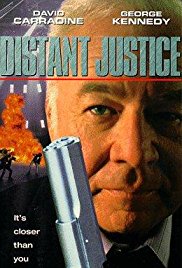
Inspector Rio (Bunta Sugawara) is visiting Boston for the first time. When his wife accidentally photographs a drug deal in process, his family his attacked. Rio’s wife is killed. His daughter is kidnapped. When Rio goes to the local police, he gets no help. It does not matter that Chief Bradfield (George Kenendy!) is an old friend of his. Bradfield is on the verge of retirement and he knows that almost every cop in his precinct is corrupt. The drug syndicate is so powerful that even the local politicians (represented by David Carradine in the role of Joe Foley) are in their back pocket. Rio is told to go back to Japan but instead, Rio wages war on the Boston syndicate himself. With the help of one of Boston’s only honest cops (Eric Lutes) and Bradfield, Rio sets out to rescue his daughter and get justice! Distant justice!
Distant Justice is a typical low-budget 90s action film. Bystanders get shot, bad guys get blown up, and there’s a shot of someone screaming as he plunges to his death. The problem with Distant Justice is that it totally wastes David Carradine in a nothing role as a crooked politician. If Carradine is in a movie about a cop seeking vengeance on a drug lord, Carradine either has to play the cop or he has to be play the drug lord. If he is cast in any role other than that, the movie has to be considered a failure. George Kennedy is his usual likable self (Kennedy built one of the longest careers in the movie on pure likability) but even that cannot make up for not taking advantage of having David Carradine as a member of the cast. Distant Justice is a missed opportunity.
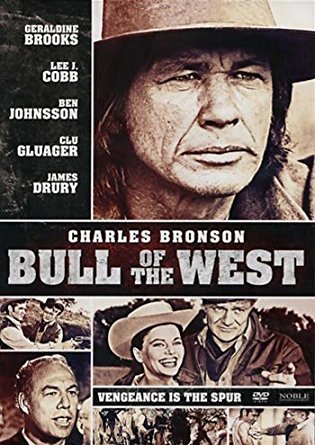
Welcome to the American frontier. The time is the 1880s and men and women everywhere are heading out west in search of their fortune. While stowing away on a train, veteran cowboy Johnny Wade (Brian Keith) meets the naive Steve Hill (Gary Clarke) and becomes a mentor to the younger man. Johnny teaches Steve how to shoot a gun and, when they get off the train at Medicine Bow, Wyoming, they get jobs working on the ranch of Georgia Price (Geraldine Brooks). When Georgia and Johnny plot to overgraze the land, Steve must decide whether he’s with them or with a rival rancher, Judge Garth (Lee J. Cobb).
At the same time, Ben Justin (Charles Bronson) has arrived in town with his son, Will (Robert Random), and his new wife (Lois Nettleton). Ben is determined to start his own ranch but, because of his taciturn and stubborn personality, he alienates the Cattleman’s Association, which led by Judge Garth and Bear Suchette (George Kennedy). Will wants to help his father but Ben keeps pushing him away. It’s up to Judge Garth’s foreman, the Virginian (James Drury), to bring the family together.
Just like The Meanest Men In The West,The Bull of the West was created by editing together footage from two unrelated episodes of The Virginian. It works better for the Bull of the West because the two episodes had similar themes and the footage mixes together less awkwardly than it did in The Meanest Men In The West. But Bull of the West is still just a TV show edited into a movie. The main reason to see it is because of all the familiar western faces in the cast. Along with Bronson, Keith, Cobb, and Kennedy, keep an eye out for Ben Johnson, DeForest Kelley, and Clu Gulager.
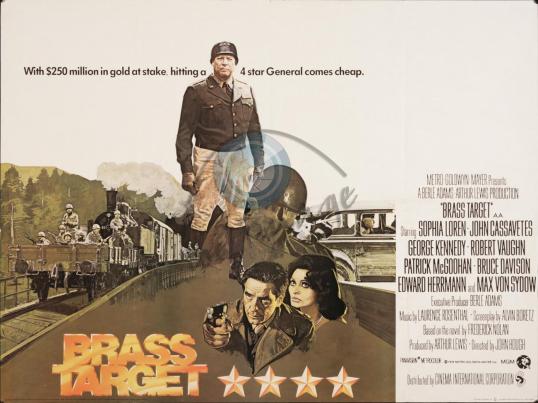
At least, that is the claim made by Brass Target, a twisty and unnecessarily complicated thriller that argues that General George S. Patton (played here by George Kennedy, who is even more blustery than usual in the role) did not, as widely believed, die as the result of a car accident but was actually killed by an assassin using rubber bullets. Why was Patton targeted for assassination? Was he targeted by Nazis angered by Germany’s defeat or maybe Russians who knew that Patton had argued in favor of invading the Soviet Union towards the end of the war? Would you believe it was all because Patton was investigating the theft of Nazi gold and his subordinates, the flamboyantly gay Colonel Donald Rogers (Robert Vaughn) and Rogers’s always worried lover, Colonel Walter Gilchrist (Edward Herrmann), were fearful that he was getting too close to discovering the truth?
John Cassevetes, who hopefully used part of his paycheck to fund either The Killing of a Chinese Bookie, Opening Night, or Gloria, plays Joe De Lucca, the burned out OSS colonel who is assigned to track down the Nazi gold but who really just wants to go back home to New York. Patrick McGoohan, sporting an accent that is supposed to be American, plays De Lucca’s former friend and colleague, Colonel Mike McCauley, who now lives in a German castle. Max von Sydow is the assassin, who also has a day job as the chairman of a refugee relocation committee. Sophia Loren plays Mara, a Polish war refugee who, by pure coincidence, has slept with not just De Lucca but almost everyone involved with the conspiracy. Bruce Davison is the young colonel who acts as Du Lucca’s supervisor. Even Charles “Lucky” Luciano (played by the very British Lee Montague) is featured as a minor part of the conspiracy.
That is an impressive cast for a less than impressive movie. Brass Target never provides a convincing reason as to why the conspirators would decide that killing Patton was their only option and, once the conspiracy gets underway and the movie starts to follow around Von Sydow for some Day of the Jackal/Black Sunday-style preparation scenes, the search for the Nazi gold is forgotten. For some reason, though, I have a soft spot for this frequently ridiculous movie. There are enough weird moments and details, like Vaughn’s twitchy performance, McGoohan’s accent, the way Kennedy blusters about the Russians being rude to him, and glamorous Sophia Loren’s miscasting, that Brass Target is always watchable even if it is never exactly good.
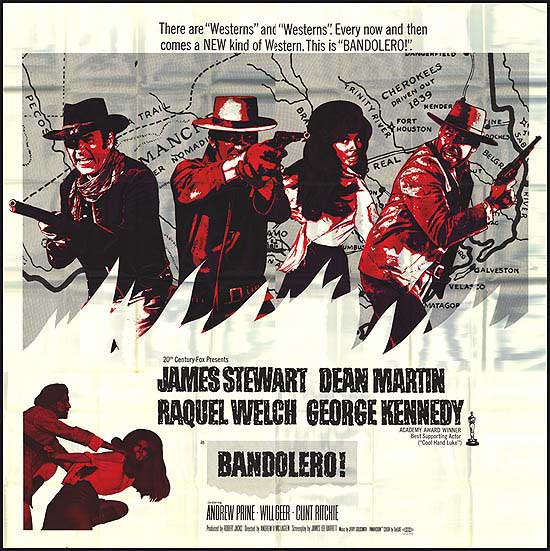
BANDOLERO! was made at an interesting time in the history of Western movies. Sergio Leone’s “Man With No Name” trilogy had begun to exert their influence on American filmmakers (HANG EM HIGH, SHALAKO). Traditional Hollywood Westerns were still being produced (FIRECREEK, 5 CARD STUD), but in a year’s time, Sam Peckinpah’s THE WILD BUNCH would change the Western landscape forever. Andrew V. McLaglen’s BANDOLERO! is more on the traditional side of the fence, though it does exhibit a dash of Spaghetti flavor in its storytelling.
Outlaw Dee Bishop and his gang attempt to rob a bank in Valverde, Texas. The heist is going well until rich Nathan Stone walks in with his beautiful Mexican wife, Maria. Stone tries to break it up, and gets shot for his troubles, thus alerting the attention of Sheriff July Johnson and his deputy, Roscoe. The lawmen successfully catch the gang as they’re leaving the bank. Stone dies, and Dee and…
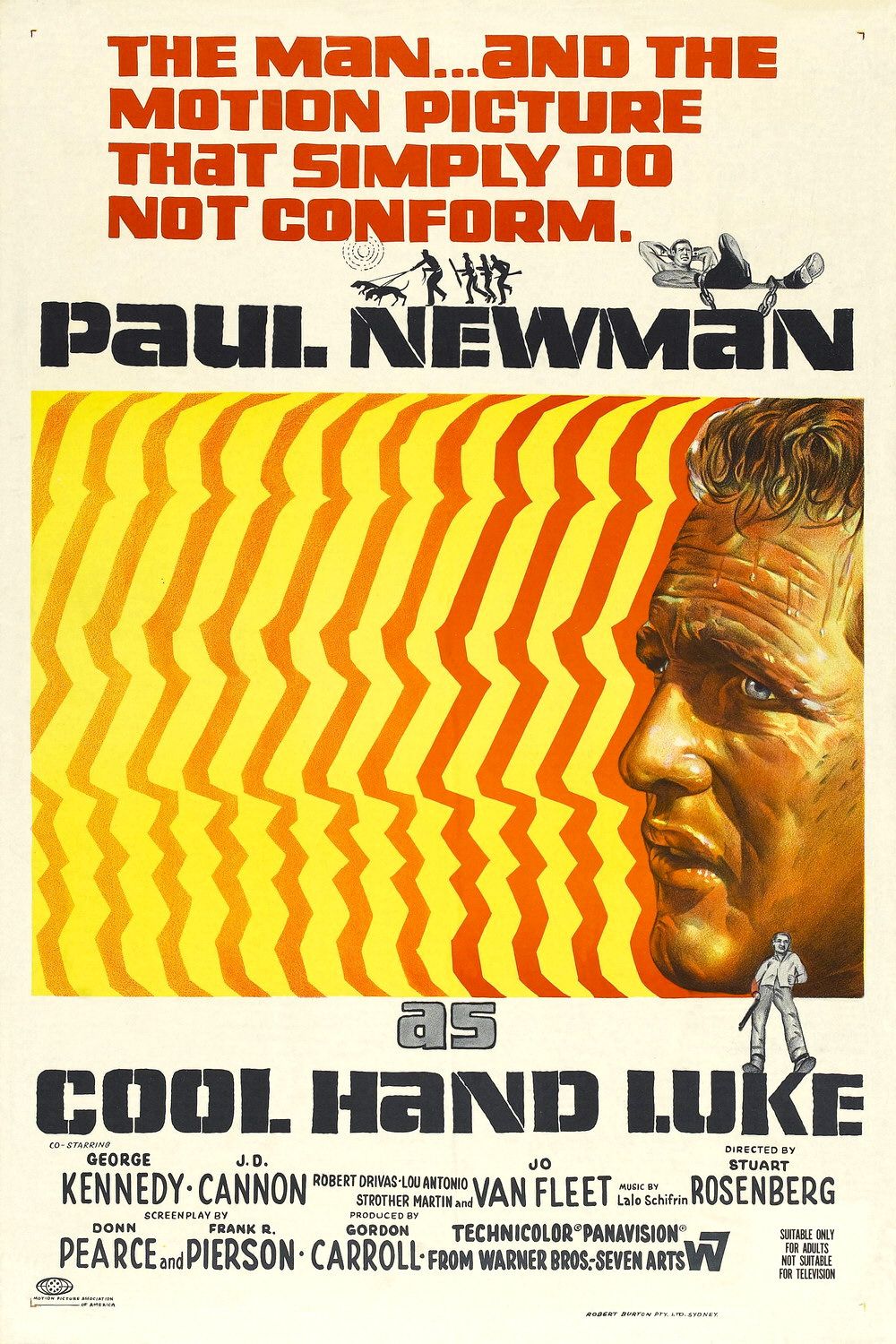
The Sixties was the decade of the rebellious anti-hero. The times they were a-changin’ and movies reflected the anti-establishment mood with BONNIE & CLYDE, EASY RIDER, and COOL HAND LUKE. Paul Newman starred as white-trash outsider Luke Jackson, but it was his co-star George Kennedy who took home the Oscar for his role as Dragline, the king of the cons who first despises then idolizes Luke.
War vet Luke gets busted for “malicious destruction of municipal property while drunk”, and sent to a prison farm in Florida. The non-conformist Luke butts heads with both the “bosses” (prison guards aka authority) and Dragline, a near illiterate convict who runs the yard. Dragline and Luke decide to settle their differences in a Saturday boxing match. The hulking Dragline beats the shit out of Luke, but the smaller man keeps getting up for more. Dragline finally walks away, and Luke earns both his and…
Today’s Horror on the Lens comes to use from 1980. In Death Ship, a cruise ship collides with a mysterious black freighter. When the survivors board the freighter, they discover that it appears to be deserted. But is it really? As the survivors explore, they start to suspect that they might not be alone. Even worse, the already unstable captain (George Kennedy) starts to hear a mysterious German voice, encouraging him to kill everyone else and stay on the freighter forever.
It’s kinda like The Shining, except it takes place on a boat and it’s not as good.
But then again, very few horror films are as good as The Shining! Death Ship is an enjoyably pulpy exercise in ghostly horror and it can actually be quite scary, especially if you have an obsessive fear of drowning, like I do!
Plus, George Kennedy really puts his heart and soul into being possessed.
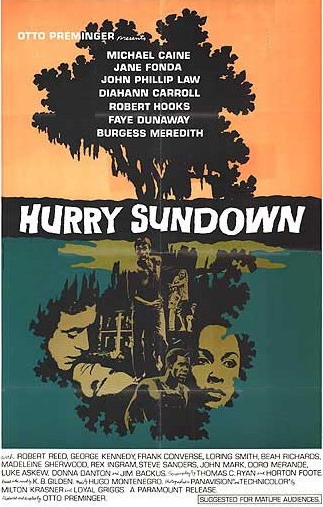
It seems like whenever film bloggers and reviewers are making out a list of the worst films of all time, somebody always mentions Hurry Sundown.
Now, don’t get me wrong. It doesn’t get mentioned as often as Battlefield Earth or Adam Sandler’s latest comedy. And, when it does get mentioned, it’s done with little of the warmth that’s given to Troll 2, The Room, or Birdemic. Instead, one gets the impression that Hurry Sundown is a film so bad that even those of us who appreciate bad films would find little to love about it.
But y’all know me. I’m the type that prefers to judge for herself and I’m also someone who rather enjoys being a contrarian. There’s a reason why one of my most read posts on this site is entitled 10 Reasons Why I Hated Avatar. Add to that, Hurry Sundown was directed by Otto Preminger who also directed one of my favorite films of all time, Anatomy of a Murder. How, I asked myself, could the man who made Anatomy of a Murder possibly also direct one of the worst films of all time? As a result, every time that I saw someone claiming that Hurry Sundown was one of the worst films of all time, I grew more and more determined to someday see the film and judge for myself.
Well, I finally got my chance this weekend. Hurry Sundown was on one of my newest favorite channels, The MOVIES! TV Network. And I proceeded to watch it. I sat through all four hours of this film (that’s including commercials and, oh my God, was I thankful for the distraction that those commercials provided). I watched Hurry Sundown and …. wow. Was it ever bad.
Released in 1967, Hurry Sundown was Otto Preminger’s attempt to take a look at race relations in the deep south. It’s a film full of good, liberal intentions and an apparent lack of knowledge about — well, about everything. As I watched this slow, almost formless blob of a film, I found myself wondering how the director who gave us Laura and Anatomy of a Murder could have possibly directed a film with a gigantic cast but absolutely no interesting characters. I wondered how the director who had been willing to challenge the racist assumptions of 1950s Hollywood by directing Carmen Jones could have been responsible for the corny and subtly condescending look at race relations that was Hurry Sundown.
Hurry Sundown takes place in 1946 and is set in rural Georgia. The war is over, the soldiers are coming home, and nobody in the film can maintain a convincing Southern accent for more than a line or two. (Seriously — I’ve heard a lot of really bad Southern accents in a lot of really bad films but none of those accents were as bad as what I heard in Hurry Sundown.) It’s a brand new world but the South is clinging to the old ways of racism and classism.
Preminger slowly (and clumsily) introduces us to the huge cast of characters who populate the slice of Hollywood Georgia.
There’s the sheriff (George Kennedy) who is so stupid that he can be distracted by an offer of fried chicken. Kennedy actually gives a good comedic performance but his character seems like he belongs in another movie and you have to wonder how civil rights activists in 1967 — many of whom had undoubtedly been arrested and harassed by Southern sheriffs much like this one — reacted to Kenendy’s character being presented as harmless comic relief.
There’s the racist judge (Burgess Meredith) who, much like the sheriff, is presented as being a comedic buffoon as opposed to an actual threat. The judge uses the n-word in every other sentence, which should be shocking and infuriating but, as a result of Meredith’s over-the-top delivery, instead simply comes across as being gratuitous and tasteless.
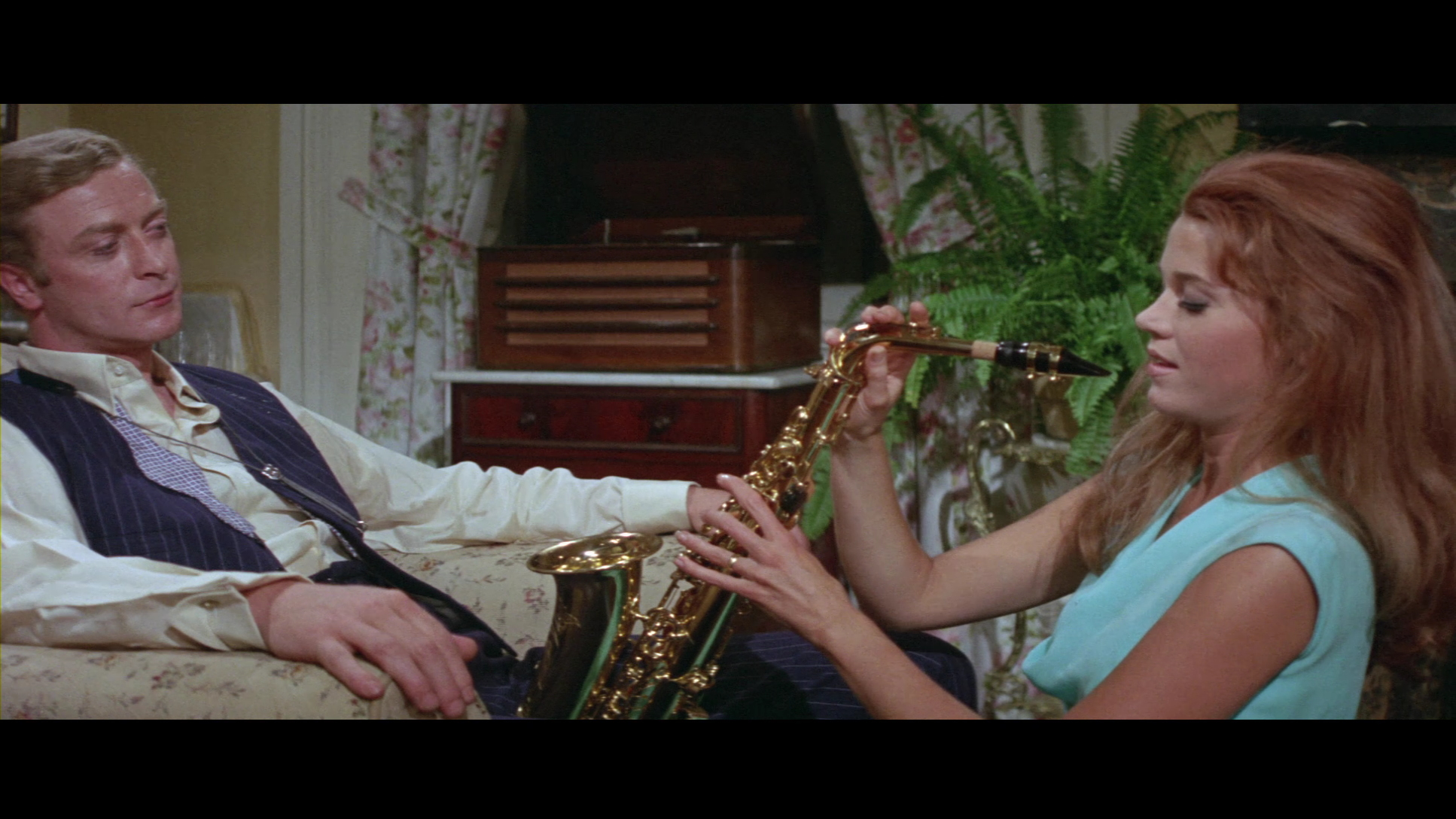
Then there’s Henry. Henry is a businessman who dodged the draft, cheats on his wife, and who has a son who literally spends the entire movie screaming at the top of his lungs. (Whenever that kid was on-screen, I imagined Preminger standing behind the camera and going, “More! More! Scream more!”) Henry is also a racist, though for some reason he loves jazz and often plays the saxophone. I kept waiting for someone in the movie to point out to him that jazz was created by black musicians but nobody did. (If Henry had appeared in Anatomy of a Murder, someone would have.)
Did I mention that Henry is played by Michael Caine? And did I also mention that Caine is the most cockney-sounding Southerner that I’ve ever heard? Because he totally is.
Henry’s wife is named Julie and is played by Jane Fonda. At one point, she suggestively blows on Henry’s saxophone. One can only imagine how audiences in the 60s reacted to that. (Actually, they probably didn’t. They probably just said, “Good thing she’s pretty because she ain’t no musician…”)
Anyway, Harry wants to buy up some farmland but half of that land is owned by Henry’s poor cousin Rad (John Phillip Law) and Rad doesn’t want to move. Rad has just returned from fighting in the war and he views Harry as being a cowardly draft dodger. Rad is married to Lou (Faye Dunaway) and wow, are they ever a boring couple! Dunaway was under a five-picture contract to Preminger when she made this film and apparently, she had such a terrible time on the set of Hurry Sundown that she sued to get out of ever having to make another movie with Otto. Dunaway’s misery comes through in every scene.
The other half of the farmland is owned by Reeve (Robert Hooks), a black farmer whose mother (played by Beah Richards) is Julie’s former mammy. Julie goes down to the farmhouse to convince Reeve to sell and Reeve’s mother responds by having the most (over)dramatic heart attack in the history of cinema. Saddened by death of his mother, Reeve is definitely not going to sell. When he’s not chastely romancing the local teacher (played by Diahann Carroll, who appears to have wandered over from a different, far more glamorous movie), Reeve is singing sprituals and working out in the fields.
One of the things that Reeve does not do — no matter how many times he gets called the n-word or is treated unfairly — is get mad. Rad gets mad. Julie gets mad. A liberal white preacher (Frank Converse) gets mad. But Reeve and the other black characters in the film are never really allowed to get mad or do anything that might make the film’s white audience feel nervous. Watching a film like Hurry Sundown, you can understand why — in just a few more years — Blaxploitation films would suddenly become so popular. It was probably the first time that black film characters were actually allowed to not only get angry over the way they were being treated but to fight back, as opposed to reacting in the Hurry Sundown-way of passive acceptance.
Anyway, Rad and Reeve come together to protect their land and Henry and the evil judge conspire to cheat them out of their land and — well, let’s just say that Hurry Sundown is one of those films that has a lot of plot and very little action. Preminger directs with a stunning lack of pace or grace, the actors deal with a poorly written script by either engaging in histrionics or going catatonic, and Michael Caine’s attempt at a Southern accent will amuse anyone who has ever been south of the Mason-Dixon.
I have to admit that I was really hoping that Hurry Sundown would turn out to be a sordid and tawdry little masterpiece, the type of overheated misfire that you love despite your better instincts. But, no. Hurry Sundown is just boring. The film is such a misfire that it doesn’t even work as a piece of history. The critics were right. Hurry Sundown sucks.
Sometimes, you have to be careful which films you choose to watch over the course of the day.
Such as, last Friday night, I heard the news that Jill Clayburgh had died and I ended up watching An Unmarried Woman. This, along with the fact that I also watched the Black Swan trailer, led to me dancing around the house in my underwear, en pointe in bare feet, and doing a half-assed pirouette in the living room. And I felt pretty proud of myself until I woke up Saturday morning and my ankle (which I don’t think has ever properly healed from the day, seven years ago, that I fell down a flight of stairs and broke it in two places) literally felt like it was on fire. That was my body’s way of saying, “You ain’t living in a movie, bitch. Deal with it.”
So, come Sunday, I decided to play it safe by watching something that I was sure wouldn’t lead to any imitative behavior on my part. Since I had previously reviewed Earthquake on this site, I decided that I would devote some time to the movies that started the entire 1970s disaster movie genre — Airport. Watching Airport led to me watching Airport’s three sequels.
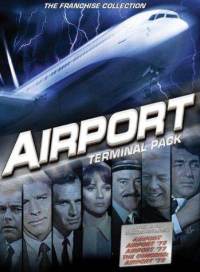
I was able to do this largely because I own the Airport Terminal Pack, a two-disk DVD collection that contains all four of the Airport films and nothing else. There’s no special features or commentary tracks. That’s probably a good thing because these films are so extremely mainstream that I doubt the commentary tracks would be all that interesting except to people who love “Me and Jennings Lang had the same lawyer…” style stories.
The movies are a mixed bag of ’70s sexism, mainstream greed, and casts that were described as being “all-star” despite the fact that they featured very few stars. They’re all worth watching as time capsules of a past time. Some of them are just more worthy than others.
Below are my thoughts on each individual film in the collection…
Airport (directed by George Seaton)
First released in 1970, Airport was nominated for 10 Academy Awards (including best picture), broke box office records, and started the whole 70s disaster movie trend. It also has to be one of the most boring, borderline unwatchable movies ever made. The fact that I managed to sit through the whole thing should be taken as proof that I’m either truly dedicated to watching movies or I’m just insane. Take your pick.
Anyway, the film is painstakingly detailed account of the every day operations of an airport. Yeah, sounds like a lot of fun, doesn’t it? Burt Lancaster runs the airport. His brother-in-law Dean Martin flies airplanes. Both of them have mistresses but we’re told that’s okay because Lancaster’s wife expects him to talk to her and Martin’s wife is cool with him fucking around as long as he comes home at night. I would be tempted to say that this is a result of the film having been made in 1969 and released in 1970 but actually, it’s just an introduction to the sexual politics of the typical disaster film. Men save the day while women get in the way. And if you think things have changed, I’d suggest you watch a little film calledf 2012…
The only interesting thing about the film is that Lancaster’s mistress is played by Jean Seberg who, ten years earlier, had helped change film history by co-starring in Jean-Luc Godard’s classic film Breathless. Nine years later, after years of being hounded by the American press and the FBI for her radical politics, Seberg committed suicide.
Airport 1975 (directed by Jack Smight)
As opposed to its predecessor, Airport 1975 is actually a lot of fun in its campy, silly way. This is the one where a small private plane (flown by Dana Andrews, the star of the wonderful film noir Laura) collides with a commercial airliner. The entire flight crew is taken out and head stewardess Karen Black has to pilot the plane despite the fact that she’s obviously cross-eyed. Luckily, since Black is a stewardess, she has a pilot boyfriend who is played by Charlton Heston. Heston talks her through the entire flight despite the fact that she was earlier seen trying to pressure him into not treating her like an idiot. Anyway, Heston does his usual clench-jaw thing and if you need a drinking game to go with your bad movie, just take a shot every time Heston calls Black “honey.” You’ll be drunk before the plane lands.
There’s some other stuff going on in this movie (for instance, Gloria Swanson appears as “herself” and doesn’t mention Sunset Boulevard or Joseph Kennedy once!) but really, all you need to know is that this is the film where Karen Black acts up a storm and random characters keep saying, “The stewardess is flying the plane!?”
Odd trivia fact: Airport 1975 was released in 1974.
Airport ’77 (directed by Jerry Jameson)
In Airport ’77, a group of art thieves attempt to hijack an airplane which, of course, leads to the airplane crashing into the ocean and somehow sinking down to the ocean’s floor without splitting apart. The crash survivors have to try to figure out how to get to the surface of the water before they run out of oxygen.
In this case, our resident sexist pilot is Jack Lemmon who has a really ugly mustache. He wants to marry head stewardess Brenda Vaccarro. Vaccarro doesn’t understand why they have to get married to which Lemmon responds, “Because I want a wife and kids!” The film also gives us Lee Grant as a woman who is married to Christopher Lee but who is having an affair with another man. She also drinks a lot and dares to get angry when she realizes that the airplane is underwater. While this sort of behavior is acceptable from Dean Martin, Charlton Heston, and Jack Lemmon, the film punishes Lee Grant by drowning her in the final minutes.
Technically, Airport ’77 is probably the best of the Airport films. The cast does a pretty good job with all the melodrama, the film doesn’t drag, and a few of the scenes manage to generate something resembling human emotion. (For instance, when the blind piano player died, I had a tear in one of my freaky, mismatched eyes.) Unfortunately, the movie’s almost too good. It’s not a lot of fun. Everyone plays their roles straight so the silly plot never quite descends into camp and the key to a good disaster film is always camp. This film also has the largest body count of the series, with most of the cast dead by the end of the movie. (And, incidentally, this film did nothing to help me with my fear of water…)
The Concorde: Airport ’79 (directed by David Lowell Rich)
The last Airport movie is also the strangest. Some people have claimed that this film was meant to be a satire of the previous Airport films. I can understand the argument because you look at film like Concorde and you say, “This must be a joke!” However, the problem with this theory is that there are moments of obvious “intentional” humor in this film (i.e., J.J. from Good Times smokes weed in the plane’s bathroom, another passenger has to go to the bathroom whenever she gets nervous) and none of them show any evidence of the type of wit and outlook necessary to come up with anything this silly on purpose. Add to that, the film’s story is credited to Jennings Lang, a studio executive. Studio execs do not take chances. (Plus, the actual script was written by Eric Roth, who went on to write the amazingly humorless The Curious Case of Benjamin Button).
No, this film is meant to be taken seriously and oh my God, where do I start?
Our pilots are George Kennedy and Alain Delon. The head stewardess (and naturally, Delon’s girlfiend) is played by Sylvia “Emanuelle” Kristel who, at one point, says, “You pilots are such men!” “Hey, they don’t call it a cockpit for nothing, honey,” Kennedy replies.
Meanwhile, Robert Wagner is trying to destroy the Concorde because one of the passengers is his girlfriend who has proof that Wagner has been selling weapons to America’s enemies. So, he attempts to blow the plane up with a guided missile and when that fails, he sends a couple of fighter planes after them. Kennedy responds by opening up the cockpit window — while breaking the sound barrier mind you — and firing a flare gun at their pursuers.
After this, there’s stop over in Paris where Delon arranges for Kennedy to sleep with a prostitute who assures Kennedy that he made love “just like a happy fish.”
The next day, everyone returns to the exact same Concorde — despite the fact that just a day earlier they’d nearly been blown up by a squadron of fighter planes — and take off on the second leg of the flight. Let me repeat that just to make sure that we all understand what this film is asking us to believe. After nearly getting blown up by a mysterious squad of fighter planes, everybody shows up the next morning to get on the exact same plane.
Oh, and it never occurs to Wagner’s ex-girlfriend that Wagner might have something to do with all of this.
Now sad to say, Concorde is the one of those films that’s a lot more fun to talk about than to actually watch. It should be a lot more fun in its badness than it actually is. Still, the movie has just enough camp appeal to make it fun in a “what the fuck…” sorta way.
And that’s how the Airport series comes to an end.



 Inspector Rio (
 Welcome to the American frontier. The time is the 1880s and men and women everywhere are heading out west in search of their fortune. While stowing away on a train, veteran cowboy Johnny Wade (Brian Keith) meets the naive Steve Hill (Gary Clarke) and becomes a mentor to the younger man. Johnny teaches Steve how to shoot a gun and, when they get off the train at Medicine Bow, Wyoming, they get jobs working on the ranch of Georgia Price (Geraldine Brooks). When Georgia and Johnny plot to overgraze the land, Steve must decide whether he’s with them or with a rival rancher, Judge Garth (Lee J. Cobb).