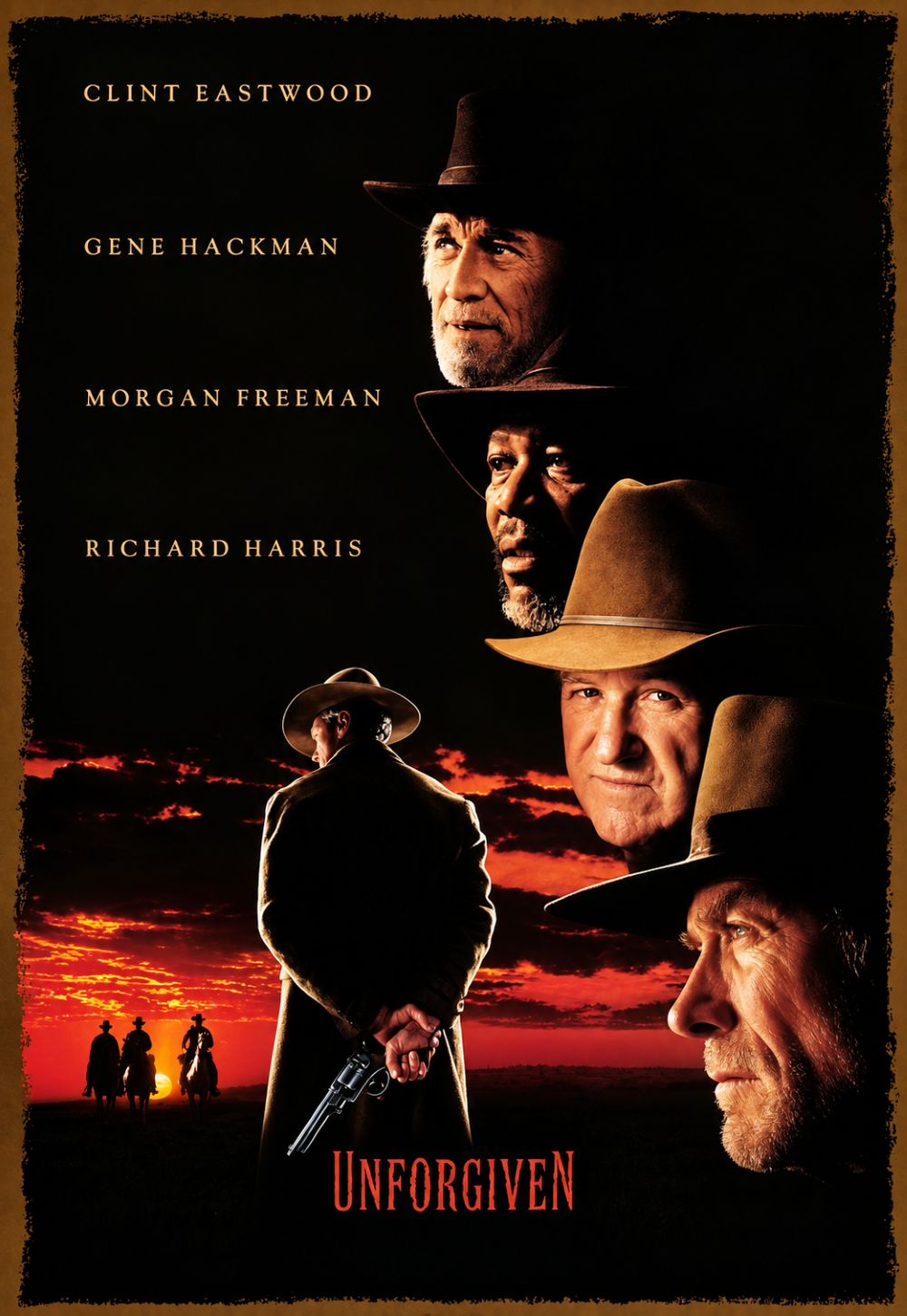
Review: Unforgiven (dir. by Clint Eastwood)


“It’s a hell of a thing, killing a man. You take away all he’s got and all he’s ever gonna have.” — William Munny

There is a point in Unforgiven when the familiar fantasy of the Western gunfighter finally collapses under the weight of what killing actually means. Clint Eastwood’s 1992 masterpiece is a revenge story, a character study, and an unusually merciless critique of the myths that turned killers into folk heroes. It takes nearly every image associated with the classic Western—the lone rider, the righteous bounty, the corrupt frontier town, the feared gunslinger, the climactic saloon showdown—and asks what those images would look like if the people involved had to suffer the consequences afterward. The answer is bleak, often grimly funny, and far more powerful than a simple “anti-Western” label suggests.

Eastwood stars as William Munny, a former outlaw and murderer trying to survive as a widowed pig farmer in Kansas. He has two young children, a failing farm, and little talent for the peaceful life he has supposedly embraced. At the beginning of the film, Munny is practically the opposite of the cool, razor-sharp gunfighters Eastwood played in his younger years. He falls into mud, cannot shoot straight, and looks exhausted before the real journey even begins. That physical decline matters because Eastwood wants the audience to see the distance between a Western legend and the actual, aging human being beneath it.

Munny’s chance to return to violence arrives when the Schofield Kid, an arrogant young would-be gunslinger, offers him a share of a bounty. In the town of Big Whiskey, Wyoming, two cowboys have viciously cut up a prostitute named Delilah Fitzgerald. The town’s sheriff, Little Bill Daggett, punishes them with a fine paid to the brothel owner rather than giving Delilah anything resembling justice. Furious, the other prostitutes gather money and put out a reward for the men responsible. Munny initially hesitates, but the bounty is enough to draw him out of retirement. He convinces his old partner Ned Logan to ride with him, and the three men head toward Big Whiskey.

On paper, that setup sounds like the start of a traditional revenge Western. The crime is vicious, the local law is corrupt, and armed men set out to punish the guilty. Unforgiven, though, immediately complicates every part of that formula. The women have every reason to be furious, but their bounty does not turn the mission into a clean act of justice. Munny and Ned may be targeting cruel men, but they are still going to kill them for money. The Schofield Kid talks about the bounty like it is an adventure, but he has no real idea what killing another person does to someone. The film keeps refusing the easy emotional release that a more conventional Western would offer.

Eastwood’s direction is particularly sharp whenever violence finally breaks out. There are no elegant shootouts designed to make the viewer cheer. Guns misfire, men miss, people panic, and the victims do not fall over conveniently after being hit. When Munny and Ned shoot one of the cowboys, the sequence is awkward, tense, and almost miserable to watch. The wounded man suffers for a long time, calling out for water while his companions are too frightened to help him. Munny does not suddenly look like an unbeatable hero. He looks like a man who has made a terrible choice and now has to stand there listening to the result.

That approach makes Unforgiven feel much harsher than most Westerns, but it also gives the film its emotional weight. It is not saying that violence is never understandable. The cowboys who attacked Delilah are not treated as innocent victims, and Little Bill’s indifference to her suffering is infuriating. What the movie understands is that a justified act can still be ugly, frightening, and spiritually damaging. Killing someone may solve a practical problem, but it does not automatically restore dignity or erase pain. The movie’s view of revenge is not that it never works; it is that it always costs more than the stories promise.

Eastwood’s performance is one of the reasons the film lands so hard. William Munny is clearly connected to the Eastwood screen persona audiences knew from earlier Westerns, but he is a far sadder and more frightening version of it. Munny’s past is revealed gradually through other characters’ stories. Before he married Claudia, he was drunk, violent, and seemingly capable of killing anyone who got in his way. Claudia helped turn him toward a better life, and after her death he has tried to honor that change. Yet the movie never suggests that redemption has erased who he was. It only suggests that he has managed to keep that part of himself under control.

As the story moves forward, Munny becomes increasingly sick, angry, and emotionally stripped down. His old skills come back, but the return is not triumphant. It is more like watching someone relapse into a destructive part of themselves. Eastwood plays this change with remarkable restraint. He does not overdo the anger or announce the transformation with long speeches. Instead, Munny’s face gets harder, his voice becomes flatter, and his decisions become more final. By the end, he has become the frightening killer people said he was, and the movie makes that feel tragic rather than exhilarating.

Gene Hackman gives one of the film’s best performances as Little Bill Daggett, the sheriff of Big Whiskey. Little Bill is cruel, blunt, and completely convinced that he is the only person keeping the town from falling apart. He sees himself as a realist. In his mind, the cowboys have paid for their crime, the prostitutes are causing unnecessary trouble, and every outside gunman is a threat to the peace he has built. But his “peace” depends on denying Delilah justice and beating anyone who challenges his authority. He is not a noble lawman protecting civilization from barbarism. He is a violent man with a badge who has decided that his version of order matters more than anyone else’s pain.

Hackman makes Little Bill compelling because he never plays him as a cartoon villain. The character can be funny, conversational, and even oddly charming when he is talking about building his house or explaining how a gunfight really works. Those ordinary details make his cruelty more believable. Little Bill is not a monster because he twirls his mustache or enjoys evil for its own sake. He is a monster because he has made violence routine. He can beat a man nearly to death, then return to discussing carpentry as if nothing meaningful has happened.

The movie’s fascination with mythmaking is another reason it remains so great. Unforgiven constantly contrasts what people say about gunfighters with what gunfighters are actually like. Richard Harris appears as English Bob, an aging outlaw who has turned himself into a storybook figure. He travels with W. W. Beauchamp, a writer who records exaggerated tales of duels, bravery, and glamorous frontier violence. English Bob wants to be remembered as the sort of man old Westerns love: a polished, fearless killer who can outdraw anyone in a fair fight.

Little Bill quickly destroys that image, humiliating English Bob and explaining that most gunfights are not won by the fastest hand or the bravest heart. They are won by whoever gets lucky, whoever fires first, or whoever is less scared at the right moment. That speech is one of the clearest examples of what Unforgiven is doing with the genre. It does not merely say that the old stories were exaggerated. It shows why people prefer exaggeration. The truth is messy, cowardly, and often too ugly to make a satisfying legend.

The Schofield Kid represents the danger of believing those legends too completely. He talks big about killing men, insists he is a famous gunfighter, and assumes the bounty will make him rich and important. But when the moment comes, he cannot handle the reality of what he has done. After taking a life, he drinks heavily and admits that he has never killed anyone before. His fantasy collapses almost instantly. Munny’s response is one of the film’s coldest and most honest moments: when you kill a man, you take away everything he has and everything he is ever going to have. There is no speech about courage, justice, or glory. There is only the permanent fact of death.

Morgan Freeman is excellent as Ned Logan, Munny’s old partner and closest friend. Ned has a quiet decency that does not erase his violent past but makes clear that he wants no part of it anymore. His scenes with Munny feel lived-in, as if the two men understand each other without needing to explain their history. Ned knows exactly what Munny used to be, and that knowledge makes him nervous about what his friend may become again. Freeman brings warmth and humor to the movie, which makes the eventual loss of that warmth feel devastating.

Ned is especially important because he shows that a person can decide not to keep living by old violent rules. He has a life with Sally Two Trees, and when the killing becomes real, he chooses to leave rather than continue. That choice separates him from Munny. Both men have done terrible things, but Ned recognizes that he has reached the point where he cannot go back. Munny, on the other hand, is eventually pulled all the way back into the identity he thought he had escaped.

Visually, Unforgiven is one of Eastwood’s most beautiful films, although “beautiful” may not be the first word that comes to mind while watching it. The landscapes are often gray, rainy, muddy, and lonely. Big Whiskey is not a romantic frontier town full of colorful saloons and grand main streets. It is wet, cramped, and miserable. The open country does not feel liberating either. It feels empty and dangerous, a place where a wounded man can die slowly because help is too far away. Cinematographer Jack N. Green gives the film a somber, dusk-like look that fits its mood perfectly.

The final confrontation in the saloon is one of the most famous scenes in Eastwood’s career because it briefly gives viewers the kind of gunfighter moment they have been waiting for. Munny walks into Big Whiskey through the rain, enters the saloon, and becomes the nightmare Little Bill and the others have feared. He kills with shocking speed and delivers lines that sound immediately iconic. For a few minutes, the old Eastwood myth appears to return in full. The silent killer is back, the bad men are terrified, and the audience can feel the raw force of the scene.

But Unforgiven refuses to turn that climax into a victory lap. Munny’s rampage is not heroic liberation. It is grief, rage, alcohol, and guilt exploding through a man who has lost the fragile stability he built after leaving violence behind. He is not reclaiming some glorious identity. He is becoming the worst version of himself again. The scene is undeniably thrilling in a purely cinematic sense, but Eastwood makes sure the thrill feels contaminated. We are watching a legend come alive, but the movie has spent two hours teaching us that legends are usually built on suffering.

That is why Unforgiven became Eastwood’s Western magnum opus. It is not just a great Western made by a star who knew the genre inside out; it is the film where he fully confronted the meaning of his own Western image. Eastwood began deconstructing that image with High Plains Drifter, where the mysterious stranger was less a traditional hero than a ghostly, cruel force of revenge. He continued the process in The Outlaw Josey Wales, a more expansive and emotional film that questioned authority and showed an outlaw finding a kind of community, even while preserving much of the old gunslinger charisma. With Unforgiven, Eastwood completes that deconstruction of the Western film genre.

In Unforgiven, there is no clean heroism left behind the gunfighter’s reputation. The lone rider is exhausted and morally compromised. The sheriff is a bully. The bounty is not justice in any simple sense. The famous gunfighter is often a fraud, a coward, or simply lucky. And the man who really is capable of becoming a legend is also capable of committing horrifying acts. Eastwood does not dismiss the Western’s power; if anything, he understands that power better than almost anyone. He knows why audiences respond to the image of a lone man walking into a saloon to face impossible odds.

What makes the film so enduring is that it asks viewers to look beyond that image. Who dies so the hero can become a legend? Who gets turned into a footnote in someone else’s story? What does the survivor carry afterward? Those questions give Unforgiven a moral weight that few Westerns, revisionist or otherwise, can match. It is a film about violence, but it is also about memory, regret, masculinity, and the lies people tell to make brutality seem noble. By its final fade-out, Unforgiven leaves the Western standing not as a celebration of violence, but as a haunted reckoning with everything violence destroys.

Behind the Camera: The Unauthorized Story of ‘Diff’rent Strokes’ (2006, dir by Robert Iscove)


Norman Lear has television superstar Conrad Bain under contract and Fred Silverman wants to build a show around Bain and a talented black child actor named Gary Coleman.  Entitled Diff’rent Strokes and featuring Todd Bridges and Dana Plato as Coleman’s brother and stepsister, the show is a hit.  The three young actors briefly become superstars, much like the amazing Conrad Bain.  And then, when the show is finally canceled after ten years, it all goes downhill as Todd Bridges and Dana Plato run into trouble with drugs and the law and Gary Coleman, once one of the highest paid stars on television, discovers that he’s now flat broke.  All three of them learn how quickly the world can turn on you when you’re no longer considered to be a success.

Behind the Camera: The Unauthorized Story of ‘Diff’rent Strokes’ was another one NBC’s cheap movies about the behind-the-scenes drama of a popular sitcom.  (They also did Three’s Company and Mork & Mindy).  Like all of NBC’s Behind the Camera movies, it makes the mistake of thinking that everyone is as interested in the habits of network executives as the people who work for them are.  (This time, it’s Saul Rubinek who gets to play Fred Silverman.)  The actors who plays Bridges, Coleman, and Plato are convincing enough but the storytelling is shallow, featuring the same information that you would expect to find in an episode of the E! True Hollywood Story.  I was disappointed that we didn’t get any scenes of Alan Thicke recording the theme song.

Todd Bridges and the late Gary Coleman both appear as themselves, talking about their experiences with the show and the difficulties of navigating life after Diff’rent Strokes was canceled.  Bridges is down-to-Earth while Coleman rambles like someone who was still trying to figure out how his life had led up to this moment.  The ending, in which Bridges and Coleman stand at Dana Plato’s grave and Coleman delivers a nearly incoherent monologue, is the one time that the film really captures any feeling of emotional honesty.  It is obvious that both Bridges and Coleman are still haunted by what happened to Plato after the show ended.  Knowing that Coleman himself would die just four years after the airing of this movie makes the scene more poignant when viewed today.


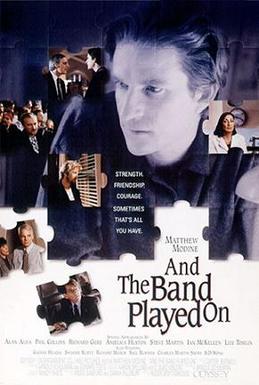
Film Review: And The Band Played On (dir by Roger Spottiswoode)


I live in a very cynical time.

That was one of my main thoughts as I watched 1993’s And The Band Played On.

Directed by Roger Spottiswoode and featuring an all-star cast, And The Band Played On deals with the early days of the AIDS epidemic.  It’s a film that features many different characters and storylines but holding it all together is the character of Dr. Don Francis (Matthew Modine), an epidemiologist who is haunted by what he witnessed during the Ebola epidemic in Africa and who fears that the same thing is going to happen in America unless the government gets serious about the mysterious ailment that is initially called “gay cancer” before then being known as “GRID” before finally being named AIDS.  Dr. Francis is outspoken and passionate about fighting disease.  He’s the type who has no fear of yelling if he feels that people aren’t taking his words seriously enough.  In his office, he keeps a track of the number of HIV infections on a whiteboard.  “Butchers’ Bill” is written across the top of the board.

Throughout the film, quite a few people are dismissive of Dr. Francis and his warnings.  But we, the audience, know that he’s right.  We know this because we know about AIDS and but the film also expects us to trust Dr. Francis because it’s specifically stated that he worked for the World Health Organization before joining the Center For Disease Control in Atlanta, Georgia.  As far as the film is concerned, that’s enough to establish his credentials.  Of course, today, after living through the excesses of the COVID pandemic and the attempts to censor anyone who suggested that it may have begun due to a lab leak as opposed to some random guy eating a bat, many people tend to view both the WHO and the CDC with a lot more distrust than they did when this film was made.  As I said, we live in a cynical time and people are now a lot less inclined to “trust” the experts.  To a large extent, the experts have only themselves to blame for that.  I consider myself to be a fairly pragmatic person but even I now find myself rolling my eyes whenever a new health advisory is issued.

This new sense of automatic distrust is, in many ways, unfortunate.  Because, as And The Band Played On demonstrates, the experts occasionally know what they’re talking about.  Throughout the film, people refuse to listen to the warnings coming from the experts and, as a result, many lives are lost.  The government refuses to take action while the search for a possible cure is hindered by a rivalry between international researchers.  Alan Alda gives one of the best performances in the film, playing a biomedical researcher who throws a fit when he discovers that Dr. Francis has been sharing information with French scientists.

It’s a big, sprawling film.  While Dr. Francis and his fellow researchers (played by Saul Rubinek, Glenne Headly, Richard Masur, Charles Martin Smith, Lily Tomlin, and Christian Clemenson) try to determine how exactly the disease is spread, gay activists like Bobbi Campbell (Donal Logue) and Bill Kraus (Ian McKellen) struggle to get the government and the media to take AIDS seriously.  Famous faces pop up in small rolls, occasionally to the film’s detriment.  Richard Gere, Steve Martin, Anjelica Huston, and even Phil Collins all give good performances but their fame also distracts the viewer from the film’s story.  There’s a sense of noblesse oblige to the celebrity cameos that detracts from their effectiveness.  All of them are out-acted by actor Lawrence Monoson, who may not have been a huge star (his two best-known films are The Last American Virgin and Friday the 13 — The Final Chapter) but who is still heart-breakingly effective as a young man who is dying of AIDS.

Based on a 600-page, non-fiction book by Randy Shilts, And The Band Played On is a flawed film but still undeniably effective and a valuable piece of history.  Director Roger Spottiswoode does a good job of bringing and holding the many different elements of the narrative together and Carter Burwell’s haunting score is appropriately mournful.  The film ends on a somber but touching note.  At its best, it’s a moving portrait of the end of one era and the beginning of another.

Lisa Reviews An Oscar Winner: Unforgiven (dir by Clint Eastwood)


The 1992 Best Picture winner, Unforgiven, begins as a story of frontier justice.

In Kansas, a young and cocky cowboy who calls himself the Schofield Kid (Jaimz Woolvett) rides up to an isolated hog farm.  He’s looking for Will Munny (Clint Eastwood), a notorious outlaw with a reputation for being a ruthless killer.  Instead, he just finds a broken down, elderly widower who is trying to raise two young children and who can barely even manage to climb on a horse.  Will Munny, the murderer, has become Will Munny the farmer.  He gave up his former life when he got married.

The Schofield Kid claims to be an experienced gunfighter who has killed a countless number of men.  He explains that a group of sex workers in Wyoming have put a $1,000 bounty on two men, Quick Mike (David Mucci) and his friend, Davey Bunting (Rob Campbell).  Quick Mike cut up one of the women when she laughed at how unimpressively endowed he was.  While Davey didn’t take part in the crime, he was present when it happened and he didn’t do anything to stop it.  The local sheriff, a man named Little Bill Daggett (Gene Hackman), had Davey give the woman’s employer several horses as compensation.  The Kid wants Munny to help him collect the bounty.

At first, Munny refuses to help the Kid.  But, when he realizes that he’s on the verge of losing his farm, Munny changes his mind.  He and his former partner, Ned Logan (Morgan Freeman), join with the Kid and the three of them head to Wyoming.  Along the way, they discover that the Kid is severely nearsighted and can hardly handle a pistol.

Meanwhile, in the town of Big Whiskey, Wyoming, Little Bill ruthlessly enforces the peace.  He’s a charismatic man who is building a house and bringing what many would consider to be civilization to the Old West. When we first meet Little Bill, he seems like a likable guy.  The town trusts him.  His deputies worship him.  He has a quick smile but he’s willing to stand his ground.  But it soon becomes apparent that, underneath that smile and friendly manner, Bill is a tyrant and a petty authoritarian who treats the town as his own personal kingdom.    Little Bill has a strict rule.  No one outside of law enforcement is allowed to carry a gun in his town.  When another bounty hunter, English Bob (Richard Harris), comes to town to kill the two cowboys, Little Bill humiliates him and sends him on his way but not before recruiting Bob’s traveling companion, writer W.W. Beauchamp (Saul Rubinek), to write Bill’s life story.  Bill’s not that much different from the outlaws that he claims to disdain.  Like them, Bill understands that value of publicity.

Unforgiven starts as a traditional western but it soon becomes something else all together.  As the Schofield Kid discovers, there’s a big difference between talking about killing a man and actually doing it.  Piece-by-piece, Unforgiven deconstructs the legends of the old west.  Gunfights are messy.  Gunfighters are not noble.  Davey Bunting is the only man in town to feel guilty about what happened but, because he’s included in the bounty, he still dies an agonizing death.  Quick Mike is killed not in the town square during a duel but while sitting in an outhouse.  Ned and Munny struggle with the prospect of going back to their old ways, with Munny having to return to drinking before he can once again become the fearsome killer that he was in the past.  And Little Bill, the man who says that he’s all about taming the west and bringing civilization to a lawless land, turns out to be just as ruthless a killer as the rest.  A lot of people are dead by the end of Unforgiven.  Some of them were truly bad.  Some of them were good.  Most of them were in the wrong place at the wrong time.  Everyone’s got it coming, to paraphrase Will Munny.

With its violent storyline, deliberate pacing, and its shots of the desolate yet beautiful western landscape, Clint Eastwood’s film feels like a natural continuation of the Spaghetti westerns that he made with Sergio Leone.  (Unforgiven is dedicated to both Leone and Don Seigel.)  Unforgiven was the first of Eastwood’s directorial efforts to be nominated for Best Picture and also the first to win.  It’s brutal meditation on violence and the truth behind the legends of the American frontier.  Eastwood gives one of his best and ultimately most frightening performances as Will Munny.  Gene Hackman won his second Oscar for playing Little Bill Daggett.

Unforgiven holds up well today.  Hackman’s Little Bill Dagget feels like the 19th century version of many of today’s politicians and unelected bureaucrats, authoritarians who claims that their only concern is the greater good but whose main interest is really just increasing their own power.  Unforgiven remains one Clint Eastwood’s best films and one of the best westerns ever made.  Leone would have been proud.

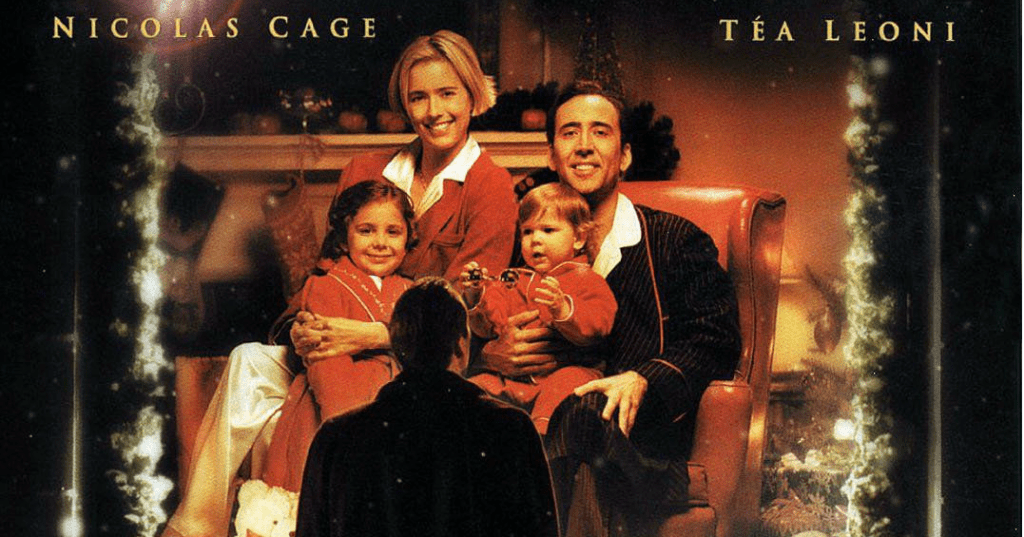
THE FAMILY MAN (2000) – Nicolas Cage gets a “glimpse” into a different life!


Nicolas Cage stars as Jack Campbell, a Wall Street hot shot, who puts his success in the business world above everything else in his life. We meet him on Christmas Eve as he’s trying to close a multi-billion dollar merger. He’s making everyone work late and even calls for a work session on Christmas Day. Jack’s administrative assistant gives him a phone message from his former girlfriend Kate (Tea Leoni), who he almost married about 15 years earlier. He’s surprised to hear from her, especially since he essentially chose his career over her all those years ago. That night as he stops at a grocery store on his way home, events transpire so that a desperate man named Cash (Dan Cheadle) pulls a gun on the clerk. Jack is able to use a calm demeanor and business sense to talk to Cash in a way that diffuses the situation and the two leave the store together. As they walk down the street, Jack tries to talk to Cash and help him. When Cash starts asking Jack about his life, Jack indicates that his life is great and he has everything he needs. Interestingly, this is where Cash mysteriously tells Jack that he’s going to do something for him, something he really needs…

The next morning, Christmas morning, Jack wakes up in a different home, he’s married to Kate, and they have two kids and a dog. He’s no longer an investment banker; now he’s a tire salesman. He no longer drives a Ferrari; now he’s drives a mini-van. In panic-mode, Jack runs out of the house as his in-laws arrive, fires up the mini-van, and drives to his office on Wall Street where nobody knows him, and they kick him out of the building. About that time, Cash pulls up in Jack’s Ferrari and tells him that he’s giving him the gift of a “glimpse” into what his life could have been if he had married Kate instead of focusing on himself and his career. So Jack heads back to try life in Jersey, wondering when the glimpse will come to an end. 

My wife and I are continuing to watch Christmas movies throughout the month of December to stay in the holiday spirit. THE FAMILY MAN is not necessarily a movie we watch every year, but I’m a fan of Nicolas Cage. I enjoy these types of films where a person sees what their lives could have been like if they had made different decisions at certain key points along the way. An easy comparison can be made to Frank Capra’s IT’S A WONDERFUL LIFE, which is my personal favorite Christmas movie, and it’s in my top 10 movies of all time. It’s not really an appropriate comparison though. These stories encounter their subjects in two very different places. In IT’S A WONDERFUL LIFE, George Bailey is at the end of his rope and thinking his family would have been better off if he had never been born. It takes Clarence to reveal just how important George has been to those he loves. In THE FAMILY MAN on the other hand, Jack Campbell is at the top of the world and standing at the precipice of his crowning achievement in his career. He believes his life is wonderful. Cash decides to teach him a lesson by offering a “glimpse” into a life that he could have had if he had chosen Kate and a family over his career. Would life with her be more fulfilling than all the money in the world? I think the sale is a lot easier for Clarence than Cash, and I also think that’s why I found the film to be less compelling. George Bailey’s decision was literally life with a family who dearly loves him, or death. Jack Campbell’s decision is if he wants a middle class life with a loving wife and two precious kids that he only just met, or if he wants to continue his prior life as the multi-millionaire mover and shaker with his pick of beautiful women.  It doesn’t help the film’s case either that Jack’s never really presented as being completely empty on the inside or unhappy, say, the way Bill Murray is in SCROOGED. While I personally enjoy the type of life that Jack is able to glimpse, his character’s specific choice is not as obvious, or earned, the way George Bailey’s is. 

Overall, as a man who wouldn’t trade my family for all the money in the world, I do appreciate what THE FAMILY MAN is going for. The execution doesn’t quite pull it off in a way that is completely satisfying, and ultimately explains why I don’t watch it every year as a holiday staple. 

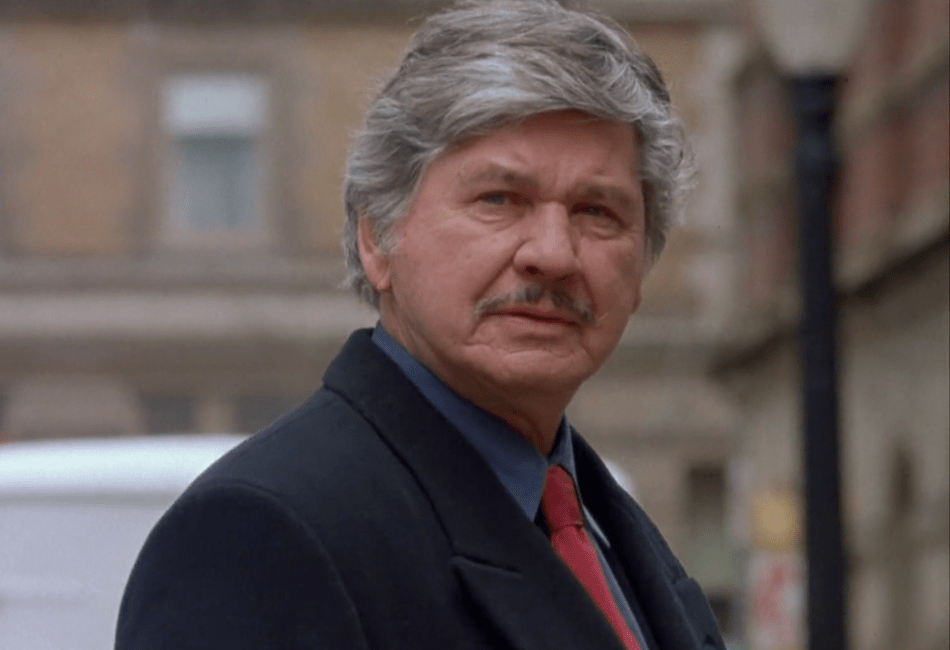
DEATH WISH V: THE FACE OF DEATH – The end.


Picture it…it’s 1992 or 1993 and I’m back at my local Hastings Entertainment superstore browsing through an entertainment magazine. Surprisingly, I came across a bit of entertainment news that a 71 year old Charles Bronson had accepted an offer of $5 million to reprise his Paul Kersey character for a fifth time. I couldn’t help but wonder what possible direction that they could take the series that would be interesting. I didn’t see anything else about the movie for the next year or so, and then it showed up some time in 1994 available for rent at that same Hastings Entertainment superstore. As far as I know, it never played in theaters in Arkansas, although it did play in some theaters in other parts of the country prior to going to home video. I immediately rented the film, somewhat apprehensive of what it would be….

DEATH WISH V: THE FACE OF DEATH, begins with Paul Kersey (Charles Bronson) back in New York. We first see him, looking quite dapper I might add, walking down the street in the garment district. He’s on his way to see his latest girlfriend, fashion designer Olivia Regent (Lesley Anne-Down), whose fashion show is currently underway. You immediately feel sorry for Ms. Regent as you know her prospects for survival are somewhere between slim and none since Kersey’s her man. It doesn’t help matters when her ex-husband, awkwardly impotent mobster Tommy O’Shea (Michael Parks) shows up and starts physically abusing her and her employees. You see, O’Shea is trying to force his ex-wife to use her fashion business to help him launder money from his various criminal activities. Kersey tries to convince Olivia to go to District Attorney Brian Hoyle (Saul Rubinek) to try to put O’Shea away. Unfortunately, there’s corruption in the D.A.’s office in the form of Hector Vasquez (Miguel Sandoval), who passes the information back to O’Shea. From this point forward, Ms. Regent’s life is in serious jeopardy and we all know Kersey’s record of keeping his women alive isn’t that great. I won’t give the details away, but let’s just say that events conspire so that the cursed Kersey will have to resume his old vigilante ways in pursuit of a justice that can never be provided to him by the law.  

I remember vividly my first ever viewing of DEATH WISH V back in 1994. I put the videotape in the VCR and watched several previews that looked crappy and didn’t give me a lot of hope for the movie. And then it started, and I have to admit I enjoyed it from the very beginning to the end. I guess my expectations were so low that it was a major relief when I realized that it was a reasonably well-made, audience satisfaction movie designed for people like me who simply enjoy seeing Bronson acting as an instrument of justice. I thought Bronson looked good for an action star over 70 years old. I really liked the movie’s sense of humor. Michael Parks overacted to the point of parody as O’Shea, and the character of Freddie Flakes (Robert Joy) was especially fun as a hitman with major dandruff problems. And there was something about Charles Bronson that was different in comparison to some of the earlier entries. Then I realized what it was, Bronson was having fun. He took out the bad guys with things like poisoned cannolis and exploding soccer balls, all with a twinkle in his eyes. In the 70’s, Bronson made several movies where his characters had that twinkle. It was nice to see it back. Bad things happened of course, but director Allan A. Goldstein kept a tone of black comedy that suited the movie and its aging star well. 

Even in 1994, watching DEATH WISH V felt like the end, not just of the DEATH WISH series, but of Bronson’s time as a movie star. As his biggest fan, that made me kind of sad. He would only make 3 more TV movies after this, those being the FAMILY OF COPS TV movies. And while there are some who don’t like DEATH WISH V and seem to go out of their way to put it down, I’m exactly the opposite. To me, DEATH WISH V: THE FACE OF DEATH is a gift to Charles Bronson fans and an enjoyable end to his signature series!

Icarus File No. 11: The Bonfire of the Vanities (dir by Brian De Palma)


In 2021, I finally saw the infamous film, The Bonfire of the Vanities.

I saw it when it premiered on TCM.  Now, I have to say that there were quite a few TCM fans who were not happy about The Bonfire of the Vanities showing up on TCM, feeling that the film had no place on a station that was supposed to be devoted to classic films.  While it’s true that TCM has shown “bad” films before, they were usually films that, at the very least, had a cult reputation.  And it is also true that TCM has frequently shown films that originally failed with audiences or critics or both.  However, those films had almost all been subsequently rediscovered by new audiences and often reevaluated by new critics.  The Bonfire of the Vanities is not a cult film.  It’s not a film about which one can claim that it’s “so bad that it’s good.”  As for the film being reevaluated, I’ll just say that there is no one more willing than me to embrace a film that was rejected by mainstream critics.  But, as I watched The Bonfire of the Vanities, I saw that everything negative that I had previously read about the film was true.

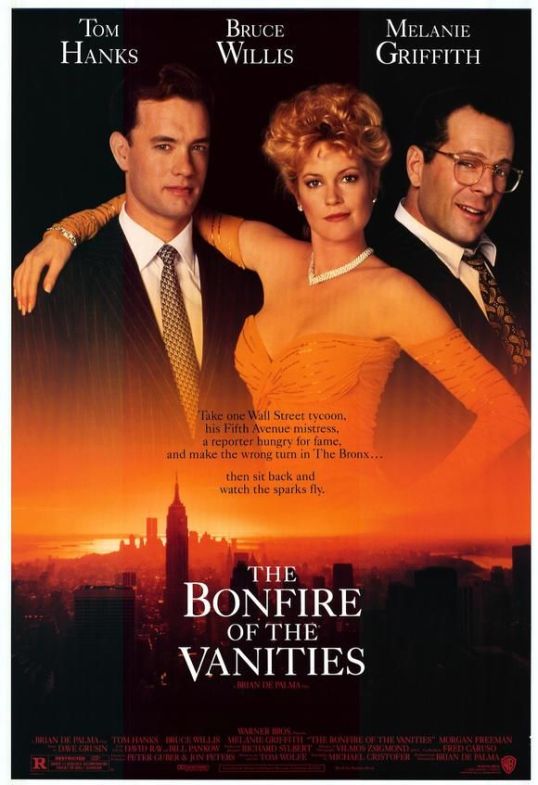
Released in 1990 and based on a novel by Tom Wolfe, Bonfire of the Vanities stars Tom Hanks as Sherman McCoy, a superficial Wall Street trader who has the perfect penthouse and a painfully thin, status-obsessed wife (Kim Cattrall).  Sherman also has a greedy mistress named Maria (Melanie Griffith).  It’s while driving with Maria that Sherman takes a wrong turn and ends up in the South Bronx.  When Sherman gets out of the car to move a tire that’s in the middle of the street, two black teenagers approach him.  Maria panics and, after Sherman jumps back in the car, she runs over one of the teens.  Maria talks Sherman into not calling the police.  The police, however, figure out that Sherman’s car was the one who ran over the teen.  Sherman is arrested and finds himself being prosecuted by a power-hungry district attorney (F. Murray Abraham).  The trial becomes the center of all of New York City’s racial and economic strife, with Sherman becoming “the great white defendant,” upon whom blame for all of New York’s problems can be placed.  Bruce Willis plays an alcoholic journalist who was British in the novel.  Morgan Freeman plays the judge, who was Jewish in the novel.  As well, in the novel, the judge was very much a New York character, profanely keeping order in the court and spitting at a criminal who spit at him first.  In the movie, the judge delivers a speech ordering everyone to “be decent to each other” like their mothers taught them to be.

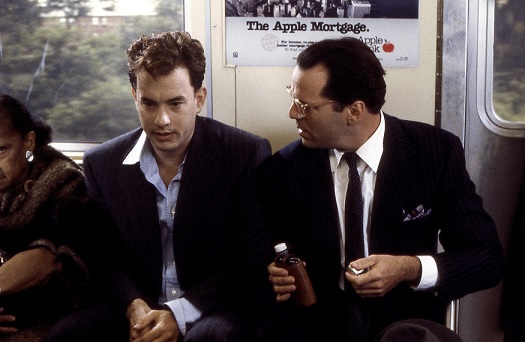
Having read Wolfe’s very novel before watching the film, I knew that there was no way that the adaptation would be able to remain a 100% faithful to Wolfe’s lacerating satire.  Because the main character of Wolfe’s book was New York City, he was free to make almost all of the human characters as unlikable as possible.  In the book, Peter Fallow is a perpetually soused opportunist who doesn’t worry about who he hurts with his inflammatory articles.  Sherman McCoy is a haughty and out-of-touch WASP who never loses his elitist attitude.   In the film, Bruce Willis smirks in his wiseguy manner and mocks the other reporters for being so eager to destroy Sherman.  Hanks, meanwhile, attempts to play Sherman as an everyman who just happens to live in a luxury penthouse and spend his days on Wall Street.  Hanks is so miscast and so clueless as how to play a character like this that Sherman actually comes across as if he’s suffering from some sort of brain damage.  He feels less like a stockbroker and more like Forrest Gump without the Southern accent.  There’s a scene, written specifically for the film, in which Fallow and Sherman ride the subway together and it literally feels like a parody of one of those sentimental buddy films where a cynic ends up having to take a road trip with someone who has been left innocent and naïve as result of spending the first half of their life locked in basement or a bomb shelter.  It’s one thing to present Sherman as being wealthy and uncomfortable among those who are poor.  It’s another thing to leave us wondering how he’s ever been able to successfully cross a street in New York City without getting run over by an angry cab driver.

Because the film can’t duplicate Wolfe’s unique prose, it instead resorts to mixing cartoonish comedy and overwrought melodrama.  It doesn’t add up too much.  At one point, Sherman ends a dinner party by firing a rifle in his apartment but, after it happens, the incident is never mentioned again.  I mean, surely someone else in the apartment would have called the cops about someone firing a rifle in the building.  Someone in the press would undoubtedly want to write a story about Sherman McCoy, the center of the city’s trial of the century, firing a rifle in his own apartment.  If the novel ended with Sherman resigned to the fact that his legal problems are never going to end, the film ends with Sherman getting revenge on everyone who has persecuted him and he does so with a smirk that does not at all feel earned.  After two hours of being an idiot, Sherman suddenly outthinks everyone else.  Why?  Because the film needed the happy ending that the book refused to offer up.

Of course, the film’s biggest sin is that it’s just boring.  It’s a dull film, full of good actors who don’t really seem to care about the dialogue that they are reciting.  Director Brian De Palma tries to give the film a certain visual flair, resorting to his usual collection of odd camera angles and split screens, none of which feel at all necessary to the story.  In the end, De Palma is not at all the right director for the material.  Perhaps Sidney Lumet could have done something with it, though he would have still had to deal with the less than impressive script.  De Palma’s over-the-top, set piece-obsessed sensibilities just add to the film’s cartoonish feel.

The film flopped at the box office.  De Palma’s career never recovered.  Tom Hanks’s career as a leading man was momentarily derailed.  Bruce Willis would have to wait a few more years to establish himself as a serious actor.  Even the normally magnanimous Morgan Freeman has openly talked about how much he hated being involved with The Bonfire of the Vanities.  That said, the film lives on because  De Palma allowed journalist Julie Salomon to hang out on the set and the book she wrote about the production, The Devil’s Candy, is a classic of Hollywood non-fiction.  (TCM adapted the book into a podcast, which is how The Bonfire of the Vanities came to be featured on the station.)  Thanks to Salomon’s book, The Bonfire of the Vanities has gone to become the epitome of a certain type of flop, the literary adaptation that is fatally compromised by executives who don’t read.

Previous Icarus Files:

  1. Cloud Atlas
  2. Maximum Overdrive
  3. Glass
  4. Captive State
  5. Mother!
  6. The Man Who Killed Don Quixote
  7. Last Days
  8. Plan 9 From Outer Space
  9. The Last Movie
  10. 88

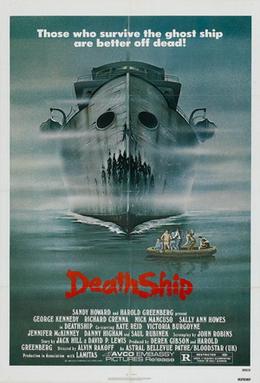
International Horror Film Review: Death Ship (dir by Alvin Rakoff)


The 1980 Canadian film, Death Ship, opens with a black freighter ominously sailing across the ocean in the middle of the night.  The freighter appears to be deserted but, when a cruise ship appears over the horizon, we suddenly hear disembodied German voices announcing that the enemy is in sight and it’s time to take battle stations.  The freighter changes direction and starts to rapidly move straight towards the cruise ship.

On the cruise ship, a really bad comedian named Jackie (played by Saul Rubinek) is telling a series of unfunny jokes.  Fortunately, before he can further offend anyone else’s comedic sensibilities. the freighter crashes into the cruise ship and sinks it.  The next morning, we see a small group of survivors floating on a piece of debris.  There’s the firm and harsh Captain Ashland (George Kennedy), who was on the verge of being forced into retirement before his boat sank.  There’s Mrs. Morgan (Kate Reid), the odd religious passenger.  There’s Trevor Marshall (Richard Crenna), his wife Margaret (Sally Ann Howes), and their two annoying kids.  There’s a guy named Nick (Nick Mancuso) and a woman named Lori (Victoria Burgoyne), who are in love but obviously doomed.  And then there’s Jackie.  That’s right, Jackie survived!  And he’s still telling bad jokes!

Suddenly, the survivors spot the freighter in the distance.  Not realizing that it’s the same freighter that previously rammed them, they board the boat and discover that it appears to be totally abandoned.  Jackie stands on the deck, encourages everyone to be positive, and makes more jokes.  Suddenly, a cable wraps around his ankles, one of the ship’s cranes suddenly moves, and Jackie is tossed back into the ocean.  The comedy Gods have spoken.

Anyway, once Jackie is no longer around to make them laugh, the cruise ship survivors set about going crazy.  It’s not that difficult to do because it turns out that not only is the freighter full of ghosts but the ship’s engine is fueled by pure hate.  That means that one passengers takes a shower just to have the water turn to blood.  Another makes the mistake of watching an old movie and eating a cursed piece of hard candy.  Yet another ends up getting tossed into the gears of the ship and loses an arm.

Meanwhile, Captain Ashland stumbles around the ship and hears voices telling him that the ship is now his.  After Ashland discovers and then puts on an old officer’s uniform, he declares that he’s in charge of the freighter and then he proceeds to try to kill everyone else on the ship.  Captain Ashland is possessed and there’s not even anyone on the boat who can make a joke about it.

Death Ship is a dumb but crudely effective movie.  This is one of those films where everyone could have saved themselves a lot of trouble by sticking together as a group instead of splitting up to search the freighter but it’s not like you’re watching a movie called Death Ship because you’re looking for a coherent narrative or anything.  The main reason you’re watching is so you can see George Kennedy get possessed and go crazy.  Fortunately, George Kennedy was just the type of character actor who you could depend upon to act the hell out of getting possessed.  There’s not a hint of subtlety to be found in Kennedy’s performance and, if nothing else, that certainly makes him entertaining to watch.  Kennedy attacks this role with the ferocity of a cheetah pouncing on a gazelle in a nature documentary.  He basically grabs hold of the film and snarls at the rest of the cast, “This is my movie!  If you steal a scene from me in your dreams, you better wake up and apologize!”  It’s fun to watch.

The same can be said about Death Ship, which is a totally over-the-top movie but which, thanks to Kennedy’s performance and a few atmospheric shots of the freighter, is also far more entertaining than it has any right to be.

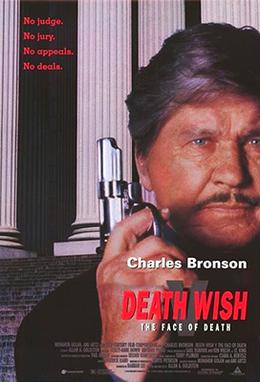
Bronson One Last Time: Death Wish V: The Face of Death (1994, directed by Allen Goldstein)


To quote Geoffrey Chaucer, “All good things must come to an end.”

Death Wish V: The Face of Death marked the end of the original Death Wish franchise, concluding the violent saga of Paul Kersey 20 years after it began.  It probably should have ended sooner.

After the box office failure of Death Wish IV and the subsequent bankruptcy of Cannon Films, future plans for the Death Wish franchise were put on hold.  After the collapse of Cannon, Menahem Golan started a new production company, 21st Century Film Corporation.  In 1993, needing a hit and seeing that the previous Death Wish films were still popular on video, Golan announced that Paul Kersey would finally return in Death Wish V: The Face of Death.  Charles Bronson also returned, though he was now 72 years old and in poor health.  Death Wish V would also mark the end of Bronson’s feature film career.  He would make appearances in a few television movies before subsequently retiring from acting.

Death Wish V finds Paul in the witness protection program.  His latest girlfriend, Olivia (Lesley-Anne Down), just happens to be the ex-wife of a psychotic mobster named Tommy O’Shea (Michael Parks).  Throughout the entire franchise, the Death Wish films argued that crime is so out of control that no one was safe and that Paul had no choice but to pick up a gun and shoot muggers.  But, judging from Death Wish V, Paul just seems to have incredibly bad luck.  What are the odds that a mild-mannered architect would lose his wife, his maid, his daughter, his best friend from the war, his next two girlfriends, and then end up dating the ex-wife of New York City’s craziest gangster?

The district attorney’s office wants Olivia to testify against her ex-husband so Tommy gets his henchman, the dandruff-prone Freddie Flakes (Robert Joy), to kill her.  Looks like it’s time for New York’s favorite vigilante to launch a one-man war against the Mafia!

The only problem is that New York’s favorite vigilante is too old to chase people down dark alleys and shoot them.  He has to get creative, which means using everything from poisoned cannoli to a vat of acid to take out his targets.  One gangster is killed by an exploding soccer ball!

With both Bronson and Lesley-Anne Down giving an indifferent performances, it is up to the supporting cast to keep the movie interesting.  Appearing here after his bravura turn as Jean Renault in Twin Peaks but before Robert Rodriguez and Quentin Tarantino introduced him to a whole new generation of filmgoers, Michael Parks is flamboyantly evil as Tommy O’Shea and injects the movie with what little life that it has.  Speaking of Twin Peaks alumni, Kenneth Welsh (who played Windom Earle in the last few episodes of season 2) plays this installment’s understanding police detective.  Saul Rubinek plays the district attorney who is willing to look the other way when it comes to killing gangsters.

Dull and cheap-looking, Death Wish V was a box office bomb and it brought the original franchise to a definite end.  Will the Eli Roth/Bruce Willis reboot of Death Wish also lead to a reboot of the franchise?  Time will tell!

Horror on the Lens: Death Ship (dir by Alvin Rakoff)


Today’s Horror on the Lens comes to use from 1980.  In Death Ship, a cruise ship collides with a mysterious black freighter.  When the survivors board the freighter, they discover that it appears to be deserted.  But is it really?  As the survivors explore, they start to suspect that they might not be alone.  Even worse, the already unstable captain (George Kennedy) starts to hear a mysterious German voice, encouraging him to kill everyone else and stay on the freighter forever.

It’s kinda like The Shining, except it takes place on a boat and it’s not as good.

But then again, very few horror films are as good as The Shining!  Death Ship is an enjoyably pulpy exercise in ghostly horror and it can actually be quite scary, especially if you have an obsessive fear of drowning, like I do!

Plus, George Kennedy really puts his heart and soul into being possessed.

Watch Death Ship below!