Playing Catch Up: First Daughter, Ice Girls, Raising The Bar, Walk Like A Man


So, this year I am making a sincere effort to review every film that I see.  I know I say that every year but this time, I really mean it.  Unfortunately, over the past two weeks, real life has interfered with my movie reviewing, if not my move watching.

So, in an effort to catch up, here are four quick reviews of some of the movies that I watched over the past two weeks!

  • First Daughter
  • Released: 2004
  • Directed by Forest Whitaker
  • Starring Katie Holmes, Marc Blucas, Amerie, Michael Keaton, Margaret Colin, Lela Rochon

Michael Keaton as the President of the United States!?  Now, that’s a great idea.  Michael Keaton plays President Mackenzie.  First Daughter was made long before Birdman so Michael Keaton doesn’t really have a huge part but, whenever he does appear, he is totally believable as a world leader.  You buy the idea that this guy could win an election and that he’d probably be a good (if not necessarily a great) President.  Someone really needs to make another movie where Michael Keaton plays the President.  Maybe President Birdman.  Just don’t give it to Inarritu to direct because he’ll make it too political…

Anyway, the majority of the film is about Katie Holmes as the President’s daughter, Samantha.  Samantha has been accepted to a college in California.  She’s excited because it means that she’ll finally be able to have a life outside of the White House.  The President is concerned because he loves his daughter and he knows that, if she makes any mistakes in California, his political opponents will try to use her against him.  Samantha goes off to college and tries to have a good (but rather chaste) time.  Making that somewhat difficult is her secret service entourage.  Fortunately, Samantha meets a guy (Marc Blucas) who loves her for who she is and not because her father is the President.

It’s all pretty silly and shallow but I have to admit that I get nostalgic whenever I see this movie.  Much like From Justin To Kelly, it’s definitely a film from a more innocent and less angry time.  To date, it’s also the last film to be directed by actor Forest Whitaker.

  • Ice Girls
  • Released in 2016
  • Directed by Damian Lee
  • Starring Michaela du Toit, Lara Daans, Arcadia Kendal, Sheila McCarthy, Taylor Hunsley, Shane Harte, Elvis Stojko

Struggling financially, Kelly (Lara Daans) is forced to move back to her hometown and move in with her sister (Sheila McCarthy).  Until she got married and gave up that part of her life, Kelly was once an up-and-coming figure skater.  Fortunately, her daughter, Mattie (Michaela du Toit), has inherited her mother’s talent.  However, a serious injury shook Mattie’s confidence.  Now, she says she doesn’t want to skate anymore.  Still, she’s willing to accept a job from Mercury (Elvis Stojko) at the local rink and it’s not too long before, under Mercury’s guidance, Mattie is skating once again.  Mattie also befriends another skater, Heather (Taylor Hunsley).  Heather happens to be the daughter of Rose (Natasha Henstridge), who was once in love with Kelly’s father…

It sounds like the set-up of a melodramatic Lifetime movie but actually, Ice Girls is a sweet-natured film about two ice skaters, one who has a mother who is too protective and the other who has a mother who is too driven.  In the end, both of them end up skating for themselves and not their mothers and that’s a good message for the film’s target audience of young skate fans.  The majority of the cast is made up of actual ice skaters, so the skating footage is pretty impressive.  It’s a predictable movie but I enjoyed it when I watched it on Netflix.

  • Raising the Bar
  • Released in 2016
  • Directed by Clay Glen
  • Starring Kelli Berglund, Lili Karamalikis, Tess Fowler, Emily Morris, Peta Shannon

I also watched this one on Netflix, a day after I watched Ice Girls.  (I was in an Olympics sort of mood, even though neither film took place at the Olympics.)  Raising the Bar feels a lot like Ice Girls, except that the ice skaters were now gymnasts and instead of relocating to Toronto, the family in Raising the Bar relocates all the way to Australia.  Once in Australia, Kelly (Kelly Johnson) finds the courage to re-enter gymnastics and ends up competing against her former teammates.

Kelly Johnson gives a good performance in the lead role.  Though it may be predictable, Raising the Bar is an effective and sweet-natured family film.  Perhaps the most interesting thing about watching the film was that I quickly found myself rooting against the American team.  Australia all the way!
  • Walk Like A Man
  • Released 1987
  • Directed by Melvin Frank
  • Starring Howie Mandel, Amy Steel, Cloris Leachman, Christopher Lloyd, Colleen Camp, Stephen Elliott, George DiCenzo, John McLiam, Earl Boen

Oh, what sweet Hell is this?

Okay, I’m going to try to explain what happens in this movie.  You’re not going to believe me.  You’re going to think that I’m just making all of this up.  But I swear to a God … this is an actual movie.

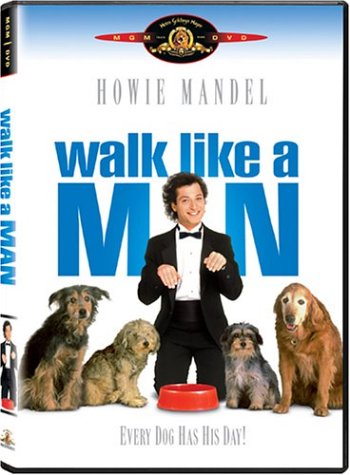
When he was a baby, Boba Shand (Howie Mandel) got separated from his family.  His mother and his father assumed that he was gone forever but what they didn’t know was that Bobo was found and raised by a pack of wild dogs.  For twenty years, Bobo lives as a dog.  Then he’s discovered by Penny (Amy Steel), an animal researcher who tries to teach Bobo how to be a human.  However, as time passes, Penny comes to realize that maybe she’s making a mistake trying to change Bobo.  Bobo is innocent and child-like and obsessed with chasing fire engines.  When he has too much to drink, he runs around on all fours.  And … PENNY’S IN LOVE WITH HIM!

Seriously, she’s in love with a man who thinks he’s a dog.

However, Bobo stands to inherit a fortune and his evil brother (Christopher Lloyd) is planning on having him committed.  Penny has to prove that Bobo is human enough to manage his own affairs while also respecting his desire to continue living like a dog.

I’m serious.  This is a real movie.

Anyway, making things even worse is the performance as Howie Mandel.  Mandel has always been a rather needy performer and the role of a man who thinks he’s a dog only serves to bring out his worst instincts.  Remember when Ben Stiller played Simple Jack in Tropical Thunder?  Well, Mandel’s performance is kinda like that only worse.  At one point, Bobo walks up to a mannequin in a mall and says, “I have to go pee pee.  Come with me,” and I nearly threw a shoe at the TV.  Oh my God, it was so bad.

The main problem with Walk Like A Man is that it wants to have it both ways.  It wants to be a wild comedy about Howie Mandel chasing fire engines but it also makes us want to tear up when Penny explains why Bobo should be allowed to live as a dog.

All in all, it’s a really bad movie.  And yes, it does actually exist.
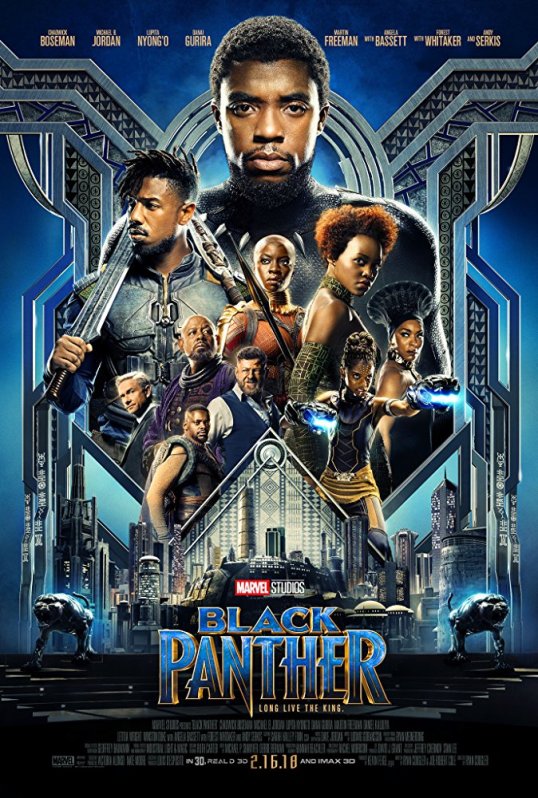
“Black Panther” : Hail To The King


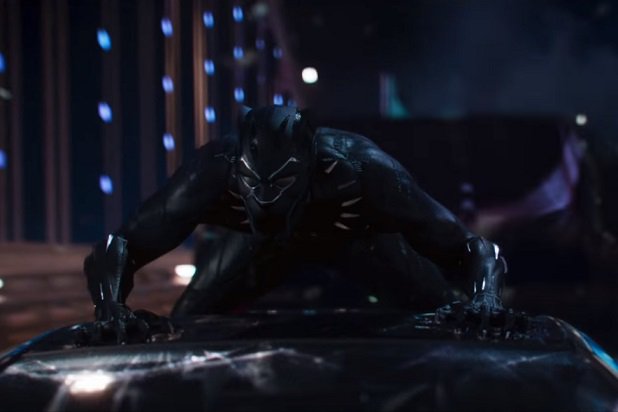
Let’s be honest — as was the case with last year’s Wonder Woman (in fact probably to an even greater degree), Black Panther was a cultural phenomenon before it was even released, and in future it will be examined as such. As something more than a movie. As something that resonated within, and reverberated throughout, the zeitgeist. Its trajectory in that regard is largely unwritten to this point, but can be predicted with a fair amount of certainty : near-universal praise will come first, followed by the inevitable backlash, followed by an almost apologetic, “ya know, maybe we were too hard on this thing that we loved at first” sort of acceptance. If we could just skip all that, and take it as a given, it would save us all a lot of time and effort — but it’s on the way, so tune in or out of all that as you see fit. My concerns here are considerably more prosaic : to talk about the movie as what it began “life” as, to wit — “just” a movie.

For what it’s worth (which may not be much), I’m tempted to agree, to an extent, with those who are pointing out that simply seeing this flick is in no way an act of “resistance” in and of itself : after all, if the fact that the first thing that runs in theaters before the film starts is a commercial for Lexus cars featuring Chadwick Boseman in full Panther gear isn’t enough to clue you in to the reality that, at the end of the day, this is much more about profits than it is about politics, then the product placement within the film itself should do the job — and at the end of the day, one of the largest corporations in the world, founded by noted racist Walt Disney, is still the one making all the money off it. If, then, shelling out ten or fifteen bucks to watch Black Panther is an inherently defiant or dissident act (and I’m not saying it is), then it’s a highly commodified and co-opted one.

All that being said, when a film is released out into the world, particularly a film with as much fanfare attached to it as this one, there are gonna be ripples that emanate out from it — and among the millions of kids, in particular, who watch this flick, the seeds of an interest in African culture are sure to be sown, and the more they follow the metaphorical stalks that grow and flower from those seeds, the more they’ll discover things like historical resistance to colonialism, exploitation, capitalism, and the like. So while Black Panther may not be a radical (or even a particularly political) work in and of itself, it may inspire some radicalism in the future — one can only hope, at any rate.

But that’s pure speculation at this point, so let’s talk about what we know for certain.

One thing anyone who follows this site, or my work anywhere else, absolutely knows is that I’m no fan of Marvel Studios product in general. Unlike, apparently, most people, I find the overwhelming majority of Marvel flicks to be hopelessly redundant, formulaic, lowest-common denominator fare directed in a flat and lifeless “house style” with no particular visual flair, no particularly standout performances, no particular vision to do anything but get audiences keyed up for the next one. They exist as a self-perpetuating celluloid organism, one with no distinct personality but a lot of business sense and promotional muscle. This has been going on for so long, and with so much box office success, that I went into flick essentially expecting more of the same — sure, I knew it had a predominantly-black cast, and was set in Africa (albeit in a fictitious country), but that doesn’t mean that director Ryan Coogler was going to break the mold in any appreciable way. Hell, it doesn’t even mean that he would be allowed to do so. Happily, my pessimism was turned on its ear almost from word the word “go” here.

Black Panther looks different, feels different, because it is different. Coogler and co-screenwriter Joe Robert Cole certainly capture the dynamism, the energy, the Afro-futurism that has been a part of King T’Challa’s backstory since Jack Kirby created the character and his world (nope, we don’t lay any credit at Stan Lee’s feet around these parts, but I’m not getting into the “whys and wherefores” of that right now because, shit, I don’t have all night), but advance it all considerably, absorbing the extra layers added onto the mythos by the likes of Don McGrregor, Billy Graham, Christopher Priest, Reginald Hudlin, and Ta-Nehisi Coates over the years, and coming out with something uniquely suited to cinema and very much of the “now.” There’s a hard-driving and kinetic sense of energy to this film that the so-called “MCU” has been missing since it inception, and if you’re among the small number of those who agree with my assessment that most of these flicks play out more like two-hour TV episodes than proper movies, you can relax : this is as bold, brash, and big as it gets. This is blockbuster fare not only in name, but in execution, with visual effects that amaze, sets that inspire awe, cinematography that commands attention, action that sizzles, a script that charges forward, and music that slicks that trajectory along. This is arresting cinema that doesn’t even give you the option to leave your seat.

But what of the acting, you ask? It ranges from good to great, and thankfully the great includes the key players : Chadwick Boseman is regal yet human, fallible, relatable in the film’s central role: Forest Whitaker embodies aged wisdom tinged with regret as high priest Zuri; Michael B. Jordan is the first truly formidable villain, crucially one with a compelling backstory and some entirely valid philosophical viewpoints, as Killmonger; Martin Freeman not only reprises, but considerably expands, his already-extant “MCU” role of CIA agent Everett K. Ross with heart, humor, and brains; Sterling K. Brown makes the most of limited but significant screen time as T’Challa’s late uncle, N’Jobu; Andy Serkis — as a human this time! — chews up the screen with dangerous charm as Ulysses Klaue (or “Klaw,” as the comics would have it). These guys are all tops, really. And yet —

It is the women that carry this film. Whether we’re talking about Lupita Nyong’o as T’Challa’s love interest Nakia, a determined, fiercely independent, and soulful force that isn’t just her partner’s “equal,” but his conscience; Danai Gurira as General Okoye, head warrioress of the Dora Milaje, who embodies martial discipline and loyalty with the controlled fury of a hurricane ready to strike at any moment; Angela Basset as Queen Mother Ramonda, a living embodiment of grace, stature, and tradition; or Letitia Wright as younger sister Shuri, part “Q” to T’Challa’s “Bond,” part grounding and humanizing influence, part Moon Girl-style intellectual prodigy — as in life, it is the women that both make this movie’s men what they are, while also being complete and fully-realized in and of themselves. African history is far less patriarchal than is commonly believed, and in Wakanda that proud matriarchal lineage is exemplified, modernized, magnified — and honored.

Most films reflect the moment. Others define the moment. Black Panther goes one further by creating the moment. It’s as near to flawless as big-budget blockbusters get and eschews the too-common-flaw that movies made on this scale have of dumbing things down to appeal to the masses. Coogler and company instead trust those same masses to be intelligent enough to meet them on their level, and to respond to being talked “up,” rather than “down,” to. By believing that the world was not just ready, but eager, for something that goes far beyond mere spectacle — something that challenges the intellect while speaking to the heart — they have woken what could very well be a sleeping giant.

Now, let’s just keep our fingers crossed they’ve spurred that giant to do something more than simply go out and buy luxury cars.

Cleaning Out The DVR: Consenting Adults (dir by Alan J. Pakula)


(Lisa is currently in the process of cleaning out her DVR!  It’s going to take a while because Lisa has over 200 things recorded.  However, one thing is for sure: it’s all getting erased on January 15th.  Will Lisa be able to watch everything before doomsday?  Keep checking here to find out!  She recorded the 1992 thriller, Consenting Adults, off of Cinemax on February 22nd!)

Consenting Adults is a rather silly film from 1992, one which starts out as a typical sex-and-sin-in-suburbia type of film and then turns into something else.  It was directed by the distinguished director, Alan J. Pakula and the cast features people who have been nominated for (and, in some cases, won) multiple Oscars, Tonys, and Emmys.  It also features the daughter of somewhat overrated playwright, Arthur Miller.

“Wow!,” you’re saying, “who exactly is in this film?”

Well, there’s Kevin Kline and Mary Elizabeth Mastrantonio.  They play a seemingly happy married couple.  They have a nice house in the suburbs.  Kevin Kline has a good job as a composer.  Mary Elizabeth Mastrantonio has really pretty hair.  It should be a perfect life but they’re both secretly bored with their safe marriage.

And then there’s Rebecca Miller.  She’s the wife of the new neighbor.  She does thing like sing and bathe in front of an open window, allowing Kline to peek in at her.  She’s also apparently murdered about halfway through the film.  As the result of a wife-swapping scheme that was suggested by his neighbor, Kevin Kline’s semen is found in her body.  Kline goes to jail for murder.  His wife divorces him and marries the neighbor.  Hmmm….does it sound like maybe someone set Kline up?

That’s what Forest Whitaker thinks!  Whitaker plays an insurance agent who is investigating Kline’s neighbor.  It seems that the neighbor has made most of his money through insurance fraud.  Whitaker looks incredibly young in Consenting Adults.  He’s probably the most likable person in the film.  He seems to be amused by it all.

“Hey,” you’re saying, “you keep mentioning this neighbor but you have yet to tell us who played him.  You just keep saying, ‘the neighbor,’ which seems kinda awkward…”

I’m getting to the neighbor!  The neighbor is the evil genius behind all of Kevin Kline’s misfortune.  He’s a totally and thoroughly evil suburbanite and, even when he’s pretending to be a good guy, he doesn’t make much of an effort to hide the fact that he’s not to be trusted.  In fact, you could argue that Kline and Mastrantonio both had to be complete idiots to trust this guy in the first place.  That’s kind of one of the problems with this movie.   Not only is the neighbor’s scheme ludicrously complicated but, in order for it to work, he had to find two of the stupidest people ever…

“We get it, Lisa,” you’re saying, “Just tell us who plays this super villain neighbor!”

Uhmmm… *whispers* Kevin Spacey.

When I saw Consenting Adults on my DVR and I also saw that it starred Kevin Spacey, I figured that I would watch it as a test.  After everything that’s come out about Kevin Spacey, is it still possible to watch him in a movie and forget about the fact that you’re watching Kevin Spacey?  Or does Spacey’s very presence now make it impossible to watch any of his previous films?  In the grand scheme of things, of course, that should be the least of our concerns when it comes to Kevin Spacey but still, regardless of who he may be as a human being, he has appeared in some very good movies.

Of course, I quickly learned that Consenting Adults is not one of those very good movies.  That was obvious from the very first scene, which featured Kevin Kline looking like a madman while composing some of the most maudlin and less interesting music that I’ve ever heard.  In fact, Consenting Adults turned out to one the silliest movies that I’ve ever seen.

As for Kevin Spacey, he is cast as a cold-hearted narcissist who hides his true self underneath a charming and witty facade.  I think a lot of people would watch this film and assume that Spacey is basically playing himself.  (I have to admit that was pretty much my reaction, despite the fact that I usually try to separate the art from the artist.)  Since Spacey’s playing a loathsome villain, his presence doesn’t make Consenting Adults any more or any less difficult to sit through.  If anything, you really can’t wait to see him get his comeuppance.

(So, I guess the real Spacey test will be whether or not I can still watch L.A. Confidential and Baby Driver.)

Anyway, Consenting Adults is occasionally entertaining in an over-the-top, WTF is going on sort of way.  Spacey’s scheme is just so out there and makes so little sense that you can’t help but be impressed that everyone making the film kept a straight face.  Otherwise, this is a truly forgettable movie.

Horror on TV: The Twilight Zone “It’s Still A Good Life” (dir by Allen Kroeker)


Tonight’s televised horror is another episode of the 2002 revival of The Twilight Zone.

In fact, it’s a sequel to a classic episode that aired during the show’s original run!

Remember that episode about the creepy little kid in Ohio who could read thoughts and mentally make just about anything happen?  He wanted it to snow so it snowed and ruined the crops.  He got mad at someone who drank too much so he turned the guy into a big jack-in-the-box.  His aunt sang too much so he took away her mouth.  That episode was called “It’s A Good Life.”

Well, It’s Still A Good Life catches up with that boy 41 years later.  He’s still ruling that little town with an iron hand but now, he’s got a daughter.  And she might have powers of her own…

Bill Mumy and Cloris Leachman both appeared in the original episode and they reprise their roles here.

Enjoy!

Horror on TV: The Twilight Zone 1.9 “The Pool Guy” (dir by Paul Shapiro and Brad Turner)


For tonight’s excursion into the world of televised horror, we have an episode from the 2002 revival of The Twilight Zone.

In The Pool Guy, Richie (Lou Diamond Philips) is a pool cleaner with a problem.  While his clients appear to believe that Richie is living a glamorous life straight out of a bad suburban melodrama, Richie actually feels as if his life is going nowhere.  He’s never even gotten seduced by a bored housewife!  Maybe Richie just isn’t a very good pool guy…

However, Richie has another problem, on top of all that.  A man keeps mysteriously appearing and telling him to “Wake up!” before then shooting him.  Immediately after getting shot, Richie wakes up somewhere else, just to once again be approached by the same man.

What is going on and why is Richie being charged $12,000 for the experience!?

Over the years, there have been quite a few attempts to revive The Twilight Zone and the results have always been mixed.  The 2002 revival featured Forest Whitaker as the host and was canceled after just one season.  That said, The Pool Guy is actually pretty good.  Philips gives a good performance and the episode’s central mystery is an intriguing one.

This episode originally aired on October 16th, 2002!

Enjoy!


A Movie A Day #262: Downtown (1990, directed by Richard Benjamin)


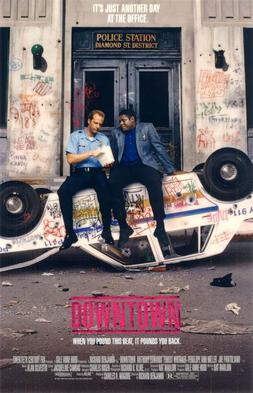
Alex (Anthony Edwards) is a patrolman assigned to the nicest neighborhood in Philadelphia but, after he gets in trouble for pulling over a wealthy businessman (David Clennon), he is told that he can either be suspended or he can take a transfer downtown, to the Diamond Street precinct.  Alex takes the transfer, even though everyone on the force says that “not even the Terminator would go to Diamond Street.”  Alex gets assigned to work with seasoned Sgt. Dennis Curren (Forest Whitaker), who is still emotionally scarred by the death of his former partner and does not want to have to babysit a naive white cop from the suburbs, especially one who is obsessed with the Beach Boys.  At first, Alex struggles with his new assignment and his new partner but, when an old friend is murdered by a notorious hitman (Joe Pantoliano), Alex is determined to crack the case and bring the killer to justice.
Downtown is a combination of other, better cop films: Alex’s situation is Beverly Hills Cop in reverse and his partnership with Dennis is lifted straight from Lethal Weapon.  Art Evans is the captain who is always yelling at Alex and Dennis and telling them to drop the case and the character is so familiar that I had to check to make sure that Evans had not played the same role in Lethal Weapon.  As the bad guys, Clennon and Pantoliano could just have easily been replaced by Beverly Hills Cop‘s Steven Berkoff and Jonathan Banks and no one would have noticed.  The only real difference is that Downtown is neither as exciting nor as funny as those two films.  Downtown was directed by Richard Benjamin, who will never be known as a particularly versatile filmmaker and who struggles to balance the fish-out-of-water comedy with some surprisingly brutal violence.  Beverly Hills Cops had Eddie Murphy and Lethal Weapon had Mel Gibson and Danny Glover.  Downtown has Anthony Edwards and Forest Whitaker, who are both good actors but who both seem to be woefully miscast here.  (If Downtown were made today, Whitaker could play Dennis but, in 1990, he was too young to be the cop who was “too old for this shit.”)    Of the many Lethal Weapon ripoffs that came out in late 80s and early 90s, Downtown is one of the most forgettable.


A Movie A Day #246: Bloodsport (1988, directed by Newt Arnold)


Bloodsport is one of Jean-Claude Van Damme’s earliest films and it is Damme good!

Forgive the terrible opening line but that is how they actually used to advertise Jean-Claude Van Damme films.  Everything was either Damme exciting or Damme amazing or Damme spectacular.  Though it was made by Cannon and had a much lower budget than the films Van Damme made during his 90s heyday, Bloodsport is still a Damme quintessential Van Damme movie.

Bloodsport claims that the story it tells is true.  Frank Dux (Van Damme) is a U.S. Army captain who goes AWOL so he can compete in Kumite, an illegal martial arts tournament that is held in Hong Kong.  Kumite is the only martial arts tournament where it is legal to kill your opponent.  Chong Li (Bolo Yeung) became champion by killing anyone who lasts more than a minute with him.  At first, no one believes that an American like Frank Dux has a chance of winning the Kumite.  What they do not know is that Frank was trained by the legendary Senzo Tanaka.  Frank is not just competing for personal glory.  He is also competing in honor of Tanaka’s dead son.

Bloodsport is both Van Damme and Cannon Films at their best.  Shot on location in Hong Kong, Bloodsport not only features Van Damme doing his thing but also gives him a memorable sidekick, Ray Jackson (Donald Gibb), who talks like a professional wrestler and gets all of the best lines.  When Ray and Frank first meet, they bond over a video game that appears to be an extremely early version of Street Fighter.  Also keep an eye out for Forest Whitaker (!), playing one of the CID officers who is assigned to track down Frank and arrest him for desertion.

Like any good Van Damme film, Bloodsport lives and dies on the strength of its fights and it does not skimp on the blood, the chokeholds, or the high kicks.  Bolo Yeung is a great opponent for Van Damme but everyone know better than to try to beat Jean-Claude Van Damme.  When it comes to fighting Van Damme, Duke put it best:

Playing Catch-Up: Arrival (dir by Denis Villeneuve)


arrival_movie_poster

I cannot begin to express how happy I was when I learned that the Directors Guild of America had nominated Denis Villeneuve for his work on Arrival.

Arrival was one of the best films of 2016.  In fact, I would argue that it’s one of the best science fiction films that I’ve ever seen.  There were a lot of reasons for that, of course.  There was the brilliant script by Eric Heisserer.  There was the starring performance of Amy Adams, who is one of the best actresses working today.  There was a surprise and thought-provoking twist, one that forced you to reconsider everything that you previously believed.  There were so many reasons why Arrival was a great film but, ultimately, it call came down to Denis Villeneuve.

Working with material that would have led most directors down the road to bombast, Villeneuve instead took a deliberately low-key approach.  Whereas most directors would have encouraged their cast to play up the drama, Villeneuve encourages his actors to take a more inward and cerebral approach to the material.  Arrival is a rarity — a film about smart people in which the people actually seem to be smart.  For once, we don’t need expositionary characters to pop up and tell us that Louise Banks (Amy Adams) and Ian Donnelly (Jeremy Renner) are brilliant.  Instead, we simply believe they are from what we see on the screen.  Much like last year’s Sicario, Arrival proves that Villeneuve is a visionary director.

Arrival is a hard film to describe, not because it’s overly complicated but because there’s a huge twist that I really can’t reveal.  Before the twist, Arrival is simply a well-directed sci-fi film.  After the twist, it is something all together different, an intense meditation on faith, love, language, and destiny.  Since I’m reviewing the film late, chances are that you already know about the twist but I’m still not going to spoil it.

What I can tell you is that Arrival opens with the arrival of twelve spaceships, all of which land at different places across the world.  The Chinese have a spaceship.  The British have a spaceship.  I imagine that the Canadians have a spaceship, because who wouldn’t want to hang out with the Canadians?  And, of course, the Americans have a spaceship.  The aliens are inside the spaceships.  They’re octopus-like creatures, ones that almost look as if they could have come from one of Lovecraft’s Cthulhu stories.  The aliens may appear to be fearsome but they actually seem to be rather benevolent.  No one’s quite sure because the aliens communicate through a complex series of symbols and nobody can understand what those symbols mean.

Louise Banks is a linguist.  Ian Donnelly is a physicist.  The Americans bring both in to help translate the symbols.  Of course, the rest of the world has their own linguists and physicists working to translate the symbols and, humans being humans, it often seems that the Americans and the Chinese are less concerned with translating what the aliens are saying and more concerned with being the first to understand.  While Louise works, she continues to be haunted by dreams and visions of her daughter’s death from cancer.

And that’s really all I can tell you without spoiling the film and potentially making myself cry.  But I will say that if you haven’t seen Arrival, you must go out and see it now.  It’s one of the most thought-provoking and emotionally wrenching films of the past year.

Add to that, it’s probably going to be nominated for best picture.  It’s been overshadowed a bit by all the attention paid to La La Land, Moonlight, and Manchester By The Sea.  But Arrival is just as good a film as any of them.  In fact, in the future, we’ll probably look at Arrival and say that it was better than all of them.


No Ewoks, No Jar Jar: Rogue One: A Star Wars Story (2016, directed by Gareth Edwards)


rogue_one_a_star_wars_story_posterA long time ago in a galaxy far, far away…
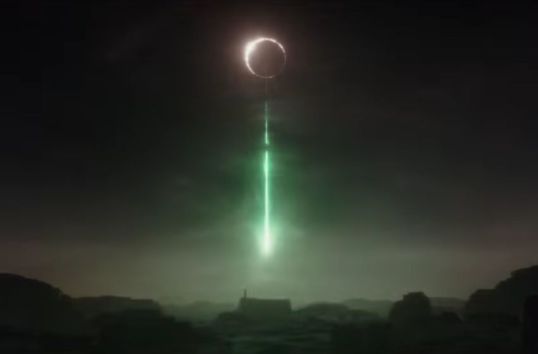
The evil Galactic Empire spent what had to be billions of Imperial credits to build the greatest weapon in the universe.  It was known as the Death Star and it housed a laser so powerful that it could blow up a planet with just one shot.  And yet, for all the effort and all the years that were spent building it, the Death Star had one glaring vulnerability, an exposed exhaust valve that the Rebel Alliance twice used to the destroy it.

For years, fanboys debated why the Empire would go to the trouble to build a super weapon with such an obvious design flaw.  I have to admit that I was often one of them.  No one else seemed to care but, to us, this was a huge deal.  If the Empire could figure out how to blow up a planet with one super laser, why couldn’t they figure out how to protect that one valve?

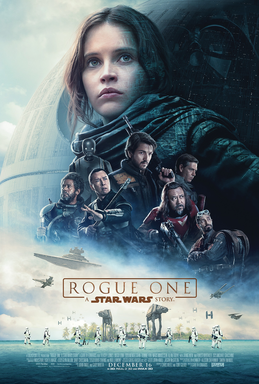
Now, thanks to Rogue One: A Star Wars Story, we have an answer.  We not only know why that valve was there but we also know what was meant in New Hope when the rebel general said that the plans to the Death Star had been stolen at great cost.

Rogue One is a fan’s dream, one that answers questions while expanding on the Star Wars mythology.  Unlike the previous prequels, it adds to the story without cheapening the original films.  In fact, of all the Star Wars films, Rogue One is the first to make the Death Star into a believable weapon of mass destruction.  When it appears over one planet, it blots out the sun.  When it blows up a rebel base, we see the destruction from inside the base instead of observing it from the safety of Death Star.  Director Gareth Evans does for the Death Star what he previously did for Godzilla.

death-star

Unfortunately, like Godzilla, the action and the special effects in Rogue One are usually more interesting than any of the film’s characters.  Felicity Jones, Diego Luna, Donnie Yen, Jiang Wen, Alan Tudyk, and Riz Ahmed are all good actors but they’re all playing underwritten parts.  No one steps up like Harrison Ford did in the original trilogy.  Commander Kennec, played by Ben Mendelsohn, has a little more depth than the typical Imperial villain but, for better or worse, the film’s most memorable performances come from a CGI Peter Cushing and James Earl Jones providing the voice of Darth Vader.

rogue-one

Despite the underwritten characters, Rogue One is still the best Star Wars film since Empire Strikes Back, a return to the grittiness, the thrilling action, and the awe of discovering new worlds that distinguished the first two movies.  For once, a Star Wars film seems to have more on its mind than just selling toys.  Though we already know what is ultimately going to happen to the Death Star at the end of New Hope, Rogue One is a frequently downbeat film.  There are no Ewoks and, to great relief and rejoicing, Jar Jar is never seen.  The closest that Rogue One gets to comic relief is Alan Tudyk providing the voice of a cynical robot.  The emphasis is on the horrors of war and even the rebels are troubled by some of the things that they have done.  For once, the Rebel Alliance actually feels like a rebellion and the evil of the Empire feels real instead of cartoonish.

Rogue One is projected to be the first of many “Star Wars stories,” stand-alone film that will expand the universe and hopefully clarify some of the points that were left unclear by the original trilogy.  I think it’s going to be very successful very Disney.  I’m just dreading the inevitable Jar Jar origin story.


Rogue One: A Star Wars Story Official Trailer Finally Arrives


Rogue One

The Rogue One official trailer finally came out after weeks of fans waiting for it since last month’s Star Wars celebration over in London.

At first, people thought the trailer would be released during the celebration, but that didn’t come to pass. Then San Diego Comic-Con came and went and still no official trailer. We already seen the teaser, the sizzle reel from London celebration and even a tv spot that aired in the last week or so. Yet, there was still no full trailer. Fans were waiting with extreme patience.

Once news came down that the first official trailer will show during the Olympics the guessing game began on which day it will be. When it was confirmed that it was to be tonight people worldwide began to wait for the trailer to premiere. And waited during each Olympic event. And waited some more. I, myself, decided I needed a nap and left orders to be awoken when it finally did show.

Well, it did show just an hour into my nap and despite being groggy from being woken up that first image of the desert planet with Forest Whitaker and Felicity Jones conversing got my full attention. The wait was long, but it was well worth it and now the wait for the film’s premiere begins.

Rogue One: A Star Wars Story is set for a December 16, 2016 release date.