Review: The Hunted (dir. by William Friedkin)


“Once you are able to kill mentally, the physical part will be easy. The difficult part… is learning how to turn it off.” — L.T. Bonham

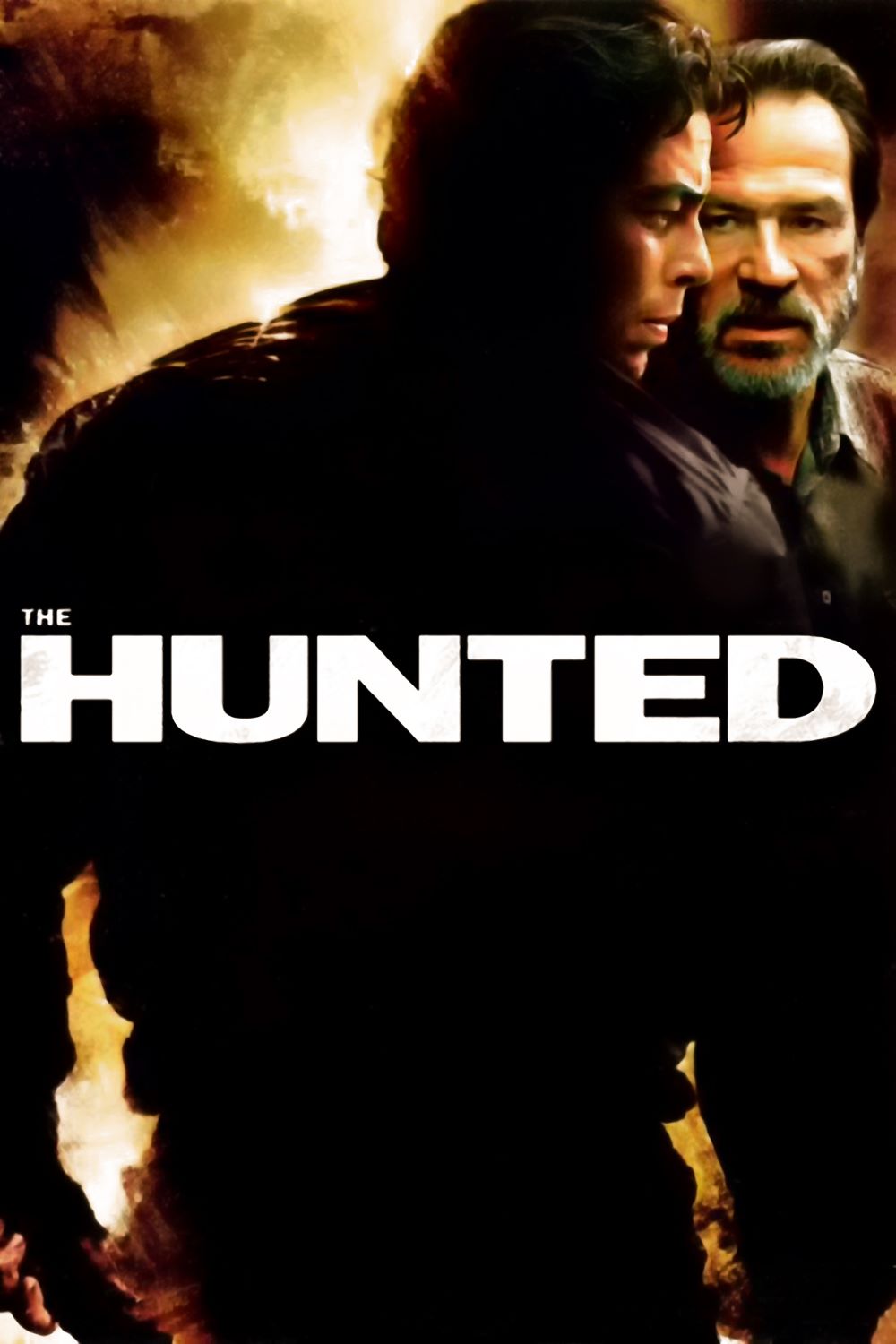
The Hunted (2003) is one of those films that feels like it slipped through the cracks of early 2000s cinema—a gritty, atmospheric thriller directed by William Friedkin, a filmmaker whose name alone should’ve guaranteed more attention. Friedkin, the man behind The French Connection and The Exorcist, has always had a knack for tension and raw, almost documentary-like realism, and The Hunted carries that same DNA. It’s not a perfect movie, but it’s a fascinating one, a slow-burn chase film that trades explosive set pieces for mood, character, and a kind of existential dread that lingers long after the credits roll.

The story follows L.T. Bonham, a former survival instructor played by Tommy Lee Jones, who’s called back to help the authorities when a series of brutal murders points to a former student of his, Aaron Hallam, played by Benicio del Toro. Hallam, a highly trained assassin, has gone rogue, and Bonham is the only one who can track him down. The premise is simple, almost minimalist: two men, one hunting the other, with the wilderness of the Pacific Northwest serving as their battleground. There’s no grand conspiracy, no world-ending stakes—just a personal, almost primal duel between mentor and protégé. The film’s strength lies in its refusal to overcomplicate things. It’s a character study disguised as a thriller, and it’s all the better for it.

What’s immediately striking about The Hunted is its pacing. Friedkin doesn’t rush. The film takes its time establishing Bonham’s world—a quiet, isolated life in the woods, where he trains soldiers in the art of survival and combat. There’s a sense of routine, of discipline, and when Hallam re-enters his life, it’s not with a bang but with a whisper. The first act is deliberate, almost meditative, as Bonham pieces together the clues and realizes the man he’s after isn’t just any killer, but someone he once shaped. This isn’t a film about action for action’s sake. It’s about the weight of violence, the cost of skill, and the thin line between hunter and hunted.

Benicio del Toro is the standout here. Hallam is a role that could’ve easily been reduced to a one-dimensional villain, but del Toro imbues him with a quiet, unsettling intensity. There’s a scene early on where Hallam, having just committed a particularly gruesome murder, calmly walks away from the crime scene, his face a mask of detached focus. It’s chilling not because he’s raging or unhinged, but because he’s so controlled. Hallam isn’t a monster in the traditional sense; he’s a man who’s been trained to kill and has embraced that role with terrifying efficiency. Del Toro plays him with a stillness that’s unnerving, his eyes always calculating, always three steps ahead. It’s a performance that relies more on presence than dialogue, and it’s one of his most underrated.

Tommy Lee Jones, on the other hand, is a different kind of compelling. Bonham is a man of few words, a hardened veteran who’s seen too much to be rattled by much. Jones, with his gravelly voice and weathered demeanor, sells the role of a man who’s spent a lifetime in the shadows. There’s a weariness to him, a sense that he’s not just chasing Hallam to stop the killings, but to confront his own past. The dynamic between the two is electric, even when they’re not in the same scene. Their eventual face-to-face encounters crackle with tension, not because of what they say, but because of what they don’t. These are two men who understand each other on a level that most people never will, and that mutual recognition makes their conflict all the more tragic.

Friedkin’s direction is, as always, masterful in its restraint. He’s never been one for flashy camerawork or overly stylized shots, and The Hunted is no exception. The cinematography is stark and functional, emphasizing the cold, unforgiving landscape of the Pacific Northwest. The forests, rivers, and small towns feel like characters in their own right, vast and indifferent to the human drama unfolding within them. There’s a scene where Bonham and a local sheriff, played by Connie Nielsen, track Hallam through the woods. The camera lingers on the trees, the mud, the rain—details that ground the film in a tangible, almost tactile reality. It’s not just a chase; it’s a test of endurance, both physical and psychological.

The film shares some striking thematic ground with First Blood, another story about soldiers haunted by what they’ve seen and done in war. Both films explore men who are not just racked with guilt but suffering from PTSD, their minds fractured by the horrors of combat. But where First Blood ultimately offered a glimmer of hope—that understanding and redemption might be possible—The Hunted takes a far bleaker view. Bonham and Hallam aren’t just damaged; they’re broken in ways that can’t be fixed. Hallam, in particular, represents the idea that some soldiers simply cannot come back from the brink of their experiences. There’s no catharsis for him, no moment of clarity or salvation. The film suggests that for some, the training and the trauma run too deep, and the only way out is through violence. It’s a brutal, unflinching perspective that sets The Hunted apart from more sentimental takes on the same themes.

The film’s action sequences, when they do arrive, are brutal and concise. There’s no shaky cam or rapid editing here—Friedkin lets the violence unfold in long, unflinching takes. A knife fight in a motel room is particularly memorable, not for its choreography, but for its rawness. It’s messy, desperate, and over in seconds. There’s no glorification, no slow-motion heroics. Just two men trying to kill each other in the most efficient way possible. It’s a far cry from the hyper-stylized action of the era, and it’s all the more effective for it.

Unfortunately, the film’s strengths are bogged down by its weaknesses, particularly in how it handles its secondary characters. The supporting cast, including Connie Nielsen as the sheriff, often feel thinly written, existing primarily as obstacles to delay the inevitable showdown between Bonham and Hallam. Their motivations and personalities are barely sketched out, making them feel more like narrative speed bumps than fully realized people. It’s frustrating because the film’s core dynamic is so compelling that these underdeveloped side characters only serve to slow down the momentum. And despite its brisk 90-plus minute runtime, The Hunted still manages to drag at times. The deliberate pacing that works so well in establishing atmosphere starts to feel indulgent when the story isn’t moving forward, leaving the audience waiting for the next meaningful interaction between its two leads.

If The Hunted has other weaknesses, it’s that it might be a little too restrained for some viewers. The slow burn won’t be for everyone, especially in an era where audiences have come to expect constant stimulation. The film demands patience, and those who aren’t willing to meet it on its terms might find it dull. There are also moments where the plot feels a bit thin, as if Friedkin and screenwriter Art Monterastelli were more interested in atmosphere than narrative complexity. But that’s also part of its charm. The Hunted isn’t trying to be a puzzle-box thriller or a high-octane spectacle. It’s a mood piece, a meditation on violence and the men who wield it.

The ending, without spoiling too much, is ambiguous in a way that feels true to the film’s themes. There’s no neat resolution, no easy answers. It’s a conclusion that lingers, forcing the audience to sit with the uncomfortable questions it raises. Is justice served? Is Hallam truly defeated, or is he just the first of many? The film doesn’t provide answers, and that’s to its credit. It’s more interested in the journey than the destination, in the hunt rather than the catch. While First Blood left room for healing, The Hunted closes the door on that possibility for some, reinforcing its bleak worldview.

In the grand scheme of Friedkin’s filmography, The Hunted might not rank alongside his most iconic works, but it’s a fascinating entry in his body of work. It’s a film that feels out of time, both in its style and its themes. Released in 2003, it arrived in a cinematic landscape dominated by CGI spectacle and franchise filmmaking, and it’s easy to see why it didn’t make a bigger splash at the time. But for those willing to seek it out, The Hunted is a hidden gem—a tense, thought-provoking thriller that rewards patience and close attention. It’s a film about the cost of violence, the weight of the past, and the thin line between the hunter and the hunted. And in an era where action movies often prioritize style over substance, its grounded, no-nonsense approach feels like a breath of fresh air.

Bully (2018, directed by Santino Campanelli)


Sixteen year-old Jimmy Mulligan (Tucker Albrizzi) is a nice kid with a big problem.  His high school is ruled by a gang led by a bully named Miles (Jack DiFalco) and the overweight and quiet Jimmy has become the gang’s number one target.

Miles has decided that Jimmy owes him a hundred dollars.  Even though Jimmy has never borrowed any money from Miles and is obviously not from a family that would have a hundred dollars to just toss around, Miles insists that Jimmy is in his debt.  When Jimmy refuses to pay, Miles beats the poor kid while he’s walking home from school.  However, the beating is observed by a retired boxer named Clarence “Action” Jackson (Ron Canada).  Action runs off Miles and then he makes Jimmy an offer.  He’ll help Jimmy learn how to box as long as Jimmy agrees to only use his skills for self-defense.  At first Jimmy and his parents are reluctant but, after he gets beaten up for a second time, it’s time to go to Manny’s Gym!

Manny (Danny Trejo!), who is a legendary trainer, takes Jimmy under his wing and teaches him how to throw a punch and avoid a jab.  Soon, Jimmy is losing weight, gaining confidence, and even going out on a date with a supercool goth girl named Adrian (Elanna White).  But Miles still wants his money and eventually, Jimmy is going to have to put his training to use.

In many ways, Bully is every bullied kid’s dream.  Not only does Jimmy learn how to throw a punch and get a girlfriend but he also gets to hang out with Danny Trejo!  Manny is a tough but funny guy with a rough past but a good heart and he is using his skills to try to make the world a better place.  The same can be said for Danny Trejo himself, so he’s the perfect choice to play Manny.  Ron Canada is also good as Action Jackson, bringing a lot of quiet dignity to the part.  Tucker Albrizzi does a good job of going from being insecure to being confident.

It’s just too bad that the film itself isn’t better.  Bully has good intentions but the execution is lacking.  The movie kept suggesting that there would be a scene where Jimmy had to chose between using his new skills for revenge or just for self-defense but it never happened.  There were too many scenes that did not seem to go anywhere and, for all of the build-up, the final fight between Jimmy and Miles was anti-climatic and confusingly filmed.  During the final 15 minutes, several new characters show up and suddenly become central to the story.  Somehow, the Mafia finds out about the fight and takes an interest in whether or not Jimmy is going to be able to beat up Miles.  On the one hand, it’s cool because Vincent Pastore is one of the gangsters but on the other hand, what’s going on?  Why are they there?

Danny Trejo’s cool, though.  That counts for a lot.

Above Suspicion (1995, directed by Steven Schachter)


Dempsey Cain (Christopher Reeve) is a former test pilot turned homicide detective who ends up getting shot because of the incompetence of another cop, a patrolman named Nick Cain (Edward Kerr).  Nick also happens to be Dempsey’s younger brother.  While Dempsey’s in the hospital, Nick has an affair with Dempsey’s wife, Gail (Kim Cattrall).  When a now-paralyzed Dempsey returns home, he deals with his depression by drinking and contemplating suicide.  He tells Gail and Nick that he no longer wants to live but that his life insurance policy doesn’t cover suicide.  He comes up with a plan for his wife and brother to stage a break-in and murder him.  Because Gail and Nick are secretly lovers and want Dempsey out of the way, they agree.  However, it turns out that Dempsey isn’t as naive as they assumed and he still has a few tricks of his own.  It looks like the perfect murder but Detective Alan Reinhardt (Joe Mantegna) is determined to solve the case.

Produced for HBO, Above Suspicion is a clever and twisty film noir that, unfortunately, never escapes the shadow of Reeve’s real-life tragedy.  Just a week after the film first aired on HBO, Christopher Reeve was suffered the spinal chord injury that left him confined to a wheelchair for the rest of his life.  Knowing that Reeve would spend the final nine years of his life paralyzed from the neck down can make it difficult to watch Above Suspicion, which is unfortunate because this film features what might be Reeve’s best performance.

As an actor, Christopher Reeve was always typecast as Superman and he definitely missed out on some roles as a mistake.  Above Suspicion makes clever use of Reeve’s good guy image but casting him as someone who everyone thinks is a hero but who actually has a very dark side to his personality.  Everyone in the film thinks of Dempsey as being Superman but he instead reveals himself to be Lex Luthor.  It was definitely a chance of pace role for Reeve and he really seems to enjoy playing a scheming villain for once.  Watching the film today, it is obvious that he had enough talent that, if not for his injury, he probably would have eventually made an Alan Alda-style comeback that would have seen him settling into the role of being a much-in-demand character actor.

Interestingly, the clever script was written by William H. Macy, shortly before he found fame as Jerry Lundegaard in Fargo.  The film is a clever homage to films like Double Indemnity and The Postman Always Ring Twice and Christopher Reeve and Joe Mantegna are both fun to watch as they play their cat-and-mouse game.  Despite the real-life tragedy that it unintentionally invokes, Above Suspicion is a clever and twisty thriller featuring a cast of talented actors at their best.


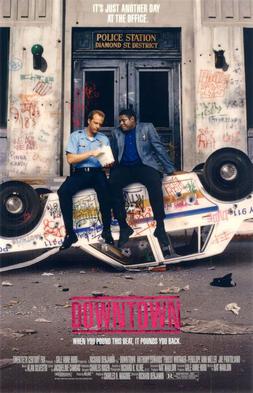
A Movie A Day #262: Downtown (1990, directed by Richard Benjamin)


Alex (Anthony Edwards) is a patrolman assigned to the nicest neighborhood in Philadelphia but, after he gets in trouble for pulling over a wealthy businessman (David Clennon), he is told that he can either be suspended or he can take a transfer downtown, to the Diamond Street precinct.  Alex takes the transfer, even though everyone on the force says that “not even the Terminator would go to Diamond Street.”  Alex gets assigned to work with seasoned Sgt. Dennis Curren (Forest Whitaker), who is still emotionally scarred by the death of his former partner and does not want to have to babysit a naive white cop from the suburbs, especially one who is obsessed with the Beach Boys.  At first, Alex struggles with his new assignment and his new partner but, when an old friend is murdered by a notorious hitman (Joe Pantoliano), Alex is determined to crack the case and bring the killer to justice.
Downtown is a combination of other, better cop films: Alex’s situation is Beverly Hills Cop in reverse and his partnership with Dennis is lifted straight from Lethal Weapon.  Art Evans is the captain who is always yelling at Alex and Dennis and telling them to drop the case and the character is so familiar that I had to check to make sure that Evans had not played the same role in Lethal Weapon.  As the bad guys, Clennon and Pantoliano could just have easily been replaced by Beverly Hills Cop‘s Steven Berkoff and Jonathan Banks and no one would have noticed.  The only real difference is that Downtown is neither as exciting nor as funny as those two films.  Downtown was directed by Richard Benjamin, who will never be known as a particularly versatile filmmaker and who struggles to balance the fish-out-of-water comedy with some surprisingly brutal violence.  Beverly Hills Cops had Eddie Murphy and Lethal Weapon had Mel Gibson and Danny Glover.  Downtown has Anthony Edwards and Forest Whitaker, who are both good actors but who both seem to be woefully miscast here.  (If Downtown were made today, Whitaker could play Dennis but, in 1990, he was too young to be the cop who was “too old for this shit.”)    Of the many Lethal Weapon ripoffs that came out in late 80s and early 90s, Downtown is one of the most forgettable.


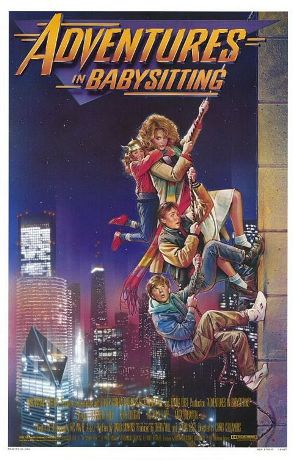
Back to School Part II #23: Adventures in Babysitting (dir by Chris Columbus)


adventures_in_babysitting

One unfortunate thing about both being the youngest of four and having a teenage reputation for being a little out of control is that I never got a chance to be a babysitter.  Whenever my mom wasn’t around, my older sisters were in charge.  When I was technically old enough to look after other children, nobody was willing to trust me with them.  So, I missed out on babysitting and…

Well, to be honest, that never really bothered me.  I was too busy either having too much fun or no fun at all to worry about any of that.  But maybe I should have because, whenever I watch the 1987 film Adventures in Babysitting, I’m always left convinced that I could have been a kickass babysitter.  Seriously, if Elisabeth Shue could still get babysitting jobs even after taking the kids into downtown Chicago and nearly getting them killed, then anyone could do it!

In Adventures in Babysitting, Chris Parker (Elisabeth Shue) is a responsible 17 year-old who lives in the suburbs of Chicago.  (As anyone who seen The Breakfast Club, Sixteen Candles, and Ferris Bueller’s Day Off can tell you, being a teenager in 1980s meant living in Illinois.)  When we first meet Chris, she’s getting ready for her anniversary date with her boyfriend, Mike Todwell (Bradley Whitford, years before achieving fame by playing assorted pompous jerks in assorted Aaron Sorkin productions) and she’s dancing around her bedroom.  There’s an important lesson to be learned from the opening of Adventures in Babysitting: if you want me to relate to a character, introduce her while she’s dancing in her bedroom.  Seriously, though, the whole film succeeds because of that opening bedroom dance.  Chris is instantly likable and relatable.  You want to see her succeed and achieve what she wants.

So, of course, we’re all disappointed when Mike shows up and breaks his date with Chris.  That said, as upset as Chris may be, she’s still willing to take the time to try to talk her friend Brenda (Penelope Ann Miller) out of trying to poison her stepmother with Drano.  That’s a true friend.

With nothing else to do, Chris ends up taking a babysitting job.  She has been tasked to look after 8 year-old Sara Anderson (Maia Brewton) and Sara’s brother, 15 year-old Brad (Keith Coogan).  Sara is a bit of a brat, though she’s also generally well-meaning and is obsessed with comic books (Thor, in particular).  Brad is likable but dorky.  He has a huge crush on Chris and even turns down a chance to spend the night at a friend’s, just so he can be around her.

Brad’s friend, incidentally, is Daryl (Anthony Rapp, who would later play Tony in Dazed and Confused and who starred in the original Broadway production of Rent).  Daryl is a hyperactive perv who is obsessed with Chris because she resembles the centerfold in one of his dad’s Playboys.  Daryl decides that, if his friend Brad can’t visit him, then maybe he should visit Brad!

However, Chris has more to worry about than just looking after Sara, Brad, and Daryl.  Brenda has attempted to run away from home and now she’s stuck in a downtown bus station!  Her glasses have been stolen and, as a result, Brenda is doing things like picking up a giant rat and calling it a kitten.  Brenda uses her last bit of money to call Chris and beg her to come pick her up.

(Of course, none of this would happen today.  Brenda wouldn’t have to use a pay phone to call Chris and she could just call Uber to get a ride home.)

So, Chris and the kids drive into Chicago and, needless to say, things quickly fall apart.  They get a flat tire on the expressway.  Chris panics when she discovers that not only does she not have a spare tire but she also left her purse back at the house.  They are briefly helped by a one-handed truck driver named Handsome John Pruitt (John Ford Noonan) but then Pruitt discovers that his wife is cheating on him and takes a detour so he can catch her in the act and, of course, this leads to Chris and the kids being kidnapped by a helpful car thief.  Soon, they’re being chased through Chicago by the Mafia and…

Well, it gets rather complicated but that’s kind of the appeal of the film.  The film starts out as a fairly realistic, John Hughes-style teen comedy and then it gets progressively crazier and crazier.  Downtown Chicago turns out to be a rather cartoonish place, one where one disaster follows after another.  (To be honest, if Adventures in Babysitting was released today, it would probably inspire a hundred increasingly tedious Salon think pieces on white privilege.  Bleh!)  But, regardless of how silly some of the adventures may get, Adventures in Babysitting remains grounded because of the good and likable performances and a script that is full of witty and quotable dialogue.

It’s an entertaining movie and it’s one of those films that always seems to be either on Showtime or Encore.  If you’re sad, watch it and be prepared to be massively cheered up!

(Avoid the Disney Channel remake.)


Ted 2 Sucks!


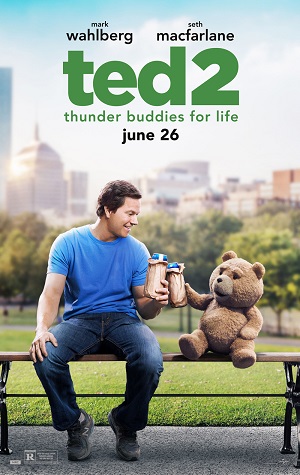
Ted_2_posterWell, I think the title of this review pretty succinctly sums up my reaction to Seth McFarlane’s latest film, Ted 2.  Thanks for reading and have a good…

Oh, really?

Okay, I’ve been told that I have to try to think up at least 300 words to say about Ted 2.  Otherwise, in the eyes of Rotten Tomatoes, we’re not a legitimate film blog.

*sigh*

Okay.

Anyway, Ted 2 is the story of a talking teddy bear (voice by Seth McFarlane) who likes to smoke weed and … well, that’s about it.  He’s just gotten married to Tami-Lynn (Jessica Barth) and they’re having trouble because Tami-Lynn wants a baby but Ted, being a teddy bear, doesn’t have any reproductive organs.  So, he and his friend John (Mark Wahlberg) decide to give Tom Brady a handjob so they can still his sperm.  But, it turns out, none of that was important because the state of Massachusetts claims that Ted is not even a person.  Instead, he’s just “property.”  So, now, John and Ted and their lawyer, Sam (Amanda Seyfried), are fighting the courts to win Ted his civil rights.  And then Giovanni Ribisi wants to kidnap Ted and Morgan Freeman shows up and says a few words.  And the film is narrated by Patrick Stewart because it’s funny to hear Patrick Stewart curse and…

Oh!  And Liam Neeson shows up.  He’s a customer at the store where Ted works as a cashier.  Liam wants to know if Trix are only for kids.  The joke here is that it’s Liam Neeson and he’s asking about cereal.  Ha ha.

Oh!  And there’s two guys who shows up at New York Comic Con so that they can beat up “nerds.”  During every scene set at Comic Con, they’re in the background beating people up and insulting them.  And the two guys are gay!  See, they’re bullies and they’re gay!  And they’re beating up random people at Comic Con, just because they can!  Hilarious, right?

Ted 2 spends a lot of time trying to convince us that Ted’s struggle to be recognized as a person is actually meant to be a metaphor for the American civil rights movement.  But, honestly, I get the feeling that McFarlane relates more to the bullies than he does to any oppressed minority.  As he previously proved with his TV shows and A Million Ways To Die In The West, McFarlane is only interested in going after easy targets.  He’s your typical white male hipster who thinks that, because he voted for Obama, he can get away with telling racist jokes.

And, before anyone misunderstands, I wouldn’t mind McFarlane’s humor if it was at least funny or original.  But instead, it’s the same stupid jokes that he always tells.  Seth McFarlane’s comedic technique is to basically drag things out until viewers laugh from pure exhaustion.  Is it effective?  Well, there are people who continue to praise and defend him and Seth certainly has made a lot of money off of his act.  So, obviously, there are people who respond to this.  But to me, Seth McFarlane’s humor just feels lazy.

Ted 2 lasts 128 minutes.  That’s over two hours devoted to a concept that feels more appropriate for a five-minute skit.  Interesting enough, the first Ted was tolerable because it focused on Mark Wahlberg’s Johnny.  Ted was just a supporting character and he worked as a metaphor for Johnny’s struggle to choose between growing up or being a happy slacker.  (The first Ted was all about Johnny falling in love with Mila Kunis, whose character is rather cruelly dismissed at the start of Ted 2.)  In Ted 2, Ted is the central character and once you get over the fact that he’s a teddy bear who drops multiple F bombs, there’s really not much to the character.  It helps, of course, that we only have to listen to McFarlane.  We don’t have to look at his imminently punchable, oddly lineless face.  But, to be honest, even McFarlane’s voice has become grating.  It’s just so self-satisfied and smug.

I saw Ted 2 with the blogger also known as Jedadiah Leland.  Over the course of 128 hours minutes (it just felt like hours), we each laughed once.  Not surprisingly, both laughs were inspired by Wahlberg’s dumb-but-sweet performance.  Now, I will admit that the rest of the audience laughed a bit more than we did.  But still, there was a definite atmosphere of resignation in the theater.  You could literally hear the people thinking, “Oh, Ted just made a joke about black people.  Better laugh now so everyone knows that I get whatever the Hell this is supposed to be.  After all, those tickets weren’t free…”

What’s the word count now?

758?

Cool.

That’s enough words for me to say, “Ted 2 sucks!”