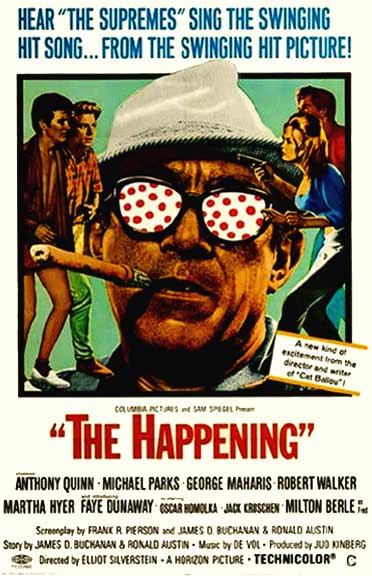
An Offer You Can Refuse #5: The Happening (dir by Elliot Silverstein)


The 1967 film, The Happening, opens with two “young” people — Sureshot (Michael Parks) and Sandy (Faye Dunaway) — waking up on a Florida beach.  The previous night, they attended a party so wild that the beach is full of passed out people, one of whom apparently fell asleep while standing on his head.  (It’s a happening!)  From the dialogue, we discover that, despite their impeccably clean-cut appearances, both Sureshot and Sandy are meant to be hippies.

After trying to remember whether or not they “made love” the previous night (wow, how edgy!), Sandy and Sureshot attempt to find their way off of the beach.  As they walk along, they’re joined by two other partygoers.  Taurus is played by George Maharis, who was 38 when this film was shot and looked about ten years older.  Taurus is a tough guy who carries a gun and dreams of being a revolutionary and who says stuff like, “Bam!  Et cetera!”  Herbie is eccentric, thin, and neurotic and, presumably because Roddy McDowall wanted too much money, he’s played by Robert Walker, Jr.

Anyway, the four of them end up stealing a boat and talking about how life is a drag, man.  Eventually, they end up breaking into a mansion and threatening the owner and his wife.  Since this movie was made before the Manson murders, this is all played for laughs.  The owner of the mansion is Roc Delmonico (Anthony Quinn).  Roc used to be a gangster but now he’s a legitimate businessman.  The “hippies” decide to kidnap Roc because they assume they’ll be able to get a lot of money for him.

The only problem is that no one is willing to pay the ransom!

Not Roc’s wife (Martha Hyer)!

Not Roc’s best friend (Milton Berle), who happens to be sleeping with Roc’s wife!

Not Roc’s former mob boss (Oscar Homolka)!

Roc gets so angry when he find out that no one wants to pay that he decides to take control of the kidnapping,  He announces that he knows secrets about everyone who refused to pay any money for him and unless they do pay the ransom, he’s going to reveal them.  We’ve gone from kidnapping to blackmail.

Along the way, Roc bonds with his kidnappers.  He teaches them how to commit crimes and they teach him how to be anti-establishment or something.  Actually, I’m not sure what they were supposed to have taught him.  The Happening is a comedy that I guess was trying to say something about the divide between the young and the middle-aged but it doesn’t really have much of a message beyond that the middle-aged could stand to laugh a little more and that the young are just silly and kind of useless.  Of course, the whole young/old divide would probably work better if all of the young hippies weren’t played by actors who were all either in their 30 or close enough to 30 to make their dorm room angst seem a bit silly.

It’s an odd film.  The tone is all over the place and everyone seems to be acting in a different movie.  Anthony Quinn actually gives a pretty good dramatic performance but his good performance only serves to highlight how miscast almost everyone else in the film is.  Michael Parks comes across like he would rather be beating up hippies than hanging out with them while Faye Dunaway seems to be bored with the entire film.  George Maharis, meanwhile, goes overboard on the Brando impersonation while Robert Walker, Jr. seems like he just needs someone to tell him to calm down.

But even beyond the weird mix of acting style, the film’s message is a mess.  On the one hand, the “hippies” are presented as being right about the establishment being full of hypocritical phonies.  On the other hand, the establishment is proven to be correct about the “hippies” being a bunch of easily distracted idiots.  This is one of those films that wants to have it both ways, kind of like an old episode of Saved By The Bell where Mr. Belding learns to loosen up while Zack learns to respect authority.  This is an offer that you can refuse.

And that’s what’s happening!
Previous Offers You Can’t (or Can) Refuse:

  1. The Public Enemy
  2. Scarface
  3. The Purple Gang
  4. The Gang That Could’t Shoot Straight

An Offer You Can Refuse #4: The Gang That Couldn’t Shoot Straight (dir by James Goldstone)


“Oh, fuck you.”

That was my reaction, last night, as I watched the 1971 film, The Gang That Couldn’t Shoot Straight.  I was talking to my DVR and yes, I was cursing quite a bit.  You know that a film has to be bad when it actually drives me to start cursing at an inanimate object.  The Gang That Couldn’t Shoot Straight was so bad that I actually got pissed off at my DVR for recording it.  It’s true that I am the one who scheduled the recording but still …. my DVR should have known better than to listen to me!

What is The Gang That Couldn’t Shoot Straight about?  I have no idea.  I watched the damn movie and I have no idea what the point of it was.  The film stars Jerry Orbach as a low-level gangster named Kid Sally.  Kid Sally’s crew — the Gang That Couldn’t Shoot Straight — is made up of a collection of malcontents, morons, and other stereotypes.  One member of the crew is a little person.  That’s the joke.  He’s a tough gangster who is wiling to put a bullet between your legs but that’s just because he’s crotch-height.  Ha ha.

Anyway, the big boss is a guy named Baccala (Lionel Stander).  Every morning, Baccala’s wife starts the car to check for bombs.  Whenever she goes outside, Baccala crawls underneath the kitchen table and waits.  Like a lot of the stuff in this movie, that’s one of those things that would be funny if it hadn’t been taken too such a cartoonish extreme.  Anyway, Baccala has zero respect for Kid Sally and Kid Sally wants to take over Baccala’s rackets.  Is it time for a mob war!?

Maybe.  A lot of people die in various “amusing” ways over the course of the film but I was never quite sure whether or not the killings were part of a mob war or if they were just the type of random mishaps that occur when a bunch of dumbasses get their hands on a cache of weapons.  Trying to follow the plot of The Gang Who Couldn’t Shoot Straight is next to impossible.  The editing of the film is so ragged that you’re rarely aware of how one scene relates to another.  If The Godfather showed how a gangster story could be a historical epic and if Goodfellas showed how an editor could recreate the kinetic experience of being a gangster, The Gang Who Couldn’t Shoot Straight shows how a mafia movie can just be a collection of random vignettes that may or may not be connected.  It’s impossible to care about the potential war between Kid Sally and Baccala because neither Kid Sally nor Baccala exist as characters beyond their silly names.

A young Robert De Niro is in this film.  He plays Mario, an Italian thief who comes to New York for a bicycle race and joins Kid Sally’s crew.  Or at least, I think he joins the crew.  It’s hard to tell.  Mario often dresses like a priest, for some reason.  He’s also fallen in love with Angela (Leigh Taylor-Young), who is Kid Sally’s sister though she could just as easily be his cousin or maybe his daughter-in-law from Tuscon.  I wouldn’t necessarily say that De Niro gives a good performance here as much as it’s just impossible not to pay attention to him because he’s a young Robert De Niro.  He and Leigh Taylor-Young do have a very sincere and touching chemistry but it’s out-of-place in a film that’s dominated by slapstick and scenes of Kid Sally using a lion to intimidate shop owners.  (Yes, that happens.)  De Niro certainly seems to be trying hard to give a good performance but he’s not a natural comedian.  Of course, you don’t need me to tell you that.  FOR THE LOVE OF GOD, WE’VE ALL SEEN DIRTY GRANDPA!

Anyway, the main problem with this film is that it’s a comedy that was apparently put together by people who think that comedy involves a lot of screaming and silly music.  I’ve actually seen a handful of other films that were directed by James Goldstone — Brother John, Rollercoaster, When Time Ran Out.  Significantly, none of those other films were comedies and there’s nothing about any of Goldstone’s other films that suggest that he was anything more than a director-for-hire.  The film itself was written by Waldo Salt, who also worked on the scripts for Midnight Cowboy, Coming Home, and Serpico.  Again, none of those films are particularly funny.  70s era Mel Brooks probably could have made this into a funny film but James Goldstone and Waldo Salt could not.

As bad as The Gang Who Couldn’t Shoot Straight is, it is also the answer to a very interesting trivia question.  This is the film that Al Pacino dropped out of when he was cast as Michael Corleone in The Godfather.  The actor who replaced Pacino was Robert De Niro.

Anyway, The Gang That Couldn’t Shoot Straight is an offer you can refuse.

Previous Offers You Can’t (or Can) Refuse:

  1. The Public Enemy
  2. Scarface
  3. The Purple Gang

An Offer You Can’t Refuse #3: The Purple Gang (dir by Frank McDonald)


The 1960 gangster film, The Purple Gang, really took me by surprise.

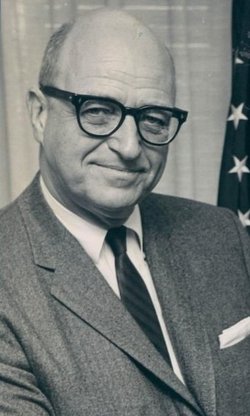
The film opens with U.S. Rep. James Roosevelt standing in front of his desk.  James Roosevelt was the son of President Franklin D. Roosevelt.  He was a notoriously shady businessman who, before entering politics, dabbled a bit in Hollywood.  That probably explains how he eventually came to be standing in his congressional office, filming the introduction for a low-budget B-movie about Detroit gangsters.  Roosevelt tells us that he’s already watched the movie that we’re about to see and that he can assure us that it is an accurate portrayal of not just the history of The Purple Gang but also of how 1920s bootlegging led to a host of other crimes.  Roosevelt goes on to compare bootleggers to modern day drug pushers.  The most interesting thing about the speech is that it almost sounds like a defense of prohibition, the law that FDR famously opposed.

To use a term from the film’s era, it’s kind of a square opening.  James Roosevelt comes across as being so vacuously earnest that it’s almost as if Beto O’Rourke got his hands on a time machine and went back to 1960.  At the same time, there’s something oddly charming about how awkward it is.  One can only imagine how audiences would react if a film today opened with a speech from a congressperson.  I guess some parts of the country would love it.  Down here in Texas, the theater would probably get set on fire.

Now, based on that less than edgy opening, you might be justified in expecting that The Purple Gang will just be your standard 1960s crime thriller but it most definitely is not.  The Purple Gang is a tough and violet movie, one that is full of shadowy and sometimes disturbing imagery.  A very young Robert Blake plays Honeyboy Willard, a teenage hoodlum who, through pure sociopathic ruthlessness, takes over the rackets in Detroit.  Barry Sullivan is Lt. Harley, the police detective whose quest to bring down the Purple Gang leads to him losing almost everything that was important to him.

Our first impression of Lt. Harley comes when he skeptically listens to a liberal social worker, Joan McNamara (Jody Lawrance), explain that criminals are not born but are instead made by their circumstances.  Harley obviously doesn’t agree.  Later, while Joan is walking around Detroit at night, she is attacked, rape,d and then murdered by the same criminals that she was earlier defending.  With the city outraged over Joan’s murder, Lt. Harley steps up his efforts to bring down the gang so Honeyboy murders Harley’s pregnant wife.

While Harley seeks revenge, Honeyboy is busy making deals with Canadian liquor distributors and building the Purple Gang into the biggest criminal enterprise in the northern midwest.  When a group of distraught businessmen, upset at being extorted by the Purple Gang, turns to the Mafia for help, Honeyboy declares war….

Of course, despite James Roosevelt’s assurance at the start of the film and the semi-documentary approach that director Frank McDonald takes to the material, the truth is far different from the movie.   In real life, The Purple Gang was predominantly made up of the children of recent immigrants from Russia and Poland.  It was run not by Honeyboy Willard but by the four Bernstein brothers.  The Purple Gang did not go to war with the Mafia but instead, they were allied with Lucky Luciano and Meyer Lansky in their attempts to create a national crime syndicate.  They were also closely allied with Al Capone, to the extent that it’s been suggested that Capone used Purple Gang gunmen to carry out the St. Valentine’s Day Massacre.  The Purple Gang eventually fell apart due to infighting and the end of prohibition, with the majority of the members who weren’t in jail simply joining other gangs.

So, no, The Purple Gang is not historically accurate but it’s still an effective and surprisingly brutal gangster film.  The noirish photography makes certain scenes seem almost as if they’ve been lifted straight out of a nightmare and, historically accurate or not, the film does do a good job of showing how organized crime came to exist in the United States.  It’s a quick-paced and energetic film and it features a great performance from Robert Blake as the chillingly sociopathic Honeyboy.  The Purple Gang is a low-budget B-movie that packs a punch.

Plus, James Roosevelt did ask you to watch.  Are you going to say no to James Roosevelt?

James Roosevelt, film critic

Previous Offers You Can’t Refuse:

  1. The Public Enemy
  2. Scarface

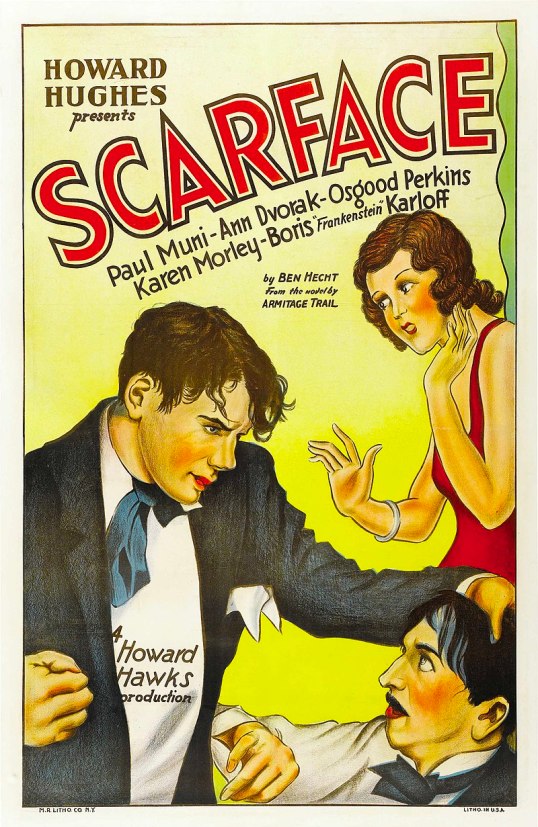
An Offer You Can’t Refuse #2: Scarface (dir by Howard Hawks)


Before there was Tony Montana …. there was Tony Camonte!

And, of course, before there was Tony Camonte, there was Al Capone.  The 1932 film Scarface was one of the many gangster movies to be based on the life of Al Capone.  Capone and Tony Camonte even share the same nickname, though — unlike Camonte — Capone hated being called Scarface.  On the other hand, as played by the charismatic and cocky Paul Muni, Tony Camonte wears his scar like a badge of honor.  He says that he got his scar serving in the war.  His best friend, Guino (George Raft, a real-life gangster associate who became a star as a result of his performance in this film), says that the scar is the result of a bar fight.

In many ways, that scar tells you almost everything you need to know about Tony Camonte.  If you can look away from the scar, he’s a handsome and charismatic figure.  But when you see the scar, you’re reminded that his life is about violence.  Everything that Tony has is due to his violent nature and it’s somewhat inevitable that his end will also be due to that violence, not to mention his obsession with his sister, Cesca (Ann Dvorak).  It’s not just Tony’s face that’s scarred.  It’s his soul as well.

The film follows Tony, from his early days of working as a gunman for Johnny Lovo (Osgood Perkins) to his eventual usurpation of Lovo’s place as the king of the underworld.  Tony not only takes over Lovo’s rackets but he also goes after Lovo’s girlfriend, the glamorous Poppy (Karen Morley).  The well-bred Poppy may be dismissive of Tony’s ambitions but, as Tony shows her, he lives in the glow of a neon sign that announces, “The World Is Yours.”  That’s something that Tony truly believes and, for a while, the world is his.  He’s done with a gun what other do with lawyer and a clever accountant.  He’s achieved the American dream and he has the money and the beautiful lover to prove it.  Only for a while, though.  You reap what you sow.

The film recreates many scenes from Al Capone’s life.  One of Tony’s rivals is gunned down in a flower shop, much as happened to Dean O’Bannion when he challenged Capone’s power.  At another point, two of Tony’s men dress up like policemen and gun down rival gangsters, just as happened during the St. Valentine’s Day Massacre.  The script was written by Ben Hecht, a Chicago native who had actually met Capone.  When Capone heard that Hecht was writing a film called Scarface, he sent two men to find out what the film was about.  Hecht assured them that the film was not about Capone but was instead a parody of the gangster genre.  Hecht was left alone but the fact that Capone was worried about his public image is quite a contrast to more recent stories about made men studying The Godfather, Goodfellas, and The Sopranos for tips on how to go about their business.  Of course, the film was made before Capone’s anticlimatic downfall so it’s not a combination of tax evasion and syphilis that ends Tony Camonte’s reign of terror.  Camonte goes out in a much more dramatically satisfying manner.

It’s a violent film.  It was a violent film for 1932 and, in some scenes, it’s a violent film for even today.  I’ve read that director Howard Hawks used live ammunition in the scenes that featured guns being fired.  In many of the scenes in which someone is portrayed as running for their lives, the actors in question were literally running and ducking for their lives.  Luckily, the cast survived making the film, though it’s been said that one crew member lost an eye.  Paul Muni went on to have a very distinguished film career, one that inspired future acting greats like John Garfield, Montgomery Clift, and Marlon Brando.  Despite his star-making turn as Muni’s best friend, George Raft’s career was not quite as distinguished, as he ended up turning down a chance to star in Casablanca.  Osgood Perkins’s son, Tony, would become a horror icon when he played Norman Bates.  And Boris Karloff went from portraying a bowling gangster in this film to playing the Monster in Frankenstein.

And, of course, the legacy of Scarface lives on, thanks to the 1983 remake starring Al Pacino.  There’s a third remake on the way, reportedly from Luca Guadagnino, who I guess decided that since he got away with tarnishing the legacy of Suspiria, he might as well go after another classic cult film.  Both versions of Scarface are rightly known as being classics of the gangster genre.  The 1983 version is great but so is the original.

Previous Offers You Can’t Refuse:

  1. The Public Enemy (1931)

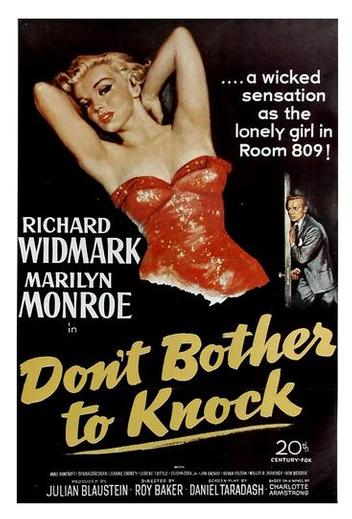
Scenes That I Love: Marilyn Monroe in Don’t Bother To Knock


Marilyn Monroe would have been 94 years old today.

Unfortunately, Marilyn died when she was just 36 years old and also when she was only starting to get a chance to reveal what she was truly capable of as an actress.  It’s a shame, because I would have liked to have seen what type of roles she would have played in her 40s and her 50s.  Would she have eventually become a respected, award-winning character actor or would she have ended up like Bette Davis, doing cameos in films that weren’t particularly worthy of her talents?  Who knows but it’s a shame that the world will never get to find out.

For her birthday, I’m going to share a scene from one of her earlier films, 1952’s Don’t Bother To Knock.  In this film, Marilyn plays an unstable woman who is staying at a hotel.  Her cousin (played by Elisha Cook, Jr.) gets her job as a babysitter but is shocked to find out that Marilyn has been trying on her employer’s clothes.  After getting admonished by her cousin and pretending to be sorry, she proceeds to then summon another gust (played by Richard Widmark) over to her room.

It’s a simple scene but it’s wonderfully played by Monroe.  This was one of her first truly dramatic roles and she does a good job with it.

From Don’t Bother To Knock, here is a scene that I love:

4 Shots From 4 Films: Special Morgan Freeman Edition


4 Shots From 4 Films is just what it says it is, 4 shots from 4 of our favorite films. As opposed to the reviews and recaps that we usually post, 4 Shots From 4 Films lets the visuals do the talking!

Today is Morgan Freeman’s 83rd birthday!

Morgan Freeman is one of my favorite actors but then again, I think he’s one of everyone’s favorite actors.  He’s an icon, not just for that famous voice but also because he’s a damn good actor.  Though he seems to get cast in a lot of mentor roles, he’s shown that he’s capable of playing a wide variety of roles, from heroes to villains to Gods.

(I have to admit that I would be so intimidated if I ever met Morgan Freeman, if just because I know that if I accidentally said something stupid, he’d probably give me a look of such utter disappointment that it would probably haunt me for the rest of my life.)

Here are….

4 Shots From 4 Films

Seven (1995, dir by David Fincher)

The Dark Knight (2008, dir by Christopher Nolan)

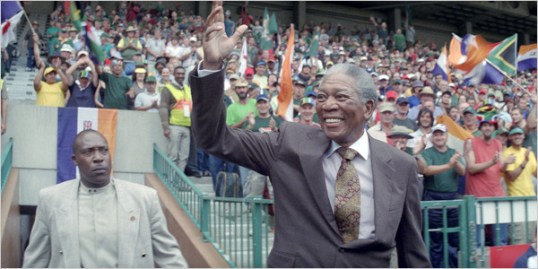
Invictus (2009, dir by Clint Eastwood)

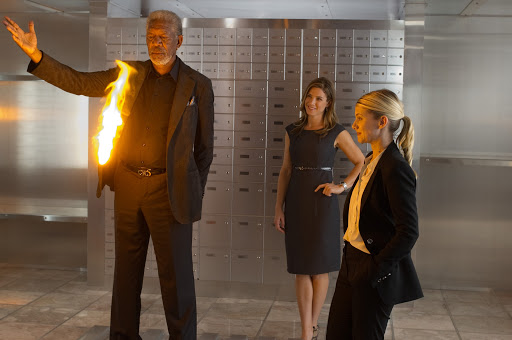
Now You See Me (2013, dir by Louis Leterrier)

An Offer You Can’t Refuse #1: The Public Enemy (dir by William Wellman)


For this month, I’ve decided to review movies about mobsters.

There’s no specific reason for that, beyond the fact that I just happen to love mobster movies.  Of course, a good gangster film is rarely just about crime.  Anyone who has ever seen The Godfather can tell you that.  At their best, American gangster films are about the American dream and the lengths that some will go to achieve it.

Plus, they’re just a lot of fun to watch.  Some of the greatest actors of all time made their mark in gangster films.

Take 1931’s The Public Enemy, for instance.

Produced during the final days of prohibition and the early years of the Great Depression, The Public Enemy tells the story of three boys who grew up poor.  Tom Powers (James Cagney) and his friend, Matt Doyle (Edward Woods) pursued a life of crime, rising through the ranks of organized crime before eventually meeting a tragic end.  The third, Mike Powers (Donald Cook), stayed on the straight-and-narrow path.  He went into the Marines and he rebuked his brother, Tom, when he discovered that Tom’s money was due to “blood and beer.”

The film opens and closes with a title card that basically tells us that Mike Powers has the right idea but, when you watch the film, you can’t help but wonder if maybe Tom had a point about his brother being kind of a sap.  Mike might be a decent citizen and he might have a chestful of medals as the result of his wartime heroics but what else does he have?  Tom Powers, meanwhile, has no education and, it would appear, no conscience, no real friends, and no one that he really loves and yet he becomes a rich man who is acquainted with powerful figures.  While Mike stays at home with their mother, Tom lives in an ornate penthouse.  When his first girlfriend (Mae Clarke) gets on his nerves, Tom shoves a grapefruit in her face and then gets an even more glamorous girlfriend, Gwen (Jean Harlow).  (Meanwhile, even dumb old Matt is doing okay for himself, marrying a woman played by Joan Blondell.)  It’s hard not to imagine that the film’s original audience — who were still reeling from the Stock Market Crash of 1929 — looked at Mike and Tom Powers and quickly decided that they’d much rather be a part of Tom’s life than Mike’s.  Even if Tom is destined for an early grave or a lifetime behind bars, at least he appears to be having fun.  Speaking for myself, I’d much rather go out with the guy who has nice clothe and his own luxury apartment than with the self-righteous dud who is still living at home with his mother.

Of course, another reason why we gravitate towards Tom Powers is because he’s played by James Cagney, who was one of the most charismatic of the stars of Hollywood’s Golden Age and whose performance still holds up today.  Cagney gives a ferocious performance, snarling out his lines and always moving like a caged animal, even when he’s just preparing to have breakfast.  He’s full of an energy that’s both dangerous and exciting to watch.  Cagney also brings a very powerful anger to the role of Tom Powers.  As played Cagney, Tom Power is not just a criminal because he’s greedy.  He’s also a criminal because he has no use for a society that he feels has rejected him since birth and which has never given him a fair chance.  He becomes wealthy not just because he wants money but because he wants to taunt everyone who ever said that he wouldn’t amount to anything.  He’s every crime is more than act of greed.  It’s also an act of rebellion, a joyful to a society that wants to tell people what they’re allowed to believe and do.  He’s the ultimate 1930s rebel, giving the the finger to not only the two Hoovers (Herbert and J. Edgar) but also to the good government leftists would be soon be swept into power with FDR.  Despite the fact that The Public Enemy was made nearly 90 years ago, there’s nothing creaky about Cagney’s performance.  It still feels vital and powerful today and it elevates the entire film.

The Public Enemy holds up surprisingly well.  The film may be close to 90 but Cagney’s ferocious performance still feels fresh and powerfully alive.


Lisa Marie’s Oscar Predictions For May (For What They’re Worth)


Are we even going to have an Oscar ceremony next year?

Who knows?  I hope we do because I think that it would provide some sort of normalcy.  Even if everyone chooses not to watch it, at least they’ll have that choice.  (People tend to forget how important, psychologically and emotionally, it is for people to have a choice.  All of these cheery “We’re all in it together” commercials don’t mean shit if people are feeling imprisoned.)  Up until this week, I was pretty confident that we would because COVID-19 was in decline and restrictions were being lifted and things seemed like they were heading in the right direction.  (Or, at least, that’s the way it seemed in my part of the world.  I know that some people disagreed with my assessment.)  Now, we’re in the middle of nation-wide rioting and a divisive presidential election so who knows what’s going to happen with the rest of this year.  Will theaters even want to risk reopening before 2021?  Will they be able to?  The Academy has said that streaming films will qualify this year but how many studios want to release all of their big productions VOD?

I’m going to continue to make my monthly Oscar predictions, though.  My reasons are pretty selfish: making them helps to keep me centered.  I’m a compulsive scheduler and keeping that schedule (which is really what I’m doing with these monthly predictions) helps me deal with my ADD.

So, with that in mind, here are my Oscar predictions.  Take them with a grain of salt.  And be sure to check out my previous predictions for January, February, March, and April!

Best Picture

Ammonite

The Father

Hillbilly Elegy

Minari

News of the World

Nomadland

Respect

Soul

The Trial of Chicago 7

West Side Story

Best Director

Paul Greengrass for News of the World

Ron Howard for Hillbilly Elegy

Francis Lee for Ammonite

Steven Spielberg for West Side Story

Chloe Zhao for Nomadland

Best Actor

Matt Damon in Stillwater

Tom Hanks in News of the World

Anthony Hopkins in The Father

Bill Murray in On The Rocks

Gary Oldman in Mank

Best Actress

Jennifer Hudson in Respect

Angelina Jolie in Those Who Wish Me Dead

Sofia Loren in The Life Ahead

Frances McDormand in Nomadland

Kate Winslet in Ammonite

Best Supporting Actor

David Alvarez in West Side Story

Tom Burke in Mank

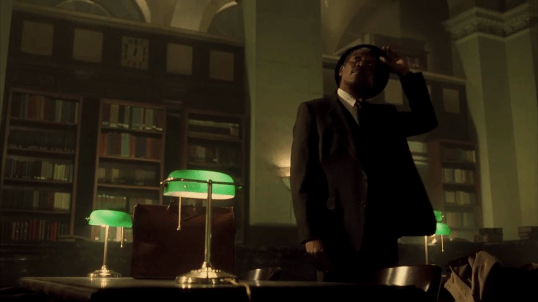
Delroy Lindo in Da 5 Bloods

Forest Whitaker in Respect

Steven Yeun in Minari

Best Supporting Actress

Abigail Breslin in Stillwater

Glen Close in Hillbilly Elegy

Olivia Colman in The Father

Saoirse Ronan in Ammonite

Helena Zengel in News of the World

That’s it for this month!  Hopefully, next month will bring a bit more clarity.


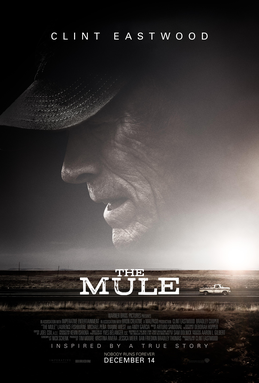
Film Review: The Mule (dir by Clint Eastwood)


In The Mule, Clint Eastwood plays Earl Stone.

In some ways, Earl is typical of the characters that Eastwood has played during the latter part of his career.  He’s grouchy.  He’s alienated almost everyone who was previously close to him.  He drives an old pickup truck and he has no idea how to text and he seems to literally snarls whenever he sees anyone under the age of 60.  He served in the Korean War and he’s not scared of guns.

In other ways, Earl is not a typical Eastwood character at all.  First off, he’s on the verge of financial ruin.  Earl may not be the first Eastwood character to not know how to responsibly handle money but he is perhaps the first one to be on the verge of homelessness as a result.  (He’s perhaps the first of Eastwood’s modern character to face real-world consequences for his flaws.)  Secondly, Earl often seems to be lost in the 21st century world.  In Gran Torino and Trouble With The Curve, Eastwood played grumpy old men who could still hold their own when it came to dealing with younger people.  But, in The Mule, Earl seems to be defeated by life.  The only thing that he really has going for him is his reputation as a horticulturist and, as the film makes clear, that’s not a skill that’s going to bring in much money.

That all changes when Earl has a chance meeting with Rico (Victor Rasuk), a friend of his granddaughter’s.  Knowing that Earl is desperate for money, Rico tells him that he could make a quick payday by transporting a package for some friends.  After giving it some thought, Earl agrees.  When Earl meets Rico’s friends, everyone is shocked at how old he is.  They’re even more shocked when Earl says that he doesn’t know how to text.  Earl is given a phone and told to answer it whenever it rings but to never use it to call anyone.  A package is put in the back of Earl’s pickup truck.  It’s suggested that Earl not look in the package.

Does Earl know that he’s transporting drugs?  At first, it’s hard to say.  While it seems obvious to us, Earl is from a different time.  Still, once Earl does eventually learn that he’s being used as a drug mule, it doesn’t seem to bother him.  If nothing else, Earl actually seems to get a kick out of being a real-life outlaw.  He continues to make his runs and he continues to make money and, perhaps most importantly, he now has a purpose in life.  In a strange way, the drug runners even become his new family.  (They call him Tata, which is Spanish for grandfather.)  Of course, they’re a family that makes it cleat that they’ll kill Earl if he’s ever late delivering the package but that doesn’t seem to matter to Earl.

Meanwhile, the DEA (represented by Laurence Fishburne, Bradley Cooper, and — somewhat inevitably — Michael Pena) are hearing reports about a new drug mule who has been nicknamed Tata.  What they don’t suspect, of course, is that Tata is a 90 year-old man who has no criminal record and who is always very careful to obey all the traffic laws.  Even when Earl is pulled over by the police, he’s such a nice old man that they let him go without bothering to really search his vehicle.  It seems like Earl’s got a perfect thing going but, unfortunately, things are never as good as they seem and eventually, the reality of Earl’s situation intrudes on his fantasy….

It’s been said that The Mule is going to be Eastwood’s final film as an actor and he gives an excellent performance as Earl.  The Mule, which feels, in many ways, like a good-natured companion piece to Gran Torino, features Eastwood at both his most vulnerable and, probably not coincidentally, his most likable and sympathetic.  In this film, Eastwood makes clear that he’s no longer the righteous Dirty Harry or the mythological Man With No Name.  Now, he’s just a man nearing the end of his life and trying to come to terms with the mistakes and the decisions of the past.  Eastwood plays Earl like a man who knows that his time is limited.  Smuggling drugs gives him a chance to feel like he’s alive again but, throughout it all, there’s still a deep sadness.  Earl can use his money to pay his bills and to fix up the local VFW hall but he still can’t buy his family’s forgiveness.  Watching the film, it’s impossible not to feel for Earl.  You’re happy that he found at least a little satisfaction with his criminal career, even though you immediately suspect that things probably aren’t going to turn out well for him.

Admittedly, there is one cringe-worthy scene in which it’s suggested that the 90 year-old Earl has had a threesome with two twenty year-olds (and one gets the feeling that the scene would not have been included if not for the fact that the film’s star was also the director).  For the most part, though, this is a thoughtful film that features a poignant performance from Eastwood and which is directed in a restrained, but empathetic manner.  If this is Eastwood’s swan song as an actor, it’s a good note to go out on.

4 Shots From 4 Films: Special Clint Eastwood Edition


Clint Eastwood in Revenge of the Creature (1955)

4 Shots From 4 Films is just what it says it is, 4 shots from 4 of our favorite films. As opposed to the reviews and recaps that we usually post, 4 Shots From 4 Films lets the visuals do the talking!

Today is Clint Eastwood’s 90th birthday!

Though Clint famously had to go to Italy to really get his film career going, he’s gone on to become an icon of American film.  While his early films were often criticized as glorifying violence and of being reactionary, his later films have — more often than not — been meditations on aging, moral ambiguity, and what a lifetime of violence does to a person’s soul.  Though Eastwood has fallen out-of-favor with a few critics as a result of the speech he gave at the 2012 Republican Convention (Film Twitter, to the shock of no one, had a particularly over-the-top reaction to it as many of them discovered, I guess for the first time, that not every artist is a Leftist), he’s a filmmaker whose legacy will be rediscovered and probably appreciated in the future.

Here are….

4 Shots From 4 Films

For A Few Dollars More (1965, dir by Sergio Leone)

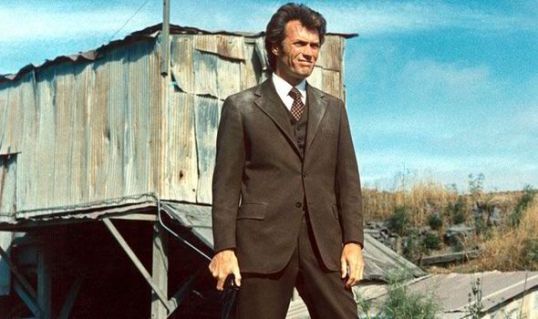
Dirty Harry (1971, dir by Don Siegel)

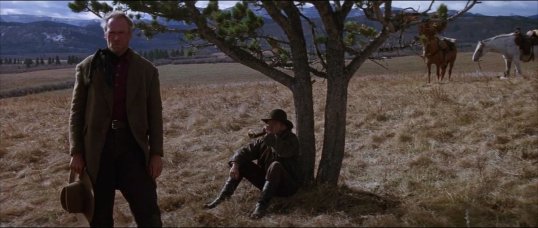
Unforgiven (1992, dir by Clint Eastwood)

Gran Torino (2008, dir by Clint Eastwood)