The Films of 2020: Valley Girl (dir by Rachel Lee Goldenberg)


Valley Girl is a remake of the 1983 film of the same name.  The original Valley Girl was a sweet but occasionally edgy comedy that starred Deborah Foreman and, in one of his first starring roles, Nicolas Cage.  Foreman played a popular rich girl who fell in love with a quirky punk rocker (Cage, of course).  Full of interesting characters and very much attuned to what it’s like to be a teenager in love, the original Valley Girl was fun and funny but it also had a serious subtext and the film, as whole, holds up surprisingly well.

The remake of Valley Girl tells basically the same story.  Jessica Rothe plays Julie Richman.  Josh Whitehouse plays Randy.  They meet.  They fall in love.  They both have to deal with the fact that they’re from different parts of Los Angeles.  Their friends say that they don’t belong together.  The story still has potential but the remake falls flat.

A huge part of the problem is that the Valley Girl remake is a jukebox musical.  In the style of Rock of Ages, it features characters expressing themselves by singing songs from the 80s.  Like many jukebox musicals, Valley Girl picks the most obvious songs and then deploys them in the most literal way possible.  For instance, Julie’s jock boyfriend is named Mickey, just so the cheerleaders can perform Mickey during a pep rally.  When Randy and his punk friends show up for the first time, it’s time to sing Bad Reputation.  When it appears that his relationship with Julie is doomed, it’s time for Randy to offer up a rather wan version of Boys Don’t Cry.  When Julie and her friends go to the beach and start to talk about how they want have to fun …. well, can you guess what song they start singing?  The film does make good use of Kids In America but, for the most part, the song choices are too predictable and the cast performs them with a notable lack of enthusiasm.

As for the cast, Jessica Rothe has a few good moments and she at least bring some playful energy to her role.  Unfortunately, Josh Whitehouse is perhaps the least convincing punk rocker that I have ever seen.  There’s nothing quirky, angry, or dangerous about Whitehouse’s Randy.  Instead, he’s a nice young man who has some eccentric friends.  He’s the punk who you can take home to meet your parents.  He’s like the one jock who hangs out with the nerds and, as a result, everyone’s decided that he must be deeper than he actually is.

Speaking of jocks, Julie’s boyfriend — named Mickey, of course — is played by Logan Paul.  Yes, that Logan Paul.  Yes, he’s terrible in the role.  Josh Whitehouse may have not been a convincing punk rocker but Logan Paul gives a performance that’s so bad that he’s not even a convincing human being.  He comes across like an animatronic Disneyland character.  He should be in the Hall of Presidents, standing next to George Washington and stiffly nodding whenever Lincoln starts talking.  Logan Paul is a huge reason why the film doesn’t work.  He’s also a huge reason why Valley Girl sat on the shelf for about three years before finally being released, as Paul’s YouTube controversies led the studio to be weary about releasing a film featuring him.

I guess one reason why I got so annoyed with Valley Girl is that I wanted to like it.  Jessica Rothe was great in the Death Day films.  I love 80s music.  I wanted this to be a good film but it’s just not.  Like, sorry.

The Films of 2020: Shooting Heroin (dir by Spencer T. Folmar)


Shooting Heroin takes place in a small town in Pennsylvania, a once close-knit community that is dying a painful death.

As the film opens, we meet several people who have lost loved ones to the Opioid Epidemic.  Hazel (Sherilyn Fenn) speaks at a school assembly about how both of her sons overdosed within hours of each other and the only response she gets is a few students snickering at her.  Adam (Alan Powell) loses his sister to heroin and has to take her baby into his home.  Sitting in a bar, prison guard and local hunter Edward (Lawrence Hilton-Jacobs) demands to know why the police aren’t doing more to lock up the dealers.  The town’s sole lawman, Jerry (Garry Pastore), can only explain that he is only one person and that he can only arrest someone if he has proof that they’re actually dealing drugs.  Suspicions and gossip aren’t enough.

After a night of heavy drinking and heavier emotions, Adam comes up with the idea of a voluntary drug taskforce.  He recruits Edward and Hazel and, after Jerry reluctantly deputizes them, the three of them set out to battle the drug dealers their own way.  (“By any means necessary,” as Edward puts it.)  Of course, all three of them have their own thoughts on how to best deal with the issue.  Hazel puts up crudely painted but well-intentioned signs, asking teenagers if they truly want to break their mother’s heart.  Edward stops every car that’s heading into town and does a search.  (Yes, it’s highly unconstitutional.)  As for Adam, he wants revenge against the man who he believes was his sister’s dealer.  And if that means setting a house on fire and picking up a rifle to go hunting, that’s what Adam’s going to do.

Now, from that plot description, you might think that Shooting Heroin is a run-of-the-mill revenge flick but it’s not.  It definitely has its pulpy elements but, for the most part, Shooting Heroin is an intelligently written and well-directed look at how the Opioid Epidemic is ravaging communities across America.  The film approaches the subject with the type of empathy that, far too often, is missing from films like this.  There are no easy villains, the film tells us, and there are also no perfect heroes.  Adam, Edward, and Hazel all have their own approaches, each with their own set of strengths and flaws but the ultimate message of the film is that nothing is going to get better until we stop attacking and demonizing one another.  That’s an important message and one that, unfortunately, doesn’t get broadcast as much as it should.  Far too often, the war on drugs is a war on those members of the community who are at their most vulnerable.

The film is full of familiar faces, with Sherilyn Fenn giving the strongest and most poignant performance as Hazel.  There’s something very touching about the combination of Hazel’s determination to get through to teenagers and her total cluelessness about the best way to actually do so.  For all of her grief and anger, Hazel remains innocent enough to believe that telling a drug addict that they’re breaking their mother’s heart is the ultimate solution to the crisis.  When she joins the task force, she hands out adrenaline shots so that addicts can be revived.  When she confronts of a pharmacy worker who has filled an obviously faked prescription, Hazel speaks with the anger of someone who has seen the damage done to her community.  When she’s handed a gun, she says that she’s not going to carry anything that can kill.  Hazel, like so many people, is just trying to do her best in a unwinnable situation and it’s sometimes both heartbreaking and inspiring to watch her.

Shooting Heroin brings empathy to its look at the Opioid Epidemic, which is something that has been lacking in far too many other examinations of the what’s currently happening in America.  What’s happening in middle America is, for many in the political and media establishment, an inconvenient truth.  During the Obama years, the Opioid Epidemic was ignored because acknowledging it would have meant acknowledging the failure of Obama’s economic policies.  During the Trump years, the victims of the Opioid Epidemic were dismissed by a media and a political class who insisted on viewing every issue through the prism of red state vs. blue state.  One can only guess how these ravaged communities will fare during the Biden years, though there’s little reason to be optimistic that a 78 year-old career politician is going to do anything differently from his predecessors.  Shooting Heroin is a film about what’s happening today and it’s a film that will leave you thinking about the future.

The Films of 2020: Olympic Dreams (dir by Jeremy Teicher)


Filmed on location at the 2018 Winter Games, Olympic Dreams tells the story of two lost souls.

Penelope (Alexi Pappas) is a skier who competes early and doesn’t win a medal.  Ignored by the media and unsure of how to talk to her fellow athletes (or, for that matter, anyone else that she meets), Penelope is left with little else to do but explore Pyeongchang and have an existential crisis about what the future means.  She’s 22, which is an age when many amateur athletes are retiring and transitioning into the next stage of their life.  Of course, it would be a lot easier to do that if Penelope was leaving South Korea with a gold medal in her luggage.

Ezra (Nick Kroll) is a dentist who is volunteering at the Olympics.  He’s 37 and is having as much of an existential crisis as Penelope.  If Penelope’s problem is that she often struggles to talk to other people, Ezra’s problem is that he talks too much.  He’s constantly talking but, in the end, he’s just as socially awkward as Penelope.

Eventually, Ezra and Penelope meet and they explore South Korea and they discuss the big issues of life and it looks like they might even be falling in love.  Along the way, both Ezra and Penelope also meet and talk to a lot of real-life Olympians, all of whom play themselves.

I have to admit that, at first, I found Olympic Dreams to be a bit off-putting.  I was kind of dreading having to watch yet another socially awkward love story and Ezra seemed like such a whiny character that I wasn’t sure I wanted to spend any amount of time dealing with him and his issues.  The film had an improvised feel, which was a bit of a mixed blessing.  Some people in the film were better at improvising than others.  Nick Kroll, for instance, has been performing for a while and obviously knows how to think on his feet.  Alexi Pappas was also a surprisingly adroit performer.  However, many of the real-life Olympians that they interacted with had this sort of deer-in-the-headlights look about them that made it obvious why they became athletes as opposed to actors.

That said, Olympic Dreams did eventually win me over.  Once Ezra stopped complaining all the time and Penelope started to get a little bit more assertive, it became easier to sympathize with the characters and to hope that they managed to find some sort of meaning in their lives.  The 2nd half of the film, in which both Ezra and Penelope realized that they were going to have to go back to the “normal” world in just a few more days, was really nicely done and the film’s final shot was far more effective than I was expecting it to be.

Whether intentional or not, Olympic Dreams has a lot in common with Lost In Translation.  In fact, I’d argue that it has a bit too much in common with Lost In TranslationOlympic Dreams sometimes seems to be struggling to escape from that earlier film’s shadow.  That said, Olympic Dreams is uneven but ultimately effective.  And, if nothing else, it’s full of behind-the-scenes footage of the 2018 Winter Games so fans of the Olympics should enjoy it.


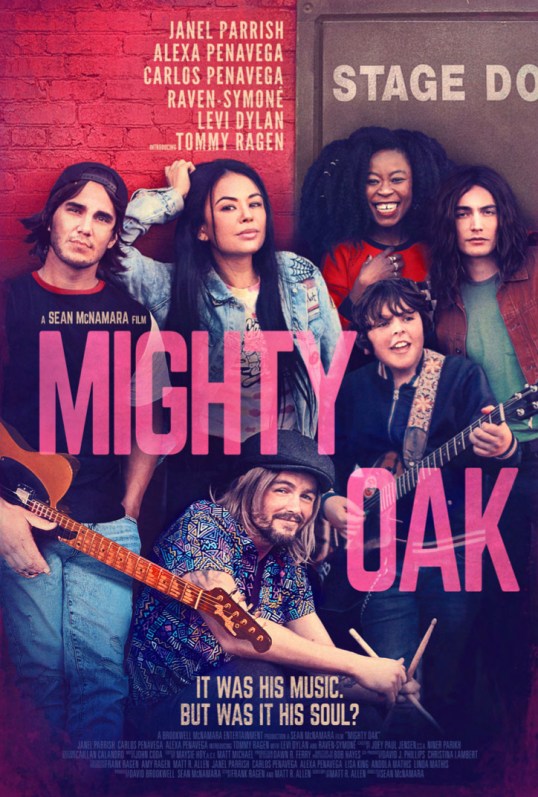
The Films of 2020: Mighty Oak (dir by Sean McNamara)


Mighty Oak tells the story of Army of Love.

Back in the day, Army of Love was an up-and-coming band in Los Angeles.  They were led by charismatic frontman Vaughn Jackson (played by Bob Dylan’s incredibly handsome grandson, Levi Dylan) and managed by Vaughn’s overprotective sister, Gina (Jannel Parrish).  Unfortunately, one night. they were driving home from a gig when a drunk driver collided with their van.  Vaughn was thrown through the windshield and killed.  Army of Love went into permanent hiatus.

However, ten years later, Army of Love is back!  Gina is once again managing and they’ve got a new lead singer.  His name is Oak Scroggins (Tommy Ragen) and he’s ten years old!  But he plays guitar and sings like he’s at least in his early 20s!  At first, some members of the band are skeptical but everyone is won over once Oak starts to perform.  Gina is especially impressed, to the extent that she becomes convinced that Oak is literally Vaughn’s reincarnation.

Of course, Oak’s life isn’t perfect.  Despite his talent (or perhaps because of it), he’s a bit of an outcast at school.  His father’s dead and his mother is the type of drug addict who misses her son’s musical debut because she’s too busy getting arrested on the California-Mexico border.  His grandparents are back in Minnesota and they seem like they mean well but his grandfather has a habit of shouting stuff like, “Kids should be seen not heard!,” so who knows?  Can Gina and the band provide Oak with the family that he needs and will Gina ever discover whether or not Oak is actually her dead brother?  Watch the film to find out.

This is kind of a weird movie.  Sean McNamara previously directed Soul Surfer, which was such a sincere and unapologetically emotional film that it was pretty much impossible not to love it.  Mighty Oak is also extremely sincere and unapologetic but it’s also such a mishmash of different elements and contradictory tones that it’s hard to really know what to make of it.  It starts out as a drama and then it becomes a bit of a broad comedy and then it goes back to being a tear jerker and, in the end, it seems to be trying too hard to convince you that reincarnation is a logical solution as opposed to just being wishful thinking.  Even if you can buy into the idea that Vaughn was reincarnated as Oak, you also have to be willing to believe that the members of defunct hard rock band wouldn’t have any issue with reforming so that they could back up a ten year old.

That said, it’s difficult to really dislike a film like Mighty Oak.  Yes, the plot is a mess and the tone is totally inconsistent and I don’t know much about reincarnation but I’m sure there’s more to the belief than what is presented in this film.  But, as I said at the start of this review, the film’s heart appears to be in the right place and everyone involved seems to mean well and there is something to be said for that.  It helps that Tommy Ragen is a real-life musical prodigy and that he actually can play the guitar just as well in real life as he does in the film.  If nothing else, this elevates the film in a way that casting a typical child actor would not.  It’s a silly movie but you can’t deny that Tommy Ragen is a talented kid.

The Films of 2020: Possessor (dir by Brandon Cronenberg)


Tasya Vos (Andrea Riseborough) is a professional assassin.

That really shouldn’t come as too much of a surprise.  For whatever reason, films about assassins have become very popular over the past few years and those assassins are often women.  However, what sets Tasya apart from other assassins is the technique that she uses.  Under the direction of Girder (Jennifer Jason Leigh), Tasya can possess someone else’s body.  While controlling that other person’s body, Tasya commits her murders and then commits suicide.  The host dies while Tasya’s mind returns to her original body.  The media then reports that the murder was some sort of random incident and, with the killer dead by their own hand, their true motives will probably never be known.  It’s an outlandish premise and yet, it’s one that feels oddly plausible.  Most mass shootings and random acts of violence remain a mystery precisely because their perpetrators often take their own lives.  Three years after the deadliest mass shooting in U.S. history, we still don’t know why Stephen Paddock opened fire on a music festival in Las Vegas.  We’ve become conditioned, I think, to accept that these things just happen.

Wisely, Possessor doesn’t go into too much details about just how exactly Tasya possesses other people.  We see that it involves a lot of odd technology and we also discover that Tasya struggles to return to her “normal” self after her mind returns to her body.  That’s really all we need to see.  Too many films make the mistake of trying to explain all of the little details, as if the audience is going to be concerned as to whether or not a film about possession is 100% plausible.  The director of Possessor, Brandon Cronenberg, understands that all he really has to do is make it look convincing.  He doesn’t have to explain it and, indeed, there’s much that Cronenberg doesn’t explain.

Tasya’s latest assignment takes her into the body of Colin Tate (Christopher Abbott), who is engaged to marry the daughter of arrogant businessman named John Parse (Sean Bean).  Colin and Tasya find themselves fighting for control of Colin’s body.  Even while Tasya is setting up the circumstances that will lead to Colin killing both his girlfriend and her father, Colin is resisting and struggling to take control.  It all leads to some disturbingly surreal imagery, as well as some shockingly gory violence.  There’s a lot of blood in Possessor.  Both figuratively and literally, Possessor is a film that’s obsessed with what lies under the skin.  Throughout the film, bodies and minds are ripped open and what we discover inside of them is frequently grotesque.

Possessor is a film that raises a lot of questions and which often refuses to provide easy answers.  Does Girder sincerely care about Tasya or is she just manipulating her emotions to get the result that she desires?  Who exactly does Girder work for?  Does Tasya truly want to get back together with her estranged husband, Michael (Rossif Sutherland)?  Is Michael as clueless as he seems or does he secretly understand that Tasya is lying whenever she says that she has to go away on business?  Possessor is not always an easy film to follow but Cronenberg’s visuals are so strong and the performances are so wonderfully off-center that it remains enthralling regardless of whether or not it always makes it sense.  By the time one person is wearing someone else’s face as a mask, it’s pretty much impossible to look away.

With its emphasis on body horror and loss of identity (as well as its chilly Canadian setting), Possessor has a lot in common with the early work of David Croneberg.  That’s perhaps not surprising, considering that Possessor was directed by David’s son, Brandon Cronenberg.  Unfortunately, Possessor doesn’t really have the same dry sense of humor that distinguished David Cronenberg’s best films.  (David Cronenberg was, in his way, as much of a satirist as a horror director and Possessor doesn’t quite have the same subversive charge as something like Rabid or Shivers.)  That said, Possessor is still a fascinating and enthralling film, one that will stick with you long after it ends.

The Films of 2020: Ava (dir by Tate Taylor)


Ava tells story of Ava Faulkner (Jessica Chastain), who has a troubled past, a turbulent present, and an uncertain future.

As we learn via a series of still frames during the film’s opening credits, Ava was the valedictorian of her high school class but her bright future was derailed by her own alcoholism.  She killed two of her friends while driving drunk and, presumably to avoid prison, she instead went into the army.  In the army, she was noted for being an efficient killer while, at the same time, being a bit unstable.  She has issues with authority.  Well, don’t we all?  When she got out of the army, she was recruited by Duke (John Malkovich), who taught her how to be an international assassin!

Unfortunately, since Ava screwed up her last mission and has gotten into the habit of talking to her targets before she kills them, Simon (Colin Farrell) wants her dead.  Simon also used to be a student of Duke’s but now he is Duke’s boss or something.  It’s all a bit vague and, to be honest, I found myself spending way too much time trying to figure out the corporate structure of whatever group it was that everyone was supposedly working for.  Apparently, Duke works for Simon but Simon still has to get Duke’s permission before trying to kill Ava or, failing that, try to kill Duke so that Duke won’t complain about it.  Duke spends a lot of time fishing and Simon spends a lot of time with his adorable family.  I liked Simon’s house.

Anyway, Ava has returned to Boston, where she’s trying to reconnect with her family.  It turns out that teenage Ava discovered that her father was cheating on her mom and that’s what set Ava on her downward spiral.  Mom (Geena Davis) is now a hypercritical semi-recluse.  Meanwhile, Ava’s sister, Judy (Jess Wexler), is a singer in a band and she’s engaged to Michael (Common, who, for some reason, keeps getting cast in all of these extremely wimpy roles), who just happens to be Ava’s ex-boyfriend.  And Michael is a gambling addict who owes a ton of money to Toni (Joan Chen).  It’s hinted that Toni and Ava also have a past but then again, everyone in the film has a past with Ava.  It’s get a little bit difficult to keep track of it all.

Ava gets off to a bad start by making us sit through one of Ava’s jobs.  She kills an accountant but first she asks him a lot questions about why anyone would want him dead because apparently, she’s an ethical assassin.  The scene goes on forever and it features Jessica Chastain trying to speak with an Arkansas accent.  Things picked up a bit during the opening credits, which was largely made up of still frames from Ava’s past.  However, once the credits ended and the film’s actual story got started, things quickly went back downhill.

The main problem with Ava is one of sensibility.  Both Jessica Chastain and director Tate Taylor have totally the wrong sensibility for a film like this.  Ava is essentially a work of pulp fiction but Chastain takes herself far too seriously to actually bring a sense of fun to the title role.  Meanwhile, Tate Taylor directs as if he’s never had a single subversive thought in his life.  (In Taylor’s defense, he was a last minute replacement for the film’s original director, Matthew Newton.)  Ava is a film that cries out for a star like Gina Carano and a director like John Stockwell, people who have no hesitation about totally digging in and embracing the silliness of it all.  Instead, we get Chastain and Taylor trying to give us a semi-realistic look at a woman battling her addictions and trying make peace with her past.  Malkovich, Farrell, and Chen all seem to get the fact that Ava should be a fun B-movie, unfortunately, Taylor and Chastain apparently didn’t get the memo.  (Of course, Chastain produced the film so maybe it was her co-stars who didn’t get the memo.  Who knows?)

Ava commits the sin of taking itself too seriously.  Check out John Stockwell’s In The Blood or Phillip Noyce’s Salt instead.

Lisa’s Oscar Predictions For December


In a normal year, this would be my final Oscar prediction post.  All of the critics groups and the Golden Globes and the SAG would have, by this point, painted a pretty clear picture of what and who was going to be nominated in January.  However, as we all know, 2020 was not a normal year and we’ve still got another two months to go until the 2020 awards season comes to its climax.

Though a few regional groups have announced their picks for the best of 2020, most of the major precursors are delaying announcing their picks in order to better influence the Academy in February.  Of the major groups, only the LAFCA stuck to their usual December schedule and they proceeded to honor Small Axe, which will probably not even be submitted for Oscar consideration.

That said, I still think the Oscar picture has cleared up a bit.  Hillbilly Elegy is no longer contender, beyond maybe Glenn Close.  Mank is a contender but probably not the powerhouse that many of us were expecting.  Nomadland and First Cow appear to coming on strong.  The Trial of the Chicago 7 will probably receive some Academy love, even if it hasn’t exactly overwhelmed the critics.

I feel good about these predictions below.  If you want to see how my thinking has evolved, check out my predictions for January, February, March, April, May, June, July, August, September, October, and November!

Best Picture

Da 5 Bloods

The Father

First Cow

Ma Rainey’s Black Bottom

Mank

Minari

Nomadland

Promising Young Woman

Sound of Metal

The Trial of Chicago 7

Best Director

David FIncher for Mank

Spike Lee for Da 5 Bloods

Kelly Reichardt for First Cow

Aaron Sorkin for The Trial of the Chicago 7

Chloe Zhao for Nomadland

Best Actor

Riz Ahmed in Sound of Metal

Chadwick Boseman in Ma Rainey’s Black Bottom

Anthony Hopkins in The Father

Delroy Lindo in Da 5 Bloods

Gary Oldman in Mank

Best Actress

Viola Davis in Ma Rainey’s Black Bottom

Sidney Flanigan in Never Rarely Sometimes Always

Vanessa Kirby in Pieces of a Woman

Frances McDormand in Nomadland

Carey Mulligan in Promising Young Woman

Best Supporting Actor

Chadwick Boseman in Da 5 Bloods

Brian Dennehy in Driveways

Billy Murray in On the Rocks

Leslie Odom, Jr. in One Night In Miami

Paul Raci in Sound of Metal

Best Supporting Actress

Ellen Burstyn in Pieces of a Woman

Glenn Close in Hillbilly Elegy

Olivia Colman in The Father

Amanda Seyfried in Mank

Yuh-jung Youn in Minari

Scenes That I Love: The Phone Call From Sam Wainwright From It’s A Wonderful Life


Tonight, NBC will be airing It’s A Wonderful Life.

Watching It’s A Wonderful Life on Christmas Eve is a tradition for many people.  It definitely is for me and my family.  I’ve watched It’s A Wonderful Life so many times that I’ve practically got the entire movie memorized.  It’s not only my favorite Christmas movie but also one of my favorite movies of all time.

Everyone knows, of course, that It’s A Wonderful Life is a film about a man named George (played by Jimmy Stewart) who gets a chance to see what the world would be like without him.  What I think is often overlooked is that it’s also a powerful and poignant love story and that the scenes between George and Mary (Donna Reed) are some of the most intensely romantic ever filmed.

In the scene below, George and Mary get a phone call from Mary’s ex, Sam Wainwright.  Sam has a business opportunity but George has more on his mind than staying in Bedford Falls and making money.  This scene, which begins with Mary upset and George feeling lost, ends with one of the most powerful kisses of the 1940s.

This is a scene that I love from a movie that I love and I look forward to watching it tonight!

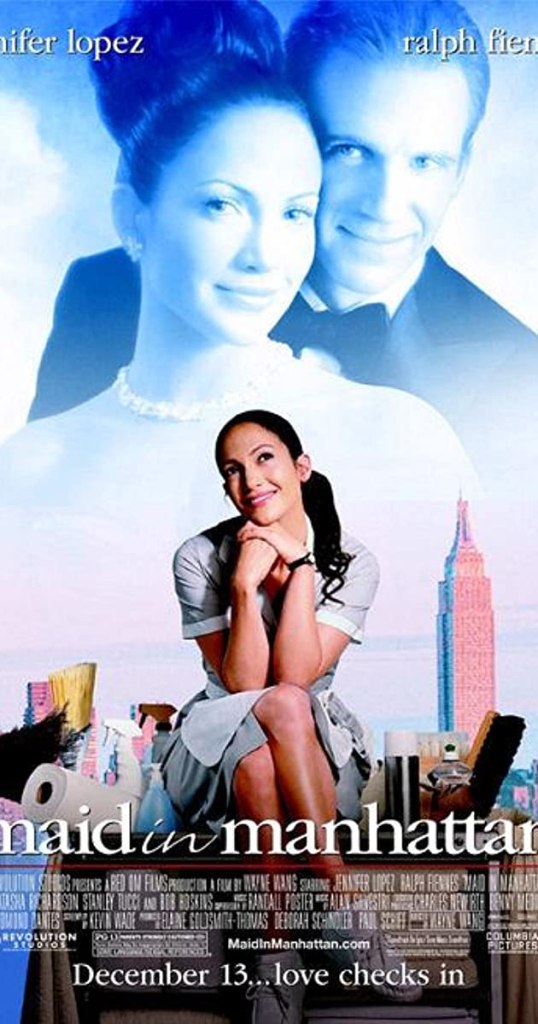
Guilty Pleasure No. 50: Maid in Manhattan (dir by Wayne Wang)


Whenever I see that the 2002 film, Maid in Manhattan, is going to be playing on HBO or Cinemax, I always think to myself, “I can’t understand why everyone hates on this film.  I mean, it’s not that bad.  It may be predictable and silly but it’s kind of sweet and Jennifer Lopez and Matthew McConaughey have a tame but sexy chemistry.”

Of course, then I watch the film and I discover that Maid in Manhattan is not the film where Jennifer Lopez and Matthew McConaughey fall in love.  That’s The Wedding Planner.  Instead, Maid in Manhattan is the one where Jennifer Lopez is a maid who works in a big fancy hotel and who is a single mother to a precocious child who is obsessed with Richard Nixon.  Maid in Manhattan is also the one where Jennifer Lopez falls in love with Ralph Fiennes.  Fiennes plays a candidate for the U.S. Senate.  Everyone is worried that he’ll never make it to Washington if people discover that his girlfriend is a maid.  I think his bigger problem is that he’s a Republican running for the U.S. Senate in New York.  (At least, I assume he’s a Republican because — as we learn from his conversations with Lopez’s son — he certainly seems to know a lot about and be rather sympathetic to Richard Nixon.)

I still like Maid in Manhattan, though perhaps not as sincerely as I like The Wedding Planner.  Some of that is because Maid in Manhattan takes place during the Christmas season and I love a good wintry romance.  Some of it is because this is probably the only mainstream film to feature people discussing the good points of Richard Nixon.  There’s the fact that Jennifer Lopez is always perfectly cast as someone determined to make something out of her life, regardless of whether or not the world supports her or not.  She’s always had the ability to make steely ambition sympathetic and that’s a good ability to have when you’re playing a maid who is determined to get promoted into management.

Finally, there’s the odd romantic pairing of Ralph Fiennes and Jennifer Lopez.  It’s one of those things that shouldn’t work and yet, strangely, it does.  Fiennes always brings a certain off-center, neurotic energy to his performances, which not only explains why he’s played so many villains but also why it’s strange to see him starring in a romantic comedy.  And yet, that odd energy is exactly what Maid in Manhattan needs.  It keeps the viewer on their toes and it makes the surprising discovery that Fiennes and Lopez have romantic chemistry all the more rewarding.

Don’t get me wrong, of course.  This is a deeply silly movie and there’s a lot of less than sparkling dialogue and the plot falls apart if you even start to think about it.  The entire story revolves around mistaken identity, with Fiennes not realizing that Jennifer Lopez is a maid and …. well, it’s all a bit unnecessarily complicated.  The film also takes Fiennes’s political aspirations a bit too seriously.  It’s not quite as bad the whole thing with Matt Damon running for the Senate in The Adjustment Bureau (“Due to his charming concession speech, he will someday be elected President,” — whatever, Beto) but it gets close.

But, still — I love romance and I love New York and the pairing of Jennifer Lopez and Ralph Fiennes in Maid in Manhattan is just too strange (and oddly effective) for me to resist.

Previous Guilty Pleasures

  1. Half-Baked
  2. Save The Last Dance
  3. Every Rose Has Its Thorns
  4. The Jeremy Kyle Show
  5. Invasion USA
  6. The Golden Child
  7. Final Destination 2
  8. Paparazzi
  9. The Principal
  10. The Substitute
  11. Terror In The Family
  12. Pandorum
  13. Lambada
  14. Fear
  15. Cocktail
  16. Keep Off The Grass
  17. Girls, Girls, Girls
  18. Class
  19. Tart
  20. King Kong vs. Godzilla
  21. Hawk the Slayer
  22. Battle Beyond the Stars
  23. Meridian
  24. Walk of Shame
  25. From Justin To Kelly
  26. Project Greenlight
  27. Sex Decoy: Love Stings
  28. Swimfan
  29. On the Line
  30. Wolfen
  31. Hail Caesar!
  32. It’s So Cold In The D
  33. In the Mix
  34. Healed By Grace
  35. Valley of the Dolls
  36. The Legend of Billie Jean
  37. Death Wish
  38. Shipping Wars
  39. Ghost Whisperer
  40. Parking Wars
  41. The Dead Are After Me
  42. Harper’s Island
  43. The Resurrection of Gavin Stone
  44. Paranormal State
  45. Utopia
  46. Bar Rescue
  47. The Powers of Matthew Star
  48. Spiker
  49. Heavenly Bodies

4 Shots From 4 Films: Special Michael Curtiz Edition


4 Shots From 4 Films is just what it says it is, 4 shots from 4 of our favorite films. As opposed to the reviews and recaps that we usually post, 4 Shots From 4 Films lets the visuals do the talking.

December 24th is not just Christmas Eve!  It’s also the anniversary of the birth of Michael Curtiz!  Michael Curtiz was born in Budapest in 1886 and, after getting his start making silent films in Hungary, he eventually came to the United States and became one of the most important directors of Hollywood’s Golden Age!  Curtiz mastered every genre and worked with every star and the end result was some of the greatest films ever made.

Today, we honor the legacy of Michael Curtiz with….

4 Shots From 4 Films

Mystery of the Wax Museum (1933; Dir by Michael Curtiz)

The Adventures of Robin Hood (1938, dir by Michael Curtiz)

Casablanca (1943, dir by Michael Curtiz)

King Creole (1958, directed by Michael Curtiz)