4 Shots From 4 Films: Special F.W. Murnau Edition


4 Shots From 4 Films is just what it says it is, 4 shots from 4 of our favorite films. As opposed to the reviews and recaps that we usually post, 4 Shots From 4 Films lets the visuals do the talking.

Today was celebrate the visionary director, F.W. Murnau!  Murnau was born 132 years ago today, in Germany.  He went on to become a leading expressionist and one of the most influential filmmakers of all time.  Needless to say, it’s time for….

4 Shots From 4 Films

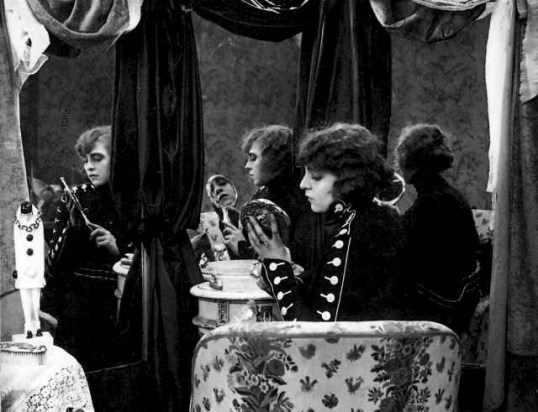
The Hunchback and the Dancer (1920, dir by F.W. Murnau)

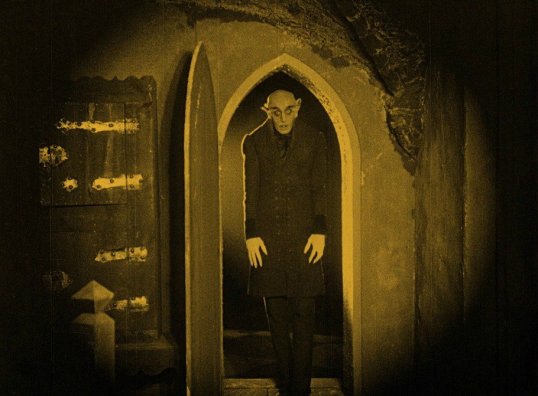
Nosferatu (1922, dir by F.W. Murnau)

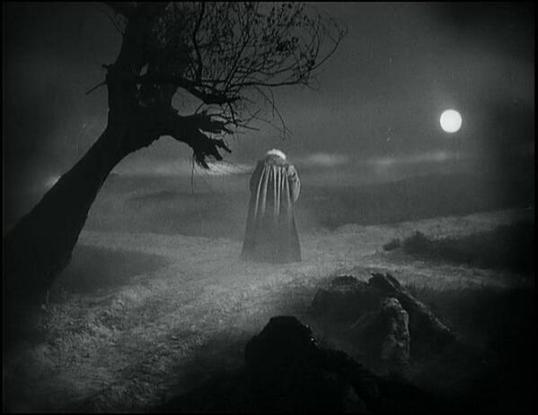
Faust (1926, dir by F.W. Murnau)

Sunrise: The Story of Two Humans (1927, dir by F.W. Murnau)

Finally, Let’s Celebrate Christmas With The Greatest Movie Ever Made!


Hi, everyone!

Well, Christmas is coming to a close.  Right now, my sisters and I are currently watching Die Hard.  That’s a huge Bowman family tradition but it’s also one that we usually reserve for the end of the holiday.

So, with Christmas coming to a close, it’s time for a TSL tradition!  It’s time to watch Treevenge!  This is the short film about sentient Christmas trees that TSL founder Arleigh Sandoc has declared to be “the greatest movie ever made.”  Watching Treevenge is something we do every year at the TSL Bunker so sit back and enjoy some Christmas horror!

Thank you for sticking with us over the course of this long and difficult year.  We look forward to continuing to hopefully keep you entertained over the next year as well!

Happy holidays to all of you.  Thank you for reading.

Here’s The Trailer For Coming 2 America!


Yes, you may have noticed that we’re a few days late in sharing this one.  Sorry, about that.  The holidays have been crazy!

Anyway, here’s the trailer for Coming 2 America!  Eddie Murphy made quite a comeback last year with Dolemite Is My Name.  A lot of people — myself included — felt that he at least deserved an Oscar nomination for his performance.  I doubt he’ll get a nomination for Coming 2 America but, still, it’ll be interesting to see if audiences flock to a sequel to a film that was made several decades ago.  I can say that people on twitter certainly do seem to be excited about the film.  I haven’t seen the original film so I can’t judge the trailer one way or the other, beyond saying that this looks like the type of comedy that will actually probably play better on a streaming platform than on the big screen.  It’s easy to imagine someone unwinding from a long day by watching this film in their living room.  That’s not a bad thing, either.  One of the best things that any movie can do is provide an easy and convenient escape from every day life.

Here’s the trailer:

4 Shots From 4 Films: Special Humphrey Bogart Edition


4 Shots From 4 Films is just what it says it is, 4 shots from 4 of our favorite films. As opposed to the reviews and recaps that we usually post, 4 Shots From 4 Films lets the visuals do the talking.

Today is not just Christmas!  It is also Humphrey Bogart’s birthday!  Bogart was born 121 years ago, today!  And that means that it’s time for….

4 Shots From 4 Films

Dead End (1937, dir by William Wyler)

Casablanca (1943, dir by Michael Curtiz)

The Big Sleep (1946, dir by Howard Hawks)

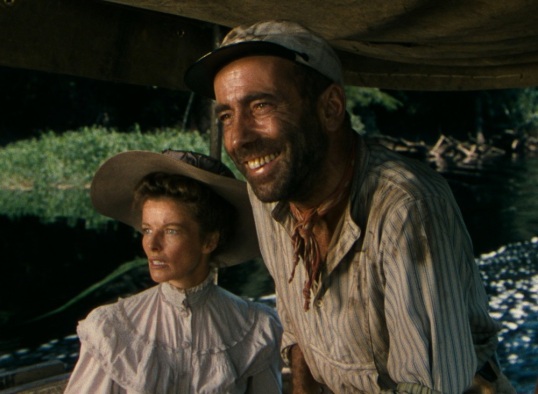
The African Queen (1951, dir by John Huston)

The Films of 2020: The Mystery of D.B. Cooper (dir by Jon Dower)


The story of D.B. Cooper has always fascinated me.

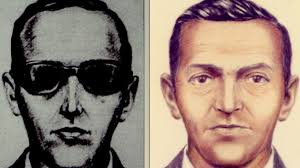
D.B. Cooper is the name assigned to a man who, in 1971, hijacked an airplane, demanded $200,000, and then jumped off the plane after he got the money.  Reportedly, he was well-dressed and unfailingly polite during the entire hijacking.  When he jumped off the plane, he was about 10,000 feet over the Washington wilderness.  After he jumped, no further trace was found of him.  Nearly 50 years after the incident, the identity and the location of D.B. Cooper remains a mystery.

It’s been said that, even though Cooper had a parachute with him when he jumped, there’s no way that he could have survived the fall.  And yet, no body has ever been found.  (Of course, finding a body in the wilderness is not as easy as some people tend to assume.)  Nine years after the the skyjacking, some of the money that Cooper received was found on the banks of the Columbia River, which was several miles away from the area that Cooper jumped over.  Did Cooper survive the jump and lose the money?  No one can say for sure.

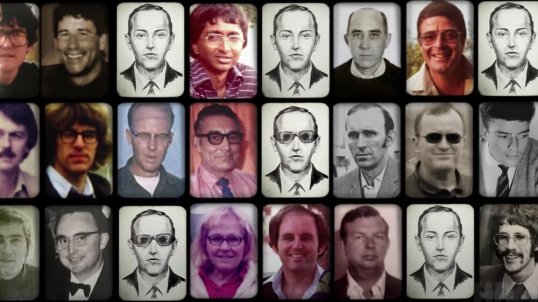
Over the years, many people have come forward to say that they know the identity of D.B. Cooper.  Many distant fathers and secretive boyfriends and long lost friends have been accused of being D.B. Cooper.  Some of those suspects are more likely than others.  Even John List, the murderer who inspired the Stepfather films, was suspected at one point.

D.B. Cooper remains a fascinating character precisely because he’s never been captured and the mystery itself will probably never be solved.  Because he remains an enigma, it’s easy to project your own pet obsessions on him and his story.  Myself, I always imagine D.B. Cooper as being some sort of clever, fun-loving international rogue, even though there’s not really any evidence to back that up.  But, the fact of the matter is that I have a weakness for clever, fun-loving international rogues so, of course, that’s who I’m going to imagine D.B. to be.

The Mystery of D.B. Cooper is a documentary that takes a look at both Cooper’s crime and his subsequent fame.  Both a flight attendant and the pilot of Cooper’s flight are interviewed and they both provide vivid memories of both the skyjacking and D.B. Cooper himself.  (They both describe Cooper as being well-spoken and polite.  The flight attendant even says that he seemed like a rather nice man.)  We also get plenty of contemporary news footage of the subsequent search for D.B. Cooper.  One man says that he likes Cooper because Cooper fought the system.  Another one says that he admires Cooper for having a plan and sticking to it.

Meanwhile, in the present day, we are introduced to several different people who are all convinced that someone from their life was D.B. Cooper.  To me, this is the most interesting part of the documentary.  Some of the people are more convincing than others.  The friends of Barbara Drayton talk about how she always claimed that she disguised herself as a man so that she could get revenge on the airline.  The ex-wife of Duane Webber talks about how he always said he injured his knee jumping out of a plane.  L.D. Cooper’s niece makes a somewhat compelling that her uncle could have been D.B. Cooper, though one can’t help but wonder if she would feel the same if the man’s name as L.D. Smith.  Perhaps the most convincing argument is the one that Richard Floyd, who was captured after skyjacking another plane and who was subsequently killed by the FBI after he escaped custody, was also D.B. Cooper.

In the end, though, the documentary is less about who D.B. Cooper was and more about what he means to people and why he remains an obsession for many.  It’s a fascinating look at a cultural phenomena and one to keep an eye out for.

And, if you’re reading and you are D.B. Cooper — way to go and Merry Christmas!

The Films of 2020: Driveways (dir by Andrew Ahn)


There’s a certain type of independent film that you tend to see quite frequently towards the end of the year.  It’s the type of film where a single mother and her precociously intelligent child move to a new town and get to know their neighbors.  Usually, the child has to deal with a bully or two while the mother reflects on her own rebellious past.  Almost inevitably, there’s a cantankerous older neighbor who seems a little bit intimidating at first but who eventually turns out to be a decent guy.  That older neighbor is often played by a character actor who has never quite gotten the appreciation that he deserves.

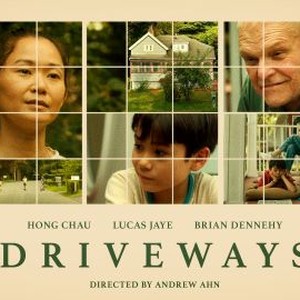
Driveways is one of those films.  This time, the mother is named Kathy (Hong Chau) and her 9 year-old son is named Cody (Lucas Jaye).  Cody is intelligent but shy.  He struggles to fit in.  He worries about the fact that his mom is constantly smoking and whenever she curses, he gives her a slightly judgmental look.  If he gets too anxious, he has a habit of vomiting.  He’s one of those kids who you just want to protect from the outside world and assure him that everything’s going to (eventually) be okay.

The neighbor is Del and he’s played by the late, great Brian Dennehy.  Del is a veteran of the Korean War and a widower.  He spends a lot of time sitting out on his porch.  He’s a nice guy and one of the things that I appreciated about this film is that Del was nice from the minute he first appeared.  Usually, in films like this, it takes a while for the neighbor to let down his defenses and show that he’s not some sort of bitter ogre.  Usually, there’s all sorts of conflicts and “Get off my lawn” moments but, in Driveways, Del pretty much warms up to Kathy and Cody as soon as he meets them.  He shows Cody how drink from a hose.  Kathy gives him a ride to VFW Hall, where he plays bingo with his friends.  Soon, Del is Cody’s only friend on the block and Del is also one of the few sources of support that Kathy has as she cleans out her recently deceased sister’s home.

There’s not really a lot of drama in Driveways.  There is one annoying neighbor named Linda (Christine Ebersole), who shows up for some of the film’s weaker moments.  And there’s a wonderfully acted scene where Del goes shopping with friend (played by Jerry Adler) who has Alzheimer’s.  Otherwise, this is a low-key film about three people who are at the beginning, the middle, and the end of life.  It’s occasionally a little predictable but it’s sweet-natured film and it has a good heart.

And, most importantly, it gives Brian Dennehy one final great role.  When Dennehy passed away earlier this year, Tommy Boy was soon trending on twitter because, whenever a great actor dies, it seems that their worst films always end up trending.  (This is largely because people on twitter have terrible taste.)  Dennehy was a great actor with a commanding screen presence and it’s somewhat surprising that he died without having ever been nominated for an Oscar.  In Driveways, he brings Del to poignant life.  At the end of the film, he delivers a lengthy monologue about his life and its a powerful moment and one that deserves awards consideration.  A supporting actor nomination for Brian Dennehy would not only be a way to acknowledge a great performance but also a great career, in which he appeared in a lot more films than just Tommy Boy.  Here’s hoping!

The Films of 2020: Money Plane (dir by Andrew Lawrence)


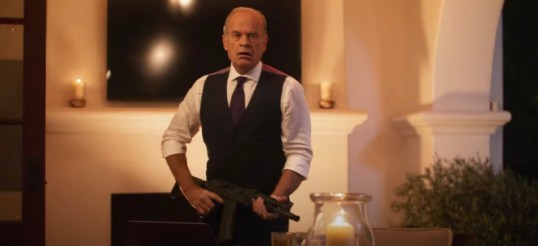
Yes, that’s Kelsey Grammer holding a machine gun in the picture above.  This is a screenshot from a film called Money Plane, which is about a plane where people gamble on everything from Texas Hold ‘Em to Russian Roulette to how long it will take a man to die after being bitten by a cobra.  A group of thieves are recruited to rob the money plane.  Grammer plays the man who ordered the robbery, a total psycho who is named Darius Grouch III but who prefers to be called The Rumble.

And listen, there’s a lot of things that you can say about Money Plane.  Does the plot always make sense?  Of course not.  Heist films aren’t supposed to make much sense.  Does the film look cheap?  You bet.  This isn’t a Hollywood blockbuster.  This film is closer to be a mockbuster.  But, dammit, any movie that features Kelsey Grammer loudly announcing, “I’m the baddest motherfucker around!” in that voice of his is automatically going to be one of the best of the year.

Well, maybe not the best.  As I said, Money Plane is a low-budget action movie and, watching it, you get the feeling that the film was largely made as a lark.  It’s a silly movie but, when taken on its own very undemanding terms, it’s actually pretty fun.  Unlike a lot of action films, Money Plane has a sense of humor and one gets the feeling that the cast and crew were in on the joke.  One could imagine a director like Steven Soderbergh taking this material and ruining it by trying to pretend as if there was more going on underneath the surface of the film than there actually was.  Money Plane, on the other hand, makes no apologies and doesn’t pretend to be anything that it isn’t.

Here’s a few things I liked about Money Plane:

1) One of the thieves was played by Katrina Norman and she got to beat up some sleazy men.  That’s always fun to watch.

2) The great Thomas Jane had a small but key role as the best friend of the main thief (who was played by former wrestler Adam Copeland).

3) I couldn’t help but be amused by the fact that the famous Money Plane was just an ordinary airplane, as opposed to some sort of gigantic floating fortress.

4) I also found myself strangely amused by the fact that the inside of the plane appeared to be significantly bigger than the outside.

5) When it was announced that the next game would be “Texas Hold ‘Em,” a dude wearing a cowboy hat stood up and was like, “This is my game!”

6) Jackson Pollock and several other painters are referred to as being “a bunch of bitches,” which amused me as an art history major.

7) Adam Copeland’s ex-wife is played Denise Richards, who once again proves that she’s a better actress than she’s frequently given credit for.

8) And, of once again, how can you not love a film that has Kesley Grammer cursing up a storm and running around with a machine gun?

I recommend Money Plane.  It’s enjoyably silly.


The Films of 2020: My Psychedelic Love Story (dir by Errol Morris)


Errol Morris is a documentarian who has made a career out of interviewing the eccentric and the quirky.

In My Psychedelic Love Story, he interviews Joanna Harcourt-Smith who, way back in the 1970s, was the lover of Acid guru Dr. Timothy Leary.  She was in her 20s and he was in his 50s but they still apparently had a wonderful time as exiles in Europe.  Leary, at the time, was a fugitive, having escaped from prison and fled to Switzerland.  (Before his escape, he was serving a 20-year sentence after being convicted of possessing two joints.  Leary claimed that he was set up by the arrest officer.  Still, the fact that two joints led to a 20-year sentence tells you all you need to know about American drug laws in the 60s and 70s.)  Leary and Joanna spent a few years as glamorous international exiles, staying at the homes of the rich and self-styled decadent.  Eventually, Leary was captured and, upon returning to the United Sates, became an informant for the FBI.  Though Leary always claimed that he gave the FBI useless information (and reportedly, no one was ever convicted of any crimes based on any of the information that Leary provided), his decision to “cooperate” with the authorities was viewed as a betrayal by many members of the counterculture.

As usually happens whenever a male cultural figure lets down his disciples, the woman was blamed.  Many — including Allen Ginsberg — suggested that Joanna Harcourt-Smith was actually an agent of the CIA who had not only arranged Leary’s capture but who was also responsible for him eventually cooperating with the government.  Interestingly enough, in My Psychedelic Love Story, Joanna also suggests that she may have been unknowingly manipulated by the CIA to take Leary down.

That’s one of the many stories that Joanna Harcourt-Smith tells over the course of My Psychedelic Love Story.  Though the film largely focuses on her relationship with Leary, Harcourt-Smith also talks about her childhood and her life after her break-up with Leary.  Some of the stories are interesting and, to be honest, some of them are more than a little boring.  The documentary never quite convinces us that Joanna Harcourt-Smith is as fascinating as she and Morris seem to believe that she is.  Perhaps her most interesting moment comes when she says that she has a long history of lying.

If anything, Harcourt-Smith comes across as being the type of figure who is familiar to anyone who has actually researched the counter culture of the 60s and 70s, the wealthy hippie who can afford to rebel because her position in society is guaranteed regardless of how that rebellion turns out.  Harcourt-Smith often comes across as something a dilettante, someone who got involved in radical politics because, at the time, that was the thing to do.  Listening to her speak, I was reminded of the end of the film Guerilla, in which former left-wing terrorist Patty Hearst, having been pardoned by the president, smiled and said that she was looking forward to going home.  (Home happened to be a mansion.)  That’s not to say that Harcourt-Smith was brainwashed as much to suggest that one reason why she could do what she did was because she had the escape clause of being from a wealthy and connected family.

As for Leary, the documentary features recordings of him speaking but he remains an enigmatic figure.  At times, he comes across as being very sincere.  At other times, he comes across as being a manipulative Svengali.  At his worst, he comes across as being a character straight from an Aaron Sorkin screenplay.  One can easily imagine Sorkin writing a screenplay about how Leary was betrayed by every woman he ever met.  (“I could have turned the world on, if not for those women with their pesky opinions!”)

Despite all of that, My Psychedelic Love Story is still an interesting historical document.  If you’re a student of the 60s and 70s cultural history, you’ll want to watch it.  The film may leave you frustrated but it’s still a chance to hear about the era from someone who was there.

The Films of 2020: Natalie Wood: What Remains Behind (dir by Laurent Bouzereau)


It’s a bit frustrating that I have to start this review of a documentary about one of my favorite classic film actresses by discussing the gossip and innuendo that has surrounded her death but, unfortunately, that’s the world that we live in nowadays.

It’s been nearly 40 years since the death of Natalie Wood and the circumstances of her drowning are still debated, largely by people who know nothing about the incident beyond what they’ve read online.  In 2011, when an employee of Wood and her husband, Robert Wagner, suddenly changed the story that he had been telling for 30 years, the Los Angeles Police Department reopened the investigation into Wood’s death.  Suddenly, all over twitter, people were accusing Wagner of having killed Wood, either deliberately or accidentally.  Interestingly enough, Christopher Walken was also on the boat on the night that Wood drowned but very few people accused him of having anything to do with it, largely because Walken is better-known to most twitter users than Wagner.  (It’s easier to accuse someone of murder when he’s not a celebrated cultural icon.)  Things were not helped when the LAPD announced that Wagner a “person of interest” in the case.  Of course, “person of interest” is a vague term that can mean anything.

Also not helping matters was that Lana Wood, Natalie’s sister, publicly accused Wagner of having something to do with Natalie’s death.  I can still remember that bloviating gasbag, Dr. Phil, having Lana on his show and asking her if she thought Wagner murdered Natalie.  Footage from that interview appears in the HBO documentary, Natalie Wood: What Remains Behind.

Fortunately, in the documentary, Robert Wagner is also interviewed about the night that Natalie Wood drowned and there’s a marked contrast between the obviously emotional Wagner who appears in the documentary and the monstrous caricature of Wagner that’s been presented by many Wood conspiracy theorists.  If I didn’t already think that Wagner was innocent and that Wood’s death was a tragic and terrible accident, this documentary would have convinced me.

Natalie Wood: What Remains Behind is a documentary about the life and, sadly, the death of Natalie Wood.  It’s hosted by her daughter, Natasha Gregson Wagner.  The film is tribute to Wood and her career, featuring interviews with the journalists who wrote about her, the photographers who snapped pictures of her, the stars who co-starred with her, and finally, the members of of her family.  There’s also a good deal of archival footage of Wood talking about her life.  One thing you quickly realize, while listening to Wood, is that she knew how to play the PR game.  In her interviews, Wood always said enough to be interesting while, at the same time, keeping up enough wall that she remained somewhat enigmatic.  Natasha, for her part, describes her mother as being a down-to-Earth person who, when she had to, could play the role of the glamorous film star.

The film examines Natalie’s career, from her time as a child actor to stardom in the 50s and 60s.  As the documentary points out, Wood was an actress who literally grew up on scree.  The film also takes a look at her semi-retirement in the 70s.  (She was making a comeback at the time of her death and Wagner, in fact, admits to getting into a rather loud argument with Christopher Walken about whether or not Wood should have been accepting more film roles.)  The documentary candidly discusses her difficult relationship with her mother, along with her occasionally tumultuous private life.  The film provides a look at both what made Wood a star and why her performances continue to resonate with so many of us.

(For the record, my favorite Natalie Wood performance will always be Splendor in the Grass.)

But, sadly to say, Wood’s death and the rumors surrounding it casts a shadow over almost every minute of the documentary.  Again, that’s the world we live in.  It’s a world dominated not only be innuendo and gossip but also a desire to destroy anyone who has ever led a public life.  As a result, there’s no way to make a documentary about Natalie Wood without discussing the conspiracy theories surrounding her death and it’s tragic that a few publicity hungry individuals continue to attempt to capitalize on the tragedy of Wood’s passing.  The film gives Wagner a chance to tell his story and for that, we should be both thankful.  This is film that will inspire viewers to celebrate Wood’s life and to despise those who have exploited her death.