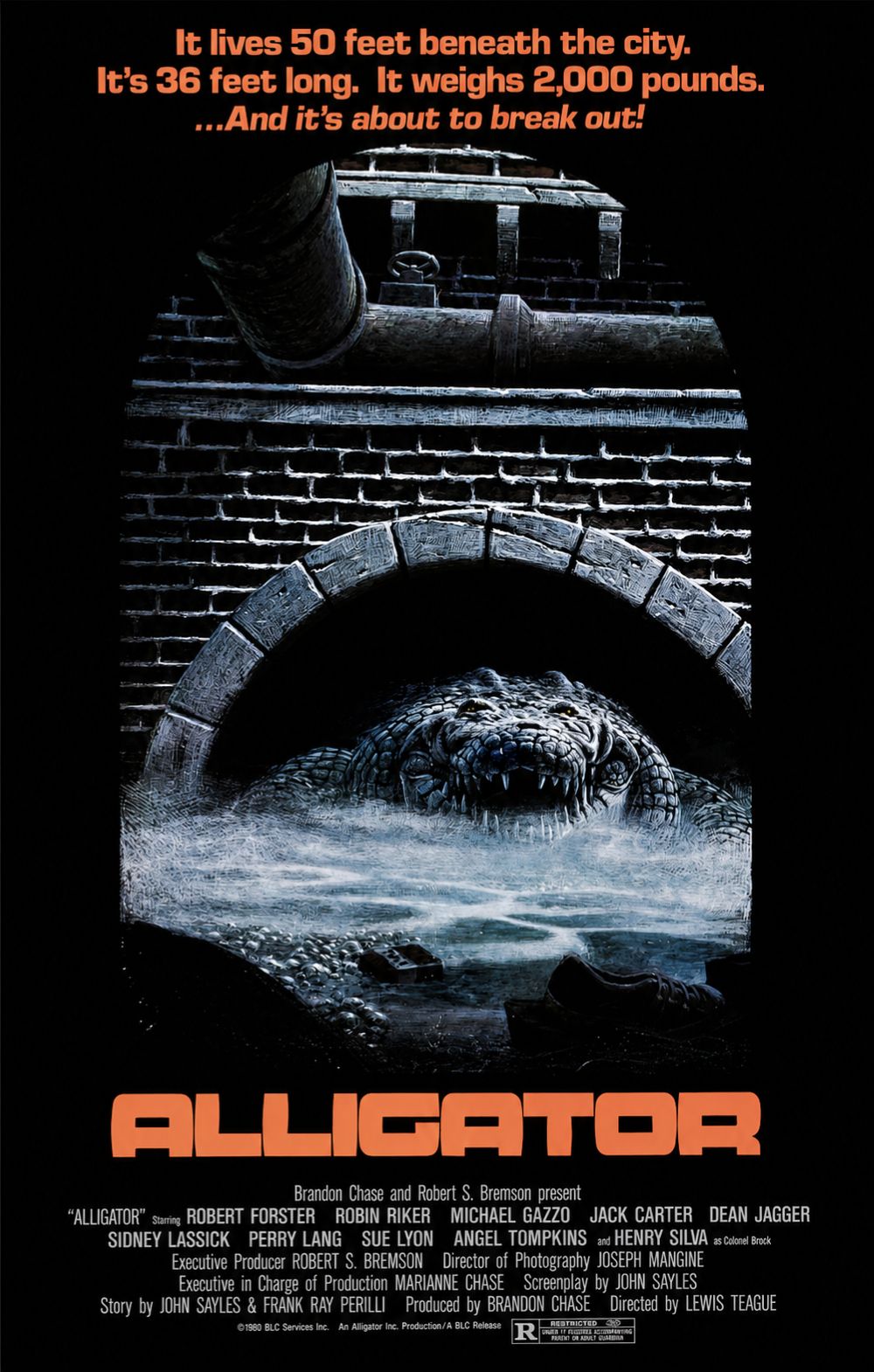
Lewis Teague’s Alligator is exactly the sort of movie that sounds like a bad joke until you sit down with it and realize it is having a much better time than most “serious” creature features. The premise is pure drive-in delirium: a baby alligator is flushed down a toilet, survives in the sewer system beneath St. Louis, Missouri, feeds on discarded laboratory animals pumped full of experimental growth hormones, and eventually becomes a gigantic, people-eating urban nightmare. It is absurd from the start, but that absurdity is the movie’s best asset. Alligator is not a good film in the polished, tightly controlled sense. It is too clunky, too broad, and too openly ridiculous for that. But it is never boring, and it understands that a movie about a giant alligator stalking the sewer tunnels under St. Louis should be grimy, nasty, funny, and just a little bit stupid.
The film arrives in that sweet spot between the straightforward animal-attack movies of the 1970s and the increasingly self-aware horror comedies of the 1980s. It has some of the structure of a Jaws knockoff, of course: authorities dismiss warnings, a difficult investigator takes the danger seriously, and a creature grows into an outsized public threat before the final confrontation. But Alligator does not have the resources, atmosphere, or aquatic terror of Spielberg’s film, and to its credit, it does not really pretend to. Instead, it leans into the cheapness of its materials. The alligator is mostly an oversized practical effect, sometimes convincing enough to be threatening and sometimes looking like the kind of thing that should be knocking over miniature buildings in a 1950s monster movie. The difference is that Teague knows how to frame the thing. He keeps the creature partly hidden when that helps, lets the sewer setting do much of the atmospheric heavy lifting, and saves the full ridiculousness of the monster for when ridiculousness is exactly what the audience wants.
There is an immediately appealing trashy logic to the story. The alligator is not simply an animal that wandered into the wrong place; it is a product of environmental carelessness, corporate experimentation, and the city’s tendency to throw its problems underground. The movie opens with a young girl’s pet alligator being flushed away after it bites someone, a cruelly comic act that functions as the film’s entire moral universe in miniature. Humans dispose of an inconvenient creature, neglect the consequences, and then act shocked when the creature becomes a gigantic murderous problem. The idea is broadly ecological and vaguely anti-corporate, but Alligator never becomes preachy. It keeps those elements in the background as an excuse for gore, sewer crawling, and a steadily escalating body count.
Robert Forster plays David Madison, a St. Louis cop with the permanently tired demeanor of someone who has been forced to listen to too many witnesses describe impossible things. Forster is a major reason the movie works as well as it does. He does not play the material like a joke, but he also does not strain to elevate it into prestige horror. His performance is dry, irritated, and completely appropriate for a man investigating missing-person cases that increasingly point toward a subterranean reptile large enough to eat a car. Madison is not a particularly complicated protagonist, but Forster gives him enough weary professionalism that the audience can follow him through the nonsense. His deadpan approach also makes the film funnier without turning it into outright parody.
The supporting cast is a strange, entertaining mixture of familiar character-actor energy and exploitation-movie weirdness. Robin Riker plays Marisa, a reptile expert and Madison’s eventual love interest, and she is better than the role strictly requires. She has a brisk, practical presence, which is useful in a movie where most characters either refuse to believe the obvious or exist to become alligator food. The romance between her and Madison is thin, but it is handled with enough low-key charm that it does not stop the movie cold. It feels like a necessary B-movie ingredient rather than a desperate attempt to convince viewers that they are watching something emotionally profound.
Then there is Henry Silva. Honestly, the presence of Henry Silva alone tells you what kind of movie Alligator is trying to be. Silva plays Colonel Brockman, a professional hunter hired by the evil pharmaceutical company to find and kill Ramon, the giant gator created by its illegal growth-hormone dumping. He is not the mastermind behind the scientific mess; he is the company’s hired cleanup crew, brought in once the whole operation has become too big and too toothy to bury. Silva approaches the role with exactly the degree of swaggering, oily menace it needs. He is here to be Henry Silva in a monster movie, which means glaring, sneering, and acting as though the chance to hunt a massive sewer reptile is simply another profitable afternoon at work. Every time he shows up, the movie gets a little more fun.
The screenplay comes from John Sayles, which is almost comically overqualified on paper, though it makes more sense once the dialogue starts landing. Sayles gives the movie flashes of wit and an edge of social satire that keep it from being totally disposable. There are jokes about cops, politicians, wealthy elites, and corporate corruption, and while none of them are especially subtle, they have the right bite for a film this grubby. The story’s best satirical impulse is its refusal to make the rich and powerful merely unlucky victims of the monster. The alligator’s rampage eventually collides with a wealthy social gathering, and the movie takes obvious pleasure in turning a fancy event into a feeding ground. It is not exactly The Texas Chain Saw Massacre in its class consciousness, but it does understand that watching an enormous reptile crash through the polished facade of upper-class respectability is satisfying.
Teague directs with the workmanlike confidence of someone who knows that the material only needs to get from one entertaining set piece to another. The sewer scenes are the film’s strongest visual material. They are damp, shadowy, cluttered, and full of the sort of industrial grime that exploitation cinema loves. The setting is inherently creepy because it is both unreal and plausible: everyone knows a city like St. Louis has tunnels, pipes, forgotten chambers, and places where things can disappear, even if nobody really believes a giant alligator lives down there. The movie uses that unease effectively. When characters descend into the darkness, the tension is simple but real. You know something huge is moving nearby, and you know the special effects are not going to hold up to close inspection, but the atmosphere carries you through.
The attacks are uneven, but that is part of the charm. Some are genuinely nasty, particularly when the movie lets the creature strike suddenly from the shadows. Others are so exaggerated that they become funny in ways the filmmakers likely anticipated. There is a particularly memorable moment involving a child and a swimming pool that has the gleefully tasteless punch of old-school grindhouse horror. Alligator is never as graphic as the nastier exploitation films of its era, but it has enough blood, torn bodies, and monstrous chomping to satisfy an audience looking for low-rent carnage. It knows the basic rule of this kind of movie: if you are going to ask viewers to accept a mutant sewer alligator, you had better let it eat some people.
What makes Alligator last beyond its premise is that it does not seem embarrassed by what it is. There are many creature features that feel apologetic, as if the filmmakers know they are making junk and are waiting for the audience to laugh at them. Teague’s film is junk, absolutely, but it is crafted junk. It has actual pacing, committed actors, useful atmosphere, and a screenplay that occasionally has more on its mind than the average monster-on-the-loose picture. It is bad enough that its flaws become part of the entertainment, especially whenever the huge reptile lumbers into view or the plot makes a leap that only makes sense if nobody involved pauses to think for ten seconds. Yet it is not so bad that it becomes a chore. That is the crucial distinction.
By the time Alligator reaches its climax, it has delivered nearly everything its title promises: sewers, corrupt businessmen, cops with guns, practical monster effects, socialites getting their comeuppance, and Henry Silva looking like he would gladly accept a corporate paycheck to hunt an enormous mutant reptile. It is the kind of film best watched with an appreciation for grime, excess, and the noble tradition of exploitation cinema turning a ridiculous idea into a perfectly decent Saturday-night monster movie. Alligator will not make anyone forget the great creature features, but it earns its place as a scrappy, trashy, oddly lovable B-movie. It is not awful. It is not even truly bad. It is just delightfully cheap, mean, and goofy enough to remind you why bad movies can sometimes be more fun than good ones.
Previous Guilty Pleasures
- Half-Baked
- Save The Last Dance
- Every Rose Has Its Thorns
- The Jeremy Kyle Show
- Invasion USA
- The Golden Child
- Final Destination 2
- Paparazzi
- The Principal
- The Substitute
- Terror In The Family
- Pandorum
- Lambada
- Fear
- Cocktail
- Keep Off The Grass
- Girls, Girls, Girls
- Class
- Tart
- King Kong vs. Godzilla
- Hawk the Slayer
- Battle Beyond the Stars
- Meridian
- Walk of Shame
- From Justin To Kelly
- Project Greenlight
- Sex Decoy: Love Stings
- Swimfan
- On the Line
- Wolfen
- Hail Caesar!
- It’s So Cold In The D
- In the Mix
- Healed By Grace
- Valley of the Dolls
- The Legend of Billie Jean
- Death Wish
- Shipping Wars
- Ghost Whisperer
- Parking Wars
- The Dead Are After Me
- Harper’s Island
- The Resurrection of Gavin Stone
- Paranormal State
- Utopia
- Bar Rescue
- The Powers of Matthew Star
- Spiker
- Heavenly Bodies
- Maid in Manhattan
- Rage and Honor
- Saved By The Bell 3. 21 “No Hope With Dope”
- Happy Gilmore
- Solarbabies
- The Dawn of Correction
- Once You Understand
- The Voyeurs
- Robot Jox
- Teen Wolf
- The Running Man
- Double Dragon
- Backtrack
- Julie and Jack
- Karate Warrior
- Invaders From Mars
- Cloverfield
- Aerobicide
- Blood Harvest
- Shocking Dark
- Face The Truth
- Submerged
- The Canyons
- Days of Thunder
- Van Helsing
- The Night Comes for Us
- Code of Silence
- Captain Ron
- Armageddon
- Kate’s Secret
- Point Break
- The Replacements
- The Shadow
- Meteor
- Last Action Hero
- Attack of the Killer Tomatoes
- The Horror at 37,000 Feet
- The ‘Burbs
- Lifeforce
- Highschool of the Dead
- Ice Station Zebra
- No One Lives
- Brewster’s Millions
- Porky’s
- Revenge of the Nerds
- The Delta Force
- The Hidden
- Roller Boogie
- Raw Deal
- Death Merchant Series
- Ski Patrol
- The Executioner Series
- The Destroyer Series
- Private Teacher
- The Parker Series
- Ramba
- The Troubles of Janice
- Ironwood
- Interspecies Reviewers
- SST — Death Flight
- Undercover Brother
- Out for Justice
- Food Wars!
- Cherry
- Death Race
- The Beast Within
- Girl Series
- Gone in 60 Seconds
- Swordfish
- Marked For Death
- The Internship
- The Angry Red Planet
- 2012
- Old School
- No Escape
- In Death Series

