Horror Film Review: The Blob (dir. by Chuck Russell)


“Listen to me, Briggs, think for a minute, do you suppose an army of guys in plastic suits show up every time a meteor falls?” — Brian Flagg

A monster doesn’t need claws, teeth, or even a face to ruin your evening. Sometimes a wobbling mass of pink slime will do just fine, especially when the filmmakers know how to make every inch of it look hungry. Chuck Russell’s The Blob (1988) takes a premise that could easily inspire nothing but giggles and turns it into a nasty, energetic horror show. A more cynical and violent remake of the original 1958 creature feature, it succeeds by taking its ridiculous threat seriously without forgetting how much fun a ridiculous threat can be. The movie has a wonderfully direct goal: make you squirm, then make you enjoy it.

The setup wastes little time getting things moving. Something falls from the sky near the small California town of Arborville, a curious man gets too close, and an unpleasant discovery becomes a rapidly growing emergency. Among those caught in the chaos are cheerleader Meg Penny, played by Shawnee Smith, and local rebel Brian Flagg, played by Kevin Dillon. Russell and co-writer Frank Darabont (yes, that Frank Darabont) introduce their community through familiar faces and recognizable social divisions. You don’t need an elaborate history of the town to understand it. A few interactions establish who belongs, who gets judged, and who assumes they have everything under control.

That economical approach is one of the movie’s strengths. Rather than spending ages explaining why you should care, it gives the characters enough personality to register and lets the situation do the rest. The familiarity also creates expectations that the film enjoys upsetting. Certain people seem important, certain places seem safe, and certain decisions seem sensible. None of those impressions is especially reliable. Without spoiling the surprises, the early stretch makes it clear that this isn’t a particularly generous movie toward its characters. That unpredictability gives the action an extra charge because you can’t always settle comfortably into the usual horror-movie rules.

The effects provide the biggest reason to watch, though, and they remain impressively unpleasant. The creature has a thick, sticky physicality that makes it feel like something occupying the same space as its victims. It stretches, swells, and presses into places where nothing that size should fit. The makeup work makes the consequences of contact horribly clear without reducing every attack to the same bloody image. Some shots look more convincing than others, but even the rough edges have charm. There’s visible imagination behind the grotesquerie, and the craftsmanship gives this shapeless thing a stronger screen presence than plenty of monsters with elaborate designs.

What makes those effects work dramatically is Russell’s attention to setting. He doesn’t simply keep dropping the creature in front of another person and repeating the process. A hospital sequence establishes the danger, a diner encounter turns an everyday location into a nightmare, and a phone booth provides a particularly tense confrontation. The movie theater sequence adds a bigger dose of public panic. Each has its own rhythm and identity, which keeps the attacks from blurring together. The details are best left unspoiled, but the overall effect is clear: ordinary spaces become much less comforting when the monster doesn’t need to use the door.

Smith gives the movie its most dependable human presence. Meg could have remained a stock cheerleader reacting to things happening around her, but the film allows her to become increasingly decisive. Smith sells that progression without making it feel like a sudden personality transplant. Meg is scared, sometimes overwhelmed, and still willing to act when someone needs help. That’s a simple foundation for a horror heroine, but it works. She gives the audience someone to follow emotionally while the effects department does its worst. The performance never demands that the movie slow down to admire her courage; it lets her choices establish it.

Dillon has a slightly harder time escaping the shorthand built into Brian. The motorcycle, leather jacket, and long hair make his outsider status obvious almost immediately. A few early moments push the misunderstood-bad-boy routine harder than necessary. Still, Dillon brings an appealing scruffiness to the role, and his attitude fits a story in which respectability doesn’t necessarily equal good judgment. His partnership with Meg works because their differences matter less as the emergency grows. They don’t need elaborate backstories or a heavily emphasized romance to hold the film together. Their shared determination supplies enough momentum between the bigger horror sequences.

The remake’s cynicism becomes especially noticeable when official intervention enters the picture. Without giving away the later developments, the film questions whether looking organized and speaking confidently should automatically earn anyone’s trust. That suspicion gives the story a sharper edge than its goofy monster might suggest. The danger exposes weaknesses in the community rather than simply giving everyone an obvious enemy to unite against. It isn’t deep political analysis, but it doesn’t need to be. The contrast between an openly destructive creature and people claiming to manage the crisis provides another source of tension, making the human side of the disaster feel troubling in its own way.

There are limitations. Several supporting characters are drawn broadly, and some dialogue does little more than announce the personality type delivering it. The explanatory passages aren’t as engaging as the visual storytelling, particularly once the audience already understands the immediate stakes. A few effects shots also strain against the production’s ambitions. Yet Russell rarely lets those problems stall the movie for long. He keeps the pace brisk while giving the suspense enough room to develop. Just as importantly, the occasional humor doesn’t turn the whole thing into a spoof. You can laugh at the situation and still care when it turns ugly.

What ultimately makes The Blob work is the confidence of its execution. It knows its monster is absurd, knows its characters are familiar, and knows the audience came expecting a mess. Then it delivers that mess with enough invention and nerve to make the familiar feel exciting again. The harsher attitude distinguishes it from the original, but the appeal remains refreshingly basic: a town, a growing threat, and people scrambling to stay ahead of it. Russell makes a faceless pile of goo feel like a genuine screen villain. That’s no small achievement for something that looks like it escaped from the dessert table.

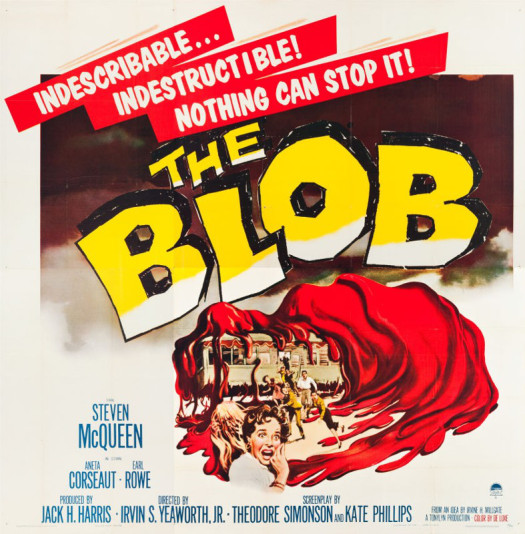
Halloween Havoc!: THE BLOB (Paramount 1958)


gary loggins's avatarcracked rear viewer

Teenagers save the world from the outer space menace known as THE BLOB in this 1958 indie-made sci-fi classic. The stars are a 28-year-old Steve McQueen (billed here as ‘Steven’), channeling his inner James Dean and cool as ever, and THE ANDY GRIFFITH SHOW’s  future Miss Helen, lovely Aneta Corsault. The cheaply made BLOB became a huge hit, and remains one of the best-loved sci-fi flicks of the 50’s.

After the peppy title tune “Beware the Blob!” (written by Burt Bacharach and Mack David), we find teens Steve (McQueen) and Jane (Corsault) out parking, as 50’s teens do, when a mysterious flying object crash lands in the distance. The curious kids investigate and come across an old man (veteran Olin Howland ) in the road, his hand covered with a purple gelatinous goo. The  geezer’s in obvious pain, so our young couple take him to Doc Hallen, who’s baffled as the goo creeps up the…

View original post 497 more words

Quick Horror Film Review: The Blob (1988 Version – Dir. by Chuck Russell)


The Year was 1988.

My father was working in a precinct in Manhattan, and on occasion, my family would have to drive into the city to either get his check or help him file / retrieve something there. Whenever we went to Manhattan, we always saw something grand, like the “Ghost Building” which was shimmered in white light (this was actually Rockefeller Center, but my little sister, brother and I never knew). We once even saw the ’89 Batmobile tear through the city on it’s way to deliver the video release of Tim Burton’s Batman to the Tower Records uptown.

At a stop light, right by the Flatiron Building, I happened to glance around at some of the construction scaffolds. They always put movie posters on there, and I’d squint to see what was coming out soon. That’s when it caught my eye, a pink poster that looked like someone was swimming underwater. We got a little closer as my dad had to make a turn and I was then able to make it out.

“Oh no.”, I muttered, scrunching down in my seat. “They redid it.” All my childhood fears came flooding up in a wave of memories.

I once saw Larry Hagman’s Beware! The Blob (alternately known as Son of Blob) when I was really little. The idea that a gooey mass could squeeze under doors and through window cracks and anywhere there was a space freaked me out. This wasn’t Michael Meyers looking for his sister, or Jason Vorhees guarding Crystal Lake. There was no reasoning my little mind could use to feel better about it. Add to the fact it was only bothered by the cold, it made every summer a secret “look over the shoulder” one. When I attended my first bowling match for fun in college, I’ll admit I hesitated to step out into the bowling alley, if only for a second.

I never saw the movie in the theatre. I got so caught up in Who Framed Roger Rabbit, and everyone talked about Die Hard so much that The Blob became something of a blip to the school kids (from what I remember), but it remembered. I read the poster, and kept tabs on the writer’s names – Frank Darabont and Chuck Russell, who both went on to interesting projects over the years.

Okay, enough about my history with The Blob, let’s dig into the film, which is quite possibly one of the best remakes I’ve ever seen. It hits all of the notes of the original while setting down the groundwork for new directions when some fresh ideas. It’s not perfect, but it’s damn good.

The Blob is a re-telling of the classic 1958 film with Steve McQueen, only this time, Chuck Russell (The Mask) and Frank Darabont (The Shawshank Redemption, The Green Mile, The Mist) brought Kevin Dillon and Shawnee Smith aboard. It’s the story of a small town that receives a strange visitor from outer space in the form of a gelatenous mass inside of a meteor. When an old man gets a little too curious with a yard stick, it jumps out on and onto his hand. Needless to say, if you ever see anything fall from the sky, please, don’t go running to check it out. It never really ends well. At least, I’ve never heard of it doing so.

Anyway, like the original, the old man is found by the Gallant Hero (Donovan Leitch) and Heroine (Smith), who put him in their car and head to the local hospital. This results in the death of the old man, but also a twist in that the Gallant Hero is also killed / absorbed by the Blob. Shawnee’s character tries to save him, but to no avail. She’s should consider herself lucky that she made it through okay. While I didn’t see this in the theatre, I always wondered what effect that might have had on the audience. I mean, here you had the would be hero of the story and he’s taken out of the picture in the first act. That had to be amazing, I think.

As with the original, the Blob makes its way to the main part of town by way of the sewer, heading into the local movie theatre. Before getting there, there’s a interesting scene where Meg and Flagg (Dillon) – the bad boy turned reluctant hero – run into the Blob in a diner and hide in a nearby refrigerator. Rather than go with the classic “solidify it all in one piece”, Darabont and Russell decided to make the Blob’s freezing effect more like pieces of quartz. I thought this made things all the more scary – how could one really tell that all of it was ever collected while it was frozen?

One has to feel just a little sorry for Candy Clarke’s character. You run into a phone booth to make a phone call, only to have slime run down the sides. To top it off, you try to make a phone call for the local sheriff (played by Darabont favorite Jeffrey DeMunn from all of his films and The Walking Dead), and as if it answered for her, the Blob puts his decaying face right on the phone booth window. Another twist thrown in the remake is the death of a child. Usually in horror movies, kids are usually spared. Usually. Not so here, and it just adds to the horror of things. No one’s safe unless you’re walking around with some liquid nitrogen, and it’s not like that’s in great supply.

Eventually, we come to find – thanks to a lot of men in white suits and Crossroads Joe Seneca – that the Blob was actually man made, and it’s the scientists fault it came back the way it did. What I found interesting about that was the idea that they felt they had to burn it. Didn’t anyone think of bringing something cold? I mean, they’re scientists. Someone in the group had to have that idea at some point. Anyway, this all ends with a huge battle in the middle of a busy street and the townsfolk hiding in the municipal hall. Meg and Flagg do find a way to get everything fixed, but (as with many horror movies), we’re left with the promise of another sequel.

Overall, I loved The Blob. There’s very little I can find wrong with it, given that the source material was never really Oscar worthy to begin with. This was just a sit down for the adult in me, grab your popcorn and enjoy the film.

The kid in me prefers to watch this in a very cold room, just in case.