4 Or More Shots From 4 Or More Films is just what it says it is, 4 shots from 4 of our favorite films. As opposed to the reviews and recaps that we usually post, 4 Shots From 4 Films lets the visuals do the talking!
Today, we honor the memory of the great French director Jean Rollin. It’s time for….
4 Shot From 4 Jean Rollins Films
The Rape of the Vampire (1968, dir by Jean Rollin)
Today’s scene that I love comes from 1990’s King of New York. While dealing the drugs the destroy communities, Frank White (Christopher Walken) finds time to attend a fundraiser and hob nob with the city’s rich and powerful. I love the contrast between Freddie Jackson’s upbeat song and what we’ve previously seen Frank and his soldiers do. And just look at Walken chair dance!
As some of our regular readers undoubtedly know, I am involved in a few weekly live tweets on Twitter and Mastodon. I host #FridayNightFlix every Friday, I co-host #ScarySocial on Saturday, and I am one of the five hosts of #MondayActionMovie! Every week, we get together. We watch a movie. We tweet our way through it.
Tonight, at 10 pm et, #ScarySocial presents I, Madman!
If you want to join us this Saturday, just hop onto twitter, start the movie at 10 pm et, and use the #ScarySocial hashtag! It’s a friendly group and welcoming of newcomers so don’t be shy.
“This is the second time he’s done this to me. There will not be a third.” — Jack Aubrey
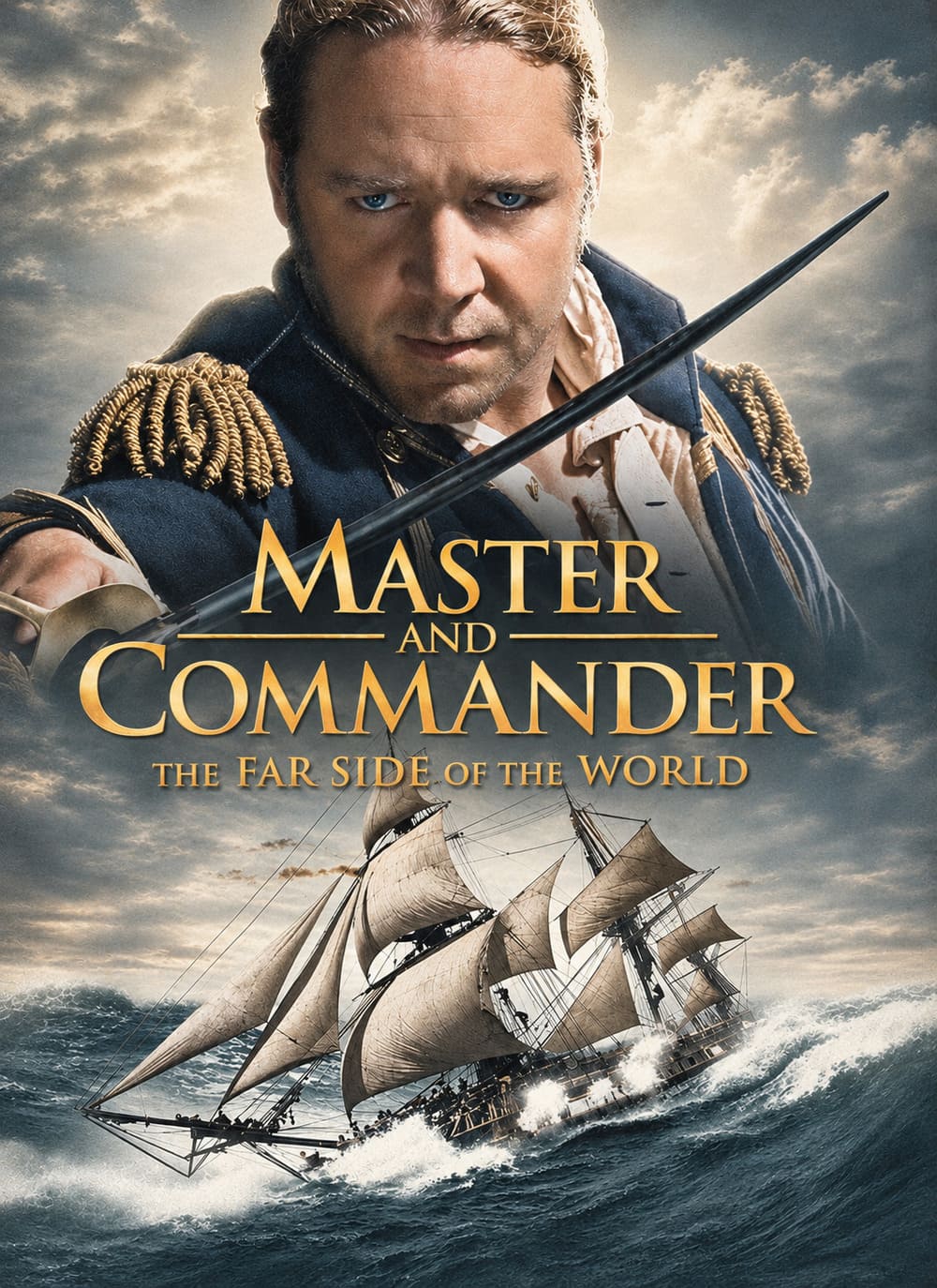
A lesser adventure movie would treat the ocean as empty space between battles. In Peter Weir’s Master and Commander: The Far Side of the World, it becomes an entire way of life. Meals, friendships, work, and terrible injuries all happen within the same cramped wooden walls, with nowhere to go when things get uncomfortable. That sense of confinement makes the film surprisingly absorbing. The cannon fire is exciting, but so is watching people figure out how to live together under pressure. What starts as a pursuit of an enemy ship gradually becomes a closer look at the man who refuses to let that enemy escape.
The film draws from the first and tenth books in Patrick O’Brian’s Aubrey–Maturin series, Master and Commander and The Far Side of the World, with the tenth supplying most of the central storyline. Rather than closely following the opening novel and introducing its characters from the beginning, Weir places us inside an established friendship and a working shipboard community. That choice gives the adaptation a lived-in quality. Aubrey and Maturin already have habits, disagreements, and ways of understanding each other that do not need explaining. We learn about their relationship by watching it function, which is more engaging than having their history handed to us.
Russell Crowe’s Captain Jack Aubrey commands HMS Surprise during the Napoleonic Wars. His target is the Acheron, a French privateer with enough speed and firepower to make their encounter seriously uneven. Weir establishes that imbalance through a brutal opening attack rather than a long explanation. The Surprise takes a beating, and suddenly the captain’s confidence has to compete with the evidence of shattered timber and injured men. Aubrey survives, but he cannot simply move on. Catching the Acheron becomes unfinished business, and everyone aboard gets pulled into his determination to settle it. The chase supplies the plot, but his reasons for continuing it supply the tension.
Crowe is a huge part of why this works. He gives Aubrey an easy authority that makes the crew’s loyalty believable. This captain can share a joke, appreciate a good meal, and make difficult decisions without appearing to switch between different personalities. There is warmth beneath his command, but also an expectation that his judgment will prevail. Crowe makes both sides convincing. You understand why the men feel safer with him in charge, even when he is asking them to do something dangerous. His confidence is attractive, and the film lets us enjoy it before making us consider its limits.
Those limits become clearer as Aubrey’s obsession with tracking down the Acheron builds. His assignment gives him a legitimate reason to pursue the French privateer, but the chase gradually becomes tangled up with his pride. Being beaten at his own game bothers him more than he wants to admit. Each setback seems to strengthen his need to prove that he can win. What makes this unsettling is how calmly he justifies himself. He never stops being intelligent or capable. Instead, military reasoning and personal ambition become difficult to separate. He can explain why the pursuit matters, but that does not mean he fully understands why it matters so much to him.
The person most willing to challenge him is Stephen Maturin, the ship’s surgeon and Aubrey’s close friend. Paul Bettany brings a dry, thoughtful quality to the role that plays beautifully against Crowe’s confidence. Maturin sees the wounded bodies behind the captain’s calculations, so arguments about duty are never purely theoretical for him. His scientific interests also give him priorities beyond the conflict. Where Aubrey sees a destination or a tactical advantage, Maturin notices something worth studying. Their disagreements make the voyage feel larger than its military objective. There is a whole world around them, even when Aubrey seems determined to reduce it to the distance between two ships.
Thankfully, the film does not turn their friendship into a series of lectures. Their shared musical sessions reveal a companionship that exists independently of whatever disagreement they are having. These scenes feel relaxed without becoming disposable. Watching them play together explains why they keep making room for each other despite their frustrations. Crowe and Bettany suggest familiarity through small changes in expression and tone rather than big emotional speeches. As a result, their arguments carry weight. They are not simply defending different opinions; they are testing how much disagreement a valued friendship can withstand, especially when one friend has the authority to overrule the other.
Weir gives the wider crew a similar sense of life beyond the plot. The Surprise feels like a workplace, a home, and an unforgiving social system all at once. Everyone has duties, everyone depends on someone else, and privacy barely seems to exist. Brief moments of joking or nervous conversation make the sailors feel individual without requiring formal introductions. The younger officers are especially affecting. Their uniforms and responsibilities cannot quite hide how young they are. Watching them try to behave bravely adds an uncomfortable edge to the adventure, because courage here is something children are already expected to demonstrate.
That attention to people makes the battles much more effective. By the time the guns start firing again, damage to the ship feels like damage to a community we recognize. The violence is messy and frightening rather than cleanly heroic. Splintering wood turns familiar spaces into hazards, while Maturin’s medical work makes the aftermath impossible to ignore. There is still plenty of excitement in watching a plan come together, but clever tactics do not erase their cost. Aubrey’s skill matters enormously, yet skill cannot guarantee that the people carrying out his orders will come through unharmed. Victory never feels quite as simple as being the better captain.
Just as importantly, the battles between the Surprise and the Acheron are exceptionally well-staged and executed. Weir makes the tactics understandable without draining the encounters of confusion or danger. You can follow the importance of positioning, timing, and coordinated work while still feeling how little separates an effective maneuver from disaster. The action moves between the larger contest at sea and the immediate struggle on deck, keeping strategy and physical consequences connected. There is a satisfying sense that the sailors’ everyday routines have prepared them for these moments. All that hauling, drilling, and following orders becomes the machinery that gives Aubrey’s ideas a chance of succeeding.
The climactic confrontation brings those strengths together, but its most satisfying ingredient comes from an unexpected place: Maturin’s interest in nature. Aubrey takes a couple of pages from his friend’s observations of camouflage and disguises the Surprise as a vulnerable whaling ship, hoping to lure the Acheron close enough to overcome its advantages. It is a clever solution because it grows out of the relationship rather than arriving as a last-minute burst of genius. After allowing the pursuit to overshadow Maturin’s scientific interests, Aubrey finds something useful in the very subjects he has been too impatient to appreciate.
That connection gives the final battle more meaning than a straightforward test of firepower. Aubrey succeeds by adapting, looking beyond his usual expertise, and recognizing the value of another person’s perspective. The plan offers a small but important counterpoint to his stubbornness: his confidence becomes more productive when it leaves room for curiosity. Meanwhile, the execution delivers the excitement the long pursuit has promised. Preparation gives way to sudden violence, and the fighting feels close, exhausting, and dangerous. The deception may create an opening, but it does not make the confrontation easy. Weir lets the tactical payoff and the human cost occupy the same scene.
Outside the fighting, the contrast between the crowded ship and the enormous ocean remains one of the film’s strongest features. Inside, everything feels close enough to touch. Outside, the water seems capable of swallowing the whole enterprise without noticing. The storms sharpen that contrast by presenting a threat Aubrey cannot intimidate or defeat through determination alone. His experience can improve their chances, but it cannot give him complete control. That limitation matters in a story about a man accustomed to trusting himself. Nature keeps reminding him—and us—that confidence is not the same thing as power, however reassuring it may look from the deck.
The film’s patience will not work for everyone. Some stretches linger over routine or scientific curiosity when a more conventional action movie would hurry toward another confrontation. The Galápagos sequences are the clearest example, shifting attention toward Maturin’s interests and slowing the pursuit. For me, that breathing room mostly pays off. It makes the world feel worth exploring rather than merely crossing, and the later camouflage strategy gives those observations a satisfying place in the adventure. Occasionally, the contrast between the two friends feels a little neatly arranged. Still, removing those quieter passages would leave a faster movie with much less personality and far less reason to care about its outcome.
By the end, the Surprise feels less like a spectacular movie location than a place whose routines you have learned. You understand why these men need their captain, why his friendship with Maturin matters, and why his certainty can be reassuring and dangerous at the same time. That is what gives Master and Commander: The Far Side of the World its staying power. Weir delivers the adventure without treating the people as equipment needed to stage it. The battles draw you in, but the lasting pleasure is the company—even when the man setting the course makes you nervous about where everyone is headed.
Welcome to Late Night Retro Television Reviews, a feature where we review some of our favorite and least favorite shows of the past! On Fridays, I will be reviewing SLEDGE HAMMER!, a cop comedy which ran on ABC from 1986 to 1988. The entire series can be found on Prime!
This week, Sledge meets his hero.
Episode 1.13 “The Old Man and Sledge”
(Dir by Charles Braverman, originally aired on January 3rd, 1987)
Sledge is upset that his hero, former Detective Gilmore Yates (Stephen Elliott), is being evicted from his apartment. Back in the day, Yates shot even more people than Sledge, but now he’s facing a future in a retirement home. Sledge and Doreau arrange for Yates to get a job as a security guard at a jewelry store. When the jewelry store gets robbed, Yates takes a bullet to the arm and ends up in the retirement home anyway. However, Sledge suspects that there was more to the robbery than meets the eye…
By the standards of this show, this was a pretty low-key episode. If not for Sledge saying that his favorite song was “Taps” and that The Deer Hunter was his comfort film, this episode could almost pass for a traditional cop show. Fortunately, David Rasche is just as wonderfully unhinged as always, and he and Stephen Elliott played off each other well. (Just watch the scene where Sledge is disappointed to learn that Yates doesn’t talk to his gun.) This was a minor episode of Sledge Hammer!, though it still had its moments.
“I’ll follow him around the Horn, and around the Norway maelstrom, and around perdition’s flames before I give him up.” — Captain Ahab
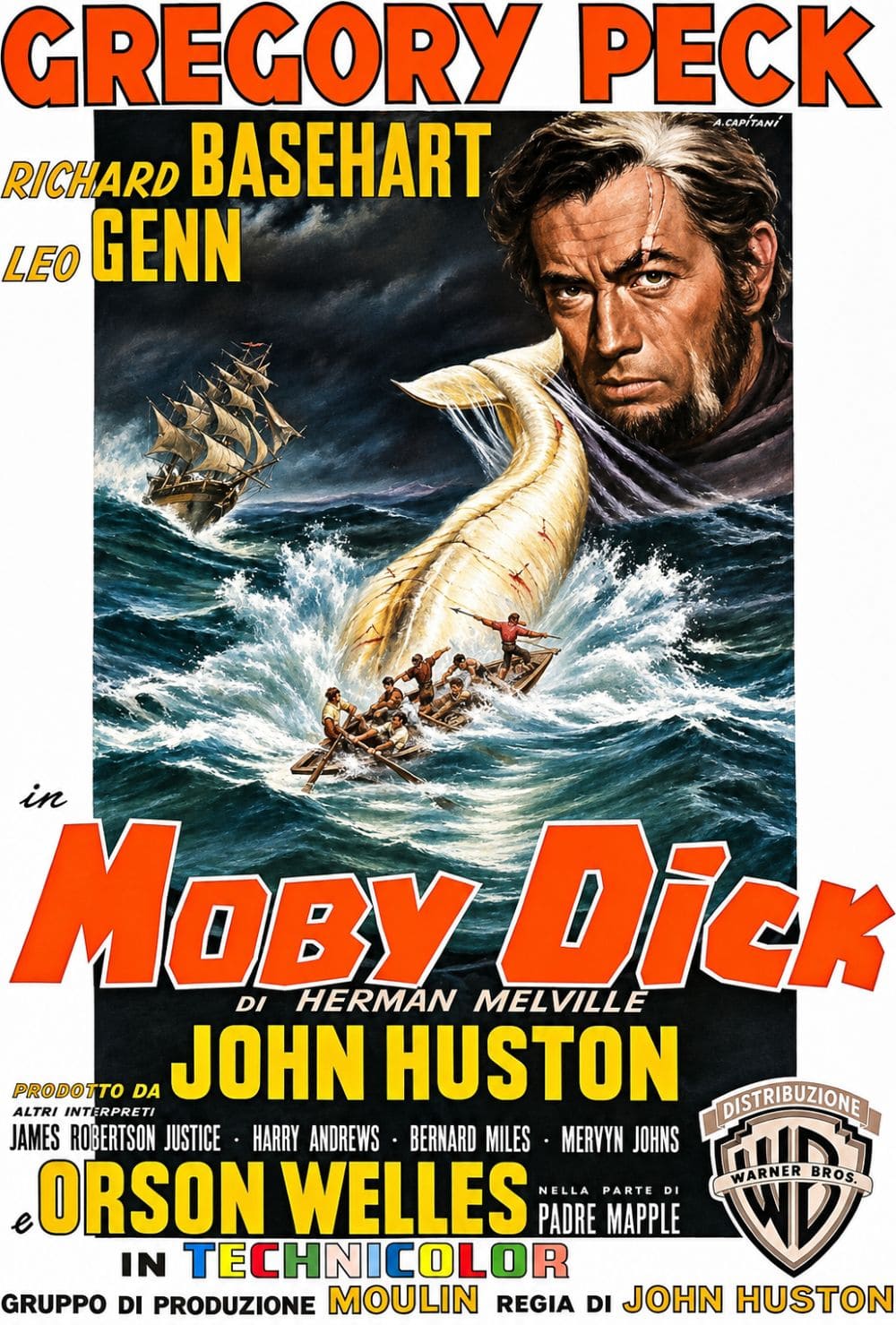
The most frightening thing in John Huston’s Moby Dick (1956) is not the enormous white whale. It is the certainty of a man who has decided that his suffering gives him the right to endanger everyone around him. That is what gives this seafaring adventure its bite. Beneath the harpoons, salt spray, and booming speeches is a story about a captain who turns personal pain into a collective mission. Huston gives Herman Melville’s Moby-Dick the scale of an old-fashioned Hollywood epic, but the film’s real strength is its uncomfortable understanding of how easily commanding leadership can slide into destructive obsession.
The story begins with Ishmael, played by Richard Basehart, looking for work and a little adventure at sea. He joins the crew of the Pequod expecting a whaling voyage, not a front-row seat to his captain’s unraveling. Captain Ahab has other plans. Having lost his leg to Moby Dick, he intends to hunt down the whale regardless of the danger or the ship’s actual business. The setup is straightforward, and that simplicity helps the movie. Even when the dialogue becomes grand and biblical, the central problem stays clear: everyone’s future rests in the hands of someone who no longer recognizes reasonable limits.
Gregory Peck makes that problem fascinating to watch. Ahab was a real change from the quiet, heroic roles Peck usually played, but he uses that familiar reserve rather than abandoning it. His captain has the upright bearing and controlled delivery of a man accustomed to being respected. What has changed is the purpose behind that authority. Despite working outside his usual screen personality, Peck plays an excellent Ahab, bringing quiet dignity to the simmering obsession eating away at him. There is something especially unsettling about watching an actor so associated with steadiness turn that quality into an expression of dangerous, immovable conviction.
Peck’s performance works best when he lets the anger sit beneath the surface. His stillness can suggest that Ahab has spent so long nursing his hatred that it no longer needs constant outward expression. When the speeches arrive, they feel like pressure finally escaping. The performance does have a theatrical edge, and some viewers may find his delivery too formal. For me, that formality mostly fits. Ahab is not simply having a bad voyage; he has built an entire identity around his grievance. Peck makes him seem like a man determined to maintain his grandeur even as his judgment falls apart.
Huston strengthens that impression by delaying Ahab’s full introduction. Before we properly meet the captain, we feel the uncertainty surrounding him, which gives his eventual appearance more weight. Meanwhile, Ishmael offers a welcoming way into the story. Basehart is not as commanding as Peck, but his openness serves a useful purpose: he lets us experience the voyage before Ahab’s will completely takes it over. The early scenes establish a working community with its own friendships, routines, and expectations. That matters because the crew must feel like people with lives of their own, not merely an audience for their captain’s speeches.
Leo Genn’s Starbuck provides the clearest challenge to Ahab’s thinking. He understands that a captain has responsibilities beyond satisfying his own anger, and his resistance gives the film an essential moral tension. This is not a simple contest between a brave man and a timid one. Starbuck’s caution requires its own courage, especially when Ahab can make his private revenge sound like a glorious shared purpose. Orson Welles also makes a memorable impression as Father Mapple. His sermon gives the opening a sense of spiritual danger, preparing us for a voyage in which pride and disobedience matter as much as wind and weather.
The film’s visual style reinforces that feeling without making every scene look like an obvious symbol. Cinematographer Oswald Morris gives the images a muted, weathered appearance that suits the roughness of the setting. This is not a sparkling ocean playground. The ship looks vulnerable against the water and sky, and even the beautiful views carry a hint of menace. Huston also understands the appeal of the practical details: ropes, boats, crowded decks, and men working together. Those textures keep the film grounded. The more convincing the ordinary labor becomes, the more disturbing it is when Ahab redirects that labor toward his own destructive goal.
As an adaptation, Moby Dick inevitably trades some of Melville’s range for dramatic focus. The screenplay, credited to Huston and Ray Bradbury, cannot accommodate all the novel’s digressions, shifting tones, and philosophical curiosity. Instead, it builds a clear line toward the confrontation between Ahab and the whale. That approach makes the film accessible, though it also narrows the experience. Ishmael becomes less of an expansive storytelling presence, while Ahab increasingly dominates everything. Still, the choice suits the movie’s central effect. We feel the voyage tightening around one man’s purpose until there seems to be very little room left for anyone else’s judgment.
The final hunt has moments when the effects show their age, particularly when the whale must function as a convincing physical creature. Yet the climax remains gripping because Huston has already established what is emotionally at stake. The important question is no longer whether the monster will look completely real. It is whether anyone can escape the consequences of Ahab’s certainty. That is why Moby Dick stays with me more as a tragedy than as a spectacle. Peck’s wounded dignity makes the captain worth watching, but never makes him right. By the end, the film has turned a thrilling pursuit into a bleak reminder that a leader’s strength means very little when he has lost the ability to turn back.
Welcome to Retro Television Reviews, a feature where we review some of our favorite and least favorite shows of the past! On Fridays, I will be reviewing St. Elsewhere, a medical show which ran on NBC from 1982 to 1988. The show can be found on Daily Motion.
Life goes on at St. Eligius.
Episode 4.19 “Out On A Limb”
(Dir by Eric Laneuville, originally aired on February 26th, 1986)
A new crop of residents has come to the hospital. Among them is Carol Novino (Cindy Pickett), who we are told was a nurse at the hospital before Dr. Westphall encouraged her to go to medical school. That’s right — Carol is a protégée of Donald’s. That really should put fear in the heart of anyone who has been watching this show from the start. The only people more depressing than Donald are the people who look up to him. Just look at Jack Morrison.
Novino has a difficult first day. The nurses think that she’s a snob. Dr. Chandler gets mad at her for disagreeing with him while doing rounds. She manages to get on Dr. Craig’s bad side… well, everyone gets on Dr. Craig’s bad side so I’m not sure why she should be any different. That said, I’ve already checked and I’ve discovered that Novino is going to be with the show to the end. It pays to be friends with Westphall. At least, I hope they’re just friends. If this turns into a romance, it’s going to be the most depressing romance ever.
There were a few other things that happened. Jack, paranoid after Pete got abducted, carried his son around with him while doing his job. Meanwhile, Dr. Craig carried his granddaughter with him. Axelrod and Fiscus went to California for a medical conference. Axelrod loved the sunny weather while Fiscus realized that he’s a Boston guy at heart. Morrison had to tell a little boy that he was going to lose his arm. Alan Autry showed up as a football player who could barely walk after all the damage he had sustained on the field.
It was …. well, to be honest, this season was kind of boring. After Bobby leaving the hospital and the two-part flashback episode, I guess it was inevitable that St. Elsewhere would need at least one episode to reset. This was a reset episode and a reminder that not every day is a melodrama.
Today’s song of the day come from the Georges Delerue-composed score of Jean-Luc Godard’s 1963 film, Le Mepris. If this song sounds familiar but you haven’t seen Le Mepris, you may have heard it in Martin Scorsese’s Casino.