Film Review: Rambo: First Blood Part II (dir by George Pan Cosmatos)


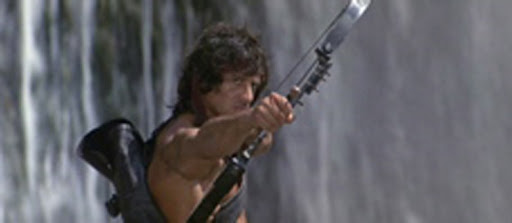
Three years after blowing up the town of Hope, John Rambo (Sylvester Stallone) is …. workin’ on the chain gang…. (I hope you sang it.)  However, Colonel Sam Trautman (Richard Crenna) has a suggestion for Rambo.  He can get a full pardon if he infiltrates Vietnam and investigates what might be a POW camp….

So begins 1985’s Rambo: First Blood Part II!

When viewers first met John Rambo in 1982’s First Blood, he was a drifter who was obviously uncomfortable with dealing with other people.  Haunted by both his experiences in Vietnam and the way he was treated when he returned to his own country, Rambo was someone who largely wanted to be left alone.  He was the ultimate outsider.  When he asked Brian Dennehy’s Sherriff Teasle where he could get a cop of coffee, Teasle told him to go over the border and have his coffee in Canada.  (Is there anything more insulting than to tell a Vietnam veteran to go to Canada like a draft dodger?)  Rambo was someone who could take care of himself.  He was someone who knew how to survive in the wilderness.  But, in the first movie, he was not superhuman.  Rambo was considerably banged up by the end of First Blood.  The other thing that is sometimes overlooked is that, as far as his time in Hope was concerned, Rambo never deliberately killed anyone.  The only person who died in First Blood was a sadistic police officer who was so determined to get a shot at Rambo that he accidentally tumbled out of a helicopter.  When Rambo fought, it was in self-defense.  Rambo had plenty of opportunities (and, by today’s cultural standards, reasons) to kill Sheriff Teasle and his deputies but he didn’t.  Things are a bit different in the sequel.  Rambo: First Blood Part II transforms Rambo from a relatively realistic character into the comic book action hero that everyone knows today.  Rambo’s gone from being a hulking drifter to being a muscle-bound warrior.

The film doesn’t waste any time getting Rambo out of prison and over to Thailand.  The obviously duplicitous Murdock (Charles Napier) tells Rambo that his mission is solely to take pictures and not to engage with the enemy.  (You may be wondering why anyone would recruit Rambo for a mission that doesn’t involve engaging with the enemy and it’s a fair question.)  Soon, Rambo is in the jungles of Vietnam, meeting up with a rebel named Co (Julia Nickson), and heading up river with a bunch of pirates.  Needless to say, Rambo is soon engaging with the enemy.

Rambo: First Blood Part II is an undeniably crude film.  Clocking in at 96 minutes, the film makes it clear that it doesn’t have any time to waste with characterization or debate.  Sylvester Stallone rewrote James Cameron’s original script and he gives a performance that has little of the nuance that was present in the first film.  And yet, the film has an undeniable hypnotic power to it.  It’s pure action.  Rambo exists to blow up his enemies, whether it’s with a gun or an explosive arrow or the missiles fired from a stolen helicopter.  Because the bad guys are all arrogant sadists who exist to remind American viewers of the humiliation of its first military defeat, there’s an undeniable pleasure in watching them get defeated by one motivated warrior who refuses to be held back by the paper pushers in charge.  Murdock tells Rambo not to rescue any POWs.  Rambo responds by machine gunning Murdock’s office.  It’s pure wish fulfillment and it is cathartic to watch.  It’s perhaps even more cathartic to watch today, after the twin traumas of the COVID lockdowns and the chaotic withdrawal from Afghanistan.  Murdock becomes a stand-in for every incompetent bureaucrat who ever let America down.  The Murdock who tells Rambo not to rescue any Americans is little different from the men who told business that they had to close and who tried to dictate whether or not people could leave their homes.  The Murdock who was prepared to leave American behind is the same person who did leave Americans behind in Kabul.  Rambo’s anger is the anger of everyone who values freedom above obedience.

Rambo kills a lot of people in the sequel but none of them are American.  He’s a patriot, albeit an angry one who will never forgive his country for not caring about its veterans as much as they cared about it.  “Do we get to win this time?” Rambo ask Trautman and it’s a moment that, like much of the movie, is both crudely simplistic but is powerful in its refusal to be complicated.  Rambo: First Blood Part II is a fantasy but it’s also a plea to be allowed to succeed.  Forget the rules.  Forget the regulations.  Just allow the people to win.

Rambo: First Blood Part II (1985, dir by George Pan Cosmatos, DP: Jack Cardiff)

Scenes That I Love: Rambo Rages In Rambo: First Blood Part II


Today’s scene that I love comes from the 1985 film, Rambo: First Blood Part II.  In this scene, Sylvester Stallone’s John Rambo — having survived being abandoned yet again in Vietnam — let’s the CIA knew exactly what he thinks about their operation.  As directed by George Pan Cosmatos and performed by Stallone, this scene is pure 80s action.

If you ever meet James Cameron, remind him that he wrote the script for this film and see how he reacts.

Here’s a scene that I love:

Scenes That I Love: Rambo Returns from George P. Cosmatos’s Rambo: First Blood Part II


On this date, in 1941, future director George Pan Cosmatos was born in Italy.  Cosmatos would go on to direct some of the most financially successfully (if critically lambasted) films of the 80s.  He’s also credited as being the director on Tombstone, though it’s generally agreed that Cosmatos largely deferred to Kurt Russell on that film.  (Cosmatos was a last minute replacement for the film’s original director.)

Other than Tombstone, Cosmatos is best-known for the films that he did with Sylvester Stallone.  And today’s scene that I love comes from the 1985 film, Rambo: First Blood Part II.  In this scene, Rambo — having survived being abandoned yet again in Vietnam — let’s the CIA knew exactly what he thinks about their operation.  Whatever else you may say about the film (and I certainly prefer the first First Blood to any of the more simplistic sequels that followed), this scene is pure 80s action.

If you ever meet James Cameron, remind him that he wrote the script for this film and see how he reacts.

Here’s a scene that I love:

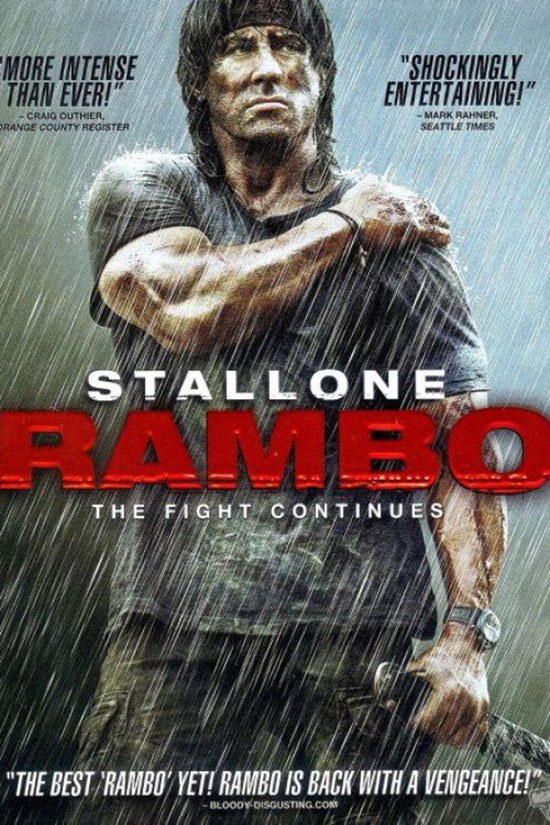
Rambo (2008, directed by Sylvester Stallone)


When a group of Christian missionaries needs someone to guide them into Burma so that they can provide medical supply to the oppressed Karen people, they approach John Rambo (Sylvester Stallone).  The missionaries think that Rambo is just an American living in Thailand who makes a meager living as a snake catcher and a boat guide.  Because we’ve seen the previous Rambo films, we know that John Rambo is actually a Vietnam vet who, after destroying the town of Hope, Washington, was recruited by the government to rescue POWs in Vietnam and fight the Russians in Afghanistan.

At first, Rambo tells the missionaries that it’s foolish for them to go anywhere near Burma and that he wants nothing to do with them.  It’s only when Sarah Miller (Julie Benz) asks him personally that Rambo agrees to ferry the missionaries up the Salween River.  Rambo isn’t doing it for the missionaries.  He’s doing it to protect Sarah.

Unfortunately, on the way to the village, Rambo is forced to kill a group of pirates and he is rejected by the pacifist missionaries and, after he drops them off at the village, they order him to leave.  However, after the village is attacked and Sarah is taken prisoner by the Burmese military, Rambo returns.  This time, he’s with a group of younger mercenaries who, like the missionaries before them, don’t know what Rambo is capable of doing.  Rambo soon proves that he might not be as young as used to be but he’s still just as deadly.

During the final 11 minutes of this movie, Rambo kills over a hundred people but fortunately, they’re all bad.  It’s excessively violent and gory and it’s also totally awesome.  When you go to see a Rambo movie, you’re not expecting to see Shakespeare.  You’re expecting to see Rambo blow away the bad guys and, on that front, this film definitely delivers.  Even more than the previous films in the series, Rambo is up front about what happens when someone gets shot by a machine gun or blown up by a bomb.  It’s not pretty picture.  The violence is so gruesome that Rambo could almost pass for an antiwar film if the people that Rambo blows up weren’t all portrayed as being almost cartoonishly evil.

Rambo is also upfront about what that type of violence would do to a man’s psyche.  This film features one of Stallone’s best performances.  Eschewing the comic book heroism of the 2nd and 3rd films in the franchise, Rambo reminds us that, when first introduced in First Blood, John Rambo was portrayed as being a seriously damaged and bitter man, someone who hated what the war had done to him and who felt that he no longer had a home in the normal world.  Stallone was 62 when he starred in Rambo and he surrendered enough of his vanity to actually allow himself to look and sometimes act his age.  In this film, Rambo may start out as bitter but he finally accepts that his pain doesn’t have to define his life.  “Live for nothing or die for something,” Rambo says, a line that has subsequently been picked up by the real life Karen National Liberation Army in Burma.

Of the four sequels to the original First Blood, Rambo is the best.  It has the biggest action sequences, the best Stallone performance, and it alerted people to very real atrocities being carried out against the Karen people.  Coming out shortly after Rocky Balboa, Rambo was one of the films that reminded audiences that Sylvester Stallone still had it.  Rambo was a box office success and, 11 years after its release, it was followed by Last Blood.  I’ll be reviewing that one tomorrow.
Here’s The Trailer For Rambo: Last Blood!


So, today, twitter is all abuzz over the trailer for the upcoming Rambo film.  Apparently this film, which is called Rambo: Last Blood, will be the final time that Sylvester Stallone will ever play John Rambo and it features Rambo coming home and fighting a Mexican drug cartel.

Look, to be honest, this trailer pretty much looks like a typical Sylvester Stallone trailer.  It could just as easily be the trailer for another Expendables film, except for the fact that Rambo has become an iconic figure in the annals of cinematic mayhem.  Just the mere mention of the name gets certain filmgoers excited.

Of course, I watched First Blood earlier this year and I was surprised to discover just how good a film it actually was.  And, of course, action film enthusiasts are still talking about that scene in Rambo where the title character kills the population of a small country in a matter of minutes.  So, I get why people are excited about this trailer but, at the same time, it still feels a bit generic.

This trailer also features Old Town Road because God knows it’s not like that song is currently overplayed or anything.

There’s one thing that I do think we definitely have to give Sylvester Stallone credit for.  I’ve read that, during the first part of his stardom, Stallone wasn’t always pleasant to work with and that he sometimes resented being thought of as just being an action star.  But, during the twilight of his career, it would appear that Stallone has definitely made a sort of peace with the roles that define him.  He understands what he does well and he tries to give his audience what they came for.  I’m predicting that, when Stallone’s 90 years old, he’ll probably still be making movies where he beats up terrorists.  By this point, of course, the terrorists might be attacking a retirement home but Stallone’s going to be there to put them in their place.

And we’ll all be better off for it!

Anyway, here’s the trailer:

Scenes I Love: Rambo


Watching Ninja Assassin made me think about how much film and special effects technology has advanced to the point that the ways people can die in a film really is only limited by the imagination of the filmmakers involved. My new choice for “Scenes I Love” may make me come across as some gorehound, violence-loving neanderthal (the first two are actually correct but the third is false since I’m homo sapiens), but I love this scene I have chosen because it’s so over-the-top yet holds many truths to the events happening therein.

Rambo was Sylvester Stallone’s attempt to restart the Rambo franchise and to a certain extent he does so. The film was better than the third one and in terms of storytelling was equal to the second one and just a tad short of the original film. It’s a film one will not write to the Academy about, but Stallone brings back the franchise to what made it popular in the first place. He brought the character of John Rambo back to being the self-destructive, self-loathing, war-scarred veteran who just wants to be left alone to live his miserable life, but always gets dragged into one good-intentioned crusade after another.

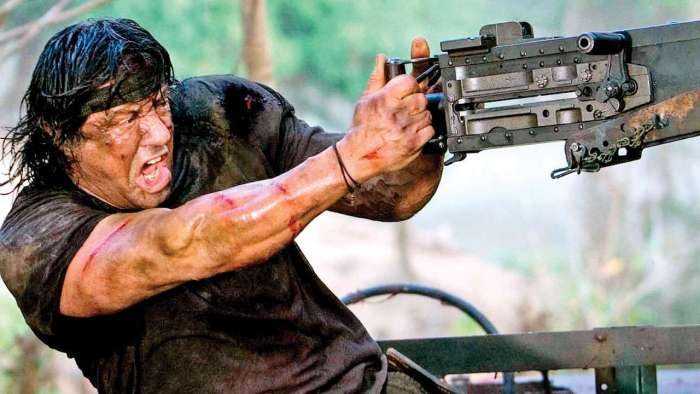
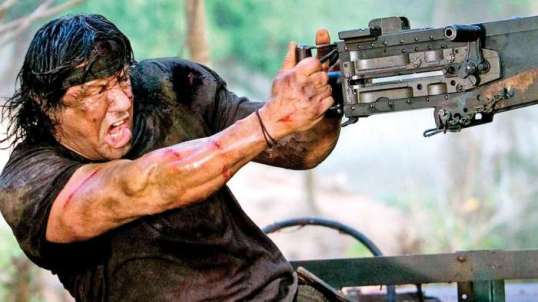
This scene happens right at the very end and one could say it’s the film’s climactic eruption of testosterone. Rambo literally explodes Burmese soldiers’ bodies through his effective use of a .50 caliber heavy machine gun (and those who think the gun’s effect on people’s bodies was over-the-top…those people would be wrong. That is exactly what a .50 caliber round does to a body. It doesn’t do a body good) and some help from the people he’s trying to rescue. It’s hard not cheer Rambo in this scene after watching these very same soldiers massacre an entire Burmese village, raping captured young women and bayonet little kids before throwing them into a hut’s raging fire.

This scene also shows why the Rambo films have been labeled as nothing but mindless violence trying to make itself to be something profound (he is killing the bad people and trying to save those who are defenseless). I always though this franchise was just about one very angry guy who may or may not be right in the head, but who definitely has a weird sense of right and wrong. Not to mention very good at killing massive amounts of people in very messy ways.

There’s a part halfway in this scene where the higher-than-though leader of the Christian missionary group (who had earlier in the film lectured Rambo for being too violent in saving his and his people’s lives) played by Paul Schulze sees the carnage happening all around him and decides to go all caveman on one soldier who killed one of his congregation. A part of me actually smirked at this part. I knew that no matter how well-intentioned, principled and civilized a man thinks he is there’s something primal deep down inside that wants to commit violence.