Film Review: Rambo: First Blood Part II (dir by George Pan Cosmatos)


Three years after blowing up the town of Hope, John Rambo (Sylvester Stallone) is …. workin’ on the chain gang…. (I hope you sang it.)  However, Colonel Sam Trautman (Richard Crenna) has a suggestion for Rambo.  He can get a full pardon if he infiltrates Vietnam and investigates what might be a POW camp….

So begins 1985’s Rambo: First Blood Part II!

When viewers first met John Rambo in 1982’s First Blood, he was a drifter who was obviously uncomfortable with dealing with other people.  Haunted by both his experiences in Vietnam and the way he was treated when he returned to his own country, Rambo was someone who largely wanted to be left alone.  He was the ultimate outsider.  When he asked Brian Dennehy’s Sherriff Teasle where he could get a cop of coffee, Teasle told him to go over the border and have his coffee in Canada.  (Is there anything more insulting than to tell a Vietnam veteran to go to Canada like a draft dodger?)  Rambo was someone who could take care of himself.  He was someone who knew how to survive in the wilderness.  But, in the first movie, he was not superhuman.  Rambo was considerably banged up by the end of First Blood.  The other thing that is sometimes overlooked is that, as far as his time in Hope was concerned, Rambo never deliberately killed anyone.  The only person who died in First Blood was a sadistic police officer who was so determined to get a shot at Rambo that he accidentally tumbled out of a helicopter.  When Rambo fought, it was in self-defense.  Rambo had plenty of opportunities (and, by today’s cultural standards, reasons) to kill Sheriff Teasle and his deputies but he didn’t.  Things are a bit different in the sequel.  Rambo: First Blood Part II transforms Rambo from a relatively realistic character into the comic book action hero that everyone knows today.  Rambo’s gone from being a hulking drifter to being a muscle-bound warrior.

The film doesn’t waste any time getting Rambo out of prison and over to Thailand.  The obviously duplicitous Murdock (Charles Napier) tells Rambo that his mission is solely to take pictures and not to engage with the enemy.  (You may be wondering why anyone would recruit Rambo for a mission that doesn’t involve engaging with the enemy and it’s a fair question.)  Soon, Rambo is in the jungles of Vietnam, meeting up with a rebel named Co (Julia Nickson), and heading up river with a bunch of pirates.  Needless to say, Rambo is soon engaging with the enemy.

Rambo: First Blood Part II is an undeniably crude film.  Clocking in at 96 minutes, the film makes it clear that it doesn’t have any time to waste with characterization or debate.  Sylvester Stallone rewrote James Cameron’s original script and he gives a performance that has little of the nuance that was present in the first film.  And yet, the film has an undeniable hypnotic power to it.  It’s pure action.  Rambo exists to blow up his enemies, whether it’s with a gun or an explosive arrow or the missiles fired from a stolen helicopter.  Because the bad guys are all arrogant sadists who exist to remind American viewers of the humiliation of its first military defeat, there’s an undeniable pleasure in watching them get defeated by one motivated warrior who refuses to be held back by the paper pushers in charge.  Murdock tells Rambo not to rescue any POWs.  Rambo responds by machine gunning Murdock’s office.  It’s pure wish fulfillment and it is cathartic to watch.  It’s perhaps even more cathartic to watch today, after the twin traumas of the COVID lockdowns and the chaotic withdrawal from Afghanistan.  Murdock becomes a stand-in for every incompetent bureaucrat who ever let America down.  The Murdock who tells Rambo not to rescue any Americans is little different from the men who told business that they had to close and who tried to dictate whether or not people could leave their homes.  The Murdock who was prepared to leave American behind is the same person who did leave Americans behind in Kabul.  Rambo’s anger is the anger of everyone who values freedom above obedience.

Rambo kills a lot of people in the sequel but none of them are American.  He’s a patriot, albeit an angry one who will never forgive his country for not caring about its veterans as much as they cared about it.  “Do we get to win this time?” Rambo ask Trautman and it’s a moment that, like much of the movie, is both crudely simplistic but is powerful in its refusal to be complicated.  Rambo: First Blood Part II is a fantasy but it’s also a plea to be allowed to succeed.  Forget the rules.  Forget the regulations.  Just allow the people to win.
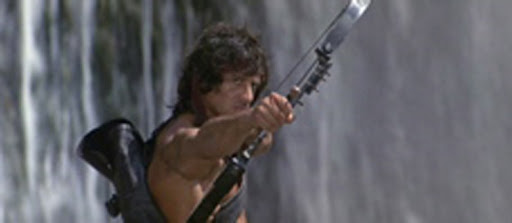
Rambo: First Blood Part II (1985, dir by George Pan Cosmatos, DP: Jack Cardiff)
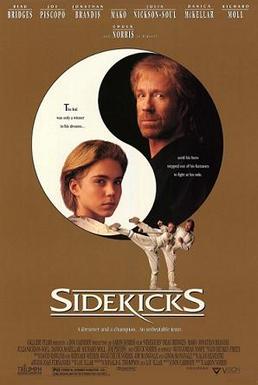
Sidekicks (1992, directed by Aaron Norris)


Barry Gabrewski (Jonathan Brandis) is a teenager living in Houston with his father (Beau Bridges).  Barry has asthma and has a hard time at school, being picked on by everyone from the school bully (John Buchanan) to the athletics coach (Richard Moll) to the clueless principal (Gerrit Graham).  Barry has only one ally and his name is Chuck Norris!  Whenever Barry is having a hard time, he imagines taking part in an exciting mission with Chuck Norris.  In his imagination, he and Chuck recreate scenes from all of Chuck’s movies even though Barry is really too young to be watching anything that violent.

Barry wants to learn karate but is turned down by an arrogant dojo owner (Joe Piscopo, channeling Martin Kove).  Barry finally finds a teacher (Mako) who uses Barry’s love of all things Chuck Norris to train him.  Barry enters the local karate tournament and wouldn’t you know it, there’s Chuck!  He’s attending as a guest and he’s hoping to see Joe Piscopo taught a lesson in humility.  When Barry and his sensei are told that they don’t have enough members for their team, Chuck volunteers to fight with them.  No one objects to the world’s most famous martial artist deciding to take part in a local, largely amateur karate tournament.  Can Barry win the tournament with the help of his hero?

Chuck Norris famously turned down a role in The Karate Kid.  Some sources say that he was offered the John Kreese role while others say that Norris was offered the sensei role that eventually become Mr. Miyagi.  Chuck has always said that his agent turned down the script and he didn’t even know it had been offered to him until years later but Sidekicks sticks so close to the Karate Kid plot that it does sometimes feel like it was made so that we could see what Karate Kid would have been like if Chuck Norris had accepted a role.  The movie follows the Karate Kid formula while lacking the edge that made Karate Kid stand out.  Karate Kid was a coming-of-age movie with a lot of karate.  Sidekicks is a blatant celebration of Chuck Norris.

Fortunately, Chuck Norris has always had the moves to back up his high self-regard and, in this film, he actually seems to be relaxed and having fun playing a version of himself.  Sidekicks is predictable and ego-driven but it has a likable energy and Chuck shows a willingness to poke fun at his earlier movies.  Whatever else you might say about Sidekicks, there were a lot of bullied kids would have loved to have had a friend like Chuck Norris.  Sidekicks is also the only place where you can see Chuck Norris fight Joe Piscopo and there’s something to be said for that.

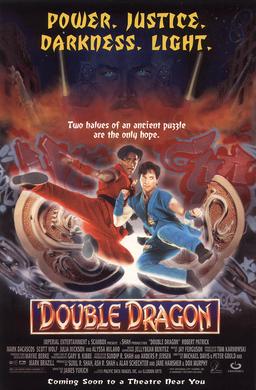
Guilty Pleasure No. 61: Double Dragon (dir by James Yukich)


The time is …. the future!

The future looks a lot like a cheap music video.  Due to repeated earthquakes, California is now an island and Los Angeles has been left in ruins.  The city has been renamed New Angeles, even though the correct name would have been Nuevos Angeles but whatever.  The important thing is that city is now a mess.  The police allow the gangs to run rampant at night in return for not running rampant during the day.  The nightly news, which is anchored by George Hamilton and Vanna White, is full of stories about the federal government refusing to send any more aid to California, despite the fact that Jerry Brown is the Vice President.  For some reason, Andy Dick plays the weatherman and gives continual updates on the smog and rain.

Despite the fact that the city is the most dangerous place on Earth, Satori Imada (Julia Nickson) still makes the time to drive her teenage sons, Billy (Scott Wolf) and and Jimmy Lee (Mark Dacascos, who was clearly not a teenager when this film was shot) to and from their karate tournaments.  However, that might all end because Sartori possesses half of a magic medallion and the evil Koga Shuko (Robert Patrick, looking oddly like Sugar Ray’s Mark McGrath) has the other half.  Satori gives her half of the medallion to Billy and tells him that he and his brother must keep it out of the hands of Shuko.

That’s not going to be easy because Shuko not only has control of the local gangs but also the police.  Fortunately, rebel leader Marian Delario (Alyssa Milano) is willing to help out the Lee brothers.  It all leads to a lot of fights, a lot of running, some campy humor, and stiffly delivered dialogue.  For whatever reason, the filmmakers decided that the way to make this marital arts film a success would be to push accomplished martial artist Mark Dacascos into the background and instead focus on Scott Wolf, who spends most of the movie looking like he’s either confused by the plot or terrified as to what Double Dragon might do to his career.

Yeah, this movie is pretty stupid and the plot is pretty much impossible to follow.  And yet, it is oddly entertaining in its own weird way.  If you ignore the story and just focus on the visuals, it can actually be kind of fun.  Look at all the bright colors.  Look at Robert Patrick, with his goat-tee and his 90s pop star hair.  Look at Alyssa Milano, who, surprisingly, seems to actually be in on the joke.  Look at all of the Mad Max-inspired fashion choices.  From a purely visual point of view, New Angeles is a huge improvement on Los Angeles.  Along with the film visuals, the film is also worth watching just so one can witness just how over-the-top Robert Patrick goes in his performance.  I don’t normally think of Patrick as being someone who chews the scenery but, in this film, he gives into every cartoonish impulse that he has and it’s actually a lot of fun to watch.  There’s not a moment of subtlety to be found in either his performance or Alyssa Milano’s and thank the Angels for that.  Finally, I have to appreciate the fact that the film’s main message appears to be that the government and all other forms of civil authority are basically useless.  Not even Vice President Jerry Brown can be bothered to help out the people of New Angeles.  That pretty much tells you all that you need to know.

In the end, Double Dragon is not a particularly good film but it’s fun in its own deeply dumb way.

Previous Guilty Pleasures

  1. Half-Baked
  2. Save The Last Dance
  3. Every Rose Has Its Thorns
  4. The Jeremy Kyle Show
  5. Invasion USA
  6. The Golden Child
  7. Final Destination 2
  8. Paparazzi
  9. The Principal
  10. The Substitute
  11. Terror In The Family
  12. Pandorum
  13. Lambada
  14. Fear
  15. Cocktail
  16. Keep Off The Grass
  17. Girls, Girls, Girls
  18. Class
  19. Tart
  20. King Kong vs. Godzilla
  21. Hawk the Slayer
  22. Battle Beyond the Stars
  23. Meridian
  24. Walk of Shame
  25. From Justin To Kelly
  26. Project Greenlight
  27. Sex Decoy: Love Stings
  28. Swimfan
  29. On the Line
  30. Wolfen
  31. Hail Caesar!
  32. It’s So Cold In The D
  33. In the Mix
  34. Healed By Grace
  35. Valley of the Dolls
  36. The Legend of Billie Jean
  37. Death Wish
  38. Shipping Wars
  39. Ghost Whisperer
  40. Parking Wars
  41. The Dead Are After Me
  42. Harper’s Island
  43. The Resurrection of Gavin Stone
  44. Paranormal State
  45. Utopia
  46. Bar Rescue
  47. The Powers of Matthew Star
  48. Spiker
  49. Heavenly Bodies
  50. Maid in Manhattan
  51. Rage and Honor
  52. Saved By The Bell 3. 21 “No Hope With Dope”
  53. Happy Gilmore
  54. Solarbabies
  55. The Dawn of Correction
  56. Once You Understand
  57. The Voyeurs 
  58. Robot Jox
  59. Teen Wolf
  60. The Running Man