Film Review: Rambo: First Blood Part II (dir by George Pan Cosmatos)


Three years after blowing up the town of Hope, John Rambo (Sylvester Stallone) is …. workin’ on the chain gang…. (I hope you sang it.)  However, Colonel Sam Trautman (Richard Crenna) has a suggestion for Rambo.  He can get a full pardon if he infiltrates Vietnam and investigates what might be a POW camp….

So begins 1985’s Rambo: First Blood Part II!

When viewers first met John Rambo in 1982’s First Blood, he was a drifter who was obviously uncomfortable with dealing with other people.  Haunted by both his experiences in Vietnam and the way he was treated when he returned to his own country, Rambo was someone who largely wanted to be left alone.  He was the ultimate outsider.  When he asked Brian Dennehy’s Sherriff Teasle where he could get a cop of coffee, Teasle told him to go over the border and have his coffee in Canada.  (Is there anything more insulting than to tell a Vietnam veteran to go to Canada like a draft dodger?)  Rambo was someone who could take care of himself.  He was someone who knew how to survive in the wilderness.  But, in the first movie, he was not superhuman.  Rambo was considerably banged up by the end of First Blood.  The other thing that is sometimes overlooked is that, as far as his time in Hope was concerned, Rambo never deliberately killed anyone.  The only person who died in First Blood was a sadistic police officer who was so determined to get a shot at Rambo that he accidentally tumbled out of a helicopter.  When Rambo fought, it was in self-defense.  Rambo had plenty of opportunities (and, by today’s cultural standards, reasons) to kill Sheriff Teasle and his deputies but he didn’t.  Things are a bit different in the sequel.  Rambo: First Blood Part II transforms Rambo from a relatively realistic character into the comic book action hero that everyone knows today.  Rambo’s gone from being a hulking drifter to being a muscle-bound warrior.

The film doesn’t waste any time getting Rambo out of prison and over to Thailand.  The obviously duplicitous Murdock (Charles Napier) tells Rambo that his mission is solely to take pictures and not to engage with the enemy.  (You may be wondering why anyone would recruit Rambo for a mission that doesn’t involve engaging with the enemy and it’s a fair question.)  Soon, Rambo is in the jungles of Vietnam, meeting up with a rebel named Co (Julia Nickson), and heading up river with a bunch of pirates.  Needless to say, Rambo is soon engaging with the enemy.

Rambo: First Blood Part II is an undeniably crude film.  Clocking in at 96 minutes, the film makes it clear that it doesn’t have any time to waste with characterization or debate.  Sylvester Stallone rewrote James Cameron’s original script and he gives a performance that has little of the nuance that was present in the first film.  And yet, the film has an undeniable hypnotic power to it.  It’s pure action.  Rambo exists to blow up his enemies, whether it’s with a gun or an explosive arrow or the missiles fired from a stolen helicopter.  Because the bad guys are all arrogant sadists who exist to remind American viewers of the humiliation of its first military defeat, there’s an undeniable pleasure in watching them get defeated by one motivated warrior who refuses to be held back by the paper pushers in charge.  Murdock tells Rambo not to rescue any POWs.  Rambo responds by machine gunning Murdock’s office.  It’s pure wish fulfillment and it is cathartic to watch.  It’s perhaps even more cathartic to watch today, after the twin traumas of the COVID lockdowns and the chaotic withdrawal from Afghanistan.  Murdock becomes a stand-in for every incompetent bureaucrat who ever let America down.  The Murdock who tells Rambo not to rescue any Americans is little different from the men who told business that they had to close and who tried to dictate whether or not people could leave their homes.  The Murdock who was prepared to leave American behind is the same person who did leave Americans behind in Kabul.  Rambo’s anger is the anger of everyone who values freedom above obedience.

Rambo kills a lot of people in the sequel but none of them are American.  He’s a patriot, albeit an angry one who will never forgive his country for not caring about its veterans as much as they cared about it.  “Do we get to win this time?” Rambo ask Trautman and it’s a moment that, like much of the movie, is both crudely simplistic but is powerful in its refusal to be complicated.  Rambo: First Blood Part II is a fantasy but it’s also a plea to be allowed to succeed.  Forget the rules.  Forget the regulations.  Just allow the people to win.
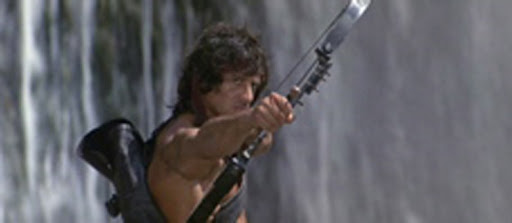
Rambo: First Blood Part II (1985, dir by George Pan Cosmatos, DP: Jack Cardiff)
Days of Paranoia: Dark Blue (dir by Ron Shelton)


2002’s Dark Blue opens in 1992, with a decorated Los Angeles cop named Eldon Perry (Kurt Russell) holed in a hotel room with a shotgun and a pistol.  Perry, who were learn comes from a long line of cops, should be happy. He’s about to finally get promoted.  While Los Angeles is in the grip of the riots that followed the Rodney King verdict, Perry’s lifelong dream is about to come true.  But, instead of celebrating, he’s a nervous wreck.  Dark Blue shows us why.

Perry is the protegee of Commander Jack Van Meter (Brendan Gleeson), a corrupt cop who regularly encourages his men to harass, arrest, and even kill anyone who is suspected of having committed a crime.  Van Meter and Perry claim that they’re doing what they need to do in order to keep the city safe.  They look at a reformer like Assistant Chief Arthur Holland (Ving Rhames) and they see someone who has no idea what it’s actually like on the streets and who is more concerned with his own ambitions than anything else.  However, Van Meter has a side operation going.  Two of his informants (played by Korupt and Dash Mihok) regularly commit robberies that he sets up and helps them get away with.  When their latest robbery leaves four people dead and one wounded, Van Meter assigns Perry and Perry’s young partner, Bobby Keough (Scott Speedman), to the case.  Bobby is young and maybe not as cynical as Perry.  But he’s also Van Meter’s nephew so the assumption is that he’ll play ball.

And, at first, Bobby does go along with whatever Van Meter and Perry say.  When Perry unknowingly gets too close to the truth about what happened at the robbery, Van Meter orders Perry and Bobby to go after someone else.  When Perry orders Bobby to execute an innocent man, Bobby does so and Perry takes the blame.  (In one of the film’s best scenes, Bobby gives his statement about the shooting to Internal Affairs, just for the detectives to shut off the tape recorder and give Bobby a chance to make a better statement.)  But when Bobby has a crisis of conscience and Van Meter reveals that depths that he’ll go to protect himself, Eldon Perry is forced to reconsider the life that he’s built for himself as a cop.  With Los Angeles descending into chaos, Perry has to finally decide whether or not to play the game or to do the right thing.

There’s a lot going on in Dark Blue. Actually, there’s too much going on.  The film is based on a story by James Ellroy and it has Ellroy’s traditionally dense plotting, full of duplicitous characters and macho dialogue.  Not only is Perry dealing with the investigation, he’s also dealing with his frayed marriage to Sally (Lolita Davidovich).  Not only is Bobby struggling with his ethics but he’s also struggling with his love for Sgt. Beth Williamson (Michael Michele), who is also Holland’s assistant and who also once had a one-night stand with Holland, pictures of which have gotten into Van Meter’s hands and which Van Meter plans to use to blackmail Holland into taking a job in Cleveland.  It’s a lot to keep track of and, visually, director Ron Shelton struggles to capture Ellroy’s trademark prose.  As a writer, Ellroy’s jittery style can get readers to accept almost anything, no matter how complex or potentially disturbing.  Ellroy has no fear of alienating the reader.  Shelton, on the other hand, has a much more gentle style and it’s not a good match for Ellroy’s vision of a world gone mad.  The film mixes Ellroy’s moral ambiguity with Shelton’s rather predictable liberal piety and the end result never really comes together.  Shelton doesn’t seem to be sure what he wants to say with Dark Blue.

That said, this film does feature an excellent performance from Kurt Russell.  Russell plays a character who is both good and bad.  Perry cares about his partner.  He cares about his family.  He’s loyal to the police department.  His methods may be extreme but he’s also taking criminals off the street.  But Perry is also thoroughly mired in Van Meter’s corruption.  Perry trusts Van Meter because Perry considers the police force to be his family.  His shock at being betrayed is one of the more poignant things about the film and Russell captures the moment perfectly.

Dark Blue has a lot that it wants to say, about morality, policing, and race relations.  It doesn’t really work because Ron Shelton was the wrong director to bring James Ellroy’s pulp sensibility to life.  But it does provide Kurt Russell a chance to show us that he’s one of our most underrated actors.

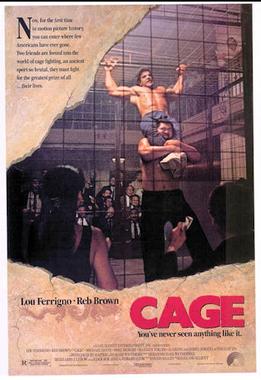
Cage (1989, directed by Lang Elliott)


As with so many stories, it all starts with Vietnam.

In 1969, soldier Billy Thomas (Lou Ferrigno) heroically saves the life of his captain, Scott Monroe (Reb Brown).  Unfortunately, while their helicopter is taking off, Billy takes a bullet to the head.  While he survives the wound, he is left with the mind of a child.  Scott dedicates his life to taking care of Billy and, after the war, they open a bar together.  However, mobster Tony Baccola (Michael Dante) feels that Billy would be the perfect contestant for a series of fight-to-death cage matches that have been set up by Chinese gangster Tin Lum Yin (James Shigeta).  In desperate need of money, Tony kidnaps Billy and forces him to fight, telling him that it’s what Scott needs him to do.  Billy doesn’t want to fight and, when he first enters the cage, he says, “Hi, how are you?” and tries to shake his opponent’s hand.  But when his opponents try to hit Billy, he has no choice but to defend himself.  It’s up to Scott to rescue his friend.

The plot of this movie is pretty dumb but I’m not embarrassed to say that the film itself won me over.  The fights were decent but the main reason why the movie works is because of Lou Ferrigno and Reb Brown, who made their friendship and their bond feel very real.  Ferrigno was especially good in this film.  How can you not root for a guy who just wants to be everyone’s friend and who, even after his twelfth cage match, still gets upset over having to hit people?

A pure B-movie all the way, Cage also features familiar faces like Branscombe Richmond, Al Leong, and Danny Trejo.  Most of the critics may not have liked it but Ferrigno has described Cage as being his his favorite film performance and I agree.