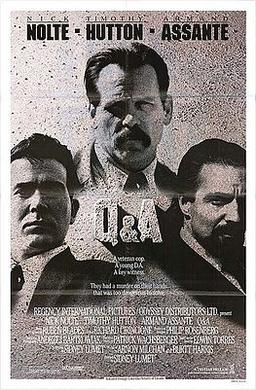
Q&A (1990, directed by Sidney Lumet)


Al Reilly (Timothy Hutton) is the son of a New York cop and a former cop himself.  Having put himself through law school, Reilly is now an assistant district attorney.  When Reilly is assigned the case of Mike Brennan (Nick Nolte), a popular detective who claims to have killed a Puerto Rican drug dealer in self-defense, everyone assumes that Al will come down on the side of Brennan.  Instead, Al discovers that Brennan is corrupt and that the shooting is connected to a drug lord named Bobby Texador (Armand Assante).  Bobby just happens to be married to Nancy (Jenny Lumet), who is Al’s ex-girlfriend.

Nobody was better at capturing the hustle and the gritty language of New York City politics than Sidney Lumet and some of the best scenes in Q&A are the ones where characters like Al, Brennan, and even Bobby are just hanging out and being the New Yorkers that they are.  The dialogue in those scenes crackle with cynicism, as everyone knows better than to trust anything that anyone says.  Coming after Serpico and The Prince of the City, this was Lumet’s third film to focus on corruption in the NYPD.  It was a world that Lumet obviously knew well and he brings the eye for detail that a story like this needs to hold our attention.

Unfortunately, the plot of Q&A is often too dependent on melodrama and coincidence.  Asking us to believe that Bobby would just happen to be married to Al’s ex is asking a lot.  As opposed to the documentary feel of Serpico and especially The Prince of the City, Q&A feels like an extended episode of a cop show, with little of the moral ambiguity that Lumet brought to his best films.  Q&A is good but its never as good as it could have been.

As an actress Jenny Lumet doesn’t really have the depth necessary to make Nancy a believable character.  (Francis Ford Coppola wasn’t the only director to miscast his daughter in 1990.)  But the rest of the cast is uniformly excellent, with Luis Guzman, Fyvush Finkel, Lee Richardson, Paul Calderon, Charles S. Dutton, and Patrick O’Neal all turning in good supporting performances.  Of the leads, Hutton is often overshadowed by the more flamboyant performances of Nolte and Assante but, overall, he does a good job of anchoring the film’s story.  Nolte is excellent in the role of Mike Brennan.  It’s just too bad that the film eventually turns him into a standard movie villain.

Sidney Lumet would return to theme of New York political corruption with the underrated Night Falls On Manhattan.

44 Days of Paranoia #30: Nixon (dir by Oliver Stone)


For our latest entry in the 44 Days of Paranoia, we take a look at Oliver Stone’s 1995 presidential biopic, Nixon.

Nixon tells the life story of our 37th President, Richard Nixon.  The only President to ever resign in order to avoid being impeached, Nixon remains a controversial figure to this day.  As portrayed in this film, Nixon (played by Anthony Hopkins) was an insecure, friendless child who was dominated by his ultra religious mother (Mary Steenburgen) and who lived in the shadow of his charismatic older brother (Tony Goldwyn).  After he graduated college, Nixon married Pat (Joan Allen), entered politics, made a name for himself as an anti-communist, and eventually ended up winning the U.S. presidency.  The film tells us that, regardless of his success, Nixon remained a paranoid and desperately lonely man who eventually allowed the sycophants on his staff (including James Woods) to break the law in an attempt to destroy enemies both real and imagined.  Along the way, Nixon deals with a shady businessman (Larry Hagman), who expects to be rewarded for supporting Nixon’s political career, and has an odd confrontation with a young anti-war protester who has figured out that Nixon doesn’t have half the power that everyone assumes he does.

Considering that his last few films have been W., Wall Street: Money Never Sleeps, and SavagesI think it’s understandable that I’m often stunned to discover that, at one point in the distant past, Oliver Stone actually was a worthwhile director.  JFK, for instance, is effective propaganda.  Nixon, which feels a lot like an unofficial sequel to JFK, is a much messier film than JFK but — as opposed to something like Savages — it’s still watchable and occasionally even thought-provoking.  Thanks to Hopkins’ performance and, it must be admitted, Stone’s surprisingly even-handed approach to the character, Nixon challenges our assumptions about one of the most infamous and villified figures in American history.  It forces us to decide for ourselves whether Nixon was a monster or a victim of circumstances that spiraled out of his control.  If you need proof of the effectiveness of the film’s approach, just compare Stone’s work on Nixon with his work on his next Presidential biography, the far less effective W.

(I should admit, however, that I’m a political history nerd and therefore, this film was specifically designed to appeal to me.  For me, half the fun of Nixon was being able to go, “Oh, that’s supposed to be Nelson Rockefeller!”)

If I had to compare the experience of watching Nixon to anything, I would compare it to taking 10 capsules of Dexedrine and then staying up for five days straight without eating.  The film zooms from scene-to-scene, switching film stocks almost at random while jumping in and out of time, and not worrying too much about establishing any sort of narrative consistency.  Surprisingly nuanced domestic scenes between Anthony Hopkins and Joan Allen are followed by over-the-top scenes where Bob Hoskins lustily stares at a White House guard or Sam Waterston’s eyes briefly turn completely black as he discusses the existence of evil.  When Nixon gives his acceptance speech to the Republican Convention, the Republican delegates are briefly replaced by images of a world on fire.  Familiar actors wander through the film, most of them only popping up for a scene or two and then vanishing.  The end result is a film that both engages and exhausts the viewer, a hallucinatory journey through Stone’s version of American history.

Nixon is a mess but it’s a fascinating mess.

Other Entries In The 44 Days of Paranoia 

  1. Clonus
  2. Executive Action
  3. Winter Kills
  4. Interview With The Assassin
  5. The Trial of Lee Harvey Oswald
  6. JFK
  7. Beyond The Doors
  8. Three Days of the Condor
  9. They Saved Hitler’s Brain
  10. The Intruder
  11. Police, Adjective
  12. Burn After Reading
  13. Quiz Show
  14. Flying Blind
  15. God Told Me To
  16. Wag the Dog
  17. Cheaters
  18. Scream and Scream Again
  19. Capricorn One
  20. Seven Days In May
  21. Broken City
  22. Suddenly
  23. Pickup on South Street
  24. The Informer
  25. Chinatown
  26. Compliance
  27. The Lives of Others
  28. The Departed
  29. A Face In The Crowd