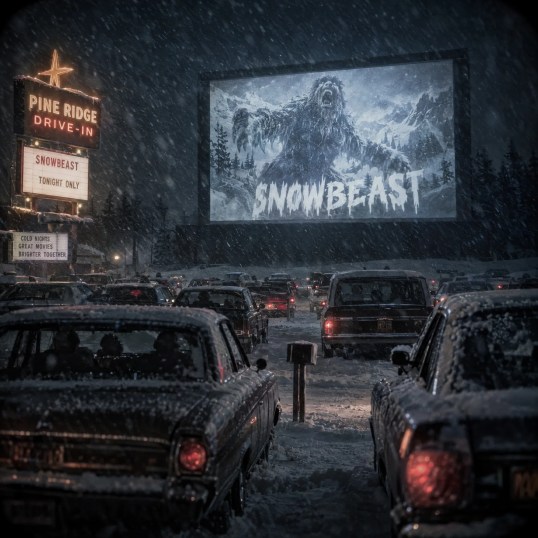
A killer yeti is ruining a resort’s Snow Carnival. Can Bo Svenson, Clint Walker, and Robert Logan set aside their differences and work together to defeat the monster before Sylvia Sidney is forced to shut the whole thing down? Let’s hope so!
Originally made for television in 1977 and subsequently included in a hundred Mill Creek box sets, Snowbeast is an surprisingly enjoyable and, at times, rather intense little horror movie. There’s nothing scarier than an angry yeti!
As some of our regular readers undoubtedly know, I am involved in a few weekly watch parties. On Twitter, I host #FridayNightFlix every Friday and I co-host #ScarySocial on Saturday. On Mastodon, I am one of the five hosts of #MondayActionMovie! Every week, we get together. We watch a movie. We tweet our way through it.
Tonight, at 10 pm et, I will be hosting #FridayNightFlix! Join us for The Giant Spider Invasion!
If you want to join us this Friday, just hop onto twitter, find The Giant Spider Invasion on Prime, start the movie at 10 pm et, and use the #FridayNightFlix hashtag! I’ll be there happily tweeting. It’s a friendly group and welcoming of newcomers so don’t be shy.
Today’s song of the day comes from the 1971 film, Vampyros Lesbos. The Vampires’ Sound Incorporation was a band specifically formed to do the soundtrack for Jess Franco’s classic portrait of Eurotrash decadence. This song found renewed popularity in the 90s when Quentin Tarantino included it on the Jackie Brown soundtrack.
I like this song. It’s great driving music and it sounds like something that a vampire would actually listen to.
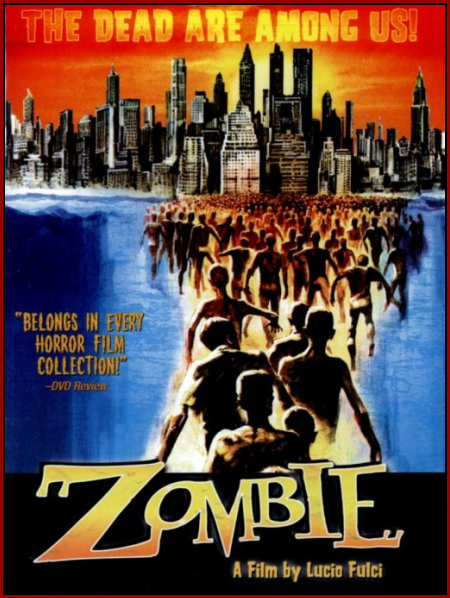
In this scene from 1979’s Zombi 2, a group of humans try to destroy the zombies that are invading a small hospital on an isolated island. Director Lucio Fulci later pointed out, in many interviews, that he used the same clips of Al Cliver throwing a Molotov cocktail and firing a shotgun multiple times in the scene.
Two things to note about this scene:
First off, it captures what is truly scary about zombies. They are relentless. They do not stop coming. No matter how many you destroy, there’s always another one following behind it.
Secondly, Italian zombies actually looked like decaying walking corpses that are on the verge of falling apart. That was one huge difference between the Italian zombie films and many of the ones that were made in America.
4 Shots From 4 Films is just what it says it is, 4 shots from 4 of our favorite films. As opposed to the reviews and recaps that we usually post, 4 Shots From 4 Films lets the visuals do the talking!
4 Shots From 4 Horror Films: October 23rd
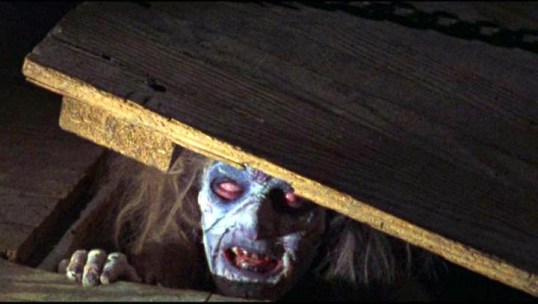
The Evil Dead (1981, dir by Sam Raimi, DP: Tim Philo)
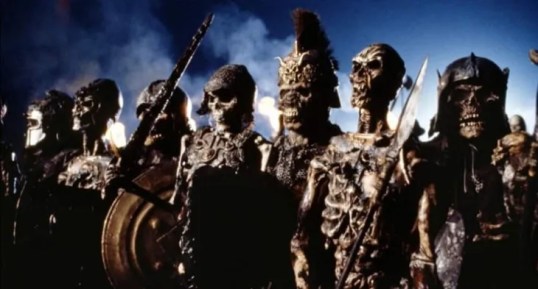
Army of Darkness (1992, dir by Sam Raimi, DP: Bill Pope)
The Gift (2000, dir by Sam Raimi, DP: Jamie Anderson)
Drag Me To Hell (2009, dir by Sam Raimi, DP: Peter Deming)
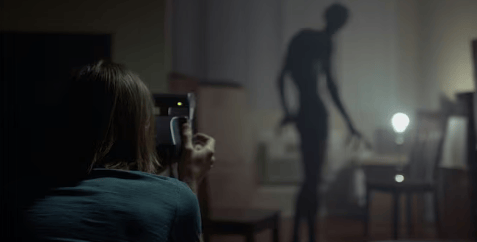
We begin with a Gen-Z guy going through old boxes and he finds a polaroid camera. He starts taking pictures and sees a demon in the photograph. So, he decides to move out and flees for his safety with just the clothes on his back. Or, he gets out and chases content on youtube to get rich. Instead of all of those smart things, he takes another photo.
When confronted with a demon from another dimension, which you are slowly unleashing into our world, and are being not at all concerned with the well-being of anyone else who could be affected by your shenanigans, it’s PICTURE TIME! You’re gonna Ansel Adams on this B!%#&H!
See, she would’ve taken photos of the demon
I just did not care that this protagonist died. What a gigantic tool! I have a headline for this one: Gigantic Tool Dies By Stupid.
I’ve often written about how, whenever you’re watching a film or television show about sports, you can always tell when a professional athlete has been cast in a role because they inevitably give the worst performance out of the entire cast. Now, admittedly, that might be a case of me being overly glib. Certainly, there are a few professional athletes who have gone on to become good actors. For instance .… well, I can’t really think of any right now, but I know they’re out there. Remember when Trainwreck came out and we all pretended like LeBron James was a good actor? I mean, I’m sure it’s happened a few times. Did George Clooney play minor league baseball? I can’t remember, but let’s just pretend that he did and move on. The fact of the matter is that, with a few notable exceptions, most athletes are more impressive on the field than in front of the camera.
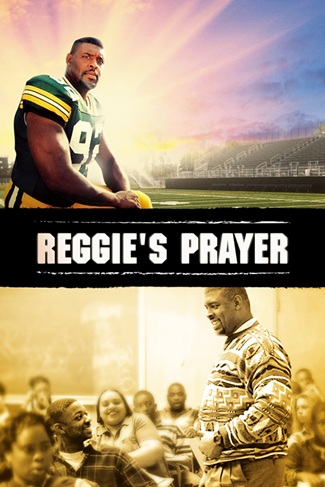
As proof, let’s consider the 1996 film Reggie’s Prayer. Reggie’s Prayer stars Reggie White, a former player for the Green Bay Packers who became a preacher, as Reggie Knox, a former player for the Green Bay Packers who becomes a high school football coach. See, the film could have just had Reggie Knox become a preacher, but instead, it challenged White by having him return to high school to coach football. Unfortunately, Reggie wasn’t really up to the challenge. In this film, Reggie White is big and intimidating, and he seems to be really happy whenever he’s in uniform or talking back to the sports press, all of whom want to know why he’s abandoning the game to be a high school coach. However, when Reggie has to stand in front of a classroom and pretend to be a history teacher or when he’s having to make jokes about how the team’s only white player is the “white sheep” of the team, he comes across as being awkward and not particularly sure where he should be looking.
The film features Reggie trying to get through to Tyler (Emmanuel Brown), a player who has tremendous potential but who is haunted by the suicide of his younger brother and who finds himself being tempted to become a part of the local drug-running operation. When Tyler drops his bag and a gun goes off, another player ends up in a coma. Tyler runs off and ends up getting held prisoner in the woods by a drug dealer, and it’s up to Reggie Knox to save him. It leads to a climax on the football field where a previously crippled player suddenly stands up from his wheelchair and walks around. Such is the power of Reggie’s prayers!
It’s all pretty silly. In fact, it’s so silly that it’s not really a surprise when Pat Morita shows up as the high school principal. He assures Reggie that he will always have his back. Now, if you’re expecting some Pat Morita karate moves, you’re going to be disappointed. Still, he’s Pat Morita and he acts circles around Reggie White.
Incidentally, Reggie White is not the only athlete in this film. Brett Favre plays a janitor who tries to interest Reggie in a play that he designed. Reggie is amused.
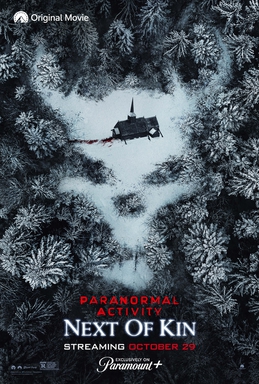
Margot (Emily Bader) was abandoned as a child and wants to learn the truth about her past. When she does a 23andMe test, she discovers that she’s Amish. Samuel (Jaye Ayers-Brown) is a relative who is currently experimenting with Rumspringa. He invites Margot and her cameraman Chris (Roland Buck III) to come to the farm. Yes, Margot has a cameraman because she thinks her journey to find her roots would make for a great documentary. Yes, this movie is supposedly made up of footage that Chris filmed. Samuel and his relatives are smart enough to trick Margot into coming to the farm so that they can give her body to a demon, but they’re not smart enough to do anything about the cameras filming them.
Why is this even a Paranormal Activity film? It has nothing to do with any of the previous Paranormal Activity movies, the majority of which were pretty stupid, but at least tried to maintain a consistent story. This movie is about Amish people sacrificing people to a demon. It’s not even the same demon that previously haunted Katie and Kristi. The only thing this movie has in common with the other films is the found footage gimmick, but even in this case, it screws things up by being too slick. There’s none of the roughness that a found footage movie needs to be credible.
Lisa has a theory that people make movies about the Amish because they know the Amish will never see them. I think this movie proves her right. I would have called it “Paranormal Amish” and gone out of my way to make sure my name didn’t appear in the credits.
Welcome to Retro Television Reviews, a feature where we review some of our favorite and least favorite shows of the past! This Thursday, I will be reviewing Twin Detectives, which was produced for ABC in 1990. The show can be found on YouTube!
Twin Detectives
(Dir by Robert Day, Originally aired on May 1st, 1976)
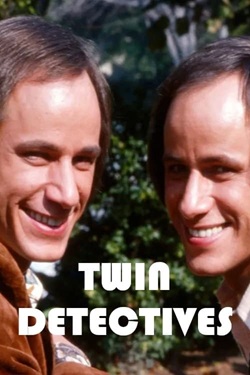
Tony (Jim Hager) and Shep Thomas (Jon Hager) are identical twins who long ago gave up on other people ever being able to tell them apart. Instead, they just pretend to be one person. They own a detective agency. Their clients think that they’re hiring one detective, but little do they know that they’re actually hiring two detectives who look exactly alike! I’m not sure exactly why the Thomas brothers have decided this is a good idea, other than the fact that I guess they each only have to work half a day. It does lead to some complications, like when one of the brothers gets into debt to some gangsters and the other brother ends up getting beaten up. To be honest, I’m not sure whether Tony was the irresponsible one or if it was Shep. All I know is that both of them spent this entire made-for-TV movie getting into trouble because of the decisions made by the other sibling.
As for why I’m reviewing this in October, there actually is a supernatural angle here. Leonard (Patrick O’Neal) and Sheila Rainier (Barbara Rhoades) are running an institute that claims to study psychic phenomena. The elderly and rich Billy Jo Haskins (Lillian Gish) has been funding the Rainiers and is convinced that they can communicate with her dead husband. Billy Jo’s attorney, Marvin Telford (David White), hires the brothers to investigate the institute. At first, it seems like Leonard’s assistant (Lynda Day George) is on the verge of revealing the truth about the scam, but then she’s murdered. The Thomas brothers have to solve the murder and also resolve the question of whether the Rainiers are truly talking to the dead.
Twin Detectives was obviously meant to be a pilot for a weekly show. The Hager brothers were so bereft of charisma and acting ability that I actually felt the need to do some research to try to discover why they were given a pilot in the first place. Apparently, the Hagers were country music performers who had appeared on several variety shows and had a following in middle America. This pilot was obviously designed to appeal to the older folks in the audience, but it didn’t work because, again, the Hagers weren’t very good actors and the whole idea of them pretending to be one person just didn’t make much sense.
Sadly, the film wastes its guest stars. Lillian Gish was one of the first film stars, but she’s not given much to do as Billy Jo Haskins. Wherever D. W. Griffith may have been, he wasn’t watching.
“I am hungry though. My stomach always feels empty.” — Justine
Leaving home for college is supposed to be the start of figuring yourself out, but Raw asks a nastier question: what happens if you don’t like the person you discover? Julia Ducournau’s 2016 coming-of-age horror film takes the familiar experience of a sheltered young woman entering an intimidating new environment and gives it teeth. Literally. Beneath the flesh-eating and bodily distress is a recognizable story about wanting independence without understanding what to do with it. Its horror comes not simply from discovering an appetite for human flesh, but from realizing that the identity you brought from home might not survive contact with the outside world.
Justine, played by Garance Marillier, arrives at veterinary school with a clearly established identity. She is academically gifted, inexperienced, and a committed vegetarian, following the professional path already taken by her parents and older sister, Alexia. Everything about her suggests someone whose life has been mapped out before she has had much opportunity to question it. Then a hazing ritual forces her to eat a raw rabbit kidney, awakening a hunger that develops into cannibalistic desire. It is an outrageous premise, but Ducournau grounds it in an ordinary anxiety: being pressured into doing something uncomfortable because refusing would mean making yourself an outsider.
The college setting is essential because it makes that pressure feel inescapable. Justine hasn’t simply left her parents; she has entered another institution with its own rules about obedience and belonging. The older students humiliate newcomers while presenting participation as a necessary introduction to campus life. From Justine’s perspective, becoming independent initially seems to mean accepting whatever this new crowd demands. There is a nasty contradiction here: she is supposedly learning to become her own person by surrendering control over her body. Raw makes that contradiction central to its version of growing up, where the invitation to loosen up carries an uncomfortable threat.
Cannibalism becomes such an effective metaphor because it turns the vague instruction to discover yourself into something physical and frightening. Justine’s appetite belongs to her, yet it feels alien. She cannot simply decide not to experience it, and recognizing it doesn’t tell her how to live with it. That captures something unsettling about adolescence and early adulthood: your body, desires, and emotions can move ahead of your understanding. Leaving childhood behind means confronting changes you didn’t necessarily ask for and cannot easily reverse. Here, that process isn’t a graceful unveiling of an authentic self. It is messy, embarrassing, and potentially destructive.
What keeps the metaphor interesting is that eating flesh never stands for just one thing. It suggests sexual awakening, rebellion, aggression, intimacy, and the desire to experience something forbidden. Those meanings overlap without settling into a tidy explanation. Justine wants closeness, but her hunger threatens to turn closeness into consumption. She wants freedom, but acting on every impulse would make her dangerous rather than liberated. The film finds its emotional complexity in the uncomfortable space between having a desire and deciding whether to satisfy it. Growing up means encountering impulses that don’t arrive neatly labeled as healthy, shameful, loving, or cruel.
The treatment of female sexuality is particularly strong because Justine isn’t reduced to either an innocent victim or a newly empowered seductress. Her awakening is awkward and contradictory. Wanting something doesn’t automatically make her confident about it, and discovering desire doesn’t mean she understands its consequences. The film allows a young woman to be hungry, confused, physically uncomfortable, and occasionally frightening without treating those qualities as mutually exclusive. Rather than presenting sexual experience itself as a threat, it explores how difficult desire can be to navigate when you barely understand yourself. The problem isn’t that Justine has desires; it is that she must decide how to act on them.
Marillier gives that struggle a vulnerable center. Justine needs to remain someone we recognize even as her behavior becomes harder to watch, and the performance holds those extremes together. Her uncertainty matters as much as her hunger. She often seems to be studying the people around her for instructions on how to behave, only to discover that their confidence isn’t evidence of wisdom. That makes the transformation affecting rather than merely grotesque. We aren’t watching an ordinary girl disappear beneath a monster. We are watching someone struggle to incorporate a frightening discovery into her understanding of herself.
Alexia makes that process even more complicated. Played by Ella Rumpf, she offers the apparent reassurance of a familiar face, but being someone’s older sister doesn’t necessarily make you a safe guide. She understands the environment Justine has entered while also participating in its cruelty. Their relationship mixes affection with competition and the uncomfortable business of establishing separate identities. Alexia also embodies one possible response to their shared appetite: surrendering to it. That makes their bond more than a contrast between innocence and experience. She represents a future Justine has to consider—and potentially reject—even while craving her sister’s acceptance.
The veterinary-school setting sharpens all of this. These students are training to care for animals while inhabiting an environment where bodies are routinely handled and examined. The idea that humans are somehow above animals starts to look less convincing when the distinction between them becomes a matter of appetite and restraint. The setting keeps that uneasy relationship visible without requiring constant explanation. Justine’s education therefore operates on two levels: she is learning about animal bodies while confronting the animal impulses within her own. The question isn’t whether she can eliminate those impulses, but whether she can acknowledge them without allowing them to dictate everything she does.
If there is a limitation to Raw, it is that the extremity of its premise can briefly overwhelm the quieter emotional story. Some viewers will understandably spend more time bracing for the next bodily violation than considering Justine’s loneliness. Still, the excess has a purpose. Raw is another great example of the boundary-pushing spirit of New French Extremity, using graphic bodily horror and taboo subject matter to explore experiences that a more conventional coming-of-age film might soften or avoid. Its willingness to get under your skin matters because the ugliness never feels disconnected from Justine’s struggle.
At its heart, Raw works so well because its cannibalism makes the confusion of growing up feel frighteningly tangible. Leaving home, finding your place, and discovering desire become parts of the same uncomfortable process: realizing that neither your family nor your new surroundings can tell you exactly who to be. Ducournau refuses to confuse adulthood with either perfect self-control or unrestricted freedom, and she doesn’t pretend that independence arrives without consequences. Justine’s real education is learning that discovering what she wants is only the beginning. Cannibalism becomes a disturbing metaphor for her coming-of-age, turning the transition from a sheltered child into a young woman facing the unknowns of the outside world into something painfully physical.