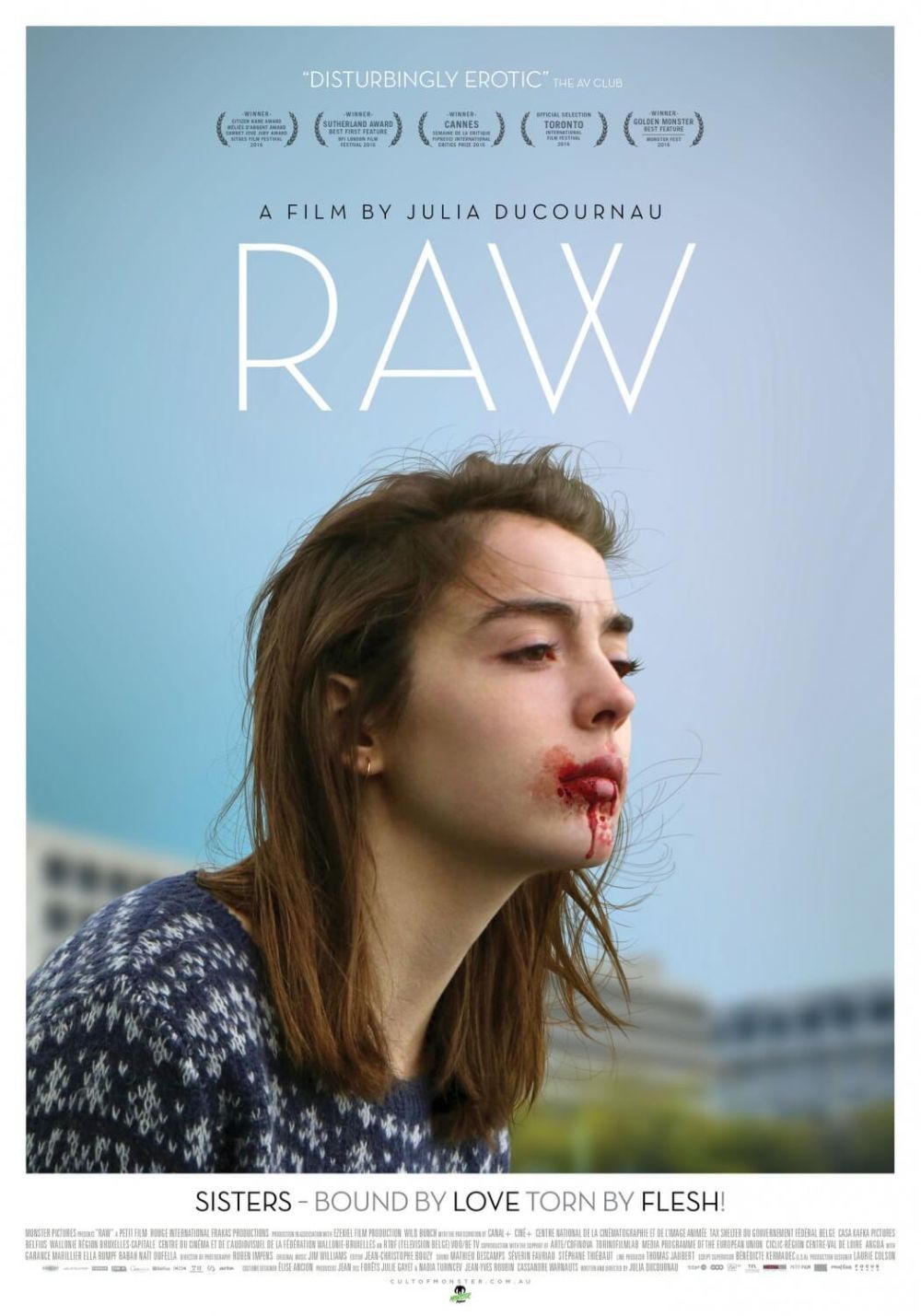
Horror Film Review: Raw (dir. by Julia Ducournau)


“I am hungry though. My stomach always feels empty.” — Justine

Leaving home for college is supposed to be the start of figuring yourself out, but Raw asks a nastier question: what happens if you don’t like the person you discover? Julia Ducournau’s 2016 coming-of-age horror film takes the familiar experience of a sheltered young woman entering an intimidating new environment and gives it teeth. Literally. Beneath the flesh-eating and bodily distress is a recognizable story about wanting independence without understanding what to do with it. Its horror comes not simply from discovering an appetite for human flesh, but from realizing that the identity you brought from home might not survive contact with the outside world.

Justine, played by Garance Marillier, arrives at veterinary school with a clearly established identity. She is academically gifted, inexperienced, and a committed vegetarian, following the professional path already taken by her parents and older sister, Alexia. Everything about her suggests someone whose life has been mapped out before she has had much opportunity to question it. Then a hazing ritual forces her to eat a raw rabbit kidney, awakening a hunger that develops into cannibalistic desire. It is an outrageous premise, but Ducournau grounds it in an ordinary anxiety: being pressured into doing something uncomfortable because refusing would mean making yourself an outsider.

The college setting is essential because it makes that pressure feel inescapable. Justine hasn’t simply left her parents; she has entered another institution with its own rules about obedience and belonging. The older students humiliate newcomers while presenting participation as a necessary introduction to campus life. From Justine’s perspective, becoming independent initially seems to mean accepting whatever this new crowd demands. There is a nasty contradiction here: she is supposedly learning to become her own person by surrendering control over her body. Raw makes that contradiction central to its version of growing up, where the invitation to loosen up carries an uncomfortable threat.

Cannibalism becomes such an effective metaphor because it turns the vague instruction to discover yourself into something physical and frightening. Justine’s appetite belongs to her, yet it feels alien. She cannot simply decide not to experience it, and recognizing it doesn’t tell her how to live with it. That captures something unsettling about adolescence and early adulthood: your body, desires, and emotions can move ahead of your understanding. Leaving childhood behind means confronting changes you didn’t necessarily ask for and cannot easily reverse. Here, that process isn’t a graceful unveiling of an authentic self. It is messy, embarrassing, and potentially destructive.

What keeps the metaphor interesting is that eating flesh never stands for just one thing. It suggests sexual awakening, rebellion, aggression, intimacy, and the desire to experience something forbidden. Those meanings overlap without settling into a tidy explanation. Justine wants closeness, but her hunger threatens to turn closeness into consumption. She wants freedom, but acting on every impulse would make her dangerous rather than liberated. The film finds its emotional complexity in the uncomfortable space between having a desire and deciding whether to satisfy it. Growing up means encountering impulses that don’t arrive neatly labeled as healthy, shameful, loving, or cruel.

The treatment of female sexuality is particularly strong because Justine isn’t reduced to either an innocent victim or a newly empowered seductress. Her awakening is awkward and contradictory. Wanting something doesn’t automatically make her confident about it, and discovering desire doesn’t mean she understands its consequences. The film allows a young woman to be hungry, confused, physically uncomfortable, and occasionally frightening without treating those qualities as mutually exclusive. Rather than presenting sexual experience itself as a threat, it explores how difficult desire can be to navigate when you barely understand yourself. The problem isn’t that Justine has desires; it is that she must decide how to act on them.

Marillier gives that struggle a vulnerable center. Justine needs to remain someone we recognize even as her behavior becomes harder to watch, and the performance holds those extremes together. Her uncertainty matters as much as her hunger. She often seems to be studying the people around her for instructions on how to behave, only to discover that their confidence isn’t evidence of wisdom. That makes the transformation affecting rather than merely grotesque. We aren’t watching an ordinary girl disappear beneath a monster. We are watching someone struggle to incorporate a frightening discovery into her understanding of herself.

Alexia makes that process even more complicated. Played by Ella Rumpf, she offers the apparent reassurance of a familiar face, but being someone’s older sister doesn’t necessarily make you a safe guide. She understands the environment Justine has entered while also participating in its cruelty. Their relationship mixes affection with competition and the uncomfortable business of establishing separate identities. Alexia also embodies one possible response to their shared appetite: surrendering to it. That makes their bond more than a contrast between innocence and experience. She represents a future Justine has to consider—and potentially reject—even while craving her sister’s acceptance.

The veterinary-school setting sharpens all of this. These students are training to care for animals while inhabiting an environment where bodies are routinely handled and examined. The idea that humans are somehow above animals starts to look less convincing when the distinction between them becomes a matter of appetite and restraint. The setting keeps that uneasy relationship visible without requiring constant explanation. Justine’s education therefore operates on two levels: she is learning about animal bodies while confronting the animal impulses within her own. The question isn’t whether she can eliminate those impulses, but whether she can acknowledge them without allowing them to dictate everything she does.

If there is a limitation to Raw, it is that the extremity of its premise can briefly overwhelm the quieter emotional story. Some viewers will understandably spend more time bracing for the next bodily violation than considering Justine’s loneliness. Still, the excess has a purpose. Raw is another great example of the boundary-pushing spirit of New French Extremity, using graphic bodily horror and taboo subject matter to explore experiences that a more conventional coming-of-age film might soften or avoid. Its willingness to get under your skin matters because the ugliness never feels disconnected from Justine’s struggle.

At its heart, Raw works so well because its cannibalism makes the confusion of growing up feel frighteningly tangible. Leaving home, finding your place, and discovering desire become parts of the same uncomfortable process: realizing that neither your family nor your new surroundings can tell you exactly who to be. Ducournau refuses to confuse adulthood with either perfect self-control or unrestricted freedom, and she doesn’t pretend that independence arrives without consequences. Justine’s real education is learning that discovering what she wants is only the beginning. Cannibalism becomes a disturbing metaphor for her coming-of-age, turning the transition from a sheltered child into a young woman facing the unknowns of the outside world into something painfully physical.
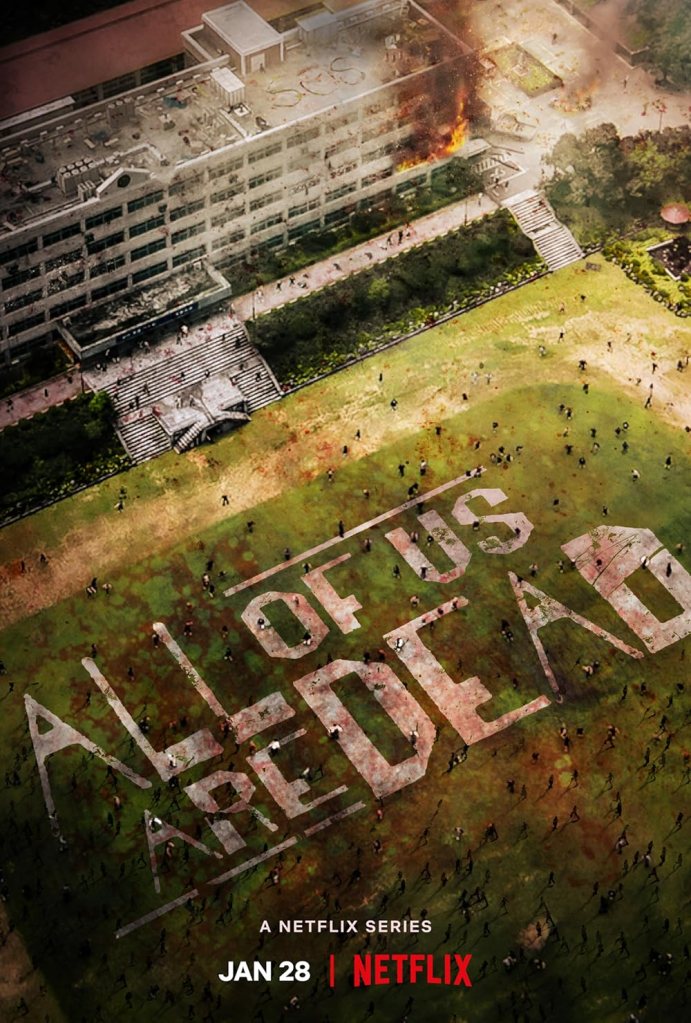
Horror Review: All of Us Are Dead


“If you cause someone else to die, living becomes meaningless.” — Ms. Park

When All of Us Are Dead premiered on Netflix on January 28, 2022, it arrived at a time when both global audiences and Korean media were steeped in a fascination with dystopia, contagion, and social decay. The success of Kingdom had already proven that Korean horror could merge sociopolitical allegory with visceral entertainment on a grand scale. But where Kingdom dissected monarchy and corruption under the opulent, pandemic-stricken Joseon Dynasty, All of Us Are Dead reimagined apocalypse through the raw immediacy of youth—transforming a high school into a microcosm of social hierarchy, moral collapse, and the cyclical violence embedded in modern society.

Adapted from Joo Dong-geun’s webtoon Now at Our School, the series reflects the renaissance of cross-media storytelling in South Korea, where digital comics serve as fertile ground for cinematic reinvention. Directed by Lee Jae-kyoo and Kim Nam-su, the show unfolds in the fictional Hyosan High School, where a science experiment gone horribly wrong ignites a deadly viral outbreak. Within moments, everyday teenage conflicts—bullying, crushes, class pressures—explode into mortal struggles for survival. The series invites viewers to witness how quickly civility crumbles when adolescence, science, and contagion intersect in a closed system, turning a familiar academic setting into an arena of horror and ethical reckoning.

A meta-textual layer enriches the show’s narrative: the characters are well-versed in zombie lore, recognizing their nightmare as their very own Train to Busan. Early in the series, protagonist Cheong-san humorously compares their desperate situation to the iconic Korean zombie film. This is more than a passing joke; it marks how deeply the zombie genre is embedded in their cultural consciousness and survival instincts. The recognition shapes how they confront the outbreak, even as attempts to label the crisis as a “zombie” emergency fall on skeptical ears. This self-awareness grounds the horror in a world where fiction informs reality, and survival requires navigating both.

The virus at the center of All of Us Are Dead is born not from malice but desperation. Created by science teacher Lee Byeong-chan to empower his bullied son, the virus is designed to amplify human strength and aggression as a defense mechanism—an ironic inversion of evolution itself. The mutation, however, spirals beyond control, weaponizing rage and reducing its hosts to flesh-craving undead. This premise gives the show a poignant moral complexity rarely seen in typical zombie narratives. The outbreak stems from parental grief and failed empathy—a symbolic contagion that mirrors the emotional and systemic rot permeating South Korea’s hypercompetitive society. Underlying the visceral terror is a searing critique of institutional neglect. Authority figures—from school staff to government officials—succumb to confusion, bureaucracy, or cruelty rather than compassion. The lack of safe leadership parallels the inept response seen in Train to Busan and Kingdom, continuing Korean horror’s thematic obsession with authority’s inability to protect the vulnerable. Director Lee Jae-kyoo leans into this chaos with both precision and restraint, allowing moments of quiet dread between bursts of violent frenzy. Through repeated imagery of locked doors and shattered glass, he suggests that confinement—psychological, social, and literal—becomes the defining motif of youth under duress.

At its heart, All of Us Are Dead is a survival story—but one filtered through adolescent turmoil. When the infection begins, friendships fracture and loyalties are tested under fire. Students like Cheong-san (Yoon Chan-young), On-jo (Park Ji-hu), Nam-ra (Cho Yi-hyun), and Su-hyeok (Park Solomon) struggle not only to avoid death but to retain a moral compass amid the chaos. Their reactions to trauma—grief, bravery, ruthlessness—expose the spectrum of maturity within youthful fragility. The school, once a symbol of guidance and protection, turns into a decaying labyrinth of fear, with empty corridors echoing the screams of former classmates. This transformation gives director Lee a theatrical staging ground reminiscent of siege narratives. Terrifying, kinetic sequences unfold in chemistry labs, stairwells, and gymnasiums, blending handheld urgency with tight spatial cinematography. The camera’s proximity to characters captures the suffocating intensity of being trapped, while drone shots of burning Hyosan provide a grim reminder of the larger devastation beyond the school gates. The claustrophobic aesthetic evokes Western zombie forebears such as 28 Days Later and Romero’s Day of the Dead, yet the show remains distinctly Korean through its fusion of tragedy, melodrama, and relentless humanity.

One of the most gripping and socially resonant themes All of Us Are Dead explores is the prevalence and devastating impact of school bullying within South Korean youth culture. Bullying is not merely backdrop but a driving narrative force shaping character motivations and the outbreak’s consequences. From the outset, the series exposes the brutal hierarchies ingrained in the school system, where sociopathic bullies like Gwi-nam (Yoo In-soo) wield unchecked power over peers, enforcing cruel dominance through intimidation and violence. The victimization of marginalized students, particularly science teacher Lee Byeong-chan’s son, becomes a poignant catalyst for the viral outbreak, directly linking structural cruelty to catastrophic consequences. This thematic focus reflects real-world concerns in South Korea, where intense academic pressures and social conformity often exacerbate bullying, sometimes with tragic outcomes.

The show’s treatment of bullying extends beyond physical violence to reveal psychological torment—the constant surveillance, social exclusion, and layers of toxic peer dynamics that fracture young lives. Through nuanced portrayals of victims, perpetrators, and bystanders, All of Us Are Dead critiques a culture that often silences or minimizes abuse. The transformation of bullies into zombies metaphorically suggests how unchecked aggression can dehumanize both victim and aggressor, perpetuating cycles of violence even amid apocalypse. Meanwhile, characters like Nam-ra, who initially grapples with victimhood, embody the complex interplay of fear, rage, and resilience spawned by bullying. This emphasis elevates the series beyond typical survival horror into a social allegory about the corrosive effects of cruelty and the desperate fight for dignity under siege.

If Kingdom reinvented the zombie with its nocturnal, plague-era ferocity, All of Us Are Dead introduces a new hybrid—an evolved generation that expands the mythology. Here, the infection mutates unpredictably, producing “hambies” (half-zombies) who retain consciousness and emotion while gaining superhuman resilience. Nam-ra epitomizes this transformation, serving as both tragedy and embodiment of moral duality. Her condition becomes a metaphor for adolescence itself—the tension between savagery and empathy, human and monster, self and society. Through Nam-ra, the series explores ethical boundaries long absent from mainstream zombie fiction. She embodies the question: what happens when survival demands losing one’s humanity? Her struggle resonates deeply in a world where mutation and difference provoke fear and ostracism. The human horror in All of Us Are Dead is not confined to the undead but radiates from the living—bullies, opportunists, and indifferent adults—whose cruelty predates the infection.

Like many Korean horrors, the series is political without proclamation. Its metaphorical core lies in observing a generation abandoned by its guardians. The adults’ failures—scientific, ethical, and parental—manifest as the apocalypse the youth must endure. The students’ isolation becomes both physical and existential; they cannot rely on rescue, and government policies treat their town as expendable containment. These threads coalesce in unforgettable moments of moral reckoning: characters sacrificing themselves to slow infection, tender scenes where guilt replaces hope, and painful realizations that not everyone can be saved. Even amid terror, the direction maintains emotional intimacy, allowing tragedy to feel earned rather than manipulative. The viewer doesn’t merely observe a zombie outbreak but experiences the painful metamorphosis of innocence to experience, of dependency into resilience.

From its opening frames, All of Us Are Dead demonstrates Netflix’s investment in cinematic quality. The production design captures a country on the brink of collapse with chilling realism—street chaos blending with intimate campus horror. Special effects and prosthetics convey the infection’s grotesque physicality, particularly during close-ups that merge human anguish with abject body horror. The use of makeup and fast, jittering movement gives the zombies a distinctive aesthetic, somewhere between Train to Busan’s agile infected and Kingdom’s twisted contortionists. Sound design contributes profoundly to the immersion. Metallic echoes, frenzied breathing, and sudden silence heighten suspense, while the restrained soundtrack underscores existential dread rather than spectacle. At times, silence becomes the loudest sound in the series—especially in scenes where survivors await dawn or confront the moral cost of killing former friends.

Performances further anchor the chaos. Park Ji-hu delivers vulnerability and quiet strength as On-jo, grounding the narrative’s emotional line, while Yoon Chan-young incarnates youthful heroism tainted by despair. Cho Yi-hyun’s Nam-ra stands out as the most nuanced performance, oscillating between stoicism and suppressed rage, embodying both victim and evolution. Supporting roles—including antagonists like the sociopathic bully Gwi-nam (Yoo In-soo)—introduce shades of human corruption that rival any monster the virus creates.

All of Us Are Dead continues Korean horror’s tradition of transforming genre entertainment into mirrors of collective trauma. If Train to Busan externalized grief and social apathy, and Kingdom allegorized class rot under feudal hierarchy, this series dramatizes a generation’s alienation in the digital age. The powerless youth of Hyosan High become metaphors for a society that prizes excellence over empathy and survival over solidarity. The outbreak amplifies what was already toxic: bullying, surveillance culture, and suppressive academic competition—forms of quiet apocalypse preceding the literal one. Even the series’ title invokes universality, suggesting that in a morally diseased world, everyone is already spiritually infected. The zombies may be the physical manifestation of what festers within ordinary relationships—rage, resentment, and humiliation. In this respect, the show transcends its genre constraints, functioning as social realism cloaked in blood.

However, the series is not without its flaws. Its ambitious, 12-episode length sometimes reveals pacing issues. The narrative occasionally stagnates in repetitive cycles of fleeing classroom to classroom, with some fight scenes and survival strategies repeating to the point of fatigue. Unnecessary characters consume screen time without meaningful contribution to the plot, diluting the impact of the central story. Logical inconsistencies also emerge—characters often make poor decisions that strain credibility, such as not isolating infected individuals early, or failing to leverage unique abilities within the group efficiently. These moments can frustrate viewers seeking more plausible survival dynamics and amplify narrative frustration.

Emotionally charged episodes sometimes suffer from heavy-handed exposition and dialogue that replace subtle character development. At times, the series relies on melodramatic reactions that may feel exaggerated or clichéd, especially in high-tension situations where urgent action would be expected. The ending, while open to continuation, drew criticism for being anticlimactic and resolving major conflicts too simplistically, diminishing the epic buildup and emotional payoffs. Additionally, the English dubbing and translation have been noted to undermine the performances’ emotional resonance for international audiences.

Despite these weaknesses, the show capitalizes on what it does best: creating authentic emotional bonds within its youthful cast, delivering intense, well-crafted horror scenes, and reflecting pertinent social anxieties through genre storytelling. Its blend of visceral thrills, tragic humanity, and cultural critique makes All of Us Are Dead a compelling, if imperfect, addition to the Korean zombie canon.

The finale deepens the ambiguity of Nam-ra’s fate. After a final, painful showdown, she isolates herself, grappling with the monstrous hunger within while refusing to surrender her humanity. In a haunting scene, she bites her own arm and feeds only on dead infected to suppress her urges. When reunited with her friends months later, she appears transformed yet unsettling—no longer wholly human, nor fully monster. She speaks cryptically of finding others like herself, neither adult nor child, caught in an uneasy in-between. Declining her friends’ plea to return, she leaps from the rooftop into darkness, leaving open whether she will emerge as ally or threat. This ambiguous exit invites viewers to ponder the fragility of identity under mutation and the precarious balance between survival and self-destruction in a world forever altered by contagion.

In a broader sense, All of Us Are Dead demonstrates that the zombie mythos remains fertile ground for reinvention. By combining the fast-paced terror of modern infection horror with the introspection of Korean melodrama, the series redefines what it means for young people to inherit a broken world.

All of Us Are Dead is more than another entry in the zombie canon—it is a generational elegy wrapped in horror. Built upon the stylistic and thematic foundations laid by Train to Busan and Kingdom, it fuses elemental fear with social autopsy, exposing the fractures of authority, empathy, and adolescence under siege. Though uneven in pacing and burdened by moments of frustration, it succeeds where it matters most: revealing that monsters are not born from contagion but cultivated by neglect. Through its relentless tension, moral ambiguity, and emotional resonance, All of Us Are Dead cements itself as one of the defining horror works of Korea’s streaming era—a mirror for an age where fear spreads faster than any virus, and where survival demands confronting not the end of the world, but the end of innocence.