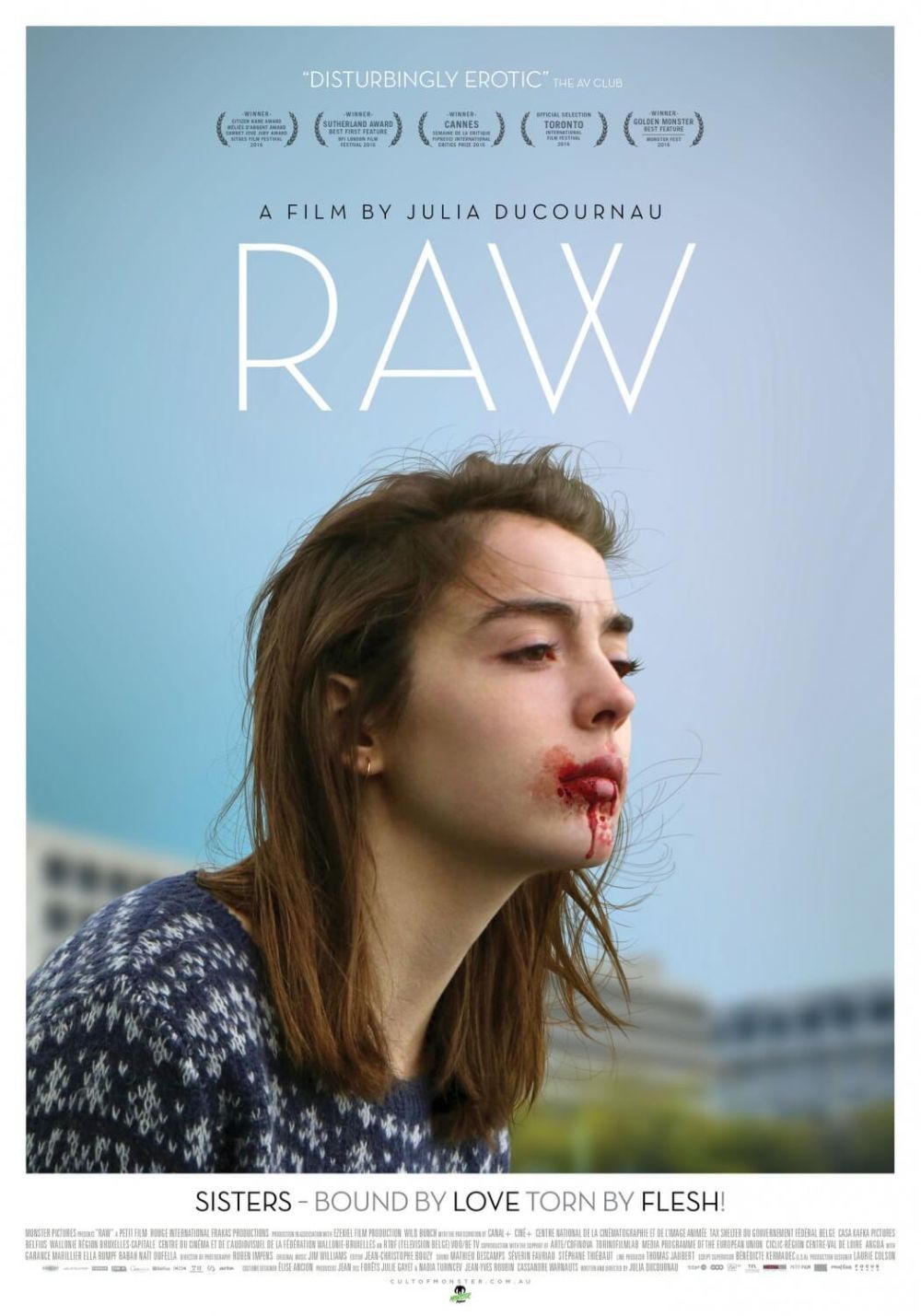
“I am hungry though. My stomach always feels empty.” — Justine
Leaving home for college is supposed to be the start of figuring yourself out, but Raw asks a nastier question: what happens if you don’t like the person you discover? Julia Ducournau’s 2016 coming-of-age horror film takes the familiar experience of a sheltered young woman entering an intimidating new environment and gives it teeth. Literally. Beneath the flesh-eating and bodily distress is a recognizable story about wanting independence without understanding what to do with it. Its horror comes not simply from discovering an appetite for human flesh, but from realizing that the identity you brought from home might not survive contact with the outside world.
Justine, played by Garance Marillier, arrives at veterinary school with a clearly established identity. She is academically gifted, inexperienced, and a committed vegetarian, following the professional path already taken by her parents and older sister, Alexia. Everything about her suggests someone whose life has been mapped out before she has had much opportunity to question it. Then a hazing ritual forces her to eat a raw rabbit kidney, awakening a hunger that develops into cannibalistic desire. It is an outrageous premise, but Ducournau grounds it in an ordinary anxiety: being pressured into doing something uncomfortable because refusing would mean making yourself an outsider.
The college setting is essential because it makes that pressure feel inescapable. Justine hasn’t simply left her parents; she has entered another institution with its own rules about obedience and belonging. The older students humiliate newcomers while presenting participation as a necessary introduction to campus life. From Justine’s perspective, becoming independent initially seems to mean accepting whatever this new crowd demands. There is a nasty contradiction here: she is supposedly learning to become her own person by surrendering control over her body. Raw makes that contradiction central to its version of growing up, where the invitation to loosen up carries an uncomfortable threat.
Cannibalism becomes such an effective metaphor because it turns the vague instruction to discover yourself into something physical and frightening. Justine’s appetite belongs to her, yet it feels alien. She cannot simply decide not to experience it, and recognizing it doesn’t tell her how to live with it. That captures something unsettling about adolescence and early adulthood: your body, desires, and emotions can move ahead of your understanding. Leaving childhood behind means confronting changes you didn’t necessarily ask for and cannot easily reverse. Here, that process isn’t a graceful unveiling of an authentic self. It is messy, embarrassing, and potentially destructive.
What keeps the metaphor interesting is that eating flesh never stands for just one thing. It suggests sexual awakening, rebellion, aggression, intimacy, and the desire to experience something forbidden. Those meanings overlap without settling into a tidy explanation. Justine wants closeness, but her hunger threatens to turn closeness into consumption. She wants freedom, but acting on every impulse would make her dangerous rather than liberated. The film finds its emotional complexity in the uncomfortable space between having a desire and deciding whether to satisfy it. Growing up means encountering impulses that don’t arrive neatly labeled as healthy, shameful, loving, or cruel.
The treatment of female sexuality is particularly strong because Justine isn’t reduced to either an innocent victim or a newly empowered seductress. Her awakening is awkward and contradictory. Wanting something doesn’t automatically make her confident about it, and discovering desire doesn’t mean she understands its consequences. The film allows a young woman to be hungry, confused, physically uncomfortable, and occasionally frightening without treating those qualities as mutually exclusive. Rather than presenting sexual experience itself as a threat, it explores how difficult desire can be to navigate when you barely understand yourself. The problem isn’t that Justine has desires; it is that she must decide how to act on them.
Marillier gives that struggle a vulnerable center. Justine needs to remain someone we recognize even as her behavior becomes harder to watch, and the performance holds those extremes together. Her uncertainty matters as much as her hunger. She often seems to be studying the people around her for instructions on how to behave, only to discover that their confidence isn’t evidence of wisdom. That makes the transformation affecting rather than merely grotesque. We aren’t watching an ordinary girl disappear beneath a monster. We are watching someone struggle to incorporate a frightening discovery into her understanding of herself.
Alexia makes that process even more complicated. Played by Ella Rumpf, she offers the apparent reassurance of a familiar face, but being someone’s older sister doesn’t necessarily make you a safe guide. She understands the environment Justine has entered while also participating in its cruelty. Their relationship mixes affection with competition and the uncomfortable business of establishing separate identities. Alexia also embodies one possible response to their shared appetite: surrendering to it. That makes their bond more than a contrast between innocence and experience. She represents a future Justine has to consider—and potentially reject—even while craving her sister’s acceptance.
The veterinary-school setting sharpens all of this. These students are training to care for animals while inhabiting an environment where bodies are routinely handled and examined. The idea that humans are somehow above animals starts to look less convincing when the distinction between them becomes a matter of appetite and restraint. The setting keeps that uneasy relationship visible without requiring constant explanation. Justine’s education therefore operates on two levels: she is learning about animal bodies while confronting the animal impulses within her own. The question isn’t whether she can eliminate those impulses, but whether she can acknowledge them without allowing them to dictate everything she does.
If there is a limitation to Raw, it is that the extremity of its premise can briefly overwhelm the quieter emotional story. Some viewers will understandably spend more time bracing for the next bodily violation than considering Justine’s loneliness. Still, the excess has a purpose. Raw is another great example of the boundary-pushing spirit of New French Extremity, using graphic bodily horror and taboo subject matter to explore experiences that a more conventional coming-of-age film might soften or avoid. Its willingness to get under your skin matters because the ugliness never feels disconnected from Justine’s struggle.
At its heart, Raw works so well because its cannibalism makes the confusion of growing up feel frighteningly tangible. Leaving home, finding your place, and discovering desire become parts of the same uncomfortable process: realizing that neither your family nor your new surroundings can tell you exactly who to be. Ducournau refuses to confuse adulthood with either perfect self-control or unrestricted freedom, and she doesn’t pretend that independence arrives without consequences. Justine’s real education is learning that discovering what she wants is only the beginning. Cannibalism becomes a disturbing metaphor for her coming-of-age, turning the transition from a sheltered child into a young woman facing the unknowns of the outside world into something painfully physical.

