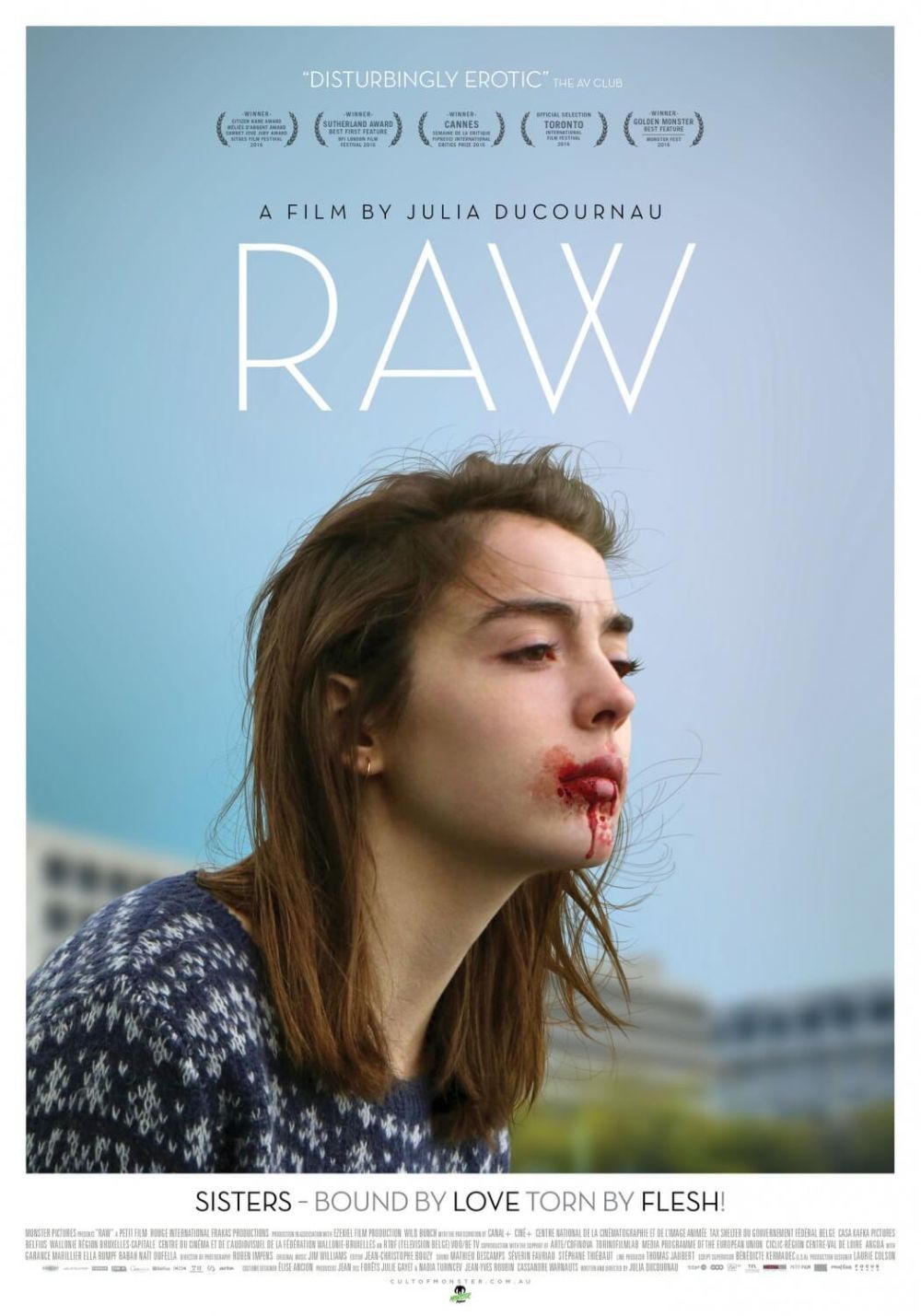
Horror Film Review: Raw (dir. by Julia Ducournau)


“I am hungry though. My stomach always feels empty.” — Justine

Leaving home for college is supposed to be the start of figuring yourself out, but Raw asks a nastier question: what happens if you don’t like the person you discover? Julia Ducournau’s 2016 coming-of-age horror film takes the familiar experience of a sheltered young woman entering an intimidating new environment and gives it teeth. Literally. Beneath the flesh-eating and bodily distress is a recognizable story about wanting independence without understanding what to do with it. Its horror comes not simply from discovering an appetite for human flesh, but from realizing that the identity you brought from home might not survive contact with the outside world.

Justine, played by Garance Marillier, arrives at veterinary school with a clearly established identity. She is academically gifted, inexperienced, and a committed vegetarian, following the professional path already taken by her parents and older sister, Alexia. Everything about her suggests someone whose life has been mapped out before she has had much opportunity to question it. Then a hazing ritual forces her to eat a raw rabbit kidney, awakening a hunger that develops into cannibalistic desire. It is an outrageous premise, but Ducournau grounds it in an ordinary anxiety: being pressured into doing something uncomfortable because refusing would mean making yourself an outsider.

The college setting is essential because it makes that pressure feel inescapable. Justine hasn’t simply left her parents; she has entered another institution with its own rules about obedience and belonging. The older students humiliate newcomers while presenting participation as a necessary introduction to campus life. From Justine’s perspective, becoming independent initially seems to mean accepting whatever this new crowd demands. There is a nasty contradiction here: she is supposedly learning to become her own person by surrendering control over her body. Raw makes that contradiction central to its version of growing up, where the invitation to loosen up carries an uncomfortable threat.

Cannibalism becomes such an effective metaphor because it turns the vague instruction to discover yourself into something physical and frightening. Justine’s appetite belongs to her, yet it feels alien. She cannot simply decide not to experience it, and recognizing it doesn’t tell her how to live with it. That captures something unsettling about adolescence and early adulthood: your body, desires, and emotions can move ahead of your understanding. Leaving childhood behind means confronting changes you didn’t necessarily ask for and cannot easily reverse. Here, that process isn’t a graceful unveiling of an authentic self. It is messy, embarrassing, and potentially destructive.

What keeps the metaphor interesting is that eating flesh never stands for just one thing. It suggests sexual awakening, rebellion, aggression, intimacy, and the desire to experience something forbidden. Those meanings overlap without settling into a tidy explanation. Justine wants closeness, but her hunger threatens to turn closeness into consumption. She wants freedom, but acting on every impulse would make her dangerous rather than liberated. The film finds its emotional complexity in the uncomfortable space between having a desire and deciding whether to satisfy it. Growing up means encountering impulses that don’t arrive neatly labeled as healthy, shameful, loving, or cruel.

The treatment of female sexuality is particularly strong because Justine isn’t reduced to either an innocent victim or a newly empowered seductress. Her awakening is awkward and contradictory. Wanting something doesn’t automatically make her confident about it, and discovering desire doesn’t mean she understands its consequences. The film allows a young woman to be hungry, confused, physically uncomfortable, and occasionally frightening without treating those qualities as mutually exclusive. Rather than presenting sexual experience itself as a threat, it explores how difficult desire can be to navigate when you barely understand yourself. The problem isn’t that Justine has desires; it is that she must decide how to act on them.

Marillier gives that struggle a vulnerable center. Justine needs to remain someone we recognize even as her behavior becomes harder to watch, and the performance holds those extremes together. Her uncertainty matters as much as her hunger. She often seems to be studying the people around her for instructions on how to behave, only to discover that their confidence isn’t evidence of wisdom. That makes the transformation affecting rather than merely grotesque. We aren’t watching an ordinary girl disappear beneath a monster. We are watching someone struggle to incorporate a frightening discovery into her understanding of herself.

Alexia makes that process even more complicated. Played by Ella Rumpf, she offers the apparent reassurance of a familiar face, but being someone’s older sister doesn’t necessarily make you a safe guide. She understands the environment Justine has entered while also participating in its cruelty. Their relationship mixes affection with competition and the uncomfortable business of establishing separate identities. Alexia also embodies one possible response to their shared appetite: surrendering to it. That makes their bond more than a contrast between innocence and experience. She represents a future Justine has to consider—and potentially reject—even while craving her sister’s acceptance.

The veterinary-school setting sharpens all of this. These students are training to care for animals while inhabiting an environment where bodies are routinely handled and examined. The idea that humans are somehow above animals starts to look less convincing when the distinction between them becomes a matter of appetite and restraint. The setting keeps that uneasy relationship visible without requiring constant explanation. Justine’s education therefore operates on two levels: she is learning about animal bodies while confronting the animal impulses within her own. The question isn’t whether she can eliminate those impulses, but whether she can acknowledge them without allowing them to dictate everything she does.

If there is a limitation to Raw, it is that the extremity of its premise can briefly overwhelm the quieter emotional story. Some viewers will understandably spend more time bracing for the next bodily violation than considering Justine’s loneliness. Still, the excess has a purpose. Raw is another great example of the boundary-pushing spirit of New French Extremity, using graphic bodily horror and taboo subject matter to explore experiences that a more conventional coming-of-age film might soften or avoid. Its willingness to get under your skin matters because the ugliness never feels disconnected from Justine’s struggle.

At its heart, Raw works so well because its cannibalism makes the confusion of growing up feel frighteningly tangible. Leaving home, finding your place, and discovering desire become parts of the same uncomfortable process: realizing that neither your family nor your new surroundings can tell you exactly who to be. Ducournau refuses to confuse adulthood with either perfect self-control or unrestricted freedom, and she doesn’t pretend that independence arrives without consequences. Justine’s real education is learning that discovering what she wants is only the beginning. Cannibalism becomes a disturbing metaphor for her coming-of-age, turning the transition from a sheltered child into a young woman facing the unknowns of the outside world into something painfully physical.
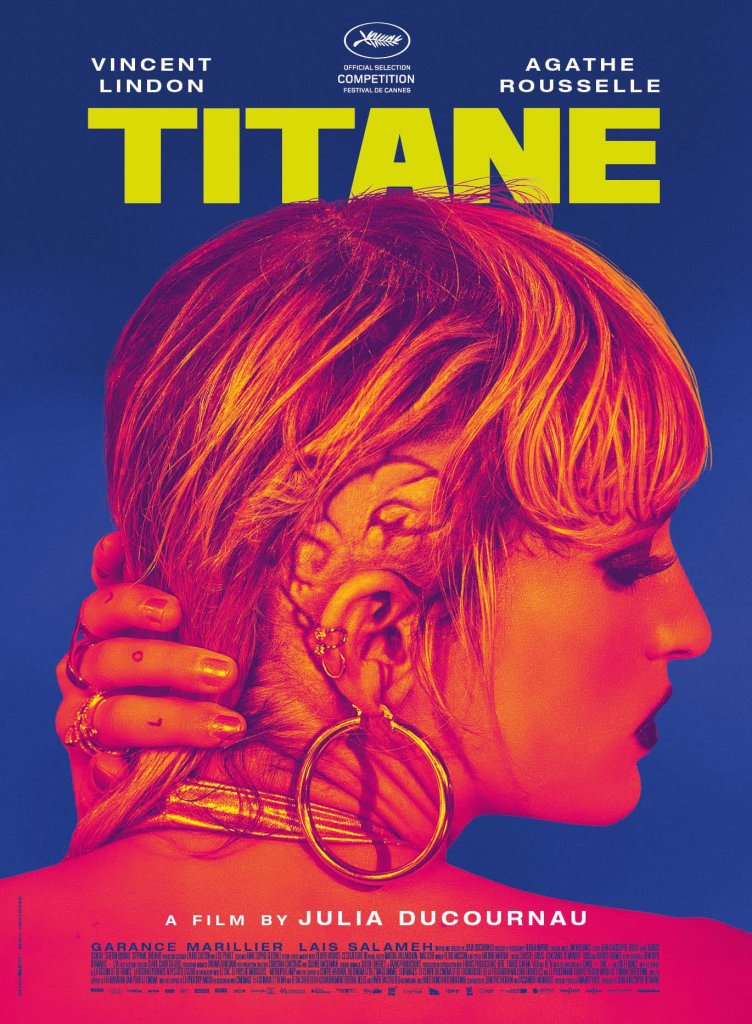
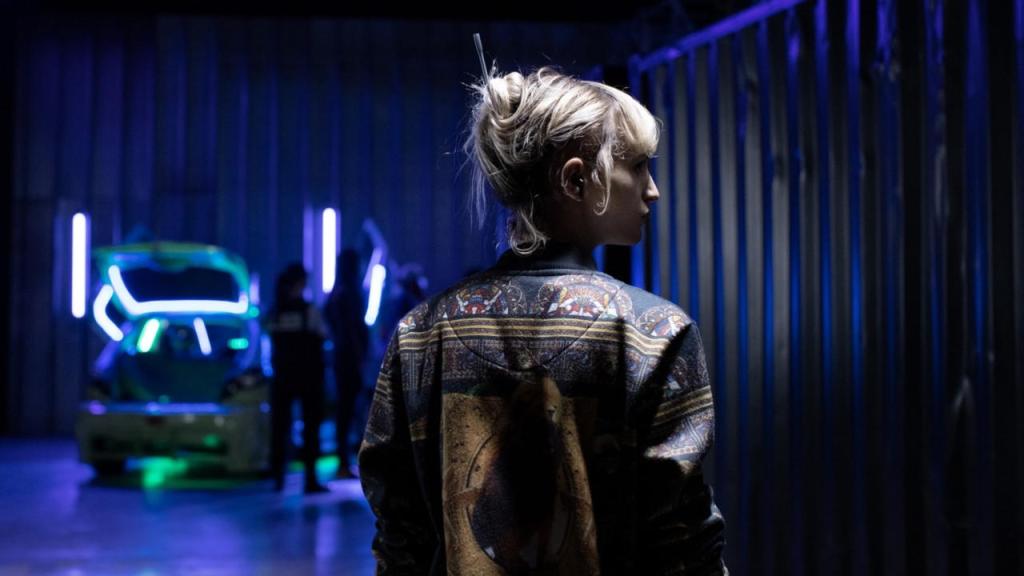
Horror Film Review: Titane (dir. by Julia Ducournau)


I like to think a person’s love of film reflects who they are. Please bear with me on this one.

The movies that move us, make us smile or laugh or cry tend to paint a picture. In some ways, this works out well. When your friend sits you down, shows you The Shawshank Redemption, watches you ball your eyes out and then laugh by the end, you get that slow nod that says..”This fellow, they understand.” The movie love spreads like that tape in The Ring. I’ve had this happen on separate occasions my Live Tweet experiences. The Manitou was an an absolute blast that had me laughing and asking myself just what the hell I was watching. A Field in England was a weird, wild trip that made me flinch at times. They may be stranger films, but they were were also great experiences. Without them, I wouldn’t have my eyes opened to what’s out there in terms of cinema.

I also believe the idea of loving anyone unconditionally is possible under the right conditions, but is a difficult concept. I’ve found that people are usually ready to “ride or die” with you as long as you are both moving along the same path, sharing the same mindset. However, there will always be something that puts a relationship (family/friends/lovers) to the test and maybe a line is drawn that can’t be crossed. It takes a lot for someone to bear all of their flaws before another person, just as it does to see them and say, “You’re cool with me.” It’s no different from having a family that loves you right up until that moment where your political or religious views diverge and you suddenly find yourself disowned because of it. That’s just my opinion.

I caught Julia’s Ducournau’s Titane last Thursday Night in a near empty theatre in Midtown Manhattan. I’ve been thinking about it in some form or another ever since. I went to catch it because I needed to get out and about for a little while, and I enjoyed Raw immensely. Just like Malignant, I went in blind, only really knowing it was a Ducournau film and seeing an image of a girl laying across a car. Maybe it was because by the end, I applauded like a seal and caught some strange looks from people on the way out of the theatre, but I kind of feel weird for enjoying this film as much as I did. I didn’t know what the hell I just watched, but it made me feel something, and that was enough. I’m not entirely sure of what that says about me as a person.

Agathe Rousselle as Alexia in Julia Ducournau’s Titane

Alexia (Agathe Rousselle, in her first full length film) is a live wire. Introduced to the audience as a child, we can see she works off of pure instinct. She also has a love for cars. When she sustains major injuries from a car accident, Alexia has to have a titanium plate (hence the movie’s title in one form) put into her skull that leaves a wild pattern on her skin. Alexia’s instincts carry with her into adulthood, but I saw her as being very feral. Whether it’s food or drink, or darker desires, she throws herself fully into it. Vincent (Vincent Lindon), is a leader and a rescue specialist coping with the loss of his son, who went missing some time ago. When their lives intersect, the plot for Titane seemed to change and for me, became a story about unconditional love. There is horror throughout Titane, suffer no illusions. Blood, broken limbs and all kids of fluids, but there’s also a sense of acceptance and forgiveness despite how dark things really get. Much like the automobile Alexia dances alongside, the plot felt like it shifted gears to the point I wasn’t sure what I really watching. Mind you, I didn’t really see a trailer or anything, so I didn’t have recognizable snippets to reference and say “Ah, I remember that from the trailer.” It may make the film a little hard for some audiences to follow. What I enjoyed, though I list it as a possible con, is that the film never bothers to tell you any of the how’s or why’s for anything you’re seeing. No explanations on why Alexia is who she is or how certain elements are possible. There’s no clear cut answer, like in Malignant.

It just is what it is.

Vincent (Vincent Lindon), testing his limits in Julia Ducournau’s Titane

Both actors carry their roles very well. Rousselle’s Alexia moves between passion, violence and vulnerability in the blink of an eye and I hope that Titane serves as a launchpad for her in future roles. Lindon also goes through the same process, though his character is more nurturing (though just as broken). It’s really hard to imagine other actors doing all of this. Garance Marillier (Raw) reunites with Ducournau as Justine, one of the other dancers Alexia knows. This also brings up something I found interesting. With the exception of Vincent, the names of all of the principal characters are the same character names from Raw. I have to wonder if that’s just coincidence or maybe Ducournau just has a fondness for those names.

During the New York Film Festival, Ducournau said in the post movie Q&A that the film was based on a nightmare she had. She doesn’t play around at all here, and puts it all on view. Titane could easy sit on a shelf among Antonia Bird’s Ravenous, Mary Harron’s American Psycho, and Coralie Fargeat’s Revenge. The blood flow is vicious and mostly brutal. There was at least once sequence that made me flinch in my seat and say..”Oh damn!” while instinctively reaching for a body part. While the movie does contain some sexual scenes and nudity, they’re not terribly explicit. The sound quality in my theatre was loud and rich, so the squishes and breaks were pretty impacting. Ruben Impens returns to work with Ducournau as the Director of Photography and for the most part, the visuals were solid. Colors were vibrant and there weren’t any scenes that seemed like they didn’t work.

So, overall, I truly enjoyed Titane. Did I fully get it? I don’t know. A lot of it is up to interpretation, but I guess that can be said of any film. I give Ducournau and the actors credit for making something that felt strange. When I get a physical copy, I’ll probably sit it next to Jean-Luc Godard’s Weekend, easily one of the most confusing films I’ve seen (that I love).

Still, I have to wonder what that all says about me.

On a side note, I was about to publish this when I realized that Titane is also the winner of this year’s Palme D’or, which is the highest recognition given to a film at the Cannes Film Festival. While I haven’t enough personal knowledge to fully explain how good or bad that may be, Cannes has been in existence since the the mid 1940s. The Shattered Lens has followed Cannes for some time now. Titane shares the win with other films over the years such as Francis Ford Coppola’s Apocalypse Now, Martin Scorsese’s Taxi Driver, Bob Fosse’s All That Jazz and as recently as Jong Boon Ho’s Parasite. Ducournau’s only the second woman to have won the prize, along with Jane Campion for The Piano.

Blade Runner 2049 wins in New Mexico!


Yesterday, the New Mexico Film Critics Association named their picks for the best of 2017!  They also became the first group to pick Blade Runner 2049 as the best film of 2017.

Here are their winners:

Best Picture
Winner: “Blade Runner 2049”
Runner Up: “Lady Bird:

Best Director
Winner: Greta Gerwig, “Lady Bird”
Runner Up: Denis Villeneuve, “Blade Runner 2049”

Glenn Strange Honorary Awards

  • Glenn Close
  • Olivia De Haviland
  • John Carpenter
  • David Lynch

Best Actor
Winner: Sam Elliot, “The Hero”
Runner Up: James Franco, “The Disaster Artist”

Best Actress
Winner: Jennifer Lawrence, “mother!”
Runner Up: Jessica Rothe, “Happy Death Day”

Best Supporting Actress
Winner: Catherine Kenner, “Get Out”
Runner Up: Maryana Spivak, “Loveless”

Best Supporting Actor
Winner: Harrison Ford, “Blade Runner 2049”
Runner Up: Ewen Bremner, “Trainspotting II”

Best Ensemble
Winner: “Raw”
Runner Up: “The Killing of a Sacred Deer”

Best Original Screenplay
Winner: “November”
Runner Up: “Lady Bird”

Best Adapted Screenplay
Winner: “The Disaster Artist”
Runner Up: “Call Me By Your Name”

Best Animated Film
Winner: “Loving Vincent”
Runner Up: “The Breadwinner”

Best Foreign Language Film
Winner: “November” (Estonia)
Runner Up: “BPM” (France)

Best Editing
Winner: “November”
Runner Up: “Blade Runner 2049”

Best Cinematography
Winner: “Blade Runner 2049”
Runner Up: “Song of Granite”

Best Music/Score
Winner: “The Shape of Water”
Runner Up: “mother!”

Best Production Design
Winner: “Blade Runner 2049”
Runner Up: “The Shape of Water”

Best Documentary
Winner: “City of Ghosts”
Runner Up: “Faces Places”

Best Young Actor/Actress
Winner: Garance Mirillier, “Raw”
Runner Up: Sophia Lillis, “It”

Best Original Song
Winner: “The Misery of Love” from “Call Me By Your Name”
Runner Up: “Prayers for this World” from “Cries from Syria”

Horror Film Review: Raw (dir by Julia Ducournau)


Raw.

“The film so shocking that apparently some theater chains distributed barf bags to patrons as they entered the theater!”

When I first heard about that, I figured that had to be a PR stunt, proof that the 70s grindhouse ethos was still alive in 2017.  However, upon doing a little research, I came across several reports that some audience members actually had fainted and/or became physically ill while watching this French-Belgian cannibal film.  Apparently, Raw was just too raw for them.

Now, I have to admit that I may be jaded as the result of spending the last few years watching countless Italian horror films.  Whether the eating was being done by zombies or an undiscovered tribe in the Amazon Rain Forest, the Italians pretty much perfected the use of cannibalism of a plot device.  And, with its vibrant color scheme and its emphasis on the blood, guts, and muscles that lay directly underneath the skin, Raw certainly does feel like a bit of an homage to those old Italian films.  However, the film takes a rather clinical (though, at time, dryly humorous) approach to its subject.  In that way, Raw has more in common with the sleek body horror of early David Cronenberg than the films of Umberto Lenzi or Ruggero Deodato.

It tells the story of two sisters, both of whom are attending a demanding veterinary school.  At first, the two sisters might seem like opposites.  Justine (Garance Marillier) is the younger of the two.  She is driven to succeed and, as a result, has experienced little over the course of her short life.  She is not only a virgin but she is also a lifelong vegetarian.  She has never tasted meat, both literally and metaphorically.  She has an awkward crush on her roommate, Adrien (Rabah Naït Oufella), despite the fact that Adrien is gay.  Her sister, Alexia (Ella Rumpf), appears to be the wilder of the two.  The dynamic between Justine and Alexa is a familiar and it’s well-portrayed by Marillier and Rumpf.  Anyone who has a sister will recognize it.  Despite the strong bond that the two share, it’s obvious that a good deal of Justine’s drive is the result of feeling as if she has to make up for Alexia’s lack of direction.

Of course, Alexia and Justine are not total opposites.  In fact, they have one thing very much in common.  They both find themselves craving human flesh.  At the start of the film, Justine freaks out when, as part of a hazing ritual, she is splashed with blood and forced to eat a rabbit kidney.  It leads to her getting a nasty rash, the result of food poisoning.  However, as her father tells her, once an animal has tasted blood, it will never be the same again.  Soon, Justine is craving both meat and sex, which leads to everything from eating raw chicken to almost biting off a guy’s lower lip.  And, of course, there’s the time that Alexia accidentally cuts off her finger…

Raw is a movie that mixes cannibalism with a coming-of-age story.  Imagine Mona Lisa Smile if the cast ended up eating each other.  (Actually, that’s a terrible and inaccurate comparison.  I just liked the way it sounded.)

Yes, Raw is graphic.  If you can’t handle the sight of blood then maybe you shouldn’t watch Raw because Raw is drenched in it.  That said, for me, the scene that left me trembling was when Justine got a Brazilian wax.  Seriously, that had me screaming in shared pain…

Raw is a well-acted, well-directed, and often a rather audacious film.  For me, the most powerful part of the film is not the mix of flesh-eating and sexual awakening.  It’s the relationship between Justine and Alexia.  Garance Marillier and Ella Rumpf are totally believable as sisters and every detail of their relationship rings true.  You may not agree with some of the choices that the sisters make in the film but they all ring true.

I recommend Raw.  I’m sure some people will find it to be disgusting but, to me, this is a well-made and intelligent film that deserves to be seen.