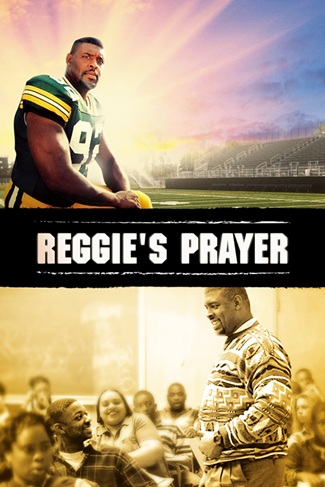
October Positivity: Reggie’s Prayer (dir by Paul McKellips)


I’ve often written about how, whenever you’re watching a film or television show about sports, you can always tell when a professional athlete has been cast in a role because they inevitably give the worst performance out of the entire cast. Now, admittedly, that might be a case of me being overly glib. Certainly, there are a few professional athletes who have gone on to become good actors. For instance .… well, I can’t really think of any right now, but I know they’re out there. Remember when Trainwreck came out and we all pretended like LeBron James was a good actor? I mean, I’m sure it’s happened a few times. Did George Clooney play minor league baseball? I can’t remember, but let’s just pretend that he did and move on. The fact of the matter is that, with a few notable exceptions, most athletes are more impressive on the field than in front of the camera.

As proof, let’s consider the 1996 film Reggie’s Prayer. Reggie’s Prayer stars Reggie White, a former player for the Green Bay Packers who became a preacher, as Reggie Knox, a former player for the Green Bay Packers who becomes a high school football coach. See, the film could have just had Reggie Knox become a preacher, but instead, it challenged White by having him return to high school to coach football. Unfortunately, Reggie wasn’t really up to the challenge. In this film, Reggie White is big and intimidating, and he seems to be really happy whenever he’s in uniform or talking back to the sports press, all of whom want to know why he’s abandoning the game to be a high school coach. However, when Reggie has to stand in front of a classroom and pretend to be a history teacher or when he’s having to make jokes about how the team’s only white player is the “white sheep” of the team, he comes across as being awkward and not particularly sure where he should be looking.

The film features Reggie trying to get through to Tyler (Emmanuel Brown), a player who has tremendous potential but who is haunted by the suicide of his younger brother and who finds himself being tempted to become a part of the local drug-running operation. When Tyler drops his bag and a gun goes off, another player ends up in a coma. Tyler runs off and ends up getting held prisoner in the woods by a drug dealer, and it’s up to Reggie Knox to save him. It leads to a climax on the football field where a previously crippled player suddenly stands up from his wheelchair and walks around. Such is the power of Reggie’s prayers!

It’s all pretty silly. In fact, it’s so silly that it’s not really a surprise when Pat Morita shows up as the high school principal. He assures Reggie that he will always have his back. Now, if you’re expecting some Pat Morita karate moves, you’re going to be disappointed. Still, he’s Pat Morita and he acts circles around Reggie White.

Incidentally, Reggie White is not the only athlete in this film. Brett Favre plays a janitor who tries to interest Reggie in a play that he designed. Reggie is amused.
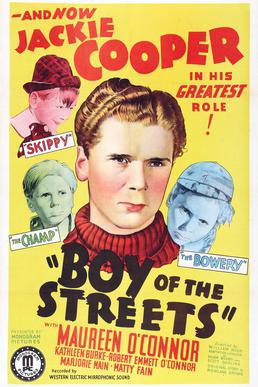
Cleaning Out The DVR: Boy of the Streets (dir by William Nigh)


Welcome to New York City, circa 1937!

It’s a place where the extremely wealthy carefully avoid the districts dominated by the extremely poor, like the Bowery.  In the Bowery, families live in tenements and worried mothers can only cry as they watch their sons join street gangs and their daughters settle for a life of abuse and loss.  Sure, there’s a few do-gooders.  Occasionally, there’s a cop who is convinced that no boy is a lost cause.  Sometimes, you’ll run into a doctor who is determined to provide adequate medical care to the inhabitants of the Bowery.  In fact, you might even see a rich person who is determined to spread about some charity.  But, for the most pat, life in the Bowery is just one hopeless day after another.

14 year-old Chuck Brennan (Jackie Cooper) lives in the Bowery.  He’s got a gang of boys who will do anything that he tells them to do and, despite the fact that Chuck is obviously smarter than almost everyone else around him, he has no interest in being a role model or decent citizen or anything else of that matter.  Chuck lives in a shabby apartment with his mother (Marjorie Main) and his father (Guy Usher).  Chuck looks up to his father who apparently knows important people and is often out of town on “business.”  However, when Chuck discovers that his father is actually a low-level hood who works for the local political machine, Chuck is not only disillusioned but also inspired to go find some gangsters to team up with himself.

The system says that Chuck is a hopeless case but not everyone agree.  Officer Rourke (Robert Emmett O’Connor) thinks that there’s hope for Chuck, he just needs something or someone to straighten him out.  (Like maybe a stint in the Navy….)  And then there’s Nora (Maureen O’Connor), the sweet Irish girl who lives in Chuck’s building and who is often heard singing to her deathly ill mother.

In the end, it’s all up to Chuck.  Will he pursue a life of crime or the life of an honest man?  Will he be a man like his father or will he end the cycle of crime and desperation?

Boy of the Streets is a low-budget, black-and-white film from 1937.  It was produced by Monogram Pictures and, much like Dead End (which came out the same year and featured a superficially similar storyline), it’s a film that mixes social commentary with a bit of gangster action.  The film’s low-budget doesn’t do it any favors and there’s nothing particularly surprising to be found in the film’s plot but child actor Jackie Cooper is convincingly cocky as the swaggering Chuck and Marjorie Main does a good job as his anguished mother.  (Interestingly, Main also played Humphrey Bogart’s mother in Dead End.)

Boy of the Streets is a good example of a film that I never would have seen if not for TCM.  (I recorded it off of TCM way back in June.)  That’s one reason why I’ll always be thankful for TCM.  At a time when so many people seem to be determined to destroy history, TCM is celebrating it.