Brian Dennehy was one of the great American character actors.
Rugged and exuding a sense of weariness, as if he were someone who had seen it all, Brian Dennehy cut a uniquely American figure. He was one of those actors who could play a New York fireman as easily as he could play a Tennessee farmer. He had those eyes that said, “Don’t mess with me,” but also the manner that made you feel everyone was welcome in his house as long as they didn’t think they were better than anyone else. He was one of those actors who could be both likable and intimidating. He was perfectly cast as Sheriff Teasle in First Blood because, even if he was a bit too hard on John Rambo when he first picked him up, it was still easy to see that Teasle didn’t mean to be a jerk. He was just doing his job. He thought he was keeping his town safe. Dennehy was just as credible playing a benevolent alien in Cocoon, a western outlaw in Silverado, or a burned-out cop in F/X. When Dennehy played a hero, you felt safe whenever he was onscreen. When he played a bad guy, he was absolutely terrifying.
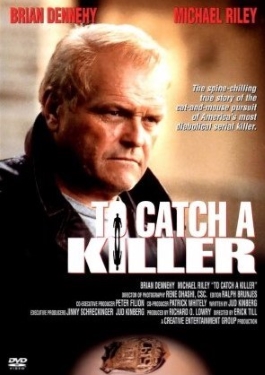
Dennehy played one of the worst of the real-life bad guys in the 1992 television film To Catch a Killer. He plays John Wayne Gacy, a contractor considered a pillar of his community in the suburbs of Chicago. He runs a successful business. He hires young men who really need the money. He has a big smile. He’s involved in local politics and even has a framed picture of himself with President Jimmy Carter’s wife. In his spare time, he dresses up like a clown and entertains the children at the local hospital. He uses the name Pogo and paints sharp points at the corners of his mouth, giving him a somewhat sinister appearance. Everyone seems to like him. Of course, most people don’t know that Gacy is an ex-con who did time for sexually assaulting a 15-year-old boy in Iowa. This film takes place in the late ’70s, before anyone could just hop online and look up public records.
To Catch a Killer follows Detective Joe Kozenczak (Michael Riley) as he investigates the disappearance of a young man last seen being offered a job by Gacy. Joe suspects Gacy from the start, but he’s continually told that Gacy is a pillar of the community. What makes this film so effective is that Brian Dennehy plays Gacy as someone so arrogant he barely bothers to hide his guilt, but also as someone with such a victim complex that he won’t stop whining about being suspected of doing something he definitely did. The scene where Gacy demonstrates a handcuff trick is frightening because Gacy seems so desperate for companionship, and so goofy, even while he’s preparing to murder someone. Personally, I prefer it when Dennehy is playing a good guy (or, at the very least, a misguided bad guy like in First Blood), but that doesn’t change the fact that he was frighteningly believable as John Wayne Gacy. Dennehy was Emmy-nominated for his performance here.
As for the real John Wayne Gacy, he killed at least 33 people before he was apprehended in 1978. (It’s thought that the actual number is much higher.) He was executed in 1994, two years after this film aired. Reportedly, his last words were, “Kiss my ass.”
In 1958’s Back From The Dead, pregnant Mandy Anthony (Peggie Castle) is on a California vacation with her husband Dick (Arthur Franz) and her sister, Kate (Marsha Hunt).
While staying at Dick’s vacation home (which overlooks the ocean), a tired Mandy grimaces when Dick starts playing a record. Dick insists that it’s her favorite record but Mandy’s reaction would seem to indicate the opposite. While the droning orchestral music plays, Mandy has a sudden seizure and passes out. Dick rushes her to the bedroom while Kate smashes the record. A doctor (Ned Glass) comes to check on Mandy and announces that she’s had both an epileptic seizure and a miscarriage. When Mandy wakes up, she’s suddenly demanding to be called Felecia and referring to Dick by an odd nickname, “Deacon.” Dick rushes out of the bedroom and refuses to reenter. When Kate demands to know what’s wrong, Dick reveals that Mandy is actually his second wife. His first wife was named Felecia and she always used to call him “Deacon.”
Soon, Mandy is demanding to be taken to see “her” parents, who are actually Felecia’s parents. Felecia’s mother (Ada Bradley) is revealed to be some sort of witch who apparently cast a spell that caused Felicia’s spirit to possess Mandy as soon as she entered the vacation home. (It turns out that terrible record that Dick insisted on playing was Felecia’s favorite.) Along with Dick’s neighbor (Marianne Stewart), Felecia’s mother is a member of a Satanic cult that is led by the mysterious Renault (Otto Reichow) The possessed Mandy is soon threatening not only Dick but also all of Dick’s friends. She even murders Dick’s dog. (Boo!)
There’s an interesting subtext to Back From The Dead, though I’m not sure it was intentional on the part of the filmmakers. Even before Mandy is possessed, Dick is hardly the model husband. He comes across as being cold and uncommunicative and when both Mandy and Kate say that they don’t want to listen to the record, he ignores them and insists that they both love it. Dick also doesn’t seem to be particularly upset by the loss of the baby. As well, he’s never even told his wife that he was married before. The only time that Dick really shows emotion is when he realizes that he can no longer control Mandy. Mandy spends the entire film either being ordered around by Dick or being possessed by Dick’s dead first wife. In the end, it isn’t Dick or any of the other men in the film who fights for Mandy’s freedom. Instead, it’s Kate, Mandy’s sister. Kate is the only person in the film who seems to care that Mandy has basically lost control over her own life. In the end, the film becomes about just how far one sister will go to protect the other. Kate fights to give Mandy back her life but it’s hard not to feel that it’s not much of a life to begin with. Much like Nicholas Ray’s Bigger Than Life, Back From The Dead ends with a false sense of happiness. For Mandy and Dick and Kate, nothing is ever going to be truly the same again.
Now, I should note that Back From The Dead is definitely a B-movie. It has the look of a well-produced episode of a 50s anthology show. All it really needed was Boris Karloff to host. Arthur Franz is a bit on the dull side as Dick but that’s largely the fault of a script that doesn’t allow him to do much other than seethe and glower. The film’s heart belongs to Masha Hunt’s fierce performance as Kate. Kate is a fighter and a protector and it’s impossible not to root for her. I can only hope to be as good as a sister as Kate but, then again, I don’t think any of my sisters are going to be possessed this holiday season. Let’s hope not!
The film has its slow spots but, for the most part, Back From The Dead is a 50s B-movie that holds your interest. You’ll never want to listen to vinyl record again.
Wealthy businessman Giorgio Minardi (Duilio Del Prete) dies of a massive internal hemorrhage. His last words are “Why?” Even though he dies surrounded by his family, none of them seem to be particularly upset about his passing. Every one of them — from his much younger wife to his stepmother to his son — is more concerned with who is going to get Giorgio’s money than the fact that someone murdered him by grinding up glass and putting it into his food. The only person who truly seems to be upset by Giorgio’s passing is his daughter, Rosie (Karina Huff). Even though Giorgio is dead and soon buried, his spirit remains and soon, he is showing up in Rosie’s dreams and imploring her to help him discover who murdered him.
Released in 1991, Voices From Beyond is one of the films that Lucio Fulci made for television towards the end of his career. By this point, Fulci was not doing well, personally or professionally. After the box office failure of films like Manhattan Babyand Murder Rock, Fulci found himself struggling to raise the money to produce the type of films that he wanted to make. Also, his critical reputation never recovered from the controversy surrounding the violence in The New York Ripper. There’s an undeniable bitterness at the heart of Voices From Beyond. Though the film features several close-ups of Giorgio’s decaying corpse and a few surreal dream sequences, the true horror comes from the way that the family reacts to Giorgio’s sudden death. No one cares that he died. No one cares that he was murdered. They just want what’s left of his estate. Giorgio, trapped in spirit form, discovers just how unloved he was. Watching the film, one gets the feeling that Fulci saw a lot of himself in Giorgio. The family becomes a stand-in for everyone who deserted Fulci during the final years of his life.
I’ve seen Voices From Beyond advertised with a rather tacky pull quote — “The last good movie Fulci made!” While the quote is accurate in that the film is better than most of Fulci’s later films (even if it can’t match the delirious heights of Zombi 2, the BeyondTrilogy, or even The New York Ripper), to call it the last good film that Fulci made is to do the director a great disservice. Even Fulci’s lesser films were uniquely his own and, as a result, they were all good Fulci films regardless of whether or not they were good on any other level. To his credit, Fulci never really sold out. He did the best with what he had. Even this made-for-TV movie manages to open with a threesome and a rather gory knifing. The film features Fulci’s characteristic touches. The camera tracks through the darkness with style. Where it suffers is with a plot that makes the identity of the killer far too obvious and also with a less-than-inspired cast. Del Prete, unfortunately, doesn’t really have the charisma necessary to make us want to stick with Giorgio even after he’s died.
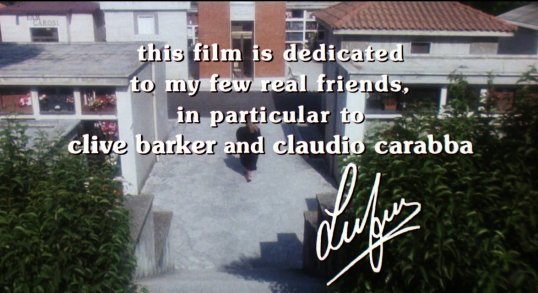
In the end, Voices From Beyond is interesting as a personal statement. It’s Fulci’s way of letting audiences know what he thought of those who had deserted him. The film ends with a dedication that is pure Fulci in both its spite and its vulnerability. Rest in peace to the maestro.
“G.I. Joe is the code name for America’s daring, highly trained special mission force. Its purpose: to defend human freedom against Cobra, a ruthless terrorist organization determined to rule the world!”
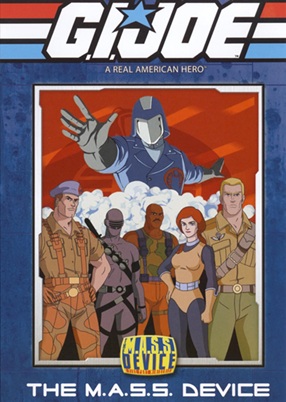
G.I. Joe has been doing a pretty good job defending human freedom from Cobra, though somehow Cobra Commander is still walking free and living in a gigantic temple that any halfway decent special mission force should be able to find. When Destro shows up at the temple with the MASS Device, it looks like Cobra will finally be able to rule the world. The MASS Device is a transportation unit that is fueled by three unique minerals. Cobra Commander decides to take over the world by using the device to… steal the Eiffel Tower? I’m starting to understand why Cobra hasn’t had much success in its quest to rule the world.
After their leader Duke gets abducted by the device and is forced to fight in Cobra-sponsored gladiatorial games, G.I. Joe tries to track down the minerals so that they can fuel their own transportation device. It leads to constant battles in which everyone is blowing things up and shooting laser guns but somehow no one gets injured. In the 80s, no organization provided better job security than being a member of Cobra and G.I. Joe. No matter how many times someone failed, no one was ever fired from Cobra. No matter how many battles they fought, no one was injured on either team.
G.I. Joe: A Real American Hero was the five-episode miniseries that introduced not only the G.I. Joe cartoon but also the G.I. Joe theme song. G.I. Joe is there, according to the song, and they are. Each episode takes the Joes to a different part of the world so that they can build their transporter. It’s entertaining in a way that a lot of bad things are entertaining once they are old enough to be viewed through the lens of nostalgia. Watching, I realized that Cobra was so inept that it seemed pointless to create an entire secret army to fight just them. It doesn’t really matter. It’s just a cartoon. What matters is that, as always, Snake Eyes is the man, Destro and the Baroness make evil look cool, and Scarlet can do backflips through any battle.
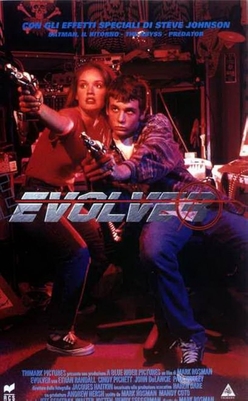
The year is 1995, and all the cool kids are going to the arcade and playing a virtual reality laser-tag game. Kyle Baxter (Ethan Embry) is one of the best laser-tag players in the country and is on the verge of winning a nationwide contest when he gets taken out by another player, a girl named Jamie (Cassidy Rae, who every teenage male in the ’90s had a crush on at some point). Kyle’s friend, Zach (Chace Quinn), uses his hacking skills to make it appear as if Kyle won anyway. Kyle’s prize is an Evolver, a robot that will allow Kyle and his friends to play the laser-tag game in real life. The only problem is that Evolver takes the idea of winning very seriously. Each time Evolver is defeated, it “evolves.” It learns from its mistakes. It uses new weapons. It refuses to stop until it can say, “Kill confirmed.”
Evolver is a mix of Child’s Play and The Terminator. Evolver eventually evolves to the point where it can say cheesy one-liners before killing someone. When someone tells it that the game is over, Evolver replies, “The game is not over.” The main problem with the film is that Evolver is such a bulky and awkward robot that it’s hard to believe it could actually defeat anyone. The people who are killed by Evolver usually fall victim because they’re too dumb to step aside when Evolver approaches them. The best thing about Evolver is that it does accurately represent how most people played video games in the ’90s. The first day, you would be really excited and you couldn’t wait to play every chance you got. By the third day, you were bored and ready to get back to doing whatever it was you were doing to begin with. Not all games were as exciting as Lee Carvallo’s Putting Challenge.
If the voice of Evolver sounds familiar, that’s because it was supplied by none other than William H. Macy. A year later, Macy would star in Fargo, and he would presumably never have to voice another angry robot again.
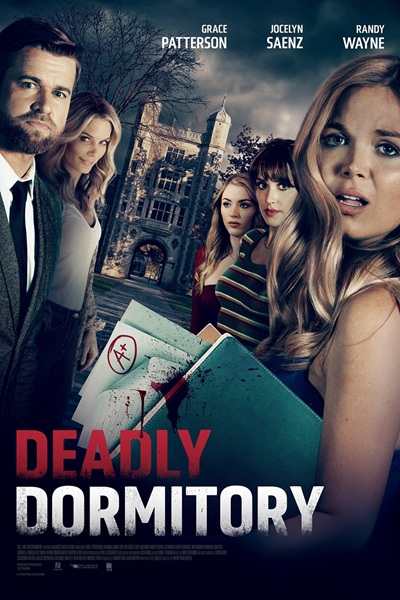
This is one of those Lifetime films that has several different titles. The poster says Deadly Dormitory. Letterboxd claims that the title is Deadly Dorm. If you want to watch this film on Prime, you’ll have to look up College Professor Obsession. Me, I’m going to go with Deadly Dorm because that’s the easiest to say and the quickest title to type.
First aired in 2021, Deadly Dorm tells the story of Jenny Willis (Grace Patterson), a high school track star who is recovering from a knee injury. She’s finally well enough to accept a partial scholarship to an exclusive college. She tells her parents that she’s willing to go to a state school, but her parents insist that they will be able to pay for college. The whole opening of the movie reminded me of that old commercial they would show where recent high school graduates would record themselves saying, “I am going to college,” as if that was some sort of rare thing. I remember one guy who said, “It’s oh-fish-ee-al,” and I was just like, “Maybe don’t say it like that once you’re on campus.”
Anyway, Jenny enrolls in the college and moves into the dorm. Everyone she meets acts shocked when they hear which dorm room she’ll be moving into. It turns out that the room was previously occupied by a girl who died under mysterious circumstances. She was on the roof of the dorm, and she either fell, was pushed, or jumped. Jenny freaks out when she realizes that she’s going to be sleeping in the dead girl’s bed. Seriously, Jenny, just buy some new sheets and calm down.
Jenny is scandalized when her psychology professor (Randy Wayne) tells her that, if she wants to get better grades, she should try dressing a little better and showing off her legs and cleavage when she comes to class. Jenny is upset, and she has every right to be, even though I do agree that Jenny’s wardrobe is a bit on the frumpy side. Jenny’s roommate and new best friend, Beth (Johanna Liauw), says that the professor is a jerk but he also has tenure, so maybe it would be a good idea for Jenny to just give him what he wants.
Jenny starts to investigate on her own, and she soon comes to believe that the dead girl was also harassed by the professor. What if the professor killed the girl who used to live in Jenny’s dorm room? What if the professor has killed several people on campus? Does tenure cover that? It probably does at a private institution like this one. Jenny really should have gone to a state school.
On the one hand, I appreciated that this film had a lot of twists and turns in the plot. It embraced the melodrama, and I support that. I have to admit, though, that Jenny and her overprotective mother (Jocelyn Saenz) both kind of got on my nerves. Jenny was such a generic character that I actually felt sorry for her roommates. One character ends up seriously injured as a result of helping out Jenny, and it was hard not to notice that Jenny didn’t really seem to feel much guilt about that. When it came to college friendships, my firm rule was that I didn’t want to be dragged into anyone else’s drama, and Jenny doesn’t seem like she would have respected that.
The best scene in the film was when Jenny tried to stand up to her professor in the middle of class and the professor responded by announcing that she had borderline personality disorder and all of the other students just nodded in agreement. That felt like the most realistic scene in the film, as it captured how people will believe anything as long as it’s said by someone in authority.
The lovely actress Elizabeth Shue was born on October 6th, 1963. She is very special to me because back in 1984, an 11-year-old Brad Crain wanted to be Daniel LaRusso, aka the Karate Kid. He knew karate, beat the bullies in the All-Valley tournament, and had an awesome friend and teacher like Mr. Miyagi. But even more important than all of that, his girlfriend was the beautiful Ali Mills, played by Elizabeth Shue. I was smitten with her, and I can honestly say she was the very first movie character I had a crush on!
In honor of her birthday, and also recognizing that we’re in the midst of Horrorthon here at TSL, I thought I’d share this clip of her in the horror flick LINK, a movie that came out a couple of years after THE KARATE KID. It’s about Jane Chase (Shue), a zoology student who’s invited to a remote seaside mansion to assist primatology professor Steven Phillip (Terence Stamp) with his experiments involving chimpanzees. Soon, dangerous events begin to occur, all involving the intelligent 45-year-old chimp, Link. I’ve never actually seen this one before, but I do remember seeing the VHS box at my local rental shops back in the day. In the spirit of the season, I may just have to finally give it a watch!
“When am I gonna make you see? It’s something inside the dog!” — Dr. Caroline Arnold
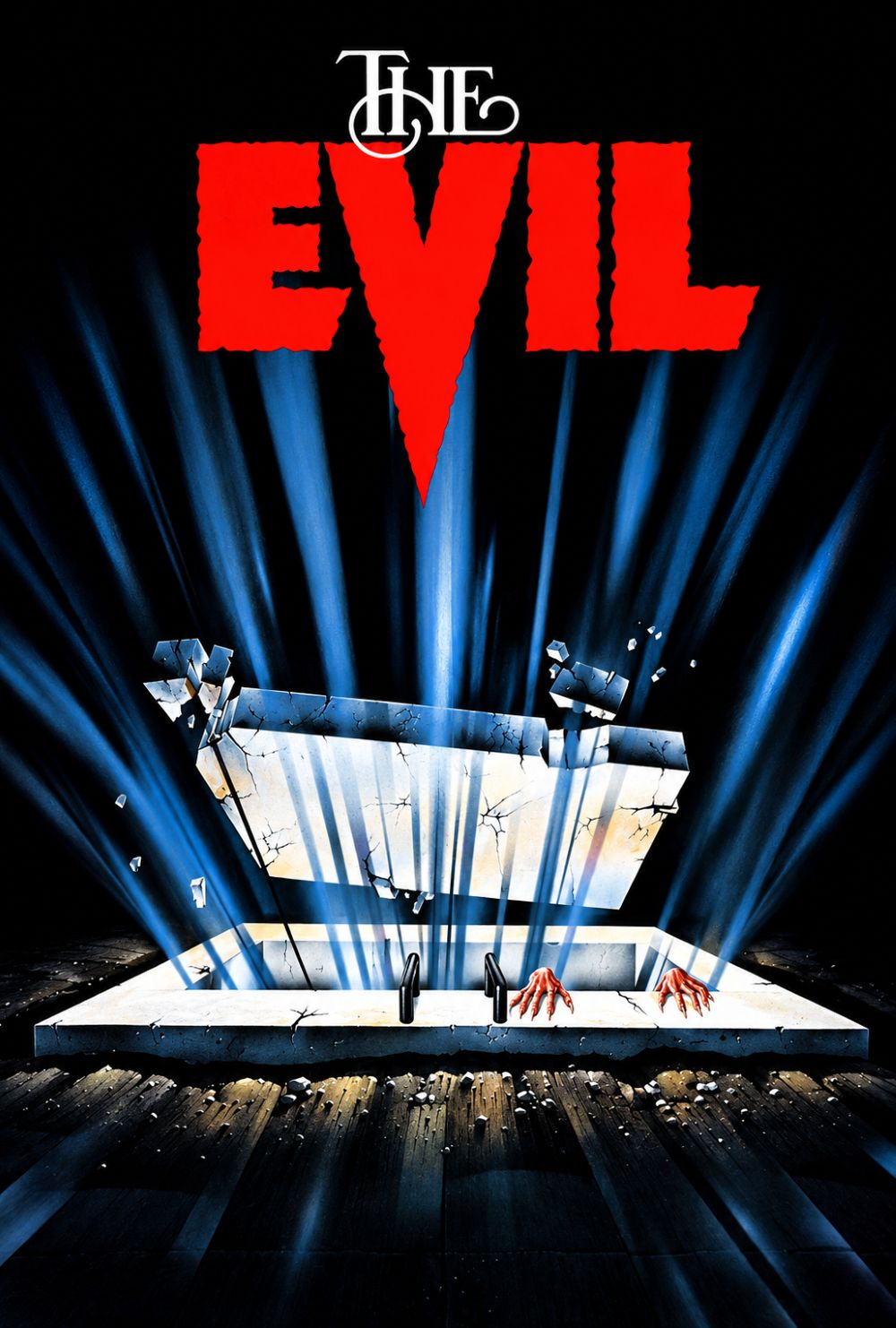
On paper, The Evil has no business being as entertaining as it is. It has a familiar haunted-mansion setup, a group of characters making predictably bad decisions, a handful of effects that are more enthusiastic than convincing, and a story that often feels like it was assembled from supernatural-horror leftovers. Yet Gus Trikonis’s 1978 film somehow makes that combination work. It is a scrappy, surprisingly lively late-1970s chiller that keeps finding ways to turn its limitations into part of the fun. The movie may not have the elegance of The Haunting or the full-scale dread of The Omen, but it has momentum, personality, and just enough weirdness to make it stick in the mind.
Richard Crenna plays Dr. C.J. Arnold, a well-meaning physician who buys the old Vargas mansion with plans to turn it into a rehabilitation center. He brings his wife Caroline, played by Joanna Pettet, along with a small group of friends and workers, to spend time cleaning up the place and preparing it for renovation. It is the kind of horror-movie premise where viewers can tell within seconds that nobody should be spending the night there. The mansion is enormous, decaying, isolated, and full of the sort of dark hallways that seem specifically designed for people to wander into alone. Still, C.J. sees a building with potential rather than a nightmare waiting to happen, and the movie gets a lot of mileage out of that mistake.
Before long, the house starts acting up in all the expected ways. Doors move on their own, strange noises echo through the corridors, flames appear where they should not, and the guests begin to realize that the mansion’s history is more sinister than they were led to believe. None of this is particularly groundbreaking, even for 1978, but The Evil understands the usefulness of a clean, direct setup. It does not waste a huge amount of time pretending the house is safe. The film gets its characters into trouble, gives them an increasingly hostile environment, and lets the tension build through a series of practical, often mean-spirited scares.
The movie came out during a period when horror was especially interested in demonic forces, cursed places, possession, and spiritual danger. You can feel the shadow of films such as The Exorcist, The Omen, Burnt Offerings, The Sentinel, and The Legend of Hell House hovering over it. The Evil is clearly playing in that same sandbox, mixing the isolated-house horror formula with the era’s fascination with the Devil and the supernatural. What keeps it from disappearing completely into the crowd is not originality so much as commitment. The film believes in its own nonsense, and that sincerity goes a long way.
Gus Trikonis directs the material with a briskness that suits it. At around 85 minutes, The Evil moves quickly enough that it rarely gives viewers much time to dwell on its thinner character work or its occasionally awkward plotting. The mansion itself does a lot of the heavy lifting. It has the faded, neglected grandeur that every good haunted-house movie needs, with dark rooms, winding staircases, sealed-off spaces, and enough shadowy corners to make even a simple walk down a hallway feel questionable. The location gives the movie a genuine sense of place, which is important because much of the film depends on the audience accepting the house as an active threat rather than just a backdrop.
There is a very specific low-budget 1970s flavor to the production that adds to its charm. The movie is not sleek or refined, and that works in its favor. The roughness of the camerawork, the muted colors, the occasionally dated sound design, and the practical effects all give it a handmade quality. The Evil never looks expensive, but it often looks tangible. When the house lashes out, the effects may not always be flawless, but they have physical weight. A lot of modern horror relies on digital polish to sell its scares; this film has to make do with tricks happening in front of the camera, and that gives the best moments an immediate, almost old-fashioned punch.
The movie is at its strongest when it keeps things simple. A character hears something in another room. Someone gets separated from the group. A familiar household object or feature of the mansion suddenly becomes dangerous. These are basic horror devices, but Trikonis uses them efficiently. He knows that the fear of walking into an empty room is sometimes more useful than a long explanation of why the room is dangerous. The Evil is not a slow-burn ghost story in the style of The Innocents. It is more interested in delivering jolts and keeping the body count moving. That can make it feel mechanical at times, but it also makes the movie easy to enjoy as a late-night scare picture.
Richard Crenna gives the film more credibility than it probably deserves. He plays C.J. as a rational, decent man who believes he can bring order and purpose to a place everyone else would wisely avoid. His growing inability to explain what is happening gives the movie an anchor. Crenna does not act embarrassed by the material or play it with a knowing wink. He treats the situation seriously, which makes the supernatural chaos around him feel more convincing. He is the kind of sturdy, professional lead who can sell even the film’s more ridiculous turns simply by looking genuinely alarmed.
Joanna Pettet also helps keep the human side of the movie from getting completely lost. Caroline is more willing than C.J. to recognize that something is wrong with the mansion, and that divide gives their relationship a modest but effective tension. The rest of the cast, including Andrew Prine, Cassie Yates, Mary Louise Weller, and Lynne Moody, is more variable. They serve the story well enough, though most of them are defined more by the danger they face than by particularly deep characterization. The film does not spend much time building rich backstories, but the actors keep the group dynamic watchable.
The middle section is where The Evil shows its limitations most clearly. The structure can become repetitive: something strange happens, someone investigates alone, the house responds, and the survivors become more desperate. The mythology behind the mansion is also not always developed with much precision. But again, the movie gets away with more than it should because it keeps pushing forward. It has the energy of a film that knows it cannot afford to be boring. Even when the story is familiar, there is usually another strange image, creepy sound, or sudden danger waiting around the corner.
The final stretch is best left mostly unspoiled, because the movie takes a turn that is much stranger and more ambitious than its early scenes might lead you to expect. It broadens the scope of the story without abandoning the slightly tacky, practical-effects character that defines the rest of the film. Some viewers will probably find the shift abrupt, especially if they are expecting a straightforward haunted-house ending. Others will enjoy the fact that The Evil refuses to settle for the safest possible conclusion. It is a movie that starts with a familiar premise and gradually gets more unhinged, and that unpredictability is a real asset.
Ultimately, The Evil is not a lost classic, but it is a lot more fun than its reputation and basic setup might suggest. It has no right to work as well as it does. The premise is familiar, the characters are not deeply written, the effects are uneven, and the story occasionally runs on pure genre momentum. Yet that momentum is exactly what makes it enjoyable. Trikonis delivers a lean, energetic little horror movie with a great old mansion, a convincingly serious Richard Crenna, a few solid practical scares, and enough late-game insanity to make the experience memorable. If you enjoy the rougher, more obscure side of 1970s supernatural horror, The Evil is the kind of movie that can catch you off guard: imperfect, sometimes goofy, but much more entertaining than it has any right to be.
On August 17th, 1920, the Cleveland Indians were playing the New York Yankees. Yankee Carl Mays was on the pitcher’s mound. Cleveland shortstop Ray Chapman was at bat. According to contemporary reports, Mays was upset because he felt Chapman had been crowding the plate all day. When Mays threw his next pitch, he aimed at Chapman’s head. Chapman never even saw the ball coming before it smashed into his forehead. The ball hit Chapman’s skull with such force and produced such a loud crack that Mays though Chapman had hit the ball with his bat and, when it bounced back to the pitcher’s mound, Mays threw it to first base. Chapman collapsed and was rushed to the hospital, where he died 12 hours later.
Ray Chapman is the only baseball player to have ever died as a result of an injury that occurred in the game. His death led to the banning of the spitball and a new rule that made it the responsibility of the umpire to replace dirty or worn baseballs that might be difficult for the hitter to see. Chapman’s death also kept Carl Mays out of the Hall of the Fame despite Mays being one of the best pitchers of his generation.
The death of Ray Chapman was a tragedy. Last night, on YouTube, I watched The Beaning, a 9-minute “documentary” that suggested that Chapman’s death was also a blood sacrifice that was arranged by the Yankees ownership as a part of a pact with the Devil. That explains why the Yankees have won 41 pennants and 27 championships. It doesn’t explain how poorly they played last night, though.
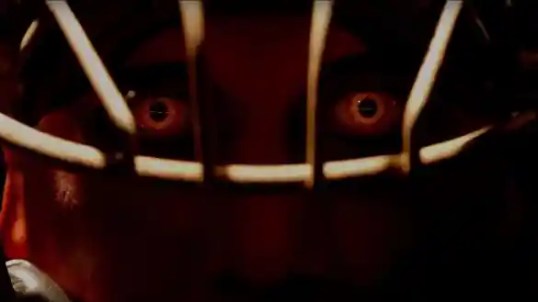
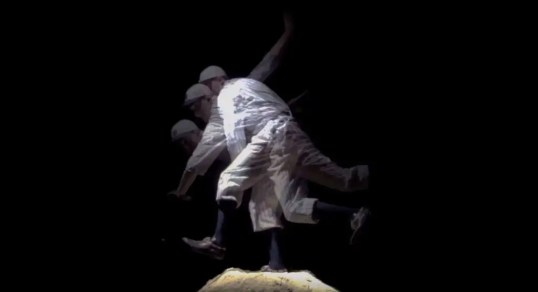
The Beaning argues that baseball was based on Masonic rituals and that the owners of the Yankees made a deal with the dark forces to make their team a success. If you don’t like the Yankees, you’ll enjoy this documentary. The documentary has plenty of archival footage and the recreation of the actual beaning is pretty creepy. The catcher’s eyes even glow red. For the record, I don’t think the Yankees sold their soul to the Devil but you should never underestimate was a team will do to make it to the postseason. Who needs to make a deal with the Devil when you can just join the Astros?
Hi there and welcome to October! This is our favorite time of the year here at the Shattered Lens because October is horror month. For the past three years, we have celebrated every October by reviewing and showing some of our favorite horror movies, shows, books, and music. That’s a tradition that I’m looking forward to helping to continue this year.
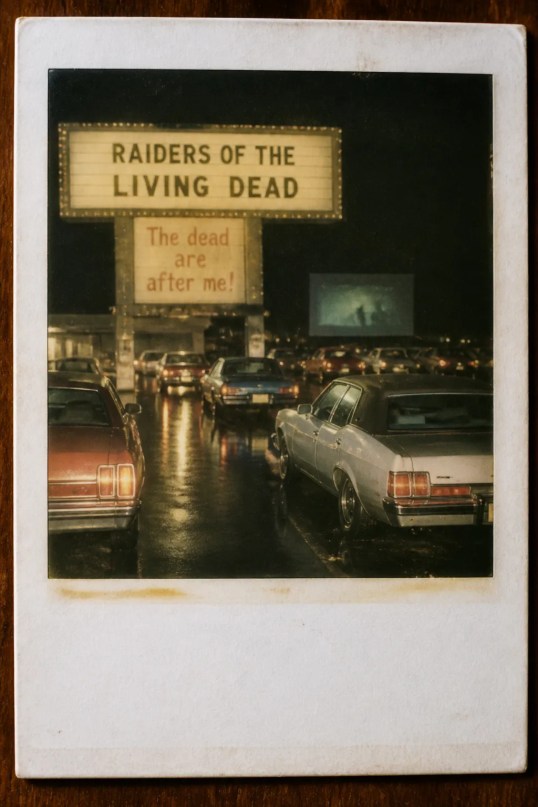
Today, we’ve got the 1986 zombie/sci-fi/action epic, Raiders of the Living Dead!
It’s the story of a creepy boy, a laser gun, a reporter, and a bunch of zombies. There’s a mad scientist involved, too. There always is. The movie opens with a truck being hijacked and then the action shifts to a power plant and, honestly, I have no idea what any of it means. If nothing else, it’s a film that you watch and you can’t help but admire the fact that it somehow got made and went on to find a small but kind of appreciative cult audience. It’s just a very strange film and one that simply most be watched in October.