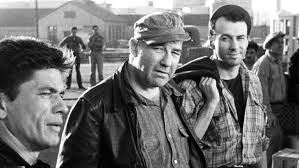
Brad takes on THE MOB (1951), starring Broderick Crawford!


In my quest to see every movie and TV show that Charles Bronson ever appeared in, I finally decided to take on THE MOB this morning. I’ve held off for years because this early, uncredited role as a dockworker only gives Bronson a couple of lines. He looks like a natural fixture on the docks, but his screen time only adds up to a minute or two in total.

With Bronson being little more than some temporary dockside scenery, I settled in for a story about Johnny Damico (Broderick Crawford), a tough, no-nonsense cop who’s doing some rainy night ring-shopping for his girlfriend when a man is killed just outside the store. He bungles up the whole situation, and the killer gets away. It turns out the killing was a mob hit and soon Damico is going undercover as Tim Flynn from New Orleans so he can infiltrate and bust the organized crime ring operating on the waterfront. 

Broderick Crawford is so good in this role. His Damico / Flynn has a cynical sense of humor that I enjoyed. He thinks fast, he’s rough around the edges, and he even gets to slap some bad guys around a time or two. He’s one of those characters whose mouth should probably get him in more trouble. Well, now that I think about it, his mouth does almost get him killed a couple of times. Crawford and Bronson would work again together a few years later in the prison film BIG HOUSE USA (1955). 

With Crawford’s performance anchoring the movie, Director Robert Parrish delivers a tight, efficient and entertaining crime story that clocks in at just under an hour and a half. One of the things that made the film enjoyable for me is the interesting and recognizable supporting cast of actors who pop up throughout the film. I’ve already mentioned Bronson, but actors like Ernest Borgnine, Neville Brand and Frank DeKova all show up to torment our undercover cop at various points throughout the film. It’s always fun for me to see a cast full of familiar faces! 

At the end of the day, I enjoyed THE MOB. It doesn’t try to be anything more than a good crime film, and with Broderick Crawford’s excellent performance, it does its job well. 
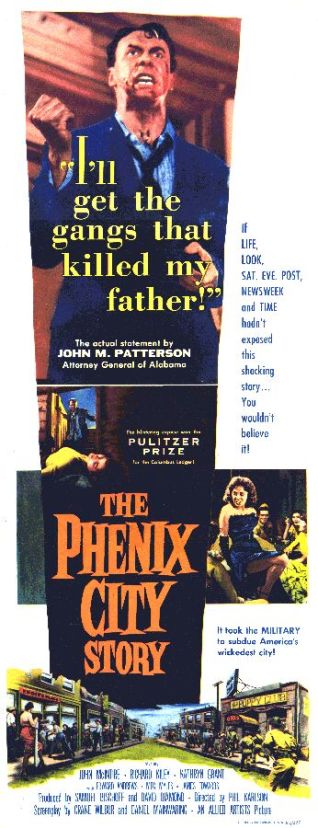
Shattered Politics #11: The Phenix City Story (dir by Phil Karlson)


PhenixCityPoster

If A Man Called Peter was the epitome of a stereotypical 1950s film, The Phenix City Story is the exact opposite.  Like A Man Called Peter, The Phenix City Story was released in 1955.  And like A Man Called Peter, The Phenix City Story is based on a true story.  However, beyond that, A Man Called Peter and The Phenix City Story might as well have been taking place on different planets.

And, in many ways, they were.  The Phenix City Story not only takes place in Phenix City, Alabama but it was filmed there as well and featured a few actual citizens in the cast.  Not only was The Phenix City Story telling a true story but the story was being told by some of the same people who actually lived through it.  That makes The Phenix City Story brutally realistic, with brutal being the key word.

And, just in case we have any doubt about the film’s authenticity, it actually opens with a 15 minute documentary in which Clete Roberts (who was an actual news reporter) interviews several citizens of the town.  All of them, speaking in thick Alabama accents and nervously eyeing the camera, assure us that what we are about to see is true.  Quite a few of them also tells us that they still live in fear of losing their lives as a result of everything that happened.

What’s amazing is that, once the actual film does get started, it manages to live up to all of that build up.  The Phenix City Story is a shocking film that remains powerful even 60 years after it was initially released.

As the film opens, we’re informed that Phenix City, Alabama is home to some of the most dangerous and violent criminals in the state.  From his club, crime boss Rhett Tanner (Edward Andrews) runs a shadowy organization that not only controls Phenix City but the entire state of Alabama as well.  The police ignore his crimes.  The majority of the town’s citizens are too scared to stand up to him.  When a returning veteran of the Korean War, John Patterson (Richard Kiley), tries to stand up to Tanner, the result is even more violence.  A young black girl is kidnapped and murdered, her body tossed on John’s front lawn as a warning.  John’s best friend is killed but Tanner uses his influence to have the death ruled accidental.

Finally, John and a group of other reformers convince John’s father — Albert Patterson (John McIntire) — to run for Attorney General.  Albert runs on a reform platform and exposes both the corruption of Phenix City and how Tanner’s power extends through the rest of the state as well.  When Albert wins the Democratic primary, he’s gunned down in the street and it’s up to John to avenge his death…

To say that The Phenix City Story is intense would be an understatement.  As directed by Phil Karlson, there’s not a single frame of The Phenix City Story that’s not full of menace and danger.  The stark black-and-white cinematography is full of shadows and the camera moves almost frantically from scene to scene, occasionally catching glimpses of dark figures committing acts of violence and cars speeding away from who knows what outage.  It’s a dark film but, ultimately, it’s also a hopeful one.  It suggests that evil will triumph when good men do nothing but that sometimes you can depend on good men — like Albert and John Patterson — to actually step up.

The Phenix City Story shows up on TCM occasionally and you should keep an eye out for it.  It’s one of the best B-movies ever made.