I actually thought that I reviewed “Backrooms” already, but I had not. However, since it is October, it’s a perfect time to review this …. story. The fanbase is Star Wars-level obsessive and just because I don’t particularly care for something, it doesn’t mean it’s terrible- it usually does, but maybe this time is different. I can’t be correct – all the time…. or can I?
This film started as a 4chan post that went viral and the writer/director Kane Parsons built his life around this 4chan post. Then, he went all found footage on its ass. From the age of sixteen to twenty, his entire life was devoted to this magical world that looks a lot like a cubicle farm without the cubicles. The backrooms is a place where you expect to see sad data entry professionals working in sweatshop conditions. Maybe the backrooms is really just a front for an H1-B scam? Whenever a person enters the backrooms, all the workers are gone; so, maybe they used the backrooms as a means to move around their illegal data entry group and things got out of hand, creating a H1-B multiverse?
The film’s quantum mechanics are very intricate, but the movie itself has a very thin plot like saran wrap thin. Backrooms is 95% lore and the plot exists just to have more scenes wandering around the backrooms. Clark is the vehicle we use to get into the backrooms; he is the protagonist – sort of. He is an abusive alcoholic and failed architect who likely killed his wife. He also runs a furniture store and has employees who hate him, but that’s pretty normal for Clark because Clark is an asshat. In fact, his asshattery is so well-developed that even his therapist thinks he’s a boring jerk.
During one of his self-loathing sessions, Clark goes to his store’s basement and tries to do some electricity maintenance and he falls through a portal in his wall to …. wait for it…the backrooms! They basically look like the same room that he was in, but crappier and there are infinite backroom dimensions and quasi-fake people who you can eat- if you want. Apparently, it is okay to go Dahmer on these freaky people because they are “still lifes” – copies of copies of the earth prime people- I think.
He tells his therapist about the backrooms and she checks them out and nearly dies. I would have avoided this adventure and I would’ve been just fine. Clark, unlike me, becomes obsessed with the backrooms, gets his employees to explore them with him, and all the employees die because of a monster or because Clark eats them. Yes, Clark is a quasi-cannibal or a full-on cannibal or he is long pig curious. Don’t worry, Clark is stopped because he gets eaten by a paper mache version of himself. I always knew that arts and crafts were the devil’s workshop.
You could say that the backrooms are a Clark eat Clark world….
If you want to understand the backrooms, be prepared to have A LOT of homework like D&D dungeon master levels of homework!
“Hell House doesn’t mind a guest or two. What it doesn’t like is people who come snooping around.” — Benjamin Franklin Fischer
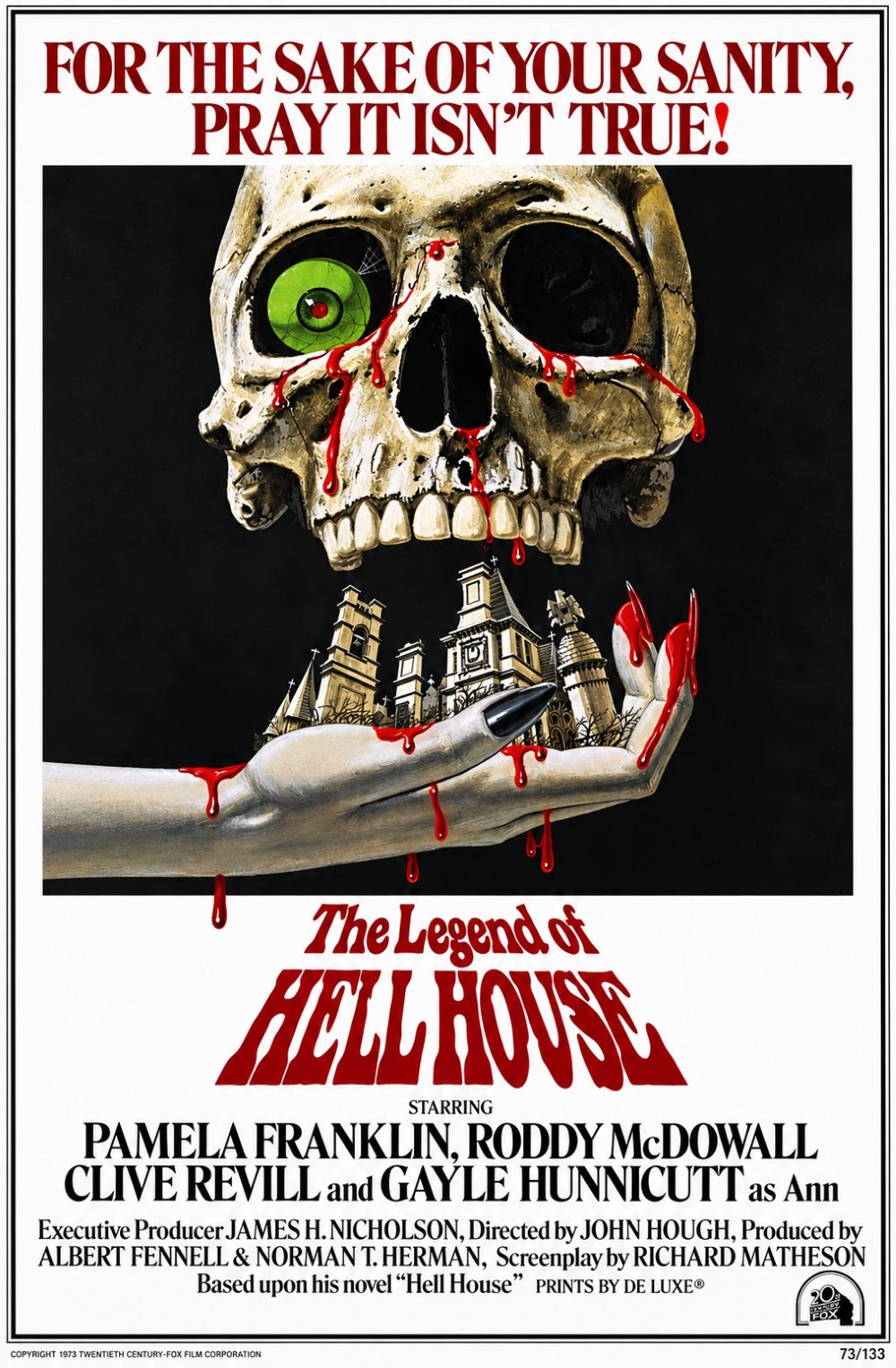
There is something deeply unpleasant about The Legend of Hell House, and that is exactly what makes it so effective. Directed by John Hough and adapted by Richard Matheson from his own 1971 novel Hell House, the film takes a fairly simple haunted-mansion premise and turns it into something mean, claustrophobic, and surprisingly adult. It is not the most visually elaborate ghost story ever made, nor the most frightening in a conventional jump-scare sense, but it has a cold, nasty atmosphere that lingers. This is a haunted-house movie where the house does not just contain evil; it seems designed to degrade everyone who steps inside.
The setup is strong because it puts several opposing viewpoints under the same roof. A wealthy man hires physicist Dr. Lionel Barrett, played by Clive Revill, to investigate the notorious Belasco House and settle the question of whether life after death exists. Barrett brings along his wife Ann, played by Gayle Hunnicutt, and the couple joins two people with far more personal connections to the place: Florence Tanner, a deeply spiritual medium played by Pamela Franklin, and Benjamin Franklin Fischer, played by Roddy McDowall, the sole survivor of an earlier investigation. The job has a deadline, a large payday, and an obvious catch: every previous expedition into the house ended in death, insanity, or both.
It is the kind of premise that could have easily become an old-fashioned “wait for the next victim” thriller, but Matheson’s script gives it more bite than that. Every character arrives with a different theory of the supernatural, and those theories become personal weapons. Barrett is the hard-line rationalist, convinced that any haunting can be explained through physical energy. Florence believes in trapped souls and approaches the house with a nearly religious determination. Fischer knows better than anyone that Belasco House does not care what people believe, while Ann becomes the emotional pressure point between all those men and their supposedly superior ideas. The ghost story works because the haunting pushes directly on each character’s vulnerabilities instead of merely making lights flicker and doors slam.
Clive Revill makes Barrett an interesting kind of horror-movie skeptic. He is not simply smug or foolish, although he can be both. He has the conviction of a man who thinks he is on the verge of solving the biggest mystery in human history with engineering equipment and enough confidence. That makes him a perfect target. Revill plays the character with a blunt, almost comically forceful seriousness that fits the film’s style. Barrett is a man who keeps insisting that the house is a machine, even as it starts treating him like a piece of disposable machinery.
Roddy McDowall is arguably the film’s secret weapon. Fischer could have been a standard nervous survivor whose only job is to warn the newcomers not to go into the basement. Instead, McDowall gives him a sly, guarded, intermittently hostile energy. He knows the house, he has seen what it does, and he has built a personality around refusing to be emotionally open about any of it. His sunglasses, dry delivery, and generally strange behavior make Fischer seem a little ridiculous at first, but that awkwardness becomes part of the performance’s appeal. By the time the film gets into the mystery of Emeric Belasco, the wealthy sadist who once ruled the estate, Fischer’s trauma feels like the one thing in the movie that cannot be explained away by a machine.
Pamela Franklin is also excellent as Florence Tanner, particularly because the film lets her be forceful rather than purely fragile. Florence is sympathetic, but she is not passive. She believes in her gifts enough to challenge Barrett head-on, and her desire to help the lost spirits of Hell House gives the story some genuine emotional stakes. The movie can be pretty ruthless with her, especially in the way it explores sexual humiliation, possession, and psychic assault, but Franklin never plays Florence as merely victimized. Her scenes with McDowall have an uneasy charge because they represent two different forms of faith: Florence sees the dead as people worth saving, while Fischer treats the dead as weapons that must be avoided.
That unpleasant streak is really what separates The Legend of Hell House from a lot of cleaner, more comforting haunted-house films. The Belasco House is not merely spooky; it is aggressively cruel, with a history rooted in sexual degradation, murder, and the grotesque whims of its former owner. Matheson’s novel was more explicit than the movie, and the screenplay softens some of its more graphic sexual and violent material. Even so, the film remains unusually frank for a mainstream early-1970s supernatural thriller. Its horror is not just that ghosts exist. It is that a dead man’s perversions can keep poisoning the living decades later.
John Hough handles all this with a remarkably physical visual style. The camera prowls through corridors, peers around corners, tilts at unnerving angles, and uses wide lenses to make the mansion feel warped and hostile. The movie’s low, wide-angle shots give the characters an exposed, trapped quality, as if the building is staring down at them. The direction is not subtle in the same manner as Robert Wise’s The Haunting, but that is not a flaw. Hough makes Hell House feel less like an unknowable mystery and more like a spiritual pressure cooker.
The film does have limitations. Its effects are sometimes modest, and a few of its shock moments are more abrupt than scary. The climax gives the haunting a concrete answer, which makes the story’s blend of supernatural Gothic horror and strange pseudo-scientific logic feel even more pulpy and distinctive. It may not carry the elusive ambiguity of The Haunting, but The Legend of Hell House is not trying to be that kind of ghost story. It wants the audience to feel trapped in a hostile space with people whose certainty, fear, and private weaknesses are being exposed one ugly piece at a time. Even when its mechanics are a little dated, that sense of contamination remains powerful.
It also benefits from being lean. At around 90 minutes, The Legend of Hell House wastes little time building out the haunted-house situation, escalating the attacks, and forcing its investigators to choose between their competing explanations. That economy makes it feel more vicious than many later possession or paranormal movies that inflate a similar premise into two-hour lore marathons. There is no elaborate mythology to memorize. There is a bad house, a horrible dead man, four damaged people, and a deadline. That is enough.
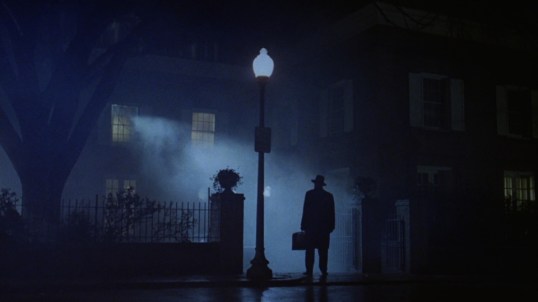
As for influence, the film has clear roots in The Haunting and Henry James-style psychological ghost stories, but it also left traces of its own. Its combination of paranormal investigation, supposedly scientific equipment, skeptical experts, psychic mediums, and a house that manipulates people’s sexuality and emotional weaknesses can be felt in many later haunted-house stories. The direct influence is most explicitly documented in Edgar Wright’s fake trailer Don’t, made for Grindhouse: Wright and Simon Pegg riffed on Hell House’s fog-shrouded mansion imagery and echoed Roddy McDowall’s distinctive 1970s look. It also features one of the earlier cinematic depictions of sexual assault by an unseen supernatural force, a disturbing concept later revisited much more brutally in The Entity.
It would be a stretch to claim that every modern “ghost hunters enter a cursed house” movie comes directly from The Legend of Hell House, but its DNA is easy to spot. The procedural side of paranormal investigation, the conflict between technical explanation and spiritual belief, and the sense that a house preserves human evil like an infection all became familiar horror tools. Its visual atmosphere has also invited comparisons to The Shining, especially in its use of ominous spatial compositions and its fixation on the house’s ability to reshape the mental state of its occupants. The connection should not be overstated—Stanley Kubrick’s film is its own colossal thing—but they are clearly kindred haunted-house nightmares.
Ultimately, The Legend of Hell House is a rougher, nastier, more aggressively lurid cousin to The Haunting. It does not have that earlier film’s sublime ambiguity, but it has its own grimy personality: a mixture of British Gothic atmosphere, American genre bluntness, psychic melodrama, and just enough 1970s sleaze to make the mansion feel truly diseased. It is best approached not as a polished prestige classic, but as a smart, compact supernatural shocker with a nasty sense of humor and an unusually strong cast. Hell House may not be the most famous haunted mansion in horror, but once you have spent an hour and a half inside it, you can understand why nobody should want to go back.
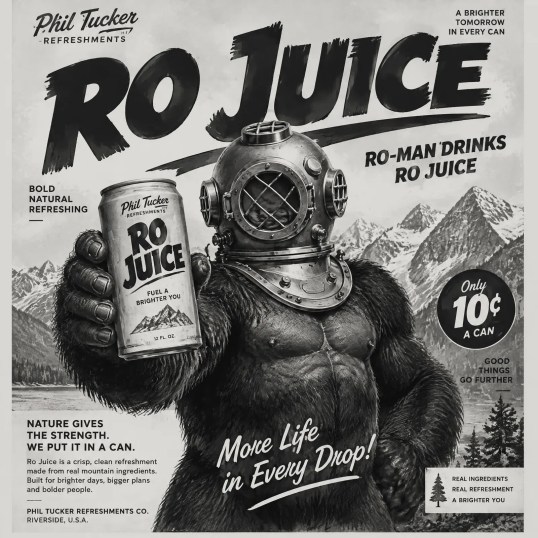
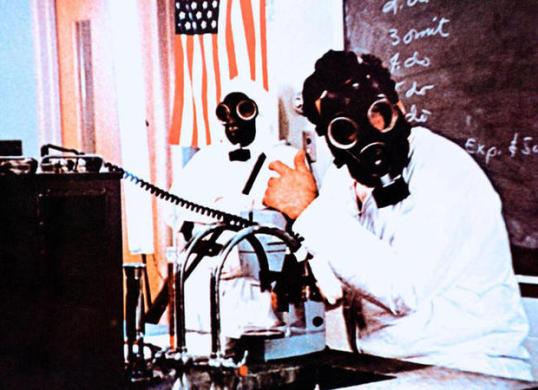
In this 1953 film, a gorilla wearing a diving helmet uses the Calcinator Death Ray to wipe out almost all human life on Earth. Only 8 people survive, among them a professor, his family, and Roy (future Eurospy star, George Nader). Ro-Man (George Barrows) is hounded by his superior to track down and destroy the survivors. Ro-Man does his best, though the humans prove to be …. well, they’re not really that resourceful. In fact, they’re pretty dumb. But Ro-Man is pretty dumb himself.
Regularly (and incorrectly) cited as being one of the worst films ever made, RobotMonster is an enjoyably absurd hybrid of horror and science fiction. Earth is destroyed through a combination of bad lighting effects and stock footage and the arguments between Ro-Man and his superior have to be heard to be believed. RobotMonster is actually a bit more self-aware than a lot of people realize. This is a low-budget Z-movie that realizes that it’s a low-budget Z-movie and which cheerfully embraces its identity. RobotMonster is a personal favorite and it’s a bit of Halloween tradition around these parts.
And now, enjoy RobotMonster in all of its black-and-white glory!
Today’s horror song of the day comes from the 1979 film, Beyond The Darkness.
This film’s theme song, courtesy of Goblin, was so acclaimed that it later turned up in several other Italian horror film, usually without anyone bothering to credit Goblin. In this video below, it’s performed by the members of Goblin Reborn, who should not be confused with the members of Claudio Simonetti’s Goblin or Goblin Legacy.
(I swear, the members of prog rock bands are almost as difficult to keep track of as the minor members of European royalty.)
As for the image behind the band, that is Cinzia Monreale, who played two roles in Beyond The Darkness.
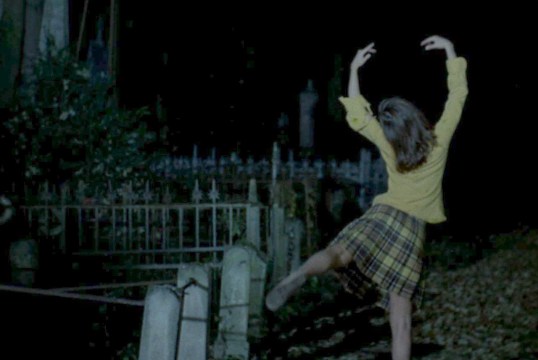
From 1958’s Attack of the 50 Foot Woman, Harry discovers that cheaters never get away with it. Especially when they’re cheating on someone who is 50 feet tell….
4 Or More Shots From 4 Or More Films is just what it says it is, 4 shots from 4 of our favorite films. As opposed to the reviews and recaps that we usually post, 4 Shots From 4 Films lets the visuals do the talking!
“Well hello, Mister Fancypants. Well, I’ve got news for you, pal: you ain’t leadin’ but two things right now: Jack and shit… and Jack just left town.” — Ash Williams
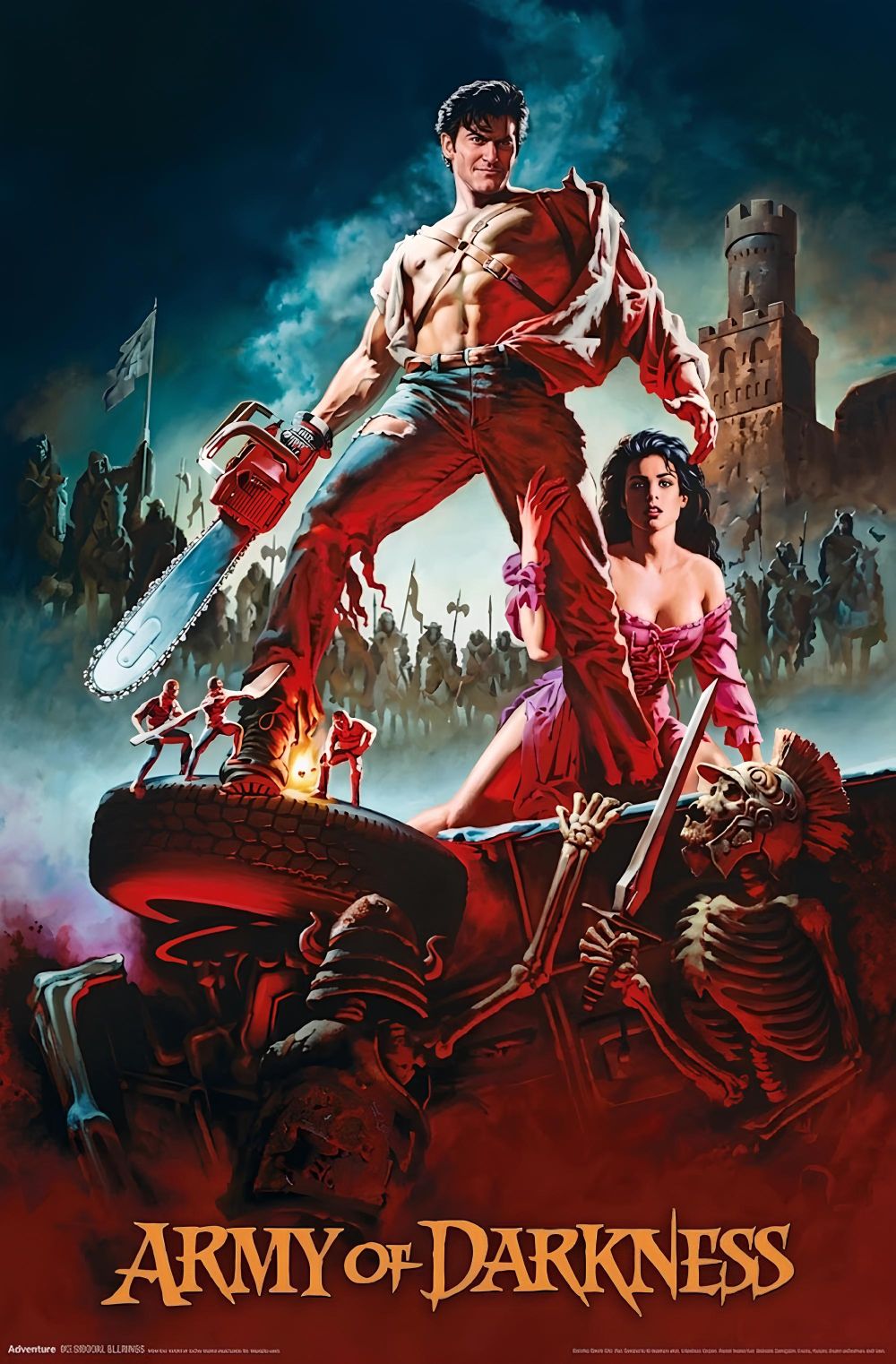
Few cult movies embrace their own insanity as joyfully as Sam Raimi’s Army of Darkness. Directed by Raimi and released in 1992, the third chapter in the Evil Dead series takes Ash Williams out of the isolated-cabin horror setting of The Evil Dead and Evil Dead II and drops him into a sword-and-sorcery adventure full of skeleton armies, haunted forests, miniature doppelgängers, exploding Deadites, and more quotable one-liners than most action comedies manage in an entire franchise. It is still technically a horror movie, but calling it just a horror movie misses the point. This is a slapstick fantasy-action comedy with monsters, and its ridiculousness is exactly why it has endured as a cult favorite.
The story picks up almost immediately after the end of Evil Dead II, with Ash getting sucked through a portal and landing in medieval England. Rather than being welcomed as some prophesied savior, he is immediately treated like a suspicious outsider and thrown into a pit with a Deadite. That opening alone tells you what kind of movie this will be. Ash is no longer simply a terrified everyman trying to survive an impossible nightmare. He is now a chainsaw-handed loudmouth who shoots first, insults everyone around him, and somehow carries himself like the greatest warrior in history despite constantly making situations worse through his own arrogance.
Bruce Campbell is the entire engine of Army of Darkness. Ash has become a full-blown cartoon hero by this point, halfway between a B-movie John Wayne, a professional wrestler cutting a promo, and a smug department-store employee who has somehow convinced himself he is a legendary warrior. Campbell plays the role with total commitment, which is the key to why the comedy works. He never acts embarrassed by the dialogue or tries to make Ash seem cooler than he is. The character is funny because he is deeply incompetent beneath all the bravado. Ash talks like a conquering hero, but his victories usually involve panic, luck, explosives, and a lot of property damage.
The familiar “Groovy” attitude from Evil Dead II gets pushed even further here. Ash is not meant to be a noble fantasy protagonist. He is selfish, crude, lazy, and usually more interested in returning to modern life than helping the people trapped in a medieval war. That makes him a funny fit for the genre. In a normal fantasy film, the chosen hero would humbly accept his destiny, train with a sword, and unite the kingdoms. Ash complains about the inconvenience, makes demands, insults the locals, and uses his knowledge of basic mechanics to become a magical figure in their eyes. His improvised metal hand, shotgun, chainsaw, and homemade weapons make him look like a mad scientist dropped into an old Ray Harryhausen movie.
Raimi’s direction is as energetic as ever, even if Army of Darkness is noticeably cleaner and more studio-sized than the first two films. The early Evil Dead movies had a grimy, do-it-yourself quality that made their horror feel unusually mean and immediate. This one has a broader, more polished adventure-movie look. There are castles, battlefields, elaborate costumes, large-scale miniature work, and a full army of stop-motion skeletons. It is still cheap-looking in places, but that is part of its charm. The effects do not need to be seamless because the movie’s entire personality is built around heightened artifice. When skeletons leap around in exaggerated stop-motion or a tiny Ash attacks the full-sized Ash in a windmill, the film feels like a live-action cartoon with blood, dirt, and medieval armor.
The windmill sequence is probably the purest expression of what makes the movie special. Ash enters a windmill to escape danger and ends up trapped with miniature versions of himself, eventually swallowing one by accident. It has almost nothing to do with the larger plot in any serious sense, yet it is hilarious because Raimi keeps escalating the gag. Instead of treating the tiny Ash as a brief visual joke, the movie turns him into a recurring problem that literally grows into Evil Ash, Ash’s undead double and the leader of the titular army. That progression makes perfect cartoon logic: a small annoyance becomes a full-scale apocalypse because Ash was too careless to deal with it properly.
The horror elements are lighter than they were in the first two films, and that will probably be the biggest dividing line for viewers. Anyone expecting the nasty isolation, body horror, and relentless dread of The Evil Dead may be surprised by how openly silly this installment is. The Deadites are still grotesque enough to keep the supernatural threat alive, especially in the opening pit fight and the later siege, but they are no longer as frightening as they are funny. Raimi is much more interested in visual gags, wild camera movement, and action-movie momentum than scares.
That tonal change does not make Army of Darkness a lesser movie; it just makes it a very different one. In fact, it may be the most accessible entry in the original trilogy for people who do not normally enjoy horror. You can watch it without being especially invested in the mythology, because the plot is basically a delivery system for set pieces. Ash needs the Necronomicon to get home. He says the magic words wrong. Evil Ash rises. A skeleton army attacks. Ash helps defend the castle. The movie keeps moving, rarely pauses to explain itself, and never tries to make its fantasy world feel more serious than necessary.
The final battle is a great example of Raimi getting the maximum entertainment out of a relatively limited toolbox. Ash turns medieval villagers into a makeshift modern army, complete with explosives, contraptions, and a vehicle that feels hilariously out of place in the period setting. The action is messy, noisy, and deliberately overblown, with exploding skeletons and clashing armies staged more like a rowdy theme-park spectacle than a conventional epic. Raimi understands that the point is not realism. The point is seeing Ash yell at an undead army while wielding a chainsaw and acting like he personally invented warfare.
The movie’s dialogue is another major reason it remains so beloved. “This is my boomstick” has become the obvious classic, but Army of Darkness is packed with lines that sound like they were designed to be repeated by friends after midnight screenings. Campbell’s delivery turns even the dumbest insult into something memorable. The movie knows Ash is absurd, but it also understands that he needs to be just cool enough for the audience to enjoy watching him survive. He is a lovable jerk because he is never actually in control for long. The universe keeps humiliating him, and Campbell makes every humiliation feel like another opportunity for a louder comeback.
Army of Darkness is not the scariest Evil Dead movie, the most atmospheric, or even necessarily the best constructed. It is uneven, shamelessly goofy, and occasionally held together by pure momentum. But it has a distinct personality that most franchise sequels would kill for. Raimi and Campbell take a low-budget horror premise and stretch it into a medieval monster comedy without losing the series’ manic spirit. It feels handmade even when it is big, silly even when it is violent, and weirdly triumphant despite Ash being one of the least heroic heroes in fantasy cinema. For fans of practical effects, stop-motion creatures, quotable cult movies, and Sam Raimi operating with absolutely no interest in restraint, Army of Darkness remains a blast.
Over the past decade, Cancel Culture was has gone though an interesting evolution. Whether or not its exists often seems to depend on who you ask or whether or not they feel that they’re the ones getting canceled.
Before 2016, it was agreed that Cancel Culture was real but it was viewed as largely being an internet meme. On Twitter, people would announce that “so-and-so is canceled” because that person had failed to mouth the right political platitudes or they were friends with someone else who had been canceled. Cancel Culture was around but few took it seriously because the main advocates were anonymous social media users who spent way too much time obsessing on Glee.
During the 2016 election and the year 2017, the Right claimed that the Left was trying to cancel anyone who voted Republican. This led to the Left declaring that Cancel Culture was a myth and that the Right was just being whiny.
In 2018, when Al Franken resigned from the Senate, the Left briefly decided that Cancel Culture was real and it was a bad thing if it led to someone that they liked getting in trouble. Once the Right started calling them out on this, the Left went back to saying that Cancel Culture was a myth but it was still bad in that it caused Al Franken to have resigned. And that’s why Kirsten Gillibrand will never be President.
In 2020, the Left decided that Cancel Culture was fine as long as the only people being canceled were people who didn’t wear masks or who had doubts about the lockdowns. However, at the same time, it was also decided that anyone who lost a job opportunity due to Cancel Culture would have lost that opportunity anyway because of …. reasons. It doesn’t matter if, like Gina Carano, you were one of the most popular actors on a show that was, for the moment, capturing the pop culture zeitgeist. The message seemed to be, “Yes, we’re cancelling people but it’s not anybody truly important so what do you care?”
Then, from 2022 to roughly 2026, the mainstream once again decided that Cancel Culture didn’t actually exist, except for when people like Eric Swalwell and Graham Platner were the ones getting canceled and that it was hypocritical of those who were previously canceled for tweeting a joke to take any joy over people being canceled for sexual assault.
In other words, Cancel Culture doesn’t exist except for when it does and hey, why do you care? Are you looking to get canceled?
As you can probably guess from the title, 2024’s Cancel Me Not is a film about Cancel Culture. Actor Chase Murray (Eddie McClintock) is accused of sexual harassment and assault by an actor who just wants to further their career. Chase is acquitted by a jury of his peers but after spending a year being relentless attacked online, he’s not ready to return to the spotlight. He travels to Florida, where he finds himself staying next door to Heather Campbell (Jana Lee Hamilton), who has just left her husband. Heather’s daughter, Emma (Arabella Weaver), is attending a college where the dean refers to the students as being his “children.” When Emma is harassed for being a Christian, it looks like it’s time for Chase to go to the school and give a speech at an assembly.
Cancel Me Not is another low-budget, faith-based film from Jason Campbell. On a technical level, the sound recording is often muddy and, despite only running for a little over an hour, it still feels a bit overlong. On the plus side, while it’s not a film that’s likely to change anyone’s mind about Cancel Culture, it is a film that is specifically designed to annoy those who claim that it doesn’t exist. It’s a “let’s tick off the other side” film and, when it works, it’s in a “Oh, I can’t wait to trick my Bernie-loving, DSA cousin into sitting through this” sort of way. There’s nothing subtle about it but it’s entertaining as long as you already agree with the film’s conclusions.
There are certain films that have scenes that make you laugh even though you really shouldn’t. When I finally got around to watching 2017’s The Bye Bye Man earlier this year, there was one scene that almost caused me to fall off my couch from excessive giggling.
It really shouldn’t have made me laugh, but I couldn’t help it. It’s hard for me to explain what was so funny about it, but I’ll try. One of the film’s characters is standing in the middle of some train tracks. A train is rapidly approaching. Yikes! Nothing funny about that. The character does not move. She fully intends to get struck by the train. We get a close-up of the character on the tracks, and then we get a close-up of the train’s engineer suddenly realizing that she’s standing in front of his train.
“NO!” he says.
It’s the “No!” that gets me. He doesn’t yell, “Get out of the way!” He doesn’t yell, “STOP THE TRAIN!” In fact, as far as I can tell, he doesn’t even try to stop the train, and seeing as how he’s the engineer, one would think that would be something he would know how to do. Instead, he sees her and he goes, “NO!” When he says it, he uses the same tone of voice that I use when I’m telling a cat not to sharpen its claws on the furniture. He’s not saying, “No, this can’t be happening!” He’s not saying, “Oh God, NO!” Instead, he’s saying, “No, don’t you stand on those tracks!” It’s such a fake and awkward moment that I couldn’t help but laugh. Later, I couldn’t help but wonder why no one was willing to say, “Well, let’s just leave that NO! on the cutting room floor. It’s not like it really adds anything to the film.”
That’s the type of film that The Bye Bye Man is. It’s inept in almost every way, from the acting to the script to the editing to …. well, everything. It’s a film that was obviously meant to launch a franchise. The Bye Bye Man was meant to be the type of evil presence who would haunt the nightmares of a generation of filmgoers. If you don’t want The Bye Bye Man to come after you, all you have to do is not say or think his name. But as soon as you see that name, that’s all you can think about. He’s kind of like Candyman, just without any sort of subtext. One has to wonder how he ended up with a name like Bye Bye Man. Maybe it’s explained in the film and I was too busy laughing at that awkward “NO!” to notice. It’s entirely possible.
I may have also been busy wondering what Faye Dunaway was doing in this film. She only has a small role. It’s really more of a glorified cameo than anything else. She plays the widow of a reporter who, years earlier, discovered the existence of The Bye Bye Man. This film came out a month or so before Dunaway and Warren Beatty accidentally gave the Best Picture Oscar to the wrong film at the 89th Annual Academy Awards. I’d like to think that was her getting revenge on Hollywood for not giving her better roles.
The Bye Bye Man did not lead to a franchise, which is a shame. I would pay money to see the future adventures of that engineer.
First released in 1998, Vampire Time Travelers is not an easy film to describe.
The film opens with a title crawl that informs us that, years ago, a vampire stalked the members of a sorority but fortunately, the vampire was defeated. In fact, vampire Lorelei (Jillien Weisz) was forced into a coffin. A cross was put on the coffin, trapping her there. This was all apparently engineered by her sister, Natalia, who is never fully seen but who is often heard. In the five years between Lorelei getting put in the coffin and the rest of the film, Natalia is killed by a sorority girl named …. wait for it …. Buffy. Now, Buffy’s younger sister, Susan Ann Marie (J.J. Rodgers), is pledging to the same sorority and Natalia’s spirt wants revenge. A man in a hood whispers to two kids that there’s copies of “Pet House” stashed in the coffin. (Both boys look directly at the camera as a guitar riff plays on the soundtrack.) The boy remove the cross and Lorelei is set free.
Sam — as Susan Ann Marie prefers to be called — is attending a sorority initiation at a professor’s house. Also at the initiation is bitchy Vaughn (Lynne Baker), former tennis star Heidi (Ali Elk), surprisingly tall Jenna (Micky Roth), and aspiring rock star Zoe (Kat Facchino). Natalia attempts to bite Sam’s neck while she’s sleeping but it turns out that she’s not strong enough. She has to drink the blood of the other sorority sisters first. But since she can’t find the strength to pierce anyone neck, she has to bite a different location. “Bite her in the butt!” a bearded man says. “Ewww, gross!” Lorelei says. I agree!
Lorelei is not the only monster lurking in this film. There’s also the Man Who Lives In The Closet (JC Grigg), who represents the childhood fear of something hiding in the …. well, the closet. And then there’s The Man Who Won’t Call Back (played by the film’s director, Les Sekely), who haunts Zoe’s nightmares. While Lorelei is forced to undergo remedial vampire training, Zoe bonds with The Man Who Lives In The Closet and Heidi seeks revenge against those who she blames for ending her tennis career.
Got all that?
There’s a lot going on in this 69-minute film and none of it is meant to be taken seriously. Vampire Time Travelers is a SOV horror film that cheerfully sends up all of the cliches that one associates with SOV filmmaking. The acting is intentionally over-the-top. The dialogue is full of deliberately bad puns. The plot is so twisty that it’s impossible to follow. Usually, all of this would be a problem but, in this film, the incoherence is the point. It’s not supposed to make sense. Instead, the film is about tossing out one joke after another and seeing how many of them work. For every joke that falls flat, there’s one that works wonderfully. I laughed a lot more than I thought I would. This movie may be crude but it’s also surprisingly clever.
Vampire Time Travelers is an effective SOV mix of horror and comedy. It took me totally by surprise.