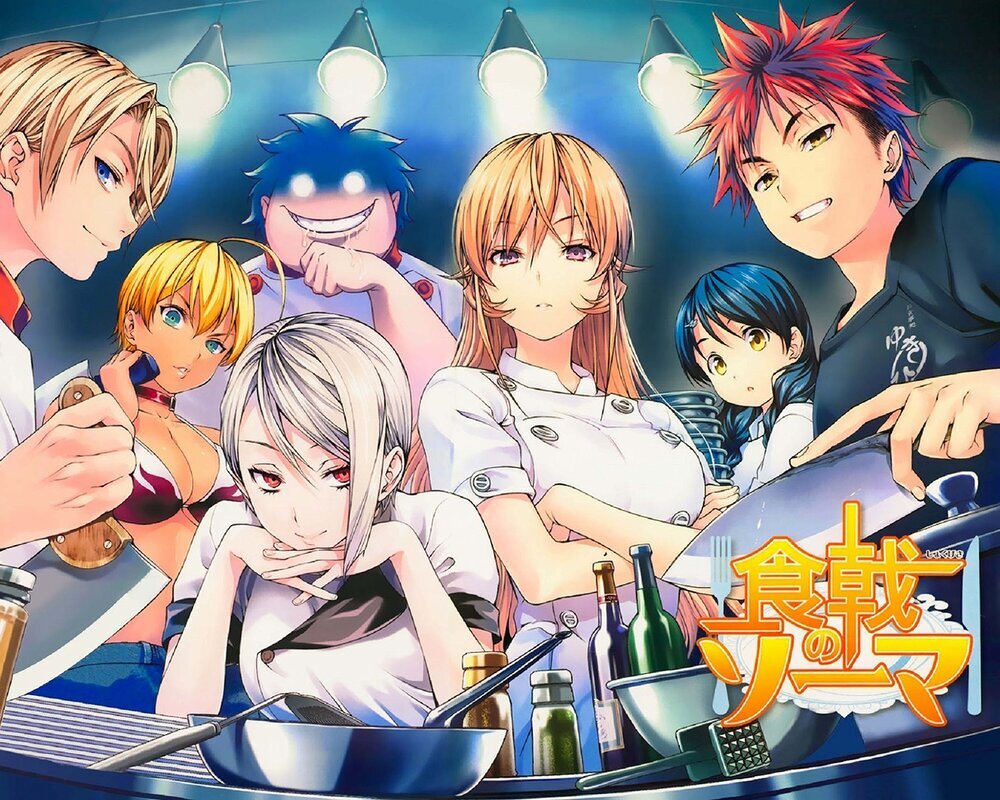
Food Wars is one of those anime that feels like it should be ridiculous on paper, but somehow turns that absurdity into part of its charm. Across its five seasons, it blends intense cooking battles, over-the-top reactions, and shameless fan service into a series that is equal parts culinary hype machine and anime guilty pleasure.
What makes Food Wars stand out right away is how seriously it treats food while never taking itself too seriously as a show. The cooking scenes are loaded with detail, and the anime clearly loves showing off the textures, colors, and techniques behind every dish. Even when the plot gets wild, the series keeps circling back to a genuine appreciation for cooking, competition, and creativity, which gives it more heart than you might expect from an anime known for clothes literally exploding off people after a good bite.
Anyone who has grown up watching the high-octane drama of Iron Chef—whether the original Japanese production or the iconic American version on The Food Network—will feel right at home with the structure of this show. Much like those classic programs, Food Wars relies on a foundation of thematic ingredient requirements, ticking clocks, and an intense panel of judges waiting to dissect every flavor. The “Shokugeki” battles, or culinary duels, capture that same competitive spirit where a single secret ingredient or a daring last-minute pivot can be the difference between legendary status and total failure.
One of the most defining aspects of the series is how it effectively gamifies the entire culinary experience, turning every kitchen session into a high-stakes arena. The show treats cooking like a complex strategy game where each ingredient choice acts as a tactical move and every technique serves as a power-up. This framing forces the audience to view food not just as sustenance, but as a weapon or a defense, making the act of creation feel as tense and strategic as a combat sequence in any traditional action series.
This competitive spirit extends directly into the tasting sequences, which are arguably the most iconic parts of the entire five-season run. When a judge takes a bite, the show transforms the experience into a sensory battleground where the flavors represent different forces, emotions, or even elemental powers that clash on the palate. By turning flavor profiles into visual and psychological challenges, the show ensures that tasting isn’t just about appreciation—it is a judgment call that defines the character’s growth, pride, and survival in the cutthroat atmosphere of Totsuki Academy.
At the center of it all is Souma Yukihira, a protagonist who is easy to root for because he is confident without feeling smug. He is the kind of main character who thrives on pressure, and the show uses him well as an engine for momentum. Every challenge becomes a chance to watch him improvise, adapt, and push himself in a way that keeps the series moving fast. He is not some brooding genius or chosen one; he is just a stubborn, talented cook who wants to prove himself, and that makes the whole competition structure more fun.
The supporting cast is a big reason the anime works as well as it does. Erina starts off as icy and intimidating, but the series gradually gives her more depth, letting her grow beyond the “judge with a famous tongue” gimmick into someone with real emotional weight. The Polar Star Dorm crew adds a lot of personality and warmth, giving the story a sense of community that balances out the cutthroat tournament energy. Even when the show leans into exaggerated comedy, the characters usually feel distinct enough that their rivalries and friendships stay entertaining.
One of the show’s biggest selling points is obviously the fan service, and Food Wars does not pretend otherwise. It uses exaggerated reactions, dramatic body language, and suggestive imagery as a kind of visual shorthand for how amazing the food tastes. That approach is part joke, part spectacle, and part stylistic identity. For some viewers, that is the whole appeal; for others, it is the thing that makes the anime hard to recommend without a warning label. Still, the series is self-aware enough that the fan service feels tied to its outrageous personality rather than just being randomly thrown in.
The first season probably captures the show’s identity best because it still has that fresh mix of school-life fun, cooking creativity, and escalating rivalry. The early arcs feel energetic and focused, with each battle building on the last and giving the cast room to establish who they are. As the series moves forward, it gets more dramatic and more tournament-heavy, which is both a strength and a weakness. On one hand, the stakes rise and the clashes feel bigger; on the other, the show can start to feel like it is repeating its own formula with just enough variation to keep going.
By the middle seasons, Food Wars becomes more polished in some ways and more excessive in others. The food presentation remains impressive, and the battles often feel like mini sports dramas, but the storytelling starts to lean harder into anime logic, rival schools, overblown power scaling, and increasingly ridiculous cooking showdowns. That is not necessarily a bad thing, because the whole series is built on heightened reality, but it does mean the emotional impact depends a lot on whether you are fully onboard with the show’s specific brand of chaos.
The final season is where opinions tend to split the hardest. Some viewers feel it loses the magic and becomes more generic battle shounen than cooking anime, while others still see it as a satisfying enough conclusion that keeps the core spirit alive. There are still character moments worth caring about, especially around Souma and Erina, and the show does try to give the story a proper sense of closure. Even so, it is hard to ignore that the later stretch does not hit the same high point as the earlier seasons, especially when the novelty of the format starts wearing thin.
What keeps Food Wars from collapsing under its own absurdity is that it genuinely understands the appeal of competition. The anime is about food, yes, but it is also about pride, craft, ambition, and the need to prove yourself through skill. That gives it a surprisingly strong backbone underneath all the comedy and fan service. When it is working at its best, the show makes cooking feel like a high-stakes art form, where one meal can define a relationship, a reputation, or a future.
In the end, Food Wars is the kind of anime you watch because you want something loud, stylish, and a little indecent, but you stay because it actually cares about the process of cooking and the people doing it. It is messy, exaggerated, and sometimes way too horny for its own good, but that is also why it sticks in your memory. Across five seasons, it delivers a strange but effective mix of genuine culinary admiration and total anime nonsense, and that combination is exactly what makes it such a recognizable cult favorite.
Previous Guilty Pleasures
- Half-Baked
- Save The Last Dance
- Every Rose Has Its Thorns
- The Jeremy Kyle Show
- Invasion USA
- The Golden Child
- Final Destination 2
- Paparazzi
- The Principal
- The Substitute
- Terror In The Family
- Pandorum
- Lambada
- Fear
- Cocktail
- Keep Off The Grass
- Girls, Girls, Girls
- Class
- Tart
- King Kong vs. Godzilla
- Hawk the Slayer
- Battle Beyond the Stars
- Meridian
- Walk of Shame
- From Justin To Kelly
- Project Greenlight
- Sex Decoy: Love Stings
- Swimfan
- On the Line
- Wolfen
- Hail Caesar!
- It’s So Cold In The D
- In the Mix
- Healed By Grace
- Valley of the Dolls
- The Legend of Billie Jean
- Death Wish
- Shipping Wars
- Ghost Whisperer
- Parking Wars
- The Dead Are After Me
- Harper’s Island
- The Resurrection of Gavin Stone
- Paranormal State
- Utopia
- Bar Rescue
- The Powers of Matthew Star
- Spiker
- Heavenly Bodies
- Maid in Manhattan
- Rage and Honor
- Saved By The Bell 3. 21 “No Hope With Dope”
- Happy Gilmore
- Solarbabies
- The Dawn of Correction
- Once You Understand
- The Voyeurs
- Robot Jox
- Teen Wolf
- The Running Man
- Double Dragon
- Backtrack
- Julie and Jack
- Karate Warrior
- Invaders From Mars
- Cloverfield
- Aerobicide
- Blood Harvest
- Shocking Dark
- Face The Truth
- Submerged
- The Canyons
- Days of Thunder
- Van Helsing
- The Night Comes for Us
- Code of Silence
- Captain Ron
- Armageddon
- Kate’s Secret
- Point Break
- The Replacements
- The Shadow
- Meteor
- Last Action Hero
- Attack of the Killer Tomatoes
- The Horror at 37,000 Feet
- The ‘Burbs
- Lifeforce
- Highschool of the Dead
- Ice Station Zebra
- No One Lives
- Brewster’s Millions
- Porky’s
- Revenge of the Nerds
- The Delta Force
- The Hidden
- Roller Boogie
- Raw Deal
- Death Merchant Series
- Ski Patrol
- The Executioner Series
- The Destroyer Series
- Private Teacher
- The Parker Series
- Ramba
- The Troubles of Janice
- Ironwood
- Interspecies Reviewers
- SST — Death Flight
- Undercover Brother
- Out for Justice

