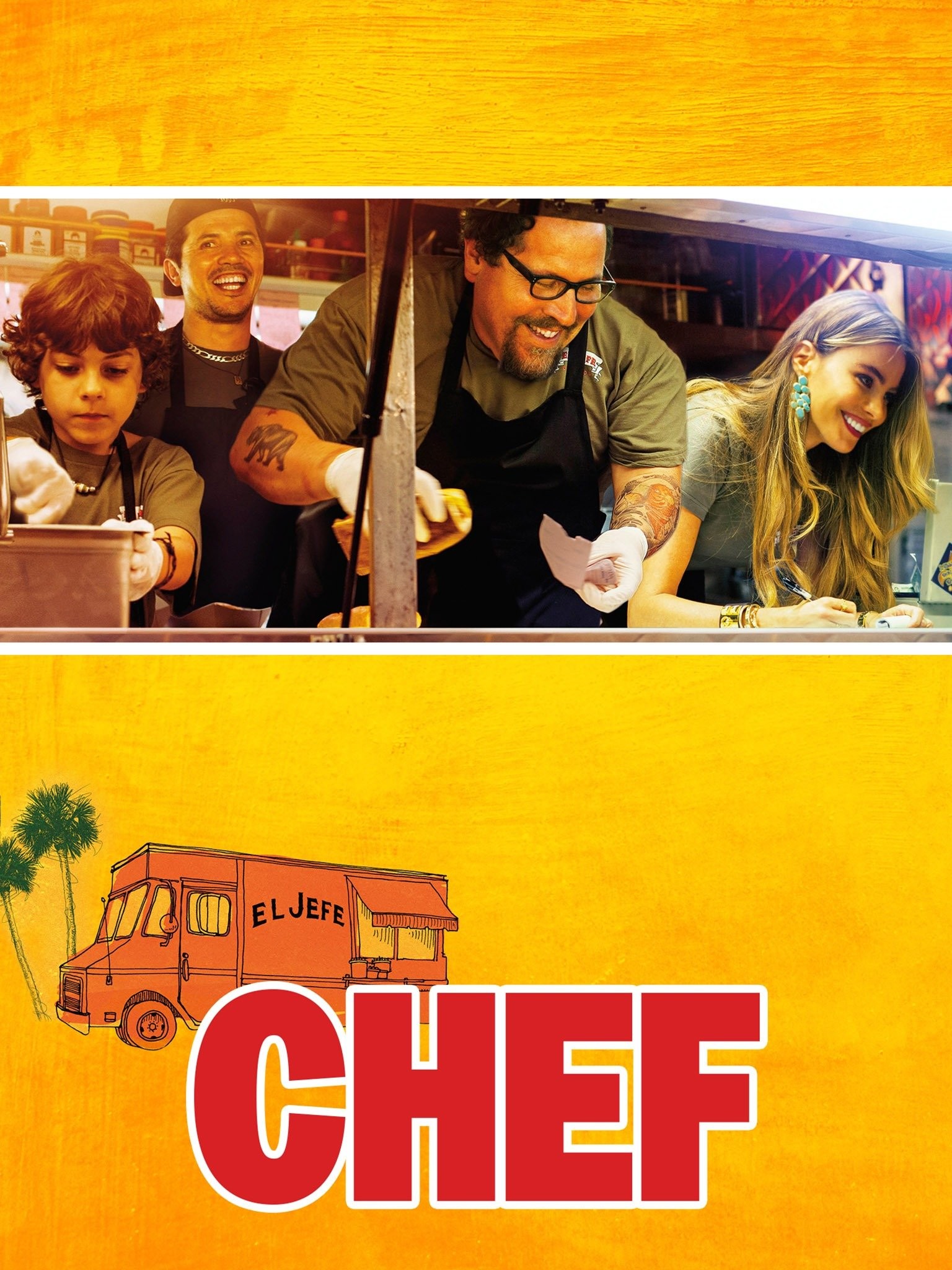
Review: Chef (dir. by Jon Favreau)


“I may not do everything great in my life, but I’m good at this. I manage to touch people’s lives with what I do and I want to share this with you.” — Carl Casper

Jon Favreau’s Chef is one of those modest, crowd‑pleasing films that wins you over by staying sincere. It is not trying to be more elaborate than it needs to be, and that restraint is part of its charm. The movie understands that a good meal, like a good story, does not need to be overloaded to leave an impression.

At its center is Carl Casper, a Los Angeles chef who has spent too long under the thumb of a controlling owner and a punishing routine. Favreau builds the character as a man with genuine talent who has gradually been boxed into serving the same familiar dishes until the spark goes out of his work. That setup gives the film emotional weight without making it needlessly grim, and the early conflict feels grounded in the kind of professional frustration that many viewers can recognize.

What makes Chef work so well is that it treats food as more than decoration. The kitchen scenes have the energy of a workplace movie, but they also carry the warmth of a film about craft, pride, and rediscovery. Favreau clearly cares about the details, and the movie’s culinary authenticity helps make the food feel alive rather than merely photogenic.

The film’s strongest material often comes from its sense of rhythm. Favreau lets scenes breathe, whether Carl is cooking, arguing, bonding with his son, or slowly finding his footing again through the food truck. The road‑trip structure gives the movie a loose, easygoing momentum that matches its themes of starting over and rebuilding a life from something more personal. It is a familiar shape, but Favreau handles it with enough warmth and confidence that it never feels mechanical.

The cast also helps carry the movie’s laid‑back appeal. John Leguizamo brings dependable energy as Carl’s friend and partner, while Emjay Anthony gives the father‑son relationship a needed emotional anchor. Sofía Vergara and Scarlett Johansson add texture to the supporting ensemble, and the cameos help the film feel like it belongs to a broader world without turning into a stunt parade. Robert Downey Jr.’s appearance is especially in the spirit of the movie’s playful, slightly scrappy personality.

If there is a weakness in Chef, it is that the stakes are sometimes as light as the movie’s tone. The conflict is easy to understand, but the film is not interested in digging especially deep into the pressures of restaurant life beyond what it needs for Carl’s personal reset. Some viewers may also feel that the story moves so smoothly that it can occasionally glide past tension rather than fully wrestle with it. Still, those softer edges are part of the movie’s comfort‑food approach, and they fit the film more often than they hurt it.

There is also something undeniably self‑referential about Favreau making a film like this at this point in his career. After years of working in large‑scale studio filmmaking, Chef feels like a deliberate return to basics, a movie about rediscovering joy in the craft rather than chasing spectacle. That choice gives the film a little extra meaning, because it plays not just as a story about a chef but as a story about an artist reconnecting with the thing that made him care in the first place.

That connection carried forward in a very natural way with Netflix’s The Chef Show, which Favreau made with Roy Choi after the film. The show turned the movie’s culinary curiosity into a full‑fledged project, with Favreau cooking alongside celebrity friends and guests across its two‑season run. In that sense, Chef was not just a one‑off passion project; it became the foundation for a longer creative obsession that blended cooking, conversation, and filmmaking into the same kind of easygoing pleasure the movie already had.

What lingers most about Chef is its tone. It is upbeat without being fake, personal without becoming self‑pitying, and relaxed without losing its sense of purpose. Favreau understands that small victories can matter just as much as dramatic ones, and he shapes the film around that idea with real affection. The result is a feel‑good film with enough flavor to satisfy, and enough honesty to keep it from feeling empty.

And for anyone who had never been especially drawn to a Cubano sandwich, Chef also worked like a terrific advertisement for giving one a try. The film made the sandwich look less like a simple handheld meal and more like a kind of culinary payoff, something warm, rich, and memorable enough to make viewers hungry before the scene was even over. While most audiences understandably gravitated toward those rapturous Cubano moments, for me the real standout was the scene featuring the mojo‑marinated pork. There was something about the way the meat was staged—the slow rendering of fat, the caramelized crust, the faint sheen of orange‑garlic sauce—that made it feel less like a quick bit of menu decoration and more like the heart of the film’s culinary language. That sequence, in its quiet way, captured the same blend of craft and desire that the whole movie is built on.

Overall, Chef is a warm, appealing, and thoughtfully made film that succeeds because it knows exactly what it wants to be. It is funny, heartfelt, and easy to enjoy, even when it does not push its dramatic material as far as it could. Favreau serves up a movie that celebrates food, family, and creative freedom in a way that feels genuine, and that sincerity is what gives the film its staying power.
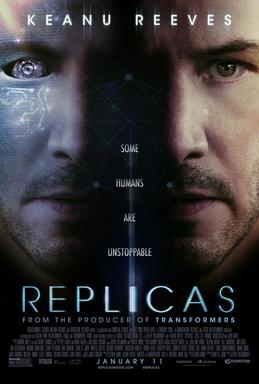

Film Review: Replicas (dir by Jeffrey Nachmanoff)


Don’t even ask me to explain what’s going on in Replicas, a sci-fi film that was released way back in January to terrible reviews and non-existent box office.

Admittedly, this film has a plot and you can kind of follow it if you force yourself to.  And really, it’s not that unusual of a plot.  It’s another one of those things where a scientist is shocked to discover that his top secret research is actually being funded by the military and everyone in the audience is supposed to be like, “OH MY GOD!  NO!  NOT THE MILITARY!”  As you can probably guess from the title, the film is also about clones.  Have you ever noticed that bad sci-fi films always seem to involve cloning?

It’s not so much that the plot can’t be followed as that the film’s storyline just feels oddly underdeveloped.  Watching Replicas, you get the feeling that the filmmakers got bored with the plot and just decided to go ahead and make the movie, without thinking everything through.  As a result, the film touches on all of the ethical and philosophical issues that come along with cloning people but that’s all it does.  Instead of actually exploring any of those issues or trying to come up with an original spin on the story, Replicas just mechanically moves from one scene to another.

Keanu Reeves plays William Foster, a scientist who, along with his longtime friend and partner, Ed Whittle (Thomas Middleditch of Silicon Valley fame), has figured out a way to transfer a dead person’s mind into a robot’s body, hence bringing the person kind of back to life.  A big evil corporation has set up a lab in Puerto Rico for Foster and Whittle to do their research.  The problem is that every time that they put a dead soldier’s mind into an android body, the dead soldier gets pissed off and destroys the body.  Evil Mr. Jones (John Ortiz) demands that they figure out a way to keep the dead soldier from getting mad.  Somehow, it doesn’t occur to Foster or Whittle that Jones wants them to put the soldier’s mind in the android’s body so that the android can then be used as a weapon of war.

(Also, if you want to use androids as soldiers, why not just do some sort of remote control thing like they do with drones?  Seriously, I don’t think Jones has thought his evil scheme through.  The less complicated the better.)

Anyway, Foster and his wife, Mona (Alice Eve), and his three children decides to spend the weekend camping and things don’t go well.  In fact, they go so badly that Foster ends up crashing the SUV and his entire family ends up dead.  Not to worry though!  Foster’s a scientist and he knows how to create clones.  So, he’ll just clone his family.  Of course, to do that, he’ll have to pretend that they’re all still alive and, because he only has room for three clones, he’ll have to pretend like his fourth child never existed.

Does Foster succeed?  Well, the movie is called Replicas.  What’s weird is that it’s obvious that Foster’s going to succeed but the movie still spends an entire hour with Foster and Whittle trying to figure out how to bring the clones to life.  I understand the movie wanted to at least pretend like there was a chance that Foster might not be able to do it but, again, the movie is called Replicas.

Anyway, Foster does eventually resurrect his family but then he discovers that Jones is actually a bad guy and soon, Foster and the Replicas are fleeing for their lives.  It really doesn’t add up too much because the film doesn’t bother to really explore any of the issues that it brings up.  Potentially big moments — like Foster deleting his youngest daughter’s existence — happen but are never really explored.  You keep waiting for some sort of twist — like the clones turning on their creator or Foster discovering that he’s a clone himself — and it never happens.  Instead, the film turns into a rather standard if not very exciting sci-fi action film.

To give credit where credit is due, Keanu Reeves does appear to be taking the film seriously and he has a few scenes that suggest that the film would have been improved if it had played up the idea of Foster being a mad scientist.  The rest of the cast seems to be either bored or miscast but Reeves does try to bring some heart to the film.  Otherwise, Replicas is pretty forgettable.

Playing Catch-Up With 6 Film Reviews: Avengers Grimm, Bad Asses On The Bayou, Hayride 2, Insurgent, Poltergeist, Tomorrowland


Here are 6 films that I saw during the first half of 2015.  Some of them are on Netflix and some of them were major studio releases.  Some of them are worth seeing.  Some of them most definitely are not.

Avengers_Grimm

Avengers Grimm (dir by Jeremy M. Inman)

Obviously made to capitalize on the popularity of Avengers: Age of UltronAvengers Grimm opens with a war in the world of fairy tales.  Evil Rumpelstiltskin (Casper Van Dien) uses Snow White’s (Laura Parkinson) magic mirror to cross over into our world and he takes Snow White with him!  It’s now up to Cinderella (Milynn Sharley), Sleeping Beauty (Marah Fairclough), and Rapunzel (Rileah Vanderbilt) to cross over into our world, save Snow White, and defeat Rumpelstiltskin.  Also sneaking over is rebellious Red Riding Hood (Elizabeth Petersen) who is determined to kill Rumpelstiltskin’s henchman, The Wolf (Kimo Leopoldo).  

Got all that?

Avengers Grimm is another enjoyably insane mockbuster from The Asylum.  The budget’s low, the performances are intentionally melodramatic, and it’s all lot of fun.  Casper Van Dien has a lot of fun playing evil, the women all get to kick ass, and Lou Ferrigno is well-cast as a labor leader named Iron John.

Avengers Grimm is currently available on Netflix.

Bad_Asses_on_the_Bayou

Bad Asses On The Bayou (dir by Craig Moss)

Apparently, this is the third film in which Danny Trejo and Danny Glover have respectively played Frank Vega and Bernie Pope, two old guys who kick ass in between worrying about their prostates.  I haven’t seen the previous two Bad Asses films but I imagine that it really doesn’t matter.

In this film, Trejo and Glover go to Louisiana to attend a friend’s wedding.  When she’s kidnapped, they have to rescue her and impart some important life lessons to her younger brother.  It’s all pretty predictable but then again, it’s also pretty good for a film called Bad Asses On The Bayou.  This is a film that promises two things: Danny Trejo kicking ass and lots of bayou action.  And it delivers on both counts.

In fact, I would say that Bad Asses On The Bayou is a better showcase for Danny Trejo’s unique style than the better known Machete films.  Danny Trejo is a surprisingly adept comedic actor and he gives a performance here that shows his talent goes beyond mere physical presence.

Bad Asses On The Bayou is currently available on Netflix.

hayride-2

Hayride 2 (dir by Terron R. Parsons)

I should admit up front that I haven’t seen the first Hayride film.  Luckily, Hayride 2 picks up directly from the end of the first film and is filled with so many flashbacks and so much conversation about what happened that it probably doesn’t matter.

Essentially, Pitchfork (Wayne Dean) is a murderous urban legend who turns out to be real.  He killed a lot of people in the first film and he stalks those that escaped throughout the 2nd film.  Like all good slasher villains, Pitchfork is a relentless killer.  He’s also an unrepentant racist, which leads to a genuinely unpleasant scene where he attacks a black detective (Corlandos Scott).  Say whatever else you will about the film, Hayride 2 deserves some credit for being on the side of the victims.  No attempt is made to turn Pitchfork into an anti-hero and the movie is relentlessly grim.

Hayride 2 is an odd film.  The film’s low-budget is obvious in every single scene.  The pacing is abysmal and the performances are amateurish.  And yet, when taken on its own meager terms, it has a dream-like intensity to it that I appreciated.  Then again, I always have had a weakness for low-budget, regional horror films.

Hayride 2 is available on Netflix.

Insurgent_poster

Insurgent (dir by Robert Schwentke)

Insurgent is both the sequel to Divergent and was also 2015’s first YA dystopia film.  Shailene Woodley is as good as ever and I guess it’s good that she has a commercially successful franchise, which will hopefully inspire audiences to track down better Shailene Woodley films like The Spectacular Now.  

All that said, Insurgent often felt even more pointless than Divergent.  For a two-hour film featuring performers like Woodley, Kate Winslet, Octavia Spencer, Ansel Elgort, and Miles Teller, Insurgent has no excuse for being as forgettable and boring as it actually was.  The next installment in The Hunger Games can not get here soon enough.

Poltergeist_2015_poster

Poltergeist (dir by Gil Kenan)

When a family (led by Sam Rockwell and Rosemarie DeWitt) move into a new house, they discover that everything is not what it seems.  For one thing, they come across a bunch of creepy clown dolls.  They also hear a lot of scary sounds.  They discover that the house was built on an old cemetery.  Their youngest daughter vanishes.  And finally, someone says, “Isn’t this like that old movie that was on TCM last night?”

Okay, they don’t actually say that.  However, as everyone knows, the 2015 Poltergeist is a remake of the 1982 Poltergeist.  Since the 1982 Poltergeist still holds up fairly well, the 2015 Poltergeist feels incredibly unnecessary.  It has a few good jump scenes and it’s always good to see Sam Rockwell and Rosemarie DeWitt in lead roles but ultimately, who cares?  It’s just all so pointless.

Watch the wall-dancing original.  Ignore the remake.

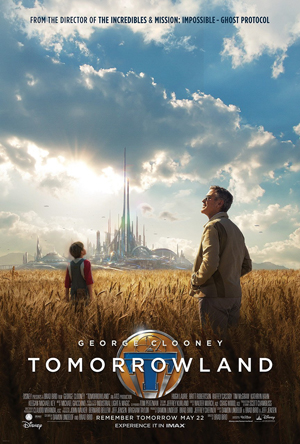
Tomorrowland_poster

Tomorrowland (dir by Brad Bird)

Welcome to the world of tomorrow!  Wow, is it ever boring!

Actually, I feel a little bit bad about just how much I disliked Tomorrowland because this is a film that really did have the best intentions.  Watching the film, you get the sinking feeling that the people involved actually did think that they were going to make the world a better place.  Unfortunately, their idea of a better world is boring and almost oppressively optimistic.  There is no room for cynicism in Tomorrowland.  Bleh.  What fun is that?

Anyway, the film basically steals its general idea from the Atlas Shrugged trilogy.  Tomorrowland is a secret place that is inhabited by inventors, dreamers, and iconoclasts.  Years ago, Frank (George Clooney) was banished from Tomorrowland because, after learning that the Earth was destined to end, he lost “hope” in mankind’s future.  Fortunately, he meets Casey (Britt Robertson), who is full of hope and through her, he gets to return.  They also get a chance to save the world and battle a cartoonish super villain played by Hugh Laurie.  (Why is he a villain?  Because he’s played by Hugh Laurie, of course!)

After all the hype and build-up, Tomorrowland turned out to be dull and predictable.  What a shame.  The Atlas Shrugged trilogy was at least fun because it annoyed the hipsters at the AV Club.  Tomorrowland is just forgettable.