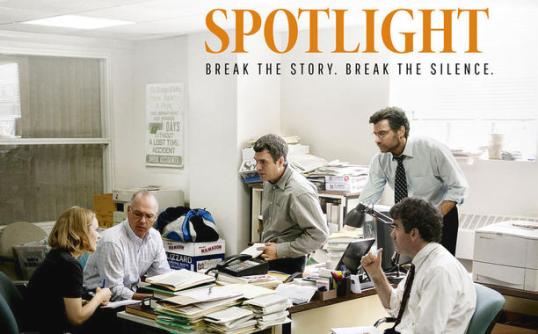
Boston and New York were not the only critics to vote today! The Los Angeles Film Critics Association announced their picks for the best of 2015 as well! Mad Max: Fury Road won best director but Spotlight won best picture with Fury Road as the runner-up. In other words, the LAFCA liked Fury Road but decided to play it safe. Let’s not forget that this is the same group of people who once named The Descendantsbest picture with The Tree of Lifeas the runner-up.
(Dear award-giving groups: Just so you know, playing it safe is really freaking boring.)
I really don’t know much about the New York Film Critics Online but, for whatever reason, the people at Awards Daily seem to hate them. And that’s more than enough reason for me to like them! Anyway, the NYFCO met today and announced their picks for the best of 2015.
And the big winner was Mad Ma…oh wait. No, sorry. The big winner was Spotlight. Check out the rest of the winners below:
Best Picture: Spotlight
Best Director: Tom McCarthy – Spotlight
Best Actress: Brie Larson – Room
Best Actor: Paul Dano – Love & Mercy
Best Supporting Actress: Rooney Mara – Carol
Best Supporting Actor: Mark Rylance – Bridge of Spies
Breakthrough Performance: Alicia Vikander – The Danish Girl
Best Screenplay: Tom McCarthy and Josh Singer – Spotlight
Best Use of Music: Love & Mercy
Best Debut Director: Alex Garland – Ex Machina
Best Ensemble Cast: Spotlight
Best Foreign Language Film: Son of Saul
Best Documentary Feature: Amy
Best Animated Feature: Inside Out
This Italian film from 1965 takes place in a future that is a lot like our present. After years of war and senseless violence, the world is finally at “peace.” Wars are avoided by allowing people to take part in the Big Hunt. When you join the Hunt, you’re agreeing to take part in 10 rounds of competition. For five rounds, you’re the hunter. For the other five rounds, you’re the hunted. Survive all 10 rounds and your reward will be money and retirement. So far, only 15 contestants have managed to survive.
If you’re being hunted, you get a letter informing you that you are now being hunted. The only way to win is to kill the person who has been assigned to hunt you. Unfortunately, you’re not told who is hunting you and, if you accidentally kill someone who is not hunting you, you’ll be sent to prison for 30 years. And, of course, the whole time you’re trying to avoid getting killed, others are being hunted around you. World peace means that there are constant gun battles in the streets, all of which are calmly observed by a rather apathetic populace. It’s a violent world but it’s legal violence so it doesn’t really concern anyone beyond the people that are getting killed.
(At one point, an announcement is heard while a hunter guns down his target: “Live dangerously but obey the law…live dangerously but obey the law…”)
Coverage of the Big Hunt is the world’s most popular television show and, as a result, legalized murder has become big business. Companies regularly sponsor hunters and turn their kills into elaborate commercials for their products.
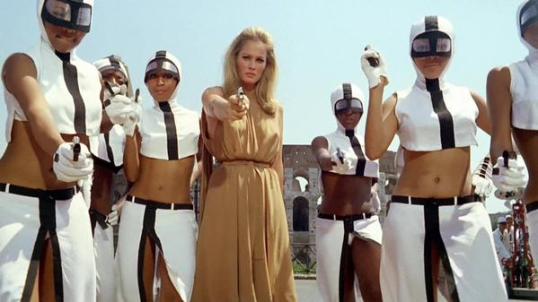
When we first meet Caroline Meredith (Ursula Andress), she is using a literal bullet bra to shoot a man dead. Caroline is sponsored by Ming Tea and, when she is assigned to hunt Marcello Pollitti (Marcello Mastroianni), the company flies her out to Italy. In order to make Marcello’s death as cinematic and commercial as possible, Ming Tea and Caroline decide to lure him to Rome’s Temple of Venus. The Ming Tea dancers are flown in, a choreographer starts working on their routine, and Caroline tracks down Marcello.
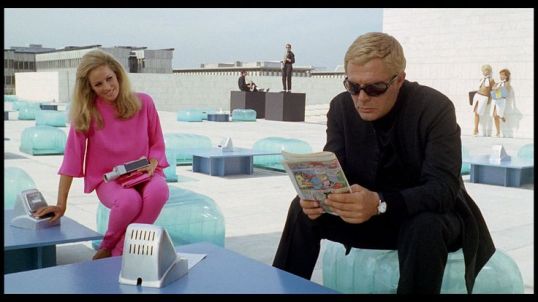
Marcello has just found out that he’s being hunted and he’s more than a little depressed. He’s also paranoid and when Caroline first approaches him, Marcello suspects that she’s his hunter and not, as she claims, a journalist. However, because of the legal penalty for killing a non-hunter, Marcello cannot kill Caroline until he’s sure that she wants to kill him. Meanwhile, Caroline cannot kill Marcello until they’re at the Temple of Venus, in front of the cameras and the dancers.
And, of course, there’s also the fact that, as they get to know each other, Caroline and Marcello start to fall in love. When Caroline observes Marcello conducting a bizarre religious ceremony (he’s the head of a cult of sun worshippers), she is so touched that she starts to cry. Or does she? Are her tears just a ploy to keep Marcello from suspecting that she wants to kill him? We’re never quite sure.
If you didn’t already know that The 10th Victim was made in 1965, you would guess it after just a few minutes. This is one of those hyperstylized works of pop art that, for many people, define 60s cinema. How you react to the film will depend on how much tolerance you have for its nonstop style. Speaking as someone who happens to love over-the-top pop art, I enjoyed it but I could imagine other viewers ripping out their hair at the sound of the film’s peppy theme song.
But, if you’re patient, you will eventually discover that, underneath the film’s excesses, it’s actually a rather clever satire of media, politics, culture, religion, and just about everything else that deserves to be satirized. Marcello Mastroianni and Ursula Andress are both a lot of fun and, in the end, the whole thing works as both a surprisingly accurate prophecy of today’s world and as a time capsule of the 1960s.
Plus, I loved the bullet bra. I need to get one of those.
With three major groups of critics scheduled to announce their picks for the best of 2015, today is a big day for those of us who love Awards Season. First off, here are the picks of the Boston Society of Film Critics! While the awards are nicely spread around, it’s not surprising that the Boston Society of Film Critics picked a Boston film for best picture.
One good thing about Mad Max: Fury Road doing so well during award seasion is that it gives me an excuse to say that “So-and-so Is Mad About Max!” Thank you, film critics, for making my job a lot easier.
Anyway, yesterday, the Washington D.C. Area Film Critics announced their nominees for the best of 2015! And, once again, a lot of love was shown to Fury Road. However, I am even happier to see that they also gave some attention to one of my favorite films of the year, Ex Machina.
Best Original Screenplay:
Matt Charman and Ethan Coen & Joel Coen (Bridge of Spies)
Alex Garland (Ex Machina)
Pete Docter, Meg LeFauve and Josh Cooley (Original Story by Pete Docter and Ronnie Del Carmen) (Inside Out)
Tom McCarthy and Josh Singer (Spotlight)
Amy Schumer (Trainwreck)
If I seem a little bit excited, that’s because I am. I’ve been excited about seeing Brooklyn ever since it was first acclaimed at the Sundance Film Festival earlier this year. I was excited before I watched the film, I was excited while I watched it, and now I’m excited about the prospect of you seeing it.
The thing is, it’s a little bit hard to explain just what makes Brooklyn such a wonderful film. I will admit that, in my case, it probably helps that it’s a deliriously romantic (yet realistic) portrait of a young woman who immigrates from Ireland to Brooklyn in the 1950s. Since I’m an incurable romantic of Irish descent, I suppose it was somewhat predestined that I would love Brooklyn. But, ultimately, you don’t have to be Irish to love Brooklyn. The story that Brooklyn tells is a universal one.
When we first meet Eilis Lacey (Saoirse Ronan), she is a quiet and meek girl living in a small Irish town. She spends her weekends working in a shop owned by the spiteful Ms. Kelly (Brid Brennan) and looks up to her older sister, Rose (Fiona Glascott). It is Rose who contacts Father Flood (Jim Broadbent) in Brooklyn and who arranges, with him, for Eilis to come to America.
After a nightmarish crossing that is marked by a Hellish case of seasickness, Eilis finds herself in Brooklyn and living in a boarding house, under the watchful and protective eye of Miss Kehoe (Julie Walters). At first, Eilis is homesick and struggles to adjust to her new surroundings. It’s only after Father Flood arranges for Eilis to take a night class in bookkeeping that Eilis starts to discover her confidence. (Somewhat poignantly, Rose is also a bookkeeper. Even separated by an ocean, Eilis is still trying to impress her big sister.)
Eventually, Eilis meets and starts to date a sweet-natured plumber named Tony (Emory Cohen). Now, in the past, I’ve actually been pretty critical of Emory Cohen as an actor. On twitter, I made some unkind comments about the performance that he gave in the TV series Smash. (He played Debra Messing’s son.) Though I didn’t make a point of mentioning it in my review, I also thought he was the weakest link in the otherwise excellent ensemble of The Place Beyond The Pines. So, when I first heard that he gave an excellent performance in Brooklyn, I was a little bit skeptical. But then I saw the movie and believe it or not, Emory Cohen gives an excellent performance. As Tony, he is sweet and tough and funny and truly the ideal boyfriend. He also flashes the sweetest smile imaginable, which is one thing that he was not allowed to do in either Smash or The Place Beyond The Pines.
Brooklyn handles Eilis and Tony’s relationship with a commendable honesty. This is a wonderfully romantic movie but, at the same time, it retains a realistic edge. As characters, Eilis and Tony are never idealized. When Tony tells Eilis that he loves her, we’re just as torn as she is because we’ve gotten to know both of them. We know that Tony is a good man but we also know and understand Eilis’s struggle to establish a life and an identity of her own in America. We know how important her independence is to her and it’s equally important to us.
As a result of unforseen circumstances, Eilis eventually finds herself returning to Ireland. Though Eilis insists that she’s only going to stay for a few months, she soon finds herself torn. Should she return to her old home, where she is now viewed as being a bit of a glamorous celebrity and is romantically pursued by the handsome and charming Jim Farrell (Domhnall Gleeson)? Or should she go back to Brooklyn, to Tony and an unpredictable future?
Brooklyn is a deceptively low-key film. Eilis changes from being a shy and insecure girl to being a strong and confident woman so gradually that both she and the viewer are initially taken by surprise when the new Eilis emerges from her shell. This is a film that both demands and rewards your patience. At the same time, it’s also a film about universal desires and experiences to which we can all relate. At some point in our life and in some way, we have all been Eilis Lacey.
Saoirse Ronan — oh my God, what can I say about Saoirse Ronan? How can I possibly describe what a wonderful performance she gives? Ever since she first came to the public’s attention in Atonement, Saoirse Ronan has been one of the best and most underrated actresses around. In Brooklyn, she gives her best performance yet. She deserved an Oscar for Hanna and she’ll hopefully win one for Brooklyn.
(Incidentally, Brooklyn was written by Nick Hornby, who also wrote another one of my favorite films, An Education. Hopefully, Brooklyn will do for Saoirse Ronan what An Education did for Carey Mulligan.)
The Boston Online Film Critics announced their picks for the best of 2015 earlier today and once again, my expectations have been defied! I figured that since Spotlight is a Boston-story, it would be an easy pick for the Boston critics.
But no! The Boston Online Critics went for … MAD MAX: FURY ROAD! According to Awards Circuit, Creed was the runner-up. (Though, to be clear, the Boston Online Critics definitely did like Spotlight, naming it the 5th best film of 2015 and giving it awards for screenplay and ensemble.) Now again, that doesn’t mean that either Fury Road or Creed is going to be Oscar-nominated. But, every bit helps. With each victory, the idea of a Fury Road best picture nomination becomes just a little more plausible.
Here’s my question — one month ago, would you have believed that the early critics awards would be dominated by Mad Max, Sylvester Stallone, and Kristen Stewart?
I finally worked my way backwards to the first in The Note trilogy, and I’m kind of disappointed in it.
The movie starts and we are introduced to a newspaper columnist named Peyton Macgruder (Genie Francis). She writes a newspaper column called The Heart Healer. We are then introduced to King (Ted McGinley) who plays her love interest and also writes for the paper.
A small complaint I have is that he never really had the short moment of douchebaggery that he had in the other two Note films. I know it was a weird anomaly, but I had gotten used to it. Here we just get a couple of lines that he chocks up to old locker room talk. It’s just not the same.
During the introductions to the characters, including that her column is on the chopping block, we also are hearing about a plane that is going down. Macgruder goes out to a funeral being held for the family of someone who died in the crash. This is when we are introduced to the problem with this film.
The allegedly evil TV news reporter. We know he’s supposed to be bad because how dare he ask this girl very politely a question after Macgruder also went over to her and introduced herself. She goes back to her office in disgust. She says, “How does a guy like Truman Harris sleep at night?” to which her friend responds, “Comfortably wrapped in the arms of any woman he wants.” All this because he went over, introduced himself, and politely asked her a question. This supposedly evil TV news reporter is a running thing in this story and it’s stupid.
After we get a flashback to tell us her husband is dead, she is sitting next to the water and discovers something. It’s a note and a bag of cookie crumbs. She’s struck gold! Now she has a story to milk in order to keep her job. Even King says, “I think you may have struck gold here.” When she brings the idea to her boss, she’s hesitant, but then her bosses boss tells her it’s a good idea so the hunt for who the letter is meant for is on!
Phone call! It’s the evil TV news reporter. He has called her up to dare to offer her the opportunity to use TV coverage to help find the person the note belongs to faster. But she turns him down because it’s her story, and how could he possibly think that finding the person quicker is what she wants. She wants to “do the story as a continuing feature.” You know, drag it out as long as possible to keep her column going.
Now she visits the first person she thinks the letter might have been meant for. The two of them have a nice little conversation, but it isn’t his. The evil TV news reporter shows up as she’s leaving. The guy says he doesn’t want to speak with him and she says, “no comment”. Then she makes sure to remind him that it’s her story and that “without the note you’ve really got nothin'”. Did they even read the lines they have her saying? She comes across as a person who is holding this personal private note hostage and dragging it out for her personal gain while lashing out at someone who could help her find the person who should have the letter as soon as possible.
Now she writes about it, and it’s a hit! Look she’s got 200 emails!
Of course this being a Hallmark movie, it cuts to her face and back to the screen to find it’s suddenly 1,991 messages.
Now she’s asked to work with the evil TV news reporter by her boss because their companies are related, but she’s not having any of it. She goes on a bit of a rant here saying: “I think corporate should go to…Look, this is a story that either I can tell or Truman can tell! Oh, wait a minute, I forgot. Truman can’t tell it because he doesn’t have the note.”
And just in case we thought we were meant to read her as going overboard, she has a conversation with her boss a little while on where she is congratulated. Apparently, she protected her “readers’ interests” and her bosses boss liked that she stood up to those “new media types in New York.” He has been a print guy for 30 years! Wow! That’s like way before television was invented in the 1980s. By the way, she publishes her articles on the Internet as well as in newspaper form.
Then she meets with another lady and this is when we finally get a real reason why she probably shouldn’t work with the TV guy. This lady shares quite a personal story with her. Of course that really doesn’t matter too much because she isn’t the one who the letter was for. Thus, making this exist only for her to have another article and pad the film out with more emotional material.
It basically carries on this way for the rest of the film. Ultimately, her hunt brings her back to herself. I feel bad spoiling it here for some reason even though you can figure it out if you’ve seen the other films in the series. She also gets closer to King in the process. It would all be a nice little emotional story of her going from person to person as this note touches lives ultimately coming around to touch hers in the most profound way. However, they had to throw in this evil TV news reporter. The only purpose he seems to serve is to pander to people who see someone like him as a threat to their traditional values as embodied by this somewhat religious newspaper reporter. It’s totally unnecessary to the story and damages the credibility of the main character needlessly. This isn’t a bad movie, but one with a stupid writing mistake that drags on it.
Whenever you saw Robert Loggia in a movie or a TV show, you knew he was going to be a tough guy.
He played gangsters in The Sopranos, The Don’s Analyst, Sicilian Vampire, Innocent Blood, Prizzi’s Honor, Armed and Dangerous, and Speedtrap. In Scarface, he played Frank Lopez and controlled the Miami drug scene until he was overthrown by Al Pacino’s Tony Montana. In David Lynch’s Lost Highway, he played Mr. Eddy and nearly killed a man over tailgating. (Before casting him in Lost Highway, Lynch offered Loggia the role of Frank Booth in Blue Velvet. When Loggia turned the role down, Lynch offered it to Dennis Hopper. If Loggia had accepted the role, the 90s would have been a very different time as far as movies are concerned.) Loggia was nominated for an Oscar for playing a tough P.I. in Jagged Edge. In Independence Day, he was the Chairman of the Joint Chiefs of Staff. If the aliens knew he was waiting for them, they probably would have stayed home.
Robert Loggia even played himself in one of the best commercials of the 1990s.
Robert Loggia’s acting career began in 1956, when he appeared alongside Paul Newman and Steve McQueen in Somebody Up There Likes Me. Over the years, he played everyone from Joseph in The Greatest Story Ever Told to Norman Bates’s psychologist in Psycho II. But, for many of us, he will always be best remembered as Mr. MacMillan in Big, the toy company owner who rediscovers his inner child by dancing on a keyboard with Tom Hanks.
Rest in Peace, Mr. Loggia. Thank you for the memories.
At first glance, Ed Wallis (Nat Wolff) seems like your typical nerdy high school student. An introvert who has a hard time making friends, Ed is a talented writer but what he really wants to do is play for his school’s legendary football team. One thing that sets Ed apart from cinematic nerds of the past is that he is not lacking in confidence. He’s shy but he understands what he’s capable of accomplishing. He knows he’s a good writer. He also know that he has the potential to be a good football player. When he crashes the team’s practice and manages to talk Coach Burton (Kevin Dunn) into giving him a shot, Ed proves that he’s the faster than anyone else on the team. And when one of the other players starts to bully him, Ed has no trouble convincing the quarterback to stand up for him. After all, as Ed explains it, if Ed’s not in a good mood than he’s not going to catch anything that the quarterback throws. And if Ed doesn’t make those catches, the quarterback won’t have a good game and, if he doesn’t have a good game, he won’t get any scholarship offers.
At first, Ed’s determination to play football horrifies both his mother, June (Sarah Silverman), and his best (and only) friend, Eloise (Emma Roberts). June is a single mother who terrifies Ed by openly discussing her sex life with him. Eloise, meanwhile, is a self-styled misfit who is nicknamed “weird girl” by Ed’s fellow jocks. It’s only after they see Ed playing on the field (and, not coincidentally, making the winning catch), that June and Eloise start to support Ed’s athletic dreams…
Meanwhile, Ed is getting to know his neighbor, Ashby (Mickey Rourke). Ashby is a former CIA agent who has just been informed that he has only a few months to live. Ed needs to talk to an old person for a class assignment. Ashby needs someone to drive him around town. At first, Ashby refuses to open up to Ed but slowly, Ashby starts to lower his defenses. Ashby is soon coming to Ed’s football games, flirting with June, and serving as a substitute father figure.
Of course, Asby is also murdering people. Though Ed doesn’t know it, the reason that Ashby keeps asking him for a ride is because Ashby is determined to track down and kill three men who he feels betrayed him. Ashby does this with the full knowledge that eventually, the CIA is going to send somebody to take him out…
Ashby is a mix of genres that don’t really go together. It’s a gentle coming-of-age comedy that’s also a violent revenge thriller. The end result is an extremely messy film that never finds a consistent tone. And yet, at the same time, that inconsistency is a part of the film’s strange charm. The film is so determined to make its oddball mix of genres work that you actually do find yourself rooting for it, even if it doesn’t quite succeed. Ashby is one of those films that shouldn’t work and yet, somehow, it does.
Some credit for that has to go to director Tony McNamara. He directs with a good eyes for detail (the satiric portrayal of both high school and suburbia feels totally authentic) and he keeps the action moving at such a quick pace that you really don’t have time to obsess over the film’s mishmash of themes and tones.
Even more credit, however, I think has to be given to the cast, all of whom show an admirable commitment to bringing their eccentric characters to life. Mickey Rourke’s plays Ashby as if he might be a distant relation to his character from The Wrestlerwhile Sarah Silverman is so perfectly cast as June that you occasionally find yourself wishing that the entire film could be just about her. I’ve lost track of how many times Emma Roberts has been cast as a quirky high school girlfriend but she still brings as much depth as she can to her underwritten character.
Ultimately, though, the film belongs to Nat Wolff, who was so good (as was Emma Roberts) in last year’s Palo Alto. Wolff’s character in Ashby may not have much in common with the sociopath that he played in Palo Alto or the blind friend he played in The Fault In Our Stars, but Wolff brings a sly charm to all three roles and that charm convince the audience to not only accept but even embrace some of the film’s inconsistencies. Nat Wolff truly holds Asbhy together, helping the film to survive some of its more uneven moments.
Ashby has been given a limited theatrical release and is available through VOD. It’s definitely an uneven film but it’s worth seeing.