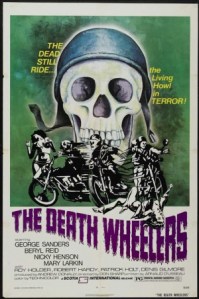
Also known as the Death Wheelers. This is one of those trailer that can pretty much speak for itself. (Though I will point out that co-star George Sanders committed suicide shortly after filming completed.)
Not surprisingly, this movie was directed by Ted V. Mikels. What makes this trailer memorable (for me) is the blandly cheerful narration. I don’t know who that is providing the narration but you hear his voice a lot as you explore the world of grindhouse trailers.
Made in the Philippines (as were many exploitation films in the 60s and 70s — I always expect to hear someone say, “Made in the Philippines — where life is cheap!” whenever I watch one of these trailers), The Twilight People is best remembered for featuring Pam Grier as the Panther Woman. I love how the trailers for Filipino exploitation films always seem to promise us that we’re in for “blood…blood…and more blood!” like some nightmarish 1950s feminine hygiene film.
“Do you think we killed niiiiiiine people for nuthin, maaaaan?” This trailer plays like one of the many “fake” grindhouse trailers that every toadsucker on Youtube is making nowadays. (And, by the way, that trend is getting increasingly obnoxious as it’s obvious that a lot of these trailers are being made by jerks who have never even seen a genuine grindhouse film.) However, Cop Killers is a real film and this is a real trailer. Every time I go down to Half-Price books, I come across the DVD for this movie. They want $9.00 for it. And every time, I end up grabbing this DVD, planning on buying it, just to then come across a movie or book that I want more. So, I haven’t seen Cop Killers yet but I’m sure that eventually, I’ll break down and get it.
Feel bad for all those cops getting killed Cop Killers? Don’t worry, the fraternity of blue meanies got their revenge in plenty of other films, including this 1978 Italian film. Convoy Busters was directed by Ruggero Deodat0 (of Cannibal Holocaust and House On The Edge of the Park fame) and is also known as Cop on Fire. (Apparently, it was retitled to take advantage of the international success of Sam Peckinpah’s Convoy.)
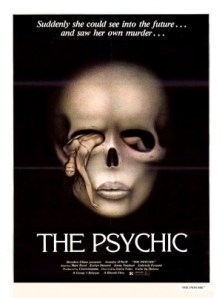
This is the (very) American trailer for Lucio Fulci’s Murder To The Tune of Seven Black Notes. This film is actually one of Fulci’s more subtle and interesting films and, considering that it’s a Fulci film without zombies or a huge amount of gore — it has a surprisingly large number of fans (including Quentin Tarantino). At the time of its release, however, it failed at the box office and so hurt Fulci’s reputation that the producers of Zombi 2 were able to hire him cheap whereas previously, they wouldn’t have been able to afford him. Hence, it can be argued that the success of Zombi 2 was directly the result of the failure of The Psychic. (That’s what we call the circle of life.)
When I was little, my family used to have this cable service called WHT. I can’t remember what it stood for, but recall that it was a one channel station that would constantly show movies. It was like Starz for anyone who didn’t want to pony up the extra money for actual HBO at the time. Since it was set up at my Grandparents house (where I lived), sometimes we’d all gather around for a Movie Night on Saturdays. This is something my family’s done often during the years, and the current part of my family does this on Sundays now, premiering films we haven’t seen yet.
It was one of these Saturday nights that I first witnessed John Carpenter’s The Thing. I had to go to bed for it, being as young as I was for the film, but with the door open I could hear the music and sounds from my bed. At one point, I climbed out of the top bunk and snuck to the stairs, watching the film in my PJ’s. My family would get pretty engrossed with movies, so they never bothered to glance in my direction. After all, this was the first time any of them were seeing this film, and they all loved the original.
I was doing fine until that Husky’s head split open. If I just kept my mouth shut, I could have seen the whole film. After that, I couldn’t stop screaming, “Omigod! The doggie!!” I was met with cries of “Go to Bed!!” from just about everyone. Even though I climbed back into bed, there was no way I was able to fall asleep. Every gunshot, every yell caused me to bundle myself under my blankets with my eyes wide open.
Since then, The Thing has become a family favorite, a reliable go to film for any time it’s cold or rainy or dark. I even showcased it for my friends in Oregon who hadn’t seen it before and they also had almost the same reaction to that poor dog.
So, what is The Thing?
Other than maybe being John Carpenter’s strongest film (which many will argue, because there’s always a place for Big Trouble in Little China for me), it’s a great example of a work in progress that was just done and put to print. Like Jaws, the film ran into some problems. Special FX member Rob Bottin suffered from exhaustion from working so hard on the film. They had some issues with coming up with the final representation of The Thing that wouldn’t appear too cartoon-like or animatronic. There was even a fire during the taping of a huge effect shot involving a body ripping open because of the chemicals that were put into the latex workup. Even though the movie takes place in Antarctica (which I believe roughly 6 months of night), the film actually has a day and night cycle, having filmed in Juneau, Alaska. On top of that, with all of the money thrown at the film, it pretty much tanked at the box office. As quirky as all those elements are, the movie just works because of both the isolation of the characters, the trust issues that occur as a result of the events, and the claustrophobic space they live in. In some ways, it’s very similar to Ridley Scott’s Alien to me (sans the trust issues), but with much better lighting. The Thing is pretty much a cult classic at this point.
The story of The Thing is boosted if you’ve seen the original The Thing From Another World with the late James Arness, but it’s not a requirement. It starts off with a dog being chased by a helicopter, who manages to reach a Research Outpost in Antarctica, occupied by Twelve members. The crew soon discovers that that things aren’t exactly what they seem, but neither are they. Unlike the original movie, the creature in this film has the ability to absorb and mimic whatever organism comes into contact with (which actually is pretty creepy in its own right, that sense of violation). Trust plays a huge part in the story as the crew fight to save themselves while still trying to keep a close eye on who’s walking among them.
The atmosphere of the film is really augmented by the sound. As old as the film is, the sound quality holds up incredibly well on a surround system. The wind from the snow, bullets ricocheting, the panting of dogs and of course the dripping of blood all sound like someone put a microphone right up to all of them to capture it as best they could. The outpost, as big as it is, actually has a lot of narrow hallways with canisters stacked to the sides in many places, giving the place a cramped feel. Add to that Ennio Morricone’s haunting theme and you’ve got a recipe for horror. I mean, for someone who’s scored fantastic Westerns, one would think that Morricone and a Carpenter film might not gel well, but it really does.
Visually, compared to films today, The Thing is pretty tame for it’s effects, and some (the final rendering of the Thing itself, in particular) can be a little dated, but not so much that you should groan about it. At the time, however, it was considered gory (and I guess when you’re in shock on seeing a dog’s face split open, there’s someone smiling somewhere saying to themselves..”Yeah, that worked right there”).
The Thing marks another John Carpenter / Kurt Russell pairing. Russell’s R.J. MacReady is the figure we follow through the film. It’s through him that we try to make sense of everything going on. In one scene that involves him huddled in a corner with a flamethower and some dynamite, defending himself from his friends, you get the notion that you want to be on that guy’s side. Even if following him means getting blown up to a million pieces, because it really becomes difficult to trust anyone in this film. Paranoia plays a huge role.
The cast is rounded out by a few other notable members. Richard Dysart (L.A. Law, Prophecy) plays Doc Copper, and is actually pretty good here. Keith David (Requiem for a Dream, They Live) plays Childs, who really doesn’t believe in any of that “voodoo bullshit”. Thomas Waites (The Warriors) is Windows, who for me, represents the scared kid of the group. He’s not sure what’s up, he just wants to be away from it. Then, of course, you have Wilford Brimley, who seems to realize the problem but takes measures in his own hands rather telling the others just how bad things could get.
Overall, The Thing is highly recommended. I know there’s a remake in the works, and part of me is a little excited for it, hoping that it’s done well. I can’t imagine the filmmakers today running into half of the issues they had in the original.
The Thing also marks one of the best Director commentaries I’ve heard. If you have a chance to watch the film with the Director track on (which I believe Russell also has a hand in with Carpenter in talking about the film), it’s pretty interesting what they elaborate on. Also noteworthy (and funny) is Rob Bottin’s story on the effect sequence that started a fire. That’s definitely worth a listen.
Last night, as I struggled to get some sleep, I ended up turning on the television to HBO and watching a truly infamous film — 1970’s Myra Breckenridge. Based on a novel by Gore Vidal (a writer that I generally have little use for), Myra Breckinridge is infamous for being one of two X-rated film released by 20th Century Fox in 1970. (The other one was Russ Meyer’s Beyond The Valley of the Dolls.)
Why Was I Watching It?
Because I’ve read a lot of books devoted to “the worst films ever made.” And all of them mention 1970’s Myra Breckinridge as being one of the worst ever made. And having seen the film, I can say that they’re right.
What’s It About?
Well, that’s a good question. Okay, there’s a bisexual film critic named Myron Breckinridge (played by an actual film critic named Red Reed). Myron gets a sex change operation from a pot-smoking doctor played by John Carradine. “It won’t grow back,” Carradine warns him.
Next thing you know, Myron is Myra and is now being played by Raquel Welch. Pretending to be Myron’s window, Myra goes to the acting school that is run by Myron’s uncle Buck (John Huston) and ends up falling in love with an acting student (played, pretty badly in her film debut, by Farrah Fawcett). Unfortunately, Fawcett’s in love with a cowboy from Oklahoma so Myra ends up anally raping the cowboy with a big dildo.
Oh, and a 70 year-old Mae West in the film for some reason. She plays a talent agent.
It all sounds a lot more interesting than it actually is.
What Worked?
Nothing. Just in case I’m not being clear, allow me to clarify: Nothing. Seriously, this may indeed be the worst movie I have ever actually sat through. What’s said is that it didn’t even work on a “so-bad-its-good” level. I love trashy film but Myra Breckinridge isn’t really interesting enough to be trashy. It’s just an amazingly boring film that thinks it’s about sex.
I’ve also read some who have claimed that this film, bad as it is, has a certain camp appeal. And, if you’ve never actually seen a campy film, you might think that Myra Breckinridge is camp. However, camp is not boring. Myra Breckinridge is.
Actually, there is one scene that has an odd, “you’ve-got-to-see-this-crap” appeal to it and here it is. Mae West sings “Hard to Handle.”
What Doesn’t Work:
The entire freaking film. Seriously. I mean, I don’t even know where to begin or what specifically to point out because, if you simply take this film’s failings on a problem-by-problem basis, it creates the false impression that the film is somewhat watchable.
Okay, here’s a few things that I simply will not be able to live with myself if I don’t take a few moments to be a bitch about:
1) There’s a lot of bad movies that are distinguished by interesting or, at the very least, watchable performances. It’s as if the actors realize that they’re going to go down with the ship unless they bring something new to the film. (Meanwhile, so-called great films feature some of the worst performances this side of Avatar…) Unfortunately, Myra Breckinridge is not one of those films. The cast alternates beyond going insanely overboard (like John Huston and Rex Reed) to delivering their lines with a dull contempt that seems to be directed as much at us as at themselves (like Raquel Welch.)
By the way, Raquel Welch is actually one of my favorite of the old school film stars. For me, she’s a bit of a role model, a strong Latina who never felt the need to apologize for being both a sex symbol and an intelligent, succesful woman. But Welch really does give a pretty bad performance here. Then again, I would argue that she gives the material exactly the amount of effort it deserves.
2) As bad as the cast is, no one is as terrible as Mae West. The 70 year-old West came out of retirement to play her role here. Anyway, it’s hard to understand why she’s in this film. At one point, when she meets a 6’7 actor, she says she’s only concerned with the seven inches. Now, imagine this being said by your great-great-great-grandma and you have some idea what it’s like to watch her performance here.
3) This film was made in 1970 and it attempts to be all counter-cultural by having “hippies” wandering around in the background. As well, we get a lot of hard-hitting political satire. By that, I mean that various fat men in cowboy hats pop up and complain about “smut” and “nudity” in the movies. I guess the audience is supposed to go, “Oh my God, they’re talking about movies like this!” It’s for this reason that I think that Myra Breckinridge is actually secretly meant to be a piece of right-wing propaganda.
4) Finally, for no real reason, clips from old 20th Century Fox films are littered throughout the film, popping up randomly to…well, I was going to say “comment on the action,” but few of them manage to do that. Basically, it works like this: you see Raquel Welch anally raping a man with a dildo. And then you see a clip of Stan Laurel for a few seconds. Then, you’re back to Raquel anally raping the man. Suddenly, there’s a clip of Claudette Colbert smiling. Suddenly, Raquel’s back and she’s still anally raping the man. And by the way, I’m not just making this up so I’ll have an example. This is what actually happens in the film.
5) And again, allow me to clarify that this film — which features Raquel Welch using a dildo to anally rape a man — is still one of the most boring things ever made.
6) “Okay,” you’re saying, “if you hated it so much then why did you sit through the entire freaking movie, Lisa?” I did it because, once I start watching a movie, I can’t stop watching until it ends. That’s my addiction. That’s my curse. That’s a duty that I’ve proudly accepted as a film lover. And not even Myra Breckenridge is going to keep me from doing my duty.
“Oh my God! Just like me!” Moments:
Yes, I know that this is where I traditionally offer up some sort of teasingly vague comment about my first year at college or where I admit that I’m scared of dogs, heights, swimming, and the area directly behind the television. And you would be justified in thinking that a film that claims to celebrate sexual freedom and bisexuality would give me the perfect excuse to be all sorts of TMI.
But you know what? There were absolutely no “Oh my God! Just like me!” TMI moments in Myra Breckenridge because there was not one single moment that, in any way, rang true or seemed to possess any sort of insight about…well, about anything. For an X-rated film that was specifically about sexuality, Myra Breckinridge left me as dry as the Sahara.
So, sorry — for the first time, I can say that I watched something that had absolutely no “OMG! Just like me!” moments.
Once again after a while of not posting anything I’m pocking my head back in with a review for a film that I’m more interested in hearing what others think rather than telling them what I thought. That film being Terrence Malick’s fifth feature film “The Tree of Life”, which received the Palme d’Or at Cannes and has been receiving quite a lot of praise from critics. But is it all warranted? Well of course that is up to the viewer to decide, but here are my thoughts…
“The Tree of Life” is a mystifying and contemplative cinematic experience with a focus on the nature of good and evil, grace versus nature, god and his absence, love, grief, innocence, reconciliation and human existence all observed at times at a cosmic scale but mostly with intimate detail. Though far from containing a conventional narrative, the story within the enigmatic pondering of “The Tree of Life” revolves around Jack O’Brien, first seen as a wary middle aged man in modern times. He awakes one morning after he apparently dreams of his parents on the anniversary of the death of his brother who he loved deeply, a death that still troubles him. As he goes about his day working his corporate job the death of his brother weighs heavily on him. Jack then begins, as he has probably done countless times before, to search for answers to that overburdening question ‘Why? Why do we die and what is the purpose of life’. Questions asked in hopes to better understand his loss and reconcile his grief.
The search for the answer, which inevitably questions god’s existence, starts where one tends to look for something, the beginning. We are quickly transported to the very first moments of the creation of the universe and travel forward through time to the formation of earth, the dawn of living organisms at a microscopic level and eventually complex life forms. Next we get to the real center of the story as we witness the birth and childhood of Jack. All of this story is observed through Jacks memories of living in a small town in Texas during the 50’s. I believe it is very important to consider that these scenes are told through his memory and so contain a dreamlike and visceral atmosphere. We are not watching it play out as a narrative would in any other film, instead we get fragments of his childhood, each an individual memory strung together as they flow through Jack’s mind. The fact that these are memories also helps in understanding the view of his parents and the way in which they represent the sides of grace and nature to such extremes; as in Malick’s “Days of Heaven” one questions whether they are a true representation of the characters or just how Jack remembers them so many years later.
Jessica Chastain plays ‘Mother’, the way of grace, as a free spirited, caring and nurturing guide who teaches love, forgiveness and the enjoyment of life. The dueling force is nature, played incredibly well by Brad Pitt, as the disciplinarian father figure who runs his family with an iron fist in an attempt to instill toughness and a yearning for achieving greatness through any means. Together they reflect the inner workings of the cosmos and have a profound influence on Jack and at times he struggles to find a balance. As he grows he witnesses the harshness of the world around him, experiencing jealousy, lust, death and is often tempted by evil and sinful thoughts. At the same time however these struggles help him to grow and understand life and he comes to express a deep love and fondness for his family, especially his brother, though his mind still questions many things as it does for us all.
As expected with any Malick film the events in Jack’s life are not a direct depiction of reality, and Malick really doesn’t care much about their outcomes or how the story unfolds in a literal sense; instead what matters is making the audience experience these events through the inner mind and consciousness of the characters. As with his other work he relies heavily on voice over narration to convey the intimate thoughts of these characters , but this time they seem to be speaking for us and not just for themselves. All of this is constructed within a very visual backdrop with breathtakingly beautiful imagery utilizing lights, shadows, sounds, CGI, nature and settings with such perfection only a true artist like Malick could achieve giving even the most simple images complex meaning.
Together it is all truly poetry in motion and though it is a term I have used many times before it has never been more fitting. The entire film is unlike any other I have seen, one that will rattle your perspective on the world. Personally, the entire experience challenged me emotionally, mentally and spirituality; I’m not a religious man and I understand the examination of Christian values and Gods part in the story but the spiritualism at play I believe transcended religion or faith and although it looks to god for answers and at times tries to explain his actions, the thematic outcomes are open to so much interpretation that to claim you know the answer would undermine the films intentions. In the end there are no definitive answers; in the bigger picture of things we live but a small moment in time. One of the final scenes depicts what is seen to be ‘heaven’ but not in a literal sense. God does not show his presence, and it isn’t located among the clouds. One does not encounter angels and no answers are given, instead there are only the ones we love as we remember them. Heaven is merely the place within out hearts where we cherish the memories of the past and it is in those memories and through those people we live them with that we find a meaning and a reason to love and live. It is there where one finds true reconciliation, understanding and peace and by films end that is what Jack and the audience get.
“The Tree of Life” will undoubtedly divide the general film going audience. In the showing I attended I saw one couple walk out while at the same time as the final scenes began to play a woman in front of me was in tears. No one will be affected in the same way as others; those with no previous experience with Malick’s work might find the whole thing pretentious, difficult to understand and hard to sit through which is very understandable. Those with a bit of patience and an open mind will bear witness to what might possibly be one of the most ambitious, beautiful and best films in a very long time that will stick with you long after you leave the theater and will be discussed and analyzed for years to come.
For those of you who have seen the film, what were your thoughts and have you seen Malick’s previous work? For those that haven’t see it, do you plan to or did the trailer and whole idea of its structure turn you off?
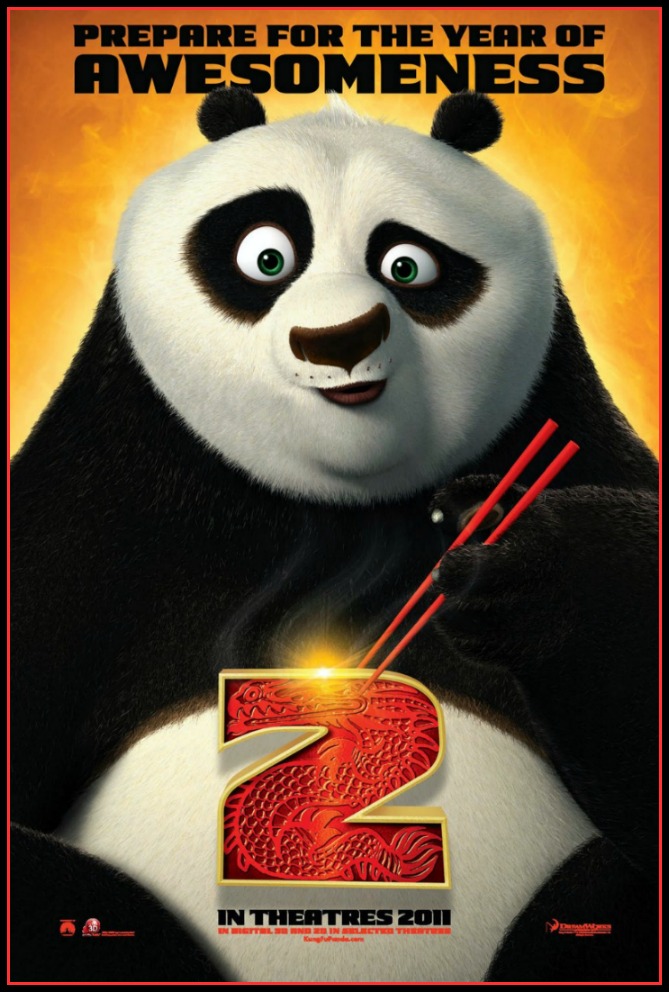
In 2008, Dreamworks Animation released what many had thought was one of their animated films. Some even went so far as to consider it on the same level as many of the Pixar animated offerings. This was high praise indeed and the praises from critics was awarded by public acclaim as Kung Fu Panda became an instant classic for Dreamworks Animation. It wasn’t a huge surprise that a sequel was quickly greenlit by the studio and now three years has passed and that sequel has finally come out. Kung Fu Panda 2 does one of those rare feats in film-making where it surpasses it’s original predecessor in all things. This was a sequel that was able to take what made the first one so fun and thrilling and build on it without losing the charm that made it so beloved in the first place.
Kung Fu Panda 2 brings back the Dragon Warrior Po (Jack Black returning in the role of the big fat panda) as he continues to live his dream of having become the Dragon Warrior and fighting evil, bandits and criminals with his fellow kung fu masters, the Furious Five. Instead of the film highlighting Po’s size as a detriment and keeping him a buffoonish character like in the beginning of the first film this sequel actually makes him an equal of his heroes, if not, surpassing them. This is a refreshing change since the writers could’ve easily banked on Po as a character who bungled and stumbled his way through most of the film.
This film was a continuation of Po’s journey as a hero which the first film was just the first step. Despite being a kung fu master in his own right his culture becomes threatened by a villain even more devious than the first film’s Tai Lung. Lord Shen (voiced by Gary Oldman) is the mad peacock heir to Gongmen City who has found an ultimate weapon through fireworks that he plans to defeat kung fu and conquer all of China. Kung fu is everything to Po and he journeys with the Furious Five to confront Lord Shen and stop his plans before it’s too late.
It’s during this journey that Po learns more about his true past and where he truly comes from. The sequences where Po’s adopted goose father tells of Po’s past was some of the best animations Dreamworks has done and I’d say surpasses some of Pixar’s own work. After seeing this film I’m sure many kids and some adults would want themselves their very own baby panda. Who would’ve thought that baby pandas sounded like human babies when they cried. It’s knowing his past that Po must now learn to find his inner peace if he’s to ever go beyond just being a kung fu master.
Kung Fu Panda 2 was actually quite a dark film in places as themes of genocide, destructive march of technology against nature, difficulties of adopted children finding their true origins and many others. That’s not to say that this sequel wasn’t fun to watch. The action took the kung fu fight scenes from the first film to a whole new level, but without turning it into all flash and no substance. It’s during some of the thrilling fight sequences that we see Po truly become part of the Furious Five and even affection from some of it’s members. It would be interesting to see how a third film would explore the growing relationship between Po and certain striped-feline.
The story gets a much needed infusion of creative help from one Guillermo Del Toro who served as creative producer. His inclusion in the film’s development was probably why the film had a much darker and serious tone in addition to the charm it continued from the first film. If there was anyone in Hollywood who knows how to further develop a character through a Campbellian hero’s journey then it’s Del Toro. If Dreamworks Animation is able to keep Del Toro on hand to further treat their other projects then it will be quite a coup for the studio.
The animation in this film is a step above the first film and anything Dreamworks Animation has ever done. With each passing year and release it looks like Dreamworks Animation has been able to come to the same level of animated work Pixar has set with their own projects. While I’m sure there’s no animosity between animators fo the two houses there probably is some sort of friendly rivalry which helps push both studios to improve on their animation work. All this means is that the public wins out in the end as we’re treated to better animated features from both Dreamworks and Pixar. It’s a good thing that Dreamworks Animation has also improved their storytelling with each new film that they’re not being called the weaker films when compared to Pixar’s latest.
In the end, Kung Fu Panda 2 more than lives up to it’s predecessor and actually surpasses it in every way. This sequel’s animation and use of stereoscopic 3D was some of the best in CG animation to date. It had a story that continued to explore and build the characters from the first film that they’ve gone beyond simple, basic animated characters but fully realized and complex individuals. Even the ending scene in the film which definitely sets-up a third film doesn’t seem tacked on but looks like something that would further continue Po’s hero’s journey. Sequels and milking of a franchise usually don’t sit well with serious film fans, but this franchise seems to be doing it correctly and using each new film to further an epic tale. Here’s to hoping we see Po and his Furious Five friends back for more in the coming years.
The name Matthew Vaughn should be familiar with comic book fans everywhere. In 2005, Vaughn was introduced as the director to replace Bryan SInger for the third film in the X-Men franchise. The news was met with some cautious optimism. This was a filmmaker who had quite the loyal and growing following for his work on Stardust and Layer Cake. Months after he was picked my 20th Century Fox news came down that he was backing out of the project due to personal reasons and the film scrambled for a replacement which ended up being Brett Ratner. History was made that day as the beginning of the franchise’s decline began and steep plummet which recently reached it’s nadir with 2009’s Wolverine: Origins.
It’s has now been five years since X-Men: The Last Stand made it to the big-screen and now we have a new film in the franchise. X-Men: First Class has a familiar name behind the director’s seat and it looks like Matthew Vaughn stayed this time around (after directing a smaller superhero film in Kick-Ass for 2010) to craft what could become the best film in the X-Men/Wolverine film franchise. This film is a prequel/reboot of sorts (more on that later) and brings a fresh set of eyes and take on the origin story of this franchise.
X-Men: Last Stand actually begins the film exactly how the first X-Men film began with the 1944 World War II concentration camp setting where a young Erik Lensherr (later to become Magneto) finally manifests his power over magnetic fields as he watches his parents torn from his side. The first film ended that sequence once Erik was knocked out, but this time around it continues with a mysterious man named Schmidt (aka Sebastian Shaw and played with James Bond villainous-flair by Kevin Bacon) taking great interest in Erik and his ability which Erik could only use during bouts of pain and anger. The film continues this slight change in the series’ origins by switching over to Westchester County and into the expansive home of a young Charles Xavier who finds a certain young, blue-skinned shapeshifter named Raven who he invites to stay and become his friend once he realized he wasn’t the only one who was different and with abilities.
These two sequences continue to move the film forward as the we see these two “leaders in the making” adults and trying to find their place in the world of the free-swinging lifestyle and the Cold War culture of the 1960’s. Charles Xavier (played like a well-meaning cad and good-natured naivete about the world by James McAvoy) is a student working on his doctorate in Oxford on genetic theories while his “sister” Raven (Jennifer Lawrence) accompanies him. This is a Xavier who still hasn’t found the patient benevelonce of Patrick Stewart’s Professor X and uses his considerable telepathic abilities to help him pick up on beautiful coeds instead. It’s during such a scene where we see Raven show just a hint of jealousy as Xavier tries his lines and moves on a beautiful British lass. It would seem Raven’s feelings for her ‘brother” may go beyond sibling affection though Xavier doesn’t see her as anything other than a sister for him to protect.
Erik Lensherr’s time as an adult was shown as having become a life of obsession over his treatment at the hands of the Nazi’s and those of Schmidt’s as he travels the world in search of escaped Nazi war criminals. Erik takes him throughout South America as he finds the trail of Nazis hiding out in that region since the end of the war. We see this adult Erik hardened by his anger and single-minded need for revenge on Schmidt and those he worked for. He’s not above using his abilities to kill in order to get the information he requires and there’s a hint of satisfaction when he does kill those he sees as responsible for his tragic upbringing with his magnetic abilities. These two adult sequences continues the film’s theme of the ideological difference between Xavier and Erik being formed through nature and nurture as their lives moved down diverging paths from an early beginning until it convergence for a small, brief period around the time of the Cuban Missile Crisis.
The film’s second act begins with Moira McTaggart (Rose Byrne), now a covert CIA Agent, investigating a certain Col. Hendry who she suspects as having betrayed the nation to the Soviets, but instead finds out that the true nature of Hendry’s associations were much more insidious and dangerous. The iconic Hellfire Club of the comics finally make their appearance with Schmidt who actually happens to be Sebastian Shaw (whose powers grant him the ability to absorb all kinetic energy which he uses to keep himself young and can release with explosive results), Emma Frost (January Jones) who’s a telepath with the ability to turn body in a sort of diamond-form, Riptide who can create tornado-like abilities and finally the demonic-looking Azazel whose ability to teleport might give people not well-versed in the “X-Men Universe” a clue as to one-half of parents who may be responsible for Nightcrawler in the second film.
X-Men: First Class spends much of this second act like it was Ocean’s 11 as Xavier and Erik get recruited by the CIA to find other mutants and create their own mutant team to counter Sebastian Shaw’s Hellfire Club and his goal of initiating World War III between the US and the USSR and thus destroy all of humanity and leave the planet for the mutants to rule over. Yeah, it is this part of the film’s plot which may strain the suspension of disbelief for some audiences who never grew up reading the comics, but it shouldn’t. Ian Fleming’s James Bond series used scenarios just as ludicrous with villains just as Machiavellian in the form of SPECTRE so X-Men: First Class and it’s world domination plans shouldn’t be too farfetched to fans of that British superspy and his adventures.
This middle section of the film is where X-Men: First Class actually begins to lag after a strong first act. I don’t know if the sequences of the new recruits training, bonding and learning how to use their powers could’ve been written to move much faster without losing some of the character building scenes. From how this second act played it seemed to look like scenes were actually cut out to try and keep the film from being too long (it’s final cut being just a tad over two hours already upon release), but I wouldn’t be surprised if the DVD/Blu-Ray release actually has a director’s or uncut version that actually expands this middle section to really give life to it instead of having it play out like a perfunctory training montage with a dash of character beats.
The film hits it’s action-film stride with the third and final act as Xavier and Erik’s team of young mutants must now use their abilities to stop Shaw and his Hellfire Club and at the same time prevent World War III from beginning and not freaking out the humans who are still unaware of their existence as a whole. It’s this third section which we see too much of it in the trailers and tv spots that one might say we’ve seen it all before we even see the film as a whole, but it still kept back a lot from those ads to make the whole final twenty minutes of the film thrilling and action-packed.
All of this could just mean that X-Men: First Class was just your run-of-the-mill superhero action film that we get on a yearly basis come summertime, but it’s a testament to Matthew Vaughn’s direction and the strength of the script by Vaughn, longtime collaborator Jane Goldman and Thor scribes Ashley Edward Miller and Zack Stentz that the film goes beyond being just an action film with all it’s sturm und drang coupled with fancy special effects. The previous films in the series always explored important cultural and moral themes that’s always been the bread-and-butter of the X-Men stories in the comic books. We just don’t see the film explore the ideological difference between Xavier’s peaceful co-existence between humans and mutants alike, but also we get more detail on why Magneto finally comes to the conclusion that war between humans and mutants was an inevitability and why his stance doesn’t fall under the aegis of being evil, but something that anyone could understand and even support whether one was human or mutant.
The story also doesn’t just pay lip-service to the idea of how mutants view themselves and how even within the mutant community there’s a visible rift between those whose abilities are invisible to the general population and those whose abilities and genetic mutation physically manifest themselves in such ways that to many might not look to appealing. This idea really gets a major exploration in the subplot involving Raven (soon to be Mystique), Hank McCoy and, to a certain degree, Xavier and Erik. We see how those like Xavier whose abilities don’t show in a physical manner have a sort of “don’t ask, don’t show” about those like Raven when it comes to their power when in public.
Raven (played beautifully by Jennifer Lawrence) is caught between Xavier who wants her to remain incognito so as not to shock the world too soon in realizing that mutants exists and that of Erik who sees Raven’s original blue-skinned form as beauty and perfection and how she should never hide who she truly is. This tug and pull between her two mentors makes for a convincing subplot in how Raven comes to the conclusion which would take her to the side of Magneto in later films, but also highlight how the two sides in later films have so much intertwining bonds of friendship and relationship that seeing them against each other becomes a tragedy on its own. Civil wars are not just a thing of humans but those who sees themselves apart from them.
The great performances by most of the leads add to the film’s strength. McAvoy and Fassbender, at first, look to be unconvincing in terms of their appearance as the younger versions of Patrick Stewart and Ian McKellen, respectively. This becomes a non-issue once they’ve established themselves through their performances which gives new layers to the personalities of Professor X and Magneto. Many people always saw these two as the comic book version of Martin Luther King, Jr and Malcolm X, but that’s an oversimplification. The film and the performances by McAvoy and Fassbender digs deeper into both their characters’ motivations and ideologies and how their past experiences and upbringing couple with their time together as brothers-in-arms and friends show more about these two than just being mutant-proxies of MLK and Malcolm X. The other young mutants do an adequate enough job that they don’t seem lost in the film. Nicholas Hoult as the young Hank McCoy and how he plays off Lawrence’s Raven during their little subplot in the film is one stand-out that I hope gets explore even more in any follow-up sequel.
There’s a nice burgeoning young love chemistry between him and Lawrence as Beast and Raven that doesn’t seem too tacked on to create a the prerequisite love couple in any film. Their common trait of having physical mutations and how they seem to both feel apart even from their fellow mutants develop their characters in ways the previous films in the series never did. They never want to rid themselves of their mutant powers. They just want to look normal and still keep their abilities. It’s a having your cake and eat it too mentality that has some surprising results for both Raven and Hank.
X-Men: First Class has had some fans of the series put in a very difficult situation. The film definitely is a prequel to the previous films, but it also does a major time in rewriting continuity in the series. I was one of those fans and thought it would ruin the film in the context of the franchise. I’m surprised that in the end I didn’t really care and actually hope that this film actually is a reboot of the franchise. I see this film and forget the previous three as being part of it. This film was just too good and fun in it the end for continuity issues to become the major flaw that sinks it. I liken this film as similar to Christopher Nolan rebooting the Batman film franchise. That film honored the contributions to the character, but went on it’s own way to tell that character’s tale. I see Vaughn doing the same with this film. He has done something which many thought was a near-impossible task and that’s make the X-Men franchise relevant once more in a pop-culture landscape that seems to have left the franchise behind after the disastrous Wolverine: Origins of 2009.
This film delivered on the ideas that made the comic books so beloved by millions of fans for almost a half-century. It made great use of the 1960’s time and setting to tell a story of these characters beginnings as heroes and villains (though the latter shouldn’t be seen as them being truly just evil bad guys). Even the inclusion of real-world historical event like the Cuban Missile Crisis was a nice touch which gave the film a foundation in realism. Again, this film played off like a superhero, Marvel version of an Iam Fleming James Bond story. For those who are huge fans of the previous films there’s even two brief cameos of those films two favorite characters that appear in this film. They don’t come off as cheesy and unnecessary and actually come off as great additions. I won’t mention who these cameos were but the audience’s reaction to them was very vocal and very positive. I say the same should be said for X-Men: First Class as a film that resuscitates the franchise.
Okay, so after months and months of it being strangely cold and pleasant down here in Texas, this week the temperature suddenly shot up to 100 degrees and everyone’s going outside and mowing their freaking lawns. Which means that it smells like freshly cut grass outside (BLEH!) and every time I step through the front door, my allergies go insane and I end up getting sick! Seriously, I was so sick last night that I ended up staying in for the night and resting, which for some reason my evil sister took as an invitation to attempt to “braid” my hair. Anyway, as I sit here trying to get the tangles out of my hair (ouch!), why not check out the latest edition of Lisa Marie’s Favorite Grindhouse and Exploitation Trailers?
The title of this weekend’s edition, by the way, is a really obvious homage to a film directed by Otto Preminger. And no, it’s not Skidoo.
For some reason, this anthology seems to pop up on TBS, TNT, USA,, and WGN a lot. Actually, is WGN actually a cable station? It sounds made up. Anyway, I hate anthology films. Seriously, they always suck so bad and the people who make them are always so freaking proud of themselves. I mean, seriously — what’s going on with that? Anyway, it seems like every time I come across it, I end up seeing the part where Emilio Estevez gets attacked by the Bishop of Battle.
Yes, I’ve done some research and guess what? This film is Italian! Yay! Anyway, this trailer informs us that somebody has given all the animals at the zoo a “deadly” dose of PCP. Okay, so if it’s a deadly dose, then why do they apparently end up going crazy and attacking humans? I mean, seriously, shouldn’t they be dead?
Okay, I first came across the trailer on YouTube many months ago while I was searching for film clips for an abandoned post about teaching-centric grindhouse films. This trailer has, for some reason, become something of an obsession of mine and it’s because I still have some doubts as to whether or not this film actually exists. Because, seriously, the trailer is just like a check list of every cliché that we associate with an out-of-control school thriller. And then it stars Jim Belushi? Seriously, this can’t be a real movie. Except I did some research and apparently, there’s a lot of people who think it is real. And you can order it off of Amazon. Not that I’m planning on doing so because Jim Belushi is just like bleh to me.
Judging from this trailer, an equally appropriate title for this film would have been The Countryass Girls Who Run Around In Their Underwear Invasion. While that may sound like stereotyping, it’s okay because I actually am a countryass girl who runs around in her underwear. Seeing as how we’re always getting victimized in movies like this, I’ve started a support group for us, called Hicks In Panties or HIP for short.
Anyway, I actually have some trouble watching this trailer because — Oh. My. God. — I hate spiders! Like I was talking to a friend of mine once and she told me about this time she was on a horse and she ended up riding right through a spider’s web and I was just like, “Girl, how are you still alive? I’d have to kill myself I’d be so worried about having little spider eggs hatching in my nasal cavities after something like that.” Anyway, she said that didn’t make any sense at all so I think she’s kinda fooling herself.
Disco Godfather! This was Rudy Ray Moore’s follow-up to Dolemite. I haven’t seen either one of them but this trailer features two of my favorite things: poetry and dancing!
Last night, I was feeling sad so I went to the handy DVR and I watched a movie that I recorded off of the Lifetime Movie Network on Memorial Day — the unacknowledged classic piece of Americana, The Babysitter’s Seduction!
Why Was I Watching It?
Oh. My. God! How could I not watch it? This apparently first came out way back in 1996 but it shows up on the Lifetime Movie Network like every six months or so and I make it a point to either watch it or at least DVR it every time it’s scheduled because seriously, this is like my favorite Lifetime movie of all time!
What’s It About?
Oh my God…okay, check this one out. So Kerri Russell is like this babysitter and she’s been hired to watch over the children of Stephen Collins who is the multimillionaire with a beautiful home and a wife who has had so many facelifts that her face just looks like wax. Kerri’s in high school here and she has a boyfriend who looks like he’s about 30 because he’s got a receding hairline and a big old widow’s peak but he’s still in high school too. Uhmm…remedial much?
So, anyway, one day, Kerri takes the kids out to the public pool and then she realizes that she left something behind at the house so she goes back and, oh my God!, Stephen Collins’s wife is lying dead on the kitchen floor with a gun in her hand. Is it suicide? Well, that’s what a police inspector played by Tobin Bell has to figure out. Turns out that Tobin is also best buddies with Stephen but he’s still got to do his job because it quickly becomes obvious that Mrs. Stephen Collins didn’t actually commit suicide. It all has to do with powder residue and a whole lot of other CSI-type stuff.
Anyway, it’s kinda obvious that Stephen Collins killed his wife but nobody notices because they’re too busy gossiping about how he’s now secretly sleeping with the babysitter. Kerri Russell tells everyone that she’s in love with Stephen Collins but little does she realize that Stephen Collins is busy trying to frame her for his wife’s murder.
Anyway, eventually the center cannot hold and things falls apart…
What Worked?
Okay, so basically, here we have a film where the Rev. Camden frames Felicity for murder and it’s up to the Jigsaw Killer to find the truth. That right there is what we call a harmonic convergence of pop culture. This film needs to be seen for this reason, if nothing else.
Also, the Babysitter’s Seduction is one of those films that succeeds by taking its formula to the most logical extreme and then taking another step or two forward. Hence, not only is the babysitter seduced but she’s just about brainwashed. Not only is Stephen Collins evil but, as the film reaches it conclusion, we come to realize that he’s actually the equivalent of that evil mayor from the third season of Buffy the Vampire Slayer. I mean, seriously — there’s nothing this guy can’t do! How, where, and when did he learn to be so evil!?
Finally, this is another one of those movies where nobody delivers a line without taking a dramatic pause in the middle of the sentence. For instance, the dead wife’s secret love introduced himself by saying, “I’m Paul Richards….I. Was. Sally’s. Lover.” Now, I have to admit that I’ve often been told that I have a tendency to 1) talk too much and 2) talk too fast and, as a result, sometimes it’s difficult to follow my train of thought. And to those who say that, I say, “Fuck you.” But anyways, after witnessing all of the dramatic pauses in this film and seeing how they helped to turn a 30-minute sitcom into a 2-hour movie, I am now much more open to the idea of adding. Pointless. Pauses. To. Everything. I. Say. From. Now. On.
Also, this film demonstrates how — if you’re in a pinch and you don’t have anything else — panties can be a handy substitute for handcuffs. So, if your boyfriend can’t quite figure out how to pull that particular quirk off, this movie serves as a nice training film for him and as 2 hours of Lifetime goodness for you.
What Didn’t Work?
Obviously, if the babysitter wasn’t an idiot then there wouldn’t be a film. But seriously, this babysitter was really an idiot. Okay — since I don’t want anyone to get the wrong idea from this movie, I’ll just go ahead and say it — if the wife of your employer shows up on the kitchen floor with a bullet in her head, do not respond by having sex with your employer. It’s just not going to look good.
There’s also a scene where Kerri Russell’s bra changes color from shot to shot. Seriously, that’s just carelessness.
“Oh my God!” Just Like Me Moments
You know, I always wanted to babysit but I never got too. My older sisters all got to babysit me at one time or another but one of the drawbacks of being the baby of the family is that there was no one younger than me for me to watch. Then again, being the baby also meant that I got spoiled rotten so I can’t complain too much.
However, there was one moment I could really relate too and that was when Kerri Russell told her concerned mother, “I don’t have an attitude…you do!” I used to say that all the time! The key to delivering the line — which Kerri nails, by the way — is to wait three beats before raising up your chin half an inch, looking down the slope of your nose and saying, “…you do.” Ha! In your face, judgmental authority figure!
Also, despite never getting to be a babysitter, I did once secretly have an older lover who murdered his wife but shhhh…don’t tell anyone.
Lessons Learned
If you’re employer kills his wife, wait a few months before having sex with him. Otherwise, it just looks bad.
Anime films have been the type to make a major crossover from Japan to the United States when it comes to the US mainstream audience. While anime series typically still remain the realm of the hardcore fans of the genre the stand-alone films get much more love from mainstream critics and audiences in addition to the hardcore. One such film which looks to have made a successful mainstream crossover to the United States was the anime film Summer Wars which was originally released in Japan in August 1, 2009. The film saw it’s American debut at film festivals around the country in 2010, but since I saw it in late May 2011 I consider it a 2011 release for me thus qualifying it as one of the best films of 2011.
Summer Wars was the project of director Hosada Mamoru whose previous stand-alone anime film, The Girl Who Leapt Through Time, was well-received by fans and critics alike. Working from a screenplay by Okudera Satoko (adapted from a story written by Hosada himself), Summer Wars was a nice blend of science-fiction, romance and Japanese slice-of-life. The story begins with the introduction and explanation of the OZ on-line community which becomes a major focal point to the film’s story and the many characters in it. OZ was explained as an on-line, social networking community which has become so ingrained in the world community that everything anyone does was done through it’s portals. Think of OZ was an amalgamation of Facebook, Second Life, iTunes, Netflix and every other social networking site all working under one umbrella. It’s a virtual world where people just don’t socially interact through games and chat lobbies, but also a place where every real-world store has a portal where people could purchase things online. It’s also become a palce where governments from local cities to whole countries have set-up their own areas that would control their cities and countries’ infrastructures. It’s Facebook on steroids.
One of the film’s main characters happens to work as a part-time moderator for OZ. Koiso Keiji also happens to be a 17-year old math whiz who would become instrumental in the story to come. The bulk of the story has Keiji being invited by a high school friend in Shinohara Natsuki (explained to him as a job she needs for him to do) to come with her to her family estate where he ends up meeting the rest of Natsuki’s very extended family and also it’s soon-to-be 90-year old matriarch in Jinnouich Sakae. This part of the film makes up the romance and it’s comedic aspect as Keiji gets introduced by Natsuki to her great grandmother Sakae as her boyfriend and future fiance much to Keiji’s surprise. As Keiji tries to awkwardly play along with Natsuki’s plan the second part of the film’s story kick’s in as he inadvertently assist someone or something into hacking into OZ and begin a sequence of events which threatens every account in OZ, but later on even threaten the world.
This part of the story actually worked quite well due to the recent major hacking of Sony’s Playstation and Qriocity networks which gave hackers access to tens of millions of account users’ info. It was hard not to think about this real-life event as something similar (albeit much more massive and danegrous in scope) occurred in Summer Wars. The fact that the film was completed in 2009 and the Sony hack happened just a month ago was real life copying fiction instead of the other way around. It’s this part of the story’s plot which added to the thrilling aspect of the film as Keiji and others (mostly the extended Jinnouichi Clan he meets) try to take on the cause of the OZ hack (which we quickly learn wasn’t a person but an advanced A.I. program released by the U.S. Army into OZ to test it’s capabilities not knowing it would become self-aware and hard to control).
Weaving in and around this science-fiction are some of what makes some Japanese anime so easily accessible to those outside of Japan. We see a slice-of-life that, at first looks to be typical Japanese daily life, but as the story moves along becomes something that everyone would recognize and have some sort of kinship with no matter their race or culture. It’s the theme of family togetherness even through adversity and the occassional disagreements between family members. It’s here we see Natsuki’s great grandmother Sakae show the need for the family to always find time to sit down and eat dinner together no matter what problems each and everyone may be having. It’s these very serene, at times quite hilarious, scenes of family life with the Jinnouichi Clan that Summer Wars will tug at audiences’ heartstrings and cause more than just a few to tear up. Some have said these scenes were too maudlin and corny, but I look at that complaint as people trying to project their own cynical nature on what was really an honest look at family life and how keeping a family together through adversity (both big and small) becomes a reward unto itself.
The Japanese voice cast did quite a good job bringing their animated characters to life from the main leads in Keiji, Natsuki and Sakae right up to the little children who added some levity to the situation. While I try to always watch anime with the Japanese language on with English subtitles for Summer Wars I also watched it with the English-voice dubbing. I was surprised to hear that the English-dubbed version was not as bad as most anime dubs and was actually quite good. Summer Wars looks to boast a who’s-who of English dub voice actors which probably lent itself to a quality dubbing in the end.
Summer Wars was produced by one of Japan’s major animation studios with Madhouse and the look of the film bears this out. The virtual world which made up OZ looked beautiful and made great use of CGI-animation. The avatars used by OZ account members were inventive and a menagerie of characters that all looked to be very distinct each and everytime a new one came on the screen. The animation for the real-world aspect of the film used traditional hand-drawn animation. While it didn’t have the sheen and flash of most anime series the flat-look and natural color scheme used for scenes when outside OZ lent a sense of realism and the natural that made it easier to get into the film. These two contrasting animation styles really helped in pointing out just how different OZ was to everything else.
Hosada Mamoru’s direction keeps everything from becoming a jumbled mess as the film juggles not just two major plot threads concurrently but smaller subplots involving certain individual family members of the Jinnouichi Clan. It’s a testament to his handling of the film that we’re never lost as the film’s story unfolds. Whether it’s the fake relationship between Keiji and Natsuki becoming something more real to the prodigal son coming back to the family after a self-imposed exile of ten years right up to a high school baseball tournament involving one of the family’s younger members who also happens to be a star pitcher.
In the end, Summer Wars should be seen as a landmark film that officially heralds the arrival of one of anime’s great filmmakers. With the untimely passing of Satoshi Kon there’s been a scramble within the anime community to find his heir apparent. Hayao Miyazaki will continue to be one of anime’s godfathers and pillar of quality work, but amongst the younger generation there was really no one stepping up the way Satoshi Kon did in so short a time. I think with Summer Wars it wouldn’t be too farfetched to say that Hosada Mamoru has also stepped up to join Miyazaki as one of the creative geniuses in the anime world. It also shows younger anime filmmakers that there is success to be had doing anime outside the usual mecha, mahou shoujo and shonen series which remains the backbone and meal-ticket for animation studios in Japan.
Summer Wars is an anime film that I’d highly recommend to all whether they’re fans of anime or have no idea what an anime was. This anime is that good and one that deserves to be called just film without the anime tag. It will be interesting to see what Hosada Mamoru comes up with next. I, for one, can’t wait to see what it is. Also, I recommend people watch this on Blu-Ray. The difference in how the animation comes across between Blu-Ray and DVD is leagues apart.
Everything Must Go is Will Ferrell’s attempt to prove that he can be a serious actor and to a large extent, he succeeds. I saw this film at the Plano Angelika and the audience, at first, seemed to be rather confused as they realized that Will Ferrell wasn’t going to be particularly funny in this film. However, as the film progressed, his performance — if not the film itself — seemed to win the audience over. Though, at first glance, this film would seem to have little in common with Anchorman or Tallegada Nights, it does fit in nicely as part of the Mediocre American Man trilogy. It’s just that here, we’re supposed to feel for Ferrell’s mediocre American man as opposed to laugh at him.
In Everything Must Go, Ferrell plays a middle-aged, alcoholic who, after getting fired from his job, returns home and discovers that his wife has locked himself out of the house and has put all of his possessions out on the front lawn. Over the next few days, Ferrell spends his time sitting out in the front yard, drinking beer, dealing with the neighbors, and eventually — with the help of a neighborhood kid (Christopher Jordan Wallace) — holding a yard sale that, as you can probably guess — serves as a metaphor for the sorry state of his life in general. The film is based on the short story Why Don’t You Dance? by Raymond Carver and, as you can tell from the plot synopsis, it’s definitely not a film to see without your Cymbalta.
I wanted to like Everything Must Go a lot more than I actually did. It’s a beautifully shot film that features scenes of true insight and pathos. Unfortunately, for every scene of subtle power, there’s another scene where director Dan Rush pushes too hard to appeal to easy sentiment. There’s a wonderfully awkward yet poignant scene in which Ferrell tracks down and talks to a woman (played by Laura Dern) who he barely knew in high school. Ferrell and Dern have a great chemistry and the scene is difficult to watch precisely because it’s so honest and revealing. However, to get to that scene, you have to deal with scenes of Ferrell dealing with a self-righteous neighbor (Stephen Root) or awkwardly talking to the pregnant woman (Rebecca Hall) who has just moved in across the street. These scenes are awkward for the opposite reason — they just seem so false, forced, and predictable.
Falling somewhere in between are the scenes in which Will Ferrell befriends a lonely neighborhood boy, played by Christopher Jordan Wallace. Wallace does a good job in the role and he and Ferrell act well opposite each other but, at the same time, it’s hard not to feel as if the Wallace is being used more as a dramatic device than an actual character. It’s hard not to feel that this is yet another film in which the filmmakers attempt to get us to accept bad behavior on the part of a white protagonist by having him befriend the only black person in the entire movie.
Everything Must Go is Will Ferrell’s attempt to prove that he can play a serious role and it must be said that he succeeds even as the film fails. Essentially, he’s just playing a real world version of the same goofy, overgrown boys that he plays in his comedies but he’s smart enough as a performer to realize that and use it to his advantage. Ferrell understands that, in real life, both Ron Burgundy and Ricky Bobby would be burned-out dinosaurs with failed marriages and no place to live. If nothing else, Everything Must Go proves that the line between comedy and tragedy is quite thin indeed.