I hope everyone had a wonderful 4th of July!
Here’s to the next 250 years!
I hope everyone had a wonderful 4th of July!
Here’s to the next 250 years!
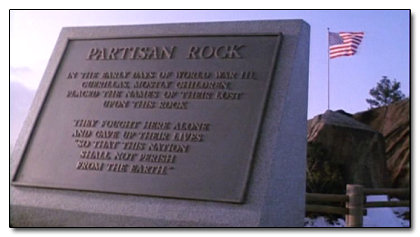
In the early days of World War III,
guerillas, mostly children,
placed the names of their
lost upon this rock.
They fought here alone
and gave up their lives
“so that this nation
shall not perish
from the earth”
Election Coverage
Tuesday’s election coverage was boring. Only Colorado voted this week and who cares?
Family Ties (Paramount Plus)
I watched an episode of this old 80s sitcom on Saturday morning. Michael J. Fox dreamt that he had to help Thomas Jefferson write the Declaration of Independence.
Full House (Disney+)
I watched four episodes of this infamous 90s sitcom on Saturday. In one episode, Jesse was fired from his band and replaced by Barry Williams. (That was actually funny.) In another episode, Stephanie was tempted to start smoking. Then, I watched an episode in which Uncle Jesse was revealed to be a high school drop out. (Loser!) And finally, I watched a truly terrible episode in which Jesse dressed his baby sons up as Elvis so that they could win a Cutest Twins contest. Seriously, this was a terrible show but I have a feeling I’m going to end up watching a few more episodes tomorrow. It’s strangely addictive.
It’s Always Sunny In Philadelphia (Hulu)
I watched four episodes on Saturday. The Gang went on Family Fight. The Gang went to the water park. Wolf Cola turned into a marketing disaster. And, Mac and Dennis battled the recession by giving out totally worthless Paddy Dollars. I still crack up at the idea of Frank selling knives door-to-door.
King of the Hill (Hulu)
There aren’t many classic 4th of July episodes out there. Back in the day of traditional network schedules, most TV shows were on hiatus during the summer and, as a result, Independence Day never got as much attention in TV Land as Halloween, Thanksgiving, and Christmas. That said, there are a few good episodes out there. On Saturday, I watched the “Born Again On The 4th Of July” episode of King of the Hill. From the show’s 13th season, it featured Bobby going through a religious phase and trying to stop the Independence Day rivalry between Hank and his neighbors. It wasn’t the strongest episode of King of The Hill — for one thing, Bobby had already gone through a religious phase a few seasons earlier — but no matter. Even the weaker episodes of King of the Hill are better than the best episodes of many sitcoms.
The Office (Peacock)
The Client, an episode from the second season, is not a 4th of July episode. It’s the episode where Michael and Jan have a lunch meeting with a client that ends up going late into the night. Meanwhile, at the office, Pam discover Michael’s screenplay for Threat Level Midnight and Jim organizes a dramatic reading. Dwight announces that he has some left-over fireworks, which he and Kevin proceed to set off outside of the office. That was enough for me to justify watching it on July 3rd.
Portlandia (Netflix)
This morning, I watched the 4th of July BBQs episode of Portlandia. The Mayor had to find fireworks for the city’s celebration. A couple tried to cycle through every barbecue in town. A punk rock barbecue led to chaos. I enjoyed it! It was nice to see Kyle MacLachlan as the mayor.
Saved By The Bell (Tubi)
On Saturday morning, I watched the 4th of July “Miss Liberty” episode. (There really aren’t that many good 4th of July episodes out there.) The Malibu Sands episodes are always strange to me. Why would Zack work a summer job? Zack’s rich!
What I Like About You (Tubi)
Tubi has the first two seasons of What I Like About You! The only problem is that they’ve replaced the cover of What I Like About You that originally played over the opening credits with his blandly generic, early aughts, girl group pop song. Bleh. The only reason I ever watched that show was because I liked that cover of What I Like About You. Anyway, I watched an episode where Amanda Bynes wanted to have a party at the loft and Jennie Garth didn’t want her to. All of the squeaky voices hurt my ears.
My best friend Evelyn and I have a long-standing pact. If either one of us dies mysteriously or suddenly disappears, the surviving friend will investigate the crime and bring those responsible to justice.
It’s the type of pact that you make when you realize how much your best friend actually means to you. Fortunately, I’ve never had to keep up my end of the pact because nothing has happened to my best friend. The truth of the matter is that it seems like it would actually be very difficult to independently solve a crime. I know that a lot of people thought that Michelle McNamara did that when she investigated the Golden State Killer but, if you actually read I’ll Be Gone In The Dark and then research the actual facts of the case, you can’t help but notice that all of McNamara’s theories were wrong. It’s not easy investigating a crime without a crime lab or a search warrant or the power to arrest people. There’s a reason why most crimes are solved by detectives and not by well-meaning civilians. Add to that, with my ADHD, there’s no way I’d be able to keep track of whatever clues I did find. Seriously, I fear that I would be useless in that situation.
If only life were a Lifetime movie!
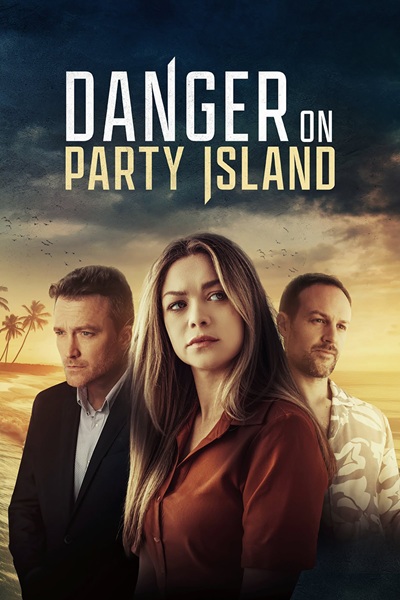
In 2o24’s Danger of Party Island, Mel Dale (Lindsey Dresbach) is a lawyer who is stunned to learn that her carefree sister, Georgia (Andrea Prevatt), has apparently washed up dead on the island of Fang Key. While her anxious mother waits for word in the States, Mel heads down to Fang Key and tries to figure what could have led to her sister’s death. The local police suggests that Georgia was on drugs and trying to cliff dive. Mel says that Georgia never drank or used drugs. (Why would you go to a “party island” if you didn’t drink or use drugs?) The police say that Mel should just go home and let them handle it. Mel says that she has to discover the truth. The police mention that Georgia’s best friend is missing too. Around this time, Mel finally figures out that the police aren’t going to be much help.
Mel’s investigation leads her to darkest corners of a party island. She befriends hunky club owner Jever (James Bobo), despite everyone telling her that Jever is actually bad news. She comes to suspect that Georgia might not even be dead. This suspicion seems to be confirmed when Georgia suddenly starts posting cheerful videos to her social media accounts. Again, everyone tells Mel that she should just go home but Mel is convinced that someone is holding Georgia against her will. Meanwhile, Mel and Georgia’s mother keeps threatening to come to the island and take over the investigation herself.
The cool thing about Danger on Party Island is that all Mel really needs to launch an investigation is a lap top and a good search engine. That certainly gave me some hope because, if I ever do have to solve a crime, I know all of the best search engines. The other good thing about Danger on Party Island is that the island was really pretty. This was a film where the plot was so-so but the scenery was lovely. Director Danny J. Boyle did a good job of contrasting the beauty of the island with the darkness of some of the things going in the shadows.
I just wish that the film had been a little bit more fun. This is a film that did indeed embrace the melodrama but I still found myself wishing that it had embraced it even more. Instead, the film’s big finale felt anti-climatic and things just never got as over-the-top as they should have. Danger On Party Island had a beautiful island but it still needed to be more of a party.
In the end, this Lifetime film held my attention. It didn’t quite live up to the melodramatic promise of its name but at least it suggested that solving a crime isn’t as hard as it looks.
I can only hope!
1972! Now, that’s a presidential election that I’m sorry I wasn’t around to witness!
1972, of course, was the year that the Democrats nominated George McGovern and President Richard Nixon went on to win 49 states. McGovern was considered to be one of the most left-wing presidential candidates of all time. He started out as a dark horse but ultimately won the Democratic nomination after the more moderate Edmund Muskie’s campaign turned to be not as strong as people assumed and after Governor George Wallace’s campaign was ended by gunfire in Maryland. (Wallace survived being shot but spent the rest of his life in wheelchair.) McGovern’s campaign knew how to win a primary but had no idea how to win a general election. He ended up getting around 37% of the popular vote. He carried Massachusetts but he lost his home state of South Dakota.
Today, it’s usually assumed that Nixon’s victory was a foregone conclusion but that’s not true. The Republicans had a weak midterm in 1970. The Vietnam War was unpopular. Nixon, himself, had managed to upset both the conservative and the liberal wings of the Republican Party with some of his policies. Much as in 2020, a record number of candidates threw their hat into the ring to take on the incumbent President. 1972 is a great “What if” election. What if the Democrats had nominated Edmund Muskie or Hubert Humphrey? What if the Watergate burglars hadn’t been arrested? What if George McGovern hadn’t picked Thomas Eagleton for Vice President or later asked him to step down as his running mate? Would history be different today?
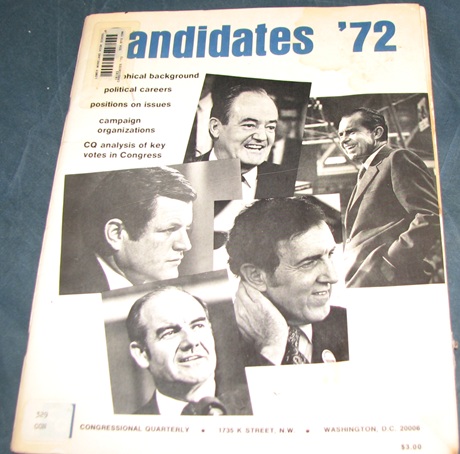
That’s why I’m glad that I have a copy of Candidates ’72.
Candidates ’72 was published, in 1971, by Congressional Quarterly. It featured profiles of the many men and women who ended up running for President in 1972. It not only detailed their backgrounds and their political stances but it also analyzed their chances of winning their party’s nomination. For a history nerd like me, this book is wonderful because it was written without the benefit of hindsight. It’s a chance to see what people were actually saying about the election of 1972 while it was going on. Often times, it’s quite different from the biased analysis that was written about the election after it had already happened.
The other reason why I like Candidates ’72 is because so many memorable people ran for the Presidency in that year. George McGovern, New York Mayor John Lindsay, U.S. Rep. Shirley Chisholm, Hubert Humphrey, Eugene McCarthy, Los Angles Mayor “Mad Sam” Yorty, George Wallace, Dr. Benjamin Spock, they are just some of the candidates profiled here. Reading the profiles really does reveal that America was at a crossroads in the early 70s. Much like today, a lot of people assumed that radicalism was ascendant while failing to consider just how serious the backlash would eventually become. Some of the other Democrats running actually made George McGovern look like a moderate. Meanwhile, on the Republican side, Nixon was challenged by an anti-war congressman named Pete McCloskey. McCloskey eventually lost his house seat in the 80s but briefly reemerged in 2006 as an environmentalist and anti-war activist. He was also a Holocaust denier so let’s be happy that he never got anywhere near the White House.
(It’s probably a sign of just how chaotic the 1972 election was that a few candidates — John Ashbrook, Terry Sanford — did not get profiled in Candidates ’72, presumably because they jumped into the fray after the book went to the presses.)
Here are the candidates and potential candidates who are profiled in Candidates ’72.
Republicans:
Democrats:
Independents:
Ran, but not profiled:
I ordered my copy of Candidates ’72 shortly after I ordered Candidates ’76. Sadly, my copy of Candidates ’72 is not in the best condition and I doubt I’ll ever find another copy. As a proud history nerd, though, I’m still happy to have it.
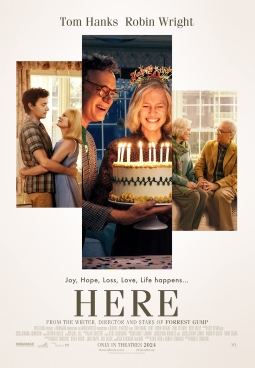
I really wanted to like Here.
Released in 2024, Here is the type of movie that I usually would like. It’s ambitious. It’s experimental. It’s about history and how certain patterns will always repeat themselves no matter what. It features Tom Hanks and Paul Bettany, two of my favorite actors. Also, unlike a lot of people, I haven’t turned on Robert Zemeckis. For the most part, I usually enjoy his movies, including the more recent ones. (Of course, when I say more recent, I’m thinking of The Walk, which came out eleven years ago. But still….)
Here has an intriguing concept. Over the course of 104 minutes, Here covers several thousand years of history. The stationary camera focuses on a single plot of land, which goes from being an area dominated by dinosaurs to being the road outside of Colonial Governor William Franklin’s house during the American Revolution to eventually becoming the living room of a house that is occupied by several different families. The story plays out in a nonlinear fashion with the marriage of Richard and Margaret Young (played by Tom Hanks and Robin Wright) ultimately dominating the narrative. We watch as people fall in love, sometimes fall out of love, and eventually die. With the exception of one key moment, the camera never moves. Instead, we watch as life plays out in front of the camera and it’s often left to our imagination as to what’s happening on the other side of the lens. When Margaret, at one point, complains about how she can’t stand to keep looking at the same couch day-after-day, we know exactly how she feels.
As I said, I really wanted to like this movie but, unfortunately, it just fell flat. We meet a lot of characters but no one really feels human. Instead, all of the dialogue and the action has the shallow snappiness of an old sitcom. It’s easy to imagine this film being aired with a laugh track and an audience going, “Awwww!” after every emotional moment. As a result, watching Here feels less like witnessing history unfold and more like flipping around the nostalgia channels and trying to pick which old sitcom you want to watch. Do you want to watch the show about Ben Franklin not liking his son or the show that features Paul Bettany as a veteran dealing with PSTD? Do you want a show about a pilot who dies during the Spanish Flu epidemic or about a masked-up husband during the COVID lockdowns? One of the film’s final scenes features a character who is suffering from Alzheimer’s visiting the house and suddenly announcing that they remember everything about living there. It’s a moment that is meant to be heartfelt but, instead, it feels insulting to anyone who has ever taken care of a loved one with dementia. Alzheimer’s is never cutesy, regardless of what the movies may tell us. In the end, very little of the film’s vision of humanity feels authentic.
The other big problem is that the film occasionally uses digital de-aging to try to convince us that Tom Hanks and Robin Wright are both teenagers and it just doesn’t work. Hanks is playing Paul Bettany’s son but, whenever the two actors appear at the same time, it’s obvious that Hanks is considerably older than his screen father. Unlike The Irishman, which had a strong story and enough good performances to convince the viewer to suspend their disbelief and accept the imperfect de-aging technology, the de-aging in Here just emphasizes how inauthentic the film’s story feels.
As I said earlier, this film had potential but, unfortunately, most of that potential goes unrealized.
And that really is a shame.
Previous Icarus Files:
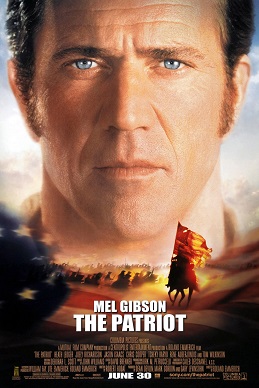
First released in the year 2000, The Patriot stars Mel Gibson (back before the arrests and scandals) as Benjamin Martin.
Benjamin Martin is a planter living in colonial-era South Carolina. When he was younger, he fought in the French/Indian War and was infamous for his ferocity as a combatant. However, in the year 1776, he is devoted to working the land and peacefully caring for his children. When, as a member of the South Carolina General Assembly, he is called upon to cast a vote for or against independence, he abstains. He’s no fan of the British but he’s also seen the harsh reality of war and doesn’t want his sons to have any part of it. However, the Assembly still votes for Independence and Martin’s oldest son, Gabriel (Heath Ledger), is among the first to enlist in the army.
Four years later, the British come to the Martin farm and demand that Benjamin had over a wounded Gabriel to them. When Benjamin resists, the arrogant Col. Tavington (Jason Isaacs) kills one of Benjamin’s other sons. After Tavington has Gabriel arrested, Benjamin and two of his remaining sons track down the British convoy transporting him. While his two youngest sons look on in horror, Benjamin savagely shoots and hacks to death all of the British soldiers and rescues Gabriel.
The Patriot may be a film about the American Revolution but it’s also definitely a Mel Gibson film. That means that Benjamin is man driven as much be revenge as by a desire to win his country’s independence. The British killed his son and burned down his house. Benjamin responds by grabbing his musket and packing his axe and soon, it’s more common than not to see Benjamin covered in blood. Benjamin attacks like a feral beast who is determined to dominate anyone and anything that would invade his territory. Two of his sons go from being honored to be asked to come along to being terrified at the sight of their father murdering soldier after soldier. It’s probably the most emotionally honest moment you’ll ever find in a Roland Emmerich film. Of course, whether Emmerich meant for it to be so is open to debate.
And indeed, it should be noted that The Patriot is very much a Roland Emmerich film. The running time is an epic 165 minutes. The battle scenes are long and loud and carefully choreographed. Gibson was still rugged and handsome when he played Benjamin Martin. (Both before his downfall and after, Gibson has always been best cast as people who just want to be left alone and who finally snap once it becomes obvious that’s not going to happen.) Heath Ledger almost appears beatific in his scenes. The film looks great without ever quite looking authentic. It’s like a fever dream that is less about how the American Revolution was actually fought and more about how we imagine it was fought.
And you know what?
The film works for me. This is one of Emmerich’s best films, which admittedly is not a high bar to clear. Yes, it’s a bit simplistic. Yes, it’s not historically accurate. Yes, all of the British are portrayed as being one-dimensional villains. Who cares? Whether he realizes it or not, Roland Emmerich has always been a B-movie maker at heart and The Patriot is effective in much the same way that many crude but shameless B-movies are. The mix of Mel Gibson’s madness, Heath Ledger’s beatific earnestness, and Jason Isaac’s arrogance transforms The Patriot into a triumph of the pulp imagination. Much like America itself, The Patriot is big and loud and it makes absolutely no apologies.
As some of our regular readers undoubtedly know, I am involved in a few weekly live tweets on twitter. I host #FridayNightFlix every Friday, I co-host #ScarySocial on Saturday, and I am one of the five hosts of #MondayActionMovie! Every week, we get together. We watch a movie. We tweet our way through it.
Tonight, for #ScarySocial, I will be hosting Attack of the Giant Leeches! It’s only an hour long so you watch it and still enjoy the fireworks!
If you want to join us on Saturday night, just hop onto twitter, start the film at 9 pm et, and use the #ScarySocial hashtag! The film is available on Prime and Youtube! I’ll be there co-hosting and I imagine some other members of the TSL Crew will be there as well. It’s a friendly group and welcoming of newcomers so don’t be shy!
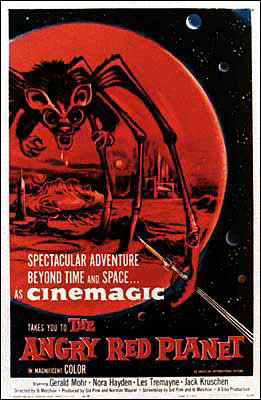
1960’s The Angry Red Planet opens with the return of the first manned space flight to Mars. When the rocketship reaches Earth, NASA is stunned to discover that only two members of the crew — Iris “Irish” Ryan (Naura Hayden) and Colonel Thomas O’Bannion (Gerald Mohr) — are still alive and that O’Bannion seems to have been infected by an intergalactic fungus of some some sort. Iris tells the story about what happened during their fateful trip to Mars.
I always enjoy the cheap science fiction films of the 50s and 60s, especially the ones that were made before America even conquered the Moon or really even went into space. Not having anything to really guide their vision of space travel, these films almost always trotted out the old war movie stereotypes and dressed them in a shiny space suit. In The Angry Red Planet, there’s gravity in space and Prof. Theodore Gettell (Les Termayne) smokes a pipe on the ship. Warrant Officer Sam Jacobs (Jack Kruschen, who, the same year this film came out, gave an Oscar-nominated performance in The Apartment) reads comic books and wonders if there will be any life on Mars. Meanwhile, O’Bannion flirts outrageously with Iris and everyone drinks coffee.
The film starts out as a standard low budget sic-fi flick, complete with sexist humor and scientific gobbledeegook, but things pick up once the crew actually reaches Mars. Of course, the Mars that they find has plant life and looks absolutely nothing like the Mars that we all know and love. That’s a part of the film’s charm. Whenever the crew leaves their rocket and explores the Martian landscape, the film suddenly becomes red-tinted. The tinting works far better than it really has any right to. That said, I did look away from the screen a few times. My eyesight is already bad enough without burning it up by watching a tinted movie.
The highlight of the film is…. well, sometimes it’s better just to let the visuals do the talking.
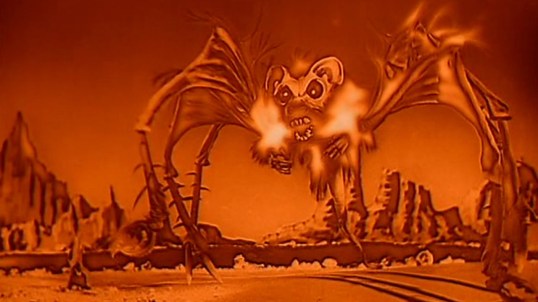
As soon as this fellow showed up, I knew that I was watching some sort of classic.
The Angry Red Planet is a thoroughly silly and implausible movie but, like most guilty pleasures, it’s also a lot of fun. It’s one of the least accurate science fiction films ever made and I love it.
Previous Guilty Pleasures
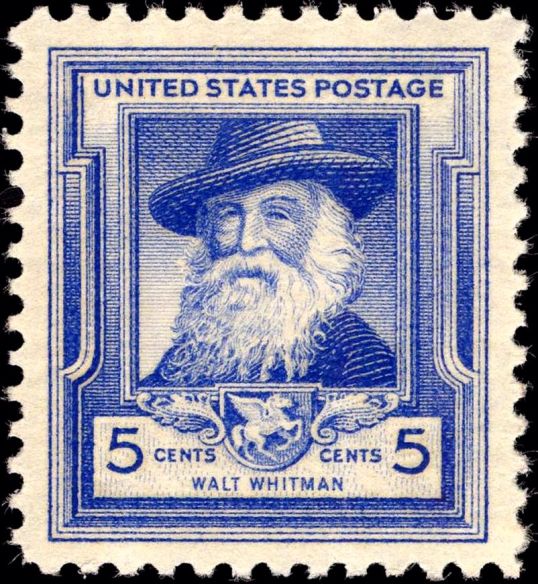
America
by Walt Whitman

