Retro Television Reviews: Fantasy Island 3.10 “Class of 69/The Pug”


Welcome to Retro Television Reviews, a feature where we review some of our favorite and least favorite shows of the past!  On Tuesdays, I will be reviewing the original Fantasy Island, which ran on ABC from 1977 to 1986.  Almost entire show is currently streaming is on Youtube!

This week, boxing comes to Fantasy Island!

Episode 3.10 “Class of 69/The Pug”

(Dir by Earl Bellamy, originally aired on November 24th, 1979)

Once again, this episode opens with no banter between Mr. Roarke and Tattoo.  Instead, Tattoo announces the arrival of the plane and rings the bell and then he and Mr. Roarke head down to the docks to meet their guests.  This is the third episode in a row without any pre-guest banter and I have to admit that I’m really missing it.

As for this week’s guests, they’re an improvement on last week’s rather forgettable offering.

Joey Lee (Gary Collins) is a former heavyweight boxer who comes to the Island with his son, Mitch (K.C. Martel).  Joey thinks that he’s just been hired to serve as a sparring partner for the world champion, Jackson Malone (Fred Williamson).  Jackson has a title defense coming up, right on the Island.  What Joey doesn’t know is that Mitch’s fantasy is for his father to have a shot at the championship.  When Malone’s opponent has to drop out of the fight, Joey is named as a substitute.  Mitch is excited, until he finds out that Joey is being pressured to take a dive in the third round.  Will Joey throw the fight?  And, even if Joey doesn’t, how will Mitch react to seeing his father getting pounded in the face by the world champion?  Will Mitch learn that his love for his father is more important than his father’s championship?

This fantasy was a typical Rocky rip-off, right down to Fred Williamson doing a credible Apollo Creed impersonation.  The problem, of course, is that the middle-aged and mild-mannered Gary Collins was in no way credible as a heavyweight boxer.  The fact that the world champion was played by an actual athlete didn’t help matters.  (It’s true that Carl Weathers, like Williamson, was also a football player before he played Apollo but Sylvester Stallone himself had been an amateur boxer before he played Rocky so it was easier to buy the idea of their match going the distance.)  In the end, I liked the fact that Mitch realized that his father’s health was more important than being champion.  The fantasy had a nice ending, even if it’s difficult to buy the set-up.

The other fantasy featured Adrienne Barbeau as Brenda Richards.  When she first arrives on Fantasy Island, Tattoo comments on how obese Brenda is, even though she’s only a few pounds overweight.  (Adrienne Barbeau wears a very unconvincing fat suit.)  Mr. Roarke explains that Brenda was humiliated at her high school prom when her date, arrogant jock Lance (Tim Thomerson), tricked her into undressing in the gym before then bringing in the entire senior class in to laugh at her.  (Yikes!)  The high school reunion is being held on Fantasy Island and Brenda’s fantasy is to get revenge.  Roarke gives her a potion which allows her to be thin for 48 hours.  (In reality, Barbeau just ditches the fat suit.)

At the reunion, Brenda tricks Lance into taking off his wig.  The entire senior class discovers that Lance is totally bald and they laugh and laugh.  Everyone is impressed with Brenda’s revenge except for Brenda’s old high school friend, Bernie Drexel (Fred Grandy, taking a break from The Love Boat).  Brenda sees that she was just as cruel to Lance as he was to her back in high school so she makes a public apology and encourages everyone to be kind to one another.  Barbeau then puts the fat suit back on.  Bernie says that Brenda will always be the most beautiful woman that he knows.  Awwwww!

I actually liked this fantasy, largely because of the chemistry between Barbeau and Grandy.  Plus, Tim Thomerson made a great arrogant jock.  I know that some people will say that this episode featured too many jokes about Brenda’s weight (especially considering the fact that, even before drinking the potion, Brenda was hardly obese) but I appreciated the fact that it had an anti-bullying message.  And if her romance with Bernie inspires Brenda to eat healthy and start getting regular exercise, all the better!

At the end of the episode, Mr. Roarke tells Tattoo that beauty is in the eye of the beholder.  “To me,” Mr. Roarke says, “you are six feet two inches tall.”

Uhmmm….yeah, I don’t know how I feel about that ending.  It seems like the show, whether intentionally or not, is saying that Tattoo will be forever unloved because of his height.  Even without the pre-guest banter, Roarke is finding ways to passive-aggressively taunt his assistant.  That’s life on Fantasy Island.

Heatseeker (1995, directed by Albert Pyun)


Directed and co-written by Albery Pyun, Heatseeker takes place in the near future, in the year 2019!  The world is a corrupt and dangerous place where the poor are getting poorer and the rich are getting richer.  Corporations are as powerful as governments.  (Albert Pyun, prophet.)  Each corporation is represented by an MMA fighter because it’s not enough that a corporation provide a needed good or service.  Their fighters also have to be able to win tournament after tournament.
Chance O’Brien (Keith Cooke) is a world champion fighter who is unique because he fights without corporate sponsorship and he is also not a cyborg.  While every other fighter has been “enhanced,” O’Brien remains all-natural.  Evil CEO Tsui Tung (Norbert Weisser) wants to show off his newest fighter, Xao (Gary Daniels).  Tung arranges for Chance’s girlfriend and trainer to be kidnapped as a way to force O’Brien to travel to New Manila and take part in the ultimate fighting tournament.  Tung’s plan is for Xao to defeat Chance while the entire world is watching.  Chance just wants to rescue his girlfriend, even if she is now being forced to train Xao.

Heatseeker, I watched in memory of director Albert Pyun.  Pyun was the master when it came to movies about cyborgs entering MMA tournaments and Heatseeker is typical of his films.  The plot is incoherent but no one is watching for the plot.  The fights are the attraction and Pyun doesn’t waste too much time before getting into them.  Gary Daniels and Keith Cooke may not have been the best actors but they were pros when it came to fight scenes and they both give it their all as the work their way to their inevitable final confrontation.  Since all of the fighters, except for Chance, are also cyborgs, that means that each match ends with sparks and exposed stainless steel.

Pyun fans will get exactly what they want out of Heatseeker.  Along with the tournament, Heatseeker also features performance from Pyun regulars like Tim Thomerson and Thom Matthews.  One thing it does not do is feature anyone seeking heart but you can’t have everything.


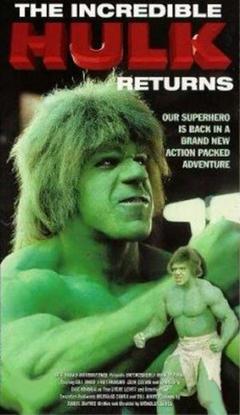
The Incredible Hulk Returns (1988, directed by Nicholas Corea)


Scientist David Banyon (Bill Bixby) has a secret.  His real name is David Banner and he has spent the last ten years in hiding, traveling up and down the highway and searching for a cure to a very strange condition.  As the result of getting dosed with gamma rays, David Banner sometimes transforms into an angry green monster known as the Hulk (Lou Ferrigno).  The world believes that David Banner is dead and Banner must let them continue to believe that until he can find a cure for the monster within.

The Incredible Hulk Returns is a continuation of the old Incredible Hulk television series, which was the first (and, until the MCU came along, only) successful attempt to build a live action show around a Marvel super hero.  Premiering in 1978, The Incredible Hulk ran for 5 seasons and got good ratings and, for a comic book series, surprisingly decent reviews.  However, it was also expensive to produce and it was abruptly cancelled in 1982, before the show got a chance to wrap up David’s story.  When The Incredible Hulk ended, David Banner was still alone and hitchhiking from town to town.  Six years later, The Incredible Hulk Returns caught up with David and tried to sell viewers on a “new” Marvel hero as well.

David “Banyon” is now living in California and working at the Joshua-Lambert Research Institute.  It’s been two years since he last turned into the Hulk.  He controls his rage by being careful not to get involved in any dangerous situations.  He also has a girlfriend, Dr. Maggie Shaw (Lee Purcell).  David is designing the Gamma Transponder, which he thinks will cure him of his condition.  Life’s good until Donald Blake (Steve Levitt) shows up.

A student of Banner’s, Blake recognizes his former teacher and approaches him with a crazy story.  When Blake was in Norway, he stumbled across a tomb that contained a hammer that contained the spirit of Thor, a Viking warrior who was banished to Earth by Odin.  To prove that he’s telling the truth, Blake commands Thor to emerge from the hammer.  When Thor (played by Eric Kramer) does, he makes such a mess in the laboratory that David transforms into the Hulk.

Thor is not Banner’s only problem.  Jack LeBeau (Tim Thomerson!) and Mike Fouche (Charles Napier!!) want to steal the Gamma Transponder and turn it into a weapon.  Also, reporter Jack McGee (Jack Colvin) s back in town and still obsessed with proving that the Hulk exists.

The Incredible Hulk Returns may be a continuation of David Banner’s story but the main reason it was filmed was so it could serve as a backdoor pilot for a Thor television series.  The Thor TV series never happened and, for those who are used to Chris Hemsworth’s comedic take on Thor, it’s jarring to see Eric Kramer playing the role like a third-tier professional wrestler.  For fans of The Incredible Hulk TV series, it’s even more jarring to see the Hulk fighting alongside a viking.  Unlike the comic book, the TV series usually tried to ground its stories in reality, with Banner’s transformations into the Hulk serving as the show’s only concession to its comic book origins.  The villains played by Thomerson and Napier both seem like typical bad guys from the show’s heyday but Thor just doesn’t belong.  Fans of the show will resent Thor taking the spotlight away from David Banner and the Hulk while fans of Thor will notice that this version of Thor is apparently not the god of thunder but instead just an egotistical viking who got on Odin’s nerves.

Bill Bixby was always The Incredible Hulk‘s not-so-secret weapon, taking and playing his role very seriously.  He continues to do that in The Incredible Hulk Returns but how seriously can anyone come across when they’re speaking to Thor?  By the end of the movie, Thor and Blake head off on their own adventures while Banner resumes hitchhiking.  Thor and Blake would not be seen again but David Banner’s adventures would continue in The Trial of the Incredible Hulk.

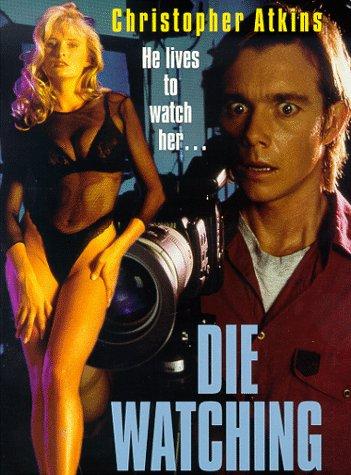
Cinemax Friday: Die Watching (1993, directed by Charles Davis)


Mentally scarred by the night that his mother murdered his father, Michael Terrence (Christopher Atkins) is a video editor who makes his living filming naked models and who deals with his mental issues by then asphyxiating those same models.  Michael’s main kink is that he ties his victims up in front of a monitor and then films them as they die, basically forcing them to witness their own murders.  In other words, Michael is one sick puppy who has perhaps seen Michael Powell’s Peeping Tom a few too many times.

Despite the fact that dead actresses and models are turning up all over Los Angeles, Detectives Lewis (Tim Thomerson) and Barry (Carlos Palomino) have no idea that Michael is responsible.  In fact, no one suspects Michael.  His neighbor, an aspiring artist named Nola (Vali Ashton), even hires Michael to help her promote her artwork.  Despite the fact that Nola already has a boyfriend, she and Michael fall in love.  Falling in love causes Michael to lose his urge to kill but it may already be too late as a video of one of his murders has fallen into the wrong hands.

For some reason, Christopher Atkins was a direct-to-video and Cinemax mainstay in the 90s.  I’ve never understood why because he was a terrible actor with absolutely no screen presence.  Unlike C. Thomas Howell, who was bland in mainstream films but usually surprisingly good when he did direct-to-video work, Atkins was always forgettable regardless of whether he was appearing in a major studio production or something like Die Watching.  For a film like this to work, the film has to convince you that there’s at least a chance the murderer could have been a decent human being if not for his tragic past.  Atkins just comes across like a natural born weirdo.  Atkins gives a sweaty and nervous performance but he makes Michael so obviously disturbed that it’s impossible to buy that Nola would dump her boyfriend for him.  Judd Nelson or, again, C. Thomas Howell probably could have pulled off the role.  Christopher Atkins just feels wrong.

Of course, the target audience for this film doesn’t care about the acting or the plot or anything else.  They care about the women and those who watch a film like this solely for the nudity won’t be disappointed.  Vali Ashton is actually really likable as Nola, though the film is stolen by Erika Nann, who plays Nola’s sex-obsessed roommate and who gets the best lines.  (Of course, there’s a difference between getting the best lines in Die Watching and getting the best lines in something like Hamlet.)  It’s also good to see Tim Thomerson in practically anything, even when it’s something as dumb as Die Watching.  

Die Watching is pretty dire but it does predict the rise of a very specific type of internet culture.  When Michael accidentally sends one of his murder tapes to a producer instead of one of his sex tapes, the producer is not disturbed but instead, he’s intrigued by the commercial possibilities.  Even Michael knows that’s messed up!  If Die Watching were made today, of course, that producer would probably own an adult website and he would be talking about selling the murder videos on the dark web.  It just goes to show that the more things chance, the more they remain the same.


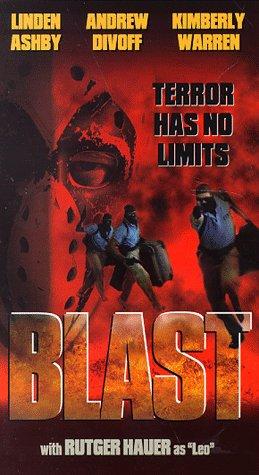
Cinemax Friday: Blast (1997, directed by Albert Pyun)


Blast opens with a title card telling us that what we’re about to see is based on a true story except that it’s not.  In the days leading up to the 1996 Atlanta Olympics, the FBI thwarted many potential terrorist plots.  Only one of the plots was a domestic terror plot.  Blast is the story of what would have happened if that plot had not been disrupted.

(What about Eric Rudolph and the Olympic Park bombing?  That’s not mentioned, probably because this film went into production before the Atlanta Olympics actually began.)

Omodo (Andrew Divoff of Wishmaster fame) is a terrorist who does evil things because he’s evil.  He and his group have taken the American Olympic swim team and their coach, Diane Colton (Kimberly Warren), hostage in an Atlanta gym.  They’re demanding money and an opportunity to escape.  The police (led by Tim Thomerson) don’t know what to do.  The FBI (represented by Rutger Hauer with braided hair) are not much help either.  Fortunately, the gym’s janitor, Jack Bryant (Linden Ashby), is a former Olympic gymnast who is a master of Tae Kwon Do!  Jack also happens to be Diane’s ex-husband!

Blast comes from us the time when every action movie was a blatant rip-off of Die Hard and we were all cool with that because Die Hard was so awesome that it deserved to be remade a thousand times.  Blast is more of the usual.  Jack sneaks around the facility, defuses bombs, and picks the terrorists off.  Omodo kills two hostages in cold blood.  Shannon Elizabeth of American Pie fame plays one of the hostages but she doesn’t get many lines beyond, “Help us!”  Why does Rutger Hauer have his hair in braids?  Because he was Rutger Hauer and everyone was probably so happy to have him on set for a few hours that they were willing to let him do whatever he wanted to do with his hair.  Rutger Hauer only gets about five minutes of screentime but he makes the most of them.

Lindsen Ashby is convincing in the fight scenes but I think the movie would have been better if he had just been an ordinary janitor, instead of a Tae Kwon Do supstar who has fallen on hard times.  That would have added some suspense to the story because, as it is, Jack is so obviously superior to his opponents that there’s never really any question as to whether or not he’s going to succeed.  Andrew Divoff is a good actor but his villain isn’t given any good lines and the people working for him are all pretty bland.  One of the best things about the first three Die Hard films was that the villains were just as interesting as the hero but the same cannot be said for Blast.

Blast is forgettable but still, five minutes of Rutger Hauer is better than no Rutger Hauer at all.

Horror Film Review: Near Dark (dir by Kathryn Bigelow)


The 1987 film Near Dark is the story of two American families.

The Coltons are a family of ranchers living Oklahoma.  Loy Colton (Tim Thomerson) is the patriarch, keeping a watchful eye on his children, Caleb (Adrian Pasdar) and Sarah (Marcie Leeds).  Caleb is a cowboy and a nice guy, even if he does seem to be a little bit too naive for his own good.  After Caleb disappears one night, Loy and Sarah start their own search, traveling across the back roads of the Southwest.

The other family may not share any biological relation to one another but they definitely share blood.  They’re a group of outcasts who have found each other and now spend their nights searching for people who can satisfy their hunger.  They’re vampires, even though that’s not a word that they tend to use.  (In fact, for all the blood-sucking that goes on throughout the film, the term “vampire” is never actually heard.)  At night, they’re all-powerful but during the day, even the slightly exposure to the sun can set them on fire.

The patriarch of this family is Jesse Hooker (Lance Henriksen), a scarred war veteran.  Jesse will do anything to protect the members of his family but he expects each of them to pull their weight.  At one point, when Jesse is asked how old he is, he says that he fought for the South and that the South lost.

Jesse’s girlfriend is Diamondback (Jenette Goldstein), who is just as ruthless as Jesse.  Filling the role of oldest son is Severen (Bill Paxton), a cocky gunslinger with a quick smile and cruel sense of humor.  Homer (Joshua Miller) appears to be a 12 year-old boy but he’s actually one of the older and more violent members of the family.  And then there’s Mae (Jenny Wright), the rebellious daughter.

Mae is the one who first met and bit Caleb.  She’s the one who turned Caleb into one of them, though it takes Caleb a while to not only discover but also understand what he’s become.  When Caleb tries to escape from Mae and his new family, he becomes violently ill.  He can no longer eat human food but, at the same time, he can’t bring himself to hunt.  Instead, he’s forced to drink whatever blood Mae can provide for him.  Even when Jesse’s group attacks a redneck bar, one cowboy manages to escape, specifically because Caleb cannot bring himself to kill him.

What is Caleb to do?  He can’t return to his old family, as much as he may want to.  (It doesn’t help that Homer has developed an obsession with Caleb’s sister, Sarah.)  At the same time, his new family says that they’re going to kill him unless he starts hunting for blood.  They only thing keeping Caleb alive is the fact that Mae likes him and even she’s telling him that he’s going to have to hunt.

Meanwhile, Loy continues his own hunt, the hunt for his son….

Long before she became the first female director to win an Oscar for The Hurt Locker, Kathryn Bigelow directed this stylish vampire film.  Visually, Bigelow emphasizes the emptiness of the Southwestern plains.  Looking at the desolate landscape, it’s easy to believe that Jesse and his family could use them to successfully hide from the rest of the world.  It’s also just as easy to believe that a well-meaning but not particularly bright young man like Caleb could get lost and not be able to find his way home.  Bigelow turns the vampire family into a group of modern-day outlaws, crossing the land in their sun-proofed vehicles and trying to stay one step ahead of modern-day posses made up by concerned families and law enforcement officers who don’t know what they’re getting into.

Even if not for Bigelow’s stylish direction, the film would be a classic for just the cast alone.  Henriksen, Paxton, and Goldstein all previously appeared in James Cameron’s Aliens and they have a camaraderie that feels real.  In fact, the vampires work so well together that it’s impossible not to kind of admire them.  They’ve got it together and, even when faced with an army of police officers determined to make them step out into the sunlight, they don’t lose their sardonic sense of humor.  The much missed Bill Paxton’s performance is a hyperactive marvel, both menacing and sexy at the same time.  Meanwhile, Jenny Wright and Adrian Pasdar have a likable chemistry as Mae and Caleb while Tim Thomerson makes Loy’s love and concern for his son feel so real that adds an unexpected emotional depth to the overall movie.  The script, written by Eric Red and Bigelow, is full of quotable dialogue and the cast takes full advantage of it.

Near Dark is vampire classic and definitely one to watch this Halloween season.

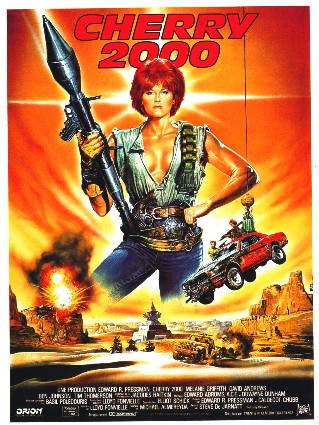
Film Review: Cherry 2000 (dir by Steve De Jarnatt)


Okay, so this one is kind of weird.

Remember how, a few nights ago, I watched and reviewed something called Prison Planet?  No?  Well, I don’t blame you.  I wish I could forget about it too.  Anyway, the movie that aired right before Prison Planet was yet another futuristic tale that was largely set in a desert wasteland.  This movie was originally released in 1988 and the title was Cherry 2000.

Cherry 2000 takes place in 2017, or perhaps I should say that it takes place in 2017 as imagined by someone in 1988.  In this film’s version of 2017, both the economy and the environment are a mess, America is divided into warring urban and rural zones, and all human emotion and creativity is being stifled by government bureaucracy.  In short, Cherry 2000‘s version of 2017 is a lot like the real world’s version of 2017…

In the future, everyone’s still obsessed with getting laid but all of the bureaucratic red tape has made things difficult.  Having sex now means first getting a lawyer to draw up a contract.  In order to avoid all of the legal complications, men are now marrying specially designed sex robots.  Again, this probably seemed way out there in 1988 but, in the current world, it just looks like my twitter timeline.

(Do they have sex robots for women in the world of Cherry 2000?  As far as I could tell, all of the sex robots in the film were designed for men’s pleasure, which doesn’t seem quite fair.)

Anyway, Sam Treadwell (David Andrews) is a business executive who thinks that he is deeply in love with his robot wife, Cherry 2000 (Pamela Gidley).  However, a mix of sex and a broken washing machine causes Cherry to short-circuit.  When Sam tries to get her repaired, he’s told that it’s a lost cause.  Cherry is beyond repair.  Add to that, apparently the Cherry 2000 model is no longer being manufactured.  If Sam wants a new Cherry, he’s going to have to go into Zone 7 and get one out of an abandoned factory.

So, of course, that’s what Sam does.  The only problem is that Sam is a business guy and Zone 7 is the most dangerous place in the world.  Why is it so dangerous?  Because it’s ruled by a warlord named …. Lester.  (No offense meant to anyone named Lester but that’s not exactly the most intimidating name in the world.)  Lester is played by B-movie mainstay Tim Thomerson, who appears to be having fun whenever he appears on-screen.

To help guide him through Zone 7, Sam hires E (Melanie Griffith).  E is the film’s saving grace, largely because she kicks everyone’s ass.  The great thing about E is that, from the minute she first appears, she makes no secret of the fact that she finds Sam and his sex robot to be just as pathetic and ridiculous as we do.  Griffith plays the role with just the right mix of humor and annoyance.  If I ever have to guide anyone through a desert wasteland to a sex robot factory, I hope that I can do it with half as much style and panache as E.

Anyway, Cherry 2000 is a weird little mix of the western and science fiction genres.  For a film about sex robots, it actually has a rather goofy and almost innocent feel to it.  It’s a film that raises a lot of issues but which is also smart enough not to spend too much time on any of them.  Director Steve De Jarnatt also directed one of my favorite 80s movies, the charming apocalyptic love story Miracle Mile.  Cherry 2000 may be a mess but it’s definitely a watchable mess.

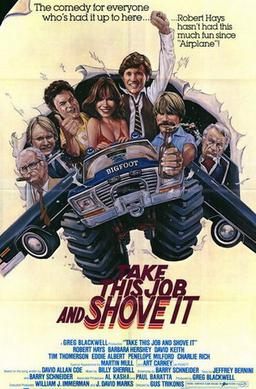
A Movie A Day #259: Take This Job And Shove It (1981, directed by Gus Trikonis)


Originally from a small town in Iowa, Frank Macklin (Robert Hays) is a hotshot young executive with The Ellison Group.  When Frank is assigned to manage and revitalize a failing brewery in his hometown, it is a chance for Frank to rediscover his roots.  His childhood friends (played by actors like David Keith, Tim Thomerson, and Art Carney) may no longer trust him now that Frank wears a tie but it only takes a few monster truck rallies and a football game in a bar for Frank to show that he is still one of them.  However, Frank discovers that the only reason that he was sent to make the brewery profitable was so that his bosses could sell it to a buffoonish millionaire who doesn’t know the first thing about how to run a business.  Will Frank stand by while his bosses screw over the hardworking men and women of the heartland?  Or will he say, “You can take this job and shove it?”
Named after a country music song and taking place almost entirely in places stocked with beer, Take This Job And Shove It is a celebration of all things redneck.  This movie is so redneck in nature that a major subplot involves monster trucks.  Bigfoot, one of the first monster trucks, gets plenty of screen time and, in some advertisements, was given higher billing than Art Carney.

A mix of low comedy and sentimental drama, Take This Job And Shove It is better than it sounds.  In some ways, it is a prescient movie: the working class frustrations and the anger at being forgotten in a “booming economy” is the same anger that, 35 years later, would be on display during the election of 2016.  Take This Job And Shove It also has an interesting and talented cast, most of whom rise above the thinly written dialogue.  Along with Hays, Keith, Thomerson, Bigfoot, and Carney, keep an eye out for: Eddie Albert, Royal Dano, James Karen, Penelope Milford, Virgil Frye, George “Goober” Lindsey, and Barbara Hershey (who, as usual, is a hundred times better than the material she has to work with).

One final note: Martin Mull plays Hays’s corporate rival.  His character is named Dick Ebersol.  Was that meant to be an inside joke at the expense of the real Dick Ebersol, who has the executive producer of Saturday Night Live when Take This Job and Shove It was filmed and who later became the president of NBC Sports?

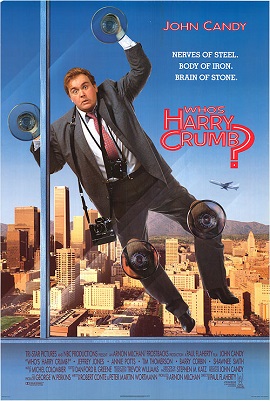
A Movie A Day #210: Who’s Harry Crumb? (1989, directed by Pat Flaherty)


Who’s Harry Crumb?

He is a private detective, the latest in a long line of gumshoes.  While Harry’s father and his grandfather may have been great detectives, Harry is about as incompetent as can be.  He is a self-styled master of disguise but not much else.  He is employed at Crumb & Crumb Detective Agency, solely because of his family background.  When the head of the agency, Eliot Draisen (Jeffrey Jones), engineers the kidnapping of a millionaire’s daughter, he gives the case to Harry because he knows Harry will never be able to solve it.

Who’s Harry Crumb?

He is John Candy, the much beloved and much missed comedic actor from Canada.  As anyone who has ever seen an old episode of SCTV knows, John Candy could be one of the funniest men alive but Hollywood rarely knew what to do with him.  Other than the movies that he made with John Hughes, Candy was always stuck in either supporting roles or in bad comedies.  In Art Linson’s A Pound of Flesh, veteran film producer Linson writes that, because of Candy’s size, some Paramount executives wanted to cast him as Al Capone in The Untouchables.  That is something that I would have enjoyed seeing.  Instead, some actor named Robert De Niro got that role and Candy ended up making movies like Who’s Harry Crumb?

Who’s Harry Crumb? tries to be a mix of comedy and mystery but, due to a weak script and uncertain direction, it does not really succeed as either.  John Candy delivers a few laughs because he was a naturally funny actor but, as a character, Harry Crumb is not that interesting.  Instead, the film is stolen by Annie Potts, playing a duplicitous femme fatale.  Potts and Candy previously came close to working together in the original Ghostbusters.  (Candy pulled out of the role of Louis Tully so that he could play Tom Hanks’s brother in Splash.  He was replaced by his SCTV co-star, Rick Moranis.)  The rest of the cast seems bored and uninterested in what they are doing.  Even Jeffrey Jones, usually so reliable in smarmy bad guy roles, seems bored.

John Candy died just 5 years after the release of Who’s Harry Crumb?, leaving behind two intriguing dream projects, one a biopic of Fatty Arbuckle and another an adaptation of A Confederacy of Dunces.  Sadly, Hollywood never really figured out what to do with this talented comedian.


Insomnia File #27: Remember My Name (dir by Alan Rudolph)


What’s an Insomnia File? You know how some times you just can’t get any sleep and, at about three in the morning, you’ll find yourself watching whatever you can find on cable? This feature is all about those insomnia-inspired discoveries!

If you were having trouble sleeping last Tuesday, around one in the morning, you could have turned over to TCM and watched Remember My Name, an odd and sometimes frustrating little thriller from 1978.

Remember My Name opens with Emily (Geraldine Chaplin) showing up in a small town in California.  From the minute we first see and hear Emily, something seems to be off about her.  She views the world through suspicious eyes.  Whenever anyone talks to her, you’re never quite sure whether she’s going be friendly or if she’s going to lash out.  When she speaks, there’s something weird about her vocal inflection, as if she’s always struggling to figure out what she’s supposed to say.  She seems to be separated from the world, almost as if she’s walking through a living dream and only talking to figments of her imagination.  There’s nothing about her that feels at all authentic.

She moves into a small apartment and enters into a relationship with her handyman (Moses Gunn), a relationship that seems to be largely defined by her refusal to open up about herself.  She gets a job at a grocery story that’s managed by a Mr. Nudd (Jeff Goldblum).  Mr. Nudd mentions something about Emily knowing his mother.  Apparently, they met in prison.

Soon, Emily is stalking a construction worker named Neil Curry (Anthony Perkins).  When Neil spots her, he calls out her name and Emily runs away.  And yet, Neil doesn’t bother to tell his wife, Barbara (Berry Berenson), about Emily.  Soon, Emily is even breaking into the Curry home, silently shadowing Barbara as she walks through the house.

I described Remember My Name as being a thriller and I guess that, technically it is.  There are a few moments of tension, especially when Emily is stalking Barbara.  However, the film itself is directed in a detached manner by Alan Rudolph.  Rudolph was a protegé of director Robert Altman (who also produced Remember My Name) and Rudolph’s approach is very Altmanesque, often to the detriment of the film.  (Chaplin and Jeff Goldblum had both appeared in several Altman films, most famously in Nashville.)  Though the film is dominated by Chaplin and Perkins, it’s still very much an ensemble film and the action plays out in a deceptively casual, almost random manner.  It tries so hard to be Altmanesque that Remember My Name gets a bit frustrating, to be honest.  Chaplin gives such a good and memorable performance and she works very hard to make Emily a character who is both frightening and, at times, surprisingly sympathetic but, for the most part, Rudolph’s technique makes it difficult to get emotionally involved in any of the action unfolding on-screen.  Rudolph observes the action but refuses to comment on it.  As a result, Remember My Name is occasionally intriguing but, just as often, it’s rather boring.  Just like real life, I suppose.  And, just like real life, it’s not for everyone.

That said, it was interesting to see Anthony Perkins playing a role other than a knife-wielding inn manager.  Without resorting to any of the familiar tics or the neurotic speech patterns that typecast him forever as Norman Bates, Perkins plays Neil as just being a regular, blue collar guy and he actually does a pretty good job.  Watching the film, I got the feeling that this was perhaps Perkins’s attempt to change his image.  (Whenever Neil appears shirtless, both the film and Perkins seem to be saying, Check out this physique!  Would someone only capable of playing a psycho have abs like this?)  Neil’s wife, Barbara, was played Perkins’s wife, Berry Berenson.  Neither one of them is with us any longer.  Perkins died of AIDS in 1990 while Berry Berenson was on one of the planes that flew into the World Trade Center on 9-11.  They both did good work in this film, as did Chaplin and Goldblum and, really, the entire cast.  It’s just a pity that the film itself isn’t as good as the performances. 

Previous Insomnia Files:

  1. Story of Mankind
  2. Stag
  3. Love Is A Gun
  4. Nina Takes A Lover
  5. Black Ice
  6. Frogs For Snakes
  7. Fair Game
  8. From The Hip
  9. Born Killers
  10. Eye For An Eye
  11. Summer Catch
  12. Beyond the Law
  13. Spring Broke
  14. Promise
  15. George Wallace
  16. Kill The Messenger
  17. The Suburbans
  18. Only The Strong
  19. Great Expectations
  20. Casual Sex?
  21. Truth
  22. Insomina
  23. Death Do Us Part
  24. A Star is Born
  25. The Winning Season
  26. Rabbit Run