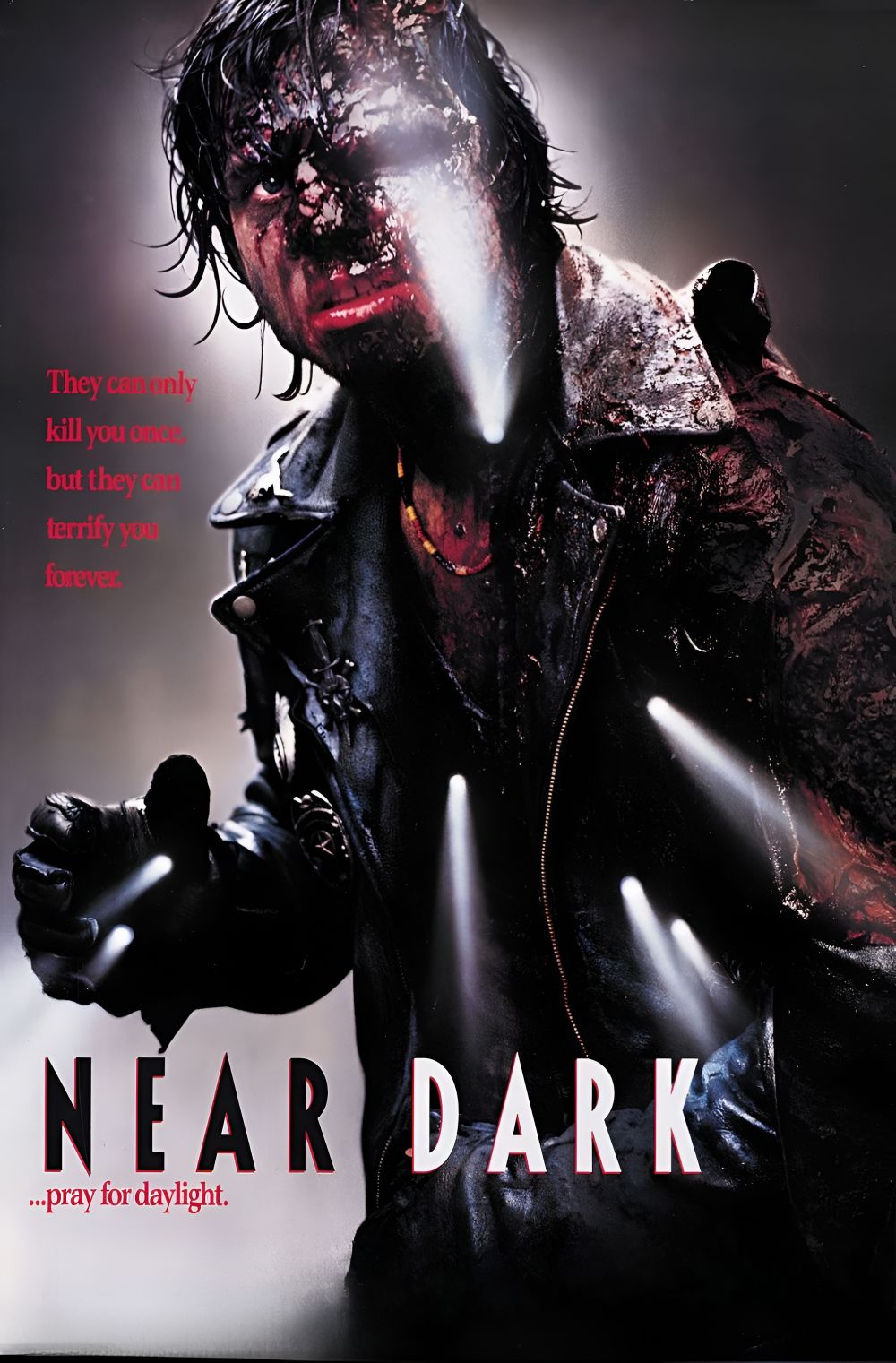
“Let’s put it this way: I fought for the South.” — Jesse
Most vampire movies make you wonder what it would feel like to live forever. Near Dark makes you wonder who you’d be stuck living forever with. In Kathryn Bigelow’s 1987 western-horror film, becoming a creature of the night means joining a small, volatile group whose affection comes with conditions and whose idea of a good evening could leave a roomful of people dead. There’s romance in this world, but very little comfort. Bigelow builds the movie around the uncomfortable possibility that finding people who understand you might be almost as dangerous as having nowhere to belong. It’s a scruffy, seductive horror film that knows how exciting bad company can seem before the bill arrives.
Caleb, played by Adrian Pasdar, doesn’t go looking for immortality. He’s a country boy looking for a little excitement when he meets Mae, played by Jenny Wright. Their early flirtation has the familiar awkwardness of two strangers trying to figure each other out, except one of them has a much better reason to worry about sunrise. A bite changes Caleb’s circumstances before he understands what he has gotten into. Soon he’s traveling with Mae’s vampire companions, who regard him less as a welcome addition than a problem she has brought home. He needs their help, but needing these particular people is its own kind of nightmare.
That dependence gives the story more tension than a simple battle between humans and monsters would offer. Caleb can’t just walk away and resume his old life, yet accepting the group means accepting what they do. The vampires aren’t interested in allowing him a long adjustment period. They expect him to feed, contribute, and stop making his confusion everyone else’s problem. There’s a darkly funny clash of perspectives here: Caleb is enduring an existential crisis, while his new companions are dealing with an irritating passenger. Bigelow makes their impatience recognizable without suggesting that their demands are reasonable.
The western elements give that conflict a natural shape. These vampires behave like an outlaw gang, traveling through an American landscape where staying mobile offers both freedom and protection. Their loyalty matters, but it exists within a closed circle. Anyone outside it is a potential resource, obstacle, or victim. That makes the genre combination feel purposeful rather than decorative. Westerns often find excitement in people who live beyond ordinary rules, and vampire stories have their own attraction to seductive outsiders. Near Dark brings those traditions together, then asks what their freedom looks like from the perspective of someone they decide to hurt.
Bigelow also understands how to make open space feel threatening. Roads and empty horizons usually suggest escape, but they provide little shelter when daylight arrives. The farther these characters get from civilization, the fewer places they have to hide. A miserable room can become more valuable than miles of beautiful countryside. That reversal gives the landscape an active role in the suspense. The vampires may dominate an encounter after dark, but their power comes with a deadline. No amount of swagger can change the time of sunrise, and the movie gets considerable mileage out of watching dangerous people suddenly become desperate.
The physical texture makes that desperation convincing. Clothes look worn, temporary accommodations feel uncomfortable, and traveling together seems like something everyone has done for too long. Immortality hasn’t brought these people luxury or even much convenience. They still have to find transport, secure shelter, and manage one another’s moods. Bigelow doesn’t stop the story to explain their routines, but the strain is visible. This is a particularly effective way of grounding the supernatural: the characters may have extraordinary abilities, yet their existence remains full of practical annoyances. Escaping ordinary human life has left them with a different set of exhausting obligations.
At the same time, the film never becomes so grimy that you lose sight of its appeal. Bigelow finds beauty in nighttime spaces, especially when Caleb and Mae are briefly alone. Darkness offers them privacy and the possibility of closeness, even as it connects them to everything threatening around them. Tangerine Dream’s electronic score helps sustain that contradiction. Its drifting, dreamlike sound creates an emotional distance from the rough surroundings without making them disappear. The music can make a moment feel tender and suspended, then leave the violence to shatter it. That push between attraction and alarm gives the film much of its distinctive atmosphere.
Bill Paxton embodies the alarming side as Severen, a vampire who seems thrilled that survival provides so many opportunities for bad behavior. He plays the role with outrageous confidence, making Severen funny without making him safe. The danger lies in how much pleasure he takes in every confrontation. He isn’t merely prepared to hurt someone if necessary; he appears disappointed when an evening doesn’t require it. Paxton makes that appetite entertaining enough to put the viewer in an awkward position. You look forward to seeing what Severen will do next while understanding that anyone actually standing beside him should be looking for an exit.
Lance Henriksen’s Jesse works through restraint rather than constant provocation. As the group’s leader, he has an authority that doesn’t need much advertising. Henriksen suggests long experience in the way Jesse watches people and decides how much patience they deserve. His steadiness makes the gang feel sustainable, at least on its own ugly terms. These aren’t simply predators who happen to be in the same vehicle. They have a structure, and Jesse helps hold it together. That structure gives Caleb’s possible acceptance real weight. He’s being offered a place in something established, not just permission to tag along until the next disaster.
The film’s strongest idea is that belonging can involve affection and coercion at the same time. The vampires’ attachments don’t have to be fake for their influence to be destructive. They can care about their own people while expecting those people to commit terrible acts. For Caleb, that makes the choice harder than rejecting an obviously empty promise. The group understands what he is becoming in a way his former world cannot. Their companionship answers a real need, but it also demands that he abandon the hesitation keeping him connected to his humanity. Acceptance is available, provided he becomes someone capable of earning it.
Mae gives that conflict its emotional center. Wright makes her vulnerable without turning her into a blameless observer of the gang’s behavior. She belongs to this life, and her attraction to Caleb doesn’t magically separate her from it. Their romance works best when it acknowledges that difficulty. She can offer tenderness without offering safety, and he can care about her without being able to live as she does. Pasdar is less immediately magnetic than the actors playing his traveling companions, but his relative ordinariness serves a purpose. Caleb still has recognizable limits, which gives the audience a way to measure how far the others expect him to go.
The roadhouse sequence makes those expectations impossible to avoid. As the gang terrorizes a bar, the movie strips away any comfortable distinction between their charisma and their cruelty. Bigelow allows the scene to be outrageous and darkly funny, particularly through Paxton, while keeping the vulnerability of the other people in view. It’s exciting filmmaking, but the excitement catches in your throat. For Caleb, the encounter is more than another demonstration of how dangerous his companions are. It’s a test of whether he can participate. He can’t remain indefinitely on the edge of their world, enjoying its romance while refusing its central activity.
That willingness to make the monsters compelling without excusing them is one of the film’s best qualities. Their humor, loyalty, and individuality matter, but none of those things makes their victims disposable. The movie holds both sides of that equation together better than it handles its eventual resolution. Without spelling out the mechanics, the route toward normality feels too convenient after Caleb’s predicament has become so physically and morally tangled. The emotional desire behind the ending is understandable; the storytelling shortcuts are less satisfying. A film so good at establishing the cost of this existence could have used a more difficult reckoning with escape.
Even so, Near Dark earns its place in the memory through the uneasy life it creates between attacks. The worn-out spaces, shifting loyalties, fleeting tenderness, and approaching daylight make the gang feel like more than a collection of horror characters. You can imagine them continuing down another road, having the same arguments and finding new strangers to consume. That’s what makes Caleb’s dilemma linger. The real threat isn’t simply that these people might kill him. It’s that he might become comfortable with them. Bigelow’s film is at its sharpest when the night looks beautiful, the company almost feels welcoming, and you remember exactly what staying would require.


