I Rewatched A League Of Their Own (1992, Dir. by Penny Marshall)


Last night, I saw that A League of Their Own was on Netflix. I tried to get my sister to watch it with me, but she just told me that she liked the high ones and called me a nag. (It makes sense if you’ve seen the movie.) So I rewatched it by myself and cried all over again.

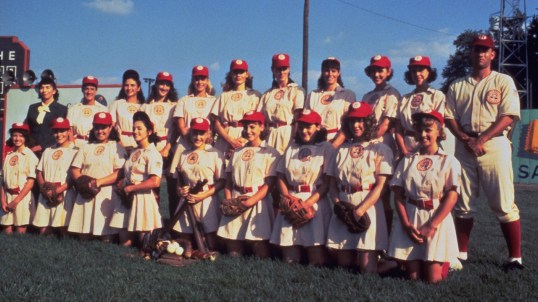
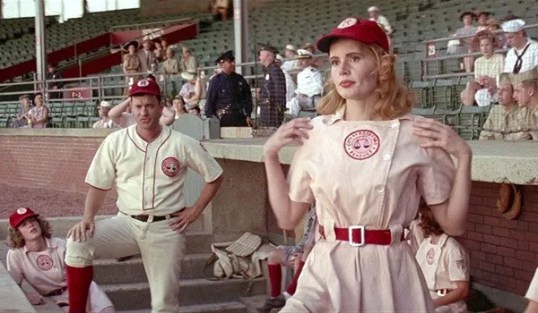
In case you’re one of the two people who haven’t heard of this movie, A League of Their Own takes place during World War II. With professional baseball players either enlisting or getting drafted, people worry there might not be another season of baseball until the war ends. Candy-bar manufacturer Walter Harvey (played by director Penny Marshall’s brother, Garry) creates the All-American Girls Professional Baseball League, with the requirement that the players not only know how to handle a bat but also look good in the impractical short skirts he expects them to wear while sliding into home. The movie follows the first season of the Rockford Peaches. Geena Davis plays Dottie, the catcher whose husband is serving overseas. Lori Petty plays Kit, the pitcher who struggles to hit high fastballs and who is also Dottie’s sister. Rosie O’Donnell and Madonna play two players from New York. Tom Hanks is Jimmy, the alcoholic former player turned manager who says, “There’s no crying in baseball!”
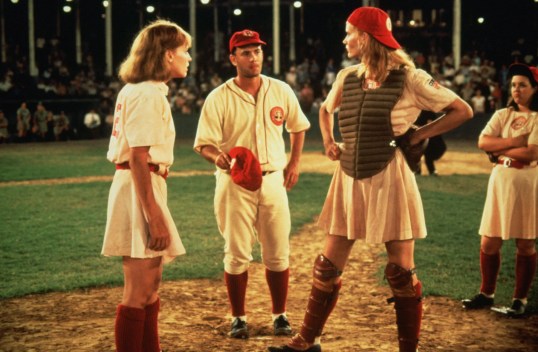
It may be heresy to admit it, but A League of Their Own is not my favorite baseball movie. (That would be Major League.) Most of the actresses, especially Geena Davis, are convincing as baseball players, and I love that the movie shone a light on the real-life AAGPBL. (Sixty former AAGPBL players appear in the movie.) But as a baseball fan, it’s always bothered me that the movie doesn’t really examine any of their games in depth. We know that Dottie is a good catcher, that Kit is a good pitcher, that Madonna can catch a baseball in her hat, and that Evelyn (Bitty Schram) cries when she gets yelled at, but we don’t learn much about the other players on the team and what they’re good at. The Peaches win games, but I would have liked to see more of how they won.

I still love A League of Their Own, though. The bonding between the players gets to me. They’re all from different parts of the country. Some of them are married and some of them are definitely single. But from the minute they’re selected to play in the AAGPBL, they form a family of their own. When one of them reveals that she’s never learned how to read, the players teach her. When Evelyn needs to bring her bratty problem child on the road, the team looks after him. When Jimmy makes Evelyn cry, the team rallies around Evelyn. Everyone remembers Jimmy saying there’s no crying in baseball, but they forget he got kicked out of the game afterward. (Jimmy eventually becomes a better coach.) When one player gets the telegram that her husband has been killed in the war, everyone cries. In the film’s epilogue, Evelyn’s son says that she was never happier than when she was playing for the Peaches, and I can understand why. The heart of the film is the relationship between Dottie and Kit. Even though you can guess from the start that Kit and Dottie are eventually going to end up on different teams and face each other in the big game, it’s still an emotional moment when they find themselves on opposite sides of the plate.

A League of Their Own is on Netflix, so watch it if you haven’t seen it before. Or, if you’re like me, rewatch it and try not to cry all over again when the former players reunite at the Baseball Hall of Fame. Hurry up, though. It’s leaving on September 30th.
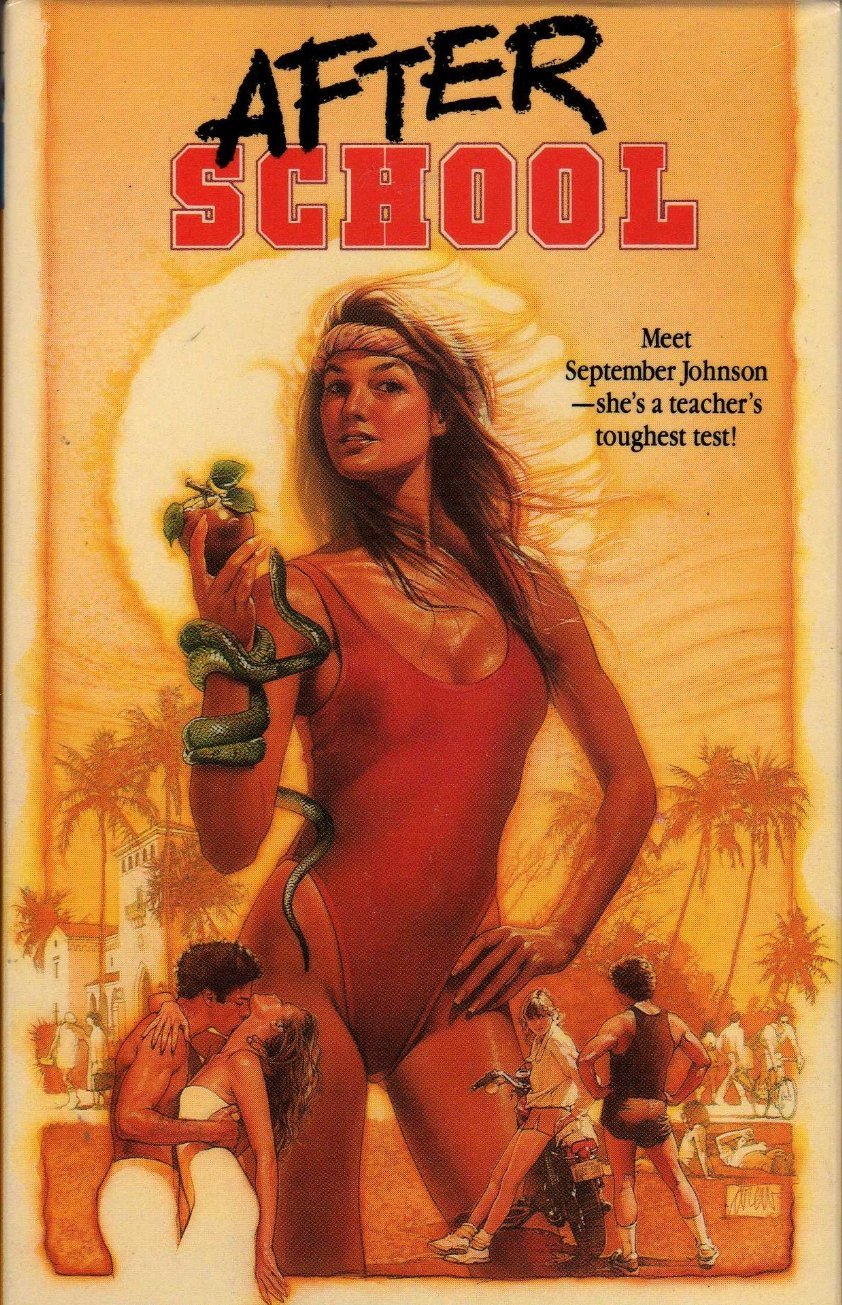


After School (1988, directed by William Olsen)


After School is a strange “what were they thinking?” type of movie.  It’s also probably the only movie to end with a religious debate that’s moderated by Dick Cavett.

Cavett plays himself.  In this film, he still has a talk show and one of his guests is going to be C.A. Thomas (Robert Lansing), a former priest who has written a novel claiming that man created God and not the the other way around.  Cavett has reached out to the Catholic Church to ask them to send someone to represent their views on the show.

For reasons that are never clear, the Church selects Father Michael McClaren (Sam Bottoms), who teaches at a college in Florida.  Father McClaren is youngish and he rides a motorcycle, which the monsignor thinks will appeal to younger viewers of Cavett’s show.  (Did The Dick Cavett Show have younger viewers?)  Because Dick Cavett is legendary for investigating the pasts of all of his guests (that’s what they say in the movie, anyway), another priest is sent down to Florida to make sure that Father McClaren does not have any skeletons in his closet.

At first, Father McClaren seems to be perfect but it turns out that he’s having a crisis of faith.  It’s not just that the local bikers don’t have much respect for a priest, even when who does ride a bike.  It’s also that he’s become attracted to one of his students, the improbably-named September Lane (Renee Coleman).  It doesn’t take the movie long to settle into a familiar pattern of September coming on Father McClaren and then Father McClaren having to run off so that he can pray for strength.

So far After School might sound like a typical movie about a priest being tempted to break his vows.  However, what sets After School apart from other films of its type is that there are frequent scenes featuring a group of cavemen living in prehistoric times.  It’s never really made clear why the cavemen are in the film.  The main caveman yells a lot and there’s a scene with a snake that suggests that he might live in the Garden of Eden.  (The movie was originally released under the title Return to Eden.)  There’s also several naked cavewomen who are in the film so that they can be ogled by the cavemen.  Oddly, the cavepeople scenes are full of broad comedy while the rest of the movie takes itself fairly seriously.

Why are the caveman there and what does it have to do with Dick Cavett?  Who knows?  That’s one of the many unanswered questions to be found in After School.  When C.A. Thomas and Father McClaren do finally meet on the Dick Cavett Show, they debate the origins of mankind.  Neither one has nothing new to say on the subject.  Even though everything that C.A. Thomas says sounds like New Age gobbledygook, Father McClaren proves himself to be incapable of countering him.

I don’t know what the point of After School was.  There were so any scenes, like one in which Father McClaren attends an aerobics class, that didn’t seem to have any purpose.  September’s lust for Father McClaren never makes any sense and his sudden declaration of love makes even less.  Even if you can make sense of all that, there’s still the cavemen and Dick Cavett to deal with.

After School thinks that it is about something but who knows what?

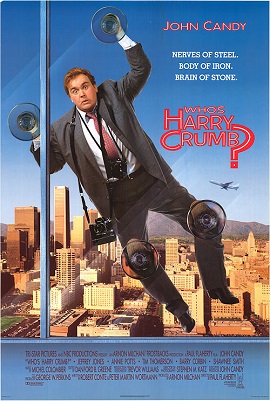
A Movie A Day #210: Who’s Harry Crumb? (1989, directed by Pat Flaherty)


Who’s Harry Crumb?

He is a private detective, the latest in a long line of gumshoes.  While Harry’s father and his grandfather may have been great detectives, Harry is about as incompetent as can be.  He is a self-styled master of disguise but not much else.  He is employed at Crumb & Crumb Detective Agency, solely because of his family background.  When the head of the agency, Eliot Draisen (Jeffrey Jones), engineers the kidnapping of a millionaire’s daughter, he gives the case to Harry because he knows Harry will never be able to solve it.

Who’s Harry Crumb?

He is John Candy, the much beloved and much missed comedic actor from Canada.  As anyone who has ever seen an old episode of SCTV knows, John Candy could be one of the funniest men alive but Hollywood rarely knew what to do with him.  Other than the movies that he made with John Hughes, Candy was always stuck in either supporting roles or in bad comedies.  In Art Linson’s A Pound of Flesh, veteran film producer Linson writes that, because of Candy’s size, some Paramount executives wanted to cast him as Al Capone in The Untouchables.  That is something that I would have enjoyed seeing.  Instead, some actor named Robert De Niro got that role and Candy ended up making movies like Who’s Harry Crumb?

Who’s Harry Crumb? tries to be a mix of comedy and mystery but, due to a weak script and uncertain direction, it does not really succeed as either.  John Candy delivers a few laughs because he was a naturally funny actor but, as a character, Harry Crumb is not that interesting.  Instead, the film is stolen by Annie Potts, playing a duplicitous femme fatale.  Potts and Candy previously came close to working together in the original Ghostbusters.  (Candy pulled out of the role of Louis Tully so that he could play Tom Hanks’s brother in Splash.  He was replaced by his SCTV co-star, Rick Moranis.)  The rest of the cast seems bored and uninterested in what they are doing.  Even Jeffrey Jones, usually so reliable in smarmy bad guy roles, seems bored.

John Candy died just 5 years after the release of Who’s Harry Crumb?, leaving behind two intriguing dream projects, one a biopic of Fatty Arbuckle and another an adaptation of A Confederacy of Dunces.  Sadly, Hollywood never really figured out what to do with this talented comedian.