Cinemax Friday: Blast (1997, directed by Albert Pyun)


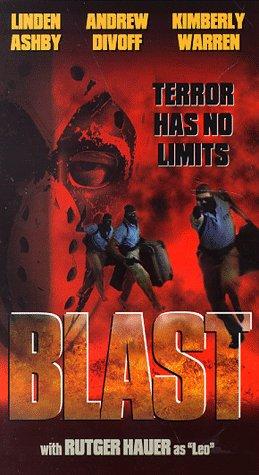
Blast opens with a title card telling us that what we’re about to see is based on a true story except that it’s not.  In the days leading up to the 1996 Atlanta Olympics, the FBI thwarted many potential terrorist plots.  Only one of the plots was a domestic terror plot.  Blast is the story of what would have happened if that plot had not been disrupted.

(What about Eric Rudolph and the Olympic Park bombing?  That’s not mentioned, probably because this film went into production before the Atlanta Olympics actually began.)

Omodo (Andrew Divoff of Wishmaster fame) is a terrorist who does evil things because he’s evil.  He and his group have taken the American Olympic swim team and their coach, Diane Colton (Kimberly Warren), hostage in an Atlanta gym.  They’re demanding money and an opportunity to escape.  The police (led by Tim Thomerson) don’t know what to do.  The FBI (represented by Rutger Hauer with braided hair) are not much help either.  Fortunately, the gym’s janitor, Jack Bryant (Linden Ashby), is a former Olympic gymnast who is a master of Tae Kwon Do!  Jack also happens to be Diane’s ex-husband!

Blast comes from us the time when every action movie was a blatant rip-off of Die Hard and we were all cool with that because Die Hard was so awesome that it deserved to be remade a thousand times.  Blast is more of the usual.  Jack sneaks around the facility, defuses bombs, and picks the terrorists off.  Omodo kills two hostages in cold blood.  Shannon Elizabeth of American Pie fame plays one of the hostages but she doesn’t get many lines beyond, “Help us!”  Why does Rutger Hauer have his hair in braids?  Because he was Rutger Hauer and everyone was probably so happy to have him on set for a few hours that they were willing to let him do whatever he wanted to do with his hair.  Rutger Hauer only gets about five minutes of screentime but he makes the most of them.

Lindsen Ashby is convincing in the fight scenes but I think the movie would have been better if he had just been an ordinary janitor, instead of a Tae Kwon Do supstar who has fallen on hard times.  That would have added some suspense to the story because, as it is, Jack is so obviously superior to his opponents that there’s never really any question as to whether or not he’s going to succeed.  Andrew Divoff is a good actor but his villain isn’t given any good lines and the people working for him are all pretty bland.  One of the best things about the first three Die Hard films was that the villains were just as interesting as the hero but the same cannot be said for Blast.

Blast is forgettable but still, five minutes of Rutger Hauer is better than no Rutger Hauer at all.
Cinemax Friday: Tactical Assault (1998, directed by Mark Griffiths)


War does strange things to people.

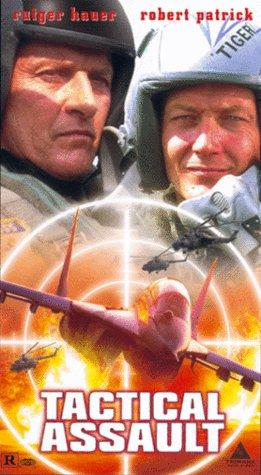
Captain Doc Holiday (Rutger Hauer!) was a damn good air force pilot until 1991.  During the Gulf War, he snapped and tried to shoot down a civilian airline that was flying over Iraqi airspace.  The only thing that stopped Holiday from committing a crime against humanity was his best friend, Capt. Lee Banning (Robert Patrick!!).  Banning fired on Holiday, shooting down his plane.  As a result, while Banning’s been moving up the ranks, Holiday has spent the last six years in an Iraqi POW camp.

By the time Holiday gets out, Banning is now a colonel and he’s married.  His wife (Isabel Glasser) is pregnant.  Banning seems to have everything he could want but he’s haunted by guilt over what happened to Holiday.  He arranges for Holiday to be assigned to his unit and tries to make amends.  Unfortunately, for Banning and his wife, Holiday holds a grudge and he’s played by Rutger Hauer so you know he’s not going to let things go anytime soon.

Is Tactical Assault worth tracking down?  It’s a low budge action movie that stars not only Robert Patrick but also Rutger Hauer so the answer should be obvious.  Of course it’s worth tracking down!  Robert Patrick and Rutger Hauer were direct-to-video film gods and putting them in the same movie is like getting the ghosts of Laurence Olivier, John Gielgud, and Ralph Richardson to all star in an afterlife production of Macbeth.  Along with being convincing in action scenes, both Robert Patrick and Rutger Hauer could actually act so there’s a little more more depth to Tactical Assault than just Top Gun-style dogfights.  Of course, if all you’re looking for is Top Gun-style dogfights, Tactical Assault has got you covered.  This is a movie that understands that some things can only be settled in the sky.

Finally, the main reason you should see Tactical Assault is because it has a scene where Rutger Hauer chases Robert Patrick … in a tank!  It doesn’t get much better than that!

Scenes That I Love: The “Tears In The Rain” monologue from Blade Runner (RIP, Rutger Hauer)


I just read that Rutger Hauer passed away on July 19th.  He was 75 years old.

Though Hauer played many great roles, most people will always think of him as the replicant Roy Batty in 1982’s Blade Runner.  One of Hauer’s most memorable scenes in that film was his final monologue.  Reportedly, Hauer himself came up with this monologue on the spot, feeling that the lines in the original script didn’t do justice to either the story or his character.

Rest in peace, Rutger Hauer.  He was one of the greats.

Horror Film Review: Buffy the Vampire Slayer (dir by Fran Rubel Kuzui)


Watching this movie was such a strange experience.

Now, of course, I say that as someone who grew up watching and loving the television version of Buffy the Vampire Slayer.  Back when Buffy was on TV, I was always aware that the character had first been introduced in a movie but every thing I read about Buffy said that the movie wasn’t worth watching.  It was a part of the official Buffy mythology that Joss Whedon was so unhappy with what was done to his original script that he pretty much ignored the film when he created the show.

So, yes, the 1992 movie version of Buffy the Vampire Slayer showed how Buffy first learned that she was a slayer, how she fought a bunch of vampires in Los Angeles, and how her first watcher met his end.  But still, Joss Whedon was always quick to say that the film should not be considered canonical.  Whenever anyone on the TV show mentioned anything from Buffy’s past, they were referencing Joss Whedon’s original script as opposed to the film that was eventually adapted from that script.  (For instance, on the tv series, everyone knew that Buffy’s previous school burned down.  That was from Whedon’s script.  However, 20th Century Fox balked at making a film about a cheerleader who burns down her school so, at the end of the film version, the school is still standing and romance is in the air.)  In short, the film existed but it really didn’t matter.  In fact, to be honest, it almost felt like watching the movie would somehow be a betrayal of everything that made the televisions series special.

Myself, I didn’t bother to watch the film version of Buffy the Vampire Slayer until several years after the television series was canceled and, as I said at the start of the review, it was a strange experience.  The movie is full of hints of what would make the television series so memorable but none of them are really explored.  Yes, Buffy (played here by Kristy Swanson) has to balance being a teenager with being a vampire slayer but, in the film, it turns out to be surprisingly easy to do.  Buffy is just as happy to be a vampire slayer as she is to be a cheerleader.  In fact, one of the strange things about the film is just how quickly and easily Buffy accepts the idea that there are vampires feeding on her classmates and that it’s her duty to destroy them.  Buffy’s watcher is played by Donald Sutherland and the main vampire is played by Rutger Hauer, two veteran actors who could have played these roles in their sleep and who appear to do so for much of the film.  As for Buffy’s love interest, he’s a sensitive rebel named Oliver Pike (Luke Perry).  On the one hand, it’s fun to see the reversal of traditional gender roles, with Oliver frequently helpless and needing to be saved by Buffy.  On the other hand, Perry and Swanson have next to no chemistry so it’s a bit difficult to really get wrapped up in their relationship.

I know I keep coming back to this but watching the movie version of Buffy is a strange experience.  It’s not bad but it’s just not Buffy.  It’s like some sort of weird, mirror universe version of Buffy, where Buffy starts her slaying career as a senior in high school and she never really has to deal with being an outcast or anything like that.  (One gets the feeling that the movie’s Buffy wouldn’t have much to do with the Scooby Gang.  Nor would she have ever have fallen for Angel.)  Kristy Swanson gives a good performance as the film version of Buffy, though the character is not allowed to display any of the nuance or the quick wit that made the television version a role model for us all.  Again it’s not that Buffy the movie is terrible or anything like that.  It’s just not our Buffy!

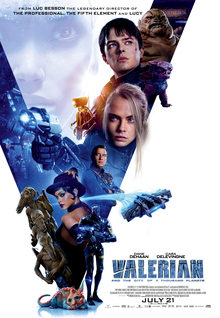
Playing Catch Up With The Films of 2017: Valerian and the City Of A Thousand Planets (dir by Luc Besson)


Valerian and the City Of A Thousand Planets is another film, much like The Dark Tower and this year’s Transformers movie, that I watched in a state of total and thorough confusion.

More than once, I asked myself, “What the Hell’s going on?  Who are those people?  Why are they blowing stuff up?  Why are they shooting at each other?  Who’s fighting who?  Wait, is he a good guy or a bad guy?  Is Valerian human or alien?  WHAT’S GOING ON!?”

But I have to admit that it really didn’t bother me that Valerian and the City of A Thousand Planets is an almost totally incoherent movie.  After all, Valerian is a Luc Besson film and Besson has always been a supreme stylist above all else.  That’s not to say that there’s nothing going on underneath the glossy visuals of a Besson film.  It’s just to say that Besson is one of the rare directors where the subtext is usually less interesting than what’s happening on the surface.

Take Valerian and the City of a Thousand Planets.  It takes place in the far future, on Alpha.  Alpha used to be the International Space Station but now it’s become a floating city where the inhabitants of a thousand different planets mix and socialize.  It’s a very cosmopolitan city, one where the only disturbance comes from obnoxious human tourists who are all either extremely British or extremely American.  Now, you could argue that Besson is making the argument that Alpha is meant to represent France but, if you spend too much time doing that, you’re going to miss just how amazingly Alpha has been visualized.  It’s not just that everyone in the movie says that Alpha is home to a million different creatures.  It’s that when the film travels to Alpha, you take one look at the screen and you believe it.

The film’s plot … well, this is where it gets difficult. It gets off to a truly brilliant beginning, with an intergalactic summit that takes place while David Bowie’s Space Oddity plays in the background.  After that, the film’s visuals were so amazing that I have to admit that I was usually too busy taking it all in to pay much attention to what was actually going on.  Valerian (Dane DeHaan) and Laureline (Cara Delevigne) are members of the special police force that has been created to protect Alpha and apparently the rest of the universe as well.  Valerian has strange dreams about a primitive race of people who live on a beach.  Laureline frets about Valerian’s recent proposal of marriage.  They’ve both been assigned to track down a creature, the last of its species, that is currently being sold in a black market.  It all links back to some secrets concerning their superior (Clive Owen) and a plot involving intergalactic refugees.

And, obviously, if you’re someone who insists on finding political subtext in every movie that you watch, there’s a lot to be found in Valerian‘s story about space refugees and government cover-ups.  But, honestly, none of that is as interesting as the effort that Besson has put into making his flamboyant universe come to life.  Valerian may be narratively incoherent but visually, it come close to proving Lucio Fulci’s theory of “absolute film.”  The plot is less important than the film’s visuals and how you, as the viewer, reacts to those visuals.  Even Dane DeHaan and Cara Delevingne seem to have been cast less for any acting ability they may have and more because the boyishly rugged DeHaan and the achingly pretty Delevingne both compliment the film’s visual scheme.  Valerian and the City of a Thousand Planets is cinematic pop art.

Movie A Day #333: Beyond Valkyrie: Dawn of the Fourth Reich (2016, directed by Claudio Fah)


The year is 1944 and a group of Germany officials and military officers, all of whom are secretly opposed to the Nazi regime, are plotting to assassinate Adolf Hitler.  A group of American and British operatives, led by Captain Evan Blackburn (Sean Patrick Flannery), have been dropped behind enemy lines.  Their mission is to protect the man who has been chosen to lead Germany after Hitler’s death but, after the assassination fails, Blackburn and his men find themselves with a new mission.  Working with a group of Russian soldiers, Blackburn tries to prevent a group of Nazis from fleeing to Argentina with a cache of stolen good.
The plot of Beyond Valkyrie is rooted in fact.  In June of 1944, Hitler was nearly assassinated by a group of high-ranking Germans who hoped to replace him with a more moderate leader.  (Historically, it’s questionable whether the majority of the conspirators were truly anti-Nazi or if they just felt that Hitler was mismanaging the war.)  At the same time, as it became evident that Germany was going to lose the war, many Nazi war criminals did escape to Argentina, where the government of Juan Peron provided them with sanctuary from prosecution.  Some of the most notorious Nazis reinvented themselves as businessmen in both South America and the Middle East.  (Others, like Klaus Barbie and Reinhard Gehlen, offered their services to any government that would accept them.)

The true story is so interesting that it’s unfortunate that Beyond Valkyrie is such a bad movie.  Basically, consider it to be Inglourious Basterds with none of Tarantino’s style or Christoph Waltz’s smiling menace.  Beyond Valkyrie is a war epic on a budget, a very low budget.  Neither the weak script nor the cheap-looking CGI does much to add authenticity to the movie.  There are a few familiar faces in the cast, though none of them are onscreen for long.  Rutger Hauer provides what little dignity Beyond Valkyrie has.  Tom Sizemore looks like he’s still recovering from the weekend.  Stephen Lang picks up his paycheck.  Sean Patrick Flanery does the best he can but he’s stuck with all the worst lines.

One final note: One of the Russian soldiers, played by Andrew Byron, is actually named Tolstoy.  I waited for Chekhov, Solzhenitsyn, and Dostoevsky to show up but they never came.

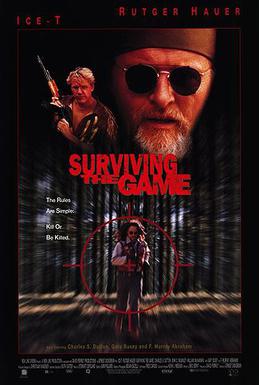
A Movie A Day #332: Surviving The Game (1994, directed by Ernest R. Dickerson)


Jack Mason (Ice-T) has been living on the streets of Seattle ever since the death of his wife and daughter.  When Cole (Charles S. Dutton), the friendly man at the soup kitchen, tells Mason that he can get him a job, the suicidal Mason accepts.  It turns out that a group of wealthy men are going on a hunting trip and they need a guide to lead them through the wilderness.  Mason accepts but, upon arriving, he discovers that the men (who are played by Rutger Hauer, F. Murray Abraham, William McNamara, John C. McGinley, and, of course, Gary Busey) are actually planning on playing the most dangerous game and hunting him for the weekend.
There are definitely better versions out there of Richard Connell’s famous short story.  One of the best, John Woo’s Hard Target, was released a year before Surviving the Game.  Both films share the idea of rich men hunting down the homeless for fun.  Surprisingly, it is Woo’s film that seems to take the idea, with all of its societal implications, more seriously.  Surviving the Game may present Jack Mason as being a suicidal homeless man but there is never any doubt that he is actually Ice-T, everyone’s favorite rapper and all-around badass.  But it’s precisely because Ice-T has such a recognizable persona that Surviving the Game is a guilty pleasure.  There is never any doubt that Ice-T can survive the game because Ice-T is the fucking game.  Matching Ice-T every step of the way is a rogue’s gallery of recognizable character actors, all of whom bring a different type of crazy to the proceedings.  When a movie delivers the spectacle of Ice-T being hunted by and then hunting Gary Busey and Rutger Hauer, it is easy to forgive whatever plot holes might be present in the script.

One final note: Surviving the Game was directed by Ernest R. Dickerson.  Dickerson got his start of Spike Lee’s cinematographer so it’s not surprising that Surviving the Game looks great.


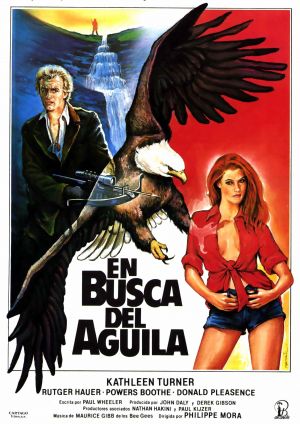
A Movie A Day #200: A Breed Apart (1984, directed by Philippe Mora)


Sometimes, the story behind a movie is more interesting than the movie itself.
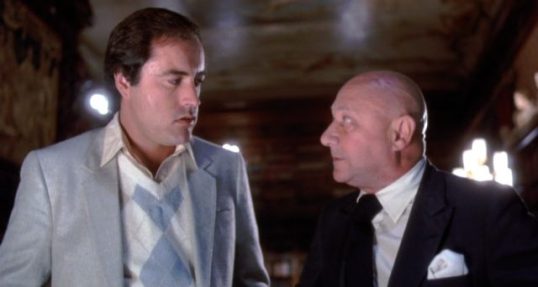

Rutger Hauer stars in A Breed Apart, playing an eccentric environmentalist named Jim Malden.  Malden loves nature but he hates people, with the exception of a local storekeeper named Stella (Kathleen Turner) and her young son.  The local fishermen (one of whom is played by Hauer’s Blade Runner co-star, Brion James) may hate him but they are no match for Malden’s guerilla tactics.  Recently, a new breed of bald eagle has been discovered and Malden is determined to protect it.  At the top of a cliff, there is a nest full of eagle eggs and Malden will not let anyone near them.

Rich collector J.J. Whittier (Donald Pleasence) is determined to get those eggs for himself.  In order to deal with Malden, Whittier hires famous rock climber, Mike Walker (Powers Boothe).  Disguising himself as a nature photographer, Walker attempts to befriend Malden so that he can get to the eggs.  Even as Malden shows Walker why it is important to protect the environment, Walker falls in love with Stella.

With a cast like this, A Breed Apart should have been far more interesting than it was.  It provides a rare chance to see both Rutger Hauer and Powers Boothe playing heroes but neither seemed to really be into their roles.  Kathleen Turner was sexy but saddled with a terrible accent while Donald Pleasence seemed to be in a different movie.  When I watched A Breed Apart last night, I thought it seemed like a very disjointed movie.  For instance, the movie abruptly jumped from Stella and Walker first meeting to the end of their first date.  There was a random scene of Malden putting on war paint, while remembering the sound of helicopters.  War paint combined with helicopters in an 80s movie usually means that someone is having a Vietnam War flashback but Malden’s military background is never mentioned again.  Even Walker’s conversion to Malden’s cause and rejection of Whittier’s money seemed to happen offscreen.

According to Wikipedia, It turns out that there was a reason for all that.  A Breed Apart was filmed in North Carolina.  After principal filming was completed, four reels of film were sent back to Los Angeles.  However, only three reels ever arrived in California.  One reel disappeared and has never been found.  The footage that actually did make it to Los Angeles was reorganized and edited to try to disguise the fact that a huge part of the movie was missing.

It didn’t work.

(ADDENDUM 9/4/2017: Originally, both myself and a lot of other reviewers, were under the impression that one reel of film went missing and, as a result, the film had to be reedited to make up for the missing footage.  This story is presented as fact on Wikipedia, which is where I and I assume a lot of other people originally got it.  The lesson here is not to use an online encyclopedia that anyone can edit for a primary or even a credible source.  In the comments below, Director Philippe Mora has let me know that there was no lost reel and that, instead, there are several different cuts of the film kicking around, some of which are incomplete and some of which are ok.  Since Mora actually worked on the film, he is a far more credible source than an anonymous Wikipedia article.  I apologize to Mr. Mora for the mistake.)

10 Sci-Fi Films That Should Have Been Nominated For Best Picture


Guardians-of-the-Galaxy-rocket-with-gun

Over the past few years, it’s gotten a little bit more common to see science fiction films nominated for best picture.  While a sci-fi film has yet to win best picture, it is no longer as much of a shock to see a science fiction film nominated.  At least not as much as it is to see a horror film nominated.

That said, it’s still an uphill fight.  Here are 10 science fiction films that I feel could and should have been nominated for best picture:

  1. Metropolis (1927)

Fritz Lang’s expressionistic silent epic remains one of the most influential films of all time.  Metropolis was eligible to be nominated during the first year of the Oscars, a year in which not one but two awards for best picture were handed out.  That Metropolis was nominated for neither Best Production nor Unique and Artistic Picture was a huge missed opportunity.

2. The War of the Worlds (1953)

This film may be over 60 years old but it’s still one of the best alien invasion films ever made.  And yes, I prefer the original to the Spielberg version.

3. The Time Machine (1960)

Morlocks, Eloi, and war … oh my!

4. Planet of the Apes (1968)

“A planet where apes evolved from man?”  No, not quite.  “YOU BLEW IT UP!  GODDAMN YOU TO HELL!”  Yes, that’s better.  Today, Planet of the Apes may seem more than a little bit campy but it’s still an unusually intelligent social satire.  Charlton Heston’s persona has never been better used.

5. 2001: A Space Odyssey (1968)

Can you believe that this classic from Stanley Kubrick was not nominated?  Kubrick got a directing nomination but, when it came to picking the best films of the year, the Academy nominated Oliver! and Rachel, Rachel.

blade%20runner%20final%20cut

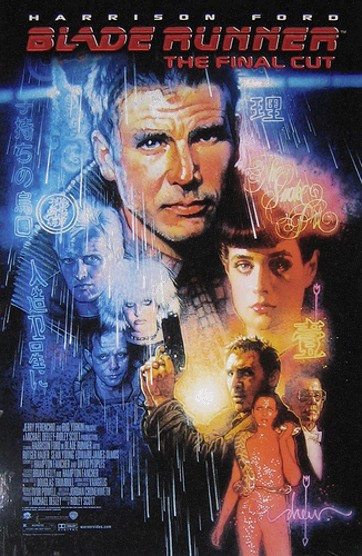
6. Blade Runner (1982)

Blade Runner is today recognized as a classic but it originally received mixed reviews and was ignored by the Academy.  At the very least, Rutger Hauer deserved a nomination.

7. Never Let Me Go (2010)

This underrated clone drama was sadly overlooked.  Andrew Garfield’s performance is heartbreaking.

Film Review Under the Skin

8. Under the Skin (2014)

This enigmatic film was probably too bizarre and unsettling for the Academy but Jonathan Glazer’s direction and Scarlett Johansson’s performance make Under the Skin a classic.

9. Guardians of the Galaxy (2014)

Whenever I rewatch Guardians of the Galaxy, I’m happy to discover that it still holds up as a wonderful piece of entertainment.  It remains my favorite film of 2014.

10. Ex Machina (2015)

Quite simply an amazing film, this is a Metropolis for the 21st Century.


You Too Can Be A Cinema Snob: Seven Beauties (1975), Storm Over Asia (1928), Meshes of the Afternoon (1943), Max Havelaar (1976)


If you’ve read enough of my reviews then you probably know that while I tend to write about B-movies, Hallmark, Disney, and late night cable movies, I do reference a lot of other films. Recently Gary did a post on The Great Train Robbery that not only revolutionized cinema by simply cutting back to a previously used set, but also firmly established that we preferred narrative films over actualites/documentaries and the cinema of spectacle. Since people seemed to respond well to his post, I thought I would occasionally do a post like this where I take advantage of YouTube to share some great films that happen to be available at the time of posting. If they are not available anymore, then simply take them as recommendations. Maybe one day I will actually review these, or perhaps they may have already been reviewed here. I hope you enjoy these kinds of posts. If not, feel free to tell me.

Seven Beauties (1975, dir. Lina Wertmüller) – This is a classic of Italian cinema from the 1970s by director Lina Wertmüller. It’s about a man who fancies himself quite a ladies man and a stereotypical suave Italian gangster type. Things turn bad for him and it takes him as far as a concentration camp during WWII. This is an example of Italian Comedy which was a special genre of comedies made between roughly 1960-1980 in Italy. The defining characteristic would be their choice of material that would often be dark, non-PC, and almost feel out of place in a comedy. It’s one of my favorites of the genre with a great performance by Wertmüller’s De Niro, Giancarlo Giannini who people might know from Casino Royale (2006) and Quantum of Solace (2008) among other films. This particular version is dubbed into English.

Storm Over Asia (1928, dir. Vsevolod Pudovkin) – Not all propaganda is bad filmmaking. Early Soviet Cinema was often loaded with propagandistic messages, but they were also very well made movies. Storm Over Asia is by director Vsevolod Pudovkin who also made such classics as Mother (1926) and The End of St. Petersburg (1927). This one uses a tale of a Mongolian who turns out to be a descendant of Genghis Khan to send its message. I love the end as he and his people cause such a storm with their horses that they are literally blowing over soldiers with the wind.

Meshes of the Afternoon (1943, dir. Maya Deren) – When you move beyond mainstream films and start looking into more underground/experimental cinema, then certain names will pop up. Names like Stan Brakhage, Kenneth Anger, and Michael Snow. Maya Deren is one of these people. Meshes of the Afternoon is usually the first Maya Deren film introduced to people. You will find numerous versions of this film available. Not because the visuals are any different, but because the film was made with zero sound or musical accompaniment. This is one that is popular for people to add their own soundtrack to.

Max Havelaar (1976, dir. Fons Rademakers) – It’s sad, but to my knowledge most people only really know about one Dutch director. That being Paul Verhoeven. However, there are certainly many more out there. Fons Rademakers is probably not nearly as well known outside of Holland as Verhoeven even though his 1986 film The Assault won Best Foreign Language Film at the Oscars. Max Havelaar is his adaptation of the very important Dutch novel of the same name. After it’s publication it changed the nature of Dutch colonialism and has ramifications for the country beyond that as well. Keep your eyes peeled for Rutger Hauer before he became a star in the United States. Also, I suggest checking out more of Rademakers’ films. Especially one of my personal favorites called Als Twee Druppels Water (1963) AKA The Dark Room of Damocles.