In this scene from Robert Altman’s 1975 masterpiece, Nashville, Julie Christie plays herself as a famous visitor to the city for which the film is named. She is introduced to Haven Hamilton (Henry Gibson), Haven’s lawyer, Delbert Reese (Ned Beatty), political advance man John Triplette (Michael Murphy), and country music star Connie White (Karen Black). Julie Christie may be a star in Hollywood but Connie is the star of Nashville.
Karen Black, who was born on this date in 1939, improvised her dismissive line about Julie Christine not even being able to comb her hair. It was a moment that reportedly shocked the rest of the cast and the crew but it was also a line that perfectly summed up both Connie as a character and Altman’s version of Nashville.
With the Cannes Film Festival underway, I have been watching some of the past winners of the prestigious Palme d’Or. On Thursday night, Jeff and I watched the winner of the 1970 winner of the Grand Prix (as the Palme was known at the time), Robert Altman’s M*A*S*H.
There are, of course, three versions of M*A*S*H. All three of them deal with the same basic story of Dr. Hawkeye Pierce and his attempts to maintain his sanity while serving as a combat surgeon at the 4077th Mobile Army Surgical Hospital during the Korean war. All three of them mix comedy with the tragedy of war. However, each one of them takes their own unique approach to the material.
The one that everyone immediately thinks of is the old television series, which ran for 11 seasons and which can be found on Hulu and on several of the retro stations. The television series starred Alan Alda as Hawkeye. I’ve watched a handful of episodes and, while the episodes that I’ve seen were undeniably well-acted and well-written and they all had their heart in the right place, the show’s deification of Hawkeye can get to be a bit much. Not only is Hawkeye the best surgeon at the 4077th, he’s apparently the best surgeon in all of Korea. In fact, he may be the best surgeon on the entire planet. Not a single thing happens in the camp unless Hawkeye is somehow involved. When a nurse is killed by a landmine in one episode, the focus is not on the other nurses but instead on how Hawkeye feels about it. When bombs are falling too close to the camp, the focus is again only on Hawkeye and how much he hates the war. If you didn’t already know that he hated the war, Hawkeye will let you know. Wish Hawkeye a good morning and he’ll yell at you about how many people are going to be wounder by the end of the day. Even when one agrees with Hawkeye, the character’s self-righteousness can be a bit much.
Less well-known is the first version of M*A*S*H, a short and episodic novel that was published in 1968. The novel was written by Dr. Richard Hornberger, who actually had served in Korea at a M*A*S*H unit and who reportedly based Hawkeye on himself. The book is a rather breezy affair. Reading it, one can definitely tell that it was inspired by someone telling Hornberger, “Your stories about Korea are so funny and interesting, you should write them down!” The book avoids politics, reserving most of its ire for military red tape. Hornberger was a Republican who so disliked Alan Alda’s interpretation of Hawkeye that, when he wrote a sequel to M*A*S*H, he included a scene in which Hawkeye talked about how much he enjoyed beating up hippies.
And then there’s the version that came in between the book and the television series, the 1970 film from Robert Altman. The film retains the book’s episodic structure while also throwing in the anti-war politics that would define the television series. (Though the film was set in the 50s, Altman purposefully made no attempt to be historically accurate because he wanted it to be clear that this film was more about Vietnam than Korea.) From its opening, the film announces its outlook, with shots of helicopters carrying severely wounded (possibly dead) soldiers to the camp while a song called Suicide is Painless plays on the soundtrack. The song was written by director Robert Altman’s fourteen year-old son, Mike. Reportedly, it took Mike five minutes to come up with the lyrics. When the instrumental version of the song was later used as the theme song for the television series, Mike Altman made over a million dollars in royalties.
The film opens with Hawkeye Pierce (Donald Sutherland) and Duke Forrest (Tom Skerritt) arriving at the 4077th MASH in a stolen jeep and it ends with them getting sent home in the same jeep. Though Duke is set up to be a major character, he soon takes a backseat to another surgeon, the unfortunately nicknamed Trapper John (Elliott Gould). Much as with the television series, the movie centers around Hawkeye and Trapper John’s antics. When they’re not in the operating room, they’re drinking, carousing, and playing pranks that are far more mean-spirited than anything the television versions of the characters would have ever done. (Indeed, the book and movie versions of Hawkeye probably would have hated Alan Alda’s Hawkeye.) Unlike the television version of Hawkeye, the film’s Hawkeye is not the best surgeon in Korea. In fact, he’s not even the best surgeon at the 4077th. (That honor goes to Trapper.) Instead, he’s just one of many doctors on staff. They’re rotated in and then, at the end of their tour, they’re rotated out. Hawkeye loses as many patients as he saves. The film’s doctors are not miracle workers, nor are they crusaders. Instead, they are overworked, neurotic, often exhausted, and frequently bored whenever there aren’t any wounded to deal with. The film emphasizes that the doctors are as professional inside the Operating Room as they’re rambunctious outside of it. Unlike the television series, Hawkeye doesn’t joke while working. He’s usually too busy trying to stop his patients from bleeding to death to tell jokes or to complain about the war that brought them to the OR.
Indeed, the film version of M*A*S*H communicates its anti-war message not through indignant speeches but instead through bloody imagery. The operating room scenes don’t shy away from showing the ugliness of war and they are occasionally so visceral that they almost seem to shame the audience for have laughed just a few minutes earlier. One of the film’s more famous (and controversial) sequences features Hawkeye driving Frank Burns (Robert Duvall) to insanity by crudely taunting him about his affair with head nurse Margaret Houlihan (Sally Kellerman). Burns attacks Hawkeye, a response that actually seems rather justified even if it is played for laughs. A scene of Burns being driven out of the camp in straitjacket is followed by a close-up of a geyser of blood erupting from a wounded soldier’s throat. It’s a jarring transition but one that makes a stronger anti-war statement than any self-righteous monologue would have. While Hawkeye and Trapper are taunting Burns and Margaret, soldiers are still being sent off to die.
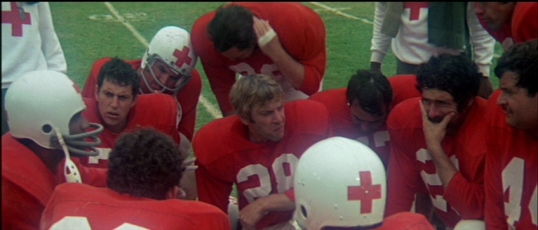
The humor in M*A*S*H is often brutally misogynistic. Margaret is described as being “a damn good nurse” but is continually humiliated because she believes in maintaining military discipline. One can disagree with her emphasis on following all of the proper regulations while also realizing the Hawkeye and Trapper’s treatment of her is unreasonably cruel. The scene where Trapper and Hawkeye expose her while she’s taking a shower is especially difficult to watch and there’s no way to justify their actions. It’s frat boy humor, the type of stuff that you would expect from a bunch of former college football players, which is what we’re told Hawkeye and Trapper are. (That, of course, is another huge difference between the film and television versions of the characters.) That said, it’s debatable whether or not were supposed to find either Hawkeye or Trapper to be heroic or even likable. As a director, Robert Altman shied away from making films with unambiguous heroes or villains. Just as Margaret could be a “damn good nurse” and a “regular army clown” at the same time, Hawkeye can be both a dedicated doctor and a bit of a jerk.
After 90 minutes of bloody operating room scenes and Trapper and Hawkeye making crude jokes, M*A*S*H suddenly becomes a sports film as the the 4077th plays a football game against their rivals, the 325th Evac Hospital. The change of tone can be a bit jarring but it’s perhaps the most important sequence in the film. For a few hours, the doctors bring “the American way of life” to Korea and the end result is a game that’s played for money and which is only won through cheating and deception. (Future blaxploitation star Fred Williamson made his film debut as the ringer who the 4077th recruits for the game.) For all of the broad comedy of the game, it’s followed by a shot of the doctors playing poker while a dead soldier is transported out of the camp, wrapped in a white sheet. Football may provided a distraction. The money may have provided an incentive. But the war continued and people still died.
Much of M*A*S*H‘s humor has aged terribly but the performances still hold up and the anti-war message is potent today. Though Sutherland and Gould are undeniably the stars of the film, M*A*S*H is a true ensemble film, full of the overlapping dialogue and the small character performances that Robert Altman’s films were known for. One reason why the film works is because it is an immersive experience, the viewer truly does feel as if they’ve been dropped in the middle of an operating field hospital. Though Hawkeye and Trapper may be at the center of the action, every character, from the camp’s colonel to the lowliest private, seems to have their own story playing out. This a film where paying attention to the little things happening in the background is often more rewarding than paying attention to the main action. I particularly liked the performances of David Arkin as the obsequies Staff Sergeant Vollmer and Bud Cort as Pvt. Warren Boone. Boone, especially, seems to have an interesting story going on in the background. The viewer just has to keep an eye out for him. Also be sure to keep an eye out for Rene Auberjonois, who reportedly improvised one of the film’s best-known lines when, after Margaret demands to know how Hawkeye reached a position of authority in the army medical corps, he deadpanned, “He was drafted.”
One of the first major studio films to be openly critical of the military and the war in Vietnam, M*A*S*H won the Palme d’Or, defeating films like Investigation of a Citizen Above Suspicion and The Strawberry Statement. Unlike many Palme winners, it was also a box office success in the United States. Though controversial, it received an Oscar nomination for Best Picture. However, unlike the Cannes jury, the Academy decided to honor a different film about war, Patton.
4 Or More Shots From 4 Or More Films is just what it says it is, 4 shots from 4 of our favorite films. As opposed to the reviews and recaps that we usually post, 4 Shots From 4 Films lets the visuals do the talking!
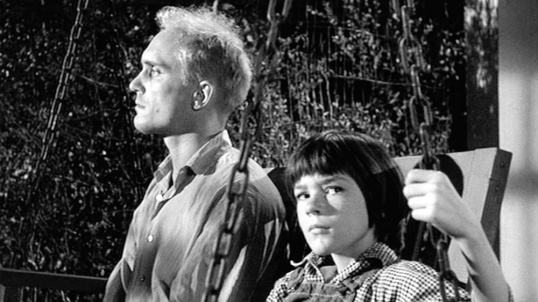
Today, we celebrate the 91st birthday of one of the finest American actors out there, Mr. Robert Duvall. Ever since he made his film debut in 1962’s To Kill A Mockingbird, Duvall has been a regular presence in American cinema. He’s an actor who has appeared in some of the best American films ever made (The Godfather, Network, Apocalypse Now, To Kill A Mockingbird, Tender Mercies, and others) and he’s played a wide variety of characters. He’s been everything from a lawyer to a cowboy to a network executive to a professional criminal to a cop and he’s never been less that convincing. He’s got a filmography about which anyone would be jealous. And, at an age when most actors have retired, Duvall is still working and taking the occasional part.
On a personal note, I have to say that, for someone who was born in California, raised in Maryland, and who started his career in New York, Robert Duvall is one of the few actors to have perfected both the Southern and the Southwestern accent. Whenever I see him playing a Texan, I always have to remind myself that he’s not actually from around here.
In honor of Robert Duvall’s birthday, here are….
6 Shots From 6 Robert Duvall Films
To Kill A Mockingbird (1962, dir by Robert Mulligan, DP: Russell Harlan)
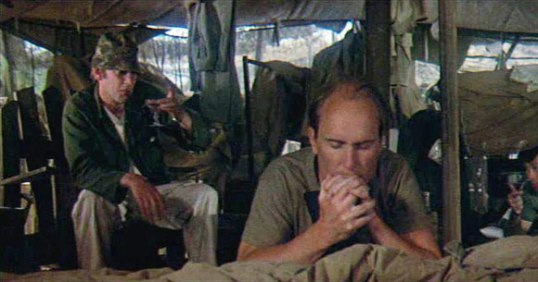
MASH (1970, dir by Robert Altman, DP: Harold E. Stine)
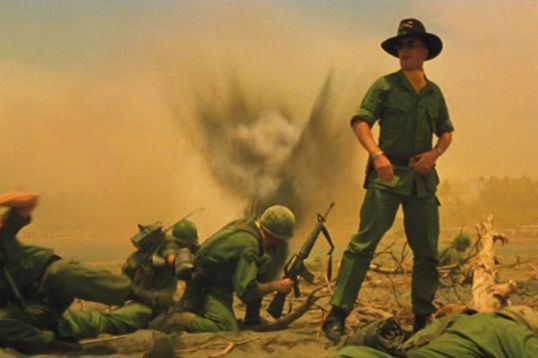
Apocalypse Now (1979, dir by Francis Ford Coppola, DP: Vittorio Storaro)
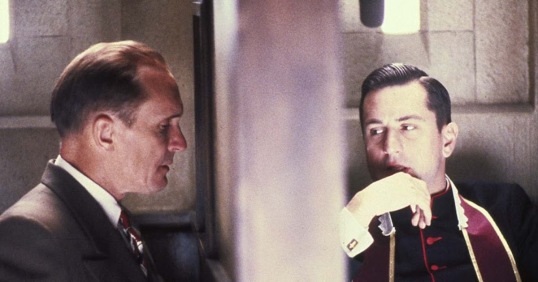
True Confessions (1981, dir by Ulu Grosbard, DP: Owen Roizman)
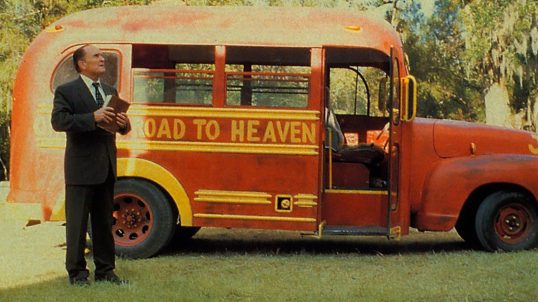
The Apostle (1997, dir by Robert Duvall, DP: Barry Markowitz)
The Judge (2014, dir by David Dobkin, DP: Janusz Kamiński)
4 Shots From 4 Films is just what it says it is, 4 shots from 4 of our favorite films. As opposed to the reviews and recaps that we usually post, 4 Shots From 4 Films lets the visuals do the talking!
Today, we pay tribute to the legendary cinematographer, Vilmos Zsigmond. Born 90 years ago today in Hungary, Zsigmond got his start in the 60s with low-budget films like The Sadist but he went on to become one of the most in-demand cinematographers around. In fact, of all the people who started their career working on a film that starred Arch Hall, Jr., it’s hard to think of any who went on to have the type of success that Zsigmond did.
Zsigmond won one Oscar, for his work on Close Encounters of Third Kind. He was nominated for three more. He also received a BAFTA award for his work on The Deer Hunter and was nominated for an Emmy for his work on Stalin. He’s considered to be one of the most influential cinematographers of all time.
In honor of the memory of Vilmos Zsigmond, here are….
4 Shots From 4 Films
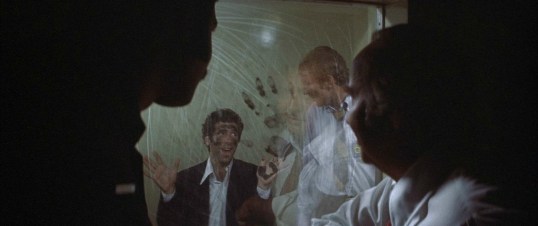
The Long Goodbye (1973, dir by Robert Altman, DP: Vilmos Zsigmond)
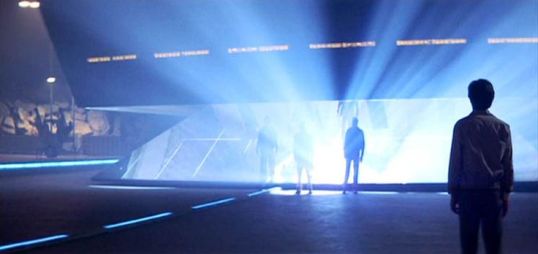
Close Encounters of the Third Kind (1977, dir by Steven Spielberg, DP: Vilmos Zsigmond)
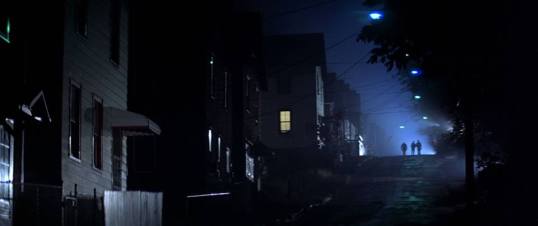
The Deer Hunter (1978, dir by Michael Cimino, DP: Vilmos Zsigmond)
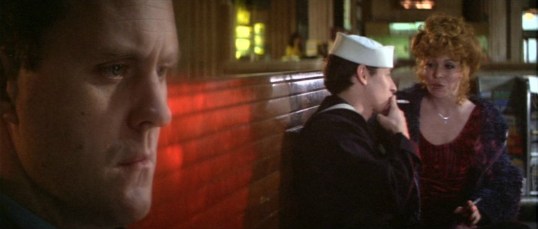
Blow Out (1981, dir by Brian DePalma, DP: Vilmos Zsigmond)
As the day draws to a close, I’m going to recommend one final film.
It’s not, by any means, a perfect film. In fact, it’s pretty damn imperfect. It’s a film that occasionally tries too hard to be profound. It’s based on a play and it never quite escapes its theatrical origins. What was undoubtedly exciting on the stage, drags a bit on the screen. It’s a fairly obscure film. I just happened to catch it on This TV a month ago and the main reason that I watched it was because of the cast.
But no matter! I still think you should watch this film if you get a chance.
The name of that film is Fool For Love.
First released in 1985 and based on a play by Sam Shepard, Fool For Love takes place over the course of one long night at a motel in the Southwest. Staying at the motel is May (Kim Basinger), who is hoping to escape from her past. Not eager to allow her to escape is her former lover, Eddie (Sam Shepard). An aging cowboy, Eddie shows up at the motel and tries to convince May to return with him to his ranch. As they argue, clues are dropped to the terrible secret that haunts their past. Martin (Randy Quaid), a buffoonish but well-meaning “gentleman caller,” shows up to take May on a date and finds himself sucked into the drama between her and Eddie.
Meanwhile, on the edge of every scene, there’s the Old Man (Harry Dean Stanton). The Old Man watches Eddie and May and offers up his own frequently sarcastic commentary. It becomes obvious that he not only knows about the secret in their past but that he’s determined that they not get together. Is the Old Man really there or is he just a figment of everyone’s imagination or is he something else all together?
As I said earlier, the film never quite escapes its theatrical origins. As well, while Shepard and Kim Basinger both give authentic and charismatic performance, they don’t quite have the right romantic chemistry to really convince us that Eddie would chase May all the way to that isolated motel. It’s hard not to feel that if May had been played by Shepard’s then-partner Jessica Lange or his Right Stuff co-star, Barbara Hershey, the film would have worked better.
And yet, even if it never comes together as a whole, Fool For Love is a film that should be seen just for its display of individual talent. Of the film’s five main creative forces, only Kim Basinger is still with us. Director Robert Altman died in 2006 while Sam Shepard and Harry Dean Stanton both passed away in 2017. While Randy Quaid is still alive, it’s doubtful he’ll ever again get the type of roles that earlier established him as one of America’s best character actors. Whenever I read another snarky article about Quaid hiding out in Vermont and ranting about the “star whackers,” I can’t help but sadly think about the perfect performances that Quaid used to regularly give in imperfect films like this one.
So, definitely track down Fool For Love. Watch it and pay a little tribute to all of the wonderful talent that we’ve lost over the last 10 or so years. Watch it for Robert Altman’s ability to turn kitsch into art. Watch it for the rugged individualism of Sam Shepard and the once-empathetic eccentricity of Randy Quaid. Watch it for Harry Dean Stanton, the legendary actor who, more than any other performer, seemed to epitomize the southwest and Americana.
Watch it and spare a little thought for all of them.
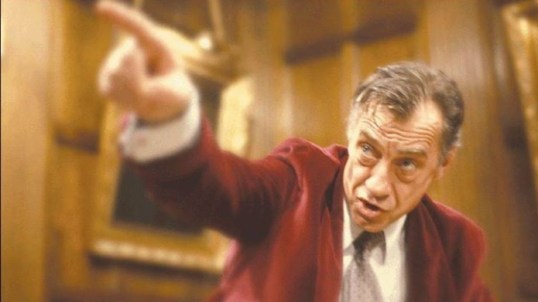
Disgraced former President Richard M. Nixon (Philip Baker Hall) sits alone in his study. He has a bottle of Scotch, a loaded gun, and a tape recorder. He is surrounded by security monitors and paintings. All but one of the paintings are portraits of former presidents, all of whom are destined to be more fondly remembered than Nixon. The only non-presidential painting is a portrait of Henry Kissinger. Over the course of one long night, Nixon drinks and talks. He talks about his Quaker upbringing and his early political campaigns. He rails against all of his perceived enemies: Eishenhower, the Kennedys, the liberals, the conservatives, and everyone in between. As he gets drunker, he starts to talk about the real story behind Watergate and why his resignation actually shielded the country from a greater scandal. As Nixon explains it, his resignation was his greatest act of patriotism, his secret honor.
A mix of historical fact and speculation, Secret Honor was one of the filmed plays that Robert Altman directed in between the flop of Popeye and his comeback with The Player. Secret Honor is a one-man show, with Philip Baker Hall and only Philip Baker Hall on screen for the entire movie. Though he looks nothing like Nixon, Hall gives an amazing performance. Hall’s Nixon is bitter, angry, full of self-pity, and occasionally even sympathetic. Altman’s stagey direction makes no attempt to hide Secret Honor‘s theatrical origins but it is impossible to look away from Hall’s mesmerizing performance.
(Secret Honor was made long before Hall found fame as a character actor. It was his fourth feature film and his first major role.)
Secret Honor will probably not change anyone’s opinion on Nixon. Nixon haters will find more to hate and Nixon defenders will find more to defend. But everyone will agree that Philip Baker Hall gives a great performance as one of America’s most controversial presidents.
What’s an Insomnia File? You know how some times you just can’t get any sleep and, at about three in the morning, you’ll find yourself watching whatever you can find on cable? This feature is all about those insomnia-inspired discoveries!
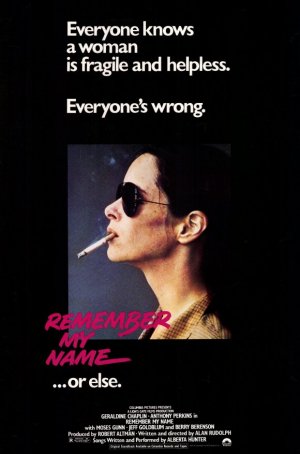
If you were having trouble sleeping last Tuesday, around one in the morning, you could have turned over to TCM and watched Remember My Name, an odd and sometimes frustrating little thriller from 1978.
Remember My Name opens with Emily (Geraldine Chaplin) showing up in a small town in California. From the minute we first see and hear Emily, something seems to be off about her. She views the world through suspicious eyes. Whenever anyone talks to her, you’re never quite sure whether she’s going be friendly or if she’s going to lash out. When she speaks, there’s something weird about her vocal inflection, as if she’s always struggling to figure out what she’s supposed to say. She seems to be separated from the world, almost as if she’s walking through a living dream and only talking to figments of her imagination. There’s nothing about her that feels at all authentic.
She moves into a small apartment and enters into a relationship with her handyman (Moses Gunn), a relationship that seems to be largely defined by her refusal to open up about herself. She gets a job at a grocery story that’s managed by a Mr. Nudd (Jeff Goldblum). Mr. Nudd mentions something about Emily knowing his mother. Apparently, they met in prison.
Soon, Emily is stalking a construction worker named Neil Curry (Anthony Perkins). When Neil spots her, he calls out her name and Emily runs away. And yet, Neil doesn’t bother to tell his wife, Barbara (Berry Berenson), about Emily. Soon, Emily is even breaking into the Curry home, silently shadowing Barbara as she walks through the house.
I described Remember My Name as being a thriller and I guess that, technically it is. There are a few moments of tension, especially when Emily is stalking Barbara. However, the film itself is directed in a detached manner by Alan Rudolph. Rudolph was a protegé of director Robert Altman (who also produced Remember My Name) and Rudolph’s approach is very Altmanesque, often to the detriment of the film. (Chaplin and Jeff Goldblum had both appeared in several Altman films, most famously in Nashville.) Though the film is dominated by Chaplin and Perkins, it’s still very much an ensemble film and the action plays out in a deceptively casual, almost random manner. It tries so hard to be Altmanesque that Remember My Name gets a bit frustrating, to be honest. Chaplin gives such a good and memorable performance and she works very hard to make Emily a character who is both frightening and, at times, surprisingly sympathetic but, for the most part, Rudolph’s technique makes it difficult to get emotionally involved in any of the action unfolding on-screen. Rudolph observes the action but refuses to comment on it. As a result, Remember My Name is occasionally intriguing but, just as often, it’s rather boring. Just like real life, I suppose. And, just like real life, it’s not for everyone.
That said, it was interesting to see Anthony Perkins playing a role other than a knife-wielding inn manager. Without resorting to any of the familiar tics or the neurotic speech patterns that typecast him forever as Norman Bates, Perkins plays Neil as just being a regular, blue collar guy and he actually does a pretty good job. Watching the film, I got the feeling that this was perhaps Perkins’s attempt to change his image. (Whenever Neil appears shirtless, both the film and Perkins seem to be saying, Check out this physique! Would someone only capable of playing a psycho have abs like this?) Neil’s wife, Barbara, was played Perkins’s wife, Berry Berenson. Neither one of them is with us any longer. Perkins died of AIDS in 1990 while Berry Berenson was on one of the planes that flew into the World Trade Center on 9-11. They both did good work in this film, as did Chaplin and Goldblum and, really, the entire cast. It’s just a pity that the film itself isn’t as good as the performances.
Earlier tonight, on TCM, I watched the 1968 science fiction film, Countdown.
Who will be the first man to walk on the moon? Will it be Chiz (Robert Duvall), who is a colonel in the Air Force and who has been training for years and who really should get the chance just because he has a really cool name like Chiz? Or will it be Chiz’s best friend, Lee (James Caan)? Lee may not have Chiz’s experience but he’s a scientist and selecting him would allow NASA to portray the mission of being one of peace as opposed to one of war. Add to that, Lee has a full head of hair and he looks like a young James Caan, who was an undeniably handsome man back in his younger days! I mean, seriously — who would you rather have as the face of the space program: Tom Hagen or Sonny Corleone?
Of course, it might not really matter who NASA picks because the Russians are determined to get to the moon as well. And you know what that means! If the Russians land on the moon first, they’ll turn it into a Socialist utopia and that’ll mean ugly architecture, bread lines, and a three-month wait for toilet paper. The stakes have never been higher!
Countdown was made and released at the height of the space race, at a time when Americans really did feel that they were competing with the Russians to be the first to reach the moon. (Of course later, it would be learned that the Russian space program actually managed to kill far more cosmonauts than it successfully sent into orbit.) It came out a year before Apollo 11 landed on the moon and Neil Armstrong became the first Earthling since Stanley Kubrick to ever step on the lunar surface. As such, it’s interesting to see how Countdown imagines the experience of exploring the moon. I won’t spoil who reaches the moon first but I will say that he moves remarkably quickly and with great ease for someone in a gravity-free environment.
Countdown is a good example of what I like to call a “time capsule” film. Seen today, it’s kinda slow and a bit predictable. For all the time that is spent on getting the astronauts ready to go into space, very little time is actually spent in orbit. This is a very Earth-bound film. And yet, if you’re a history nerd like me, it’s hard not to be a little bit fascinated by a movie like this. In everything, from its fashions to its dialogue to its cultural outlook, this is very much a document of its time. It may be a while until we have the technology necessary to travel through time. Until then, watching a film like this might be as close as I’ll ever get to experiencing what the straight, non-Hippie crowd was doing in 1968.
If you’re a student of film history, Countdown is significant for being one of the first films to be directed by Robert Altman. To be honest, if not for his name in the opening credits, you would probably never guess that Countdown was directed by one of America’s most influential and iconic directors. Altman specialized in making film that were almost defiantly iconaclastic and there’s very little of that to be found in Countdown. Admittedly, there are a few scenes that make use of overlapping dialogue and there’s a party scene that’s definitely Altmanesque. However, the only reason I really noticed that party scene is because I was specifically looking for evidence of Altman’s style. For the most part, the most identifiably Altmanesque element of Countdown is the casting of Michael Murphy in a small role.
The film is dominated by Robert Duvall and James Caan and, especially if you’re a fan of The Godfather, it’s undeniably fun to see these two acting opposite each other in something other than an epic gangster film. (Duvall and Caan also acted together in The Rain People and The Killer Elite and were reportedly great friends off-camera as well.) Duvall is especially good in Countdown, playing Chiz as a man torn between an innate sense of loyalty and his own competitive nature. The scenes between Duvall and Caan have a charge to them that occasionally bring some much-needed life to this film.
In the end, Countdown is a fairly forgettable film but it’s worth seeing as a piece of history.
(Lisa recently discovered that she only has about 8 hours of space left on her DVR! It turns out that she’s been recording movies from July and she just hasn’t gotten around to watching and reviewing them yet. So, once again, Lisa is cleaning out her DVR! She is going to try to watch and review 52 movies by Wednesday, November 30th! Will she make it? Keep checking the site to find out!)
The 1979 post-apocalyptic film Quintet aired on FXM on November 15th. I recorded it because this film is often cited as being one of director Robert Altman’s worst but I’ve also read some very passionate defenses of Quintet. Since I’ve enjoyed several of Altman’s films (Nashville, Gosford Park, Short Cuts, The Company, The Player, The Long Goodbye, and many more), I wanted to experience Quintet for myself.
I mean, seriously — a postapocalyptic sci-fi film from Robert Altman!? That would have to be at least interesting, right?
Anyway, I watched Quintet and to be honest, I wasn’t really sure what the Hell was going on for most of the film. Things made a bit more sense after I did a little bit of research and I discovered that Quintet was 1) inspired by a fragment of a dream that Altman had and 2) went into production despite not having a completed script.
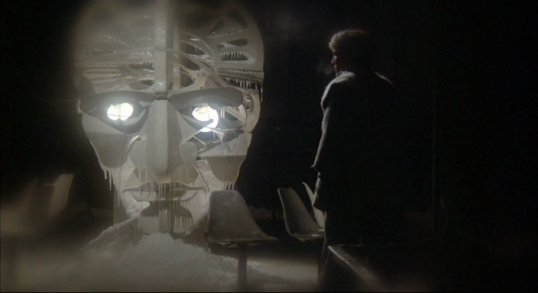
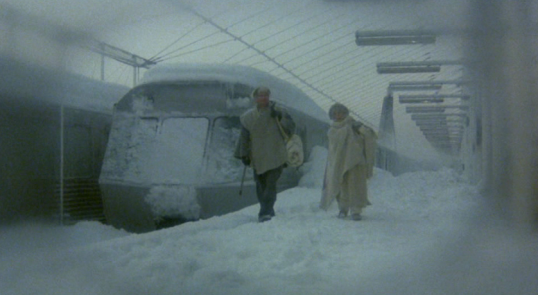
Quintet opens with a breath-taking shot of a frozen landscape. There’s been a new ice age. The entire Earth is frozen. There’s only a few hundred humans left and their number is rapidly dwindling. Some, like Essex (Paul Newman) and Vivia (Brigitte Fossey) spend their days hiking across the tundra and hunting seals. Others — like practically everyone else in the entire freaking film — spend their times in ramshackle villages, pursuing what little pleasure they can find while waiting to die.
In this new frozen world, the most popular activity — outside of getting drunk — is playing a board game called Quintet. I have no idea how Quintet is played, though the film is full of scenes of people playing it. From what we do see, it really doesn’t look like that fun of a game but I guess you can’t be picky when you’re waiting to freeze to death. I mean, honestly, if the world’s ending, I’d rather play a board game than charades.
Anyway, in one of the frozen towns, a group of people are having a Quintet tournament, with the rule being that, once you’re eliminated in the board game, you are also killed in real life. (And again, this is where it would have been helpful for the film to take just a few minutes to clarify just how exactly Quintet is played.) One of the Quintet players is killed by a bomb, which unfortunately blows up Viva as well. Seeking revenge (or, at least, I’m guessing that was his motivation because Paul Newman didn’t exactly give the most communicative performance of his career in Quintet), Essex assumes a fake identity and enters the tournament.
Soon, he’s running around the frozen landscape, killing people. He knows that the final player standing will receive a prize of some sort but he doesn’t know what the prize is. How deep! Or something.
Dammit, I really wanted to defend Quintet. I really did. Whenever I see a movie that has gotten almost universally negative reviews, my natural instinct is to try to find something good about it. And I will say this: visually, Quintet is fascinating. A lot of care was put into creating this frozen world and it’s interesting to note how every location is decorated by elaborate ice sculptors. The ice may be destroying civilization but it can’t squelch humanity’s natural creativity.
Unfortunately, Quintet may be well-designed but it’s also a painfully slow film. Just because the film takes place on a glacier, that doesn’t mean that it needs to move like one. The slow pace is not helped by the fact that many of the characters have a tendency to suddenly start delivering these faux profound philosophical monologues, the majority of which are about as deep as the typical Tumblr post.
Quintet stars Paul Newman, who was both an iconic movie star and a legitimately great actor. He spends most of Quintet alternating between looking confused and looking stoic. That said, it’s always interesting to watch an actor like Paul Newman slog his way through an artistic misfire like WUSA or Quintet. Let’s give Paul Newman some credit: he delivered his lines with a straight face. Just as Essex knew he was trapped on a glacier, Paul Newman understood that was trapped in Quintet. Both did what they had to do to survive.
Robert Altman was a great director but Quintet is not a great film.
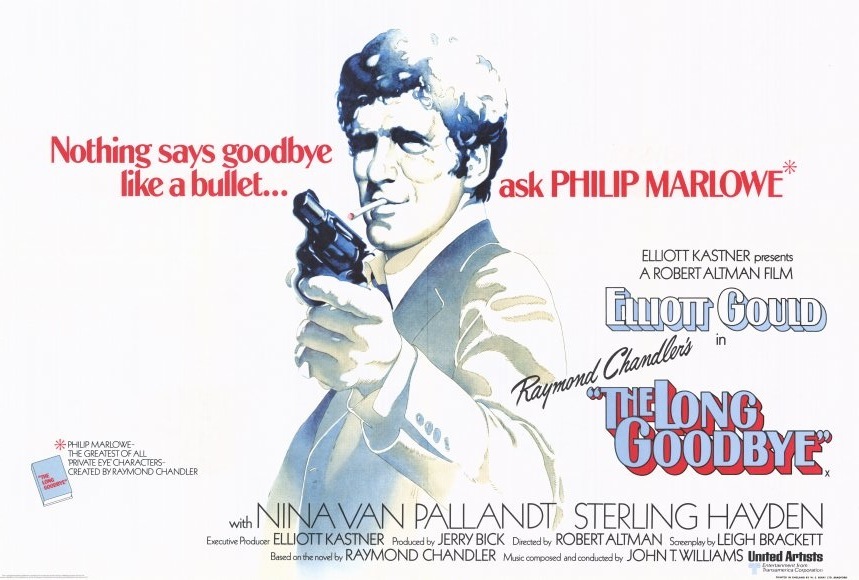
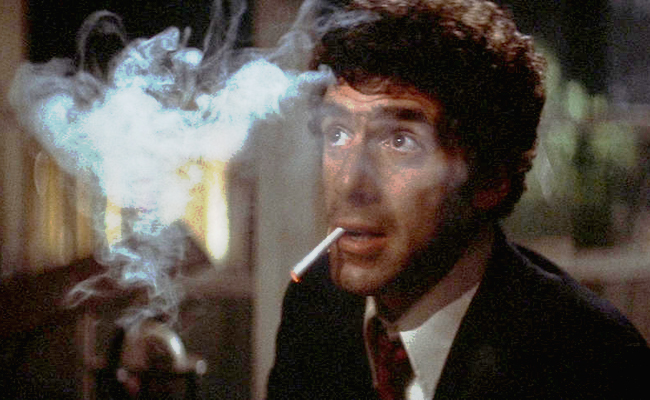
Elliott Gould was a hot Hollywood commodity in the early 1970’s. The former Mr. Barbra Streisand broke through in the 1969 sex farce BOB & CAROL & TED & ALICE, earning an Oscar nomination for supporting actor. He was marketed as a counter-culture rebel, quickly appearing in MOVE, GETTING STRAIGHT, LITTLE MURDERS, and Robert Altman’s M*A*S*H. But his flame dimmed just as fast, and his erratic onset behavior and rumored drug abuse caused him to become unemployable. When Altman decided to make the neo-noir THE LONG GOODBYE, he insisted on casting Gould as Philip Marlowe. The film put Gould back on the map, and though critics of the era weren’t crazy about it, THE LONG GOODBYE stands up well as an artifact of its era and a loving homage to Raymond Chandler’s hard-boiled hero.
Philip Marlowe is clearly an anachronism is 70’s LA, with his ever-present cigarette, cheap suit, beat-up ’48 Lincoln…




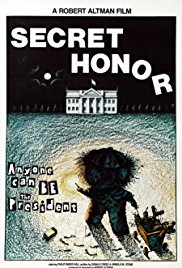 Disgraced former President Richard M. Nixon (Philip Baker Hall) sits alone in his study. He has a bottle of Scotch, a loaded gun, and a tape recorder. He is surrounded by security monitors and paintings. All but one of the paintings are portraits of former presidents, all of whom are destined to be more fondly remembered than Nixon. The only non-presidential painting is a portrait of Henry Kissinger. Over the course of one long night, Nixon drinks and talks. He talks about his Quaker upbringing and his early political campaigns. He rails against all of his perceived enemies: Eishenhower, the Kennedys, the liberals, the conservatives, and everyone in between. As he gets drunker, he starts to talk about the real story behind Watergate and why his resignation actually shielded the country from a greater scandal. As Nixon explains it, his resignation was his greatest act of patriotism, his secret honor.