Let’s Talk About Toxic Shark (dir by Cole Sharpe)


Oh Hell yeah!

This past week has been Shark Week on SyFy!  On Sunday, SyFy is going to premiere the latest Sharknado movie.  As always, in the days before the latest chapter in the Sharknado saga, SyFy has been showing other shark-related films.  Of course, my friends and I have been watching and live-tweeting all of these films.  What makes the experience especially fun is that, often times, the filmmakers themselves will join in and tweet along with us.  It’s a wonderful reminder that watching an original movie on SyFy should always be a community experience.

Take Toxic Shark for instance…

Toxic Shark premiered on Thursday night and I had a blast watching it.  Need proof?  Check out my tweets.  But what made Toxic Shark especially fun was that I was watching it with my friends, a group of movie lovers who call themselves the Snarkalecs.  We’ve been watching movies on SyFy since …. well, since forever.  I joined them in 2011 but they were watching movies together before I even showed up.  Even better, members of the cast and crew, including producer Neil Elman and editor Don Money, joined in the live tweet.  Toxic Shark is an audience participation film.  This is a movie for people who want to have a good time with their snarkiest and funniest friends.  If you’re not talking back to the screen while watching Toxic Shark, you’re doing it wrong.

Toxic Shark is a film that, in many ways, centers around friendship.  Two groups of friends are looking forward to relaxing at a singles retreat in Puerto Rico.  Unfortunately, things don’t go quite as smoothly as you might hope.  For one thing, it turns out that the retreat is being run by Reese (Eric Etebari, giving a hilarious performance), who is one of those people who you dread meeting at the gym.  Along with that, local fisherman are disappearing.  One of the singles, Ryan (Owen Saxon), worries over whether his shirt is too tight or not tight enough.  (That might not sound like a big deal but he was quite concerned about it.)  Body parts are washing up on the beach.  Eden (Kabby Borders) is shocked to discover that her ex-boyfriend, Sam (Bryce Durfee), just happens to be at the retreat.  Something attacks Gabby (Cirstina Jayo) when she goes out into the ocean.  A yoga class get eaten.  It may not be as bad as Fyre Festival but still…

Oh, wait a minute.  I forgot to mention the biggest problem at the retreat.  There is this giant shark that keeps jumping out the ocean and eating people.  Seriously, that’ll ruin any vacation.  But it’s not just that the shark is really big and fast.  This shark has also become toxic!  It can not only bite you in half but it can spew toxic waste on you as well…

But that’s not all!  The bite of this shark also turns its victims into zombies!  Yes, you read that correctly.  Assuming you don’t accidentally get killed by Reese, there’s always the chance that the shark will eat you.  And, if the shark doesn’t get you, the zombies will…

I mean, seriously, how can you not love that?  Toxic Shark is a blast of pure chaotic fun, featuring beautiful beach scenery, hot people in swimsuits, and a kickass musical score.  Everyone appears to be having a ball, running from sharks and turning into zombies.  Kabby Borders and Bryce Durfee make for a likable couple (even when they’re arguing) and the rest of the cast strikes the perfect balance between horror and comedy.  I especially liked the performance of Owen Saxon as the somewhat dim but well-meaning Ryan.  There was something touching about how concerned he was about whether or not his shirt was too tight.

Toxic Shark was a lot of fun.  If you get a chance, be sure to catch it!

Just don’t let the shark catch you…

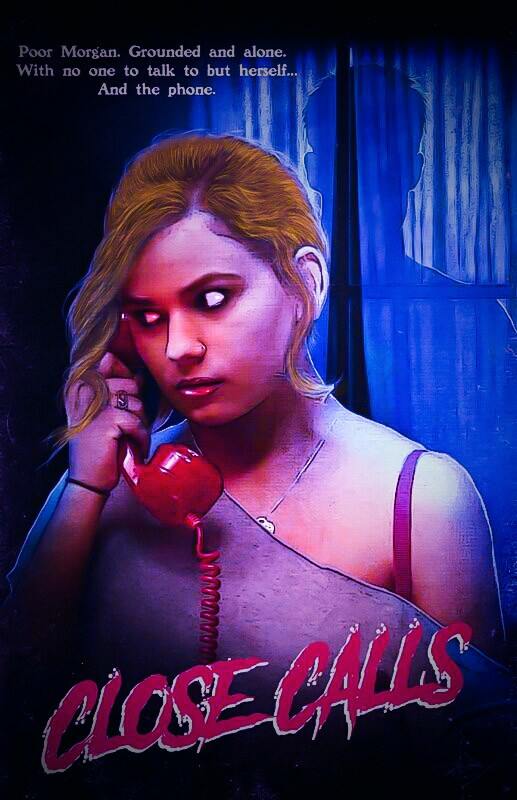
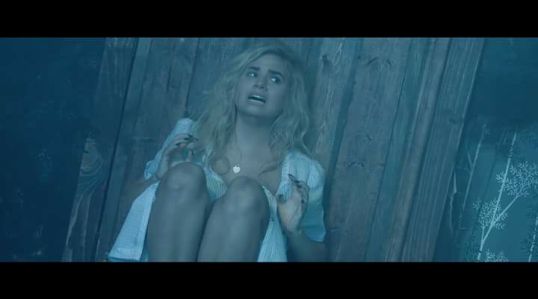
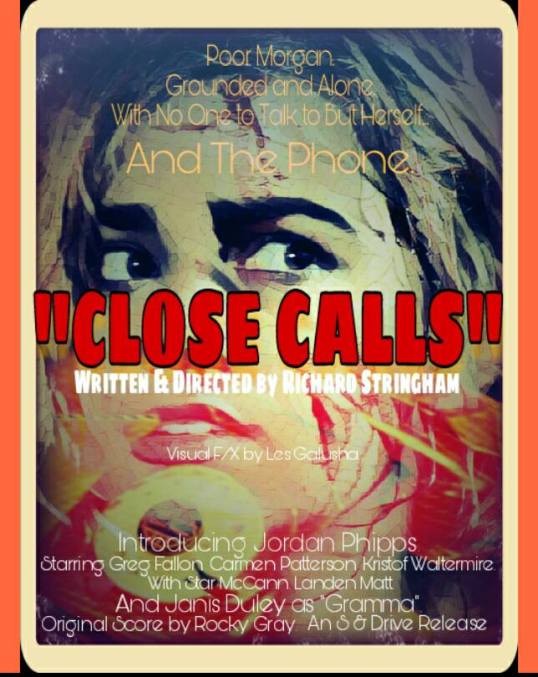
Film Review: Close Calls (dir by Richard Stringham)


This week, I was lucky enough to get a chance to see a new independent horror film called Close Calls.

When Close Calls begins, the first image that appears on the screen is of a VHS tape.  Even though it’s just a part of the logo for S & Drive Cinema, that VHS tape is exactly the right image to start this film off with.  Close Calls is a throwback to the horror films of the late 70s and the early 80s.  It’s a film that pays homage to the old slasher and haunted house films that, though they may not have had a huge budget, did have an abundance of atmosphere, shocks, and out-of-control plot twists.   I always love a good homage so, as soon as I saw that VHS tape, I was excited to see what would follow.

Teenager Morgan MacKenzie (Jordan Phipps) has her own very good reasons for being upset with the world in general.  She is still struggling to deal with the death of her mother, something that is not made any easier by the fact that her father, David (Kristof Waltermire), is now dating the bitchy Brynn (Carmen Patterson).  (Morgan describes Brynn as being a “steaming pile of bitch.”)  She lives in a really nice house but, due to her rebellious attitude and her casual drug use, her father has grounded her and refuses to trust her.  (When he hears Morgan swear, he snaps, “If I was to cuss at my dad the way that you do, he would have beat the shit out of me!”  That’s the kind of father that David is.)  Whenever David leaves the house, he takes Morgan’s phone with him.  Morgan is literally a prisoner in the house, with her only company being her rather strange grandmother (Janis Duley).  Grandma spend her time upstairs, occasionally ringing a bell to let Morgan know that she needs something.  

Close Calls takes place over one very eventful night in Morgan’s life.  As soon as her father abandons her so that he can go on a date with Brynn, odd things start to happen.  Grandma starts to act strange and, despite writing a reminder on her inner thigh, Morgan keeps forgetting to take her pills upstairs.  As a storm brews outside, Morgan hears a voice from the past, whispering to her.  Pictures in the house start to change, as once happy photographs are changed into images of grief and pain.  The landline phone rings and, every time that Morgan answers, she hears a voice making threats.  A friend drops by, insisting that Morgan try a new drug.  Even worse, a man named Barry (Greg Fallon) shows up at her front door.  He says that he works for Morgan’s father and he just wants to come in out of the rain.  He seems okay, until he smiles what may be the most evil smile ever.  Morgan may have a shoebox of cocaine hidden in her closet but that’s not going to be as much help as you might think.  It’s going to be a long, dangerous, and twist-filled night.  When I say twist-filled, I’m not being hyperbolic.  In the tradition of a 70s giallo, Close Calls is full of unexpected plot developments.  At first, Morgan may seem paranoid but, as the film progresses, it becomes obvious that she has good reason for that paranoia.

Close Calls definitely had an Italian horror feel to it, which is one of the reasons why I enjoyed it.  When the camera is stalking through the house, I was reminded of two Lamberto Bava films, A Blade In The Dark and Delirium.  (The house’s swimming pool even reminded me of the pool where so much of the action in Delirium took place.)  A few of the more surreal scenes were tinted and lit in a way that reminded me of the scenes of Jessica Harper exploring the dance school in Suspiria.  For that matter, the film’s final scenes reminded me of something from Lucio Fulci’s Beyond trilogy.  Much like those films, Close Call frequently feels as if it’s a filmed nightmare.  The atmosphere is dream-like and frequently surreal.  In the tradition of the best of Italian horror, the story is sometimes less important than the way it’s told.  As well, director Richard Stringham deserves a lot of credit for including a drug trip sequence that actually feels authentic.

(Also of note: Rocky Gray’s score.  It’s a throwback to the wonderfully creepy and ominous horror music of the 70s and 80s.  Goblin would be proud.)

For a film like this to work, you have to a sympathetic lead and Jordan Phipps gives a wonderfully empathetic performance as Morgan, making her a sympathetic character even when she’s snorting cocaine and talking about how much she hates having to take care of her grandmother.  Phipps commits the role, giving an intense and believable performance.  Janis Duley also does well as grandma, constantly making you wonder whether she’s just a senile old lady or if there’s something more sinister about her quirks.  Finally, Greg Fallon is appropriately sinister as Barry, keeping us off-balance as to what his true intentions are.

Close Calls is definitely a film for horror fans to keep an eye out for, especially horror fans who like a film that keeps you guessing.  If you get a chance to see it, take that chance.

TV Review: Twin Peaks: The Return Part 12 (dir by David Lynch)


Do you realize that there are only 6 episodes of Twin Peaks: The Return left?

Normally, this is when most limited series would start working towards a climax.  If this was any other show, Cooper would no longer be trapped in Dougie’s body, everyone would already be back in Twin Peaks, and … well, things would be a lot different.

But the fact of the matter is that Twin Peaks is different.  That’s why we watch.  That’s what makes it exciting.  David Lynch has repeatedly shown that he has no interest in slavishly following the traditional rules of television.  In fact, to call Twin Peaks a television series is incorrect.  It’s an 18-hour movie, one that’s been directed by America’s premiere surrealist.  In many ways, this show requires the viewer to take a leap of faith.  “Trust me,” Lynch is saying, “You might not understand it all but you’ll never forget it.”  I have no idea what’s going to happen over the next month but, as always, I’m looking forward to finding out.
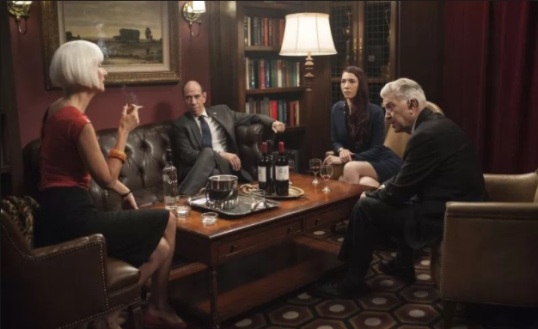
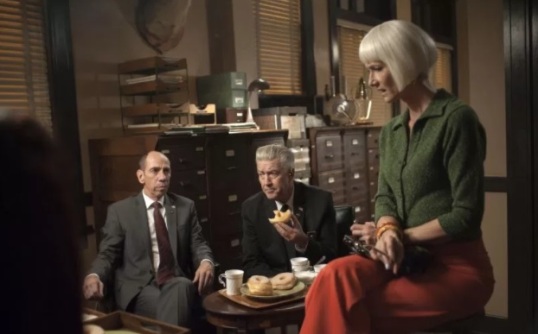
Part 12 opens in an office, with Albert (Miguel Ferrer) telling Tammy (Chrysta Bell) to ignore the strange man.  The man in question is Gordon Cole (David Lynch) and while Gordon may be eccentric, Albert is just showing off his famous wit.  Albert, Gordon, and Tammy drink a toast to the bureau and then Tammy is invited to join the Blue Rose.  Albert explains that the Blue Rose is a secret task force that was set up to investigate that strange cases that Project Blue Book could not solve.  The Blue Rose was originally made up of Albert, Philip Jeffries, Dale Cooper, and Chet Desmond.

“Perhaps you have noticed,” Albert says, “that I’m the only one of that group who hasn’t vanished without explanation.”

Despite the dangers, Tammy agrees to join the task force.  Yay, Tammy!

Diane (Laura Dern) then enters the office.  Gordon and Albert offer to deputize her into the Blue Rose.  Diane at first seems hesitant but suddenly, after a sudden burst of dramatic music, she says, “Let’s rock!”  And, of course, true fans of the show will immediately remember the first time that Cooper met the Man From Another Place during the first season of Twin Peaks.  Coincidence?  I don’t know if anything in Twin Peaks is ever a coincidence.

(I loved this scene.  It was nicely acted by all involved, including the underrated Chrysta Bell, and Angelo Badalamenti’s haunting music was used to wonderful effect.)

Back in Twin Peaks, Jerry (David Patrick Kelly) finally comes running out of the woods.

Meanwhile, in a grocery store, Sarah Palmer (Grace Zabriskie, who is absolutely brilliant in this episode) wanders down the liquor aisle.  After filling up her shopping cart with liquor, she goes to the check out and also gets a carton of Salems.  While the cashier rings her up, Sarah stares at a display of beef jerky.  She appears to be disturbed by it and I don’t blame her.  Beef jerky is nasty.

Anyway, Sarah’s liquor and cigarette bill comes to $133.70.  However, she is more concerned about the beef jerky display.  It wasn’t there before, she says.  She asks if the beef jerky is smoked.  The cashier says that it’s the same beef jerky except that its turkey.

“Were you here when they brought it in?” Sarah asks.  Then, “Your room seems different … AND MEN ARE COMING!  I am trying to tell you that you have to watch out!  Things can happen!  Something happened to me!  I don’t feel good, I don’t feel good!  Sarah … Sarah, stop doing this.  Okay.  Leave this place.”

Leaving behind her liquor and cigarettes, Sarah leaves the store.

At the trailer park, Carl (Harry Dean Stanton) talks to one of his residents, an old man who walks with a cane.  Carl finds out that the man has been selling his blood for money.  Yet, he mows people’s lawns and puts in propane tanks for free.  Carl gives the man $50 and tells him not to worry about paying that month’s rent.  Carl says he doesn’t like the idea of people selling their blood.

In Las Vegas, Dougie (Kyle MacLachlan) and his son play catch in the back yard.  Or, to be honest, his son tries to play catch.  Dougie just stands there while the baseball bounces off his head.  Here’s what Kyle MacLachlan had to say on twitter after someone asked him how he felt after filming this scene:

Back in Twin Peaks, Hawk (Michael Horse) walks up to the Palmer House, to check on Sarah’s well-being.  As he approaches, we see the infamous ceiling fan through a window.  In the original series, any shot of that ceiling fan was usually followed by an appearance by Killer BOB.

Sarah tells Hawk that she doesn’t know what came over her in the grocery store.  Sarah says she’s fine now but she refuses to open the door wide enough for Hawk to get a good view inside the house.  Hawk asks if there’s someone in the house.  “No,” Sarah says, “just something in the kitchen.”

“You’re okay, then?” Hawk asks.

“It’s a goddamn bad story, isn’t it, Hawk?” Sarah suddenly snarls.

Hawk says that if she needs help, she can call him anytime.  Sarah shuts the door in his face.

Cut to Twin Peaks Hospital, where a badly beaten Miriam (Sarah Jean Long) lies in bed.

At the hotel bar, Diane gets a text, asking if they’ve asked about Las Vegas yet.

At the Great Northern, Truman (Robert Forster) meets with Ben (Richard Beymer).  Truman tells Ben that they know that his grandson, Richard, was behind the wheel in the hit and run that killed the little boy.  Truman also says that Richard tried to kill Miriam.  Miriam is a teacher without insurance and now, she’s in intensive care and is going to need an operation.  Truman suggests that Ben should pay for her medical treatment.  Ben agrees and then says that something has always been wrong with Richard.

After talking about Richard being on the run, Ben holds up Cooper’s old room key, the one that he received in the mail a few episodes ago.  He gives it to Truman and asks him to give it to Harry.

After Truman leaves, Ben tells Beverly (Ashley Judd) about Richard.  Richard never had a father, Ben says.  (Perhaps because his father was Doppelganger Cooper.)
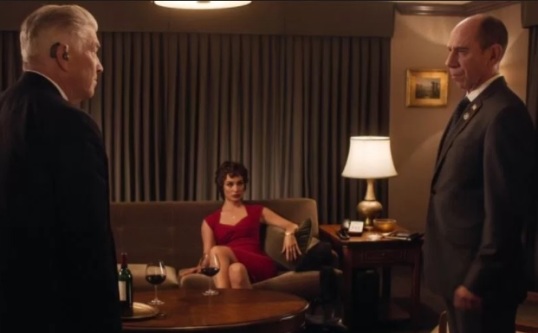
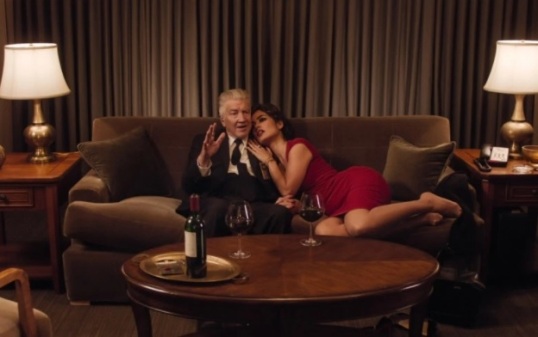
Back in South Dakota, Gordon has a mysterious French woman (Bérénice Marlohe) in his hotel room.  He’s telling her an old FBI story when they’re interrupted by Albert.  Albert asks the woman to wait downstairs.  Though it takes her a while to get her shoes back on (we’ve all been there), she finally does leave.  Gordon explains that the woman is visiting a friend who owns a turnip farm.  The friend’s daughter has disappeared.

“I told her the daughter would turn up eventually,” Gordon explains, before adding, “She didn’t get it either.”  What’s funny is that I can imagine David Lynch telling that exact same joke in real life.

Anyway, Albert is more concerned about the text message that Diane received, the one asking about Las Vegas.

Gordon says they’ll figure it out but, first, he’d like to get back to his wine.

“What kind is it?” Albert asks.

Gordon looks at his watch.  “11:05,” he announces.

When Albert stares at him without responding, Gordon says, “Albert, sometimes I really worry about you.”

Meanwhile, Chantal (Jennifer Jason Leigh) and Hutch (Tim Roth) use a sniper rifle to assassinate the warden (James Morrison) as he walks up to his house.  The warden’s young son comes outside and sees his father dead on the porch.  “Daddy!” he shouts.  It could have been worse.  Hutch wanted to kidnap and torture the warden but Chantel was hungry and wanted to get something to eat.

Back in Twin Peaks, Dr. Jacoby (Russ Tamblyn) rants about the government and sells his golden shovels.  In her shop, Nadine (Wendy Robie) listens approvingly.  Apparently, Dr. Jacoby is now known as Dr. Amp and, just from the way he rants, I bet he’s on twitter and he probably does the whole numbered tweet threading thing.
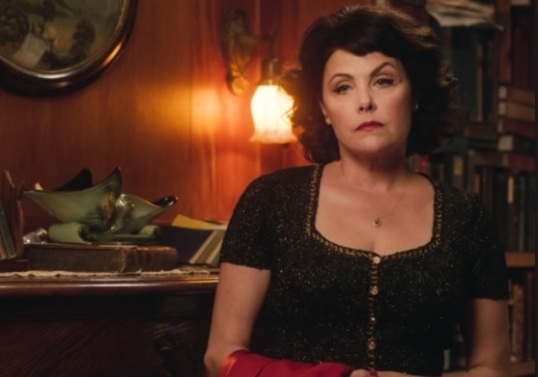
Meanwhile, Audrey Horne (Sherilyn Fenn) is talking to her husband Charlie (Clark Middleton) and — OH MY GOD!  AUDREY’S BACK!  Audrey and Charlie are arguing.  Audrey wants to go out and find someone named Billy.  Charlie says he has a lot of paperwork to do and that there’s no point in going at night.  Audrey is emotional and Charlie … well, Charlie most definitely is not.  Charlie is calm to the point of being creepy.

“What kind of shit are you?” Audrey asks, “You are nothing but a fucking no-balls loser.”

You tell him, Audrey!  I don’t know Charlie but if Audrey says he’s a loser…

Charlie gets peeved and asks Audrey not to talk to him like that but Audrey has no use for him or his hurt feelings.  “You have no balls,” she tells him, “that’s why I am in love with Billy.   That’s why I am fucking Billy.  And Tina … I got to find Tina.  She was the last person who fucking saw Billy and I can’t stand being in the same room as her!”

Audrey demands that Charlie sign some papers that she gave him.  Charlie says he’s not singing anything until he runs them by his lawyer.  Apparently, their marriage involves a contract and, by demanding a divorce, Audrey is reneging on a contract.  Charlie is shocked but Audrey doesn’t care.

Charlie finally agrees to go with Audrey to Roadhouse so they can look for Billy.  But first, Charlie suggests that he should call Tina and talk to her.  Audrey repeats that Tina was the last one to see Billy but then she says that “Chuck is certifiable so we can’t count on anything from him.”

“Did you know,” Charlie asks, “that Chuck stole Billy’s truck last week?”

Charlie goes on to say that the police eventually found Billy’s truck and that Billy dropped all charges.  Audrey seems both confused and fascinated by this story.  Myself, I’m wondering if Billy, Chuck, and Tina actually exist.  (Chuck and Charlie, of course, are both nicknames for Charles.)

I guess Tina is real because Charlie does call her, or at least he claims that he’s called and is talking to Tina.  (We only hear Charlie’s side of the conversation.  And everything that Charles says seems to be intentionally vague.)  After hanging up the phone, Charlie refuses to reveal what Tina said.

In South Dakota, Diane sits in the hotel bar and looks up the coordinates that were written on Ruth Davenport’s arm.  Not surprisingly, they’re the coordinates for Twin Peaks.

Meanwhile, at the Road House, Chromatics are playing once again.  In a booth, two women, Abbie (Elizabeth Anweis) and Natalie (Ana de la Reguera), gossip about a guy named Clark, who is apparently cheating on his girlfriend, Angela, with someone named Mary.  Apparently, Angela is off her meds now.  They also note that Angela’s having a rough time but they’re not surprised.  “Losing her mom like that!” they say.

Suddenly, they’re joined by a hyperactive man named Trick (Scott Coffey, who also played the mysterious Cowboy in Mulholland Drive) who is upset because, on his way to the roadhouse, another vehicle ran him off the road. Trick says he wishes he could kill whoever the other driver was.  When Trick goes to get a beer, Abbie and Natalie discuss that Trick was under house arrest but he’s free now.

To quote something that I said in my initial thoughts post for this episode:

In Dario Argento’s Inferno, there’s a random shot of a woman who we’ve never seen before hanging herself.  She’s never mentioned or seen again.  Argento has said that he included that random shot to show that the world was out of balance.  I think, to a large extent, that’s what Lynch is doing with several of the more random aspects of Twin Peaks.

And, with that in mind, the end credits roll and we only have six more episodes to go.
Twin Peaks on TSL:

  1. Twin Peaks: In the Beginning by Jedadiah Leland
  2. TV Review: Twin Peaks 1.1 — The Pilot (dir by David Lynch) by Lisa Marie Bowman
  3. TV Review: Twin Peaks 1.2 — Traces To Nowhere (directed by Duwayne Dunham) by Jedadiah Leland
  4. TV Review: Twin Peaks 1.3 — Zen, or the Skill To Catch A Killer (dir by David Lynch) by Lisa Marie Bowman
  5. TV Review: Twin Peaks 1.4 “Rest in Pain” (dir by Tina Rathbone) by Leonard Wilson
  6. TV Review: Twin Peaks 1.5 “The One-Armed Man” (directed by Tim Hunter) by Jedadiah Leland
  7. TV Review: Twin Peaks 1.6 “Cooper’s Dreams” (directed by Lesli Linka Glatter) by Lisa Marie Bowman
  8. TV Review: Twin Peaks 1.7 “Realization Time” (directed by Caleb Deschanel) by Lisa Marie Bowman
  9. TV Review: Twin Peaks 1.8 “The Last Evening” (directed by Mark Frost) by Leonard Wilson
  10. TV Review: Twin Peaks 2.1 “May the Giant Be With You” (dir by David Lynch) by Leonard Wilson
  11. TV Review: Twin Peaks 2.2 “Coma” (directed by David Lynch) by Jedadiah Leland
  12. TV Review: Twin Peaks 2.3 “The Man Behind The Glass” (directed by Lesli Linka Glatter) by Jedadiah Leland
  13. TV Review: Twin Peaks 2.4 “Laura’s Secret Diary” (dir by Todd Holland) by Lisa Marie Bowman
  14. TV Review: Twin Peaks 2.5 “The Orchid’s Curse” (dir by Graeme Clifford) by Lisa Marie Bowman
  15. TV Review: Twin Peaks 2.6 “Demons” (dir by Lesli Linka Glatter) by Leonard Wilson
  16. TV Review: Twin Peaks 2.7 “Lonely Souls” (directed by David Lynch) by Jedadiah Leland
  17. TV Review: Twin Peaks 2.8 “Drive With A Dead Girl” (dir by Caleb Deschanel) by Lisa Marie Bowman
  18. TV Review: Twin Peaks 2.9 “Arbitrary Law” (dir by Tim Hunter) by Lisa Marie Bowman
  19. TV Review: Twin Peaks 2.10 “Dispute Between Brothers” (directed by Tina Rathbone) by Jedadiah Leland
  20. TV Review: Twin Peaks 2.11 “Masked Ball” (directed by Duwayne Dunham) by Leonard Wilson
  21. TV Review: Twin Peaks 2.12 “The Black Widow” (directed by Caleb Deschanel) by Leonard Wilson
  22. TV Review: Twin Peaks 2.13 “Checkmate” (directed by Todd Holland) by Jedadiah Leland
  23. TV Review: Twin Peaks 2.14 “Double Play” (directed by Uli Edel) by Jedadiah Leland
  24. TV Review: Twin Peaks 2.15 “Slaves and Masters” (directed by Diane Keaton) by Lisa Marie Bowman
  25. TV Review: Twin Peaks 2.16 “The Condemned Woman” (directed by Lesli Linka Glatter) by Leonard Wilson
  26. TV Review: Twin Peaks 2.17 “Wounds and Scars” (directed by James Foley) by Lisa Marie Bowman
  27. TV Review: Twin Peaks 2.18 “On The Wings of Love” (directed by Duwayne Dunham) by Jedadiah Leland
  28. TV Review: Twin Peaks 2.19 “Variations on Relations” (directed by Jonathan Sanger) by Lisa Marie Bowman
  29. TV Review: Twin Peaks 2.20 “The Path to the Black Lodge” (directed by Stephen Gyllenhaal) by Lisa Marie Bowman
  30. TV Review: Twin Peaks 2.21 “Miss Twin Peaks” (directed by Tim Hunter) by Leonard Wilson
  31. TV Review: Twin Peaks 22.2 “Beyond Life and Death” (directed by David Lynch) by Lisa Marie Bowman
  32. Film Review: Twin Peaks: Fire Walk With Me (dir by David Lynch) by Lisa Marie Bowman
  33. Here’s The Latest Teaser for Showtime’s Twin Peaks by Lisa Marie Bowman
  34. Here’s The Newest Teaser for Showtime’s Twin Peaks by Lisa Marie Bowman
  35. 12 Initial Thoughts About Twin Peaks: The Return Parts One and Two by Lisa Marie Bowman
  36. This Week’s Peaks: Parts One and Two by Ryan C. (trashfilm guru)
  37. TV Review: Twin Peaks: The Return Parts One and Two (dir by David Lynch) by Lisa Marie Bowman
  38. 4 Shots From 4 Films: Special Twin Peaks Edition by Lisa Marie Bowman
  39. This Week’s Peaks: Parts Three and Four by Ryan C. (trashfilm guru)
  40. 14 Initial Thoughts About Twin Peaks: The Return Part Three by Lisa Marie Bowman (dir by David Lynch)
  41. 10 Initial Thoughts About Twin Peaks: The Return Part Four by Lisa Marie Bowman (dir by David Lynch)
  42. TV Review: Twin Peaks: The Return Parts Three and Four (dir by David Lynch) by Lisa Marie Bowman 
  43. 18 Initial Thoughts About Twin Peaks: The Return Part 5 (dir by David Lynch) by Lisa Marie Bowman
  44. This Week’s Peaks: Part Five by Ryan C. (trashfilm guru)
  45. TV Review: Twin Peaks: The Return: Part 5 (dir by David Lynch) by Lisa Marie Bowman
  46. 14 Initial Thoughts On Twin Peaks Part 6 (dir by David Lynch) by Lisa Marie Bowman
  47. This Week’s Peaks: Part Six by Ryan C. (trashfilm guru)
  48. TV Review: Twin Peaks: The Return Part 6 (dir by David Lynch) by Lisa Marie Bowman
  49. 12 Initial Thoughts on Twin Peaks: The Return Part 7 (dir by David Lynch) by Lisa Marie Bowman
  50. This Week’s Peaks: Part Seven by Ryan C. (trashfilm guru)
  51. TV Review: Twin Peaks: The Return Part 7 (dir by David Lynch) by Lisa Marie Bowman
  52. Ten Initial Thoughts on Twin Peaks: The Return Part 8 (dir by David Lynch) by Lisa Marie Bowman
  53. This Week’s Peaks: Part Eight by Ryan C (trashfilm guru)
  54. TV Review: Twin Peaks: The Return Part 8 (dir by David Lynch) by Lisa Marie Bowman
  55. 16 Initial Thoughts on Twin Peaks: The Return Part 9 (dir by David Lynch) by Lisa Marie Bowman
  56. This Week’s Peaks: Part Nine by Ryan C (trashfilm guru)
  57. TV Review: Twin Peaks: The Return Part 9 (dir by David Lynch) by Lisa Marie Bowman
  58. 20 Initial Thoughts On Twin Peaks: The Return Part 10 (dir by David Lynch) by Lisa Marie Bowman
  59. This Week’s Peaks: Part 10 by Ryan C (trashfilm guru)
  60. TV Review: Twin Peaks: The Return Part 10 (dir by David Lynch) by Lisa Marie Bowman
  61. 16 Initial Thoughts About Twin Peaks: The Return Part 11 (dir by David Lynch) by Lisa Marie Bowman
  62. This Week’s Peaks: Part 11 by Ryan C (trashfilm guru)
  63. TV Review: Twin Peaks: The Return Part 11 (dir by David Lynch) by Lisa Marie Bowman
  64. 20 Initial Thoughts on Twin Peaks: The Return Part 12 (dir by David Lynch) by Lisa Marie Bowman
  65. This Weeks Peaks: Part 12 by Ryan C (trashfilm guru)
20 Initial Thoughts on Twin Peaks: The Return Part 12 (dir by David Lynch)


As always, these are just my initial thoughts.  A full recap will appear either later tonight or tomorrow!

  1. Because I watched 5-Headed Shark Attack on SyFy tonight, I’m running a bit behind.  That said, the whole time that five-headed shark was eating people, I was thinking about Twin Peaks.
  2. If nothing else, Twin Peaks: The Return continues to serve as a testament to the amazing talent of the late Miguel Ferrer.
  3. “Let’s rock.”  OMG, was that just a coincidence or does it mean that Diane’s been possessed by the Man From Another Place?
  4. That was a well-stocked liquor aisle.
  5. Somehow, it seems appropriate that Sarah Palmer would smoke Salems.
  6. It was nice to see Robert Forster and Richard Beymer, those two old pros, share a scene together.
  7. Random thought I had while watching tonight’s episode: Is Josie still trapped in that door knob?
  8. It always takes me a while to leave a room too.  We’ve all been there.
  9. No, Gordon — you belong with Shelley!  And if not Shelley, Tammy.
  10. Really? 6,000 languages?
  11. There’s something comforting about the way David Lynch always mixes the corniest humor with the most disturbing drama.
  12. Awww, that hateful old Warden had a son.  That’s sad.
  13. “It’s 7 O’Clock!  Do you know where your freedom is!?”
  14. But has Nadine ever gotten around to ordering a gold shovel?
  15. Did Jacoby legally change his name to Dr. Amp?
  16. I bet Dr. Amp has got a blue check mark and a huge twitter following.
  17. OH MY GOD!  Audrey!
  18. But where is John Justice Wheeler?
  19. In Dario Argento’s Inferno, there’s a random shot of a woman that we’ve never seen before hanging herself.  She’s never mentioned or seen again.  Argento has said that he included that random shot to show that the world was out of balance.  I think, to a large extent, that’s what Lynch is doing with several of the more random aspects of Twin Peaks.
  20. Only six episodes left.  I’m kind of resigned to the possibility that Dougie may never become Cooper again.  Strangely, I know I’ll be satisfied with whatever Lynch gives us.  Let’s take a moment and give some major credit to Showtime for handing over an hour a week to someone who refuses to play by the rules.

Twin Peaks on TSL:

  1. Twin Peaks: In the Beginning by Jedadiah Leland
  2. TV Review: Twin Peaks 1.1 — The Pilot (dir by David Lynch) by Lisa Marie Bowman
  3. TV Review: Twin Peaks 1.2 — Traces To Nowhere (directed by Duwayne Dunham) by Jedadiah Leland
  4. TV Review: Twin Peaks 1.3 — Zen, or the Skill To Catch A Killer (dir by David Lynch) by Lisa Marie Bowman
  5. TV Review: Twin Peaks 1.4 “Rest in Pain” (dir by Tina Rathbone) by Leonard Wilson
  6. TV Review: Twin Peaks 1.5 “The One-Armed Man” (directed by Tim Hunter) by Jedadiah Leland
  7. TV Review: Twin Peaks 1.6 “Cooper’s Dreams” (directed by Lesli Linka Glatter) by Lisa Marie Bowman
  8. TV Review: Twin Peaks 1.7 “Realization Time” (directed by Caleb Deschanel) by Lisa Marie Bowman
  9. TV Review: Twin Peaks 1.8 “The Last Evening” (directed by Mark Frost) by Leonard Wilson
  10. TV Review: Twin Peaks 2.1 “May the Giant Be With You” (dir by David Lynch) by Leonard Wilson
  11. TV Review: Twin Peaks 2.2 “Coma” (directed by David Lynch) by Jedadiah Leland
  12. TV Review: Twin Peaks 2.3 “The Man Behind The Glass” (directed by Lesli Linka Glatter) by Jedadiah Leland
  13. TV Review: Twin Peaks 2.4 “Laura’s Secret Diary” (dir by Todd Holland) by Lisa Marie Bowman
  14. TV Review: Twin Peaks 2.5 “The Orchid’s Curse” (dir by Graeme Clifford) by Lisa Marie Bowman
  15. TV Review: Twin Peaks 2.6 “Demons” (dir by Lesli Linka Glatter) by Leonard Wilson
  16. TV Review: Twin Peaks 2.7 “Lonely Souls” (directed by David Lynch) by Jedadiah Leland
  17. TV Review: Twin Peaks 2.8 “Drive With A Dead Girl” (dir by Caleb Deschanel) by Lisa Marie Bowman
  18. TV Review: Twin Peaks 2.9 “Arbitrary Law” (dir by Tim Hunter) by Lisa Marie Bowman
  19. TV Review: Twin Peaks 2.10 “Dispute Between Brothers” (directed by Tina Rathbone) by Jedadiah Leland
  20. TV Review: Twin Peaks 2.11 “Masked Ball” (directed by Duwayne Dunham) by Leonard Wilson
  21. TV Review: Twin Peaks 2.12 “The Black Widow” (directed by Caleb Deschanel) by Leonard Wilson
  22. TV Review: Twin Peaks 2.13 “Checkmate” (directed by Todd Holland) by Jedadiah Leland
  23. TV Review: Twin Peaks 2.14 “Double Play” (directed by Uli Edel) by Jedadiah Leland
  24. TV Review: Twin Peaks 2.15 “Slaves and Masters” (directed by Diane Keaton) by Lisa Marie Bowman
  25. TV Review: Twin Peaks 2.16 “The Condemned Woman” (directed by Lesli Linka Glatter) by Leonard Wilson
  26. TV Review: Twin Peaks 2.17 “Wounds and Scars” (directed by James Foley) by Lisa Marie Bowman
  27. TV Review: Twin Peaks 2.18 “On The Wings of Love” (directed by Duwayne Dunham) by Jedadiah Leland
  28. TV Review: Twin Peaks 2.19 “Variations on Relations” (directed by Jonathan Sanger) by Lisa Marie Bowman
  29. TV Review: Twin Peaks 2.20 “The Path to the Black Lodge” (directed by Stephen Gyllenhaal) by Lisa Marie Bowman
  30. TV Review: Twin Peaks 2.21 “Miss Twin Peaks” (directed by Tim Hunter) by Leonard Wilson
  31. TV Review: Twin Peaks 22.2 “Beyond Life and Death” (directed by David Lynch) by Lisa Marie Bowman
  32. Film Review: Twin Peaks: Fire Walk With Me (dir by David Lynch) by Lisa Marie Bowman
  33. Here’s The Latest Teaser for Showtime’s Twin Peaks by Lisa Marie Bowman
  34. Here’s The Newest Teaser for Showtime’s Twin Peaks by Lisa Marie Bowman
  35. 12 Initial Thoughts About Twin Peaks: The Return Parts One and Two by Lisa Marie Bowman
  36. This Week’s Peaks: Parts One and Two by Ryan C. (trashfilm guru)
  37. TV Review: Twin Peaks: The Return Parts One and Two (dir by David Lynch) by Lisa Marie Bowman
  38. 4 Shots From 4 Films: Special Twin Peaks Edition by Lisa Marie Bowman
  39. This Week’s Peaks: Parts Three and Four by Ryan C. (trashfilm guru)
  40. 14 Initial Thoughts About Twin Peaks: The Return Part Three by Lisa Marie Bowman (dir by David Lynch)
  41. 10 Initial Thoughts About Twin Peaks: The Return Part Four by Lisa Marie Bowman (dir by David Lynch)
  42. TV Review: Twin Peaks: The Return Parts Three and Four (dir by David Lynch) by Lisa Marie Bowman 
  43. 18 Initial Thoughts About Twin Peaks: The Return Part 5 (dir by David Lynch) by Lisa Marie Bowman
  44. This Week’s Peaks: Part Five by Ryan C. (trashfilm guru)
  45. TV Review: Twin Peaks: The Return: Part 5 (dir by David Lynch) by Lisa Marie Bowman
  46. 14 Initial Thoughts On Twin Peaks Part 6 (dir by David Lynch) by Lisa Marie Bowman
  47. This Week’s Peaks: Part Six by Ryan C. (trashfilm guru)
  48. TV Review: Twin Peaks: The Return Part 6 (dir by David Lynch) by Lisa Marie Bowman
  49. 12 Initial Thoughts on Twin Peaks: The Return Part 7 (dir by David Lynch) by Lisa Marie Bowman
  50. This Week’s Peaks: Part Seven by Ryan C. (trashfilm guru)
  51. TV Review: Twin Peaks: The Return Part 7 (dir by David Lynch) by Lisa Marie Bowman
  52. Ten Initial Thoughts on Twin Peaks: The Return Part 8 (dir by David Lynch) by Lisa Marie Bowman
  53. This Week’s Peaks: Part Eight by Ryan C (trashfilm guru)
  54. TV Review: Twin Peaks: The Return Part 8 (dir by David Lynch) by Lisa Marie Bowman
  55. 16 Initial Thoughts on Twin Peaks: The Return Part 9 (dir by David Lynch) by Lisa Marie Bowman
  56. This Week’s Peaks: Part Nine by Ryan C (trashfilm guru)
  57. TV Review: Twin Peaks: The Return Part 9 (dir by David Lynch) by Lisa Marie Bowman
  58. 20 Initial Thoughts On Twin Peaks: The Return Part 10 (dir by David Lynch) by Lisa Marie Bowman
  59. This Week’s Peaks: Part 10 by Ryan C (trashfilm guru)
  60. TV Review: Twin Peaks: The Return Part 10 (dir by David Lynch) by Lisa Marie Bowman
  61. 16 Initial Thoughts About Twin Peaks: The Return Part 11 (dir by David Lynch) by Lisa Marie Bowman
  62. This Week’s Peaks: Part 11 by Ryan C (trashfilm guru)
  63. TV Review: Twin Peaks: The Return Part 11 (dir by David Lynch) by Lisa Marie Bowman

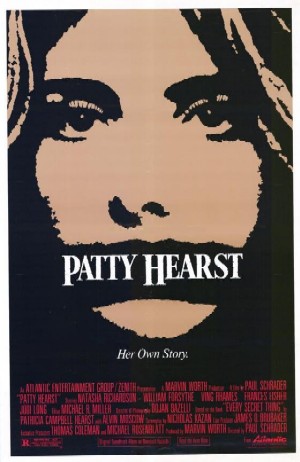
Film Review: Patty Hearst (dir by Paul Schrader)


The 1988 film, Patty Hearst, is based on a fascinating true story.

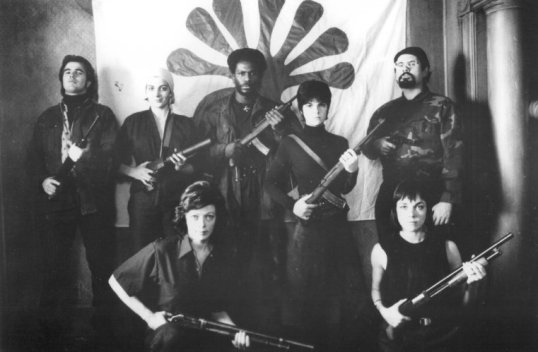
In 1974, newspaper heiress Patty Hearst was a 19 year-old student at Berkeley who was kidnapped from her apartment by a group of self-styled leftist revolutionaries known as the Symbionese Liberation Army (SLA).  The SLA was led by a charismatic escaped prisoner who called himself Field Marshal Cinque and who announced — via messages that Hearst read into a tape recorder — that Hearst was being held hostage in the name of social justice.  The police and FBI spent several months unsuccessfully searching for Hearst until one day, the SLA released an audio tape in which Hearst announced that she had now joined the SLA and would now be known as Tania.  Hearst was soon robbing banks and went from being a hostage to a wanted criminal.  When she was arrested in 1975, Hearst claimed to have been brainwashed by the SLA and people still debate whether she was a sincere revolutionary, a calculating criminal, or a victim.

(From what I’ve read about the Hearst kidnapping, I guess the modern day equivalent would be if Kendall Jenner disappeared and then resurfaced in Portland, setting cars on fire with Antifa.)

What can said for sure is that, after being arrested and convicted of bank robbery, Patty Hearst was sentenced to 7 years in prison.  Hearst served less than three years before her sentence was commuted by President Jimmy Carter.  Twenty years later, another President — Bill Clinton — gave her a full pardon.  Needless to say, the rest of the SLA did not receive a pardon or, for that matter, even a commutation.  The majority of them, including Field Marshal Cinque, died in a fiery explosion that came at the climax of a gun battle with police.  The rest were arrested, convicted, and ended up serving their full sentences.  Of course, while the majority of the SLA came from middle and upper middle class backgrounds, only one of them was the heir to a fortune.  When she was arrested, Patty may have given her career as being an “urban guerilla,” but ultimately, she was the granddaughter of William Randolph Hearst.

(Regardless of whether you believe Patty Hearst was brainwashed or not, it’s an undeniable fact that it’s easier to be a revolutionary when you know you won’t face any serious consequences if the revolution eventually fails.  If the members of the SLA were around today, they could just spend their time on twitter, retweeting John Fugelsang’s thoughts on Jesus.  But, in 1974, there was no twitter…)

Based on Every Secret Thing, Hearst’s own account of her kidnapping and subsequent life as a fugitive, Patty Hearst opens with the heiress (played by Natasha Richardson) being kidnapped and held prisoner by the SLA.  For the first fourth of the film, we see everything exclusively through Patty’s eyes.  She spends her days locked in a dark closet that’s so tiny that she can barely stand.  Whenever the door is opened, shafts a bright light flood both the closet and the screen, blinding not only Patty but the audience as well.  At first, Patty cannot even see the faces of the people who have kidnapped her.  All she knows are their voices.  Whenever that door opens, neither Patty nor the viewer knows whether she’s going to fed, berated, comforted, or raped.  All four of them happen to her, several times over the course of her time in that closet.  It’s harrowing to watch, all the more so because Natasha Richardson gives such an empathetic and bravely vulnerable performance as Patty.  When Patty is finally allowed to leave that closet, the audience is almost thankful as she is.  And, when Patty gets out of the closet, the look of the film changes as well.  It goes from being darkly lit to almost garishly colorful.  Patty’s entire world has changed.

The first part of the film is so powerful that it’s not surprising that the rest of Patty Hearst suffers by comparison.  Once Patty gets out of the closet and declares her allegiance to the revolution, she becomes a bit of a dead-eyed zombie and the focus naturally shifts to the rest of the SLA.  Ving Rhames gives a powerful performance as Cinque, the head of the SLA.  Cinque may be a passionate revolutionary but he also has a dangerous messianic streak.  Even worse, the film suggests, is Cinque’s lieutenant, Teko (William Forsythe).  Teko claims to be a revolutionary but ultimately reveals himself to be as much of a misogynist as those who he claims to oppose.  (Today, Teko would probably be one of those guys arguing that it’s okay for him to use the C word because he’s an “ally.”)  Whereas Cinque has no doubt about his revolutionary commitment, Teko always seem to be trying to prove something to everyone, especially himself.

Ultimately, Patty becomes almost a bystander to her own story.  For a time, she is the most famous bystander in the country.  Though the film is sympathetic to Patty, Natasha Richardson plays her with just a hint of ambiguity.  Ultimately, Patty comes across as someone desperately searching for an identity.  Since she is not sure who she ultimately is, it’s easy for Patty to become an “urban guerilla” and it’s just as easy for to her go back to being an heiress.  By the end of the film, it’s obvious that Patty is just as confused by her life as everyone else.

Patty Hearst was directed by Paul Schrader, who is best known for writing the scripts for such films as Taxi Driver and Rolling Thunder.  (Among Schrader’s other directorial credits: Blue Collar, Hardcore, American Gigolo, Cat People, and The Canyons.  Needless to say, he’s had an interesting career.)  In many ways, Patty Hearst is probably more relevant today than it was first released.  Considering that our culture is currently dominated by people pretending to be revolutionaries and celebrities famous solely for being famous, Patty Hearst feels rather prophetic.

Watching this film and experiencing Patty’s transformation from vapid heiress to brainwashed political activist to briefly notorious celebrity, I realized that we now live in a world of Patty Hearsts.

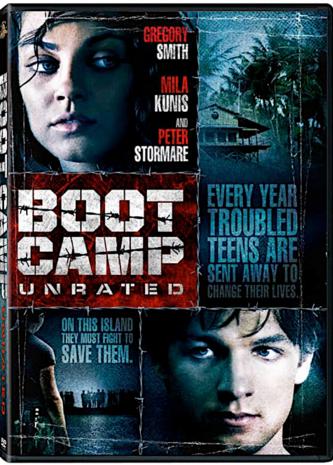
Film Review: Boot Camp (dir by Christian Duguay)


Occasionally, if you’re lucky, you come across a film that so totally and completely conforms to your own worldview that you’re forced to wonder if maybe you wrote the script and then somehow forgot about it.

That was certainly the case, for me, when I recently watched 2008’s Boot Camp, a teen melodrama with an anti-authoritarian subtext.  Check out the trailer:

In Boot Camp, Mila Kunis plays Sophie.  Sophie is rich and, in the eyes of her parents, out of control.  She talks back.  She sneaks out of the house.  She hangs out at all the wrong clubs and with all the wrong people.  You know the story.  We’ve all seen the talk shows.  Sophie’s parents are convinced that the only way that they can get Sophie under control is to exile her to what the film calls a “tough love boot camp.”

The boot camp is located on an island, just a few miles away from a luxurious resort.  From the minute Sophie arrives, she is told that escape is impossible and she can only leave after the facility’s founder, Dr. Arthur Hall (Peter Stomare), says that she can.  Some people have been at the camp for years, waiting for Dr. Hall to announce that they’re rehabilitated.

The rest of the film follows Sophie and several other inmates as they try to survive boot camp without surrendering their free will.  It’s not easy.  Though he is more than happy to take their money, Dr. Hall resents the parents and his program is mostly designed to brainwash the inmates into thinking of him as being their new father figure.  The camp is staffed with brutes, sadists, and rapists.  When one inmate drowns, the staff tries to cover up his death.  Eventually, like the inhabitants of the Island of Dr. Moreau, Sophie and the other inmates have no choice but to rise up in rebellion against their masters.

“Tough love boot camps” are a real thing.  They used to be hugely popular with daytime talk show audiences and I know that Dr. Phil still has a ranch to which he sends “out of control” teens.  (I put “out of control” in quotes because, often times, it seems that “out of control” is code for “thinking for yourself.”)  The idea is that rebellious teenagers are sent to the camp, where they get yelled at until they agree to stop being so rebellious.  Over the years, there’s been a lot of debate over whether boot camps actually work.  If I had been sent to a boot camp, I think I would have just lied about my feelings and put on a repentant good girl act just to get the yelling to stop.  I’d be perfectly humble and contrite for three months and then, as soon as I got out of the camp, I’d go back to sneaking out of the house, skipping school, shoplifting, doing drugs, and whatever else got me sent to the camp in the first place.  From what I’ve seen of the whole boot camp experience, it seems to be more about brainwashing than anything else.  What’s the point of having well-behaved children if they can’t think for themselves?

But, then again, boot camps have never really been about  helping the teenagers sent to them.  Instead, they’ve always been about making lousy parents feel better about themselves.  Parents who have spent the last 14 years totally fucking up their children get to pat themselves on the back because they sent their kids to boot camp.  Other adults, bitter over having lost their youth, get to say, “It’s time to teach those ungrateful children to respect authority.”  As for the people who run the boot camps, it’s less about the inmates and more about power and money.

That’s certainly the message of Boot Camp.  In fact, I was taken by surprise to discover just how much Boot Camp conformed to my own thinking on … well, on just about everything.  Make no mistake, Boot Camp is a flawed film.  There’s nothing subtle about Christian Duguay’s direction and, with the exception of Mila Kunis, none of the performances are as memorable as you might hope that they would be.  Peter Stomare is way too obvious in his villainy, giving a performance that belongs in the Overacting Hall Of Fame.  (You’ll find Stomare’s Dr. Hall in the villain wing, right next to Christoph Waltz in SPECTRE.)

But, even with all that in mind, it was impossible for me not to get excited when Sophie and her fellow out-of-control teens finally made their move against their tormentors.  The final third of Boot Camp turns into a celebration of disobedience and rebellion and it was impossible for me not to be thrilled by it.  Considering the increasingly Orwellian nature of American culture, we need more movies that celebrate revolution and individual freedom.  At a time when we’re being told that we “have to do this” or “have to do that,” Boot Camp says, “Nobody has to do anything, beyond what they choose.”

It’s an important message and one that people need to start heeding.


TV Review: Twin Peaks The Return Part 11 (dir by David Lynch)


The latest episode of Twin Peaks begins, appropriately enough, in Twin Peaks, with a group of kids tossing a baseball around outside of a trailer park.  When one of them misses a catch, he chases the ball out into the middle of the road.

Needless to say, this scared the Hell out of me.

Seriously, we all know what happens when you run out into the middle of the road in Twin Peaks.  Richard Horne appears out of nowhere, screaming about cocaine, and basically runs you down in a stolen pickup truck.  Needless to say, I was totally prepared for this kid to die but it didn’t happen.  Instead, he spotted a seriously injured Miriam (Sarah Jean Long) dragging herself out of the woods.  Apparently, she survived being attacked by Richard at the beginning of last week’s episode.

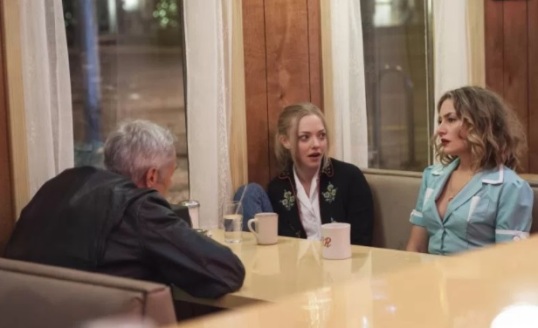
Speaking of trailer park drama, someone calls Becky Burnett (Amanda Seyfried) and informs her that her good-for-nothing husband, Steve (Caleb Landry Jones), is at an apartment with Gersten Hayward (Alicia Witt).  Enraged, Becky screams that she doesn’t have a car.  However, she does have a mother, Shelley (Madchen Amick) and Shelley knows a little something about bad boys.  When Becky calls and says that she needs her mom’s car, Shelley runs from the diner and heads to the trailer park.

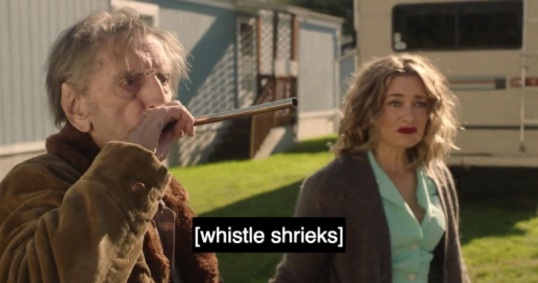
When Shelley arrives, she discovers that Becky 1) has a gun and 2) wants the car so that she can track down Steve and shoot him.  As Shelley gets out of the car, Becky jumps in and starts to drive off.  Shelley jumps onto the hood of the car but ends up flying off as Becky speeds out of the trailer park.  Fortunately, Shelley only ends up with a skinned knee.  Carl (Harry Dean Stanton), who has apparently seen his share of Becky and Steve’s drama, uses a flute to summon a VW microbus and soon, Carl and Shelley are on the road!

It turns out that Carl also knows Maggie (Jodi Thelen), the dispatcher at the sheriff’s office.  While sitting, with Shelley, in the back of the microbus, Carl calls Maggie and asks to be put through to Deputy Bobby Briggs (Dana Ashbrook).  That’s right — Becky is Shelley and Bobby’s daughter!  (Okay, that’s actually not a huge shock but seriously, I’ve been wondering if the revival would ever acknowledge Bobby and Shelley’s relationship in the original series.)  Shelley tells Bobby that Becky has a gun and they’re not sure where she went.

“Oh God,” Carl says, in a tone of voice that suggests he’s not particularly shocked by any of this.

Meanwhile, at an apartment building, Becky bangs on the door to Room 208.  When the woman in the next room pops out her head and announces that “They just left,” Becky responds by shooting the door six times.  (And, literally everyone in Twin Peaks responds by calling the sheriff’s department.)

Meanwhile, in South Dakota, Gordon (David Lynch), Albert (Miguel Ferrer), Diane (Laura Dern), Tammy (Chrysta Bell), MacKlay (Brent Briscoe), and Bill Hastings (Matthew Lillard) pull up in front of the deserted farm where Hastings claims he and Ruth Davenport found the portal that led them to Major Briggs.  Let’s see if I can keep straight what happened here:

  1. A fat little Woodsman kept appearing and then vanishing.  Gordon, Albert, and Diane all spotted the Woodsman.  None of them seemed to be particularly surprised.
  2. Gordon, and only Gordon, saw a swirling vortex, much like the one from Donnie Darko, appear in the sky.
  3. Gordon nearly got sucked into the vortex.  Before Albert pulled him back, Gordon saw what appeared to be three Woodsmen standing on a staircase.
  4. Gordon and Albert stumbled across the headless body of Ruth Davenport.
  5. Sitting in the backseat of MacKlay’s car Bill looked really concerned and I was briefly reminded of Lillard’s performance in 13 Ghosts.
  6. That fat little woodsman snuck up behind MacKlay’s car.  Diane saw the woodsman but said nothing.
  7. MacKlay glanced in the backseat and started to scream.
  8. Everyone else glanced into the car.
  9. Suddenly, Bill Hasting was missing the top half of his head.
  10. “He’s dead,” Gordon commented.  (Lynch delivered the line with perfect nonchalance.)

That night, at the Double R, Bobby sits in a booth with Becky and Shelley.  Becky says she wants a divorce but that she also still loves Steve.  Bobby tells her that Becky is going to have to pay for the door, which Becky is not at all happy to hear.  Bobby goes on to reveal that he’s convinced the Sheriff not to arrest Becky and that he’s through allowing Steve to get away with stuff.  From now on, if Steve breaks the law, Bobby’s not going to step in to protect him from the consequences.  When Bobby and Shelley offer to help her get away from Steve, Becky suddenly starts to defend her abusive husband.  It’s a touching and rather sad scene, a chance to see Bobby and Shelley as true adults.  However, it all ends when Red (Balathazar Getty) walks up to the diner.  Shelley’s face lights up as she runs outside to see him.  Meanwhile, Bobby and Becky exchange looks.  Just as Becky is blind to Steve’s true character, Shelley is blind to who Red is.

(Shelley went from Leo to Bobby — back when Bobby was still a drug dealer — to Red.  Shelley!  I like bad boys too but goddamn … you can do so much better!  Gordon Cole, for instance, was in love with you…)

As soon as Shelley reenters the Double R and sits back down with her daughter and ex-husband, gunshots ring out!  Oh my God, is Red trying to kill Bobby!?  Or is one of Red’s enemies (Richard maybe) trying to kill Shelley!?  Those were my first two thoughts but no — it turns out that a kid accidentally fired a gun that he happened to find in his parent’s SUV.  Bobby immediately brings order to the scene and it’s interesting to see just how much of a responsible adult and authority figure Bobby Briggs has actually become.

(Still, I always wonder if everyone’s forgotten that Bobby murdered a Canadian drug smuggler in Twin Peaks: Fire Walk With Me.  Bobby shot off the top of his head, in much the same way that the fat little woodsman ripped off the top of Bill’s head.)

The scene ends on an odd (and rather grotesque) note when Bobby tells the woman in the car behind the SUV that she needs to stop honking her horn.  The woman shouts that she has to get home and that they have miles to go.  She also says that the passenger in the car with her is sick.  In the passenger’s seat, a zombiesh girl looks at Bobby and starts to spit something up.

At the Sheriff’s Department, Truman (Robert Forster) and Hawk (Michael Horse) look at a map, trying to pinpoint where Major Briggs’s note told them to go.  Actually, they have two maps.  Truman has Google Earth while Hawk has an old Indian map.  The Log Lady (Catherine Coulson) calls and asks if Hawk has found something.  “My log is afraid of fire,” she explains, “There is fire where you are going.”

Back in South Dakota, Gordon is concerned because his hand is shaking.  (In the original series, a twitching arm or hand often indicated that BOB was entering our world from the Black Lodge.)  Albert shows Gordon a picture that he took of several numbers that were written on Ruth Davenport’s arm.  Albert believes that the numbers are coordinates.  Diane smokes.  Tammy and MacKlay come by with donuts and coffee.  “Ah!” Gordon shouts when he sees the donuts, “the policeman’s dream!”

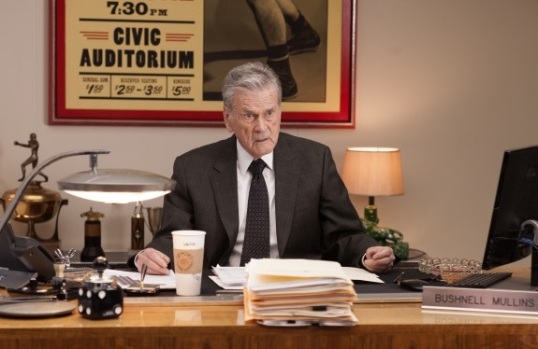
In Las Vegas, everyone is still hilariously unaware that Dougie (Kyle MacLachlan) is an empty shell who is mostly concerned with coffee and shiny badges.  Bushnell Mullins (Don Murray) tells Dougie that it’s obvious that Dougie’s “investigative work” has exposed a connection between police corruption, organized crime, and the insurance industry.  As Mullins praises Dougie for his hard work, Dougie blankly drinks his coffee.  Mullins says that, despite their fearsome reputation, the Mitchum Brothers are not involved in any of the corruption.

“It’s somebody else,” Mullins says.

“Somebody else,” Dougie repeats.

“That right,” Mullins agrees.

It turns out that the Mitchums want to have a personal meeting with Dougie about their claim.   (Of course, we know that the Mitchums want to kill Dougie because Tom Sizemore’s Anthony Sinclair framed Dougie for cheating them out of a claim.)  Mullins gives Dougie a $30 million claim check to the give to the Mitchums and then explains all of the weird technical stuff that will allow the firm to make money even as if it pays off a huge claim.  I couldn’t really follow it but Mullins was certainly proud of himself.

Mullins says that the Mitchums are sending a car to pick Dougie up for their meeting.  Does Mullins realize that the Mitchums are planning to kill Dougie?  And could that be the real reason that Mullins gave Dougie the check, as a way of convincing the Mitchums not to kill him?  I’m not sure.

Fortunately, while walking out to the waiting limo, Dougie sees MIKE (Al Strobel) beckoning him to enter a small pastry shop.  Dougie buys a cherry pie.  As we shall soon see, MIKE is still looking out for him.

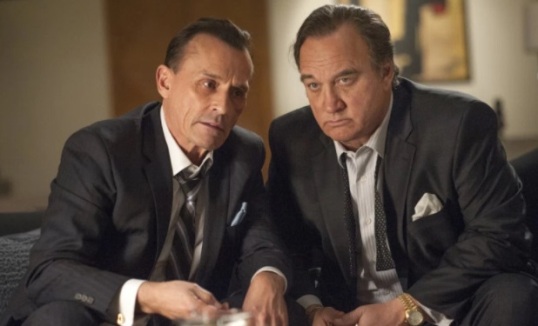
Dougie is then driven out to the desert by the same limo driver (Jay Larson) who previously drove him home from the casino.  The Mitchums are waiting for him but it quickly turns out that neither Rodney (Robert Knepper) nor Bradley (Jim Belushi) is really that enthusiastic about killing Dougie.  Despite the fact that he’s been having dreams about murdering Dougie, Bradley is especially reluctant.  After all, Dougie took care of Ike the Spike for them.  Plus, there was more to Bradley’s dream then just killing Dougie.  Bradley just can’t remember what exactly.

They’re even more reluctant once they discover that 1) Dougie is carrying a pie with him (just as he was in Bradley’s dream) and 2) Dougie has a huge check for them.  So, instead of killing Dougie, they take him out to eat.  Dougie especially enjoys that pie.  The old woman from the casino happens to enter the restaurant and she tells “Mr. Jackpots” that, ever since he helped her win all that money, her life has been perfect!  Yay!  Everyone’s a winner!

All in all, this was a pretty good episode.  It was good to see that the story’s moving forward.  I’m really liking Bobby Briggs (and Dana Ashbrook) as the voice of moral responsibility and the Las Vegas story remains far more entertaining than it has any right to be.  And now that Gordon has seen the woodsmen, what will happen next?

I can’t wait to find out!

Twin Peaks on TSL:

  1. Twin Peaks: In the Beginning by Jedadiah Leland
  2. TV Review: Twin Peaks 1.1 — The Pilot (dir by David Lynch) by Lisa Marie Bowman
  3. TV Review: Twin Peaks 1.2 — Traces To Nowhere (directed by Duwayne Dunham) by Jedadiah Leland
  4. TV Review: Twin Peaks 1.3 — Zen, or the Skill To Catch A Killer (dir by David Lynch) by Lisa Marie Bowman
  5. TV Review: Twin Peaks 1.4 “Rest in Pain” (dir by Tina Rathbone) by Leonard Wilson
  6. TV Review: Twin Peaks 1.5 “The One-Armed Man” (directed by Tim Hunter) by Jedadiah Leland
  7. TV Review: Twin Peaks 1.6 “Cooper’s Dreams” (directed by Lesli Linka Glatter) by Lisa Marie Bowman
  8. TV Review: Twin Peaks 1.7 “Realization Time” (directed by Caleb Deschanel) by Lisa Marie Bowman
  9. TV Review: Twin Peaks 1.8 “The Last Evening” (directed by Mark Frost) by Leonard Wilson
  10. TV Review: Twin Peaks 2.1 “May the Giant Be With You” (dir by David Lynch) by Leonard Wilson
  11. TV Review: Twin Peaks 2.2 “Coma” (directed by David Lynch) by Jedadiah Leland
  12. TV Review: Twin Peaks 2.3 “The Man Behind The Glass” (directed by Lesli Linka Glatter) by Jedadiah Leland
  13. TV Review: Twin Peaks 2.4 “Laura’s Secret Diary” (dir by Todd Holland) by Lisa Marie Bowman
  14. TV Review: Twin Peaks 2.5 “The Orchid’s Curse” (dir by Graeme Clifford) by Lisa Marie Bowman
  15. TV Review: Twin Peaks 2.6 “Demons” (dir by Lesli Linka Glatter) by Leonard Wilson
  16. TV Review: Twin Peaks 2.7 “Lonely Souls” (directed by David Lynch) by Jedadiah Leland
  17. TV Review: Twin Peaks 2.8 “Drive With A Dead Girl” (dir by Caleb Deschanel) by Lisa Marie Bowman
  18. TV Review: Twin Peaks 2.9 “Arbitrary Law” (dir by Tim Hunter) by Lisa Marie Bowman
  19. TV Review: Twin Peaks 2.10 “Dispute Between Brothers” (directed by Tina Rathbone) by Jedadiah Leland
  20. TV Review: Twin Peaks 2.11 “Masked Ball” (directed by Duwayne Dunham) by Leonard Wilson
  21. TV Review: Twin Peaks 2.12 “The Black Widow” (directed by Caleb Deschanel) by Leonard Wilson
  22. TV Review: Twin Peaks 2.13 “Checkmate” (directed by Todd Holland) by Jedadiah Leland
  23. TV Review: Twin Peaks 2.14 “Double Play” (directed by Uli Edel) by Jedadiah Leland
  24. TV Review: Twin Peaks 2.15 “Slaves and Masters” (directed by Diane Keaton) by Lisa Marie Bowman
  25. TV Review: Twin Peaks 2.16 “The Condemned Woman” (directed by Lesli Linka Glatter) by Leonard Wilson
  26. TV Review: Twin Peaks 2.17 “Wounds and Scars” (directed by James Foley) by Lisa Marie Bowman
  27. TV Review: Twin Peaks 2.18 “On The Wings of Love” (directed by Duwayne Dunham) by Jedadiah Leland
  28. TV Review: Twin Peaks 2.19 “Variations on Relations” (directed by Jonathan Sanger) by Lisa Marie Bowman
  29. TV Review: Twin Peaks 2.20 “The Path to the Black Lodge” (directed by Stephen Gyllenhaal) by Lisa Marie Bowman
  30. TV Review: Twin Peaks 2.21 “Miss Twin Peaks” (directed by Tim Hunter) by Leonard Wilson
  31. TV Review: Twin Peaks 22.2 “Beyond Life and Death” (directed by David Lynch) by Lisa Marie Bowman
  32. Film Review: Twin Peaks: Fire Walk With Me (dir by David Lynch) by Lisa Marie Bowman
  33. Here’s The Latest Teaser for Showtime’s Twin Peaks by Lisa Marie Bowman
  34. Here’s The Newest Teaser for Showtime’s Twin Peaks by Lisa Marie Bowman
  35. 12 Initial Thoughts About Twin Peaks: The Return Parts One and Two by Lisa Marie Bowman
  36. This Week’s Peaks: Parts One and Two by Ryan C. (trashfilm guru)
  37. TV Review: Twin Peaks: The Return Parts One and Two (dir by David Lynch) by Lisa Marie Bowman
  38. 4 Shots From 4 Films: Special Twin Peaks Edition by Lisa Marie Bowman
  39. This Week’s Peaks: Parts Three and Four by Ryan C. (trashfilm guru)
  40. 14 Initial Thoughts About Twin Peaks: The Return Part Three by Lisa Marie Bowman (dir by David Lynch)
  41. 10 Initial Thoughts About Twin Peaks: The Return Part Four by Lisa Marie Bowman (dir by David Lynch)
  42. TV Review: Twin Peaks: The Return Parts Three and Four (dir by David Lynch) by Lisa Marie Bowman 
  43. 18 Initial Thoughts About Twin Peaks: The Return Part 5 (dir by David Lynch) by Lisa Marie Bowman
  44. This Week’s Peaks: Part Five by Ryan C. (trashfilm guru)
  45. TV Review: Twin Peaks: The Return: Part 5 (dir by David Lynch) by Lisa Marie Bowman
  46. 14 Initial Thoughts On Twin Peaks Part 6 (dir by David Lynch) by Lisa Marie Bowman
  47. This Week’s Peaks: Part Six by Ryan C. (trashfilm guru)
  48. TV Review: Twin Peaks: The Return Part 6 (dir by David Lynch) by Lisa Marie Bowman
  49. 12 Initial Thoughts on Twin Peaks: The Return Part 7 (dir by David Lynch) by Lisa Marie Bowman
  50. This Week’s Peaks: Part Seven by Ryan C. (trashfilm guru)
  51. TV Review: Twin Peaks: The Return Part 7 (dir by David Lynch) by Lisa Marie Bowman
  52. Ten Initial Thoughts on Twin Peaks: The Return Part 8 (dir by David Lynch) by Lisa Marie Bowman
  53. This Week’s Peaks: Part Eight by Ryan C (trashfilm guru)
  54. TV Review: Twin Peaks: The Return Part 8 (dir by David Lynch) by Lisa Marie Bowman
  55. 16 Initial Thoughts on Twin Peaks: The Return Part 9 (dir by David Lynch) by Lisa Marie Bowman
  56. This Week’s Peaks: Part Nine by Ryan C (trashfilm guru)
  57. TV Review: Twin Peaks: The Return Part 9 (dir by David Lynch) by Lisa Marie Bowman
  58. 20 Initial Thoughts On Twin Peaks: The Return Part 10 (dir by David Lynch) by Lisa Marie Bowman
  59. This Week’s Peaks: Part 10 by Ryan C (trashfilm guru)
  60. TV Review: Twin Peaks: The Return Part 10 (dir by David Lynch) by Lisa Marie Bowman
  61. 16 Initial Thoughts About Twin Peaks: The Return Part 11 (dir by David Lynch) by Lisa Marie Bowman
  62. This Week’s Peaks: Part 11 by Ryan C (trashfilm guru)

Music Video of the Day: Ain’t No Rest For The Wicked by Cage The Elephant (2008, dir by D.A.R.Y.L.)


ain’t no rest for the wicked/money don’t grow on trees

Hi everyone!  Lisa here, filling in for our resident music video expert, Valerie.

Now, there’s a variety different reasons why Val or I might pick a video for music video of the day.  Sometimes, the choice is made as a way to honor an artist who has recently passed away.  Sometimes, it’s done to commemorate a historical event.  And sometimes, especially in my case, it’s just because the song’s chorus has gotten stuck in my head.

For instance, take today’s music video of the day.  Sunday morning, I was driving to the store and I turned on the radio and, just by chance, this was the song that was playing.  Ever since, I’ve had Ain’t No Rest For The Wicked, Money Don’t Grow On Trees stuck in my head.

And really, the song has a point.  Money doesn’t grow on trees.

Anyway, this video was directed by D.A.R.Y.L., which is the creative moniker of directors James Hall and Edward Lovelace.

Enjoy!

oh, there ain’t no rest for the wicked


Film Review: Cutter’s Way (dir by Ivan Passer)


Yesterday, after it was announced that actor John Heard had been found dead in a Palo Alto hotel room, I lost track of how many people declared that Cutter’s Way, a 1981 film in which Heard co-starred with Jeff Bridges, was one of their favorite movies of all time.  (That includes quite a few people who write for this very site.)  In fact, people were so enthusiastic about Cutter’s Way that I quickly decided that this was a film that I needed to watch for myself.  So, last night, after watching All About Eve on TCM and My Science Project with the Late Night Movie Gang, I curled up on the couch and I watched Cutter’s Way.

Technically, Cutter’s Way is a murder mystery but it’s actually a lot more.  In the grand noir tradition, the mystery is less important than the milieu in which it occurs.  Cutter’s Way takes place in Santa Barbara, California, which the film presents as being a microcosm of America.  It’s place where the rich are extremely rich and the poor are pushed to the side and expected not to complain.  The Santa Barbara of Cutter’s Way is controlled by new money and haunted by old sins.  It’s a world that is perfectly captured, by director Ivan Passer and cinematographer Jordan Cronenweth, in the film’s haunting opening scene:

John Heard plays Alex Cutter.  Years ago, Cutter served in Vietnam and returned with one less eye, one less arm, and one less leg.  An angry alcoholic, the type who always looks like he’s in desperate need of a shower and a shave, Cutter exists on the fringes of society.  Like many alcoholics, Cutter is a master manipulator.  When he has to, he can turn on the charm.  When the police are called after a drunken Cutter purposefully destroys his neighbor’s car, we suddenly see a totally different Alex Cutter.  He’s polite and apologetic, explaining that he was merely swerving to avoid something in the road and, by the way, he served his country in Vietnam.  As soon as the police leave, the real Cutter comes out.  He gets his bottle and starts to rant about how much the world owes him.  Watching the film, you find yourself understanding why some people might want to push this one-legged, one-armed, one-eyed veteran down a flight of stairs, that’s how obnoxious Alex Cutter can be.

And yet, there are people who love Alex Cutter.  There’s his long-suffering wife, Mo (Lisa Eichhorn).  Mo lives in squalor with Cutter, taking care of him and putting up with his bitterness.  There’s the local bar owner, who could probably put his kids through college on Cutter’s bar tab.  (He even drives Cutter home in the morning, after everyone else has deserted him.)  And finally, there’s Richard Bone (Jeff Bridges).

Bone is Cutter’s best friend.  Whereas Cutter is perpetually pissed off, Bone is almost always laid back.  Whereas Cutter feels that everything is his business, Bone prefers to remain detached from the world.  Mention is made of Bone being a graduate of the Ivy League but he spends most of his time giving tennis lessons and sleeping with wealthy women.  Bone takes care of Cutter, though their friendship is occasionally hard to figure out.  Why does Bone stick with Cutter despite all of Cutter’s abuse?  Perhaps Bone feels guilty because he avoided being drafted while Cutter lost half of his limbs in Vietnam.  Or maybe it’s because Bone is in love with Mo.

One night, when Bone is leaving a hotel, he sees a man in an alley.  The man appears to be hiding something in a dumpster.  Later, when the body of a woman is found in that same dumpster, Bone realizes that he probably saw the murderer.  Even more so, Bone thinks that the man resembled J.J. Cord (Stephen Elliott), one of the richest men in Santa Barbara.

Bone, however, isn’t sure that Cord’s the murderer.  Even more so, even if Cord was the murderer, Bone prefers to not get involved.  However, Cutter is sure that Cord’s the killer.  To Cutter, it makes perfect sense.  If men like Cord were willing to send boys to Vietnam and then refuse to take care of them when they returned both physically and mentally maimed by the experience, then why wouldn’t they also think that they could get away with murdering some hitchhiker?

Soon, Cutter has met the dead girl’s sister, Valerie (Ann Dusenberry).  Cutter says that his plan is to blackmail Cord.  He badgers the reluctant Bone into working with him.  It quickly becomes obvious, however, that Cutter is after more than money.  He is obsessed with proving that this rich and powerful man is a murderer.  And he’s not going to let anyone stand in his way.  Not even a stuffed animal:

As I said, Cutter’s Way is about much more than just a murder.  It’s a film about class differences, with even the otherwise slick Bone discovering how difficult it is to infiltrate Cord’s wealthy world.  It’s a film about disillusionment, cynicism, and the fleeting promise of happiness.  As angry as Cutter is, he still ultimately possesses the idealism that both Bone and Mo have lost.  He still believes in right and wrong.  While that angry idealism may make Cutter a pain in the ass, it’s also his redeeming feature.  As the youngest of them, Valerie is still an optimist but she is also the least prepared to deal with the sordid reality of the world around her.  Bone and Mo, meanwhile, both appear to have surrendered their belief that the world can be and should be a better place.  Ultimately, Cutter’s Way is a film that forces you to consider what you would do if you were in the same situation.  Cutter’s Way is not a great title, largely because it makes the film sound like a CW western, but it’s an appropriate one.  The entire film is about Cutter’s way of viewing the world and whether or not Bone will follow Cutter or if he’ll continue to refuse to get involved.

(The novel that the film’s based on was called Cutter and Bone.  According to Wikipedia, the title was changed because audiences thought the movie was a comedy about surgeons.)

I have to agree with those who have called Cutter’s Way a great film.  Not only is it gorgeous to look at but it’s one of the best acted films that I’ve ever seen, from the stars all the way down to the most minor of roles.  John Heard dominates the film, giving a performance of almost demonic energy but he’s perfectly matched by Jeff Bridges.  Bridges, back in his incredibly handsome younger days, gives a subtle and powerful performance as a man struggling with his conscience.  In the role of J.J. Cord, Stephen Elliott doesn’t get much screen time but he makes the most of it.  When he first see him, he’s riding a white horse and rather haughtily looking down on the world around him.  When he last see him, he delivers a line of such incredible arrogance that it literally left me stunned.  Though, when compared to Bridges and Heard, their roles are underwritten, both Lisa Eichhorn and Ann Dusenberry more than hold their own, providing able and poignant support.

Cutter’s Way is a great film and one that everyone should watch if they haven’t.


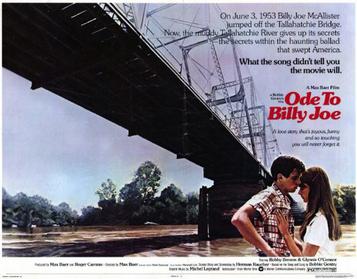
Film Review: Ode to Billy Joe (dir by Max Baer, Jr.)


Why, on June 3rd, did Billie Joe McAllister jump off of the Tallahatchie Bridge in Mississippi?

That was the question that was asked in Ode to Billie Joe, a 1967 country song by Bobbie Gentry.  In the song, the details were deliberately left inconclusive.  Why did Billie Joe commit suicide?  No one knows.  All they know is that he was a good worker at the sawmill and, the weekend before jumping, he was seen standing on the bridge with a teenage girl and apparently, they dropped something down into the river below.  The song suggests that the girl and the narrator are one in the same but even that is left somewhat vague.

Ode to Billie Joe was a hit when it was first released, largely because it’s story could be interpreted in so many different ways.  Why did Billie Joe kill himself?  Maybe it was because he didn’t want to be drafted.  Maybe it was because he and his girlfriend had killed their baby and tossed it off the bridge.  Maybe it was because he was hooked on Dexedrine and his doctor wasn’t available to renew his prescription.  It could be any reason that you wanted it to be.

However, in 1976, when Ode to Billie Joe was turned into a movie, ambiguity would not do.  As opposed to the song, Ode To Billy Joe had to answer the question as to why Billy Joe jumped into that river.  In the movie, 18 year-old Billy Joe (Robby Benson) works at the sawmill and spends his time courting 15 year-old Bobbie Lee Hartley (Glynnis O’Connor).  Bobbie Lee’s father (Sandy McPeak) says that she’s too young to have a “gentleman caller,” even though Bobbie Lee insists that she’s “15 going on 34 … B cup!”  Bobbie Lee warns Billy Joe that her father is liable to shoot his ears off but Billy Joe insists that he doesn’t need ears because he’s in love with her.  That’s kind of a sweet sentiment, even though I don’t think Billy Joe would look that good without ears.

(Whenever I complain about how Southerners in the movies always seem to have two first names, my sister Erin replies, “Yeah, that’s really annoying, Lisa Marie.”  So, I won’t make a big deal about it this time…)

One night, Billy Joe and his friends go out and Billy Joe ends up getting drunk.  He disappears for several days and when he shows up again, something has definitely changed.  After unsuccessfully trying to make love to Bobbie Lee, Billy Joe tells her what happened that night he got drunk.  Billy Joe had sex with a man, something that he has been raised to view as being the ultimate sin.  When Billy Joe is later pulled out of the river, the entire town wonders why he jumped off the bridge and how Bobbie Lee was involved…

Ode to Billy Joe, which aired last Tuesday on TCM, is a better-than-average film, one that I was surprised to have never come across in the past.  That doesn’t mean that it’s a perfect movie. Robby Benson, in the role of Billy Joe, gives an absolutely terrible performance.  You can tell that Benson was trying really hard to do a good job but, often, he goes totally overboard, making scenes that should be poignant feel melodramatic.  Though it probably has more to do with when the film was made than anything else, the film is also vague about Billy Joe’s sexuality.  Is Billy Joe in denial about his identity?  Is he deeply closeted or was he in such a drunken stupor that he was taken advantage of?  Ode to Billy Joe does not seem to be sure.  By committing suicide, Billy Joe joins the ranks of gay movie characters who would rather die than accept their sexuality.  Obviously, he had to jump off that bridge because that’s what the song said he did but there’s a part of me that wishes the movie had featured someone commenting that they never actually found Billy Joe’s body and then the final scene could have taken place 16 years later, with Bobbie Lee living as a hippie in San Francisco and just happening to spot Billy Joe walking down the street, hand-in-hand with his boyfriend.

Here’s what does work about the movie.  Glynnis O’Connor gives a great and empathetic performance as Bobbie Lee.  The scenes with her father and her mother (played by Joan Hotchkis) have a very poignant and wonderful realness to them.  Though I’ll always be a city girl at heart (well, okay — a suburb girl), I spent some time in the country when I was growing up.  And while I was never quite as isolated as Bobbie Lee (who lives in a house with no electricity or plumbing) and the film took place in the past, I could still relate to many of Bobbie Lee’s experiences.  The film may have been made in 1976 and set in 1952 but life in the country hasn’t changed that much.

For instance, there’s this great scene where Bobbie Lee’s father is trying to drive across the bridge.  The only problem is that there’s a bunch of drunk shitkickers on the bridge, sitting in their pickup truck and blocking his way.  It’s a very tense scene, one that I found difficult to watch because, when I was growing up in Arkansas, Oklahoma, Louisiana, and South Texas, I saw the exact same thing happen more times than I care to admit.  In the country, no one backs down.  Scenes like that elevated Ode To Billy Joe to being something more than just another movie based on a song.

Finally, there’s a beautiful scene towards the end of the film, between Bobbie Lee and a character played by an actor named James Best.  I won’t spoil the scene but it’s a master class in great acting.  (Best also played one of the sadistic villains in Rolling Thunder, another good 70s film about life and death in the country.)

Though I wasn’t expecting much from it, Ode to Billy Joe was a pleasant surprise.  It’s not perfect but it’s still worth watching.