12 Oscar Snubs From the 1950s


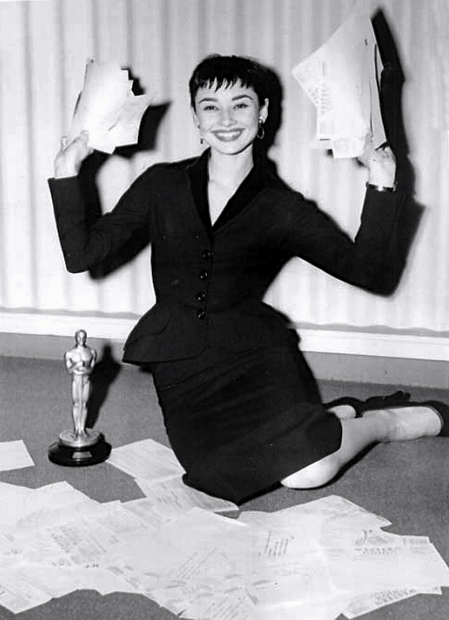
Audrey Hepburn and her Oscar.  At least the Academy didn’t snub her!

Continuing our look at the Oscar snubs of the past, it’s now time to enter the 50s!

World War II was over. Eisenhower was President. Everyone was worried about communist spies. And the Hollywood studios still reigned supreme, even while actors like Marlon Brando and James Dean challenged the establishment.  There were a lot great film released in the 50s.  There were also some glaring snubs on the part of the Academy.  Here’s twelve of them.

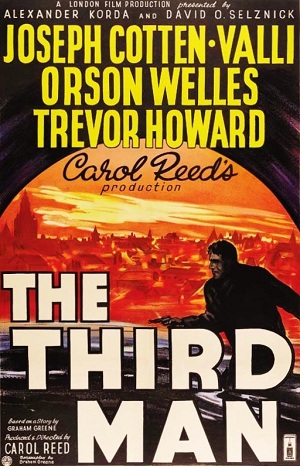
1950: The Third Man Is Not Nominated For Best Picture

….and Orson Welles was not nominated for Best Supporting Actor!  The Third Man received three Oscar nominations, for Director, Cinematography, and Editing.  The fact that Welles, Joseph Cotten, Alida Valli, and the film’s score were not nominated (and that King Solomon’s Mines was nominated for Best Picture instead of The Third Man) remains one of the more surprising snubs in Oscar history.

1952: Singin’ In The Rain Is Not Nominated For Best Picture

What the Heck, Academy!?  This was the year that The Greatest Show On Earth won the Best Picture Oscar.  Personally, I don’t think The Greatest Show On Earth is as bad as its reputation but still, Singin’ In The Rain is a hundred times better.

1953: Alan Ladd Is Not Nominated For Best Actor For Shane

How could Shane score a nomination for Best Picture without Shane himself receiving a nomination?

1954: Rear Window Is Not Nominated For Best Picture

Rear Window was not totally ignored by the Academy.  Alfred Hitchcock received a nomination for directing.  It also received nominations for Best Adapted Screenplay, Cinematography, and Sound.  However, Rear Window was not nominated for Best Picture and James Stewart, Grace Kelly, Raymond Burr, and Thelma Ritter all went unnominated as well.  Today, Rear Window is definitely better-remembered than the majority of 1954’s Best Picture nominees.  Certainly, it deserved a nomination more than Seven Brides For Seven Brothers and Three Coins in The Fountain.

1955: Ralph Meeker Is Not Nominated For Best Actor For Kiss Me Deadly

I guess I shouldn’t be surprised.  If the Academy wasn’t going to nominate Rear Window for Best Picture, there was no way that they would have nominated Ralph Meeker for playing a sociopathic private detective who, even if inadvetedly, helps to bring about the end of the world.

1955: Rebel Without A Cause Is Not Nominated For Best Picture or Best Actor

The 1955 Best Picture lineup was a remarkably weak one.  The eventual winner was Marty, a likeable film that never quite escapes its TV roots.  Picnic has that great dance scene but is otherwise flawed.  Mister Roberts was overlong.  Love Is A Many-Splendored Thing and The Rose Tattoo are really only remembered by those of us who have occasionally come across them on TCM.  Perhaps the best-remembered film of 1955, Rebel Without A Cause, received quite a few nominations but it was not nominated for Best Picture.  And while the Rebel himself, James Dean, was nominated for Best Actor, it was for his performance in East of Eden.  1955 was a strange year.

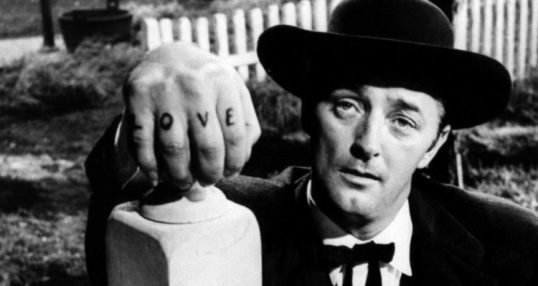
1955: Robert Mitchum Is Not Nominated For Best Actor For The Night of the Hunter

Robert Mitchum only received one Oscar nomination over the course of his entire career, for 1945’s The Story of G.I. Joe.  He deserved several more.  His performance as the villainous preacher in The Night of Hunter made Reverend Harry Powell into one of the most iconic film characters of all time.

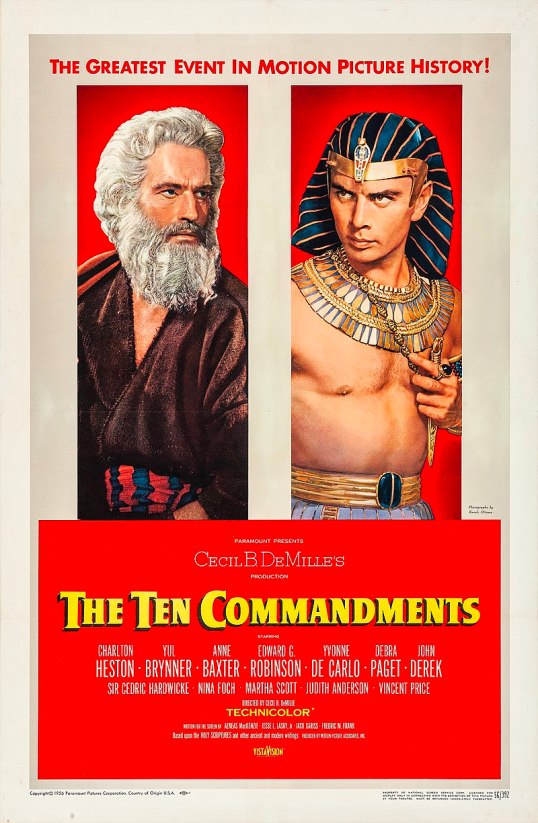
1956: Cecil B. DeMille Is Not Nominated For Best Director For The Ten Commandments

Cecil B. DeMille was only nominated once for Best Director, for 1952’s The Greatest Show On Earth.  DeMille, however, deserved to be nominated for The Ten Commandments.  As campy as DeMille’s films can seem today, he was an expert storyteller and that’s certainly evident when one watches The Ten Commandments, a film that holds the viewer’s attention for nearly four hours.  DeMille deserved a nomination for the Angel of Death scene alone.  The screams in the night are haunting.

1957: Henry Fonda Is Not Nominated For Best Actor For 12 Angry Men

With 12 Angry Men, Fonda did something that very few actors can.  He made human decency compelling.  One gets the feeling that, much like Tom Hanks in Captain Phillips, Fonda made it look so easy that the Academy took him for granted.

1958: Touch Of Evil Is Totally Ignored

Anyone who had researched the history of the Academy knows that there was no way that the 1950s membership would have ever honored Orson Welles’s pulp masterpiece, Touch of Evil.  That said, it still would have been nice if they had.  Touch of Evil has certainly go on to have a greater legacy than Gigi, the film that won Best Picture that year.

1958: Vertigo Is Almost Totally Ignored

Vertigo did receive nominations for Art Direction and Sound but Alfred Hitchcock, James Stewart, and the film itself were snubbed.

1959: Some Like It Hot Is Not Nominated For Best Picture or Best Actress

Some Like It Hot received 6 Oscar nominations, including nominations for Best Director, Best Actor, and Best Adapted Screenplay.  It did not receive a nomination for Best Picture and, sadly, Marilyn Monroe did not receive a nomination for Best Actress.  Much as with Henry Fonda in 12 Angry Men, one gets the feeling that the Academy took Monroe for granted.  It’s sad to realize that, while two actresses have been nominated for playing Marilyn Monroe, Monroe herself would never be nominated.

Agree?  Disagree?  Do you have an Oscar snub that you think is even worse than the 12 listed here?  Let us know in the comments!

Up next: Things get wild with the 6os!

Night of the Hunter (United Artists 1955; D: Charles Laughton)

Horror on the Lens: The Night Stalker (dir by John Llewelyn Moxey)


For today’s horror on the lens, we have a real treat!  (We’ll get to the tricks later…)

Long before he achieved holiday immortality by playing the father in A Christmas Story, Darren McGavin played journalist Carl Kolchak in the 1972 made-for-TV movie, The Night Stalker.  Kolchak is investigating a series of murders in Las Vegas, all of which involve victims being drained of their blood.  Kolchak thinks that the murderer might be a vampire.  Everyone else thinks that he’s crazy.

When this movie first aired, it was the highest rated made-for-TV movie of all time.  Eventually, it led to a weekly TV series in which Kolchak investigated various paranormal happenings.  Though the TV series did not last long, it’s still regularly cited as one of the most influential shows ever made.

Anyway, The Night Stalker is an effective little vampire movie and Darren McGavin gives a great performance as Carl Kolchak.

Enjoy!

The TSL’s Horror Grindhouse: Food Of The Gods (dir by Bert I. Gordon)


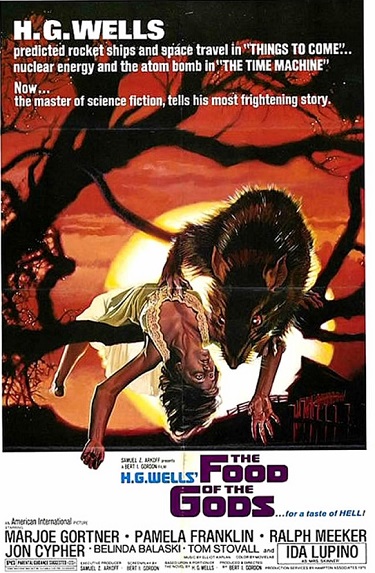
Uh-oh! Something weird has bubbled up to the ground on an island near British Columbia and a farmer and his wife (played by John McLaim and Ida Lupino) foolishly decided to feed it to their farm animals! Soon, they’ve got giant chickens! And listen, that might sound like a good thing to some but I’ve spent enough time around farms to know that giant chickens are not a good thing! Seriously, normal-sized chickens are messy enough. Giant ones? I don’t even want to thinking about it.

Unfortunately, it’s not just the chickens that are eating the food. Rats are eating the food. Wasps are eating the food. All of the animals are turning into giants and now, they’re hunting humans! After his best friend is attacked and killed by giant wasp, a football player named Morgan (Marjoe Gortner) decides to investigate on his own. You would think that a football player would be busy preparing for his next game or something like that but no, not Morgan! Morgan’s determined to find out why there are giant animals off the coast of Canada.

Of course, Morgan isn’t the only one interested in the so-called Food of the Gods. There’s also Jack Bensington (Ralph Meeker), who owns a dog food company. Jack wants to sell the food. Why would Jack want to do that? Does he actually think that causing dogs to transform into giants who would undoubtedly try to kill their masters is somehow going to be good for his company’s reputation? Jack’s main motivation seems to be that he’s a businessman and, in this film’s moral universe, that automatically makes him one of the bad guys. But it seems like even an evil businessman would know better than to kill off all of his customers.

This 1976 film, which is loosely (very loosely) based on a novel by H.G. Wells, was directed by Bert I. Gordon and, if you think the plot sounds a little ludicrous …. well, it is. Nothing about the film really makes much sense but that’s kind of to expected from a Bert I. Gordon film. Gordon specialized in making films about giants destroying stuff. The films were never particularly good but Gordon obviously understood that American filmgoers love big things. Food of the Gods, as silly as it may be, apparently made a lot of money when it was first released.

Today, of course, it’s impossible to watch the film without noticing just how terrible the special effects are. Between the unconvincing use of super-imposed images and the obviously fake rats that are tossed at some of the actors, there’s not a single shot that doesn’t somehow look totally ridiculous. In fact, it’s all so silly and obviously done on the cheap that it becomes rather charming, or at least as charming as the superimposed image of giant wasp ever could possibly be. You have to admire the film’s determination to tell its story despite not having the resources to do so. As for the rest of the film, it’s dumb but it doesn’t take itself too seriously. If you’re specifically searching for a bad giant animal movie, The Food of the Gods is fun in its own goofy, nonsensical, low-budget way.

Horror On The Lens: The Dead Don’t Die (dir by Curtis Harrington)


For today’s horror on the lens, we have a 1975 made-for-television movie called The Dead Don’t Die!

The Dead Don’t Die takes place in Chicago during the 1930s.  George Hamilton is a sailor who comes home just in time to witness his brother being executed for a crime that he swears he didn’t commit.  Hamilton is convinced that his brother was innocent so he decides to launch an investigation of his own.  This eventually leads to Hamilton not only being attacked by dead people but also discovering a plot involving a mysterious voodoo priest!

Featuring atmospheric direction for Curtis Harrington and a witty script by Robert Bloch, The Dead Don’t Die is an enjoyable horror mystery.  Along with George Hamilton, the cast includes such luminaries of “old” Hollywood as Ray Milland, Ralph Meeker, Reggie Nalder, and Joan Blondell.  (Admittedly, George Hamilton is not the most convincing sailor to ever appear in a movie but even his miscasting seems to work in a strange way.)

And you can watch it below!

Enjoy!

An Offer You Can’t Refuse #18: The St. Valentine’s Day Massacre (dir by Roger Corman)


On February 14th, 1929, seven men were murdered in a garage in Chicago, Illinois.  Five of the seven men were known to be associates of gangster George “Bugs” Moran.  The other two men were considered to be innocent bystanders, a mechanic and a dry cleaner who just happened to enjoy hanging out with gangsters.  Though no one was ever convicted of the crime, it was well-known that the murders were carried out on the orders of Al Capone.

In many ways, the St. Valentine’s Day Massacre was a turning point in America’s relationship with organized crime.  Before the massacre, Capone had become a bit of a folk hero.  He knew how to talk to the press and he was viewed as merely breaking a law (in this case, prohibition) that most people opposed in the first place.  However, after the murders, public opinion soured on Capone.

Some of it was the brutality of the crime.  It’s been said that over five hundred bullets were fired in that garage, all to kill seven defenseless men who were lined up against a wall.  Grisly pictures of the victims were released to the press.  Perhaps if the seven men had been carrying weapons and had been involved in a shootout with their murderers, the public’s reaction would have been different.  But this was a cold-blooded execution.

Personally, I think the fact that the killers disguised themselves as cops also played a role in the public’s outrage.  It was a very calculated move on the part of the killers and it highlighted just how much planning went into the St. Valentine’s Day Massacre.  As well, it undoubtedly made people paranoid.  If a bunch of killer could dress up like cops, who knew who else they could dress up as?

Finally, I think that Capone’s biggest mistake was carrying out the crime on Valentine’s Day.  You don’t murder people on a holiday.  Anyone should know that.  If Capone had waited until February 20th, he probably could have gotten away with it.

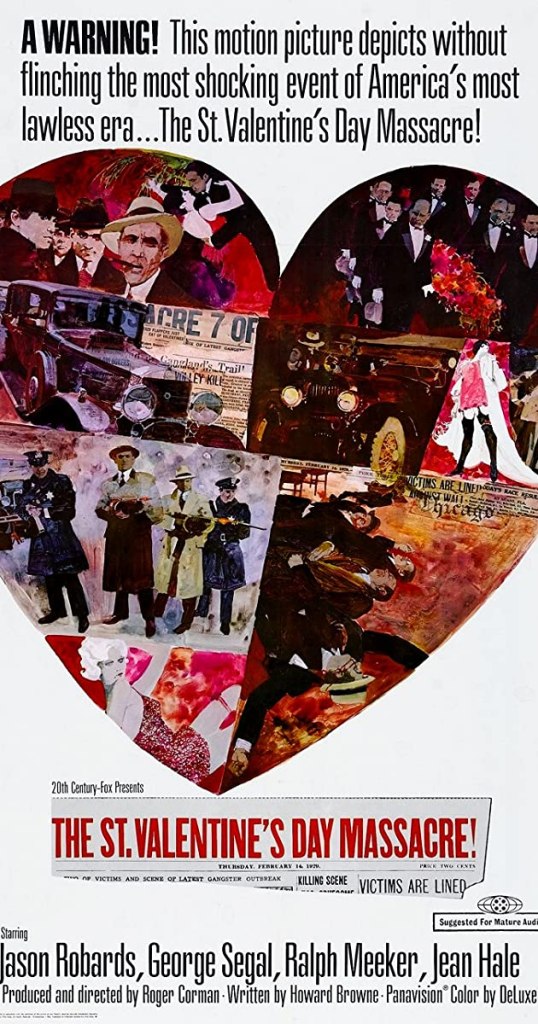
The 1967 film, The St. Valentine’s Day Massacre, details the rivalry between Capone and Moran, starting with them fighting for control over the Chicago rackets and ending with the title event.  Moran is played by Ralph Meeker while Jason Robards plays Capone.

Now I know what you’re probably thinking.  Perennial WASP Jason Robards as Al Capone?  That may sound like odd casting and, let’s just be honest here, it is.  However, it actually kind of works.  Robards may not be convincingly Italian but he is convincingly ruthless.  Add to that, one of the major subplots of the St. Valentine’s Day Massacre is that, even as the head of the Chicago Outfit, Capone still feels like an outsider in the world of organized crime because, while he is Italian, he isn’t Sicilian.  Capone feels as if Lucky Luciano and all of the major New York crime bosses look down on him and one reason why he’s so ruthless about taking over Chicago is that wants to show Luciano that he can be just as effective a crime lord as any Sicilian.  Capone feeling out of place in the Mafia is reflected by Robards initially seeming to be out of place in a gangster film.  By the end of the movie, of course, Capone has proven himself and so has Jason Robards.

Robards isn’t the only familiar face to be found in The St. Valentine’s Day Massacre.  Though this film was released by 20th Century Fox, it was directed by Roger Corman and Corman fills the production with members of his stock company.  Dick Miller, Jonathan Haze, and Jack Nicholson all have small roles as gunmen.  Bruce Dern plays the unlucky mechanic who enjoys hanging out with gangsters.  Buck Taylor, Leo Gordon, and Joe Turkel all have small roles.  John Agar plays Dion O’Bannon and is gunned down in his flower store.  Though not members of the Corman stock company, George Segal and David Canary plays brothers who work for Moran.  There’s a lot of characters wandering through this film but Corman makes sure that everyone gets a chance to make an impression.

It’s a good gangster film.  Though he was working with a larger budget than usual, Corman still brought his exploitation film aesthetic to the material and the end result is a violent, melodramatic gangster film that looks really impressive.  The film’s recreation of 1920s Chicago is a visual delight and looking at the well-dressed and stylish gangsters walking and driving down the vibrant city streets, you can understand why organized crime would have such a draw for some people.

The St. Valentine’s Day Massacre is a classic gangster film and a classic Corman film.  It’s an offer you can’t refuse.

Previous Offers You Can’t (or Can) Refuse:

  1. The Public Enemy
  2. Scarface
  3. The Purple Gang
  4. The Gang That Could’t Shoot Straight
  5. The Happening
  6. King of the Roaring Twenties: The Story of Arnold Rothstein 
  7. The Roaring Twenties
  8. Force of Evil
  9. Rob the Mob
  10. Gambling House
  11. Race Street
  12. Racket Girls
  13. Hoffa
  14. Contraband
  15. Bugsy Malone
  16. Love Me or Leave Me
  17. Murder, Inc.


Birds of Prey (1973, directed by William A. Graham)


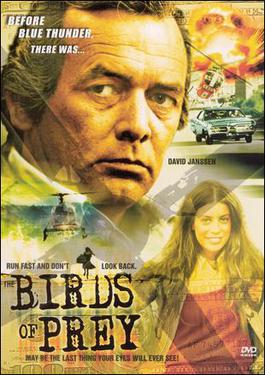
When three disgruntled Vietnam vets rob Zion’s Bank in downtown Salt Lake City and take a bank teller (Elayne Heilveil) hostage, they’re spotted by traffic reporter Harry Walker (David Janssen).  A World War II vet who is going through a mid-life crisis and who feels unappreciated by the country that he risked his life to defend, Harry chases after the robbers in his helicopter.  With Harry’s help, the police corner the robbers on the roof of a parking garage.

That’s when they discover that the robbers have a helicopter of their own!  After abandoning their car, the robbers and their hostage take off in their helicopter, heading into the Oquirrh Mountains.  Though he’s running low on fuel and has been ordered to back off by Police Captain Jim McAndrew (Ralph Meeker), Harry continues to pursue the other helicopter into the wilderness.

A made-for-TV movie from 1973, Birds of Prey is a chase movie, with the usual cars replaced by helicopters.  What makes this movie so exciting is that it was directed in the days before CGI so, when you watch the two helicopters dangerously pursuing each other over Salt Lake City and taking daredevil risk over the mountains of Utah, you’re watching the real thing.  David Janssen was a trained pilot who actually was flying the helicopter and doing his own stunts for the majority of the film.  When the two helicopters nearly collide, you’re aware that you’re seeing a real near-miss, one that could have gone tragically wrong if not for the talents of the men piloting those helicopters.

Despite all of the action in the air, the film does occasionally touch ground.  Harry and McAndrew talk about why some vets can move on and others can’t.  Harry briefly lands on the freeway and gets some help from a passing motorist.  Finally, Harry gets to know the kidnapped teller, who has never been outside of Salt Lake City and who shares Harry’s love of old movies.  David Janssen was the go-to guy for gruff and grizzled heroes in 1970s made-for-TV movies and he’s pretty good as Harry.  But the real stars of the film are the helicopters and the still-impressive aerial footage of them chasing each other above Utah.

Unfortunately, I have never seen a good print of Birds of Prey.  Even the version on Amazon Prime is grainy, scratchy, and sometimes washed-out.  (It also features a promo for a television station in Phoenix, suggesting that it was transferred straight from a VHS tape.)  I hope that, at some point in the near future, someone will restore this minor chase classic.

The First Police Story: Slow Boy (1973, directed by William A. Graham)


Long before The Wire, Homicide, Chicago PD, NYPD Blue, or even Hill Street Blues, there was Police Story.

Co-created by cop-turned-writer Joseph Wambaugh, Police Story aired on NBC from 1973 to 1978.  It was an anthology series, with each episode following a different member of the LAPD as they deal with crime and social issues in Los Angeles.  For its time, it was ground-breaking in its realistic approach to the life and work of the police.  Interestingly, the show wasn’t always blindly pro-cop.  Often the cops featured were deeply flawed and the war on crime was frequently portrayed to be unwinnable.  Over the course of its run, Police Story was a regular Emmy nominee and won the award for Best Drama Series in 1976.

Police Story started, in 1973, with a two-hour TV movie.  At the time it aired, the pilot was called Stakeout but it has since aired in syndication under the title Slow Boy.  Vic Morrow stars as Sgt. Joe LaFrieda, a plainclothes detective who can’t keep his marriage together but who can take criminals off the street.  LaFrieda is the second-in-command of a special squad of detectives who specialize in watching and taking down high-profile criminals.  Their methods frequently come close to entrapment but they usually work.  Their current target is Slow Boy (Chuck Conners), the son of a mafia chieftain, who enjoys robbing stores.  When LaFrieda’s first attempt to put Slow Boy in jail is thwarted by a liberal judge and departmental bureaucracy, he and the squad come up with a second, less-than-legal plan to take Slow Boy down.

Considering the involvement of Joseph Wambaugh, it’s no surprise that plot is secondary to exploring the day-to-day lives of the blue-collar cops trying to take Slow Boy down.  The heart of the movie is in the scenes of the cops shooting the breeze and trying to keep each other amused during length shakeouts.  Their humor is often grim and the fascinating dialogue is cynical, dark, and, even by today’s standards, surprisingly raw.  One of the detectives (played by Harry Guardino, who specialized in loud-mouth city cops) is an unapologetic racist.  Though he gets a comeuppance of sorts, the way the film and the rest of his squad handle his racism will undoubtedly make modern audiences uncomfortable, even if it is authentic to the era in which Slow Boy was made.

The underrated Vic Morrow gives one of his best performances as the tough but sympathetic LaFrieda, who is bad at everything but his job.  He is ably supported by a host of familiar character actors.  Ed Asner plays LaFrieda’s reactionary lieutenant while Sandy Baron is great in the role of an informant.  Diane Baker was also perfectly cast as LaFrieda’s potential girlfriend.  (She first meets the detective while Slow Boy is holding a gun to her head.)  Finally, Chuck Conner is as intimidating as always as the sadistic Slow Boy.

Slow Boy is a tough and uncompromising police procedural and it provided a great start for Police Story.  Reruns of Police Story currently air on H&I on Sunday morning.

Horror on the Lens: The Night Stalker (dir by John Llewelyn Moxey)


For today’s horror on the lens, we have a real treat!  (We’ll get to the tricks later…)

Long before he achieved holiday immortality by playing the father in A Christmas Story, Darren McGavin played journalist Carl Kolchak in the 1972 made-for-TV movie, The Night Stalker.  Kolchak is investigating a series of murders in Las Vegas, all of which involve victims being drained of their blood.  Kolchak thinks that the murderer might be a vampire.  Everyone else thinks that he’s crazy.

When this movie first aired, it was the highest rated made-for-TV movie of all time.  Eventually, it led to a weekly TV series in which Kolchak investigated various paranormal happenings.  Though the TV series did not last long, it’s still regularly cited as one of the most influential shows ever made.

Anyway, The Night Stalker is an effective little vampire movie and Darren McGavin gives a great performance as Carl Kolchak.

Enjoy!

Horror on the Lens: Without Warning (dir by Greydon Clark)


For today’s horror on the Shattered Lens, we have 1980’s Without Warning.  

In this horror/sci-fi hybrid, humans are hunted by an alien hunter who uses a variety of weapons and … what was that?  No, we’re not watching Predator.  We’re watching Without Warning.  For the record, Without Warning and Predator may have almost exactly the same plot but Without Warning came out long before Predator.

(Interestingly enough, Kevin Peter Hall played the intergalactic hunter in both films.)

Anyway, Without Warning is probably the best film that Greydon Clark ever directed.  Some would say that’s not saying much but seriously, Without Warning is a surprisingly effective film.  It also has a large cast of guest stars, the majority of whom are killed off within minutes of their first appearance.  That alien takes no prisoners!  (I especially feel sorry for the cub scouts.)

Of course, the main characters are four teenagers.  One of them is played by David Caruso, which I have to admit amuses me to no end.

Enjoy!

Horror On The Lens: The Dead Don’t Die (dir by Curtis Harrington)


For today’s horror on the lens, we have a 1975 made-for-television movie called The Dead Don’t Die!

The Dead Don’t Die takes place in Chicago during the 1930s.  George Hamilton is a sailor who comes home just in time to witness his brother being executed for a crime that he swears he didn’t commit.  Hamilton is convinced that his brother was innocent so he decides to launch an investigation of his own.  This eventually leads to Hamilton not only being attacked by dead people but also discovering a plot involving a mysterious voodoo priest!

Featuring atmospheric direction for Curtis Harrington and a witty script by Robert Bloch, The Dead Don’t Die is an enjoyable horror mystery.  Along with George Hamilton, the cast includes such luminaries of “old” Hollywood as Ray Milland, Ralph Meeker, Reggie Nalder, and Joan Blondell.  (Admittedly, George Hamilton is not the most convincing sailor to ever appear in a movie but even his miscasting seems to work in a strange way.)

And you can watch it below!

Enjoy!