Horror Film Review: The Legend of Hell House (dir. by John Hough)


“Hell House doesn’t mind a guest or two. What it doesn’t like is people who come snooping around.” — Benjamin Franklin Fischer

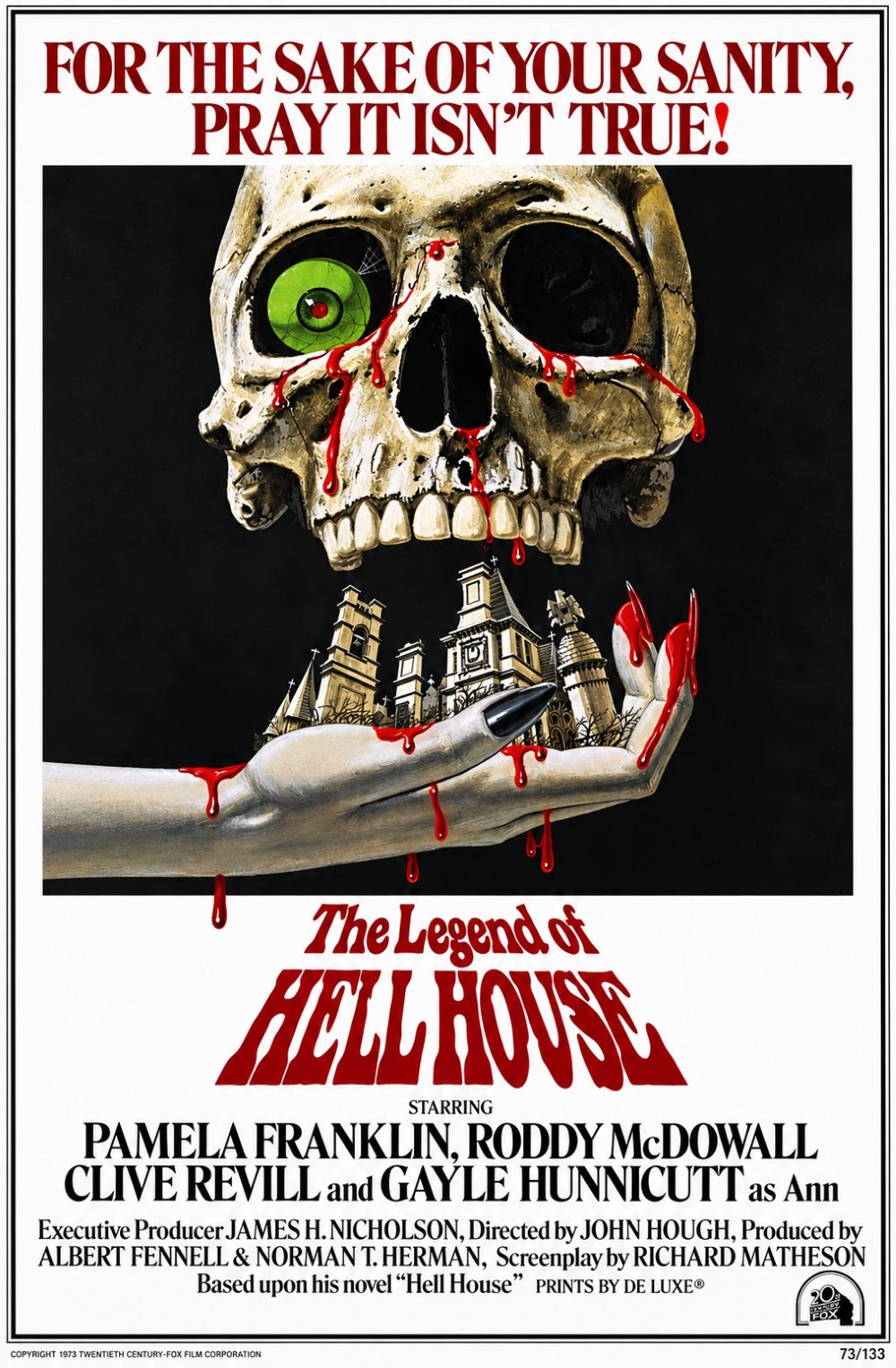
There is something deeply unpleasant about The Legend of Hell House, and that is exactly what makes it so effective. Directed by John Hough and adapted by Richard Matheson from his own 1971 novel Hell House, the film takes a fairly simple haunted-mansion premise and turns it into something mean, claustrophobic, and surprisingly adult. It is not the most visually elaborate ghost story ever made, nor the most frightening in a conventional jump-scare sense, but it has a cold, nasty atmosphere that lingers. This is a haunted-house movie where the house does not just contain evil; it seems designed to degrade everyone who steps inside.

The setup is strong because it puts several opposing viewpoints under the same roof. A wealthy man hires physicist Dr. Lionel Barrett, played by Clive Revill, to investigate the notorious Belasco House and settle the question of whether life after death exists. Barrett brings along his wife Ann, played by Gayle Hunnicutt, and the couple joins two people with far more personal connections to the place: Florence Tanner, a deeply spiritual medium played by Pamela Franklin, and Benjamin Franklin Fischer, played by Roddy McDowall, the sole survivor of an earlier investigation. The job has a deadline, a large payday, and an obvious catch: every previous expedition into the house ended in death, insanity, or both.

It is the kind of premise that could have easily become an old-fashioned “wait for the next victim” thriller, but Matheson’s script gives it more bite than that. Every character arrives with a different theory of the supernatural, and those theories become personal weapons. Barrett is the hard-line rationalist, convinced that any haunting can be explained through physical energy. Florence believes in trapped souls and approaches the house with a nearly religious determination. Fischer knows better than anyone that Belasco House does not care what people believe, while Ann becomes the emotional pressure point between all those men and their supposedly superior ideas. The ghost story works because the haunting pushes directly on each character’s vulnerabilities instead of merely making lights flicker and doors slam.

Clive Revill makes Barrett an interesting kind of horror-movie skeptic. He is not simply smug or foolish, although he can be both. He has the conviction of a man who thinks he is on the verge of solving the biggest mystery in human history with engineering equipment and enough confidence. That makes him a perfect target. Revill plays the character with a blunt, almost comically forceful seriousness that fits the film’s style. Barrett is a man who keeps insisting that the house is a machine, even as it starts treating him like a piece of disposable machinery.

Roddy McDowall is arguably the film’s secret weapon. Fischer could have been a standard nervous survivor whose only job is to warn the newcomers not to go into the basement. Instead, McDowall gives him a sly, guarded, intermittently hostile energy. He knows the house, he has seen what it does, and he has built a personality around refusing to be emotionally open about any of it. His sunglasses, dry delivery, and generally strange behavior make Fischer seem a little ridiculous at first, but that awkwardness becomes part of the performance’s appeal. By the time the film gets into the mystery of Emeric Belasco, the wealthy sadist who once ruled the estate, Fischer’s trauma feels like the one thing in the movie that cannot be explained away by a machine.

Pamela Franklin is also excellent as Florence Tanner, particularly because the film lets her be forceful rather than purely fragile. Florence is sympathetic, but she is not passive. She believes in her gifts enough to challenge Barrett head-on, and her desire to help the lost spirits of Hell House gives the story some genuine emotional stakes. The movie can be pretty ruthless with her, especially in the way it explores sexual humiliation, possession, and psychic assault, but Franklin never plays Florence as merely victimized. Her scenes with McDowall have an uneasy charge because they represent two different forms of faith: Florence sees the dead as people worth saving, while Fischer treats the dead as weapons that must be avoided.

That unpleasant streak is really what separates The Legend of Hell House from a lot of cleaner, more comforting haunted-house films. The Belasco House is not merely spooky; it is aggressively cruel, with a history rooted in sexual degradation, murder, and the grotesque whims of its former owner. Matheson’s novel was more explicit than the movie, and the screenplay softens some of its more graphic sexual and violent material. Even so, the film remains unusually frank for a mainstream early-1970s supernatural thriller. Its horror is not just that ghosts exist. It is that a dead man’s perversions can keep poisoning the living decades later.

John Hough handles all this with a remarkably physical visual style. The camera prowls through corridors, peers around corners, tilts at unnerving angles, and uses wide lenses to make the mansion feel warped and hostile. The movie’s low, wide-angle shots give the characters an exposed, trapped quality, as if the building is staring down at them. The direction is not subtle in the same manner as Robert Wise’s The Haunting, but that is not a flaw. Hough makes Hell House feel less like an unknowable mystery and more like a spiritual pressure cooker.

The film does have limitations. Its effects are sometimes modest, and a few of its shock moments are more abrupt than scary. The climax gives the haunting a concrete answer, which makes the story’s blend of supernatural Gothic horror and strange pseudo-scientific logic feel even more pulpy and distinctive. It may not carry the elusive ambiguity of The Haunting, but The Legend of Hell House is not trying to be that kind of ghost story. It wants the audience to feel trapped in a hostile space with people whose certainty, fear, and private weaknesses are being exposed one ugly piece at a time. Even when its mechanics are a little dated, that sense of contamination remains powerful.

It also benefits from being lean. At around 90 minutes, The Legend of Hell House wastes little time building out the haunted-house situation, escalating the attacks, and forcing its investigators to choose between their competing explanations. That economy makes it feel more vicious than many later possession or paranormal movies that inflate a similar premise into two-hour lore marathons. There is no elaborate mythology to memorize. There is a bad house, a horrible dead man, four damaged people, and a deadline. That is enough.

As for influence, the film has clear roots in The Haunting and Henry James-style psychological ghost stories, but it also left traces of its own. Its combination of paranormal investigation, supposedly scientific equipment, skeptical experts, psychic mediums, and a house that manipulates people’s sexuality and emotional weaknesses can be felt in many later haunted-house stories. The direct influence is most explicitly documented in Edgar Wright’s fake trailer Don’t, made for Grindhouse: Wright and Simon Pegg riffed on Hell House’s fog-shrouded mansion imagery and echoed Roddy McDowall’s distinctive 1970s look. It also features one of the earlier cinematic depictions of sexual assault by an unseen supernatural force, a disturbing concept later revisited much more brutally in The Entity.

It would be a stretch to claim that every modern “ghost hunters enter a cursed house” movie comes directly from The Legend of Hell House, but its DNA is easy to spot. The procedural side of paranormal investigation, the conflict between technical explanation and spiritual belief, and the sense that a house preserves human evil like an infection all became familiar horror tools. Its visual atmosphere has also invited comparisons to The Shining, especially in its use of ominous spatial compositions and its fixation on the house’s ability to reshape the mental state of its occupants. The connection should not be overstated—Stanley Kubrick’s film is its own colossal thing—but they are clearly kindred haunted-house nightmares.

Ultimately, The Legend of Hell House is a rougher, nastier, more aggressively lurid cousin to The Haunting. It does not have that earlier film’s sublime ambiguity, but it has its own grimy personality: a mixture of British Gothic atmosphere, American genre bluntness, psychic melodrama, and just enough 1970s sleaze to make the mansion feel truly diseased. It is best approached not as a polished prestige classic, but as a smart, compact supernatural shocker with a nasty sense of humor and an unusually strong cast. Hell House may not be the most famous haunted mansion in horror, but once you have spent an hour and a half inside it, you can understand why nobody should want to go back.

Horror On The Lens: Satan’s School For Girls (dir by David Lowell Rich)


For today’s horror on the lens, we have a 1973 made-for-TV movie called Satan’s School For Girls.

After her sister turns up dead, Elizabeth (Pamela Franklin) refuses to accept that official conclusion that it was a suicide.  Instead, Elizabeth is convinced that it was murder and that it has something to do with the exclusive school that her sister attended, the Salem Academy for Women.

Well, honestly, the Salem part is a dead giveaway.  I think we can all agree on that.

Anyway, this movie features a Satanic cult, an old school clique, and plenty of early of 70s fashion choices.  It may be silly but it’s also definitely entertaining.


Retro Television Review: Fantasy Island 4.14 “The Chateau/White Lightning”


Welcome to Retro Television Reviews, a feature where we review some of our favorite and least favorite shows of the past!  On Tuesdays, I will be reviewing the original Fantasy Island, which ran on ABC from 1977 to 1984.  Almost the entire show is currently streaming on Daily Motion.

This week, we get a bad fantasy and a good fantasy.  Smiles, everyone!

Episode 4.14 “The Chateau/White Lightning”

(Dir by Leslie H. Martinson, originally aired on February 7th, 1981)

The first of this week’s fantasies involves the McAllister clan and the Scroggins clan, two feuding families from Appalachia who both come to Fantasy Island with the same fantasy.  They want to find the formula for a legendary type of moonshine called White Lightning.  The McAllisters are led by Clora (Carolyn Jones) and include her children, Ruth Ann (Wendy Schaal), Amos (Ed Begley, Jr.), and Otis (Richard Lineback).  The Scroggins are led by Norris (George Lindsey) and include his sons, R.J. (Randy Powell) and Bobby Joe (Ernie Lively).

Since both families have the same fantasy and they both want the recipe for themselves….

What?  Yes, this the bad fantasy.

Anyway, Mr. Roarke gives them a map that will lead them to White Lightning still on Fantasy Island.  The two families race to be the first to reach the still, not realizing that the still is guarded by an old man with a rifle and that old man is Mr. Roarke in a fake beard.

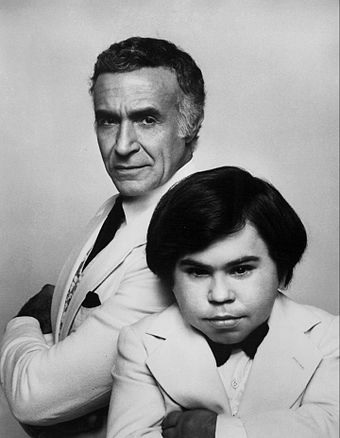
You will probably not be surprised to learn that Mr. Roarke pretending to be a moonshiner is the best part of this fantasy.  Seriously, I hope everyone involved with this series appreciated the dedication that Ricardo Montalban brought to bringing even the most ridiculous of scenes to life.

This was a dumb fantasy and, from the minute the two families stepped off the plane, it was obvious that they’re going to end up setting aside their differences and working together.  The hillbilly stuff just felt out of place on Fantasy Island.  Let’s move on and let’s do so quickly.

The other fantasy is a bit more fun.  Vicky Lee (Pamela Franklin) is writing a book about her grandmother, a silent screen actress who died under mysterious circumstances.  Her fantasy is to interview her grandmother’s former co-star, Claude Duncan, who lives in seclusion in a Fantasy Island chateau.  Mr. Roarke tries to dissuade her from entering the chateau and warns her that her fantasy might be dangerous in ways that she could never imagine.  Vicky says that she can take care of herself.

In the chateau, she meets Karl Dixon (David Hedison), who looks exactly like Claude Duncan!  She assumes that Karl must be Claude’s grandson but the audience knows better.  For one thing, we’ve noticed the statue of Pan in the chateau’s courtyard and we’ve also noticed that its eyes glow whenever something strange happens.  It turns out that Claude Duncan and Karl Dixon are one in the same!  Claude has remained young by offering up sacrifices to Pan.  And it appears that he’s planning on making Vicky his latest sacrifice.

Vickey Lee’s fantasy was silly but entertaining, in the way that the best episodes of Fantasy Island often are.  I always prefer the fantasies that have an element of the supernatural and that’s certainly the case with this one.  At one point, Duncan even claims that Mr. Roarke has no power in the Chateau, which leads me to once again wonder about who truly rules Fantasy Island.  If Mr. Roarke was truly in control of Fantasy Island, why would he allow Claude Duncan to live there?  In an interview, Ricardo Montalban suggested that Fantasy Island was a form of Purgatory and that Mr. Roarke was more of a caretaker than a ruler.  This fantasy would certainly suggest that to be true.

(The fantasy also features a charmingly weird scene where Mr. Roarke suddenly appears on a television screen in the chateau so he can tell Vicky that she’s in danger.  Strange Mr. Roarke is the best Mr. Roarke.)

So, this week gave us one bad fantasy and one good fantasy.  Fortunately, the good fantasy was really, really good.

Retro Television Reviews: Fantasy Island 3.3 “Tattoo: The Love God/Magnolia Blossoms”


Welcome to Retro Television Reviews, a feature where we review some of our favorite and least favorite shows of the past!  On Tuesdays, I will be reviewing the original Fantasy Island, which ran on ABC from 1977 to 1986.  The entire show is currently streaming on Tubi!

This week, Mr. Roarke tries to kill Tattoo!

Episode 3.3 “Tattoo: The Love God/Magnolia Blossoms”

(Dir by Earl Bellamy, originally aired on Sept. 21st, 1979)

This week’s episode of Fantasy Island opens with Tattoo driving his mini-car across the island and nearly running over a group of Islanders.

Tattoo has every reason to be excited!  This week, he is getting his fantasy.  Using a fake name (Dr. H.L. Oottat — spell the last name backwards), Tattoo requested a chance to come to the Island and live out his fantasy of being irresistible to women.  At first, Mr. Roarke pretends as if he had no idea that Dr. Oottat was actually Tattoo but, by the end of this episode, it’s pretty clear that Roarke not only knew who Oottat was but that he also saw this fantasy as his best chance to kill off his troublesome assistant.

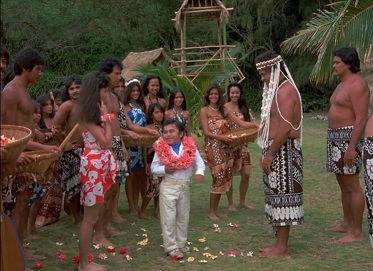
Seriously, how else can you explain how Mr. Roarke grants Tattoo his fantasy.  Tattoo wants women to find him attractive.  (That’s actually kind of sad.  Poor Tattoo!)  So, Mr. Roarke arranges for a bunch of native Islanders to mistake Tattoo for their legendary love god, Nooyeeowee.

Words goes out that Nooyeeowee has returned to the Island.  A group of Islanders take Tattoo to their village.

The chief explains that, as the Love God, Tattoo is not only responsible for deciding who in the tribe will marry who but that his presence will also guarantee successful fishing expeditions.  Unfortunately, Tattoo is also expected to be able to fly.  When one of the islanders, jealous because Tattoo has stolen his girlfriend, accuses Tattoo of being a fraud, Tattoo is told to prove his powers by taking flight.  Instead, with the help of a native girl, Tattoo gets in a canoe and flees back to the main island.

Mr. Roarke acts as if he’s happy to have his assistant back but let’s be honest here.  Mr. Roarke has shown, on numerous occasions, that he cannot be fooled or tricked by anyone.  Are we to believe that Mr. Roarke didn’t realize that the letter from Dr. Oottaat was actually from Tattoo?  After three seasons of listening to their passive-aggressive banter, it should be obvious to anyone that Roarke and Tattoo actually hate each other.  Personally, I think Mr. Roarke was hoping Tattoo wouldn’t be able to escape.

As for the second fantasy, it features Pamela Franklin and Lisa Hartman as two women who want to become Southern belles by returning to what they consider to be the most romantic time and place in US. History, Civil War-era Georgia….

Uhmm…. yeah.  This is definitely a fantasy that would not be allowed today.  But, back in 1979, Roarke sends the women back to Civil War era Altanta so that they can both pursue a romance with the two Confederates of their dreams.  Lisa Hartman falls hard for Dack Rambo, who is made up to look like Clark Gable.  Pamela Franklin falls just as hard for Christopher Connelly, who is made up to look like Leslie Howard.  Unfortunately, their night at the plantation is ruined by the arrival of an evil Union captain, played by Luke Askew.

Sadly, the fantasy ends before the belles get a chance to marry their men.  But no worries!  It turns out that the two men were also on the Island to live out their fantasies of fighting for the Confederacy during the Civil War.  So, everything works out….

This was a weird episode and, as I mentioned earlier, it’s definitely one that would not be made today.  I can only imagine how Twitter, if it had existed back then, would have reacted to the Civil War fantasy and the frequent appearances of Dixie on the soundtrack.  To be honest, though, the the two belles were less in love with the Confederacy and more just obsessed with Clark Gable and Leslie Howard.  Tattoo’s fantasy was actually the cringier of the two, with Tattoo pretending to be a God just to get laid and its suggestion that the Islanders will basically just worship anyone that they can convince to come to their village.

(Why don’t they worship Mr. Roarke then?  I mean, he has literal magic powers!)

As I said, this episode was just very weird.  1979, you know?

Retro Television Reviews: Fantasy Island 2.7 “Let the Good Times Roll/Nightmare/The Tiger”


Welcome to Retro Television Reviews, a feature where we review some of our favorite and least favorite shows of the past!  On Tuesdays, I will be reviewing the original Fantasy Island, which ran on ABC from 1977 to 1986.  The entire show is currently streaming on Tubi!

This week, we’ve got a special, 90-minute episode of Fantasy Island!

Episode 2.7 “Let the Good Times Roll/Nightmare/The Tiger”

(Dir by George McCowan, originally aired on November 4th, 1978)

This week’s supersized episode of Fantasy Island begins with Tattoo revealing that he’s come up with a new way to annoy Mr. Roarke.

Mr, Roarke rolls his eyes and dramatically sighs, especially when Tattoo makes the mistake of assuming that Roarke is a Pisces.  (“I am a Sagittarius!” Roarke snaps.)  For once, Mr. Roarke is right to be annoyed.  There’s no time for this foolishness this week!  We’ve got three fantasies to deal with!

For instance, Duke Manducci (Paul Sand) and Ernie “Smooth” Kowalski (Peter Isacksen) want to go back to the 1960s and relive their youth.  Duke was once known as the King of the Strip because he could outrace anyone.  Now, years later, Duke is just a guy working in a garage.  Roarke leads them to an exact recreation of the Strip.  The Strip is so perfectly recreated that even Donny Bonaduce shows up to make trouble.

Uh-oh, it turns out that Mr. Roarke has also invited all of Duke’s old friends to come take part in Duke’s fantasy.  Except, of course, none of them know that Duke is still working at the same gas station that he worked at as a teenager.  Duke ends up telling a lot of lies in order to convince them that he’s made a success of himself.   But when he falls for Sheila Crane (Mary Ann Mobley), he realizes that it’s time to be honest.  And when Bonaduce challenges him to a race, Duke eventually realizes that his racing days are over and it’s time for him to be a grown-up.  Duke not only learns an important lesson but he’s also offered a job working on a NASCAR pit crew.  Yay!

Meanwhile, Janine Sanford (Pamela Franklin) is haunted by a recurring nightmare.  She always has the dream at midnight and she’s never made it to the end of the dream without waking up.  She travels to Fantasy Island with her husband (Brett Halsey, who later starred in Fulci’s Touch of Death) and her father (Ray Milland).  Her fantasy is see how her nightmare ends.  Mr. Roarke takes her to what he calls the Nightmare House.

And, oh my God, this nightmare is seriously freaky!  We see it twice.  It involves Janine watching as all of her childhood toys catch on fire.  There’s even a clown that comes to life and go crazy at one point.

Janine’s father is convinced that the dream is linked to some sort of past trauma and he fears that Janine will be hurt if she relives it. 

It turns out the joke’s on him!  Janine’s nightmare is not about the past but the future.  It turns out that it was warning her that her father was going to be trapped in a fire.  When her father is indeed trapped in a fire, Janine is able to rescue him.  Yay!  What a great fantasy and I love a happy ending.  This fantasy is handled so well that it takes a while to realize that the show just kind of dropped the whole idea of Janine suffering from past trauma, despite the fact that her father seemed really worried about what she might end up remembering.  

Finally, for our third fantasy, Victor Duncan (Darren McGavin) is a Hemingwayesque writer who wants to go to India so he can hunt a legendary tiger.  How do you think that works out for him?

Yep, the tiger kills him.

Fear not, though!  Mr. Roarke explains to Tattoo that Victor was actually terminally ill and his fantasy was to die on Fantasy Island.  So, I guess that’s a happy ending.

I actually liked this episode, if just because it was throwback to season one when all of the fantasies were linked by a common theme.  Here the link is aging and growing up.  Duke and Victor both have to deal with the fact that they’re no longer young men.  Janine manages to put her nightmare behind her and move on.  These three fantasies all seemed to belong together, so there were none of the strange tonal shifts that I’ve noticed in some of the other episodes.  All in all, this was a good trip to Fantasy Island.

Retro Television Reviews: Fantasy Island 1.11 “Reunion/Anniversary”


Welcome to Retro Television Reviews, a feature where we review some of our favorite and least favorite shows of the past!  On Tuesdays, I will be reviewing the original Fantasy Island, which ran on ABC from 1977 to 1986.  The entire show is currently streaming on Tubi!

This week, Fantasy Island is all about confronting the mistakes of the past.

Episode 1.11 “Reunion/Anniversary”

(Dir by Allen Baron and John Newland, originally aired on April 29th, 1978)

Before I talk about the two fantasies in this episode, here’s a bit of trivia.  This episode was originally intended to be the first episode of the series.  That perhaps explains why it has a tone that is more similar to the original TV movie than to the more light-hearted episodes that followed.  Just as in the made-for-TV movie, Mr. Roarke is a bit of an enigma in this episode, one who has little trouble manipulating his guests in order to get the results that he wants.  This episode even ends with Tattoo saying, “Thank God,” and Mr. Roarke replying with a mysterious half-smile.  Roarke isn’t quite as sinister as he was in the TV movie but he’s also not quite the cheery host that he would become in later episodes.  Roarke, at one point, also mentions that he has people who research everyone’s fantasy before choosing whether to grant it.  That’s certainly different from later episodes, in which the fantasies are apparently available to anyone who can pay or who has been lucky enough to win Roarke’s sympathy.

Of course, when it came time to air the first season of Fantasy Island, this episode got pushed back and it aired as the eleventh episode.  As a result, it presents a bit of a change-of-pace from the episodes that aired the weeks before.  One can only imagine how someone who decided to start watching the show because of the fantasy where Don Knotts played a private eye reacted to this episode, in which four guests were stalked by a murderer who wore giallo-style black gloves.

The guests being stalked by the murderer are Agnes (Pamela Franklin), Hannah (Hilarie Thompson), Carol (Michele Lee), and Jill (Sue Loyon).  They are all members of the Honeybees, a group of former high school cheerleaders who are having a ten-year reunion.  Their fantasy is to spend the weekend at a recreation of the Beehive, a cabin where they used to hang out while in high school.  Of course, every one of them has a dark secret and, after one of the Honeybees is apparently blown up in a nearby barn, the three remaining Honeybees have to solve the mystery.  It all gets fairly dark and sordid but, fear not!  Mr. Roarke shows up and even takes part in some hand-to-hand combat before revealing the truth about what is going on at the Beehive.

(Again, this is not something that we would normally expect from Mr. Roarke.)

Meanwhile, troubled couple Toni (Lucie Arnaz) and Tom Elgin (Ronny Cox, looking slightly embarrassed) come to the island for their anniversary!  Toni wants to relive the weekend that they got married, when they were still happy and before Tom became a drunk.  All of their old friends are invited to the island and soon, Tom is flirting with another woman while Toni is flirting with another man.  Mr. Roarke even invites Rev. Allen (Stuart Nisbet), the man who performed the original wedding ceremony.  The reverend explains that, due to a mix-up at the licensing office, he wasn’t actually legally allowed to perform marriages when Toni and Tom get married so it turns out that Tom and Toni have been living in sin all this time!  Now, Tom and Toni have to decide whether to get married for real or to go their separate ways.

I vote for separate ways, just because they really do seem to be miserable together.  However, it turns out that Mr. Roarke has a plan to keep this awful couple together.

The decision to move this episode from the start of the season to the latter half was definitely a good one.  It was probably a bit too dark and dramatic to really work as the premiere episode but, as the 11th episode, it provides a nice change-of-pace.  After several comedic and somewhat shallow episodes, this episode emphasizes the dramatic side of Fantasy Island.  In this episode, the ultimate lesson appears to be that fantasies are fun but that it’s far more important to deal with the real world.  In other words, Fantasy Island is a nice place to visit but only Mr. Roarke and Tattoo should live there.

Retro Television Reviews: The Love Boat 1.10 “Dear Beverly/The Strike/Special Deliver”


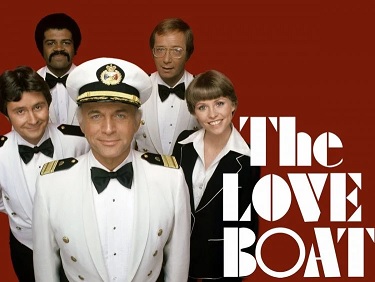
Welcome to Retro Television Reviews, a feature where we review some of our favorite and least favorite shows of the past!  On Wednesdays, I will be reviewing the original Love Boat, which aired on ABC from 1977 to 1986!  The series can be streamed on Paramount Plus!

Come aboard!  We’re expecting you!

Episode 10.10 “Dear Beverly/The Strike/Special Delivery”

(directed by Allen Baron, originally aired December 3rd, 1977)

Tonight’s voyage is all about misunderstandings!

For example, Beverly Blanchard (Eva Gabor) is an advice columnist who has built a career out of helping people work their way through misunderstandings.  When she boards the Love Boat, she is swarmed by fans who all want her advice.  She even leads a little seminar by the pool, in which she asks people if they have any problems that she can help with.  Unfortunately, what she doesn’t understand is that her husband, Russ, is feeling neglected.  Usually, I would say that Russ should stop feeling sorry for himself but Russ is played Leslie Nielsen, who is so superlikable in his stiffly earnest way that it’s hard not to have some sympathy for him.  When Beverly finds out that Russ has been spending time with another passenger (Stephanie Blackmore), she writes a column in which she announces her retirement so that she can give Russ the attention he deserves.  Personally, I would think a better column would be about why husbands shouldn’t cheat on their wives, especially with someone who they’ve known for less than 24 hours.

Speaking of cheaters, Jeff Smith (Robert Urich) cheated on his wife, Gail (Pamela Franklin), and now they’re separated.  When Jeff boards the ship, he tries to pursue a romance with Julie but he quickly admits that he’s still hung up on his wife.  What Jeff doesn’t know is that Gail is also on the ship and she’s 9 months pregnant!  Now, considering that this is The Love Boat, it probably will not surprise you to learn that Gail goes into labor while on the boat and it’s up to Doc and Jeff to deliver the baby while the rest of the crew waits outside.  Fortunately, the baby makes it and Jeff and Gail get back together.  But what about Jeff cheating on Gail?  Well, Gail takes responsibility for that, saying that she drove him to it.  I was expecting at least one member of the crew to tell her that Jeff was responsible for his own decisions but instead, everyone nodded alone.  Like, what the Hell?

Meanwhile, Captain Stubing was upset to learn that Chef Antonio Borga (Al Molinaro) was going to be in charge of the ship’s kitchen for the cruise.  Apparently, there was bad blood between the two.  When Borga refused to work, Stubing attempted to prepare dinner himself.  The results were disastrous but the Chef respected the Captain for trying.  And perhaps Chef Borga realized that Captain Stubing could probably get him fired for insubordination.  Well, the important thing is that everyone came to an agreement and people got to eat.

This was a weird episode.  The Chef storyline seemed like filler.  The other two stories both featured women making excuses for cheating husbands.  If this episode wanted to remind me that The Love Boat is very much a show of the 70s, it succeeded.  This episode had a lot of boat but not a lot of love.

Hopefully, next week’s cruise will be a bit less problematic.

Horror on TV: Ghost Story 1.7 “Half a Death” (dir by Leslie H. Martinson)


On tonight’s episode of Ghost Story, Pamela Franklin plays two roles.  She plays both Christina Burgess and Lisa (hey!), the twin sister who Christina has never met.  When Lisa mysteriously dies (boooo!), Christina finds herself haunted by her sister’s ghost.  But is the ghost benevolent or is the ghost seeking revenge?

Co-written by Richard Matheson, this episode originally aired on November 3rd, 1972.

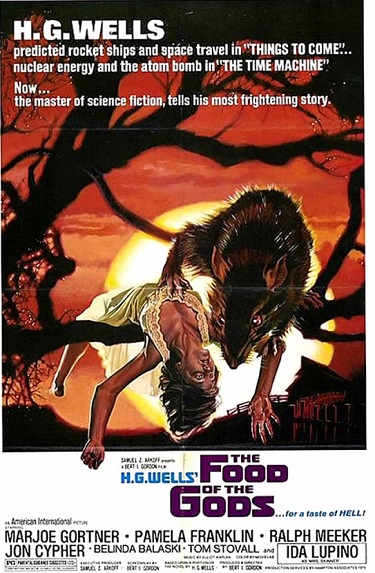
The TSL’s Horror Grindhouse: Food Of The Gods (dir by Bert I. Gordon)


Uh-oh! Something weird has bubbled up to the ground on an island near British Columbia and a farmer and his wife (played by John McLaim and Ida Lupino) foolishly decided to feed it to their farm animals! Soon, they’ve got giant chickens! And listen, that might sound like a good thing to some but I’ve spent enough time around farms to know that giant chickens are not a good thing! Seriously, normal-sized chickens are messy enough. Giant ones? I don’t even want to thinking about it.

Unfortunately, it’s not just the chickens that are eating the food. Rats are eating the food. Wasps are eating the food. All of the animals are turning into giants and now, they’re hunting humans! After his best friend is attacked and killed by giant wasp, a football player named Morgan (Marjoe Gortner) decides to investigate on his own. You would think that a football player would be busy preparing for his next game or something like that but no, not Morgan! Morgan’s determined to find out why there are giant animals off the coast of Canada.

Of course, Morgan isn’t the only one interested in the so-called Food of the Gods. There’s also Jack Bensington (Ralph Meeker), who owns a dog food company. Jack wants to sell the food. Why would Jack want to do that? Does he actually think that causing dogs to transform into giants who would undoubtedly try to kill their masters is somehow going to be good for his company’s reputation? Jack’s main motivation seems to be that he’s a businessman and, in this film’s moral universe, that automatically makes him one of the bad guys. But it seems like even an evil businessman would know better than to kill off all of his customers.

This 1976 film, which is loosely (very loosely) based on a novel by H.G. Wells, was directed by Bert I. Gordon and, if you think the plot sounds a little ludicrous …. well, it is. Nothing about the film really makes much sense but that’s kind of to expected from a Bert I. Gordon film. Gordon specialized in making films about giants destroying stuff. The films were never particularly good but Gordon obviously understood that American filmgoers love big things. Food of the Gods, as silly as it may be, apparently made a lot of money when it was first released.

Today, of course, it’s impossible to watch the film without noticing just how terrible the special effects are. Between the unconvincing use of super-imposed images and the obviously fake rats that are tossed at some of the actors, there’s not a single shot that doesn’t somehow look totally ridiculous. In fact, it’s all so silly and obviously done on the cheap that it becomes rather charming, or at least as charming as the superimposed image of giant wasp ever could possibly be. You have to admire the film’s determination to tell its story despite not having the resources to do so. As for the rest of the film, it’s dumb but it doesn’t take itself too seriously. If you’re specifically searching for a bad giant animal movie, The Food of the Gods is fun in its own goofy, nonsensical, low-budget way.

The TSL’s Grindhouse: Satan’s School For Girls (dir by David Lowell Rich)


Have you ever wanted to enroll in a private school so that you could investigate a murder and maybe uncover some sort of occult conspiracy?  Sure, we all have!  Well, don’t worry …. there’s a place for you!  Welcome to Salem Academy, an exclusive all-girl’s college where students learn all the basic subjects, along with taking courses in art and human sacrifice!

Salem Academy is overseen by the feared and intimidating Mrs. Williams (Jo Van Fleet), who keeps a close eye on her students and tries to make sure that they aren’t distracted or corrupted by any outside influences. However, not even Mrs. Williams can keep Martha Sayers (Terry Lumley) from fleeing the school and going to her sister’s house in Los Angeles. When Martha’s sister, Elizabeth (Pamela Franklin), returns home, she discovers that Martha has been hanged. The police say that it was suicide. Elizabeth believes that it’s something else.

So, Elizabeth does what any vengeance-seeking sister would do. Using an assumed name, she enrolls in Salem Academy herself. She meets and befriends three other students (played by Kate Jackson, Jamie Smith Jackson, and Cheryl Ladd). She gets to know two rather suspicious teachers, Prof. Delacroix (Lloyd Bochner) and Dr. Clampett (Roy Thinnes). She also manages to raise the concerns of Mrs. Williams, who doesn’t like the fact that the new girl keeps asking so many questions about why so many students at Salem Academy have died recently.

Still, Elizabeth continues to investigate. Perhaps the secret can be found in a mysterious painting that she comes across, one that appears to be of Martha? Perhaps the teachers and the students know more than they’re telling. But who can Elizabeth trust?

A made-for-television film from 1973, Satan’s School For Girls is frequently as silly as its name.  Fortunately, the film, which was produced by Aaron Spelling and directed David Lowell Rich, seems to understand just how ludicrous it is and it totally embraces both the melodrama and the silliness of its plot. This film is totally product of the time in which it was made, from the dialogue to the hairstyles to the fashions to the ending that you’ll see coming from a mile away. At the same time, that’s also why this film is a lot of fun. It’s such a product of its time that it doubles as a time capsule. Do you want to go back to 1973? Well, go over to YouTube and watch Satan’s School For Girls.  After you’ve watched it, step outside and ask anyone who the president is and they’ll probably say, “Richard Nixon.”  And if you ask them who they’re favorite Brady is, they’ll look at you like your crazy because everyone know that Marcia is the best Brady.  If you even have to ask, it’s obvious that you don’t really watch the show.  After that, you should probably try to find a way to get back to 2021 before you change the future or something.  You know how tricky time travel can be.

As for Satan’s School for Girls, it’s just a really fun movie so check it out and be sure not to be late for class!