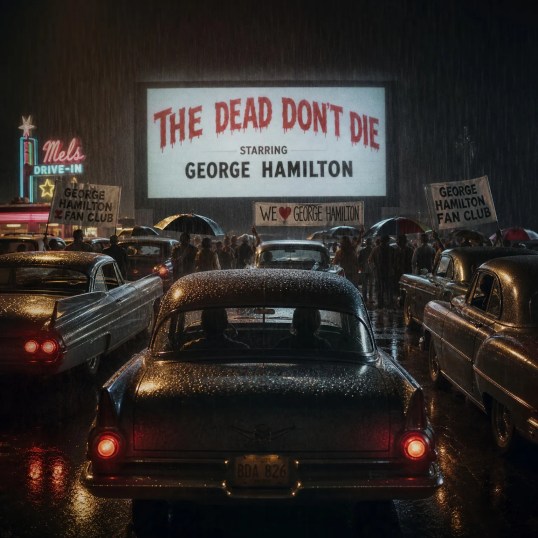
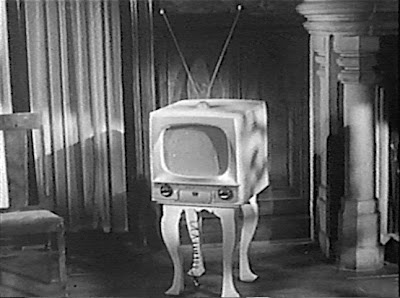
Today, we offer up a bonus horror on the lens, a 1975 made-for-television movie called The Dead Don’t Die!
The Dead Don’t Die takes place in Chicago during the 1930s. George Hamilton is a sailor who comes home just in time to witness his brother being executed for a crime that he swears he didn’t commit. Hamilton is convinced that his brother was innocent so he decides to launch an investigation of his own. This eventually leads to Hamilton not only being attacked by dead people but also discovering a plot involving a mysterious voodoo priest!
Featuring atmospheric direction for Curtis Harrington and a witty script by Robert Bloch, The Dead Don’t Die is an enjoyable horror mystery. Along with George Hamilton, the cast includes such luminaries of “old” Hollywood as Ray Milland, Ralph Meeker, Reggie Nalder, and Joan Blondell. (Admittedly, George Hamilton is not the most convincing sailor to ever appear in a movie but even his miscasting seems to work in a strange way.)
71 years ago today, Alfred Hitchcock Presents premiered on CBS. Produced and hosted by Alfred Hitchcock, this series featured stories of suspense and real-life horror and set the standard for the anthology shows that followed.
Revenge, the first episode, was directed by Hitchcock himself. Elsa Spann (Vera Miles) is a housewife who is recovering from a mental breakdown. When a man breaks into her home and assaults her, the police struggle to come up with any leads. Elsa’s husband, Carl (Ralph Meeker), takes Elsa on a vacation to try to help her heal. While they’re driving through town, Elsa spots a man in a gray suit and says that he is the man who attacked her. Carl stalks the man and then murders him, beating him to death in a motel room. Later, while driving through another town, Elsa spots another man and says that he was the one who attacked her. Carl realizes that he may have murdered an innocent man. He turns himself in to the police and goes to jail while Elsa is sent to a mental asylum.
When I was a kid, one of the local stations used to air a nightly block of Alfred Hitchcock Presents and The Twilight Zone. I think I was ten or eleven when I first saw Revenge and it made such an impression on me that I still haven’t forgotten it. The scariest thing about this episode? The man who attacked Elsa and started all of this was probably still out there, walking free.
Alfred Hitchcock Presents ran for ten seasons. It all started 71 years ago, on a night in October.
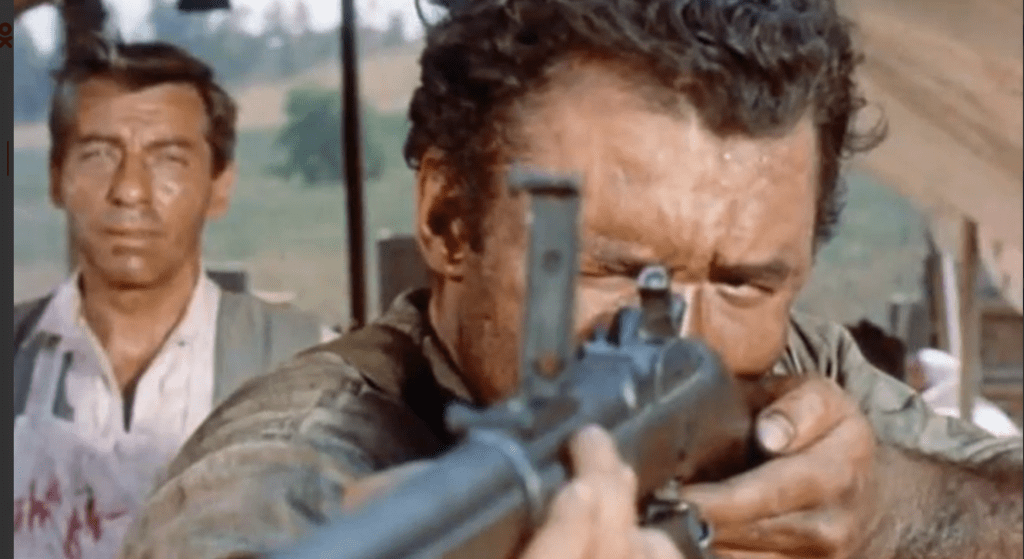
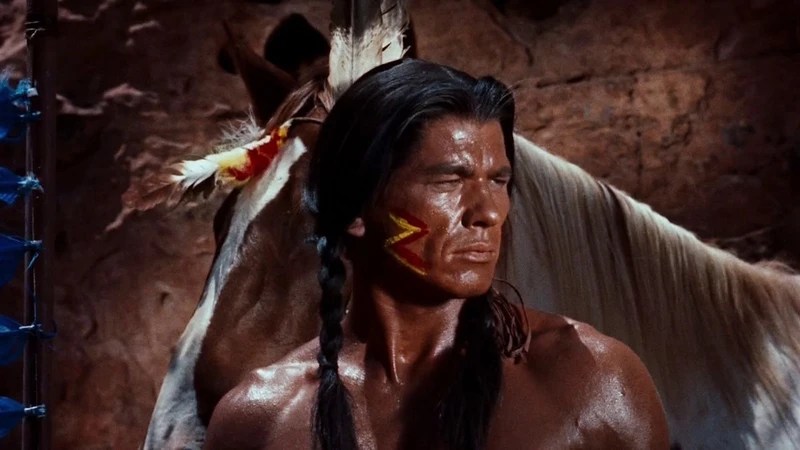
RUN OF THE ARROW opens with confederate sharpshooter O’Meara (Rod Steiger) shooting the final shot of the Civil War. With no war to fight and with a heart full of hate for the Yankees, O’Meara declares himself to be a man without a country and heads west. When he’s captured by a band of Sioux warriors led by Crazy Wolf (H.M. Wynant), he invokes the “run of the arrow”, a ritualistic game that could save his life. The problem… no one has ever survived the run of the arrow, but today’s his lucky day as he’s wounded but survives just long enough to be saved by the beautiful Yellow Moccasin (Sarita Montiel). She nurses him back to health and presents him to her tribal chief, Blue Buffalo (Charles Bronson), who eventually allows O’Meara and Yellow Moccasin to get married. Things seem to be going so well, too well. When Crazy Wolf starts another violent campaign against the American army, O’Meara must decide if he’s a Sioux warrior willing to kill American soldiers, or if there’s a part of him that can still love his country?
In RUN OF THE ARROW, director Samuel Fuller made a movie about the damage that occurs when human beings allow their hearts to be so filled with hate that they quit caring about other people. It’s also about what happens when those same people run into rational people, and we find out if they’re capable of considering the possibility that their own hate has blinded them from the truth. In other words, it’s a film that’s possibly more relevant today than it was when it was made in 1957. Bitterness and hate are represented by the characters of O’Meara (Steiger), Crazy Wolf (Wynant), and Lieutenant Driscoll (Ralph Meeker). O’Meara hates Yankees, Crazy Wolf hates the white man, and Driscoll hates the Indians. The rational people are the characters of Yellow Moccasin (Montiel), Blue Buffalo (Bronson), and Captain Clark (Brian Keith). Yellow Moccasin saves O’Meara when everyone else would have just let him die. Blue Buffalo engages in honest conversation with O’Meara and even welcomes him into their tribe. Captain Clark shows O’Meara an empathetic ear and kindness when others have told him to just get over himself. The actions and fates of the characters play out against this dynamic of hatred versus humanity, with the results underscoring just how tragic it is when people focus on the things that separate us rather than the things that unite us. It’s all so unnecessary, but it’s also a realistic vision of the world we live in. The film also struck me as particularly violent for a 50’s western, which also underscores that reality.
Some of the performances are very effective in the film. Rod Steiger’s Irish, confederate Sioux is an interesting character and the actor gives it his all as you’d expect. I’m a big fan of Steiger and his performance here only solidifies my respect for him. Brian Keith’s Captain Clark arrives fairly late in the proceedings and comes across as a tough, but honest man of integrity at a point when the movie really needs him. He has an excellent scene with Steiger where he debates the old confederate’s reasons for renouncing his citizenship with both sound logic, empathy, kindness and a hint of likable sarcasm all at the same time. It’s one of the best scenes in the film. And likewise, Charles Bronson, the most buff Hollywood Indian to ever strip down to a loincloth, comes across as a reasonable and kind tribal chief in his dealings. Bronson had played American Indians before, but he was usually more of the renegade, warpath variety, so it was nice seeing him as a good guy here. H.M. Wynant took the renegade Sioux warrior role here which you might have expected for Bronson at the time. He’s suitably fierce but one-dimensional. The same can be said for Ralph Meeker as Lieutenant Driscoll. He’s pretty much just a stereotypical jerk. He’s good at being a jerk though! And Sarita Montiel, voiced by Angie Dickinson, is quite the beauty as Yellow Moccasin.
I’ve recently heard RUN OF THE ARROW compared to Kevin Costner’s DANCES WITH WOLVES, and there are definitely similarities. I won’t go into all of those here, but one of the things I appreciated the most about RUN OF THE ARROW is the fact that the movie makes its feelings known about politics. In a movie filled with characters who have had their lives upended by the various decisions of political leaders, Fuller has crafted a story that focuses most sharply on defining the quality of men based on what’s in their “hearts.” When it’s all said and done, oftentimes the only control we have is the way we respond to the events in our lives, and that’s not politics, it’s personal. To drive this home, an older scout named Walking Coyote tells O’Meara that he could have been a chief if he had wanted to be. When O’Meara pushes him on why he didn’t want the position, Walking Coyote responds with, “Because I hate politics!” On that point, I couldn’t agree more.
“And kill any officer in sight. Ours or theirs?” — Victor Franko
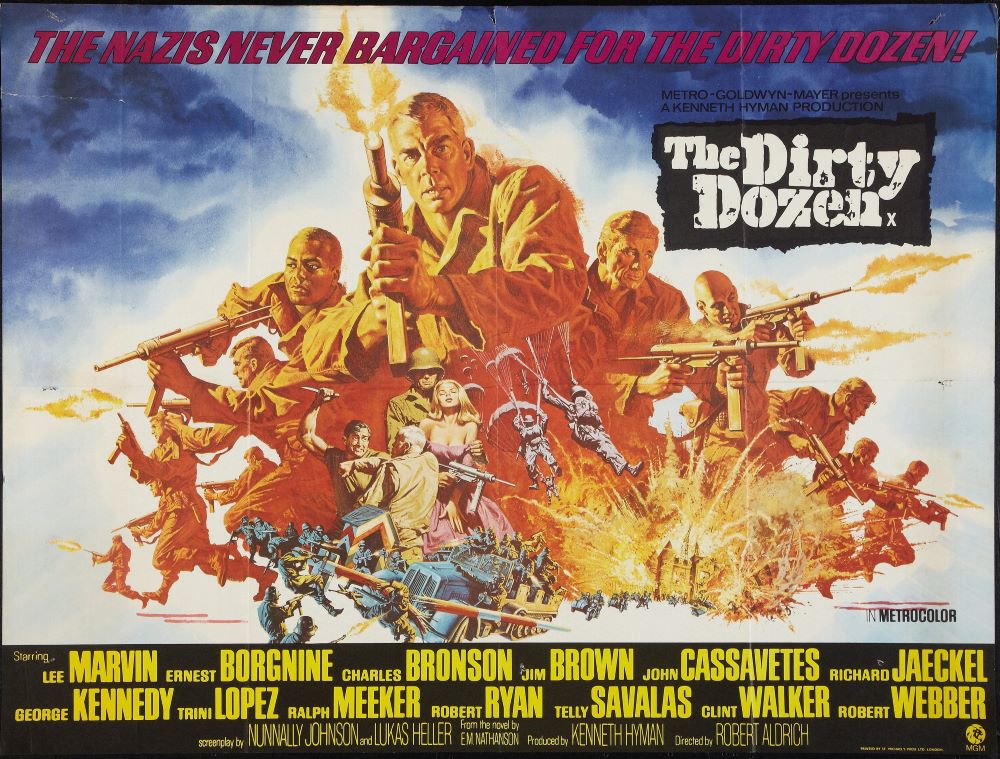
The Dirty Dozen is one of those war movies that feels like it was built in a lab for maximum “guys-on-a-mission” entertainment: big stars, a pulpy premise, plenty of attitude, and a third act that goes full-tilt brutal. It is also, even by 1967 standards, a pretty gnarly piece of work, and how well it plays today depends a lot on how comfortable you are with its mix of macho camaraderie, anti-authoritarian swagger, and disturbingly gleeful violence.
Directed by Robert Aldrich and released in 1967, The Dirty Dozen is set in 1944 and follows Major John Reisman (Lee Marvin), a rebellious U.S. Army officer assigned to turn a group of twelve military convicts into a commando unit for a suicide mission behind enemy lines just before D-Day. The deal is simple and grim: survive the mission to assassinate a gathering of German high command at a chateau, and your death sentence or long prison stretch gets commuted; fail, and you die as planned, just a little earlier and with more explosions. It is a high concept that plays almost like a war-movie prototype of the “villains forced to do hero work” formula that modern blockbusters keep revisiting.
The film’s biggest asset is its cast, stacked with personalities who bring a rough, lived-in charm to what could have been a lineup of interchangeable tough guys. Lee Marvin’s Reisman is the glue: a cynical, gravel-voiced officer who clearly hates bureaucratic brass almost as much as the criminals he is supposed to whip into shape, and Marvin plays him with a dry, weary sarcasm that avoids hero worship even as the film asks you to root for him. Around him, you get Charles Bronson as Wladislaw, a capable former officer with a chip on his shoulder; John Cassavetes as Franko, the volatile, insubordinate troublemaker; Jim Brown as Jefferson, whose physical presence and final-act heroics leave a strong impression; and Telly Savalas as Archer J. Maggott, a violently racist, fanatically religious, and almost certainly deranged soldier sentenced to death for raping and beating a woman to death. Savalas never softens that portrait, playing Maggott with a creepy combination of sing-song piety and sudden bursts of viciousness that makes him deeply uncomfortable to watch and the one member of the Dozen who feels like an outright monster even compared to the other killers. He sells Maggott’s self-justifying religiosity—quoting scripture, talking about being “called on” by the Lord—as both delusional and dangerous, so every time he starts sermonizing, it feels like a warning siren that things are about to go bad, and that pays off in the finale where his obsession with “sinful” women sabotages the mission. Even smaller roles from Donald Sutherland, Clint Walker, and others get memorable beats, which helps the ensemble feel like an actual crew rather than background noise.
For much of its runtime, the film plays like a rough-and-rowdy training camp movie, and that middle stretch is where a lot of its charm sits. Reisman’s solution to building teamwork is basically to grind the men down, deny them basic comforts, and force them to build their own camp, leading to the nickname “the Dirty Dozen” when their shaving kits are confiscated and they slip into permanent grime. The squad slowly gels through a mix of forced labor, competitive drills, and a memorable war-games exercise where they outsmart a rival, straight-laced unit led by Colonel Breed (Robert Ryan), which lets the film indulge in its anti-authority streak by making the rule-breakers look smarter than the regulation-obsessed brass. Savalas’s Maggott adds a constant sense of volatility to these scenes, his presence giving the group dynamic a genuine horror edge that keeps the movie from becoming a simple “lovable rogues” fantasy and making viewers eager to see him punished.
That anti-establishment energy is one of the reasons The Dirty Dozen hit so hard with audiences in the late 1960s, especially as public attitudes toward war and authority were shifting in the shadow of Vietnam. The movie clearly enjoys showing higher-ranking officers as petty, hypocritical, or out of touch, while Reisman and his misfit killers get framed as the ones who actually understand how war really works: dirty, improvisational, and morally compromised. Critics at the time noted that this defiant attitude, coupled with the convicts’ transformation into rough heroes, gave the film a rebellious appeal that helped it become a box office smash even as traditional war films were losing their shine.
Where the film becomes more divisive is in its moral perspective, or arguably its lack of one. From the start, these are not misunderstood saints: several of the men are condemned to death for murder, others for violent crimes and serious offenses, and the script never really suggests they were framed or unfairly treated. Yet once they are pointed at Nazis, the movie largely invites you to cheer them on, leaning into the idea that in war, the ugliest tools might be the most effective, and that conventional standards of justice and morality can be suspended if the target is the enemy. Maggott stands apart here as the line the film refuses to cross into sympathy, with Savalas’s committed and unsettling performance underlining how poisonous he is even to other criminals.
The climax at the chateau is where this tension really spikes. The mission involves infiltrating a mansion where German officers and their companions are gathering, rigging the place with explosives, and driving the survivors into an underground shelter that is then sealed and turned into a mass deathtrap with gasoline and grenades. It is a sequence staged with brutal efficiency and undeniable suspense, but it is also deeply unsettling, essentially pushing the protagonists into orchestrating a massacre that includes unarmed officers and civilians in evening wear, and the film offers minimal reflection on that horror beyond the visceral thrills. Maggott’s instability forces the team to react mid-mission, heightening the jagged tonal mix of rousing action and casual atrocity.
This blend of rousing action and casual atrocity did not sit well with many critics in 1967. Contemporary reviews complained that the film glorified sadism, blurred the line between wartime necessity and psychopathic cruelty, and practically bathed its criminals “in a heroic light,” encouraging what one critic called a “spirit of hooliganism” that was socially corrosive. Others, however, praised Aldrich for making a tough, uncompromising adventure picture that pushed back against sanitized war clichés, arguing that the cruelty and amorality felt like a more honest reflection of war’s ugliness, even if the film coated it in action-movie swagger and gallows humor. Savalas’s Maggott amplifies this debate, singled out by fans as a great, memorable character who adds real repulsion without turning into a cartoon.
From a modern perspective, the violence itself remains intense but not especially graphic by contemporary standards; what lingers is the attitude around it. The movie’s glee in letting some of these characters off the moral hook, contrasted with the genuinely disturbing behavior of someone like Maggott, creates that jagged tonal mix: part old-school “men on a mission” yarn, part cynical commentary on the kind of men war turns into tools. Depending on your tolerance, that mix either gives the film an edge that keeps it from feeling like simple nostalgia, or it plays as carelessly flippant about atrocities that deserve more introspection than a last-minute body count and a fade-out.
On a craft level, though, The Dirty Dozen still works surprisingly well. Aldrich keeps the film moving across a long runtime by building distinct phases: the recruitment and introduction of each convict, the training and bonding section with its rough humor and humiliation, and the final mission that shifts into suspense and near-horror. The action is clear and muscular, the editing sharp enough that you rarely lose track of who is where, and the sound design—even recognized with an Academy Award for Best Sound Effects—helps the chaos of the finale land with blunt impact.
At the same time, the structure exposes a few weaknesses. The early sections do such a good job of sketching out personalities that some characters feel underused or abruptly sidelined once the bullets start flying, and the film’s length can make parts of the training montage drag, especially if you are less enamored with its barracks humor and macho posturing. The writing also leans on broad types—psychopath, wisecracking crook, stoic professional—which the cast elevates, but the script rarely pushes them into truly surprising territory, beyond a few late-movie acts of sacrifice.
Still, as a piece of war-movie history, The Dirty Dozen earns its reputation. It helped popularize the template of the misfit team thrown into an impossible mission, a structure that later shows up everywhere from ensemble war pictures to superhero teams and modern “suicide squad” stories. Its mix of black humor, anti-authoritarian streak, and violent catharsis captures a specific late-1960s mood, even as its politics and ethics remain muddy enough to spark debate decades later. Savalas’s turn as Maggott ensures that edge never dulls, keeping the film’s thrills packaged with a moral outlook as messy and conflicted as the men it sends to kill.
For someone coming to it fresh now, the film plays as a rough, sometimes exhilarating, sometimes queasy ride: entertaining as pulp, compelling as an ensemble showcase, and troubling in the way it treats brutality as both a necessary evil and a spectator sport. If you are interested in the evolution of war cinema or the origins of the “ragtag squad on a suicide mission” trope, The Dirty Dozen is absolutely worth watching, with the understanding that its strengths—like Savalas’s chilling Maggott—come wrapped in those ethical ambiguities.
For today’s horror on television, we have a 1975 made-for-television movie called The Dead Don’t Die!
The Dead Don’t Die takes place in Chicago during the 1930s. George Hamilton is a sailor who comes home just in time to witness his brother being executed for a crime that he swears he didn’t commit. Hamilton is convinced that his brother was innocent so he decides to launch an investigation of his own. This eventually leads to Hamilton not only being attacked by dead people but also discovering a plot involving a mysterious voodoo priest!
Featuring atmospheric direction for Curtis Harrington and a witty script by Robert Bloch, The Dead Don’t Die is an enjoyable horror mystery. Along with George Hamilton, the cast includes such luminaries of “old” Hollywood as Ray Milland, Ralph Meeker, Reggie Nalder, and Joan Blondell. (Admittedly, George Hamilton is not the most convincing sailor to ever appear in a movie but even his miscasting seems to work in a strange way.)
Long before he achieved holiday immortality by playing the father in A Christmas Story, Darren McGavin played journalist Carl Kolchak in the 1972 made-for-TV movie, The Night Stalker. Kolchak is investigating a series of murders in Las Vegas, all of which involve victims being drained of their blood. Kolchak thinks that the murderer might be a vampire. Everyone else thinks that he’s crazy.
When this movie first aired, it was the highest rated made-for-TV movie of all time. Eventually, it led to a weekly TV series in which Kolchak investigated various paranormal happenings. Though the TV series did not last long, it’s still regularly cited as one of the most influential shows ever made.
The Night Stalker is an effective little vampire movie and Darren McGavin gives an entertaining performance as the rather nervous Carl Kolchak.
First released in 1953, The Naked Spur is one of the most cynical and downbeat movies that I’ve ever seen.
It’s also one of the most visually beautiful. Filmed in the Rockies and presented in glorious Technicolor, The Naked Spur is a western that is full of amazing scenery, from green forests to snow-capped mountains to a river that, under different circumstances, would probably be a wonderful place to just sit down and think for a spell. Director Anthony Mann crafts an image of the American frontier that makes it easy to understand why anyone would want to explore it and build a new life there. Mann contrasts the beauty of nature with the ugliness of the people who trample across it.
Jesse Tate (Millard Mitchell) is a grizzled and somewhat sickly prospector who runs into a stranger named Howard Kemp (James Stewart). Kemp is, at first, antagonistic and paranoid but soon, he offers to pay Tate $20 if Tate will help him track down an outlaw named Ben Vandergroat. Vandergroat, wanted for the murder of a U.S. marshal, is believed to be hiding in the mountains. In need of the money, Jesse agrees. Soon, he and Kemp are joined by another wanderer, a recently discharged soldier named Roy Anderson (Ralph Meeker). From the minute that Roy shows up, it’s obvious that he’s not being totally honest about why he’s wandering around the Rockies.
As for Ben Vandergroat (Robert Ryan), he is indeed hiding in the mountains. He’s accompanied by Lina Patrch (Janet Leigh), a naive young woman whose late father was one of Ben’s partners-in-crime. Lina looks up to Ben as a father figure and refuses to believe that he could possibly be guilty of any of the things that he’s been accused of doing. Ben, meanwhile, manipulates Lina into doing his bidding.
After being captured by Kemp, Jesse, and Roy, Ben proves himself to be far more clever than he initially seems. After revealing that Kemp isn’t who Jesse assumed him to be, Ben works to try to turn the three men against each other. There’s a reward on Ben’s head and, after Kemp reluctantly agrees to share the money with Jesse and Roy, Ben mentions that there will be a lot more money if its split two ways instead of three. Soon, Ben has the three men distrusting each other even more than they already did. However, Lina finds herself falling in love with Kemp.
TheNakedSpur is a great film. Featuring only five-speaking parts, it plays out like a particularly intense play and every single member of the cast does a great job of bringing the film’s characters to life. Robert Ryan is coolly manipulative as the cocky Ben while Ralph Meeker is crudely menacing as the untrustworthy Roy Anderson. Millard Mitchell is, at times, heart-breaking as the sickly prospector. Janet Leigh reveals the strength underneath Lina’s naive persona. Of course, the film is stolen by James Stewart, who is convincingly bitter and ultimately rather poignant as Howard Kemp. Kemp feels like a continuation of the character that Stewart played in BrokenArrow. He’s seen the worst that humanity has to offer. Even in the beautiful Rockies, Stewart’s character cannot escape the ugliness that he’s witnessed firsthand. Stewart’s performance as that haunted and angry Howard Kemp is one of his best.
TheNakedSpur is an intelligent and well-acted western and one of eight movies that Stewart made with director Anthony Mann. It’s psychological complexity, beautiful scenery, compelling script, and brilliant cast make it a true classic.
In 1971’s The Anderson Tapes, Sean Connery stars as Duke Anderson.
Duke is a career criminal, a safecracker who has just spent ten years in prison. He’s released, alongside Pops (Stan Gottlieb), who spent so much time behind bars that he missed two wars and the Great Depression, and the quirky Kid (Christopher Walken, making his film debut). Duke immediately hooks up with his former girlfriend, Ingrid (Dyan Cannon), and decides to rob the luxury apartment building where Ingrid is now living.
Of course, Duke will have to put together a crew. It’s not a heist film without a quirky crew, is it? Duke recruits the Kid and Pops. (The Kid is happy to be in the game but he’s not a fan of violence. Pops, meanwhile, has none of the skills necessary for living in the “modern” world and would much rather return to prison.) Duke also brings in the flamboyant Tommy Haskins (an overacting Martin Balsam) and driver Edward Spencer (Dick Anthony Williams). Duke goes to the mob for backing and Pat Angelo (Alan King) gives it to him on the condition that he take along a sociopathic racist named Socks (Val Avery) and that Duke kills Socks at some point. Duke reluctantly agrees.
So far, this probably sounds like a conventional heist film. Director Sidney Lumet mixes comedy and drama with uneven results but, overall, he does a good job of ratcheting up the tension and TheAndersonTapes is a good example of one of my favorite mini-genres, the “New Yorkers will be rude to anyone” genre. At first glance, Sean Connery seems to be playing yet another super smooth operator, a confident criminal with a plan that cannot fail. Duke seems like a criminal version of James Bond, However, as the film progresses, we start to suspect that things might be getting away from Duke. When Duke has to go the Mafia for support and is told that killing Socks is now a part of the job, we see that Duke isn’t as in-control of the situation as we originally assumed. This is the rare Sean Connery film where he has someone pushing him around.
(Apparently, Connery took this role as a part of his effort to escape being typecast as Bond. Perhaps that explains why Duke seems like almost a deconstruction of the James Bond archetype.)
Of course, what really lets us know that Duke isn’t as in-charge as he assumes is the fact that four different law enforcement agencies are following his every move. From the minute he gets out of prison, Duke is being watched. The apartment is bugged. Security cameras records his every move. Once the heist begins, we’re treated to flash forwards of breathless news reports. TheAndersonTapes is less a heist film and more a portrait of the early days of the modern Surveillance State. Of course, none of the agencies make any moves to stop Duke because doing so would reveal their own existence. The film really does become a portrait of a government that has gotten so big and intrusive that it’s also lost the ability to actually do anything.
The Anderson Tapes is entertaining, even if it’s not really one of Lumet’s best. Connery is, as always, a fascinating screen presence and it’s always entertaining to see a young Christopher Walken, showing early sings of the quirkiness that would become his signature style. TheAndersonTapes is a portrait of a world where you never know who might be listening.
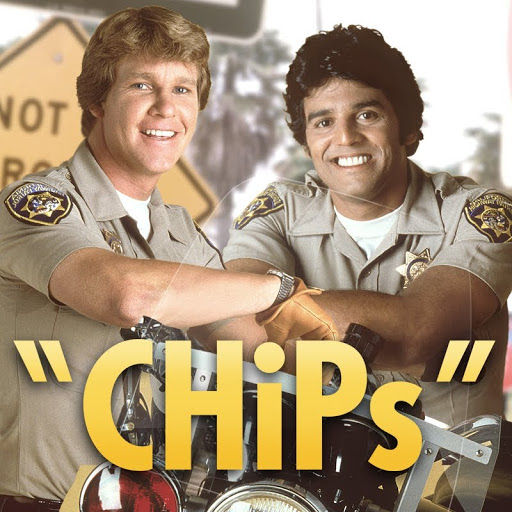
Welcome to Late Night Retro Television Reviews, a feature where we review some of our favorite and least favorite shows of the past! On Mondays, I will be reviewing CHiPs, which ran on NBC from 1977 to 1983. The entire show is currently streaming on Prime!
Tonight’s episode is weird.
Episode 3.6 “Counterfeit”
(Dir by John Florea, originally aired on October 20th, 1979)
Ponch is shocked to discover that he’s carrying several counterfeit twenties. He turns the money into the Treasure Department, hoping that it will mean receiving an monetary award. Instead, he’s told that his reward is helping the government crack down on the bad guys. Ha! Take that, Ponch!
That said, you better believe that Ponch is there to help arrest the counterfeiters, who turn out to be a bunch of phony preachers working out of a church. I know that sounds like the sort of thing that could be interesting. But, for the most part, these guys are still just generic CHiPs bad guys, even if one of them is played by veteran screen tough guy Ralph Meeker.
Meanwhile, Ponch goes on a date with a woman and is upset when it appears that she’s shallow and doesn’t want to talk about anything that is the least bit intellectual. That’s our, Ponch! He’s never shallow! Fortunately, it turns out that his date isn’t shallow either. She was just pretending to be shallow to test whether or not Ponch was shallow. And now, it’s time to dance! Wait, what? That doesn’t make any sense. Ponch — when are you going to settle down? Disco isn’t going to last forever.
While that’s going on, architect James O’Hara (played by veteran dwarf actor Billy Barty) becomes frustrated with people assuming that he can’t drive because of his size. He gets tired of all the dumb jokes and the condescending remarks. As a result, he keeps getting into minor accident whenever he drives on the highway. This was a strange storyline, largely because O’Hara’s scenes made up over half the episode despite the fact that he had never appeared on the show before and he barely interacted with the members of the Highway Patrol. A part of me wonders if maybe this episode was meant to be a backdoor pilot for a series about James O’Hara. The other weird thing about this episode is that O’Hara’s frustration over people making fun of his height was often played for laughs. The whole thing just felt well-intentioned but oddly tone deaf.
If you’re keeping track, this episode had two Ponch storylines and a storyline about a guy we had never seen before. Sorry, Baker! If we had any doubts about who was the favored partner as far as this show goes, this episode erased them.
This whole episode just felt weird. On the plus side, there was a lot of nice California scenery and there were quite a few accidents, which is the main reason why most people would have been watching the show in the first place. But this episode really is an example of how a show can get bogged down with a character that we’ve never seen before and that we’ll probably never see again. The episode just never comes together.
For today’s horror on the lens, we have a real treat! (We’ll get to the tricks later…)
Long before he achieved holiday immortality by playing the father in A Christmas Story, Darren McGavin played journalist Carl Kolchak in the 1972 made-for-TV movie, The Night Stalker. Kolchak is investigating a series of murders in Las Vegas, all of which involve victims being drained of their blood. Kolchak thinks that the murderer might be a vampire. Everyone else thinks that he’s crazy.
When this movie first aired, it was the highest rated made-for-TV movie of all time. Eventually, it led to a weekly TV series in which Kolchak investigated various paranormal happenings. Though the TV series did not last long, it’s still regularly cited as one of the most influential shows ever made.
The Night Stalker is an effective little vampire movie and Darren McGavin gives a great performance as Carl Kolchak.