The New York Film Critics Circle Embraces Lady Bird


On Thursday, the New York Film Critics Circle announced their picks for the best of 2017!  For best picture, they selected Lady Bird.  If nothing else, that’s a relief to those of us who were scared the entire precursor season would be dominated by The Post.

Here are the winners:

Best Film – “Lady Bird”
Best Director – Sean Baker, “The Florida Project”
Best Actor – Timothee Chalamet, “Call Me by Your Name”
Best Actress – Saoirse Ronan, “Lady Bird”
Best Supporting Actor – Willem Dafoe, “The Florida Project”
Best Supporting Actress – Tiffany Haddish, “Girls Trip”
Best Screenplay – Paul Thomas Anderson, “Phantom Thread”
Best Animated Feature – “Coco”
Best Non-Fiction Film – “Faces Places”
Best Foreign Language Film – “BPM (Beats Per Minute)”
Best Cinematography – Rachel Morrison, “Mudbound
Best First Film – Jordan Peele, “Get Out”
Special Achievement Award – Molly Haskell

Music Video of the Day: Daydreaming (2016, dir by Paul Thomas Anderson)


Since Paul Thomas Anderson’s latest film, Phantom Thread, had a pretty good showing with the National Board of Review yesterday, I figured that I would pick his video for Radiohead’s Daydreaming for today’s music video of the day.

(Raidohead guitarist Johnny Greenwood has, of course, composed scores for many of Anderson’s films, including Phantom Thread.)

As for the video itself, it follows Thom Yorke as he randomly wanders from location to location.  Is he dreaming?  Is he traveling through time?  Is he in a building that just has an extremely odd layout?  I guess any solution could be true.

Supposedly, this song was inspired by the end of Yorke’s relationship with Rachel Owen.  (Tragically, Owen herself passed away only a few months after this video was released.)  Supposedly, if you listen to the song backwards, Yorke appears to be singing, “Every minute, half of my love.”  Interpret that however you want.  It’s Radiohead, after all.

It’s always interesting how Radiohead can be both so consistently compelling and so consistently depressing at the same time.

On that note, enjoy!

The National Board of Review Honors Greta Gerwig, The Disaster Artist, Get Out, and Wonder Woman!


The National Board of Review has spoken and the Oscar season has truly begun!

Here’s what won:

Best Picture: The Post

Best Director: Greta Gerwig for Lady Bird

Best Actor: Tom Hanks in The Post

Best Actress: Meryl Streep in The Post

Best Supporting Actor: Willem DaFoe in The Florida Project

Best Supporting Actress: Laurie Metcalf in Lady Bird

Best Original Screenplay: Paul Thomas Anderson for Phantom Thread

Best Adapted Screenplay: Scott Neustadter & Michael H. Weber for The Disaster Artist

Best Animated Feature: Coco

Best Documentary Feature: Jane

Best Foreign Language Film: Foxtrot

Best Ensemble: Get Out

Breakthrough Performer: Timothée Chalamet in Call Me By Your Name

Best Directorial Debut: Jordan Peele for Get Out

NBR Spotlight Award: Gal Gadot and Patty Jenkins for their collaboration on Wonder Woman

NBR Freedom of Expression Award: First They Killed My Father and Let It Fall: Los Angeles 1982–1992

Top 10 Films of 2017 (in alphabetical Order):

  1. Baby Driver
  2. Call Me By Your Name
  3. The Disaster Artist
  4. Downsizing
  5. Dunkirk
  6. The Florida Project
  7. Get Out
  8. Lady Bird
  9. Logan
  10. Phantom Thread

Top 10 Independent Films of 2017:

  1. Beatriz at Dinner
  2. Brigsby Bear
  3. A Ghost Story
  4. Lady MacBeth
  5. Logan Lucky
  6. Loving Vincent
  7. Menashae
  8. Norman: The Moderate Rise and Tragic Fall of a New York Fixer
  9. Patti Cake$
  10. Wind River

Top 5 Documentaries:

  1. Abacus: Small Enough to Jail
  2. Brimstone & Glory
  3. Eric Clapton: Life in 12 Bars
  4. Faces Places
  5. Hell on Earth: The Fall of Syria and the Rise of Isis

Top 5 Foreign Language Films:

  1. A Fantastic Woman
  2. Franzt
  3. Loveless
  4. Summer 1993
  5. The Square

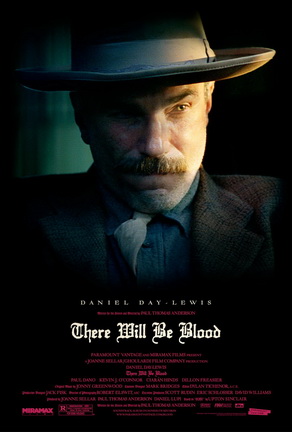
Embracing the Melodrama Part II #109: There Will Be Blood (dir by Paul Thomas Anderson)


There_Will_Be_Blood_PosterYou know how there are some films that you really want to love and that you know that, given your taste in cinema, you probably should love but yet you somehow just cannot bring yourself to actually love?

To a certain extent, that’s the way I feel about the 2007 best picture nominee There Will Be Blood.  It’s a film that I greatly respect, as I tend to respect all of Paul Thomas Anderson’s movies.  He’s one of the best director working today and also one of the most consistently interesting.  (He’s also probably the only contemporary filmmaker who would actually base a two and half hour epic on the first 150 pages of a forgotten novel by Upton Sinclair.)  And I think that There Will Be Blood is a well-made and well-directed film.  I also think it’s well-acted, though I do think Daniel Day-Lewis goes a bit too far over-the-top at the film’s conclusion.   (If anything, Paul Dano is the one who actually deserved to win an Oscar for his work in this film.)  There Will Be Blood is an original work of cinematic art.  I’m thankful that it was made and that Anderson stayed true to his vision.

But, with all that in mind, it’s never been a film that I’ve been able to love.  Unlike Anderson’s earlier Boogie Nights, There Will Be Blood holds the audience at a distance.  We remains outsiders looking in.  As a result, the film engages intellectually but not emotionally.  It’s a film that earns respect without necessarily winning the audience’s love.

Speaking of respect, that’s something that you have to give to both Daniel Day-Lewis and Paul Thomas Anderson.  From the start of the film, Daniel Plainview (played by Day-Lewis) is a cruel and self-centered bastard and that characterization remains consistent throughout.  Briefly, it does seem that Plainview might truly care about his deaf, adopted son but, by the end of the film, Plainview has even proven that to be wishful thinking on our part.  (The only other character to whom Plainview is consistently pleasant is a young girl named Mary but Day-Lewis plays those scenes with such a corrupt twinkle in his eye that the subtext becomes increasingly creepy.)  Give Anderson and Day-Lewis credit.  They commit to portraying Daniel Plainview as being an almost Satanic character and, at no point, does either one of them waver in that commitment.  As we watch Plainview ruthlessly buy up all the land and drill all the oil that he can find, we wait for him to have some moment of redemption.  It took guts for neither Anderson nor Day-Lewis to allow him one.

Paul Dano plays Eli Sunday, an evangelical preacher who stands in the way of Plainview’s efforts to buy up all the land around the Sunday family farm.  The film presents Eli and Plainview as being two sides of the same coin.  Plainview hides his moral emptiness behind his money.  Eli hides behind his religion.  The two characters hate each other because they alone truly recognize what they truly are.  Dano, who also plays Eli’s brother, gives a mesmerizing performance, one that unfortunately has been overshadowed by Day-Lewis’s work.

It all ends, as all things must, with violent death in a bowling alley.  I know that a lot of my fellow cineastes think that the bowling scene is the highlight of the film but, to be honest, this was the point where the film lost me.  To me, this was the scene where Daniel Day-Lewis’s performance crossed the line from being flamboyant to shrill.  The end just did not work for me.

However, two things that did definitely work for me: Johnny Greenwood’s wonderfully ominous and atmospheric score and Robert Elswit’s amazing cinematography, which made the film’s landscape appear both beautiful and threatening at the same time.  The mix of Greenwood’s music with Elswit’s cinematography created some truly haunting moments.

In the end, There Will Be Blood is a lot like Daniel Plainview.  It is powerful, memorable, unpredictable, flamboyant, overbearing, and at times a little frightening.  And, again much like Daniel Plainview, it’s a film that’s easy to respect and difficult to love.

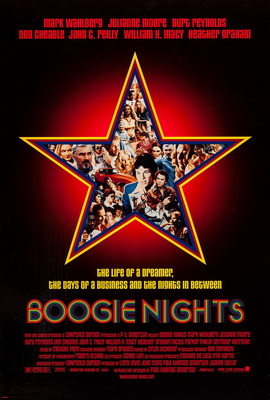
Embracing the Melodrama Part II #93: Boogie Nights (dir by Paul Thomas Anderson)


Boogie_nights_ver1The 1997 film Boogie Nights (which, amazingly enough, was not nominated for best picture) is a bit of an overwhelming film to review.  It’s a great film and, if you’re reading this review, you’ve probably seen Boogie Nights and you probably already know that it’s a great film.  And if you haven’t seen Boogie Nights, you really should because it’s a great film.  So, this review, in short, amounts to: Great film.

Boogie Nights takes place in the late 70s and the early 80s.  Eddie Adams (Mark Wahlberg) is a high school dropout who works as a busboy, lives with his parents, and has a really big cock.  (Indeed, one of the film’s most famous lines is, “This is a giant cock.”)  When we first meet Eddie, he’s likable and cute in a dumb sort of way.  Then he meets adult film director Jack Horner (Burt Reynolds) and becomes a star.  At first, everything is great.  Eddie changes his name to Dirk Diggler and no longer has to deal with his abusive mother (a chilling Joanna Gleason).  Jack and Amber Waves (Julianne Moore) become his new parents.  He gets a cool older brother in the form of actor Reed Rothschild (John C. Reilly, totally nailing the “People tell me that I look like Han Solo,” line).  He makes friends with other adult film actors, like the desperately unhip Buck (Don Cheadle), the free-spirited (and secretly very angry) Rollergirl (Heather Graham), and the poignantly insecure Jessie St. Vincent (Melora Walters).  He gets new admirers, like Scotty J. (Philip Seymour Hoffman).  He also gets addicted to cocaine.  And while Dirk falls from stardom, the adult film industry is taken over by gangsters like Floyd Gondolli (Philip Baker Hall) and self-styled artists like Jack Horner find themselves pushed to the side.

And you may have noticed that I mentioned a lot of actors in the paragraph above.  That’s because Boogie Nights is a true ensemble piece.  It’s full of great performances and memorable characters.  Along with everyone that I mentioned above, the cast also includes William H. Macy as cinematographer “Little Bill” Daggett.  From the minutes we first meet Little Bill, we get the feeling that he might be a little bit too uptight for pornography.  Maybe that’s because his wife — played by the inspiring sex positive feminist and veteran adult film star Nina Hartley — is constantly and publicly cheating on him.  Macy and Hartley do not have as much screen time as the rest of the cast but, ultimately, their characters are two of the most important in the film.

And then there’s Robert Ridgely, who is marvelously sleazy as the paternal but ultimately icky Col. James.  When we first meet the Colonel, he’s almost a humorous character.  But then, suddenly, there’s one chilling scene where he opens up to Jack Horner and we are forced to reconsider everything that we had previously assumed about both the Colonel and his business.

And how can we forget Luis Guzman, as a club owner who desperately wants to appear in one of Jack’s films?  Or Ricky Jay as a plain-spoken cameraman?  Or how about Thomas Jane, playing one of those tightly wound characters who you know is going to be trouble as soon as you see him?  And finally, nobody who has seen Boogie Nights will ever forget Alfred Molina, singing along to Sister Christian and running down the street, clad only in black bikini briefs and firing a shotgun.

But it’s not just the actors who make Boogie Nights a great film.  This was Paul Thomas Anderson’s second film and, under his direction, we feel as if we’ve been thrown straight into Dirk’s exciting and ultimately dangerous world.  When the film begins, the camera almost seems to glide, capturing the excitement of having everything that you could possibly want.  But, as things go downhill for Dirk, the camerawork gets more jittery and nervous.   A sequence where Anderson cuts back and forth between Jack trying to shoot a movie on video (as opposed to his beloved film) and Dirk nearly being beaten to death in a parking lot remains one of the best sequences that Anderson has ever directed.

And then there’s the music!  Oh my God!  The music!

And the dancing!

And the singing!

I’ll be the first admit that I have no idea whether or not Boogie Nights is a realistic portrait of the adult film industry in the 70s and 80s.  But ultimately, Boogie Nights is not about porn.  It’s about a group of outsiders who form their own little family.  At the end of the film, you’re happy that they all found each other.  You know that Dirk will probably continue to have problems in the future but you’re happy for him because, no matter what happened in the past or what’s going to happen in the future, you know that he’s found a family that will always love him.

As I mentioned at the start of this appreciation, Boogie Nights was not nominated for best picture.  Titanic was named the best picture of 1997.  As I’ve said before, I loved Titanic when I was 12.  But, nearly 18 years later, Boogie Nights is definitely the better picture.

It has stood the test of time.


The Denver Film Critics Society Announce Their Picks For The Best of 2014!


American Sniper

American Sniper

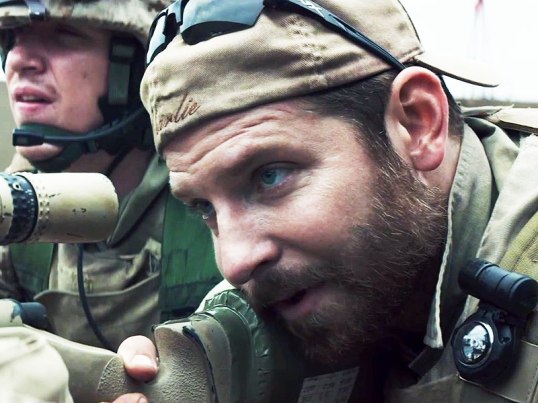
The Denver Film Critics Society announced their picks for the best of the year and guess what?  They picked the suddenly surging American Sniper, which just goes to show how unpredictable this year could potentially be.

Best Picture: “American Sniper”

Best Director: Richard Linklater, “Boyhood”

Best Actor: (tie) Ralph Fiennes, “The Grand Budapest Hotel,” Bradley Cooper, “American Sniper”

Best Actress: Rosamund Pike, “Gone Girl”

Best Supporting Actor: J.K. Simmons, “Whiplash

Best Supporting Actress: Patricia Arquette, “Boyhood”

Best Animated Film: “The Lego Movie”

Best Science Fiction/Horror Film: “Dawn of the Planet of the Apes”

Best Comedy: “Guardians of the Galaxy”

Best Original Screenplay: Alejandro Gonzalez Inarritu, Nicolas Giacobone, Alexander Dinelaris, Armando Bo, “Birdman”

Best Adapted Screenplay: Paul Thomas Anderson, “Inherent Vice”

Best Documentary: “The Overnighters”

Best Cinematography: Emmanuel Lubezki, “Birdman”

Best Original Song: “Everything Is Awesome,” Tegan and Sara, “The Lego Movie”

Best Score: Antonio Sanchez, “Birdman”

Best Foreign Language Film: “Two Days, One Night”


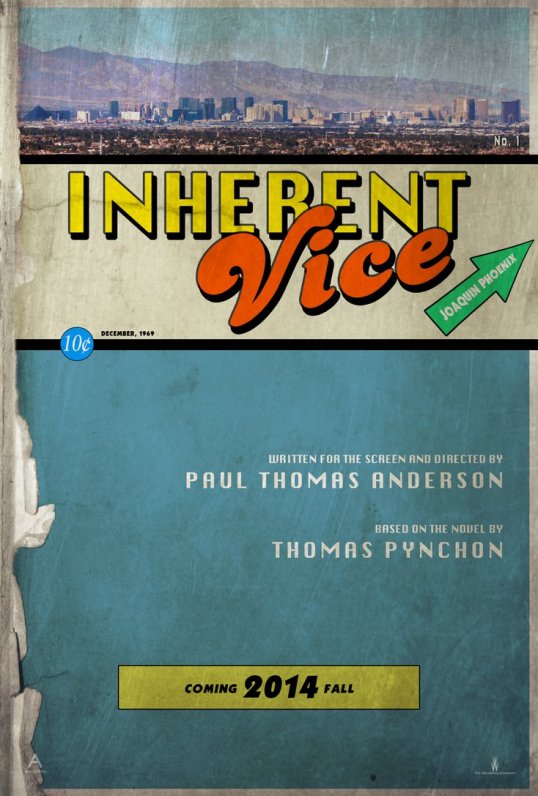
Film Review: Inherent Vice (dir by Paul Thomas Anderson)


Inherent-Vice-poster

One of the best things about Paul Thomas Anderson’s latest film, Inherent Vice, is that Doc Sportello, the private detective played by Joaquin Phoenix, is a real stoner.  He’s not one of those weekend smokers, who gets high on Saturday, brags about it on Sunday, and then spends the rest of the week interning at Vox.  For the entire 2 hour and 20 minute running time of Inherent Vice, Doc is stoned.  From the minute we first meet him to the end of the film, there is never one moment where Doc is not stoned.  Most stoner comedies feature a scene where the main character shocks everyone by turning down a hit because he’s dealing with something so important that he has to “keep his mind straight.”

Not so with Doc!

And, in Doc’s case, it definitely helps him out.  Inherent Vice tells a story that is so full of paranoia, conspiracy, and random connections that only a true stoner could follow it.  Much like Doc, the film often seems to be moving in a haze but occasionally, out of nowhere, it will come up with a scene or a line of dialogue or a detail that is so sharp and precise that it will force you to reconsider everything that you had previously assumed.

To be honest, if you are one of the people who watched Inherent Vice this weekend and could actually follow the film’s plot, then you’ve got a leg up on me.  (That said, I’ve still got pretty good legs so it all evens out.)  But, that’s not necessarily a complaint.  As befits a film based on a novel by Thomas Pynchon and directed by one of the most idiosyncratic filmmakers around, the twists and turns of Inherent Vice are deliberately meant to be obscure and confusing.  Characters appear and then vanish.  Clues are discovered and then forgotten.  Connections are hinted at but then never confirmed.  Inherent Vice ultimately serves a tribute to stoner’s paranoia and, as a result, the plot’s incoherence leads to a certain contact high.

The film takes place in California in the 1970s.  Doc is both a hippie and a private detective. His current girlfriend (Reese Witherspoon) works for the district attorney’s office and doesn’t seem to like him much.  His ex-girlfriend, Shasta (Katherine Waterston), reenters his life and asks him to help protect her new boyfriend, real estate developer Mickey Wolfman (Eric Roberts).  Mickey has disappeared.  Shasta disappears.  As Doc investigates, he wanders through a psychedelic Los Angeles and deals with an ever growing collection of eccentrics.

For instance, there’s Hope Harlingen (Jena Malone), a former heroin addict who now runs a group that aims to promote “responsible drug use” among children.  She believes that her husband, Coy (Owen Wilson), is dead but actually Coy is a government informant who keeps popping up in the strangest places.

There’s Rudy Blatnoyd (Martin Short), a decadent dentist who may or may not be responsible for all of the heroin entering California.

There’s Sauncho Smilax (Benicio Del Toro), Doc’s lawyer who specializes in maritime law.

There are Nazi bikers, new age doctors, a formerly blacklisted actor turned right-wing spokesman, a black revolutionary whose best friend was a member of the Aryan brotherhood, three FBI agents who keep picking their noses, the decadent rich, and, of course, the endlessly clean-cut and bullying officers of the LAPD.

And then there’s Detective “Big Foot” Bjornsen (Josh Brolin), a celebrity cop and occasional television extra who seems to admire Doc, except for when he’s trying to frame Doc for everything from murder to drug smuggling.  Bjornsen is probably the most interesting character in the entire film and Brolin plays the character perfectly.  His scenes with Phoenix crackle with a comedic energy that bring the film to life.

As for the movie itself, it’s not for everyone.  A lot of very smart people are going to dislike it, much as many of them did with The Master.  In some ways, Inherent Vice truly is an endurance test.  Speaking as someone who enjoyed the film, even I occasionally found myself saying, “Okay, does everyone have to have a silly name?”  Inherent Vice is a long, rambling, and occasionally frustrating film but, for me, it still worked because of the strong cast and Anderson’s attention to detail.

Unbroken is a film that seems to take place in an entirely different world from Inherent Vice but these two films do have one big thing in common.  Both of them have been victims of the expectation game.  Many of the same people who thought Unbroken would be a surefire Oscar nominee also assumed, sight unseen, that Inherent Vice would be right there with it.  Much as how Unbroken has suffered for merely being good as opposed to great, Inherent Vice is also suffering for failing to live up to the expectations that were thrust upon it.  Inherent Vice is not an awards movie.  Instead, it’s a fascinatingly idiosyncratic film that was made by a director who has never shown much concern with playing up to the audience.  While Unbroken is enough of a crowd pleaser to still have a shot at some Oscar glory, Inherent Vice is the type of film that will probably never get nominated.  (I do have some hope that Brolin will get a supporting actor nomination but, even there, it appears likely that Brolin’s spot will be given to The Judge‘s Robert Duvall.)

Well, no matter!  Flaws and all, Inherent Vice will be a film that people will still be debating and watching years from now.

The National Society Of Film Critics Honors Goodbye to Language!


Goodbye to Lanugage

Earlier today, the National Society of Film Critics announced their picks for the best films of 2014!  By one vote, they named Jean-Luc Godard’s Goodbye To Language as best picture of the year.

Thank you, National Society of Film Critics, for reminding us that, occasionally, unexpected things do happen!

Check out the winners and the runner-ups below!

BEST PICTURE
*1. Goodbye to Language 25 (Jean-Luc Godard)
2. Boyhood 24 (Richard Linklater)
3. Birdman 10 (Alejandro G. Iñárritu)
3. Mr. Turner 10 (Mike Leigh)
BEST DIRECTOR
*1. Richard Linklater 36 (Boyhood)
2. Jean-Luc Godard 17  (Goodbye to Language)
3. Mike Leigh 12 (Mr. Turner)
BEST NON-FICTION FILM
*1. Citizenfour 56 (Laura Poitras)
2. National Gallery 19 (Frederick Wiseman)
3. The Overnighters 17 (Jesse Moss)
BEST SCREENPLAY
*1. The Grand Budapest Hotel 24 (Wes Anderson)
2. Inherent Vice 15 (Paul Thomas Anderson)
2. Birdman 15 (four co-writers)
BEST CINEMATOGRAPHY
*1. Mr. Turner 33 (Dick Pope)
2. The Immigrant 27 (Darius Khondji)
3. Goodbye to Language 9 (Fabrice Aragno)
BEST ACTOR
*1.Timothy Spall 31 (Mr. Turner)
2. Tom Hardy 10 (Locke)
3. Joaquin Phoenix 9  (Inherent Vice)
3. Ralph Fiennes 9 (The Grand Budapest Hotel)
BEST ACTRESS
*1. Marion Cotillard  80 (Two Days, One Night)
2.  Julianne Moore 35 (Still Alice)
3. Scarlett Johansson 21 (Lucy; Under the Skin)
BEST SUPPORTING ACTOR
*1. J.K. Simmons 24  (Whiplash)
2. Mark Ruffalo 21 (Foxcatcher)
3. Edward Norton 16 (Birdman)
BEST SUPPORTING ACTRESS
*1. Patricia Arquette 26 (Boyhood)
2. Agata Kulesza 18 (Ida)
3. Rene Russo 9 (Nightcrawler)

Birdman Lands In Florida


Birdman

The Florida Film Critics have voted and they’ve named Birdman the best film of 2014!  You can find all of the Florida winners below and check out the Florida nominees by clicking here!

Best Picture:

Birdman

Runner-up: Boyhood

Best Director:

Richard Linklater – Boyhood

Runner-up: Alejandro González Iñárritu – Birdman

Best Actress:

Rosamund Pike – Gone Girl

Runner-up: Julianne Moore – Still Alice

Best Actor:

Michael Keaton – Birdman

Runner-up: Jake Gyllenhaal – Nightcrawler

Best Supporting Actor:

J.K. Simmons – Whiplash

Runner-up: Edward Norton – Birdman

Best Supporting Actress:

Patricia Arquette – Boyhood

Runner-up: Emma Stone – Birdman

Best Ensemble:

The Grand Budapest Hotel

Runner-up: Boyhood

Best Original Screenplay:

The Grand Budapest Hotel (Wes Anderson)

Runner-up: Birdman (Alejandro González Iñárritu, Nicolás Giacobone, Alexander Dinelaris, Armando Bo)

Best Adapted Screenplay:

Gone Girl (Gillian Flynn)

Runner-up: Inherent Vice (Paul Thomas Anderson)

Best Cinematography:

Interstellar (Hoyte Van Hoytema)

Runner-up: The Grand Budapest Hotel (Robert D. Yeoman)

Best Visual Effects:

Interstellar

Runner-up: Guardians of the Galaxy

Best Art Direction/Production Design:

The Grand Budapest Hotel

Runner-up: Interstellar

Best Score:

Under the Skin (Micah Levi, aka Micachu)

Runner-up: Gone Girl (Trent Reznor & Atticus Ross)

Best Documentary:

Life Itself

Runner-up: Citizenfour

Best Foreign-Language Film:

The Raid 2

Runner-up: Force Majeure

Best Animated Film:

The Lego Movie

Runner-up: How to Train Your Dragon 2

Pauline Kael Breakout Award:

Damien Chazelle (writer/director: Whiplash)

Runner-up: Gugu Mbatha-Raw (actress: Belle, Beyond the Lights)

Here’s What Won In Toronto! Love you, Canada!


Love you, Canada!

Love you, Canada!

Here are the Toronto Film Critics Awards.

BEST PICTURE
“Boyhood” (Mongrel Media)
Runners-up
“The Grand Budapest Hotel” (Fox Searchlight)
“Inherent Vice” (Warner Bros.)

BEST ACTOR
Tom Hardy, “Locke”
Runners-up
Ralph Fiennes, “The Grand Budapest Hotel”
Jake Gyllenhaal, “Nightcrawler”

BEST ACTRESS
Marion Cotillard, “The Immigrant”
Runners-up
Julianne Moore, “Still Alice”
Reese Witherspoon, “Wild”

BEST SUPPORTING ACTOR
J.K. Simmons, “Whiplash”
Runners-up
Josh Brolin, “Inherent Vice”
Edward Norton, “Birdman Or (The Unexpected Virtue of Ignorance)”

BEST SUPPORTING ACTRESS
Patricia Arquette, “Boyhood”
Runners-up
Tilda Swinton, “Snowpiercer”
Katherine Waterston, “Inherent Vice”

BEST DIRECTOR
Richard Linklater, “Boyhood”
Runners-up
Paul Thomas Anderson, “Inherent Vice”
Wes Anderson, “The Grand Budapest Hotel”

BEST SCREENPLAY, ADAPTED OR ORIGINAL
“The Grand Budapest Hotel”, screenplay by Wes Anderson
from a story by Wes Anderson & Hugo Guinness
Runners-up
“Boyhood”, written by Richard Linklater
“Inherent Vice”, screenplay by Paul Thomas Anderson
based on the novel by Thomas Pynchon

BEST FIRST FEATURE
“The Lunchbox”, directed by Ritesh Batra
Runners-up
“John Wick”, directed by Chad Stahelski
“Nightcrawler”, directed by Dan Gilroy

BEST ANIMATED FEATURE
“The Tale of the Princess Kaguya” (GKids)
Runners-up
“Big Hero 6″ (Walt Disney Studios)
“How to Train Your Dragon 2″ (20th Century Fox)
“The Lego Movie” (Warner Bros.)

BEST FOREIGN-LANGUAGE FILM
“Force Majeure” (filmswelike)
Runners-up
“Ida” (filmswelike)
“Leviathan” (Mongrel Media)

BEST DOCUMENTARY
“The Overnighters” (filmswelike)
Runners-up
“Citizenfour” (Entertainment One)
“Manakamana” (filmswelike)

JAY SCOTT PRIZE FOR AN EMERGING ARTIST
Albert Shin, director of “In Her Place”